Blog

  • Fat Transfer for Breast Enlargement: How Three Visual Priorities Change the Conversation

    Fat Transfer for Breast Enlargement: How Three Visual Priorities Change the Conversation

    Three Visual Priorities, Not One Standard Fat-Transfer Decision

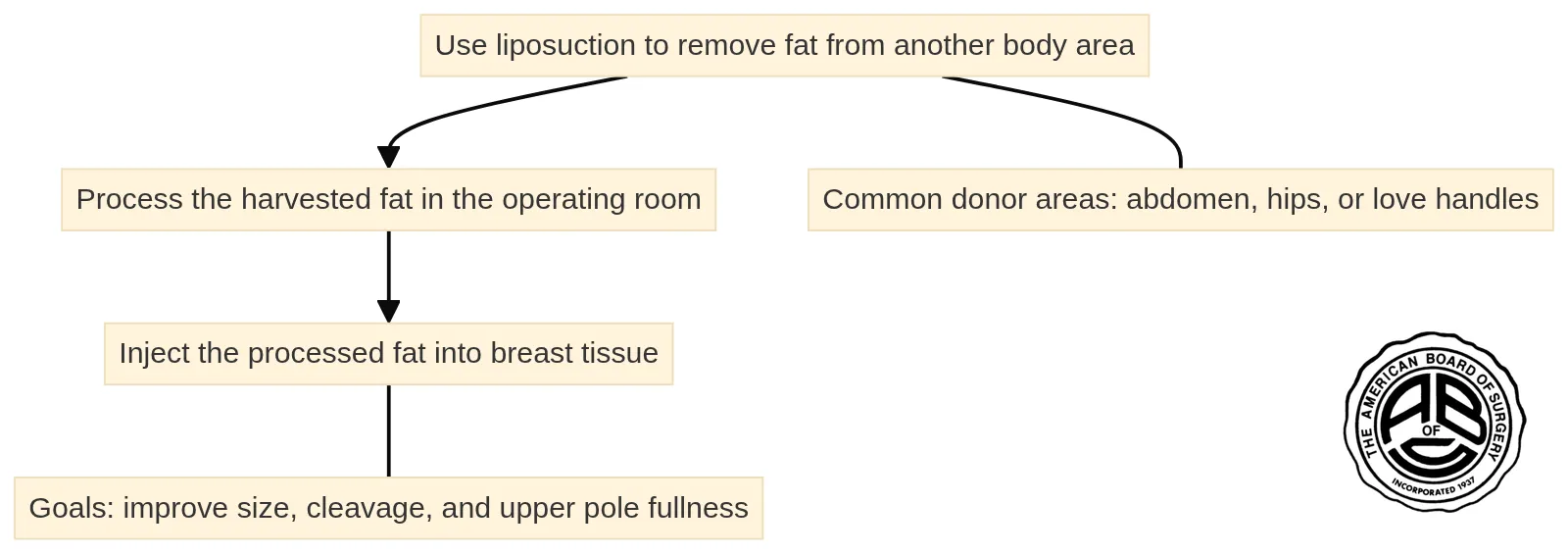
    Fat transfer for breast enlargement uses liposuction to harvest fat from another body area and inject it into the breasts. Because the procedure involves both a donor area and the breasts, it is not simply another way to request a certain amount of volume.

    This article uses three visual priorities to make the subject more specific: fullness across a narrow breast base, visible unevenness between the breasts, and an upper-pole preference in thinner tissue. Each priority changes the meaning of “more volume.” It may point toward a localized contour concern, a broader-volume goal, or a concern involving shape and tissue coverage as well as volume. These general descriptions do not predict a cup size or an individual result.

    Fat can be placed with attention to selected breast areas, making it relevant to a contour-focused discussion. The amount of grafted fat retained over time remains uncertain, however. Reading the three priorities separately helps show why the same uncertainty matters differently when the desired change concerns fullness, unevenness, or an upper-pole transition.

    Reading Breast Features Within Each Visual Priority

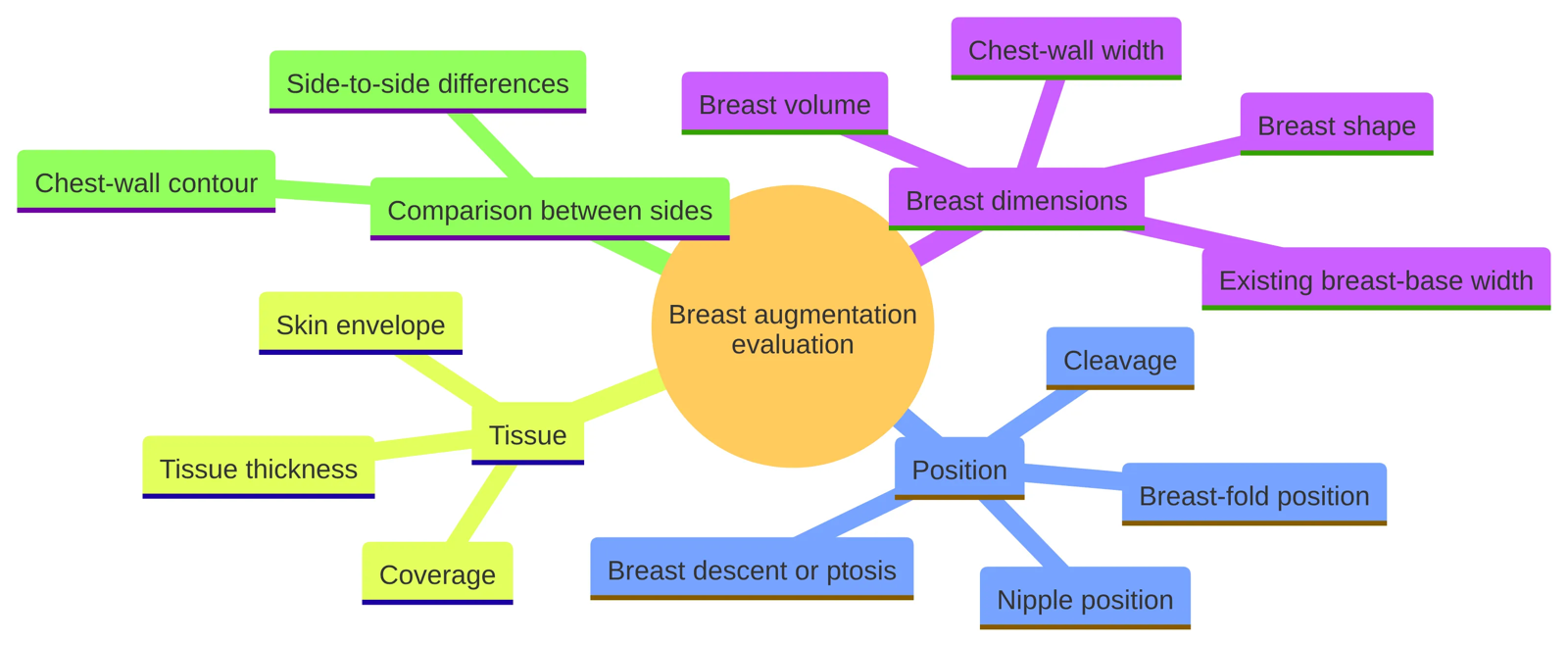
    Each visual priority directs attention to different features of the existing breast, but none supplies a conclusion on its own. Fullness across a narrow base raises a different descriptive question from uneven volume between the breasts or a preference for a softer-looking upper-pole transition. A qualified surgeon assesses breast base and overall shape, nipple level or position, skin excess, chest-wall differences, tissue coverage, and available donor fat in person.

    These features help describe what is being seen rather than serving as a reader-operated test. A narrow base does not establish that fat transfer is appropriate. Visible asymmetry does not establish that one technique will make breasts match. Thin tissue does not establish that fat will create a particular feel. Their value is in showing why a request that sounds simple can contain more than one visual concern.

    A concise consultation map

    Desired change: localized contour or broader volume
                        ↓
    Breast shape • nipple position • skin excess • chest-wall differences
                        ↓
    Tissue coverage • available donor fat • current asymmetry
                        ↓
    Discussion of fat transfer, implants, or a combined approach
                        ↓
    Limits, uncertain retention, follow-up, and imaging considerations
    

    The map is deliberately sequential. A desired look starts the conversation, but it does not settle the technique. In particular, available donor fat is not a minor detail added after breast planning; it is part of what makes a fat-transfer discussion possible at all. Likewise, breast features may explain why a surgeon discusses trade-offs rather than presenting a single visual goal as straightforwardly achievable.

    For a productive appointment, it can help to describe the change in visual terms: more fullness across the breast, a softer transition in the upper portion, less noticeable unevenness, or a small adjustment to contour. Then ask how those goals relate to your existing shape, tissue coverage, and donor-fat availability. Ask what limitations would matter most in your case, and which parts of the goal should remain uncertain until examination.
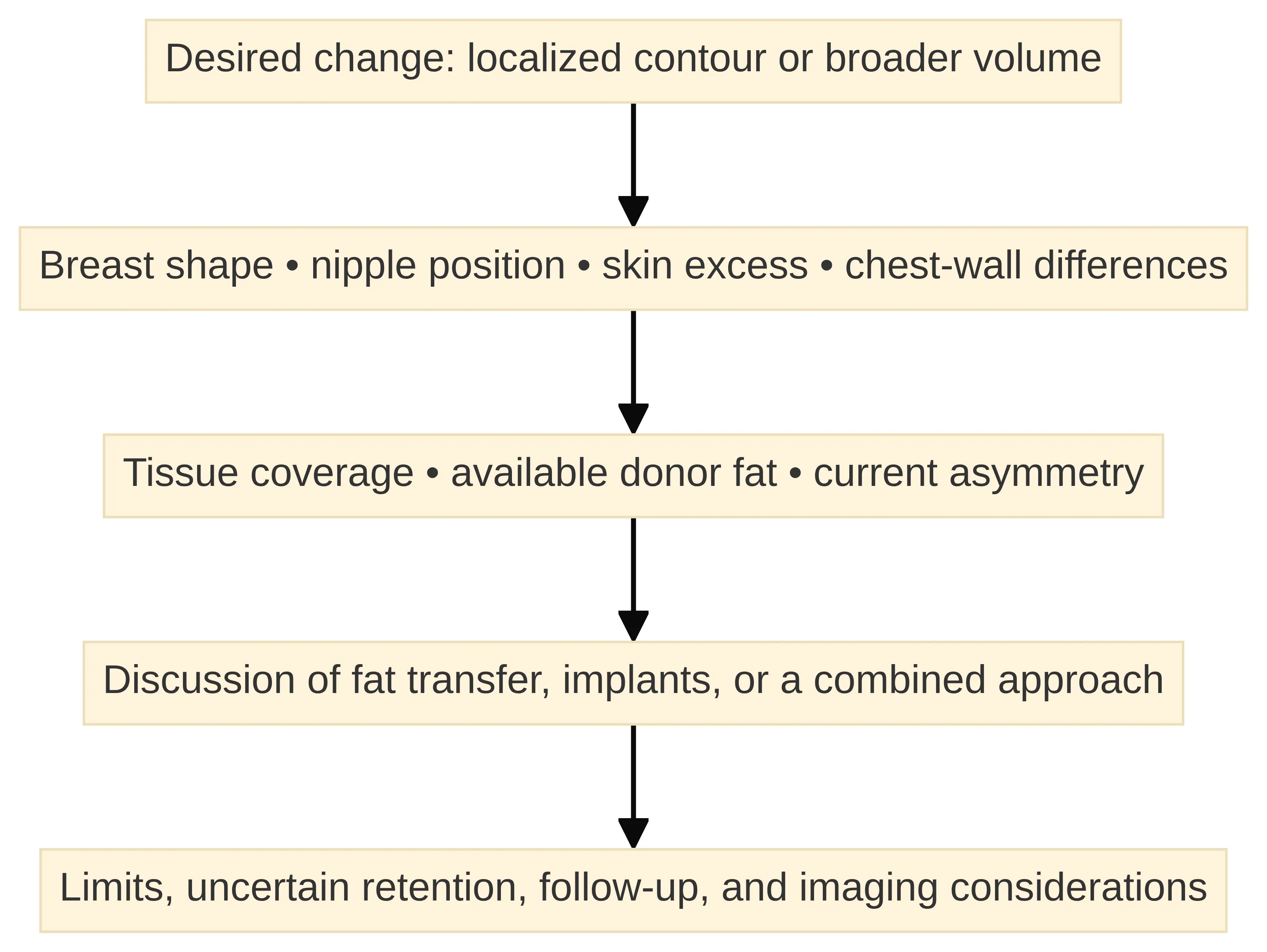
    A four-step consultation flow from the desired breast change to anatomy factors, donor fat and tissue coverage, treatment options, and follow-up considerations.
    A consultation should move from the desired change to anatomy, donor fat, option selection, and follow-up concerns.

    A Narrow Breast Base With a Wish for Fullness

    With a narrow breast base, “more fullness” can describe very different visual priorities. One person may mean a small contour change in a selected area; another may mean more fullness across the breast; another may be seeking a broader increase in overall volume. These requests need to be separated before choosing an approach.

    For localized contour, targeted fat placement is one option. The surgeon examines the starting shape and identifies where fullness is wanted, while explaining that fat grafting is generally framed as a modest-volume option. A narrow base does not determine placement, candidacy, or a personal limit on the result.

    When fullness means a broader volume goal, implants may enter the comparison because fat transfer may not be as effective for larger breasts or a larger overall increase. This is a difference in what each approach may be intended to address, not a ranking of one approach over another. In some circumstances, an implant may be paired with fat grafting for additional shaping.

    This scenario gives the reader a specific way to describe the goal: identify whether the desired change is localized, distributed across the breast, or broadly volumizing. The surgeon can then explain how that distinction relates to the existing breast shape, available donor fat, and the uncertainty of retained volume.

    Visible Asymmetry or Uneven Volume

    Visible asymmetry can look like a volume issue while also reflecting differences in breast shape, nipple position, skin excess, or the way each breast sits on the chest wall. That is why this scenario begins by separating an observation—one side looks different—from a conclusion about which procedure should be used.

    Fat may be placed with attention to a selected contour area, so it can be part of a conversation about uneven volume or contour. But targeted placement does not guarantee symmetry. The amount of grafted fat retained over time is uncertain, and a difference between the breasts may involve features that are not resolved by adding volume.

    An in-person assessment can consider breast base, existing tissue, volume distribution, nipple level or direction, skin excess, and chest-wall differences. Those findings can clarify whether the visible concern is mainly about a localized contour, broader volume, or several features together. Fat transfer, implants, or a combined approach may then be discussed in relation to those limits and to available donor fat.

    A useful description for this scenario is concrete rather than diagnostic: note whether the difference appears to involve volume, contour, nipple position, or how each breast sits. The clinical discussion can then address what may remain visible as well as what options can reasonably be considered.

    Thinner Tissue or a Preference for a Softer Upper Pole

    A reader who prefers a softer-looking upper-pole transition may wonder whether fat transfer should replace implants. The preference itself does not establish what any technique will look or feel like. It instead gives the consultation a visual priority to examine alongside tissue coverage, existing breast shape, volume goals, and donor-fat availability.

    When tissue is thinner, coverage can become a central planning topic. A review of autologous fat grafting describes combined implant-and-fat grafting as an option used to improve implant coverage or camouflage implant edges in very thin patients with little subcutaneous fat or breast tissue. This does not mean thin tissue requires a combined procedure, and it does not predict a particular appearance or feel.

    Here, the key distinction is contour refinement versus broader volume. Fat transfer directs volume to selected areas for contour-focused shaping. Broader overall volume brings implants into the comparison. A combined approach pairs volume with additional shaping, although retained fat volume remains uncertain.

    The relevant questions are therefore specific: Is the upper-pole request about localized shaping, broader volume, or both? How do tissue coverage and available donor fat affect the options being considered? Which aspects of the desired appearance cannot be forecast reliably? These questions keep a preference from becoming a promise.

    Retention Is the Variable Behind Every Visual Priority

    Retention is not a separate technical footnote after a visual goal has been named. It changes how each of the three priorities can be discussed. With a narrow base and a wish for fullness, it limits certainty about how a contour-focused change may persist. With visible unevenness, it is one reason that added volume cannot be presented as a way to make breasts match. With an upper-pole preference, it limits how confidently additional shaping or coverage can be anticipated over time.

    Published group findings provide context, not a personal forecast. One literature review reported mean retention of 62.4% after cosmetic breast fat grafting, with or without implants, over a mean follow-up of 16.6 months. The review also identifies important limits in those estimates: injected material may contain an unknown amount of fluid; imaging measurements can be affected by weight change or edema; follow-up is limited; and studies include different patient and clinical variables. A 2024 narrative review likewise found wide variation in reported first-year graft loss and noted that standardized protocols for collection, preparation, and injection remain lacking.

    The practical implication is not to convert an average into a predicted breast change. It is to ask how retention uncertainty changes the particular visual priority under discussion and which aspects of that priority cannot be forecast reliably.

    A clear comparison separates three issues that can otherwise become blurred together: the amount of volume being sought, the location where additional contour is wanted, and the uncertainty a person is prepared to discuss. Fat transfer may be relevant when the conversation centers on modest, contour-focused volume, but retained volume remains a limitation even when the desired change is localized. When the goal depends on a broader overall increase, the discussion may also include implants or a combined approach. This is not a self-selection rule; it is a way to make the trade-off explicit before an in-person assessment.

    Why Follow-Up and Breast Imaging Belong in the Decision

    A visual priority is only one part of the decision. Fat grafting can create nodules or calcifications that may resemble concerning findings on an examination or imaging. A review notes that these findings can mimic breast cancer and potentially delay diagnosis, so future breast evaluation belongs alongside the conversation about contour or volume.

    This does not mean every person follows the same imaging path. A 2024 narrative review describes MRI as a precise method for volume assessment and for detecting complications such as oil cysts and necrosis, but that finding does not prescribe routine MRI for every patient. The appropriate follow-up and imaging discussion depends on the treating clinicians and the individual clinical context.

    Complications also need to be considered without turning pooled research into an individual prediction. A systematic review summarized in a conference poster reported complications, including fat necrosis, among its included studies. These findings support a discussion of risks, follow-up, and communication with clinicians involved in later breast care; they do not calculate a personal outcome.

    General information cannot evaluate a new breast finding or establish an individual screening schedule.

    What the Three Visual Priorities Leave Open

    The three visual priorities do not produce one standard answer. Fullness across a narrow base may clarify the difference between localized contour and broader volume. Unevenness may involve volume alongside shape, nipple position, skin excess, or chest-wall differences. An upper-pole preference brings tissue coverage and the difference between contour refinement and overall volume into view.

    A modest, contour-focused goal can lead to a conversation about fat transfer. Broader volume goals bring implants into the comparison, while an implant-and-fat approach can pair volume with additional shaping. A qualified surgeon evaluates breast shape, nipple position, skin excess, chest-wall differences, tissue coverage, available donor fat, and retention uncertainty in person.

    If concerns about implants are driving interest in fat transfer, discuss those concerns directly before surgery rather than assuming fat transfer resolves them. Include risks, follow-up, and breast-imaging considerations in the same conversation as the visual change you want to understand.


    Frequently Asked Questions About Fat Transfer for Breast Enlargement

    How does a visual priority change a fat-transfer discussion?

    A request for fullness, less noticeable unevenness, or a different upper-pole transition may raise different questions about contour, broader volume, existing breast features, and the limits of general information. An in-person assessment is needed to determine what may be appropriate to discuss.

    Is fat transfer intended for a large breast-volume increase?

    For broader volume goals, implants may enter the discussion. Neither general description predicts an individual result.

    Why is retained volume important to every visual priority?

    The amount of grafted fat retained over time is uncertain. That uncertainty means a contour change, an attempt to address unevenness, or additional shaping should not be treated as a predictable outcome.

    Can fat transfer and implants be discussed together?

    Yes. A combined approach can pair an implant with fat grafting for additional breast shaping. Whether that approach is relevant requires clinical assessment.

    Why should later breast imaging be part of the conversation?

    Fat grafting can create nodules or calcifications that may resemble concerning findings on examination or imaging. Discussing treatment history, follow-up, and coordination with clinicians involved in future breast care can help place later findings in context.


  • Breast Augmentation: How to Review Implant Labeling Before a Consultation

    Breast Augmentation: How to Review Implant Labeling Before a Consultation

    Start With an Implant-Labeling Review Record

    Before a consultation, use the implant materials as a document-audit set rather than as a general procedure summary. Breast augmentation is intended to increase breast size, and implant-based augmentation involves placing implants under breast tissue or chest muscles. The audit question is narrower: can you identify what the materials say about the proposed device, what each document is for, and which terms still need clarification?

    Collect the benefit-and-risk labeling, boxed warning information, patient decision checklist, manufacturer patient labeling, and device card for the implant under discussion. Mark each document’s title, device details, warnings, risks, and unresolved terms. The FDA states that breast implants are not lifetime devices, so the record should also show where the materials address monitoring and the possibility of additional procedures.

    Do not use the documents to select an implant, placement, incision, or surgical plan on your own. Use them to make the later discussion more precise and to distinguish information that is device-specific from decisions that require an individualized clinical assessment.

    Record What Labeling Cannot Choose for You

    A labeling record should include a clearly marked section called “questions the materials cannot answer.” Device information can describe an implant, but it cannot establish whether a particular surgical plan fits an individual.

    Implant insertion and positioning are individualized based on factors such as implant type, the degree of enlargement desired, body type, and the surgeon’s recommendations. Potential incision locations include the areolar edge, the fold under the breast, and the armpit. These are discussion topics, not options to select from a general article. The American Society of Plastic Surgeons notes that a belly-button approach is associated with a higher complication rate.

    Write your own questions beside, rather than inside, the device materials:

    • What change am I hoping to discuss?
    • Which implant characteristics, placement, and incision are being considered, and why?
    • What features of my anatomy need professional assessment?
    • What would the proposed approach not change?

    Also separate volume from breast position. Implants do not prevent breast sagging, so a lift may be discussed when sagging is a concern. Whether augmentation alone addresses a particular concern cannot be settled by a label, photograph, or another person’s experience.

    Use Your Goals to Read Benefits and Limits Carefully

    Before reading a proposed implant’s materials, add a short statement of what you want to discuss. Breast augmentation is intended to increase breast size, but that general purpose does not establish that every appearance concern will be addressed.

    Use a second note headed “limits that matter to me.” For example, breast implants do not stop breast sagging, and changes in the breasts and body over time can affect appearance. If position is an important concern, record it as a topic for individualized assessment rather than assuming added volume will resolve it.

    Future breastfeeding priorities also belong in this note. Breast augmentation can affect nerves and ducts involved in lactation. Cleveland Clinic notes that implant placement and incision location can matter for future milk production. This does not predict an individual experience; it identifies a priority that should be raised before a plan is selected.

    This part of the record helps distinguish a hoped-for change from questions that need clinical explanation. It is a way to read benefit information carefully, not a way to forecast a personal result.

    Build the Record From Required Implant Materials

    Audit Each Document Against the Others

    Start with the benefit-and-risk labeling and boxed warning. Record the proposed device’s identifying details and copy the main benefits, warnings, risks, and limitations into separate notes. Do not combine a general implant statement with a device-specific statement unless the materials support that connection.

    Next, review the patient decision checklist. Under FDA requirements, the checklist is reviewed with the prospective patient and signed by the patient and implanting physician. Mark each topic that is clear and each term that needs explanation. The checklist is an informed-discussion document, not a personal risk calculation.

    Then compare the manufacturer’s patient labeling and educational materials with the earlier notes. Look for information that adds detail, narrows a statement, or identifies a device-specific qualification. If a term appears inconsistent or unclear, preserve both references in the record and bring the discrepancy to the surgeon rather than resolving it yourself.

    Finally, record what the device card identifies, including the implant’s serial or lot number and style and size. Keep the card with the reviewed labeling so the device information remains accessible later. The FDA advises reading the manufacturer’s materials and discussing questions with the surgeon before deciding.

    A completed audit should answer three limited questions: which documents were reviewed, which statements appear to describe the proposed device, and which points require clarification. It should not become a substitute for examination or an individualized surgical plan.

    Add Device Risks to the Record Without Self-Calculating

    FDA approval reflects testing for reasonable assurance of safety and effectiveness; it does not eliminate implant risks. Your individual likelihood of a complication cannot be determined from an article, but the known categories should be part of the decision before surgery.

    The FDA identifies capsular contracture, reoperation, and implant removal among the most common local complications and adverse outcomes. It also identifies rupture or deflation, wrinkling, asymmetry, scarring, pain, and infection at the incision site. For silicone gel-filled implants, rupture can be silent, meaning it may occur without symptoms.

    Some risks may require further evaluation or treatment. The FDA describes breast implant-associated anaplastic large cell lymphoma, or BIA-ALCL, as a risk associated with implants that can occur in the breast or surrounding scar capsule; it is not breast cancer. The FDA also says that cases of squamous cell carcinoma and various lymphomas in the capsule around implants may be rare.

    These facts do not tell you what will happen in your case. They do establish why informed consent should be more than a general statement that surgery has risks. Ask for an explanation of the risks associated with the proposed implant, what symptoms or changes should prompt contact, and what further evaluation or treatment could be considered if a complication occurs.

    A reasonable decision does not require pretending that risks are absent. It requires understanding which risks are known, which questions remain individualized, and whether you are prepared to accept the possibility of additional care.

    One way to keep this discussion useful is to separate three kinds of questions. First, ask which complications and warnings are identified in the labeling for the specific device under consideration. Second, ask what changes or symptoms the treating team would want you to report and what evaluation may follow. Third, ask which aspects of your health history, anatomy, and proposed plan still need individualized assessment. This separation matters because a general risk list can identify subjects for discussion, but it cannot predict whether a complication will occur for you or determine how a clinician would manage it.

    If an explanation leaves you unsure whether a point is a known device risk, a monitoring issue, or an individualized concern, write it down for clarification before making a decision. Understanding the category of a question can make manufacturer materials and the patient decision checklist more useful without turning them into a personal risk calculation.

    Record the Follow-Up Responsibilities Attached to a Device

    The device card and follow-up information should form the long-term section of the review record. The FDA states that breast implants require monitoring for as long as they remain in place, and that the likelihood of complications and adverse outcomes rises the longer implants are in place.

    For silicone gel-filled implants, a clinician may recommend periodic MRI or ultrasound screening for rupture and other complications. Record the questions you need answered about the proposed device: what monitoring may be considered, when it may be considered, who will explain the plan, and how the plan will be documented.

    The device card contains information specific to an implant, including its serial or lot number and style and size. Keep it with the labeling and postoperative information so the information remains accessible later. The FDA advises promptly contacting a surgeon or health care provider about abnormal changes in the breasts or implants.

    A completed record does not supply a universal follow-up schedule. It helps you recognize that device information remains relevant after surgery and gives you a focused list for a clinician-led follow-up discussion.

    Keep Recovery Questions Separate From Device Information

    Keep recovery logistics in a separate section of the record rather than treating them as device-labeling details. Preparation may include testing, medication review or adjustments, smoking cessation, and avoiding certain substances as directed by the surgical team. Do not make medication or substance changes from a general checklist alone.

    After surgery, support may include gauze dressings and an elastic bandage or support bra. Instructions vary, including directions about support garments and incision care. The treating plastic surgeon’s specific postoperative instructions are the directions to follow.

    Use this page to capture practical questions for a consultation:

    • Which preparation steps would need to be discussed in light of my medical history and current medications?
    • What garment use, incision care, support, and activity questions should I ask about?
    • What follow-up arrangements would be relevant to the proposed plan?
    • Whom should I contact if I have a recovery question?

    This is not a recovery schedule or a promise about healing. It is a way to determine whether you understand the practical responsibilities that would accompany an individualized surgical plan.

    Use the Completed Record to Decide Whether to Seek Discussion

    Use the Audit to Prepare a Focused Discussion

    Bring the reviewed documents and a short discrepancy list to a consultation. Ask which labeling applies to the implant being discussed, how the patient decision checklist will be reviewed, what the boxed warning means in this context, and what information the device card will contain.

    Also mark questions that the documents cannot answer, including how your goals and anatomy affect the proposed plan, what placement or incision options may be considered, how recovery instructions would be individualized, and what monitoring or future procedures may need discussion. The American Society of Plastic Surgeons identifies asking whether a surgeon is certified by the American Board of Plastic Surgery as an important consultation question.

    The purpose of this audit is not to produce a recommendation. It is to make the source documents easier to compare and the unresolved questions easier to explain. If you want an individualized discussion of the audited materials and your goals, move from general education to a personalized assessment.


    Breast Augmentation Consultation FAQ

    How is the implant plan chosen?

    The choice depends on factors like the amount of enlargement desired, body type, implant characteristics, and the surgeon’s recommendations. A consultation is where placement and incision options are discussed in relation to your goals.

    What should I know if I want to breastfeed in the future?

    Mention that early in the discussion. Augmentation can affect the nerves and ducts involved in lactation, and implant placement and incision location may matter, so this priority should be reviewed before a plan is selected.

    What are the main risks to discuss before deciding?

    Some silicone implant ruptures can happen without symptoms, so risks should be reviewed carefully.

    Do breast implants need long-term follow-up?

    Yes. Discuss the follow-up plan for the device being considered with the surgeon.

    What should I expect during recovery planning?

    Preparation may include testing, medication review or adjustments, smoking cessation, and avoiding certain substances if directed by the surgical team. After surgery, you may be instructed to use a support garment and follow specific incision-care directions.

    What questions are useful to bring to a consultation?

    Ask which implant is being proposed, what labeling materials you should read, what the device card will show, how the decision checklist will be reviewed, whether the plan addresses sagging or breastfeeding goals, and what follow-up or monitoring may be needed.


  • How to Choose a Nearby Breast Augmentation Provider: A Verification and Consultation Guide

    How to Choose a Nearby Breast Augmentation Provider: A Verification and Consultation Guide

    Use local search results to build candidates—not make the final choice

    A search for “breast augmentation near me” can identify practices in a workable travel area, but it cannot tell you which provider is right to contact. Search placement, polished galleries, and promotional language are starting points for discovery—not proof of qualifications, communication quality, surgical-setting details, or follow-up arrangements.

    Breast augmentation may involve implants or fat transfer, and the appropriate discussion is individualized. That makes the provider-selection task more important than finding a single highly visible result. Build a small list, verify facts that can be checked independently, and use the same questions with every practice you consult.

    The goal is not to declare one surgeon “best” from a screen. It is to narrow your choices to providers who can give clear, specific, and verifiable answers about their background, recommendations, surgical setting, risks, and continuity of care. A nearby office may be convenient, but proximity should be one consideration alongside the quality of the information you receive.

    Build a shortlist through discovery, verification, comparison, and booking

    Use a four-step process that separates decisions a search page often blurs together.

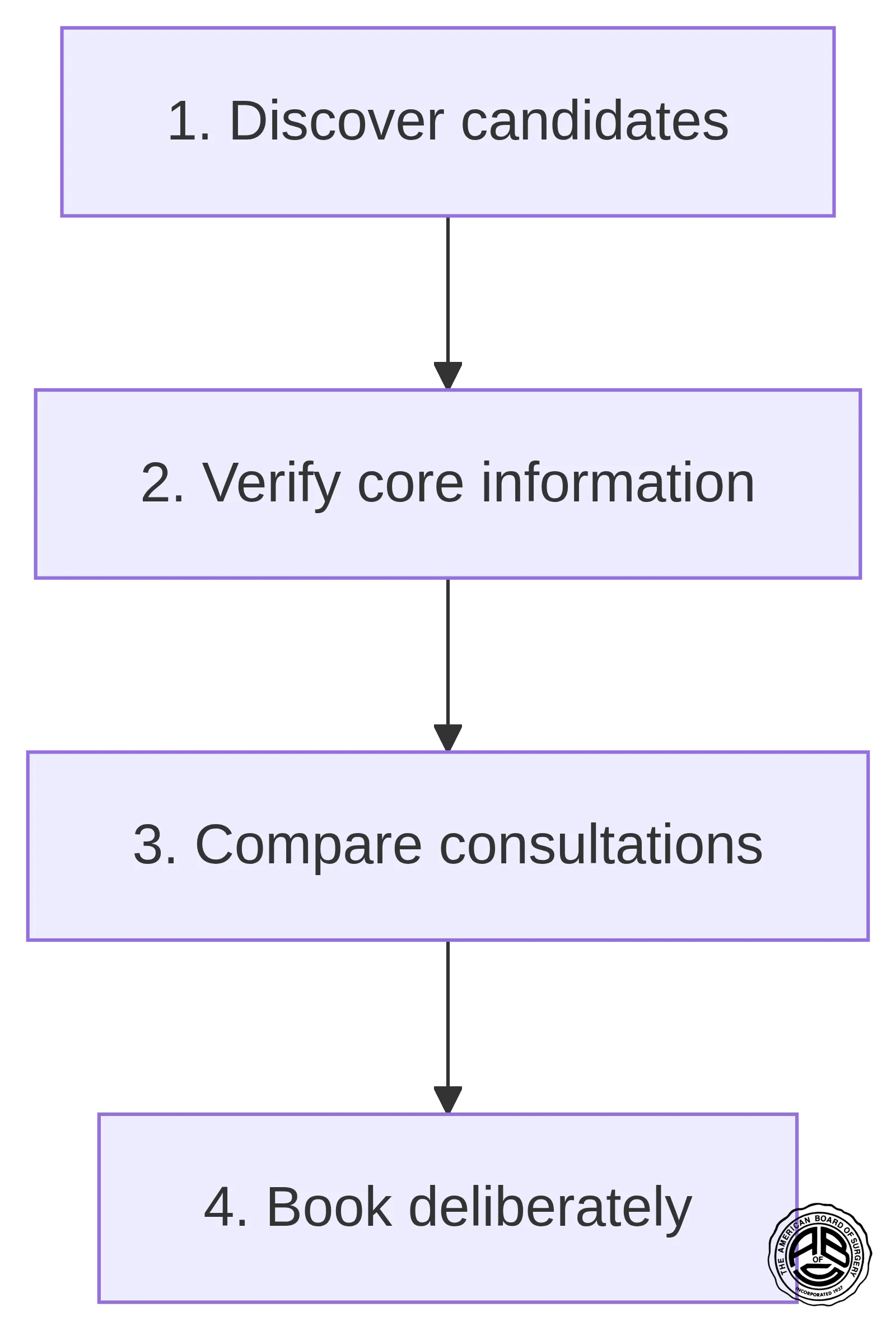
    1. Discover candidates. Search locally, ask for referrals if you wish, and note several practices whose services appear relevant. At this stage, collect names and contact details; do not treat marketing claims as verified facts.

    2. Verify core information. Confirm surgeon credentials through an independent source, then ask each office about the planned surgical setting, hospital privileges, and how follow-up is handled. Record what is confirmed, what is stated by the practice, and what remains unanswered.

    3. Compare consultations. Bring the same written goals and question list to each consultation. Compare the clarity of explanations, the discussion of alternatives and uncertainty, and the specificity of plans for recovery, complications, and revision decisions.

    4. Book deliberately. Contact the practice or practices that provide complete, consistent answers without pressure. If a key answer is unclear, preserve that question for a follow-up conversation or seek another consultation.

    A simple worksheet helps keep the comparison fair. Patient-facing decision tools are designed to organize options, benefits, risks, and personal priorities in an accessible way. However, the available review found that direct decision-aid evidence in plastic surgery was concentrated in breast reconstruction, not aesthetic surgery. Treat this scorecard as a practical way to organize your own notes, not as a validated tool that can determine the right choice for you.

    Comparison area What to record Decision boundary
    Credentials Independent certification result, training answers, hospital privileges Verify rather than relying on a profile or advertisement.
    Relevant experience How the surgeon describes breast-augmentation experience and recommendation rationale Look for direct, individualized explanations.
    Surgical setting Where surgery would occur and the facility status when office-based Ask for information you can confirm directly.
    Communication Whether goals, alternatives, limits, and risks were discussed clearly Pause if answers are dismissive, rushed, or inconsistent.
    Follow-up and revision planning Postoperative contact, appointments, complication response, and dissatisfaction discussion Do not leave these topics unresolved.
    Long-term questions How future implant-monitoring questions would be addressed Ask which current guidance the practice follows.
    A four-step process for choosing a nearby breast augmentation provider: discover candidates, verify core information, compare consultations, and book deliberately.
    Use a simple four-step workflow to shortlist and compare providers before booking.

    Verify surgeon credentials before relying on practice claims

    For U.S. candidates, use the American Board of Plastic Surgery public search to verify whether a surgeon is certified by ABPS. Record the result and the date you checked it rather than relying on a practice biography, directory badge, or search snippet.

    ABPS describes its certification as voluntary. According to ABPS, its certified surgeons have completed appropriate training and passed comprehensive written and oral examinations. That is meaningful information, but it is one part of a broader evaluation—not a substitute for a consultation, discussion of relevant experience, or verification of provider-specific arrangements.

    Certification status also deserves a current check. ABPS says certificates issued since 1995 are valid for 10 years and require continuing-certification requirements for renewal. ABPS also states that active, unrestricted licensure is required for certification. When its results show a “See FSMB” alert, ABPS directs users to Federation of State Medical Boards information.

    Add two separate lines to your worksheet:

    • ABPS result: verified, date checked, and any follow-up indicated by the result.
    • State license and disciplinary review: verify directly through the appropriate official state resources for the state where the surgeon practices.

    Do not collapse these into a single yes-or-no label. A credential check establishes a specific fact; it does not answer whether the surgeon’s communication, recommendations, surgical setting, or follow-up plan fit your needs. If an office cannot identify the surgeon who would perform the procedure or answers about credentials are unclear, seek further verification before booking.

    Compare breast-augmentation experience and the reasoning behind recommendations

    A useful consultation does more than list options. It connects your stated goals to a recommendation and explains the reasoning in language you can understand. The American Society of Plastic Surgeons includes questions about ABPS certification, plastic-surgery training, years of training, and hospital privileges in its breast-augmentation consultation guidance.

    Ask each prospective surgeon:

    • Are you certified by the American Board of Plastic Surgery?
    • What plastic-surgery training did you complete?
    • What hospital privileges do you have for this procedure, and at which hospitals?
    • How do you approach breast-augmentation consultations for goals like mine?
    • What implant or procedural characteristics do you recommend for me, and why?
    • How do shape, size, surface texturing, incision site, and placement site enter that recommendation?

    You are not asking for a promise or trying to establish candidacy from a checklist. You are testing whether the discussion is specific, responsive, and grounded in your individual priorities. A clinician may recommend against a requested approach, suggest more discussion, or identify uncertainty; those can be signs of a substantive consultation when they are explained respectfully.

    Use your notes to distinguish an explanation from a slogan. “This is the right option for everyone” is not a personalized rationale. A more useful answer describes the relevant choices, the trade-offs being considered, what the surgeon can and cannot predict, and what information would be needed before a plan is made. If recommendations change between conversations, ask what new information accounts for the change. If the answer remains vague, keep the candidate in the verification stage or obtain another opinion.

    Confirm the surgical setting, postoperative access, and follow-up plan

    The setting and the plan after surgery deserve the same attention as the initial consultation. Ask where and how surgery would be performed. If surgery is planned in an office-based facility, ask whether it is accredited by a nationally or state-recognized agency, state-licensed, or Medicare-certified, as applicable. Record the exact answer and verify facility status directly with the relevant organization or regulator before proceeding.

    Ask the practice to explain who will be involved in the surgical setting and how you can verify provider-specific details. This includes any anesthesia arrangements that apply to your planned care. Do not assume that a facility description on a website answers every operational question.

    Then focus on continuity after surgery. ASPS recovery guidance states that patients are given specific postoperative instructions and a follow-up appointment before leaving after breast augmentation. Ask how this practice arranges those instructions and appointments, who handles routine postoperative questions, and how you would contact the team if a concern arises. Recovery instructions can vary by surgeon, so the operating surgeon’s directions are the ones to follow.

    A practical note template is:

    • Planned setting: location and type of facility discussed.
    • Facility status: exact accreditation, licensure, or certification information provided; verification still needed or completed.
    • Postoperative instructions: when and how they are supplied.
    • Follow-up: expected appointment arrangement and primary contact.
    • Questions or concerns: how the practice says it handles them outside a routine visit.
    • Future continuity: how the practice will address later questions about implants or monitoring.

    Long-term guidance can change, so avoid treating a generic online timeline as a complete plan. Ask the practice how future follow-up and monitoring questions will be handled. If the office cannot explain its follow-up process clearly, do not treat that as a minor administrative detail; resolve it before moving forward.

    Ask questions that test whether the consultation supports an informed decision

    Bring questions in writing and leave space for answers. A meaningful consent discussion should cover material risks, alternatives—including no surgery—realistic limits, uncertainty, and provider-specific factors without pressure. The point is not to memorize technical terms; it is to understand what is being proposed, why it is being proposed, and what remains uncertain.

    Goals and options

    • Based on my goals, what options are being considered and why?
    • What implant or procedural characteristics do you recommend, and what trade-offs are relevant to that recommendation?
    • What alternatives, including choosing not to have surgery, should I understand?
    • Can I review before-and-after photos for this procedure and discuss what is reasonable for me?

    Risks, limits, and future decisions

    • What are the material risks and complications associated with this procedure?
    • Does the discussion address scars, asymmetry, contour changes, nerve symptoms, dissatisfaction, revision, and recovery limitations?
    • How are complications handled by this practice?
    • How many additional implant-related operations might be relevant over a lifetime?
    • What are the options if I am dissatisfied with the cosmetic outcome?
    • What would implant removal without replacement mean for my appearance over time?

    Recovery and support

    • What recovery needs should I plan to discuss, including the help I may need?
    • What postoperative instructions will I receive, and when?
    • When will follow-up appointments be arranged?
    • How should I contact the practice with a postoperative concern?

    Personal circumstances and longer-term questions

    • How might pregnancy or breastfeeding be part of the discussion for me?
    • What current guidance does the practice follow for future implant-monitoring questions?
    • Which parts of the plan depend on information that is still uncertain or requires further evaluation?

    Write down the answer in the provider’s own terms, then note whether you understood it. If you leave unable to explain the recommendation, alternatives, risks, or follow-up plan back to yourself, ask for clarification before making a decision. No consultation can promise permanent results, symmetry, invisible scars, a complication-free recovery, or no future revision.

    Treat pressure, guarantees, and unverifiable claims as reasons to pause

    The way a practice communicates is information you can compare. Clear communication does not require certainty where certainty is impossible. It requires direct answers about limits, alternatives, risks, and what the practice would do if the course is not straightforward.

    Pause and seek further verification or another consultation when you encounter any of these patterns:

    • Credentials, hospital privileges, facility status, or the identity of the operating surgeon are difficult to confirm.
    • A recommendation is presented without a clear explanation of why it fits the goals you described.
    • Questions about complications, recovery limitations, dissatisfaction, or revision are brushed aside.
    • You are discouraged from asking about alternatives, including no surgery.
    • Answers change without an explanation, or the practice will not put key details in a form you can review.
    • You feel rushed to decide before you understand the plan.
    • Marketing language substitutes for provider-specific information.
    • The discussion suggests guaranteed satisfaction, permanent results, perfect symmetry, invisible scars, or freedom from complications or future revision.

    Images also need context. Treat simulation or AI images as illustrative rather than as a promise of a surgically achievable result. Ask whether an image is an example, a simulation, or an expected outcome, and ask what limits the clinician sees in applying it to your situation.

    A respectful practice may tell you that more time, more information, or another opinion is appropriate. That is different from pressure. The decision boundary is simple: if you cannot obtain clear and consistent answers about the procedure, setting, and follow-up, do not let convenience or urgency make the decision for you. Continue verification or consult another qualified provider.

    Ask how the practice will handle long-term implant monitoring questions

    Keep long-term monitoring on your scorecard, but do not treat it as a fixed, one-size-fits-all instruction. A review of breast plastic surgery monitoring notes that recommendations have differed among organizations and that guidance can change. The review describes differing positions on routine imaging for people without symptoms.

    The practical question for a consultation is therefore: What monitoring plan do you recommend, which current guidance do you follow, and how will future questions be addressed? Ask who will discuss changes in guidance with you, whether the practice expects periodic follow-up, and how to reconnect if you have a later concern.

    This conversation should sit beside, not replace, discussion of your ordinary health care and any screening recommendations that apply to you. Your provider can explain how the proposed plan relates to your circumstances and what future contact pathway the practice offers. If the answer is only a broad assurance without an explanation of the practice’s approach, ask for clarification or document it as unresolved before deciding.

    Move forward with the candidates who provide clear, verifiable answers

    Set your completed notes side by side before you contact a practice again. Give the most weight to independently verified credentials, a clear explanation of the recommendation, a surgical-setting discussion you can verify, and a specific plan for postoperative access and follow-up. Preserve unanswered questions rather than filling gaps with assumptions.

    A useful next step may be a follow-up call or a second consultation focused only on unresolved points. Choose the candidates that communicate directly, acknowledge uncertainty, discuss alternatives without pressure, and help you understand what would happen before and after surgery. A structured comparison cannot make the decision for you, but it can make the basis for your next conversation clearer.


    Frequently asked questions about choosing a nearby breast augmentation provider

    How can I compare nearby breast augmentation providers in a fair way?

    Use the same checklist for every office: verify the surgeon’s credentials, ask who would perform the procedure, compare how clearly each practice explains options and risks, and confirm the surgical setting and follow-up plan. That keeps the choice based on verifiable details rather than search placement or marketing.

    What should I verify about a surgeon before booking a consultation?

    Check whether the surgeon is certified by the American Board of Plastic Surgery, confirm current licensure through the appropriate state resources, and ask about plastic-surgery training and hospital privileges. If any of those details are unclear, treat that as a reason to ask more questions before scheduling.

    What questions should I ask about the procedure itself?

    Ask what implant or procedural characteristics are being recommended, why they fit your goals, and what alternatives—including no surgery—should be considered. It also helps to ask about the material risks, expected recovery needs, and what options exist if you are dissatisfied with the outcome later.

    How do I confirm that the surgical setting is appropriate?

    Ask where the surgery will be performed and whether the facility is accredited, state-licensed, or Medicare-certified when it is office-based. You should also confirm how anesthesia is handled and whether the practice can point you to information you can verify directly.

    What should a good postoperative plan include?

    It should cover written recovery instructions, a follow-up appointment, and a clear way to reach the practice if a concern comes up after surgery. Since recovery instructions can vary by surgeon, make sure you understand whose directions you will be expected to follow.

    When should I keep looking for another provider?

    If answers are vague, inconsistent, rushed, or pressure-filled, it is reasonable to pause and seek another consultation. The same applies if a practice suggests guaranteed results, avoids discussing complications or revision, or will not give clear information about credentials, setting, or follow-up.


  • Select Tax Prep Program Types for a Small-Business Tax-Planning Review Packet

    Select Tax Prep Program Types for a Small-Business Tax-Planning Review Packet

    Choose the tool category before comparing tax prep programs

    The best tax prep program is not a universal vendor choice. It is the category of tool that fits the return context you need to prepare while keeping your records and unresolved questions available for a credentialed tax professional.

    Start by mapping five distinct jobs:

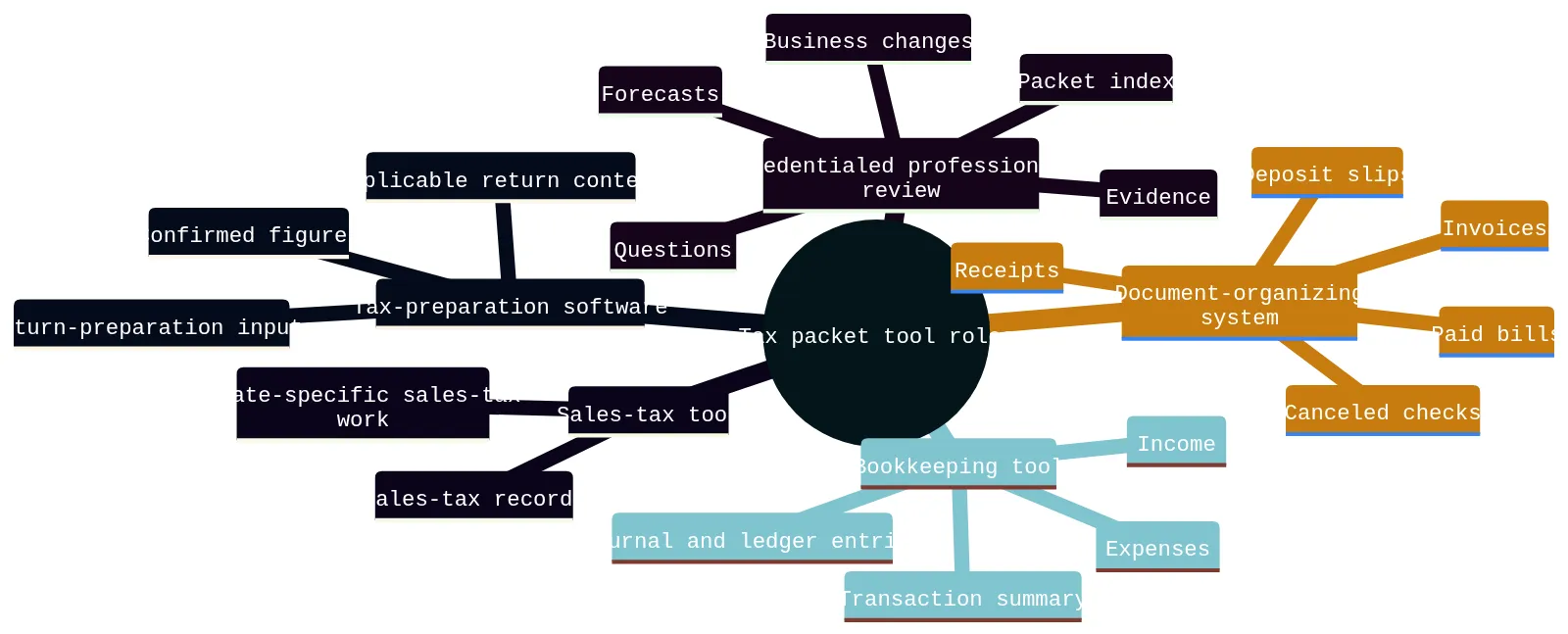
    • Bookkeeping tools summarize transactions in books, journals, or ledgers.
    • Document-organizing systems retain payment evidence and other source material behind those transactions, such as invoices, receipts, paid bills, deposit records, payroll materials, and business assets records.
    • Tax-preparation software uses entered information to prepare annual income-tax return information. The IRS describes commercial software as using a question-and-answer format.
    • Sales-tax tools address collected sales tax, which Quicken distinguishes from annual federal and state income-tax preparation.
    • Credentialed professional review considers the facts and questions that a program cannot settle from an entry screen.

    This map changes the comparison question. Rather than asking which product is best, ask which category you need for the applicable entity, period, and return context. CNBC Select describes tax software as a quick, inexpensive option for straightforward situations, using a single-owner Schedule C business with no employees and minimal expenses as an example. The same source notes that a CPA or other tax professional provides customized care that software cannot replicate.

    Choose the return-preparation category first. Then confirm a specific program’s applicable tax year, entity support, return context, and service scope before relying on it.

    Compare what bookkeeping, document systems, tax software, and professional review each do

    Compare tool categories by the output each one should produce for the next category. The IRS permits a recordkeeping system suited to the business when it clearly presents income and expenses. It also says that a system should include a transaction summary, ordinarily in books such as journals and ledgers. Electronic systems follow the same basic recordkeeping principles as hard-copy records.

    Tool category Useful output Do not expect it to settle
    Bookkeeping tool A transaction summary for the entity and period Unreconciled activity or unclear classifications
    Document-organizing system Retrievable source files connected to transactions Whether a record’s tax treatment is correct
    Tax-preparation software Prompts and entered return-preparation information Missing evidence, mixed entities, or unresolved facts
    Sales-tax tool A separate sales-tax workflow where applicable Annual income-tax preparation or professional determinations
    Credentialed professional review Discussion of records, facts, and questions A substitute for maintaining source records

    A transaction summary and its source material have different roles: one summarizes activity, while the other supports the underlying entries.

    Use this as a handoff chain. First produce a readable transaction summary. Next retain the supporting documents outside the filing program. Enter only information that is ready for the applicable preparation task, and reserve unresolved matters for professional review. This keeps a program choice tied to what it can receive and produce, rather than treating it as the place where every business record must live.

    A mind map showing five tax packet tool roles: bookkeeping, document organization, tax-preparation software, sales-tax tools, and credentialed professional review.
    Use different tool categories for different parts of the tax-planning review packet.

    Match the program type to your entity, period, and return context

    Before comparing program screens, identify two facts: which entity generated the activity and which period the packet covers. Put both at the top of your packet index. If you operate more than one business, keep records separate by business rather than combining activity because it shares an owner or bank login.

    Your entity and return context narrow the field. According to Quicken, most consumer-facing tools handle an individual Form 1040 that may include Schedule C business income, rather than separate entity-level returns for partnerships, S corporations, or C corporations. Quicken also states that TurboTax Business desktop and TaxAct business products handle entity returns separately from personal returns. These are category-level starting points, not a current eligibility determination. Confirm applicable-year forms, entity support, state availability, and product scope directly with the vendor before relying on a program.

    Use this decision boundary:

    • Single-owner activity tied to an individual return: a consumer-facing individual-return tool may be worth evaluating if your records are complete and the situation is straightforward. Confirm current form support.
    • Separate partnership, S-corporation, or C-corporation return context: begin with programs that explicitly support the separate entity return for the applicable year. Do not assume an individual-return product covers it.
    • More than one entity or a recent entity change: maintain separate folders, separate transaction summaries, and separate question lists. Ask a credentialed tax professional how the facts should be handled.
    • Unclear entity or period: pause program selection. Mark the item Needs confirmation and establish the entity and period first.

    A tax program may ask questions efficiently, but it cannot repair a packet that mixes entities, combines years, or substitutes estimates for records.

    Use five questions to narrow your tax prep program options

    Use this path before committing time to a specific program.

    1. What entity and period does this packet cover? Write the legal or operating entity name used in your records and the exact tax year or other review period. If business activity changed entities during the period, keep the change visible and add a professional-review question.

    2. Are the bookkeeping records complete enough to summarize activity? Identify the transaction summary, the accounts included, and any unreconciled or uncategorized activity. Do not use a tax program as a substitute for locating the underlying bookkeeping records.

    3. Can you find prior-year documents? Prior-year documents provide context for the next review. Compatibility can change by version and return type, so confirm current import limitations before making it a deciding factor.

    4. Do you need professional review rather than software prompts alone? A program may be a preparation tool, while a credentialed tax professional reviews the factual context and questions. This matters when records are incomplete, the entity is unclear, activity spans locations, or a business change needs discussion.

    5. Does the vendor currently support this exact use? Confirm the applicable tax year, entity return type, state scope, imports, service limits, and any professional-assistance boundaries. For example, TurboTax lists current limitations for its Expert Assist Business and Expert Full Service Business products that include C corporations and entities electing C-corporation treatment, trusts and estates, tax-exempt entities or nonprofits, and returns requiring more than five state filings. Treat vendor statements as product-specific and time-sensitive.

    If one answer remains uncertain, your next step is not to guess. Add the uncertainty to the packet index, assign a follow-up owner, and bring it to professional review.

    Build a tax-planning review packet index for records and questions

    Use a tax-planning review packet index as a program-selection record, not as a filing checklist. Its purpose is to show which information is ready for a program, which material remains supporting evidence, and which items should go to a credentialed tax professional before you select a product.

    Information group Selection question What to record
    Transaction summary Does the program fit the entity and period shown in the summary? Entity, period, report name, and included accounts
    Supporting documents Can the source material remain retrievable outside the program? Source location and related transaction group
    Prior-year documents Is a usable prior-year file format available for the program you are considering? Return type, tax year, and file format
    Forecasts and open questions Should this stay outside completed-period preparation pending review? Assumption or factual question, period, and follow-up owner

    For every row, record the entity, period, source, status, file location, and follow-up owner. This makes the program decision depend on the information you actually hold rather than on a broad product description.

    Use the index to define program inputs

    Transaction summaries identify the preparation context. The IRS says a suitable recordkeeping system clearly shows income and expenses and includes a transaction summary, ordinarily in books such as journals and ledgers. Identify the summary for the selected entity and period before evaluating program prompts.

    Supporting documents remain evidence. Keep the source files connected to the related transaction summary.
    Prior-year files are only one comparison factor. Note whether you have a prior-year data file, PDF return, or scanned paper return. Confirm current version and return-type limitations before using any prior-year import capability as a deciding factor.

    Forecasts are not completed-period inputs. Record the forecast period and source, then keep unresolved questions available for credentialed professional review. A program choice should not turn a forecast or an unanswered question into a documented fact.

    Keep Ready, Missing, and Needs confirmation items separate

    Apply an input-boundary test to each information group before using it to compare or enter information in a tax-preparation workflow. This is not a conclusion about tax treatment. It identifies whether the item helps establish program fit, remains evidence, or requires professional review.

    Input boundary Use it when Effect on program selection
    Ready to evaluate The item has an identified source and belongs to one entity and period Compare the program against the applicable input and return context
    Evidence retained The file supports a figure or explains activity Keep it retrievable with the related transaction summary
    Needs confirmation The entity, period, purpose, amount, or factual context is unclear Do not treat a program prompt as an answer to the question
    Source unavailable Expected material is unavailable Record what is absent before relying on the information
    Outside this comparison The item belongs to another entity or period, or does not apply Exclude it from this program decision and retain the reason

    For example, an account-statement payment can show that a payment occurred while its business purpose still needs confirmation. A projected equipment purchase belongs in a forecast discussion, not in completed-period asset information. A remembered expense without available support should remain marked Source unavailable rather than becoming a program entry.

    It also says that retention depends on what a document records and that records must be kept as long as needed to prove income or deductions on a return.

    This test distinguishes a program-selection decision from a record-review process. Select a program only when you can identify the entity and period it must address, the information it may receive, the evidence that stays available, and the questions that remain for professional confirmation.

    Recognize what tax software cannot settle

    Treat the limits of a program as part of the selection decision. Commercial tax-preparation software can support electronic filing, and the IRS describes commercial software as using a question-and-answer format. Those functions organize preparation only after you identify the correct entity, period, and available information.

    Use three stop checks before relying on a program answer:

    1. Input stop: Do you have a documented answer for this prompt? FreeTaxUSA states that users are responsible for complete and accurate entries and that it does not assume liability for user-generated errors.
    2. Context stop: Does the answer belong to this entity, period, and return context? A prompt cannot resolve mixed-entity records, a missing source document, or an unclear business change.
    3. Scope stop: Is this the right workflow for the obligation in question? Quicken distinguishes annual federal and state income-tax preparation software from sales-tax compliance software; do not assume one workflow completes the other.

    Nor does a program’s ability to accept an entry establish that the entry is complete or supported.

    CNBC Select states that a CPA or other tax professional offers customized care that tax software cannot replicate. For Texas franchise tax, nexus, entity changes, locations, or out-of-state activity, document the relevant facts and use professional review to confirm what those facts mean. Do not select an answer merely because a generic program prompt appears to fit.

    Choose a program with defined input boundaries

    Choose among tax prep program types by defining the preparation boundary first. Identify the entity and period, locate the transaction summary, and decide whether the available information belongs in a preparation workflow, remains supporting evidence, or needs professional confirmation.

    A tax-planning review packet supports that decision without becoming the decision itself. Use the packet index to compare each program against the inputs you have, not to assume that every file belongs in the program. Keep forecasts separate from completed-period information, and leave unavailable or unclear material visible. For electronic records, IRS Publication 583 says a storage system must index, store, preserve, retrieve, and reproduce records in legible format.

    Bring these professional-review questions when relevant:

    • What facts should we provide about Texas franchise tax?
    • Do our activities, customers, locations, or out-of-state operations raise a nexus question?
    • Did an entity change, new location, or business expansion create information that needs review?
    • Which missing records or unclear payments should be resolved before preparation proceeds?

    The useful outcome is not a universal program recommendation. It is a program type selected for a defined entity, period, and preparation context, with evidence and unresolved questions kept available for credentialed tax professional review.

    Frequently asked questions about tax prep programs and review packets

    What should I put in a tax-planning review packet before a meeting?

    Label each item by entity, period, source, status, and follow-up owner so the reviewer can see what is documented and what still needs confirmation.

    How do I tell whether a tax prep program fits my business entity?

    Start with the entity that created the activity and the period the packet covers. Consumer-facing tools often handle individual returns with business income, while separate entity returns need products that explicitly support that return type for the applicable year. Confirm current form support before relying on any program.

    Can bookkeeping software replace tax-preparation software?

    No. Bookkeeping tools summarize transactions and help you keep the source records organized. Tax-preparation software uses the information you enter to prepare return inputs. Keep the two jobs separate so your records stay usable for professional review.

    What should stay marked as missing or needs confirmation?

    Anything without a readable source, a clear period, or a clear business purpose should stay visible as missing or needs confirmation. Do not fill gaps with estimates, memory, or assumed treatment. That keeps the packet honest and easier to review.

    What records are most important for receipts, payroll, and assets?

    For payments and expenses, keep proof of payment, dates, amounts, payee details, and a description of the item or service. For payroll and contractor records, keep the available payroll materials and related payment records. For assets, keep the records needed to identify the property and support depreciation or sale calculations.

    When should I raise Texas franchise tax, nexus, or location questions?

    Bring them up whenever the business has Texas activity, out-of-state activity, entity changes, or new locations. Document the facts in the packet and ask the credentialed tax professional to confirm the tax implications rather than guessing from the software.

  • Tax Prep Services Checklist: Build a Meeting-Ready Tax-Planning Review Packet

    Tax Prep Services Checklist: Build a Meeting-Ready Tax-Planning Review Packet

    Build a review packet, not a document pile

    A useful tax-planning review packet does not try to answer tax questions on its own. It gives a credentialed tax professional a clear view of your business records, current changes, forecasts, missing support, and questions that need confirmation.

    Start with one searchable packet index rather than a folder full of unlabeled files. Each record should show the period, entity, source, file name or location, status, and person responsible for follow-up. Keep documented bookkeeping records and payment evidence separate from estimates, assumptions, and unresolved questions.

    Good records can support financial statements, income tracking, property-basis tracking, return preparation, and items reported on a return. Prior-year documents and financial statements also help the reviewing professional understand your tax history and business financial information. This packet is for preparation and discussion. It does not determine deductions, filing duties, nexus, registration, liability, or deadlines.

    Create one packet index for every record and issue

    Use one spreadsheet, document checklist, or shared index as the front page of your tax-planning review packet. A visible checklist makes received items, missing items, and items needing attention easier to discuss than a long email chain.

    Create one row for every document, record group, estimate, business change, or question. Include these fields:

    Packet-index field What to record
    Module Bookkeeping, payments, payroll and contractors, assets, forecasts, prior-year documents, business changes, or Texas review topics
    Document or issue A plain-language description, such as “March bank statement” or “new warehouse lease”
    Period The month, quarter, year, or effective date covered
    Entity The legal business entity the item relates to
    Source or file location System name, folder path, secure portal location, or original document source
    Status Ready, Missing, Needs confirmation, or Not applicable
    Follow-up owner The person who will locate, explain, upload, or raise the item at the meeting
    Meeting question A short question when a professional determination is needed

    Use a naming pattern that keeps related files together, such as 2026-03_Entity_BankStatement_Ready.pdf. The format is less important than consistency and a source location someone else can find. Keep the index current as files arrive; do not hide a gap by replacing it with an assumption.

    Use statuses to separate evidence, estimates, and questions

    A status is not a tax conclusion. It tells the reviewer what exists, what is absent, and what still needs discussion.

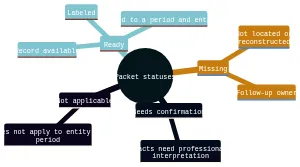
    • Ready: The record is available, labeled, tied to a period and entity, and stored at the listed location. Example: a reconciled ledger plus the related bank statement.
    • Missing: You expect the item to exist, but it has not been located or reconstructed. Name the follow-up owner and a target for locating it.
    • Needs confirmation: The packet contains facts, but a credentialed tax professional must interpret them. Example: “Texas activity began in July; confirm review implications.”
    • Not applicable: The module genuinely does not apply to that entity or period. Add a brief reason, such as “no employees during this period.”

    Create separate rows for documented facts, estimates, and questions. An estimate should identify who prepared it, the period it covers, the inputs used, and why source records are incomplete. Do not place an estimate in the same folder or row as documented payment evidence. Incomplete records may lead preparers to consider estimates, but incomplete records do not assure that an estimate can be used. Keep the missing support visible and ask for professional review.

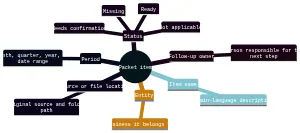
    A mind map showing four packet statuses: Ready, Missing, Needs confirmation, and Not applicable, with the meaning of each status.
    Use these four statuses to make available records, gaps, and items needing professional review visible.

    Checklist: Gather bookkeeping records and payment evidence

    Begin with the records that explain how your books were built. The IRS says a recordkeeping system may be suited to your business if it clearly shows income and expenses. Electronic records follow the same basic recordkeeping principles as hard-copy records.

    Bookkeeping records

    • Transaction summary from your accounting journals, ledgers, or bookkeeping system.
    • Current profit-and-loss statement, balance sheet, and any account-reconciliation workpapers available for review.
    • Business bank-account statements, with the covered period, entity, and file location recorded.
    • Business credit-card statements and payment-platform summaries.
    • A list of accounts that are not reconciled, with the last completed period and follow-up owner.
    • A short note identifying bookkeeping changes, new software, changed chart-of-account categories, or records maintained outside the usual system.

    For most small businesses, the business checking account is a main source of entries in the books. It is a starting point, not a substitute for keeping the supporting records behind transactions.

    Income and payment evidence

    • Sales summaries, invoices, receipt books, cash-register reports, deposit information, and applicable Forms 1099-MISC.
    • A gross-receipts schedule that identifies the amount and source of receipts by period.
    • Paid bills, invoices, receipts, canceled checks, account statements, and electronic-payment confirmations for purchases and expenses.
    • For each material purchase or expense, support showing the payee, amount, proof of payment, date, and description of the item or service.
    • A list of deposits, transfers, refunds, or charges that cannot yet be matched to the books.

    Organize supporting documents by year and by income or expense type, then link each group to the related index row. One record may not show every detail. Retain the combination of records that documents the transaction rather than relying on a single screenshot or bank-line description.

    Boundary: Label unclear transactions as Needs confirmation. Do not decide whether a transaction has a particular tax treatment from the packet alone.

    Checklist: Add payroll, contractors, assets, and forecasts

    These modules connect current operations to the questions likely to arise in planning. Keep the facts and your projections distinct.

    Payroll and contractor records

    • Payroll registers or summaries by pay period and entity.
    • Payroll tax records and payment evidence available for the period.
    • Employee compensation changes, bonuses, new hires, departures, and benefit changes, labeled as documented facts.
    • Contractor payment records, invoices, agreements available for review, and payment evidence.
    • A list of workers or payments needing classification or reporting confirmation, without assigning a conclusion.

    The IRS states that employment records must be kept for at least four years. Confirm retention needs for your circumstances with the appropriate professional. Treat payroll, contractor, identity, and account information as sensitive.

    Business assets

    • Asset register or list of business assets, including equipment, furniture, vehicles, or other property used in the business.
    • Purchase invoices, payment support, dates placed in service when available, and sale or disposal records.
    • Planned asset purchases, separated from completed purchases and labeled as forecasts.
    • Questions about an asset’s use, ownership, sale, replacement, or related records.

    Keep business-asset records because they are needed to verify information for annual depreciation and gain or loss on sale. The packet should preserve the records; a credentialed tax professional should confirm the relevant treatment.

    Forecasts

    • Revenue forecast, showing the forecast period, preparer, assumptions, and source data.
    • Projected income and major expected expenses, clearly labeled as estimates.
    • Owner compensation plans, payroll expectations, and contractor-payment expectations.
    • Expected state activity, planned locations, and planned purchases.
    • A variance note identifying major differences between current bookkeeping records and the forecast.

    A planning packet can identify the entity, ownership, revenue, projected income, owner compensation, payroll, contractor payments, planned asset purchases, state activity, bookkeeping quality, and prior-year positions for professional review. Record what you know, identify the source, and flag what needs confirmation.

    Checklist: Connect prior-year documents to current business changes

    Prior-year documents provide context. Current business changes explain why a prior-year pattern may no longer describe the business.

    Prior-year documents

    • Prior-year tax returns for the entity and related financial statements available for the review.
    • Prior-year bookkeeping reports and year-end account balances, if available.
    • Prior-year asset schedules and records of asset sales or disposals.
    • Prior-year correspondence, notices, extensions, or unresolved items that the reviewing professional should see.
    • A short list of prior-year positions or questions that remain open, marked Needs confirmation.

    Include prior-year returns and financial statements so the reviewing professional can understand tax history and business financial information. Record the year, entity, source location, and whether the document is complete.

    Current business changes

    Create a separate change log with an effective date, source, status, and owner for each item:

    • Entity formation, conversion, merger, termination, or ownership change.
    • New or closed business locations.
    • New products, services, lines of business, or operating jurisdictions.
    • Material changes in revenue, staffing, payroll, contractors, or owner compensation.
    • New loans, financing, inventory practices, or significant contracts.
    • Planned purchases, sales, or disposals of business assets.
    • Out-of-state customers, employees, contractors, property, or operations.

    Describe the change factually. For example, write “Operations began in another state on [date]” rather than assigning a filing or nexus result. End each uncertain row with a direct question for professional review.

    Checklist: Flag Texas and out-of-state review topics without deciding them

    Add a Texas review module whenever the business was formed in Texas, has Texas activity, has changed entity status, or may have activity outside its formation state. This is a discussion list, not a filing position.

    • Entity name, entity type, formation jurisdiction, and governing-law information.
    • Texas business locations, employees, property, contractors, customers, and operational dates.
    • Out-of-state locations, employees, property, contractors, customers, and operational dates.
    • Dates of formation, registration, conversion, merger, termination, withdrawal, or cessation of activity.
    • Texas franchise tax correspondence, account information, prior reports or information reports available for review.
    • A timeline of when Texas or out-of-state activity began, changed, or ended.
    • Questions about nexus, registration, entity classification, and report requirements, all marked Needs confirmation.

    Texas franchise-tax rules apply to taxable entities formed or organized in Texas or doing business in Texas. Record the entity type and ask a credentialed tax professional to confirm its Texas franchise-tax treatment. For a Texas review, document where the entity was formed and what law governs its internal affairs; do not use the principal office location alone to classify it as domestic or foreign.

    Texas and out-of-state activity should be listed as a nexus and registration review topic. A Texas Nexus Questionnaire may be useful, but it does not provide a definitive registration answer. Texas registration can have tax, legal, and licensing consequences, so it requires appropriate professional review.

    If the business is terminating, converting, or merging, flag the change and dates for current Texas professional review. If an out-of-state entity may be ending Texas nexus, record the cessation date and seek current professional confirmation promptly.

    Prepare sensitive packet files for secure sharing

    Before sharing, identify documents containing payroll details, contractor information, payment-account data, taxpayer identification details, banking information, or other sensitive business records. Keep an orderly packet copy in your own records, with the same file names used in the index.

    Use the secure channel supplied by the reviewing practitioner when one is available, such as a client portal or secure email link. Do not send a collection of unlabeled attachments without the packet index. Upload by module where possible, then mark the corresponding row Ready only after confirming the correct file was shared.

    For every sensitive file, verify the period, entity, source or file location, status, and follow-up owner before sharing. If a document is unavailable, mark it Missing. If its meaning or completeness is uncertain, mark it Needs confirmation rather than editing it to appear complete.

    Turn open items into a focused meeting agenda

    Your final step is to turn every Needs confirmation row into a short meeting question. Keep each question tied to a document, period, entity, and decision point. This lets the meeting focus on the items that require professional judgment instead of searching for files.

    Bring questions such as:

    • “Which missing bookkeeping records should we reconstruct before further review?”
    • “What additional payment evidence would help explain these unmatched transactions?”
    • “How should we document the assumptions behind this forecast?”
    • “Which payroll or contractor records need follow-up?”
    • “What asset records should we locate for this purchase, sale, or planned acquisition?”
    • “What prior-year documents or unresolved items should be considered with current changes?”
    • “Which facts about our Texas activity, entity, locations, or out-of-state operations need further review?”
    • “Who owns each remaining Missing item, and what is the next follow-up step?”

    Review the index once more before the meeting. Confirm that every row has a status and owner, estimates are clearly separated from source records, and sensitive documents are ready for secure sharing. The result is a practical handoff: organized facts, visible gaps, and focused questions for a credentialed tax professional.

    Frequently asked questions about tax-planning review packets

    What should be included in a tax-planning review packet?

    Include bookkeeping records, payment evidence, payroll and contractor records, business assets, forecasts, prior-year documents, and any open business-change or Texas review topics. Keep each item tied to a period, entity, source, status, and follow-up owner.

    How should missing records be handled in the packet?

    Mark them as Missing and keep them visible. Add the period, entity, source location if known, and who is responsible for finding or reconstructing them. Do not fill gaps with assumptions.

    How should estimates be labeled alongside source records?

    Keep estimates separate from documented facts. Note who prepared the estimate, what period it covers, what inputs were used, and why the underlying records are incomplete. Flag it for professional review.

    What Texas items should be flagged for review?

    Record Texas formation, entity type, business activity, locations, and any out-of-state activity. Also flag nexus, registration, entity changes, termination, merger, or withdrawal questions for confirmation.

    How detailed should payment and expense support be?

    For each material transaction, keep support that shows the payee, amount, proof of payment, date, and what was purchased or received. One document may not cover everything, so keep the full set that explains the transaction.

    What prior-year materials are most useful to include?

    Prior-year returns, financial statements, year-end balances, asset schedules, and unresolved prior-year questions are helpful. They give the reviewing professional context for your current records and changes.

    How should sensitive files be shared for review?

    Use the secure portal or secure email link provided by the reviewing professional when available. Keep file names consistent with the packet index, and confirm the correct document, period, and entity before uploading.

  • Breast Fat Transfer Consultation Brief: A Two-Area Guide for Beverly Hills

    Breast Fat Transfer Consultation Brief: A Two-Area Guide for Beverly Hills

    Start With a Two-Area Trade-Off

    Before comparing procedures, write two short statements: what you want changed, and what uncertainty you can discuss. Keep those statements separate.

    Statement one: your breast-area goal. Note whether you want to discuss fullness, cleavage, contour, or symmetry. Do not turn that preference into a predicted result. [cont10-retest-20260906]

    Statement two: your trade-off question. Ask whether donor-area liposuction and possible fat resorption fit the conversation, or whether an implant device and its ongoing responsibilities also need review.

    This sequence creates a clearer consultation starting point. First, describe the breast change. Next, identify the trade-off that matters most. Then ask whether fat transfer, implants, or both approaches should be discussed.

    Fat transfer uses liposuction to remove fat from another area, then places it in the breasts. ASPS describes it as an option for women seeking a relatively small size increase and natural results. Another ASPS source describes fat grafting as providing moderate enlargement and shape improvement. Some transferred fat is resorbed after surgery.

    Implants create a separate device discussion. FDA materials state that breast implants are not lifetime devices. They also require ongoing monitoring. If implants remain part of your questions, record those device responsibilities separately.

    Bring your two statements to a consultation with a board-certified plastic surgeon. Ask which parts require personal assessment, what remains uncertain, and how each option would address the goal you described.

    How Breast Fat Transfer Works

    Fat transfer is a two-area procedure. It involves a donor area and the breasts.

    First, a surgeon uses liposuction to remove fat from another part of your body. Common donor areas described by ASPS include the abdomen, hips, and love handles. The available donor area is therefore part of the consultation. It is not a separate detail.

    Next, the harvested fat is processed in the operating room. In the described process, the surgeon places processed fat into small syringes. The fat is then injected into breast tissue.

    This sequence matters when you compare options. Fat transfer does not only concern breast shape. It also includes liposuction in the selected donor area. Ask the surgeon to explain how both areas fit into the proposed plan.

    Useful questions include:

    • Which donor areas would you assess for me?
    • Why are those areas appropriate for discussion?
    • How would the fat be processed and placed?
    • What breast-shape goals can the proposed placement address?
    • How would you assess existing breast asymmetry?
    • What should I understand about the donor-area portion of surgery?

    A consultation should make the steps understandable in plain language. You should be able to repeat back the plan: where fat may come from, how it is handled, and what it is intended to add to the breast. If that description remains unclear, pause and ask for clarification before choosing an approach.

    A three-step breast fat transfer process: remove fat with liposuction, process it in the operating room, and inject it into breast tissue.
    Breast fat transfer follows a simple donor-to-processing-to-injection sequence.

    Match Your Goal to the Fat-Transfer Path

    Use the comparison as a note-taking tool. It separates questions by where they belong.

    Question lane Fat-transfer notes Implant notes
    What is involved? Liposuction removes fat from another body area. Processed fat is injected into the breasts. A breast implant device is used.
    What change is described? ASPS sources describe relatively small or moderate enlargement and shape improvement. Review the specific device and its labeling.
    What needs careful discussion? Donor areas, breast shape, symmetry, and resorption uncertainty. Risks, monitoring, and possible future surgery.
    What belongs in your record? The intended breast change and questions about both procedure areas. The proposed device and its patient information.

    This format does not decide which approach fits you. It helps prevent one broad preference, such as “natural,” from hiding several different questions.

    For the breast portion, describe the appearance you want to discuss. You might note fullness, cleavage, contour, or balance between breasts. For the donor-area portion, ask what role liposuction would play in the proposed plan. If implants remain under consideration, use a separate device note rather than blending those questions into the fat-transfer discussion.

    Visual references can help explain a preference. Describe what you notice in them instead of treating them as a personal forecast. A clear description gives the surgeon a better starting point for discussing options and limitations.

    Fat Retention Is an Important Uncertainty

    Fat retention deserves a direct discussion. Some transferred fat is resorbed after surgery. That is a core limitation of fat grafting.

    A 2016 systematic review included 22 articles involving 3,565 patients. Follow-up ranged from 12 to 136 months. The review reported mean retained volume of 62.4%, with wide variation across included studies. The reported range was 44.7% to 82.6%.

    Those figures are not a forecast for you. They summarize older, study-level findings across different included studies. They do show why a consultation should not promise a precise final volume or a fixed degree of retained fat. The review also called for more research into factors affecting retention.

    Ask direct questions instead:

    • How do you explain resorption uncertainty to patients?
    • What change is realistic to discuss for my goals?
    • How would uncertainty affect the plan?
    • Could more than one procedure become a discussion point?
    • How would you assess whether my donor areas support the goal?
    • What would you consider a reasonable expectation in my case?

    You do not need a guaranteed number to make progress. You need a clear explanation of what remains uncertain. A useful consultation separates the intended change from what cannot be predicted in advance. That distinction helps you compare fat transfer with implants without assuming either option provides certainty.

    Fat-Transfer Risks, Imaging, and Evidence Gaps to Discuss

    Ask about risks and follow-up without expecting a one-size-fits-all answer. The available evidence here needs careful interpretation.

    The 2016 systematic review reported a pooled complication rate of 17.2% in cosmetic breast fat-grafting studies. This is study-level evidence, not an individual risk prediction. The review identified indurations, persistent pain, and hematoma among the most frequently reported complications.

    The same review reported mammographic micro-calcifications and macro-calcifications in included fat-grafting studies. It also called for further research on cancer occurrence and detection after cosmetic breast fat grafting.

    These findings are reasons for a focused discussion. They are not a basis for predicting what will happen to you. Ask the surgeon how they address risk, what follow-up they recommend, and how you should communicate your surgical history to clinicians involved in future breast imaging.

    Use this question set:

    • What risks do you discuss for breast fat transfer?
    • Which risks relate to the breasts, donor areas, or both?
    • How are complications handled if they occur?
    • What breast imaging or screening questions should I raise?
    • What records should I keep for future care?
    • What follow-up plan would you recommend after surgery?

    A clinician should tailor those answers to your medical assessment. Do not rely on a review statistic, online images, or another person’s experience to replace that assessment. Clear uncertainty is part of informed decision-making.

    If You Also Review Implants

    If an implant option remains part of your visit, request the specific patient labeling and safety information. FDA materials advise reviewing these records for the implant under consideration.

    Keep breast-imaging questions in that same implant note. If you have implants, follow your clinician’s imaging instructions and tell the mammography facility about them. For silicone gel-filled implants, clarify whether MRI or ultrasound monitoring is recommended.

    FDA materials list BIA-ALCL among implant risks. Have the clinician explain relevant risks for the option under review. Keep this device review separate from your questions about donor areas, fat placement, and resorption.

    When a Combined Fat-Transfer and Implant Approach Is Worth Discussing

    A combined plan has separate parts to explain. Some surgeons use fat transfer with implants for additional breast shaping.

    Use a three-part note if this option is raised. Label the parts implant, donor area, and fat placement. Under each label, record its intended purpose in the proposed plan.

    The implant note should cover the specific device, its labeling, risks, monitoring, and possible future surgery. The donor-area note should cover the liposuction portion of surgery. The fat-placement note should cover the breast-shape goal and the uncertainty created by fat resorption.

    This structure matters because one explanation should not stand in for all three parts. Ask the surgeon to state the purpose of each part in plain language. Record whether it is intended to address volume, shaping, symmetry, or another stated goal.

    Questions for this format include:

    • What purpose does the implant serve?
    • What purpose does the fat placement serve?
    • Which donor areas are part of the discussion?
    • Which uncertainties apply to each part?
    • How would follow-up address the implant and fat-transfer portions?

    Leave any unanswered item open. A combined plan needs a clear explanation before it can be compared with either approach alone.

    Build a Fat-Transfer Consultation Brief

    Bring a short two-area consultation brief. It organizes the questions that fat transfer creates before any implant discussion begins.

    Breast-area page. State the change you want to discuss. Note shape, cleavage, upper-breast fullness, and asymmetry if relevant. Add what you do not want. Then ask what the proposed fat placement is intended to address.

    Donor-area page. List the areas you want explained. Ask how liposuction would fit into the proposed procedure. Write down questions about the donor-area portion of surgery and its follow-up.

    Uncertainty line. Write that some transferred fat is resorbed after surgery. Ask how the surgeon explains that uncertainty in relation to your stated goals. Do not turn a study average into a personal prediction.

    Optional implant page. Add this page only if an implant remains under review. Request the specific device labeling and safety information. Record questions about monitoring, complications, and possible future surgery separately from your fat-transfer notes.

    Safety and setting line. Confirm whether the surgeon is certified by the American Board of Plastic Surgery. Review relevant training, hospital privileges, and facility accreditation or licensing.

    Support and follow-up line. Clarify where and how the procedure would be performed. Discuss recovery support, complication handling, and follow-up.

    This brief is not a scorecard or a candidacy test. It gives you a clear record of the questions tied to each part of the discussion. Bring it to a board-certified plastic surgeon and leave space for answers in the surgeon’s own words.

    Turn Your Priorities Into a Clear Discussion

    A productive consultation begins with a clear trade-off. Fat transfer involves donor-area liposuction, breast injection, and resorption uncertainty. Implants require a device-specific discussion, monitoring, and review of possible complications. A combined approach may also deserve discussion when both volume and shaping matter.

    Bring your written priorities. Include breast shape, symmetry, donor areas, implant concerns, follow-up, imaging questions, and the recovery support you may need. Ask how the procedure would be performed, how complications are handled, and what results are reasonable for you.

    Choose a board-certified plastic surgeon for the discussion. The goal is not to select an option from a checklist. It is to understand which questions need an individualized medical assessment before you move forward.


    Frequently Asked Questions About Choosing a Surgeon and Facility

    What does breast fat transfer involve?

    It uses liposuction to remove fat from one area. The fat is then processed and injected into the breasts.

    How is fat transfer different from implants?

    Fat transfer uses your own tissue. Implants use a device and come with ongoing monitoring needs.

    What should you expect from fat transfer results?

    It may suit a smaller increase and shape improvement. Some transferred fat is resorbed after surgery.

    What risks should you discuss before choosing fat transfer?

    Ask about donor-area healing, breast changes, and complications. Also ask how follow-up and imaging are handled.

    What should you ask about if implants are part of the discussion?

    Ask for the specific implant labeling, risks, and monitoring plan. Implants are not lifetime devices.

    Can fat transfer and implants be used together?

    Yes, some surgeons discuss both together. The plan should clearly explain each part’s purpose and trade-offs.

    Who should you choose for this consultation?

    Choose a board-certified plastic surgeon. Ask open questions about goals, expectations, and reasonable results.


  • Three Anatomical Trade-Offs Behind Breast-Augmentation Goals

    Three Anatomical Trade-Offs Behind Breast-Augmentation Goals

    Three appearance goals, each with a different trade-off

    Words such as fullness, unevenness, and softness can seem self-explanatory in a breast-augmentation conversation. They are not. Each can describe more than one visible feature, and those features may lead attention to different anatomical reference points.

    This feature uses three illustrative, non-identifying narratives as a language-to-anatomy reading exercise. They are not patient cases, a self-assessment method, or a recommendation for a particular procedure. In each narrative, an ordinary appearance word is separated into the features it may be describing before considering what a surgeon may evaluate.

    Fullness may refer to the breast’s horizontal footprint, forward projection, or upper-breast contour. Unevenness may refer to volume, nipple level, breast-fold position, skin excess, or how each breast sits on the chest. Softness may refer to a preferred upper-pole transition, tissue coverage, or both. The point is not to assign a technical explanation to a reader’s observation. It is to keep different meanings from being compressed into one conclusion.

    Across all three narratives, breast shape after augmentation reflects both the implant and the existing skin, glandular tissue, and fat coverage. Planning may consider those features with breast shape and a person’s goals. General information can clarify the meaning of an appearance word; it cannot determine an individual plan.

    The reference points that keep one visual goal from standing in for another

    A visual description becomes more useful when it identifies the feature it is describing. A surgeon may evaluate chest-wall width, breast-base width, nipple and breast-fold measurements, tissue thickness in several areas, cleavage, and nipple position relative to the sternal notch. These observations may help guide discussion of implant width, height, and projection.

    Rather than treating these as a formula, this article uses them as a way to distinguish meanings that everyday appearance words can combine. A request for “more fullness,” for example, may be about horizontal breadth, forward projection, or upper-breast contour. The same stated volume can therefore leave the central visual priority unclear. In the cited planning approach, breast dimensions provide the starting context for considering volume, along with implant width and, where relevant, height and tissue characteristics.

    Vertical landmarks add another layer of meaning. Nipple level, the nipple-to-inframammary-fold relationship, breast descent, and skin excess may all be relevant to how shape is discussed. The breast fold helps define the lower boundary of the breast, and its position may differ between sides. A description of one breast as “lower” may therefore refer to more than one landmark.

    The chest also changes how a visual word is read. Chest-wall contour and side-to-side rib-cage differences may influence breast position, spacing, and direction. An apparent gap or directional difference is not necessarily a statement about breast volume.

    This creates a different kind of reading task. First, identify the appearance word being used. Next, separate the distinct features that word could describe: horizontal setting, vertical position, coverage, or side-to-side context. Then recognize that a clinical evaluation is needed to establish which features are relevant. The purpose is not to select a technique or turn anatomy into a reader exercise. It is to make the observation itself clearer.

    For example, breast-base and chest-wall width can provide context when “fullness” means breadth. Nipple level and the breast fold can provide context when “uneven” means one breast appears higher or lower. Tissue thickness can provide context when “soft” refers to the transition over the upper breast. Cleavage and chest-wall contour can help distinguish spacing from breast size. Skin excess or breast descent may add yet another meaning to a description of shape.

    A single visual concern can include several of these meanings at once. The point is not to isolate one feature as the answer or rank one feature above another. It is to avoid converting an ambiguous appearance word into a premature technical conclusion. General information can clarify the vocabulary of a concern; individualized evaluation is what connects that concern with planning.

    A mind map of the factors a surgeon may evaluate when a desired breast volume is considered: breast dimensions, position, tissue, and side-to-side differences.
    A volume preference is assessed alongside breast shape, tissue, position, and chest-wall differences.

    A narrow base: balancing breadth, projection, and upper contour

    Consider an illustrative person with a relatively narrow breast footprint who wants more fullness. The important tension is not simply whether more volume is desired. It is whether the desired change is mainly about a broader horizontal presence, more forward projection, a fuller upper contour, or a combination of those priorities.

    A surgeon may evaluate breast-base width with chest-wall width and contour, then consider breast shape, cleavage, tissue thickness, nipple-to-fold relationships, and the skin envelope. Those observations describe the horizontal and vertical setting in which a fullness goal is being considered. Measurements may help guide discussion of implant width, height, and projection.

    Breadth, projection, and upper-pole contour are related but distinct visual directions. Greater breadth concerns how the breast occupies space across the chest. Projection concerns forward contour. Upper-breast fullness concerns the transition above the nipple. Breast shape, tissue characteristics, and the skin envelope can add context to each direction, while nipple level and fold position keep the discussion connected to the breast’s vertical frame.

    The trade-off revealed by this narrative is one of emphasis. A person may use one word, fullness, for several priorities that cannot be assumed to carry equal weight. Evaluation does not convert those priorities into an automatic answer. It makes the competing meanings visible so that fit, shape, and contour can be discussed as separate parts of the same goal.

    Unevenness: separating volume from the breast’s vertical frame

    Consider an illustrative person who notices that one breast appears smaller or lower than the other. Volume may be part of what is visible, but the central trade-off is between describing the difference as size alone and preserving the several landmarks that can contribute to apparent unevenness.

    A surgeon may compare breast-base dimensions, nipple and fold relationships, tissue thickness, cleavage, and the position of each breast on the chest. Skin excess or breast descent may also be relevant. Chest-wall contour and side-to-side rib-cage differences may influence spacing and direction, providing context that a volume comparison alone cannot supply.

    The breast fold helps define the lower boundary of the breast, while nipple level is a separate vertical reference. Along with breast shape and the skin envelope, these landmarks can help distinguish whether the visible difference concerns position, shape, volume, or more than one feature. They do not establish how an individual difference would be addressed.

    This narrative therefore keeps asymmetry descriptive rather than reductive. Existing asymmetry and overall chest and body shape may remain noticeable or become more apparent. That is not an individual forecast. It explains why a discussion centered on one side appearing lower or smaller may need to retain the breast’s vertical frame and chest-wall setting rather than treating unevenness as a single volume problem.

    Softness: distinguishing a contour preference from tissue coverage

    The third illustration begins with soft. A person may mean a softer upper-pole transition, may notice relatively thin tissue over the upper breast, or may be describing both. The trade-off is between treating these as one preference and recognizing that contour and coverage refer to different parts of the planning picture.

    Evaluation may include tissue thickness in several areas, breast-base dimensions, breast shape, the skin envelope, and nipple and fold relationships. A desired upper-breast transition is an appearance priority. Coverage concerns the tissue environment in which that priority is considered.

    When soft-tissue coverage is limited, implant palpability, visible edges, and rippling may become relevant considerations. This does not establish that these features will occur for a particular person, and it does not identify a particular surgical response. It explains why a description of a preferred contour can lead to a separate discussion about coverage.

    The trade-off is not between fixed labels such as “natural” and “full.” It may involve upper-pole fullness, slope, softness, edge visibility, and the coverage already present. Surgical planning can include decisions about implant dimensions and type, pocket position, and incision location, but the word soft does not determine one technique.

    Coverage is a consideration, not a built-in solution

    Once limited coverage is part of the anatomical picture, the appropriate next step is still not to assign a procedure. The literature describes several clinical approaches that may be discussed when soft-tissue coverage is limited, including different implant-pocket strategies and, in some circumstances, combining an implant with a person’s own fat.

    Composite augmentation refers to combining an implant with a person’s own fat, with distinct roles for core volume and overlying soft-tissue or shape refinement. That definition clarifies the subject under discussion without making composite augmentation a default answer to thin tissue, an upper-pole preference, or any other visible concern. Whether an approach is relevant depends on individualized evaluation.

    The evidence base also requires caution. A 2019 systematic review of primary composite augmentation identified five studies totaling 382 patients. The available literature was largely retrospective, single-institution case series, and the review noted that higher-level evidence is needed. Composite augmentation is therefore an evolving clinical topic rather than a general planning endpoint.

    In this feature, the value of raising coverage is narrower: it shows why tissue thickness may be a separate reference point from volume and contour. Naming that distinction can make the anatomy behind a planning conversation clearer.

    The cross-case lesson: identify the trade-off before naming the goal

    These three narratives do not sort people into procedure categories. They show how three ordinary appearance words can point in different directions. Fullness may point to breadth, projection, or upper contour. Unevenness may point to volume, vertical landmarks, or the chest beneath the breasts. Softness may point to contour preference, tissue coverage, or both.

    The same visual description can involve more than one reference point. Breast shape, nipple and fold position, skin excess or descent, tissue coverage, breast-base fit, and chest-wall differences may overlap in a single discussion. The useful distinction is not which feature is the answer, but which feature gives the stated word its most specific meaning.

    For women in Beverly Hills considering breast augmentation, general information can help separate what is being noticed from the conclusion that might otherwise be attached to it. A qualified surgeon can then connect the clarified observation with an individualized evaluation and explain which planning considerations are relevant. General information cannot produce a guaranteed contour, identical breasts, or an individual outcome.

    Schedule a breast augmentation consultation.


    Frequently asked questions about anatomy-related trade-offs in breast augmentation

    What anatomical reference points may be reviewed during breast augmentation planning?

    A surgeon may evaluate chest-wall width, breast-base width, nipple and fold position, tissue thickness, cleavage, skin excess or breast descent, and side-to-side differences. These observations provide context for discussing volume, shape, and contour.

    How do breast-base and chest-wall dimensions affect a fullness discussion?

    They provide context for the breast’s horizontal setting. A concern about fullness may involve breadth across the chest, forward projection, upper-breast contour, or more than one of these features. Measurements may help guide discussion of implant width, height, and projection.

    Why are nipple level and breast-fold position relevant when breasts appear uneven?

    They are separate vertical landmarks. Differences in nipple level, fold position, breast shape, skin excess, breast descent, and chest-wall contour can each contribute to an uneven appearance beyond a difference in volume.

    How is tissue coverage different from a softer upper-pole preference?

    Tissue coverage concerns the layer over an implant, while a softer upper-pole preference concerns contour. When coverage is limited, palpability, visible edges, and rippling may become relevant considerations without predicting that they will occur for an individual.

    Does limited tissue coverage determine a particular technique?

    No. Clinicians may discuss different approaches, including implant-pocket strategies and, in some circumstances, composite augmentation. Whether any approach is relevant requires individualized evaluation, and the evidence for composite approaches has important limitations.

    What is the main purpose of an anatomy-first planning discussion?

    It connects a visible concern with the breast footprint, vertical landmarks, coverage, and chest-wall context that may be relevant. It does not select a procedure or predict an individual outcome.


  • Tax-Planning Meeting Packet: A Record Triage Guide

    Tax-Planning Meeting Packet: A Record Triage Guide

    Start with a record triage board

    Before gathering files, create a record triage board. Its purpose is to show a credentialed tax professional what is documented, what is incomplete, and what needs discussion. It does not decide deductions, tax liability, eligibility, filing obligations, or other tax positions.

    Use the board to identify the entity, period, source, status, and owner for every record group. Create separate groups for bookkeeping records, payroll and contractor records, business assets, and prior-year documents.
    The IRS says a business may use a recordkeeping system suited to its operations if it clearly shows income and expenses. Purchases, sales, payroll, and other transactions generate supporting documents, which support entries in business books and on a tax return. Your packet should make the connection between the summary and its available support easy to inspect.

    Begin with an index rather than a document pile. List each record group and its status. Leave an unavailable item visible. Record who will locate it and what question remains if it cannot be found.

    A recordkeeping system may be suited to the business if it clearly shows income and expenses; supporting documents support business-book entries and tax-return entries.

    Build an item card for each record or issue

    Treat each document, estimate, or question as an item card in your index. The card gives the reviewer enough context to locate the underlying file without opening every folder. Consistent file names and folders organized by year and document type support this approach.

    Item-card field Record Example
    Item Plain-language description August operating account statement
    Entity Business connected to the item ABC Services LLC
    Period Date range covered Aug. 2026
    Source Original location or file path Bank portal / 2026 / Cash activity
    Status Ready, Missing, Needs confirmation, or Not applicable Ready
    Owner Person taking the next step Owner

    A file name such as ABC-Services-LLC_2026-08_Operating-Account_Ready.pdf can mirror the card. Apply the same pattern to reports, invoices, payroll files, asset support, and prior-year materials.

    Use Ready only when the item is available and connected to the right entity and period. Use Missing when you expect support but cannot locate it. Use Needs confirmation for an estimate, incomplete information, or a professional-review question. Use Not applicable only with a brief reason. These labels describe the state of the material; they do not confirm tax treatment.

    Mind map showing the six fields used to label every tax-planning review packet item: item name, entity, period, source or file location, status, and follow-up owner. Status options are Ready, Missing, Needs confirmation, and Not applicable.
    Use the same six-field label to make every packet item searchable and review-ready.

    Route records, projections, and questions separately

    Use three routes on the triage board: evidence, planning inputs, and questions. Keeping them apart prevents an assumption from being mistaken for a completed transaction.

    Evidence is a source record or completed report, such as a bank statement, invoice, paid bill, deposit record, payroll report, receipt, canceled check, contract, or asset invoice. For purchases and expenses, the IRS describes records that identify the payee, amount, proof of payment, date, and the item or service. One document may not show every detail, so connect related records rather than treating a partial record as complete.

    Planning inputs include forecasts and estimates. Keep them in a separate worksheet that identifies the entity, period, preparation date, source, assumptions, and preparer. A projection based on signed work and a projection based on a sales pipeline may both be useful, but each should retain its own description and Needs confirmation status.

    Questions belong in a short decision log. For each one, state the known facts, linked files, missing support, and the specific matter to confirm.

    Material Route Status
    Completed source record Relevant evidence folder Ready
    Projection with assumptions Forecast worksheet Needs confirmation
    Expected but unlocated support Relevant folder and decision log Missing
    Irrelevant category Index with reason Not applicable

    This routing system helps the professional conversation begin with the actual gap instead of reconstructing it from mixed notes.

    Test the bookkeeping trail against payment support

    Use the transaction summary as the starting point for an evidence check. The IRS describes a transaction summary as part of a business recordkeeping system, commonly maintained in accounting journals or ledgers. Export the available reports for the review period, identify the entity, and note which accounts remain unreconciled.

    Create a short support map beside the reports. It can include:

    • Profit and loss statement, balance sheet, and general ledger.
    • Operating-account and card statements connected to business activity.
    • Reconciliations, plus a list of accounts still requiring work.
    • Sales summaries, invoices, deposit information, receipt books, or cash-register records.
    • Unusual, uncategorized, split, large, or personal transactions that need discussion.

    Then test material ledger lines against available support. The IRS recommends organizing supporting documents by year and income or expense type. For gross receipts, retain documents showing the amount and source. For purchases and expenses, gather available payee, amount, payment proof, date, and item or service information.

    Where one record lacks context, link it to another. Pair an invoice with a statement or transfer record when payment evidence is separate. Pair a payment record with a receipt, invoice, or vendor note when its purpose is unclear. Preserve the source documents and flag unresolved facts for review rather than assigning them a tax result.

    Create exception lists for compensation and assets

    Build two exception lists: one for compensation records and one for property records. This makes gaps visible without requiring you to classify a payment or calculate a tax outcome.

    For the compensation list, collect available payroll registers, provider reports, payment support, contractor invoices, agreements, payment summaries, and year-end materials. Mark files where the entity, period, description, or related bookkeeping entry does not match. Keep payroll and contractor materials separately labeled even when they relate to the same period.

    The IRS states that employment tax records should be kept for at least four years after the tax becomes due or is paid, whichever is later. Put retention questions on the decision log rather than applying a general timeline to a specific situation without review.

    For the property list, create one item card per business asset, such as equipment, furniture, vehicles, machinery, or other business property. The IRS says asset records are needed to compute annual depreciation and gain or loss on disposition. Gather available records for:

    • Description, entity owner, and business use.
    • Acquisition date, method, purchase price, and improvement costs.
    • Available deduction or depreciation history.
    • Sale, trade-in, retirement, damage, or other disposition details.
    • Invoices, closing statements, and payment support.

    Generally, retain property records until the limitation period expires for the year of disposition. If an asset changed use or left the business, attach the available facts and mark the item for professional review.

    Compare current plans with prior-year context

    Use a comparison page to connect current plans to earlier records and dated changes. Divide it into three panels: forward-looking inputs, prior-year reference, and change events.

    In the forward-looking panel, list available projections for revenue, owner compensation, payroll, contractor payments, planned asset purchases, and state activity. A tax-planning workflow may gather entity, ownership, revenue, projections, compensation, payroll, contractor, asset, state-activity, bookkeeping, and prior-year-position information. For each projection, name its source and assumptions. State whether it is based on a signed agreement, budget, sales pipeline, or informal estimate.

    In the prior-year panel, include filed tax returns, financial statements, bookkeeping reports, and available carryforward details or notes. The IRS notes that copies of filed tax returns can help with future returns and amended-return computations. These documents provide context; they do not establish the right treatment for the current period.

    In the change-events panel, make a dated timeline for:

    • Entity formation, conversion, merger, termination, or ownership changes.
    • Compensation changes or new owners.
    • New, closed, remote, or out-of-state locations and operations.
    • Major contracts, payment channels, or operational changes.
    • Purchases, sales, or changes in use of business property.

    Attach the available source document and one review question to each event. For example: “Conversion completed in May; confirm which current-period records and review topics are relevant.”

    Make a state-activity fact sheet

    Create a state-activity fact sheet when business activity extends beyond one state or raises Texas questions. Record facts first: where the entity is formed, where work occurs, where people and property are located, and when activity began, changed, or ended. Do not use the sheet to decide nexus, registration, franchise-tax status, or filing obligations.

    The Texas Comptroller describes Texas franchise tax as a privilege tax imposed on each taxable entity formed or organized in Texas or doing business in Texas. Texas Secretary of State guidance says a foreign entity’s registration need depends on the nature and extent of its Texas activities. Documenting the activity creates a clearer basis for entity-specific confirmation.

    Include, when available:

    • Formation documents and current entity details.
    • Texas and out-of-state locations, projects, inventory, employees, and contractors.
    • Dates for activity in each state.
    • Ownership, conversion, merger, termination, or withdrawal records.
    • Prior Texas filings, notices, or correspondence.
    • Open questions about franchise tax, nexus, registration, or other state activity.

    For reports due in 2024 and later under Texas Comptroller guidance, entities at or below the no-tax-due threshold may still need to file an annual information report. Confirm current requirements and entity-specific obligations before acting.

    Ask the credentialed tax professional: Which Texas franchise-tax topics need review? Do the documented locations, personnel, contractors, inventory, or activities raise a nexus question? Does another state require a separate review? Did an entity or ownership change create a current-period follow-up? Which facts or files are still needed?

    For each state-activity entry, use a compact row: activity or change, entity, location, start and end date if known, source, status, and question owner. For example, record a new project location as a documented fact, attach the available agreement or internal record, and keep any registration or nexus question separate. This format lets the reviewer distinguish an ongoing activity from a historical change and see whether the date or source still needs confirmation. If you do not know when activity began or ended, leave that field visible as Missing rather than estimating a date.

    Hand off an indexed set of open decisions

    The final handoff is an index, not a claim that every matter is resolved. Before sharing it, scan the item cards and decision log for missing fields, duplicate files, and unclear owners.

    Use this final check:

    • Verify every item identifies an entity, period, source, status, and follow-up owner.
    • Check that transaction summaries have linked support or a visible gap.
    • Keep projections separate from completed records and retain their assumptions.
    • Confirm each Missing item has a next step and responsible person.
    • Review the change-events timeline and state-activity fact sheet for supporting files.
    • Share sensitive bank, payroll, payment, and identity information only through an appropriate secure method.
    • Restrict access to sensitive tax documents with strong passwords and multifactor authentication where available.
    • Keep electronic files organized under the same basic recordkeeping principles that apply to hard-copy records.
    • Preserve records supporting reported income, deductions, or credits until the applicable limitation period expires, and ask the reviewing professional about retention questions affecting your circumstances.

    Packet-preparation guidance can organize, label, flag, and prepare materials for secure professional review. It does not determine deductions, liability, eligibility, filing obligations, entity status, Texas nexus, or another tax position.

    A useful meeting packet makes the evidence trail, unavailable support, forecasts, changes, and unanswered questions visible at the same time.

    Tax-planning review packet FAQ

    What should be in a meeting-ready tax-planning review packet?

    Keep each item tied to a period, source, status, and follow-up owner.

    How should I label items in the packet?

    Use one consistent label for every item: item name, entity, period, source or file location, status, and follow-up owner. That makes it easier to see what is ready, missing, or still needs confirmation.

    How do I separate estimates from documented records?

    Put source documents in the applicable records module and keep forecasts in a separate forecasts section with their assumptions noted. If a figure is only projected or incomplete, mark it as needs confirmation rather than treating it like a completed transaction.

    What Texas topics belong in the review packet?

    Use the Texas section for entity facts, locations, ownership changes, new or closed activity, and any questions about franchise tax, nexus, registration, or out-of-state operations. Treat these as review topics and confirm the filing position with a credentialed tax professional.

    How should I share the packet securely?

    Share it through an appropriate secure method and limit access to sensitive banking, payroll, payment, and identity information. Keep digital files organized and protected with strong passwords and multifactor authentication where available.

  • Breast Augmentation Revision Claims in Beverly Hills: A Pre-Consultation Question Path

    Breast Augmentation Revision Claims in Beverly Hills: A Pre-Consultation Question Path

    A Revision Guarantee Is Meaningful Only in Writing

    Before comparing detailed terms, run a simple pre-consultation screen. Ask whether the surgeon is board-certified, then request the complete current policy in writing.

    First, check whether the provider has stated a revision policy at all. Next, identify whether any separate document describes the proposed implant warranty. Finally, ask what routine follow-up the practice plans to provide.

    Record each answer separately. Mark missing, verbal, or outdated information as unconfirmed. This screen helps you decide what to clarify before scheduling or moving forward.

    A written policy still does not predict your result. It cannot determine whether you will need revision surgery. It also cannot establish whether revision would be clinically appropriate, approved, or available for your situation. Those questions require an individualized discussion with a qualified surgeon.

    Use the three separate records to prepare for that discussion: the provider policy, the manufacturer warranty, and the follow-up plan.

    Keep Provider Policy, Implant Warranty, and Follow-Up Separate

    Treat these as three separate columns in your notes.

    Provider revision policy. This is the practice’s own written commitment. It may describe situations in which the practice will review a concern or consider revision. Its terms may include eligibility rules, exclusions, timing limits, documentation, and decision authority. A provider policy is not the same as a manufacturer warranty.

    Implant manufacturer warranty. This is tied to a particular device and manufacturer. It may address a qualifying product event, such as rupture or deflation. It does not automatically promise a surgical revision, a particular appearance, or every expense connected with care. The proposed implant and current warranty document control.

    Routine postoperative and long-term follow-up. This describes care and surveillance after surgery. It may include scheduled visits, reassessment, and discussion of concerns. Follow-up is not a revision guarantee. A plan to monitor you does not mean revision will be needed, offered, or approved.

    Write each answer in its own column. If a representative blends two columns, ask them to separate the terms. That simple step can reveal whether a statement describes product protection, clinical care, or a provider commitment.

    A consent-framework article recommends asking what postoperative and long-term implant surveillance a practice plans to provide. Use that question alongside the policy questions. Keep the answers distinct.

    A mind map showing three separate subjects: provider revision policy, implant manufacturer warranty, and routine postoperative follow-up.
    Keep provider policy, implant warranty, and follow-up as separate terms.

    Why You Should Ask About Possible Future Surgery

    Asking about revision does not mean you expect a problem. It means you are considering the full scope of implant surgery.

    Breast revision surgery may address scarring or revise the implant pocket to improve breast shape. Breast appearance can also change after pregnancy, nursing, weight changes, aging, or gravity. These changes may occur independently of a provider’s policy.

    Implant surgery may not be a one-time procedure. Breast implants are not lifetime devices. Future implant surgery may be needed for replacement or removal. Ask how the provider discusses that possibility before you proceed.

    Also ask what changes may remain if implants are later removed. Some breast changes after augmentation may not be reversible.
    The goal is not to predict revision. The goal is to understand the policy boundary before surgery. A clear answer should tell you what the policy addresses. It should not imply that revision is inevitable or guaranteed.

    Read a Provider Revision Claim Before You Rely on It

    Read a revision claim as a starting point for one conversation. Do not treat it as a complete promise.

    Begin with the exact words used in the claim. Then ask the provider to explain what those words mean. A claim may describe a review of a concern. It may describe a clinical assessment. It may describe possible revision in limited circumstances. Those are different statements.

    Use this reading path.

    First, identify the stated concern.

    • What concern does the claim name?
    • Does it mention scarring, implant position, or an implant pocket?
    • Does it describe a complication, an appearance concern, or neither?
    • Does it say what the practice will do first?

    Next, identify the limits.

    • Which situations does the statement exclude?
    • Does it address changes after pregnancy, nursing, weight changes, aging, or gravity?
    • Does it apply after surgery by another provider?
    • Does later surgery change the stated terms?

    Then, identify the individual decision.

    • Who evaluates a concern?
    • What examination or records inform that evaluation?
    • How will the surgeon consider your anatomy and health history?
    • What alternatives might be discussed?

    Request the complete current terms in writing only after you understand these questions. Confirm the document date, eligibility conditions, exclusions, timing, documentation, and who decides whether the terms apply.

    Clinical appropriateness depends on the reason for surgery, implant type, and your health history. A medical-policy source distinguishes clinically indicated implant procedures from procedures sought mainly for aesthetic change. That distinction is not an individual coverage decision. It explains why a general claim cannot replace a surgical assessment.

    If a provider cannot explain a term, leave that point open for consultation. Do not turn missing details into an assumption.

    Identify the Separate Implant-Warranty Questions

    Move from a provider claim to a separate device conversation. A manufacturer warranty concerns a particular implant and its current terms. It does not answer whether revision would be clinically appropriate.

    Start by identifying the proposed device. Ask for the manufacturer, model, fill type, current patient brochure, and current warranty document.

    Then ask the manufacturer questions in order.

    What event is described?

    • Does the document address rupture, deflation, or another listed event?
    • What makes that event qualify?
    • What information confirms it?

    What support is described?

    • Does the document describe a replacement implant?
    • Does it describe support connected with a qualifying event?
    • What support does the document not describe?

    What conditions apply?

    • What time limits apply?
    • What eligibility rules apply?
    • Who submits required materials?
    • Which records, tests, or implant details are needed?
    • Would a later implant exchange affect the terms?

    Current MENTOR materials show why these questions matter. They describe replacement implants for qualifying rupture or deflation. They also describe additional support for certain qualifying events within stated periods. Those terms are device-specific and date-sensitive. Confirm the current documents for the exact implant discussed with you.

    Review current implant labeling with your surgeon, including long-term complications and BIA-ALCL information. Ask for time to read the proposed implant brochure before deciding.

    If the proposed device changes, restart this device conversation with updated materials. Do not carry an assumption from one implant to another.

    Map the Follow-Up Conversation Separately

    Follow-up is a third conversation. It concerns how the practice will receive and assess a concern after surgery. It is not a promise about revision.

    Ask the practice to describe the follow-up path from surgery through later implant questions.

    Start with planned care.

    • Who provides postoperative visits?
    • Which visits are planned after surgery?
    • How will you receive instructions and appointment details?
    • Which records will you receive and keep?

    Then ask how concerns reach the team.

    • How should you contact the practice between visits?
    • Who responds to a change in shape, position, scarring, or discomfort?
    • What information should you provide?
    • When should you request reassessment?

    Finish with longer-term communication.

    A cited consent framework recommends postoperative surveillance through suture removal and ideally while an implant remains in place. That is a framework recommendation. It does not show that any practice provides a particular schedule.

    Record the practice’s actual answer in plain language. A follow-up path can clarify whom to contact. It cannot predict a diagnosis, revision, approval, or result.

    Use a Question Path Before You Schedule

    Use this path before scheduling or moving forward. It is not a post-consultation policy audit. Its purpose is to show which conversation you still need.

    Identify a provider claim.
    If yes, clarify what concern it addresses, what limits apply, and who makes an individualized decision. Request the current written terms after the provider explains the claim.

    Check for a device statement.
    If yes, identify the exact proposed implant. Request its current brochure and manufacturer warranty. Clarify which qualifying event, conditions, and time limits the document describes.

    Separate a follow-up statement.
    If yes, confirm who provides care, how concerns are reported, and how long-term implant questions are handled.

    Test whether terms were blended.
    A manufacturer document covers device terms, while provider-policy questions require the practice’s written answer. A follow-up visit describes care after surgery, not warranty terms. Whether a revision is needed or appropriate requires an individualized clinical assessment.

    List what remains open.
    Write only the unresolved question. For example: “Who decides whether this provider term applies?” or “Which current warranty applies to my proposed implant?” Bring that question to the surgeon.

    This path helps you avoid relying on a broad guarantee phrase. It does not choose a provider. It does not establish medical necessity, coverage, eligibility, approval, or a specific outcome.

    Questions to Bring to Your Breast Augmentation Consultation

    Bring your worksheet to the consultation. Have the surgeon explain each answer in plain language.

    Discuss your goals

    • What change are you seeking?
    • What limits does your anatomy place on that goal?
    • How will you evaluate proportion, shape, and symmetry?
    • What alternatives should you consider?

    Clarify the proposed implant

    • Which manufacturer, model, size, and fill type are you proposing?
    • Why does that device fit my goals and health history?
    • May I receive the current product brochure?
    • What long-term complications should I understand?
    • Which warranty terms apply to this exact device?

    Explore possible future surgery

    • Why might someone later need implant surgery?
    • How could scarring or an implant pocket affect a revision discussion?
    • What changes may follow pregnancy, nursing, weight change, aging, or gravity?
    • What changes may remain if implants are removed?
    • How would you evaluate a concern before discussing revision?

    Request provider-policy details

    • May I receive the complete current revision policy?
    • What does it cover?
    • What does it exclude?
    • What conditions must I meet?
    • What time limits apply?
    • Who decides whether it applies?
    • What documentation must I provide?
    • Does the policy promise evaluation, revision, or something narrower?

    Confirm follow-up arrangements

    • Who will provide my routine postoperative care?
    • How long will planned follow-up continue?
    • What long-term surveillance do you recommend?
    • How should I report a concern?
    • Which records will I receive?

    Fully informed consent should come from direct discussion with your surgeon. Use the consultation to discuss risks, benefits, alternatives, and unanswered policy terms. Request time to review the written materials. Do not make a decision based on a guarantee phrase alone.

    Your health history and surgical goals may change the answer. Let the surgeon explain what requires individualized assessment. Keep those clinical answers separate from the provider’s general policy language.

    Use Written Terms to Make a Clearer Decision

    Before moving forward, collect three items: the current provider revision policy, the current warranty for the exact proposed implant, and the practice’s written follow-up plan.

    Compare them in separate columns. Confirm scope, eligibility, exclusions, timing, decision-maker, documentation, and update date. Mark every unanswered term. Then discuss the open questions with the surgeon.

    This process does not predict whether revision will be needed. It does not establish eligibility, approval, medical necessity, coverage, or a specific outcome. It gives you a clearer basis for an informed consultation decision.

    Use the written-terms checklist to organize your questions before consultation.


    Frequently Asked Questions About Revision-Guarantee Claims

    What should you ask for before trusting a revision policy claim?

    Ask for the current written policy. Get the date, scope, exclusions, timing, and decision-maker.

    How is a provider revision policy different from an implant warranty?

    A provider policy is the practice’s own terms. A warranty comes from the implant manufacturer.

    What should a breast implant warranty usually confirm?

    Confirm the exact device, the covered event, eligibility rules, time limits, and required records.

    Why does routine follow-up matter when you compare providers?

    Follow-up shows how the practice monitors you. It does not promise revision or a specific result.

    What should you do if the written answer is vague?

    Mark it as unconfirmed. Ask again in writing before you decide.

    Can a revision policy tell you whether revision will be approved?

    No. Approval depends on the actual terms and your individual clinical situation.

    What questions help you compare consultations on the same terms?

    Ask about goals, implant choice, eligibility, exclusions, timing, documentation, and follow-up.


  • Breast Cancer Surgery: A Five-Part Planning Map for Talking With Your Care Team

    Breast Cancer Surgery: A Five-Part Planning Map for Talking With Your Care Team

    Breast cancer surgery is one part of a broader treatment plan

    Breast cancer surgery is not one isolated decision. It is one part of a treatment plan that may also include medicines used against cancer, radiation, and discussions about reconstruction. Breast cancer treatment often includes surgery such as breast-conserving surgery or mastectomy. For many early-stage cancers, surgery is performed first. In other situations, treatment may come before surgery to shrink a tumor or affected underarm lymph nodes.

    The purpose of an operation can differ across situations. In early-stage breast cancer, removing the cancer can reduce the chance of cancer returning locally. When breast cancer has spread to another part of the body, medicines are usually the main treatment; surgery may sometimes be considered to relieve symptoms in a specific area. These are general treatment patterns, not a way to determine what is right for one person. Your oncology and breast-surgery team must interpret your diagnosis, test results, and priorities.

    Cancer-directed breast surgery is different from elective breast augmentation. Augmentation is a cosmetic procedure and is not treatment for breast cancer. The useful question is not simply “Which operation is best?” It is “What is the purpose of surgery in my overall plan, and what decisions need to be made together?”

    Use a five-part map to understand what is being decided

    A cancer care team considers medical history and the features of the cancer when discussing surgery. In some situations, more than one surgical option may be available. A practical way to prepare is to separate the conversation into five connected parts.

    1. Surgery’s purpose: Is the operation intended to remove cancer from the breast, gather information that will guide treatment, relieve a local problem, or serve more than one purpose?
    2. The breast operation: Is the discussion about breast-conserving surgery, mastectomy, or another approach to removing breast tissue?
    3. Lymph-node assessment: Will the team assess lymph nodes, and how could those findings affect staging or later treatment discussions?
    4. Reconstruction: Do you want information about rebuilding the breast mound after mastectomy, and if so, what timing should be discussed?
    5. Treatment sequencing: What is planned before surgery, after surgery, or alongside it, including radiation or medicines?

    This map does not replace medical advice. It helps you hear the plan as a set of related decisions rather than a list of unfamiliar procedure names. It also gives you room to state what matters to you and how much guidance you want from your clinicians. If you prefer a recommendation, say so; if you want to compare options carefully, ask the team to explain the differences in plain language.

    A five-step planning map showing surgery’s purpose, the breast operation, lymph-node assessment, reconstruction, and treatment sequencing.
    Use the five-part map to organize a breast cancer surgery discussion with the care team.

    Breast-conserving surgery and mastectomy address different surgical questions

    Breast-conserving surgery removes the cancer and some nearby normal tissue while leaving the rest of the breast in place. You may also hear it called a lumpectomy or partial mastectomy. How much tissue is removed depends on factors including the tumor’s size and location.

    Mastectomy removes the entire breast, including all breast tissue and sometimes nearby tissues. It is a different operation with a different scope; it is not merely a larger lumpectomy.

    Radiation planning is one reason the choice cannot be reduced to procedure names alone. Radiation is commonly part of treatment after breast-conserving surgery. After mastectomy for early-stage cancer, radiation may be less likely, but the decision remains individualized. Ask the team to explain the expected role of radiation for the proposed approach rather than assuming it will or will not be needed.

    If more than one approach is medically appropriate, ask what each option is designed to accomplish, what additional treatment is commonly considered with it, and which details of your cancer or medical history are driving the recommendation. You can also discuss how each approach may relate to your priorities. Do not try to select an operation from a general overview; ask your breast surgeon to connect these choices to your own records and treatment plan.

    Mastectomy details and reconstruction are related but separate decisions

    “Mastectomy” describes a category of surgery, not one identical experience for every patient. A total, or simple, mastectomy removes the whole breast, including breast tissue, the nipple, areola, and most overlying skin. In a skin-sparing mastectomy, breast tissue is removed while most outer skin is kept for reconstruction. Surgeons can sometimes preserve the nipple and areola, but sensation and nipple function can change after this type of surgery.

    Reconstruction is a separate conversation from whether a mastectomy is recommended. After mastectomy, reconstruction may rebuild the breast mound using an implant or a person’s own tissue. Some people want to discuss reconstruction early; others may have different priorities, including choosing not to reconstruct. Timing is also a planning question. At Memorial Sloan Kettering, breast surgery and reconstruction are often done during the same procedure, but that is an institutional practice, not a promise that the same timing will fit every person.

    Ask whether reconstruction is an option for you, whether a reconstruction specialist should join the discussion, and what choices about timing are relevant to your treatment plan. A team can explain the surgical details, likely stages of planning, and the limits of what can be predicted for an individual.

    Lymph-node assessment can help guide staging and treatment planning

    Breast surgery may include a discussion about nearby lymph nodes. In a sentinel lymph node biopsy, the surgeon removes the first lymph nodes that receive drainage from the breast. It may be done during lumpectomy or mastectomy, or separately.

    For early-stage breast cancer, checking sentinel lymph nodes can show whether cancer has spread beyond the breast and help inform staging and treatment planning. If cancer is found in sentinel nodes, the team may discuss further lymph-node surgery or radiation to lymph nodes. In certain situations, some people with early-stage breast cancer may not need lymph-node surgery; the team determines that plan with the patient.

    It is reasonable to ask what node procedure, if any, is being proposed; what information it is meant to provide; and how its results could affect the next decisions. The answer should be specific to your diagnosis. A node procedure is not automatically required simply because it is part of another person’s treatment plan.

    Plan for individualized recovery, lymphedema discussions, and support

    Recovery planning should be individualized. Before surgery, find out who will provide your discharge instructions, how follow-up will be arranged, and whom to contact with concerns. Your team should tailor instructions to the operation performed and to the rest of your care plan. Clarify what preparation is expected, whether an overnight stay is anticipated, and what the first follow-up visit will address.

    If lymph nodes are removed or treated, ask about lymphedema. Lymph-node removal can disrupt lymph flow and contribute to lymphedema, a chronic swelling condition that can occur soon after treatment or later. Risk is higher when many underarm nodes are removed and can also increase with radiation to underarm nodes. No approach can guarantee prevention. Lymphedema has no cure, but treatment approaches may help manage symptoms. Ask your team about your individual risk, symptoms they want you to report, and whether rehabilitation or lymphedema support is appropriate.

    The effects of a breast cancer diagnosis and surgery are not only physical. Some cancer centers offer counseling, mental health services, support groups, or psycho-oncology support. Bringing up emotional concerns is part of cancer care, not a distraction from it.

    For preparation and recovery, follow the instructions from your own cancer and surgical teams. General online guidance cannot safely substitute for the individualized instructions they give you.

    Bring this grouped question checklist to your cancer-care visit

    Use this as a conversation tool, not as a self-diagnosis guide. Write down answers, bring a support person if you wish, and ask for plain-language explanations when needed.

    About the diagnosis and the plan

    • What do my pathology and imaging results mean for surgical planning?
    • What is the purpose of surgery in my treatment plan?
    • Do I have more than one medically appropriate option? If so, what are the trade-offs you want me to understand?

    About the proposed breast operation

    • Which operation do you recommend, and why?
    • What tissue would be removed, and what factors in my case led to that recommendation?
    • What side effects or changes should I discuss before deciding?
    • Will I likely need additional treatment after surgery, including radiation or medicines?

    About lymph nodes and treatment sequence

    • Is lymph-node assessment planned? What question will it answer?
    • If sentinel nodes contain cancer cells, what further options might be discussed?
    • Is treatment planned before surgery? If so, what is the goal of that sequence?
    • How could the surgery and node findings affect later treatment planning?

    About reconstruction

    • Is reconstruction an option for me?
    • Should I speak with a reconstruction surgeon now?
    • What timing choices should I understand in relation to my cancer treatment?

    About recovery and follow-up

    • How soon is surgery needed, how long may it take, and should I expect an overnight hospital stay?
    • What should I expect after surgery, and who gives my individualized recovery instructions?
    • When is follow-up, and which symptoms or changes should I report to the team?
    • What is my lymphedema risk, and should I discuss rehabilitation or lymphedema support?

    About support and your role in decisions

    • What counseling, social-work, peer-support, or survivorship resources are available?
    • What matters most for me to consider when comparing options?
    • How can I tell you the role I want to have in making this decision?

    End the visit by asking the team to summarize the next step and the reason for it. If you remain uncertain, say so directly and ask what additional explanation or specialist input would help.

    Use the map to prepare for a personalized cancer-team conversation

    The five parts of planning—surgery’s purpose, the breast operation, lymph-node assessment, reconstruction, and treatment sequence—belong in one conversation. Your clinicians can apply them to your diagnosis, medical history, and priorities; an article cannot do that work for you.

    Take the checklist to a qualified oncology and breast-surgery team, especially if you are deciding among options or preparing for an operation. Ask for timely guidance about personal concerns, recovery instructions, and changes you are unsure about. The consultation below concerns surgical or med spa treatment and is not a substitute for cancer-directed oncology or breast-surgery evaluation.


    Frequently asked questions about breast cancer surgery

    How does breast cancer surgery fit with other treatments?

    Surgery may be used to remove the cancer, gather information that helps with staging, or help with local control. Depending on the situation, it may come before or after radiation or medicines, and sometimes treatment is given before surgery to shrink the tumor or nearby nodes.

    What is the difference between breast-conserving surgery and mastectomy?

    Breast-conserving surgery removes the cancer and a margin of nearby normal tissue while leaving most of the breast in place. A mastectomy removes the entire breast, so it has a different scope and may lead to different follow-up treatment discussions.

    Is lymph-node surgery always part of treatment?

    Not always. Some people do not need lymph-node surgery, while others may have a sentinel lymph node biopsy to check whether cancer has spread beyond the breast. If cancer is found in those nodes, the team may discuss more lymph-node surgery or radiation.

    Can breast reconstruction be discussed at the same time as surgery planning?

    Yes. Reconstruction is a separate decision that can be discussed early, especially if a mastectomy is being considered. It may use an implant or your own tissue, and the timing should be planned with the cancer team.

    What should I ask about recovery after breast cancer surgery?

    Ask who will give your discharge instructions, what follow-up will look like, whether an overnight stay is expected, and what symptoms or changes you should report. It is also reasonable to ask about lymphedema risk, rehabilitation, and any support services that may help during recovery.

    What questions help when deciding between surgical options?

    A useful approach is to ask which operation is recommended, why it fits your diagnosis, what tissue would be removed, and what additional treatment may follow. You can also ask how your imaging, pathology, and personal priorities affect the plan.