Blog

  • Home Health Care Nursing vs. Home Visits: A Denver Family’s Guide to Choosing Care for a Loved One

    Home Health Care Nursing vs. Home Visits: A Denver Family’s Guide to Choosing Care for a Loved One

    Match your loved one’s needs to the right type of home-based care

    Choosing home-based care starts with identifying the kind of help your loved one needs. Home health care nursing refers to skilled medical support delivered in the home, often as part of broader home health care. Home health care may involve licensed nurses or therapists and can address medical needs related to recovery, chronic disease management, or serious-illness symptoms. Caregiving, by contrast, focuses on everyday care and daily needs. A family-medicine home visit is a medical visit at home rather than an ongoing caregiving service.

    For a Denver family, the central question is not simply whether care happens at home. The central question is whether the requested support is medical care, everyday assistance, or a primary-care encounter. A loved one who needs medication assistance or wound care may need a skilled medical provider. A loved one who needs help with daily routines or companionship may need non-medical home care. A loved one whose family wants to discuss a medical concern with a primary-care practice may need a family-medicine home visit.

    The distinctions guide the first conversation, but the distinctions do not determine eligibility or confirm a particular service. Describe the care purpose to the provider and ask the provider to confirm the appropriate scope before scheduling.

    Home health care nursing brings skilled medical care into the home

    Home health care nursing is the nursing portion of medical care delivered in a patient’s home. Home health care is often provided by licensed nurses or therapists, while skilled nursing addresses medical needs such as medication assistance, wound care, and recovery-related care. The term skilled describes the medical nature of the support rather than the amount of time a caregiver spends in the home.

    A family considering skilled nursing at home should describe the medical task rather than rely on a broad label. Medication assistance, wound care, and recovery support communicate a different need from meal preparation, conversation, or help with basic household activities. Clear wording helps a provider explain whether the requested service belongs within nursing care, another home health discipline, or a separate type of support.

    Skilled nursing at home also differs from a brief clinician appointment. A nurse may provide skilled care in the home as part of a home health service, while a family-medicine clinician conducts a primary-care encounter. Both forms of care take place at home, but the provider role and purpose are different. A family should ask who will provide the service, what medical need the service addresses, and whether the requested support is included before making arrangements.

    The practical boundary is straightforward: use skilled nursing as a category for medical support, not as a general term for every service delivered in a home. Ask a qualified provider to confirm the service scope for the individual care situation.

    Skilled home health care can address recovery and ongoing medical needs

    Home health care can support recovery from illness or injury, chronic-disease management, and management of serious-illness symptoms. The broader home health category can include more than nursing alone. Examples can include medication management, physical therapy, speech therapy, occupational therapy, wound care, disease-management education, and nutritional counseling.

    Skilled nursing represents one part of that wider range. Skilled nursing addresses medical needs such as medication assistance, wound care, and other recovery-related care. Therapy, education, and nutritional counseling involve different kinds of professional support, even when the services are organized under home health care. A family should therefore ask about the specific discipline involved rather than assume that every home health provider offers every listed service.

    A useful planning conversation separates three questions:

    • What is the medical purpose? Describe whether the concern involves recovery, ongoing disease management, symptoms of a serious illness, medication support, wound care, or another medical need.
    • What kind of professional support is being requested? Ask whether the requested help involves nursing, physical therapy, speech therapy, occupational therapy, education, nutritional counseling, or another service.
    • What does the provider actually include? Ask the provider to explain the available service, the provider role, and the boundaries of the visit or care plan.

    These questions help a family discuss care accurately without trying to determine a clinical need independently. A general description of home health care cannot establish whether a particular loved one qualifies for a service. A home health provider must confirm the appropriate service and scope.

    Caregiving focuses on everyday support rather than skilled medical care

    Caregiving focuses on everyday support rather than skilled medical care. Non-skilled home care may assist an older adult with supervision, basic activities around the home, conversation, and support for continuing to live at home. Companion care is one example of non-medical support. Companion care may give an older adult regular company while helping with ordinary household needs, but companion care is not the same as nursing care.

    Skilled nursing addresses medical needs such as medication assistance, wound care, and recovery-related care. Non-skilled home care focuses on daily support. The difference matters because a caregiver should not be assumed to provide skilled nursing, and a nurse should not be assumed to provide ongoing companionship or household assistance. In-home nursing and non-medical home care are distinct services delivered by different provider types.

    A family can use the loved one’s daily routine to clarify the caregiving question. If the main request involves supervision, conversation, or basic household activities, ask a non-medical home-care provider whether the service plan can be tailored to those needs. If the main request involves medication assistance, wound care, or recovery-related medical support, ask a skilled medical provider about the appropriate home health service. If the main request is a clinician’s medical evaluation or primary-care discussion at home, ask a family-medicine practice about a home visit.

    The word caregiving should not be used as a substitute for medical care. A family should explain the requested tasks and ask the provider to confirm which provider type can address the request.

    A family-medicine home visit is a clinician-led medical encounter

    A family-medicine home visit is a clinician-led medical visit conducted in the patient’s home. A family-medicine home visit is not the same as everyday caregiving, companion care, or ongoing skilled home-health nursing. The visit centers on a medical encounter, while caregiving centers on daily support and home health nursing centers on skilled medical care delivered through a home health service.

    Primary care can involve family medicine, internal medicine, pediatrics, or senior health. Primary-care physicians may also coordinate referrals for additional care. Physician assistants and nurse practitioners may be part of a primary-care team and may provide common medical services. The clinician role can therefore vary within a primary-care practice, so a family should ask which professional will conduct the home visit and what the visit is designed to address.

    A home visit may be the relevant category when the family wants to discuss a medical concern with a primary-care practice without bringing the loved one to a clinic. A home visit is not a general household-support arrangement. A home visit also does not, by itself, establish that nursing, therapy, wound care, or other home health services are included. The family should name the medical purpose and ask the practice to confirm the visit’s scope.

    For a planned, non-urgent care discussion, a family-medicine home visit can be considered alongside home health nursing and caregiving as a separate option. The appropriate conversation depends on whether the family is seeking a clinician encounter, skilled home health support, or everyday assistance.

    Use the care purpose to decide which provider to contact

    Use the care purpose as the first screening question. A Denver family can compare the three categories by the kind of support requested, the provider role, and the question that should guide the first contact.

    Care purpose Home-based care category Provider role to discuss Direct reader action
    Skilled medical support, such as medication assistance, wound care, or recovery-related care Home health care nursing or another skilled home health service A licensed nurse, therapist, or other relevant home health professional Ask a home health provider whether the requested medical support is within the provider’s scope
    Supervision, conversation, or basic activities around the home Non-skilled home care or companion care A non-medical home-care provider or caregiver Ask whether the provider can tailor the service plan to the loved one’s everyday needs
    A primary-care medical discussion conducted at home Family-medicine home visit A primary-care physician, physician assistant, or nurse practitioner Contact a family-medicine practice and describe the medical purpose of the requested visit

    The table separates service categories; the table does not determine which service a particular person should receive. A family should avoid selecting a provider based only on the phrase home care because the phrase can refer to skilled medical support or everyday assistance. A family should also avoid assuming that a family-medicine home visit includes ongoing caregiving or skilled home-health nursing.

    The next step is to write one plain-language sentence about the requested help. For example, a family might describe a need for wound-care support, daily supervision, or a primary-care conversation at home. The family can use the sentence when contacting a provider and ask the provider to confirm the appropriate category and scope.

    Ask these questions before arranging care at home

    A short provider checklist can keep the first conversation focused. Write the loved one’s main care purpose and use the following questions when speaking with a home-care provider or family-medicine practice:

    1. Which type of care does the requested help represent? Ask whether the request is skilled medical care, everyday assistance, companion care, or a family-medicine home visit. Different provider types deliver in-home nursing and non-medical home care, while a family-medicine home visit is a medical visit at home.
    2. Can the service plan be tailored to the loved one’s care needs? A provider should explain how the provider matches the requested support with the individual situation. Ask for a clear description of what the service plan includes.
    3. Who provides the care or conducts the visit? Ask whether the service involves a nurse, therapist, caregiver, physician, physician assistant, or nurse practitioner. The provider role helps distinguish skilled medical support from everyday assistance and a primary-care encounter.
    4. How does the provider handle schedule changes? Ask how the provider handles cancellations, changes to the planned schedule, or requests for additional care.
    5. How and when can the provider be reached for scheduling requests? Ask for the appropriate contact method and scheduling hours so the family knows how to communicate a change.
    6. What does a family-medicine home visit cover? If a primary-care visit is under consideration, ask the practice to explain the visit purpose, clinician role, and boundaries before scheduling.

    The checklist is a conversation aid. The checklist does not determine medical eligibility or replace a provider’s explanation of available care.
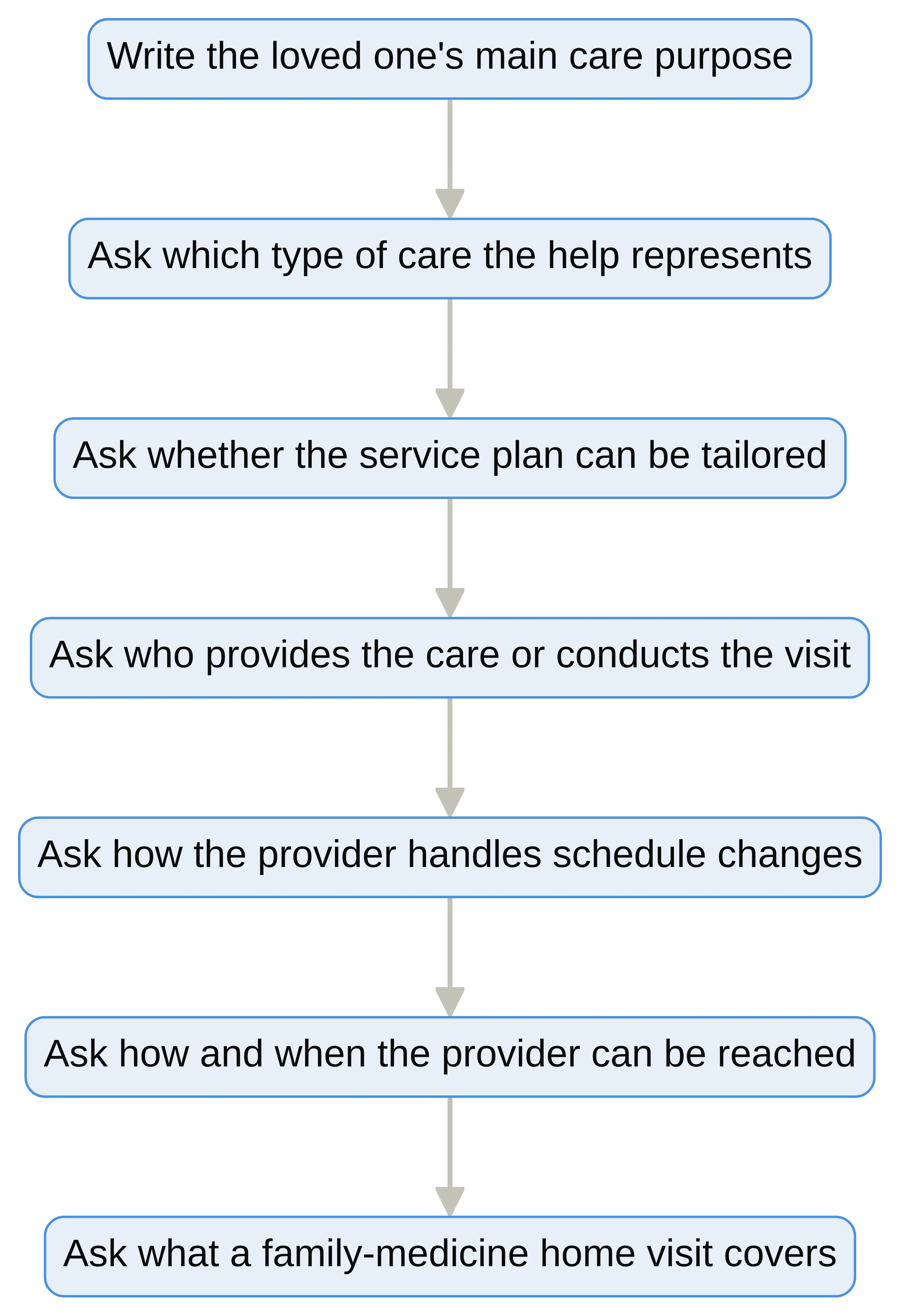
    Process chart showing a provider conversation checklist: write the loved one's main care purpose, ask which type of care the help represents, ask whether the service plan can be tailored, ask who provides the care or conducts the visit, ask how schedule changes are handled, ask how and when the provider can be reached, and ask what a family-medicine home visit covers.
    Use the questions to keep the first care-planning conversation focused.

    Confirm what Paragon’s home visit service includes before scheduling

    A family-medicine home visit is a medical visit at home rather than everyday caregiving. Paragon Family Medicine’s Home Visits service should therefore be discussed as a clinician-led home-visit option. A family should not assume that a home visit includes nursing, skilled home-health care, therapy, wound care, or ongoing household assistance. Ask Paragon Family Medicine to confirm the requested service scope directly.

    Paragon Family Medicine describes its care offering with personalized healthcare, flexible scheduling, same-day or next-day appointments, a family medicine plus model, and health education resources. Use those service descriptions as prompts for a specific conversation rather than as a reason to assume that every feature applies to every home visit.

    Before making plans, ask Paragon Family Medicine five focused questions:

    • Can a clinician-led home visit address the loved one’s stated medical purpose?
    • Which clinician or primary-care team member conducts the visit?
    • What is included in the home visit, and what falls outside the visit’s scope?
    • What appointment timing and flexible scheduling options are available for the requested visit?
    • Are health education resources part of the conversation or a separate offering?

    A clear answer to each question lets the family compare the requested care with the actual service being discussed. Paragon Family Medicine should confirm current timing, scope, provider role, and any applicable charges before the family schedules care. The family should contact a different type of provider when the primary need is ongoing caregiving or skilled home-health nursing rather than a family-medicine home visit.

    Contact Paragon to discuss whether a home visit fits your loved one’s needs

    Home health care nursing, caregiving, and family-medicine home visits serve different purposes. Skilled medical support belongs in a home health conversation, everyday assistance belongs in a caregiving conversation, and a clinician-led medical encounter at home belongs in a family-medicine conversation. Write down the loved one’s main care purpose, share the purpose with the practice, and ask the practice to confirm the current scope before making plans. A precise care description gives the family a clear starting point for discussing whether a home visit fits the situation.


    Questions families commonly ask about home-based care

    What is home health care nursing?

    Home health care nursing refers to skilled medical support delivered in a patient’s home, often by licensed nurses or therapists. It addresses medical needs related to recovery, chronic disease management, or serious-illness symptoms.

    How does home health care differ from caregiving?

    Home health care focuses on skilled medical support, such as medication assistance and wound care, while caregiving provides everyday support like supervision and help with basic activities.

    What should I ask a provider before scheduling a home visit?

    Inquire about the type of care being offered, whether the service plan can be tailored to your loved one’s needs, who will provide the care, how schedule changes are handled, and how to reach the provider for scheduling requests.

    What is a family-medicine home visit?

    A family-medicine home visit is a clinician-led medical encounter conducted in the patient’s home, distinct from everyday caregiving or skilled nursing care.

    How can I confirm what services are included in a home visit with Paragon Family Medicine?

    Ask Paragon Family Medicine to clarify the scope of the home visit, including which clinician will conduct it, what is included, and any scheduling options available.

    How do I schedule a home visit with Paragon Family Medicine?

    To schedule a home visit, contact Paragon Family Medicine directly and discuss your loved one’s needs to confirm the service scope and appointment timing.


  • Should Your Child Have Preventive Care? A Parent’s Decision Guide Before Booking

    Should Your Child Have Preventive Care? A Parent’s Decision Guide Before Booking

    Decide whether your child’s need is routine preventive care

    A well-child visit is a routine visit focused on prevention, including early-childhood visits and annual visits through age 21. A well-child visit may include an examination, measurements, and other age-appropriate review.

    A routine visit is not a diagnosis, individualized medical advice, or a promise that a practice can provide every requested service. A parent can ask the practice which appointment type matches the child’s stated need.

    Start by naming the child’s purpose rather than relying only on an appointment label. A check-up, growth and development review, vaccination-information discussion, screening question, or general health assessment can be described directly. That description gives the practice context for its response; it does not decide whether the appointment is medically appropriate. If more than one topic applies, list each one rather than assuming the practice will infer it from a general label. This approach helps a parent notice when the request is focused on a concern that may need another route.

    Before contacting the practice, consider which of the following topics match the child’s needs:

    • A scheduled well-child check-up.
    • A general health assessment.
    • Review of growth, developmental milestones, learning, or social behavior.
    • Discussion of nutrition or safety at home and school.
    • Review of vaccination information without assuming a particular vaccine or schedule.
    • Guidance about screening that may be appropriate for the child’s age and individual circumstances.

    These recommendations are designed for children who have no manifestations of important health concerns and are growing and developing satisfactorily. Additional visits may be needed when concerns arise. A parent should describe the child’s actual reason for contact instead of choosing a general label without explanation.

    If a child has a new, severe, rapidly worsening, or urgent concern, pause the usual booking process and use appropriate immediate medical care. A routine-care decision does not determine medical eligibility.

    Identify what preventive care may include

    A child’s visit can combine several types of routine review. Routine visits may also include screening tests intended to find some diseases early, when earlier identification may make treatment easier.

    Screening needs vary with age, sex, overall health, family health history, and risks for certain diseases. A screening discussion is not a conclusion about a child’s health, and a parent should not assume that every screening applies to every child.

    These visits may include vaccines plus education or counseling about health decisions. A family may use a routine visit to ask about nutrition, safety, activity, sleep, learning, or other topics relevant to the child’s health. Ask the practice which requested components are included before treating an appointment description as confirmed.

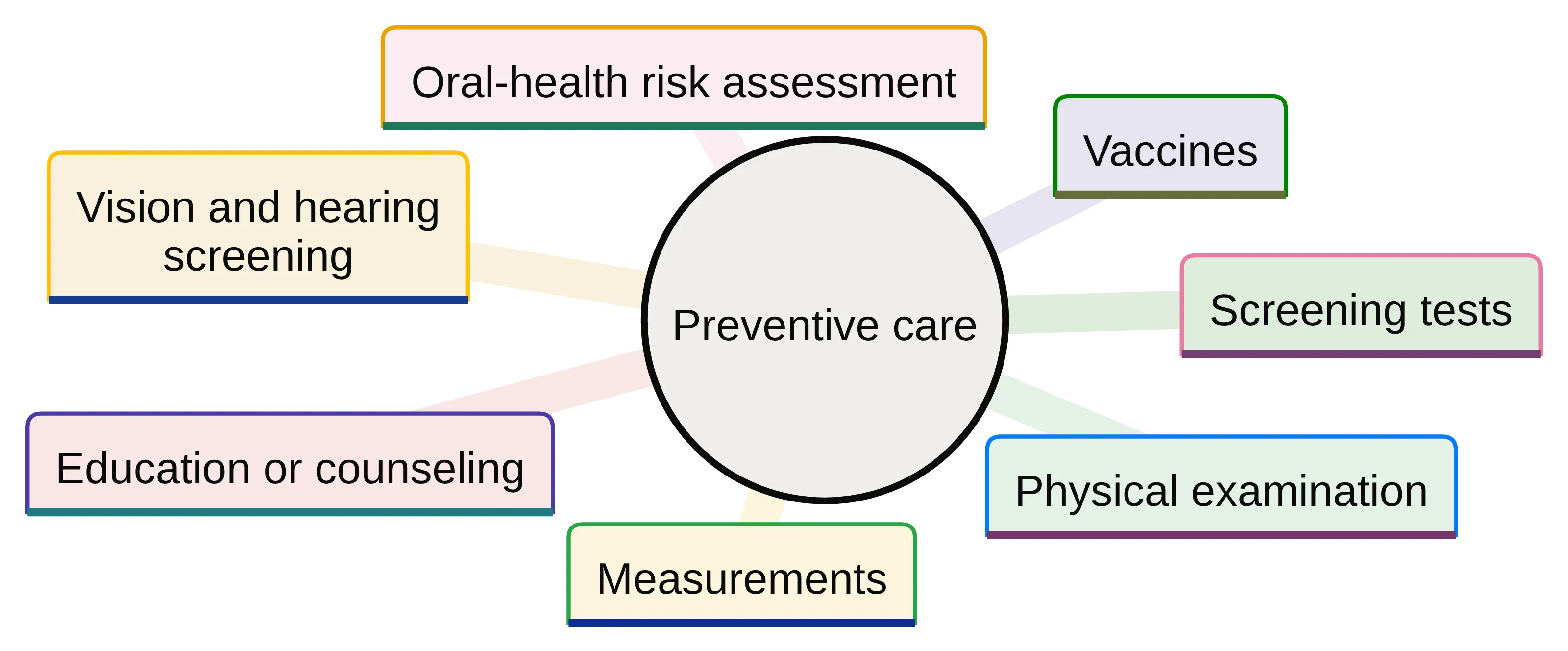
    Possible health-assessment components can be named more specifically when a parent contacts the practice. An examination and measurements, vision and hearing screening, and an oral-health risk assessment are examples of components associated with well-child visits. Their inclusion depends on the visit’s scope and the child’s circumstances, so treat them as questions to clarify rather than items promised by a general description. The same applies to screening tests, vaccines, and education or counseling: each may be relevant without being included in every appointment. Ask which items the practice handles directly and which require another current service.

    A parent can think of a well-child appointment as a structured conversation with several possible components:

    1. General review: The clinician may discuss the child’s current health and questions.
    2. Developmental review: The family may discuss growth, milestones, social behaviors, learning, or everyday functioning.
    3. Screening discussion: The clinician may consider whether screening is appropriate for the child’s age, health, family history, and relevant risks.
    4. Vaccination discussion: The clinician may review vaccination information and identify topics for discussion.
    5. Family guidance: The visit may include education or counseling that helps a parent make informed health decisions.

    The list describes possible visit components, not a guaranteed service package. Before contacting the practice, write down the components the family wants to discuss. During contact, ask whether the practice offers each requested component, whether a separate visit is required, and what information the practice needs.

    Concept chart showing preventive care as a set of possible components: physical examination, measurements, vision and hearing screening, oral-health risk assessment, screening tests, vaccines, and education or counseling.
    Preventive care can combine several routine review and guidance components, depending on the child’s circumstances.

    Use a well-child visit to review growth and development

    A well-child visit can help a parent and clinician track the child’s growth and development over time. Discussion may cover developmental milestones, social behaviors, learning, eating, sleep, behavior, and relationships with family members. A parent does not need to wait for a major concern before writing down an observation or question for a routine visit.

    Nutrition and safety questions can also be raised during a well-child visit. Examples include questions about nutrition at home, safety at home or school, learning, sleep routines, or behavior. Preparing examples helps a family use appointment time clearly; preparation does not provide a medical conclusion about the child.

    Before the visit, write down the most important questions or concerns and raise the highest-priority topics early in the appointment. A short list can help a parent explain what the family has noticed and what answer the family needs from the clinician.

    A useful development note for one child can include:

    • A milestone, learning, behavior, sleep, eating, or social question.
    • The setting where the parent notices the question, such as home or school.
    • The approximate time when the parent first noticed the change or concern.
    • The parent’s main question for the clinician.
    • Any nutrition or safety topic that needs discussion.

    A parent should describe observations in ordinary language rather than trying to assign a diagnosis. The child’s clinician can decide what belongs in a routine review and what needs another type of assessment. Bring the three to five questions that matter most, and place the highest-priority question at the beginning of the visit.

    The immediate use of the note is simple: keep the note with the child’s other appointment information, read the questions before contact, and lead with the question that matters most.

    Consider your child’s age and individual circumstances

    Age is one factor in deciding what a child’s preventive-care visit may cover, but age alone does not establish the right assessment. Screening needs can vary with age, sex, overall health, family health history, and risks for certain diseases. A parent should provide the child’s age and relevant history when asking a practice which visit type fits.

    Parent education materials from the American Academy of Pediatrics are organized by age from infancy through adolescence. Age-based organization can help a parent prepare questions, but an educational handout does not confirm a practice’s scope, establish medical eligibility, or replace a clinician’s assessment.

    Individual circumstances also matter. A child with an ongoing developmental, psychosocial, or chronic-disease need may require counseling or treatment separate from routine preventive care. Tell the practice about the child’s actual needs so the practice can explain whether the request belongs in a routine visit or another appointment type.

    Use age and circumstances to shape questions, not to guess a schedule. Ask the practice:

    • Which preventive-care assessment is appropriate for the child’s age?
    • Which health history details should the parent provide before the appointment?
    • Does the requested visit include developmental review, screening discussion, vaccination review, or several components?
    • Does an ongoing developmental, psychosocial, or chronic-disease need require a separate counseling or treatment visit?
    • Which parent education materials or preparation instructions apply to the child’s age?

    Because recommendations can differ, a parent should ask about the child’s own record and circumstances rather than infer a vaccine schedule from age alone.

    A parent can use the child’s age as a starting point for questions, then add the child’s history and current needs. The practice’s response should determine the next administrative question, while a clinician determines medical appropriateness.

    To make that preparation practical, separate the note into three lines: what is already known from the child’s record, what the parent has observed, and what the parent needs the practice to clarify. The record line can identify available vaccination information and relevant history. The observation line can capture a question about growth, learning, sleep, behavior, nutrition, or safety. The clarification line can ask whether those topics belong in the requested assessment or another visit. This keeps age-based material in its proper role: it organizes questions, while the child’s information and the practice’s response guide the next contact step. If information is missing, mark it as unavailable and ask what the practice wants supplied. Do not fill gaps by inferring a vaccine schedule, screening need, or appointment type from age alone.

    Recognize when routine preventive care may not be the right route

    Well-child visits are generally intended for children who are doing well, while additional visits may be needed when concerns arise. A parent should tell the practice when a child needs more than a routine review, including a developmental, psychosocial, or chronic-disease discussion.

    Some developmental, psychosocial, or chronic-disease needs may require a separate counseling or treatment visit. The distinction does not mean a well-child visit has no value for a child with an ongoing need. The distinction means the family should ask whether the concern can be addressed during the requested visit or needs a separate appointment type.

    Use a direct description when contacting the practice: explain that the child needs a routine check-up, vaccination discussion, health assessment, or review of a specific concern. Ask whether the practice recommends a well-child visit, a separate counseling or treatment visit, or another current route. Administrative fit checks do not determine medical eligibility.

    A well-child appointment may be a poor fit when the family is seeking care primarily for an active concern that needs focused counseling or treatment. A parent should not hide the concern behind a general appointment label to obtain a simpler booking path.

    When a concern is not urgent but needs focused attention, describe the concern during the first contact and ask what appointment type the practice recommends. When a concern is urgent, severe, or worsening, do not rely on the usual booking route. Use appropriate immediate medical care instead.

    The decision boundary is clear: use a well-child visit for a routine review, disclose active concerns during contact, and follow the practice’s direction when a separate visit may be needed.

    Route urgent, severe, or worsening concerns to immediate care

    A routine preventive-care appointment is not the route for a medical emergency.
    For a medical emergency, the caller should be ready to provide the emergency location, the callback phone number, the nature of the emergency, and relevant details such as symptoms or injuries. The 911 call-taker’s questions help direct the response, so answer the questions as clearly as possible.

    During a 911 call for a child’s medical emergency, follow the call-taker’s instructions and remain on the line until the call-taker says to hang up. A parent should not use a routine preventive-care form, ordinary practice message, or appointment request as a substitute for immediate emergency guidance.

    A parent may not be able to determine the correct medical route from an article alone. When the situation appears urgent, severe, or worsening, choose appropriate immediate medical care. Reserve routine booking questions for a child whose immediate needs do not require emergency response.

    Prepare a separate checklist for each child

    Create one preparation note for every child who may need care. A separate note keeps each child’s request, history, medications, and questions distinct.

    For each child, record:

    • The child’s name and age.
    • The reason for requesting care, such as a routine check-up, vaccination discussion, or health assessment.
    • Relevant health history that the parent already knows.
    • Current medications or other information the practice has requested.
    • Vaccination information or records available to the family.
    • Growth, developmental, learning, behavior, sleep, eating, nutrition, or safety questions.
    • The parent’s most important questions for the clinician.
    • Any concern that may require a separate counseling or treatment visit.

    A parent can mark uncertain details for later confirmation instead of guessing. The checklist organizes information for contact with the practice; the checklist does not determine eligibility or provide a medical assessment.

    To keep the notes usable, give each one a clear child identifier and use the same headings for that child’s information. Keep uncertain or unavailable items visibly marked rather than completing them from another child’s record. If a question applies to more than one child, state that explicitly and identify each child to whom it applies. If the children need different services, list those differences at the top of the relevant notes. Before submitting a request, read each note independently and remove details that belong to another child. This preparation supports clear communication with the practice, but it does not determine whether a visit is appropriate or what care a clinician may recommend.

    When more than one child needs care, give the practice information for each child separately. State whether the children need the same or different appointment types, and ask whether the practice wants one request per child. Keep one question list and one vaccination-history note for each child.

    Writing the most important questions before contact helps a parent raise priority topics early. Reviewing vaccination history can help identify vaccines to discuss during routine or acute-care visits. A parent should provide the records or details requested by the practice, while allowing the practice to explain the assessment type and current booking requirements.

    The family can use the following short sequence for each child:

    1. Describe the child’s reason for care.
    2. Note relevant history and current medications.
    3. Gather vaccination information.
    4. List the most important questions.
    5. Ask which visit type and booking route fit the child.
    6. Record the practice’s instructions separately for each child.

    The immediate use of the sequence is to prepare one complete contact record per child before a parent calls, writes, or submits a request.

    Review vaccination information without assuming a schedule

    A vaccination-history review can help identify vaccines to discuss at routine or acute-care visits. Healthcare providers are encouraged to review whether patients are up to date on vaccinations, even when a provider does not administer vaccines. A parent should therefore ask whether the practice reviews vaccination records, provides vaccinations, or directs families to another current service.

    Bring the child’s available vaccination record and ask the clinician to explain which topics apply to the child.

    Keep vaccination questions tied to the record for the child whose visit is being discussed. Note whether the family has a complete record, a partial record, or no record available, and tell the practice which situation applies. The practice can then explain what it needs for review and whether the next step is a routine discussion, an administration visit, or another current service. A record review can support a conversation without establishing that a vaccine is due or that the practice will administer it. Do not use a general list as a personal recommendation; use the child’s information to frame questions for the clinician.

    Vaccine administration involves preparation and patient-care steps before a dose is given. Ask the practice what information or preparation is needed before a vaccination appointment, and ask whether vaccination review belongs in a routine preventive visit or a separate appointment.

    A parent should avoid promising a particular vaccine appointment until the practice confirms the current scope, assessment type, and booking route. A parent should also avoid treating a general vaccine list as a personal recommendation. The child’s vaccination history, relevant health information, and clinician discussion provide the basis for the practice’s next instruction.

    Before contact, place the available vaccination record beside the child’s checklist. During contact, ask whether the practice needs the complete record, a specific portion of the record, or another form of information. Follow the practice’s current instructions rather than relying on an assumed schedule.

    Confirm whether Tely Health is the right practice before booking

    Do not assume that Tely Health serves Austin. Tely Health lists its location in Port Orange, Florida, so an Austin family should confirm the current practice address and service area directly before traveling, submitting personal information, or treating a booking as confirmed.

    The location check should come before the appointment decision. Ask whether the current practice location is in or near Austin, whether pediatric care is offered at the location relevant to the family, and whether the practice accepts routine preventive-care requests for children. Keep the answer in the family’s records so each parent or caregiver uses the same confirmed information.

    A location match alone does not establish that the requested care fits the child. Confirm the practice’s current pediatric scope, the requested health assessment type, and the correct booking route in the same contact whenever possible.

    Before making the request, separate the details that must be confirmed from questions that can wait. First confirm where the relevant service is offered and whether the practice accepts the type of child visit requested. Then ask which assessment description and booking route apply. If the location or scope answer is unclear, do not treat a general reply as confirmation; ask a focused follow-up or pause the request until the practice clarifies it. This sequence keeps travel and information submission after the location question is resolved.

    Use ordinary service language when asking about scope. A parent can ask how the practice currently handles:

    • Family medicine for children and adults.
    • Pediatric care for routine check-ups, vaccinations, and health assessments.
    • Preventive care when a child also has an ongoing health need.
    • Chronic disease management when a child needs continuing support.
    • Diabetes management or hypertension monitoring when a child’s care involves either service label.

    The list is a set of clarification questions, not a statement that Tely Health provides every listed service. Ask whether the child’s request belongs in a preventive-care visit, a separate counseling or treatment visit, or another current route. Ask whether the practice performs the requested service, coordinates the service elsewhere, or requires a different appointment type. Obtain a clear answer before scheduling.

    Contact the practice only after the fit checks are clear

    After the location and scope checks are clear, contact Tely Health through the practice’s current communication channel. Keep the contact focused on the child’s request and ask for the details needed to make an informed booking decision.

    A concise contact script can include:

    I am seeking routine preventive care for a child. Please confirm your current location, pediatric scope, the appropriate assessment type, and the current booking route. The child’s reason for care is [brief description]. Please tell me what history, medication information, vaccination information, or questions you need before scheduling.

    Replace the bracketed description with the child’s actual reason for contact. If more than one child needs care, provide a separate description and separate information for each child. Ask the practice to clarify whether one request can cover multiple children or whether each child needs a separate booking process.

    Before a parent schedules, travels, or submits detailed personal information, confirm all four fit points:

    1. Location: The current address and service area match the family’s needs.
    2. Scope: The practice currently accepts the child’s requested pediatric preventive-care need.
    3. Assessment type: The practice has identified the appropriate routine check-up, vaccination discussion, health assessment, or separate visit.
    4. Booking route: The practice has confirmed the current way to request or arrange the appointment.

    Ask about insurance acceptance, pricing, appointment availability, or required records only when the practice provides current information. Do not infer any administrative detail from a general service description. A confirmed address, contact response, or form submission does not determine medical eligibility. Follow the practice’s instructions and ask for clarification when any fit point remains uncertain.

    For a family with multiple children, repeat the four checks for each child when the children have different needs, requested services, or appointment types. Keep the confirmed information tied to the correct child and visit request.

    A simple confirmation record can make the decision easier to review. For each child, write the practice’s answer beside four labels: location, pediatric scope, assessment type, and booking route. Mark each label as confirmed, not confirmed, or needing follow-up; do not treat a partially answered message as a completed fit check. If the location is not suitable, stop before sharing more information or arranging travel. If the location fits but scope is unclear, ask about the child’s stated request. If scope fits but the assessment type is unclear, ask whether the practice recommends routine preventive care or a separate visit. If all four points are clear, follow the current booking instructions and retain the response with that child’s preparation note. These administrative steps organize the request; they do not replace a clinician’s judgment about care.

    If the practice gives different answers through different channels, treat the discrepancy as unresolved and ask which current instruction controls before proceeding. Keep the date or context of the response in your notes without assuming it remains current later.

    Take the confirmed next step for your child’s assessment

    A per-child checklist helps a parent describe the child’s needs, history, medications, vaccination information, and questions clearly. Confirm the practice’s current location, pediatric scope, assessment type, and booking route before travel or information submission. Keep immediate medical concerns on an appropriate urgent-care or emergency pathway rather than a routine booking route.

    Once the practice confirms the four fit points, keep the practice’s instructions with the correct child’s records and follow the agreed route for the visit.


    What should I prepare for a child’s routine visit?

    How can I prepare for my child's routine visit?

    Before the visit, write down important questions and raise them early in the appointment.

    What should I do if my child has urgent health concerns?

    For urgent, severe, or worsening concerns, seek immediate medical care instead of a routine appointment. For a medical emergency, call 911 and be ready to give the location, callback number, nature of the emergency, and relevant symptoms or injuries.

    How can I confirm if Tely Health serves my area?

    Before booking, confirm directly with Tely Health whether they serve Austin, Texas, and whether they offer the pediatric services you need.

    What should I ask the practice when contacting them for an appointment?

    When contacting the practice, ask about their current location, pediatric scope, the appropriate assessment type for your child, and the booking route.

    How do I know if my child's needs require a separate visit?

    If your child has ongoing developmental, psychosocial, or chronic-disease needs, those needs may require a separate counseling or treatment visit.


  • Balderas Family Medicine: How Austin Parents Can Verify Pediatric Preventive Care

    Balderas Family Medicine: How Austin Parents Can Verify Pediatric Preventive Care

    Separate the Balderas Family Medicine search from unrelated clinic information

    If you are searching for Balderas Family Medicine in Austin, begin by confirming that the name, physician, location, pediatric scope, and contact route all refer to the same practice. Do not treat a page, form, or phone number using the Tely Health name as proof that you have reached Balderas Family Medicine. The two names should remain separate unless the practice itself confirms a connection.

    The practical decision is simple: contact the practice when the material details line up, or continue looking when a key detail remains unclear. A directory listing can help you identify a possible practice, but it does not replace a direct check of the information you would rely on before arranging care for your child.

    Use this order:

    • Identity: Confirm the practice name and the clinician or organization associated with it.
    • Austin location: Confirm the exact office where your child would be seen.
    • Pediatric fit: Ask whether the practice currently handles the type of preventive visit, health assessment, vaccination question, or developmental screening your child needs.
    • Contact route: Reconfirm the phone number, booking process, and any information the practice wants before scheduling.

    This approach keeps a search for an Austin family medicine practice focused on your child’s actual needs. It also prevents a convenient-looking consultation route from being mistaken for confirmation that the intended practice has been found. You do not need to decide from a name alone. You need enough current information to know whom you are contacting, where the visit would occur, and what to ask for.

    Public profiles connect Dagoberto Balderas with family medicine and primary care in Austin, Texas. A WellMed directory also identifies Balderas Family Medicine and links the organization with Dagoberto Balderas, DO. Those descriptions provide useful identity leads, while the practice’s present details still need to be confirmed through its current communication channel. Use the name and city as starting points, not as a substitute for that confirmation.

    Start with the decision: is this current Austin listing a fit for your child?

    Before you call, decide what a suitable listing must establish. For a child’s routine-care request, a useful listing should point to the intended Austin practice and give you a way to ask whether the practice’s present services match your child’s needs. The AAP describes age-based pediatric guidance that can include screenings, assessments, physical examinations, procedures, and anticipatory guidance. Its well-child-care guidance also discusses prevention, growth and development, and parent questions about behavior, sleep, eating, and other areas of daily life. That framework can help you form precise questions, but it does not confirm what any particular practice offers today.

    Treat the listing as a fit when you can answer these questions with reasonable confidence:

    1. Am I looking at Balderas Family Medicine rather than a different clinic or an unrelated business name?
    2. Is the practice location in Austin the one that serves the area where I plan to take my child?
    3. Does the practice currently provide or coordinate the pediatric care I am seeking?
    4. Have I identified the right type of request, such as a routine check-up, health assessment, vaccination discussion, or developmental screening question?
    5. Do I have a current route for contacting the practice and asking about scheduling?

    If all five answers are clear, contact the practice and describe the visit you need. If one of the first four remains unclear, keep checking before making a routine booking. If the contact route itself is uncertain, do not assume that a number or form belongs to the intended practice simply because it appears beside a familiar name.

    A good fit is therefore not just a matching keyword. It is a matching identity, location, care request, and communication path. The more specific your request is, the easier it is for the practice to tell you whether the appointment type is appropriate or whether another service is needed.

    Turn the check into a short written record before you contact anyone. This keeps facts from separate listings from blending together and gives you a clear point at which to pause.

    Record these fields:

    • Search name: Write the exact name that brought you to the listing, including any spelling or organization wording.
    • Practice name confirmed: Leave this blank until a current practice communication channel confirms the name used for appointments.
    • Clinician connection: Note the clinician’s full name and whether the practice confirms the association.
    • Austin office: Record the complete address for the visit you are considering, not only the city.
    • Requested care: Describe the child’s need in plain language, such as a routine check-up, health assessment, vaccination question, or developmental concern.
    • Pediatric-care answer: Write whether the practice handles the request, routes it elsewhere, or needs more information.
    • Contact route: Record the number, portal, form, or other route the practice confirms for that request.
    • Next action: Note whether you should schedule, send records, call another office, or continue looking.

    Use “confirmed,” “unclear,” or “not applicable” beside each field. Do not fill an unanswered field with information copied from a different directory. If the practice confirms a detail that differs from a listing, keep the confirmed version and note where you received it.

    A concise opening can help: “I am trying to reach Balderas Family Medicine in Austin about a [child’s age]-year-old who needs [visit purpose]. Can you confirm that this is the right practice and tell me which office and appointment type apply?” Then ask only the questions that affect the next step. If the person who answers cannot confirm the practice, office, or requested service, do not treat the call as complete verification.

    Finish the record immediately after the interaction. If the identity, location, care fit, or route still has an unanswered material field, continue checking instead of booking through assumption.

    Write down the four facts you still need to confirm: the exact practice name, the Austin office, the child’s requested service, and the current contact route. Use those facts to guide the rest of your search.

    Use Austin directories to identify the practice, then reconfirm its details

    Several public directory descriptions can help connect the name you searched with a person and an Austin practice. A Zocdoc profile identifies Dr. Dagoberto Balderas as a primary care doctor serving Austin, Texas and describes him as working with an independent practice there. An MDVIP profile describes Dagoberto Balderas, DO, as a family-medicine physician in Austin and reports more than 15 years of local practice experience. A WellMed directory identifies Balderas Family Medicine and links it with Dagoberto Balderas, DO.

    These descriptions are useful for cross-checking names. They are not enough, by themselves, to establish every detail you need for a child’s appointment. Profiles can use different organization labels, may describe a clinician rather than the full practice, and can require confirmation before you rely on their contact or location information.

    Compare the listings for the details that should match:

    • The practice or organization name.
    • The clinician’s full name and credentials as displayed.
    • Austin, Texas, as the relevant city.
    • A contact route that appears to connect with the same practice.
    • Any office information that can be reconfirmed before travel.

    Do not combine the strongest-sounding parts of separate listings into one assumed profile. For example, one page’s description of the clinician does not automatically establish that another page’s phone number, office, organization, or booking route remains current. Keep each detail tied to the page or communication channel where it appears, then ask the practice to confirm the combined information.

    The same method applies if a search result uses a shortened name, a network directory label, or a physician profile instead of the practice name. Ask whether the listing is for the practice you intend to contact and whether the person and office shown are still associated with it. This is especially important when you are arranging preventive care for a child and need to know where records, questions, and follow-up should be directed.

    Use the directories to create a short identity note, then ask the practice to confirm the exact organization name, clinician, Austin location, and contact route before you schedule. If the details cannot be reconciled, continue searching rather than choosing one listing by appearance alone.

    Confirm which practice name and organization currently apply

    The practice name deserves its own check because public pages describe it in more than one way. An About Us page says the organization changed its name to Balderas Family Medicine in 2020. A WellMed directory uses the name Balderas Family Medicine and links it with Dagoberto Balderas, DO. The directory label and the name-change statement point toward the same practice name, but they do not tell you every current organizational or administrative detail.

    When you contact the practice, ask which name you should use for the appointment and for any forms, records, billing questions, or follow-up communication. You can also ask whether the clinician, practice, and directory listing are still connected. Keep the question neutral: you are confirming that the name shown in your search is the name used by the practice today.

    Do not assume that a historical name, a network directory, and a clinician profile represent identical booking systems. A practice may be described by its organization name in one place and by a clinician’s name in another. That difference does not prove that the listing is wrong, but it does create a reason to ask before relying on it.

    If the practice confirms the name and connection, record the exact wording you were given. If the answer points to another organization or a different office, update your search before sharing your child’s details. If no one can confirm the relationship, treat the identity as unresolved and continue looking for a current practice contact.

    Ask, “What practice name should I use when requesting my child’s appointment, and is it associated with Dr. Dagoberto Balderas?” Proceed only when the answer matches the practice you intended to find.

    Check the current Austin office before planning a visit

    Location is a separate decision from identity. A WellMed listing displays 1-512-643-4400 as a number to call to schedule. A Zocdoc profile says Dr. Balderas has two office locations in Austin. Because these details come from directories and can change, confirm the office you would actually use before arranging transportation or arriving with your child.

    Ask the practice to confirm:

    • The complete street address for the relevant appointment.
    • Whether more than one Austin office is available for the type of visit you are requesting.
    • Which office the phone number or booking route reaches.
    • Whether the office location has changed since the directory listing was published or updated.
    • What arrival instructions apply to a child’s routine visit.

    The phrase “Austin office” is not specific enough if more than one location is associated with the clinician. A location that appears in a profile may not be the location for every appointment type. Likewise, a scheduling number may connect to a central line, a network directory, or a practice route that needs confirmation.

    Keep a written record of the address and the person or department that confirmed it. If the practice gives you a different address from the one shown in a directory, use the practice’s confirmed information for your next step and do not rely on the older listing. If the practice cannot confirm which office serves your request, pause the booking and seek a clearer current route.

    Call the displayed scheduling number only as a lead, and ask which Austin office applies to your child’s requested visit. Confirm the full address before planning travel; if the office remains unclear, continue searching.

    Ask whether the practice currently covers your child’s preventive-care needs

    Once the identity and office look consistent, clarify the care scope. Do not assume that the phrase family medicine answers every pediatric question. Ask directly whether the practice currently handles the specific request you have, such as pediatric care, a routine check-up, health assessments, preventive care, vaccinations, or developmental screening.

    The AAP describes its Bright Futures guidance as covering age-based pediatric screenings, assessments, physical examinations, procedures, and anticipatory guidance. Its well-child-care guidance says routine visits can address prevention, growth and development, and parent concerns involving behavior, sleep, and eating. The AAP also describes a periodicity schedule that covers recommended screenings and assessments from infancy through adolescence. These materials can help you name the service you want to discuss, but they do not establish that Balderas Family Medicine provides each item.

    Use specific questions rather than asking only, “Do you see children?” For example:

    • Does the practice schedule routine well-child visits for my child’s age?
    • Can the clinician complete the health assessment I need?
    • Does the practice provide the vaccination service my child needs, or will it direct us elsewhere?
    • Does the practice conduct developmental surveillance or developmental screening when appropriate?
    • If my child needs diabetes monitoring or hypertension management, is that part of the practice’s current scope, or should I contact another clinician?

    The last questions may not apply to your child, and asking them does not imply that your child needs that care. They simply show why a general label is not enough for every family. A practice may answer differently depending on age, visit purpose, clinician availability, or the assessment requested. Ask for the present scope and the next appropriate route rather than assuming that a general service label confirms a particular appointment.

    Describe your child’s age and the exact preventive-care request, then ask the practice to confirm whether it handles that request today. If the answer is unclear or the practice directs you elsewhere, follow that direction or continue looking for a suitable pediatric route.

    Identify the right visit or assessment before you call

    A clearer description of the requested visit helps you avoid booking the wrong kind of appointment. Start by separating a routine preventive visit from a focused assessment. A routine visit may involve general health supervision, growth and development questions, preventive guidance, or several concerns together. A focused request may involve developmental surveillance, a developmental screening question, a vaccination discussion, or follow-up for a specific health matter.

    AAP materials describe the Bright Futures schedule as age based and emphasize continuity of care in comprehensive health supervision. The AAP also says well-child visits can cover prevention, growth and development, and parent concerns such as behavior, sleep, and eating. That means you can prepare a short description rather than relying on the broad phrase “check-up.”

    Developmental surveillance and developmental screening are related but not identical terms. AAP guidance recommends developmental surveillance during every health-supervision visit, with special attention at ages 4 to 5. The same guidance says general developmental screening tests should be conducted at 9, 18, and 30 months, and autism-spectrum-disorder screening at 18 and 24 months. It also says screening may be appropriate when a clinician, parent, or early-childhood professional raises a concern outside the routinely listed ages. These age points come from the cited guidance and should be checked against the current AAP schedule when you make plans.

    For a call, describe the request in one sentence:

    • “I am looking for a routine well-child visit for my [age]-year-old.”
    • “I want to ask about a developmental concern and whether a screening appointment is appropriate.”
    • “I need to discuss vaccination records and what preventive visit my child needs next.”
    • “I need a health assessment for a school, activity, or other stated purpose.”

    Do not use a screening label as a conclusion about your child. A screening question is a request to ask the clinician what evaluation is appropriate; it is not a diagnosis or a determination of eligibility. Similarly, a routine visit does not guarantee that every requested assessment will occur during one appointment. Ask how the practice classifies the visit and whether it wants additional information before confirming it.

    If your child has an ongoing concern, include when you first noticed it and whether another clinician or early-childhood professional has raised it. Keep the description factual and brief. The practice can then tell you whether to request routine scheduling, a focused assessment, another type of appointment, or a different care route.

    Before contacting the practice, write your child’s age, the purpose of the visit, and any developmental or preventive-care question in plain language. Ask the practice to classify the appointment rather than choosing a screening or assessment label on your own.

    Prepare your child’s details and three to five priority questions

    Preparation can make a routine inquiry more focused. AAP guidance suggests bringing three to five priority questions or concerns to discuss at the start of a routine child visit. You can use the same limit when preparing to contact a practice: choose the questions that affect whether the appointment is suitable, then keep secondary questions for later.

    Have these details available if the practice requests them:

    • Your child’s age or date of birth.
    • The reason for the visit in one sentence.
    • Whether the request is routine preventive care, a health assessment, vaccination-related, developmental, or follow-up care.
    • Relevant dates, such as the last routine visit or when a concern first arose.
    • The names of clinicians or services already involved, if that helps explain the request.
    • Vaccination or health records that the practice asks you to provide.
    • Your preferred contact details and any scheduling limits.

    Then select three to five questions. A practical set might include:

    1. Is this practice the correct Austin location for my child’s requested visit?
    2. Does the practice currently provide the service I described?
    3. What records or forms should I have ready?
    4. Does the requested assessment occur during a routine visit or require a separate appointment?
    5. What is the confirmed next step after this inquiry?

    You may also ask whether the practice accepts your insurance or what payment information applies, but do not assume acceptance, pricing, or coverage from a directory listing. Ask for the practice’s present answer before you make a financial decision.

    Keep your notes factual. You do not need to prepare a long account of every past concern for an initial scheduling question. A concise description helps the practice route your request, while the clinician can decide what information is relevant during care. If the practice asks for records, send only through the communication method it identifies.

    Write down three to five priority questions and keep your child’s basic visit details nearby. Use the first contact to establish fit and preparation requirements; save less urgent questions for the appointment or the practice’s requested follow-up.

    Verify the contact and booking route when you are ready to act

    A contact route should be confirmed in the same way as the practice name and office. The WellMed listing displays 1-512-643-4400 as a scheduling number. Because the listing’s contact details can change, treat that number as a lead that requires confirmation rather than as a permanent guarantee.

    When the call connects, state the practice name you are trying to reach and ask whether the person or department handles appointments for the Austin location. Then give your child’s age and the type of visit you want to discuss. Ask whether the practice wants you to use a different phone number, portal, form, or office for that request. Do not submit personal details through a route that you cannot connect to the intended practice.

    If the number does not connect, reaches a different organization, or produces an answer that conflicts with the listing, pause before booking. Search for a more recent practice communication channel and compare it with the name, clinician, and Austin location you have already checked. If a practice page provides a different route, ask that route to confirm the relationship rather than assuming that one listing supersedes every other detail.

    A successful connection also does not guarantee an appointment. It gives you an opportunity to ask whether the practice is the right place for your request and what must happen next. Availability, visit type, records, insurance, pricing, and credentials require direct confirmation when they matter to your decision.

    Use the displayed number only to begin the check. Confirm the organization, Austin office, requested visit, and next booking step with the practice before treating the route as ready for action.

    Contact the practice only after the material details align

    At this point, choose between two practical paths: contact the practice or continue searching. Use the same criteria for both options rather than letting one convenient detail decide for you.

    Check Contact the practice Continue searching
    Identity The practice name, clinician, and organization connection have been confirmed. The name changes across listings, or no current contact can confirm the connection.
    Austin location The practice confirms the exact office for your child’s requested visit. The office, address, or applicable Austin location remains unclear.
    Pediatric scope The practice confirms that it handles or appropriately routes the preventive-care request you described. The practice cannot confirm pediatric care, the requested assessment, vaccination question, or developmental request.
    Visit fit You can explain whether you need a routine check-up, health assessment, preventive visit, or focused question. You are not sure what appointment type to request, or the practice cannot identify the right one.
    Contact route A current practice representative confirms the route and tells you what to do next. The number, form, or listing cannot be tied to the intended practice.

    Choose contact the practice when the identity, location, pediatric scope, visit type, and route are all sufficiently clear. During the call, repeat the visit purpose and ask for the next action. That may be a scheduling step, a records request, a different office, or a recommendation to use another care route. Follow the answer that applies to the practice you reached.

    Choose continue searching when any material detail remains unresolved. A missing address, uncertain organization name, unclear pediatric scope, or disconnected route is enough to pause. Continuing the search is not a judgment about the practice; it is a way to avoid arranging care through an unconfirmed listing. Record what you know, identify the unanswered question, and look for a current practice communication channel or another Austin option that can answer it.

    Make the call only after the first path in the table fits your situation. If the second path describes your situation, keep searching until a current practice contact can answer the unresolved question.

    Know when routine scheduling is not the right next step

    This guide cannot determine what your child’s symptoms mean or decide which level of care is appropriate. When immediate medical attention may be needed, use the appropriate emergency or urgent-care route rather than waiting for a routine family-medicine appointment.

    MedlinePlus recommends determining the location and quickest route to the nearest emergency department before an emergency occurs and keeping emergency phone numbers accessible. Make that plan in advance for your household, including knowing which local number or emergency service to use. If an urgent situation is happening now, follow current local emergency instructions and seek immediate medical care.

    For a non-urgent request, return to the verification steps: identify the practice, confirm the Austin office, describe the visit, and ask for the current contact route. Do not use a routine scheduling form to seek an immediate response.

    For urgent, severe, or worsening concerns, seek appropriate immediate medical care. Use routine practice contact only for a concern that can safely wait for ordinary scheduling.

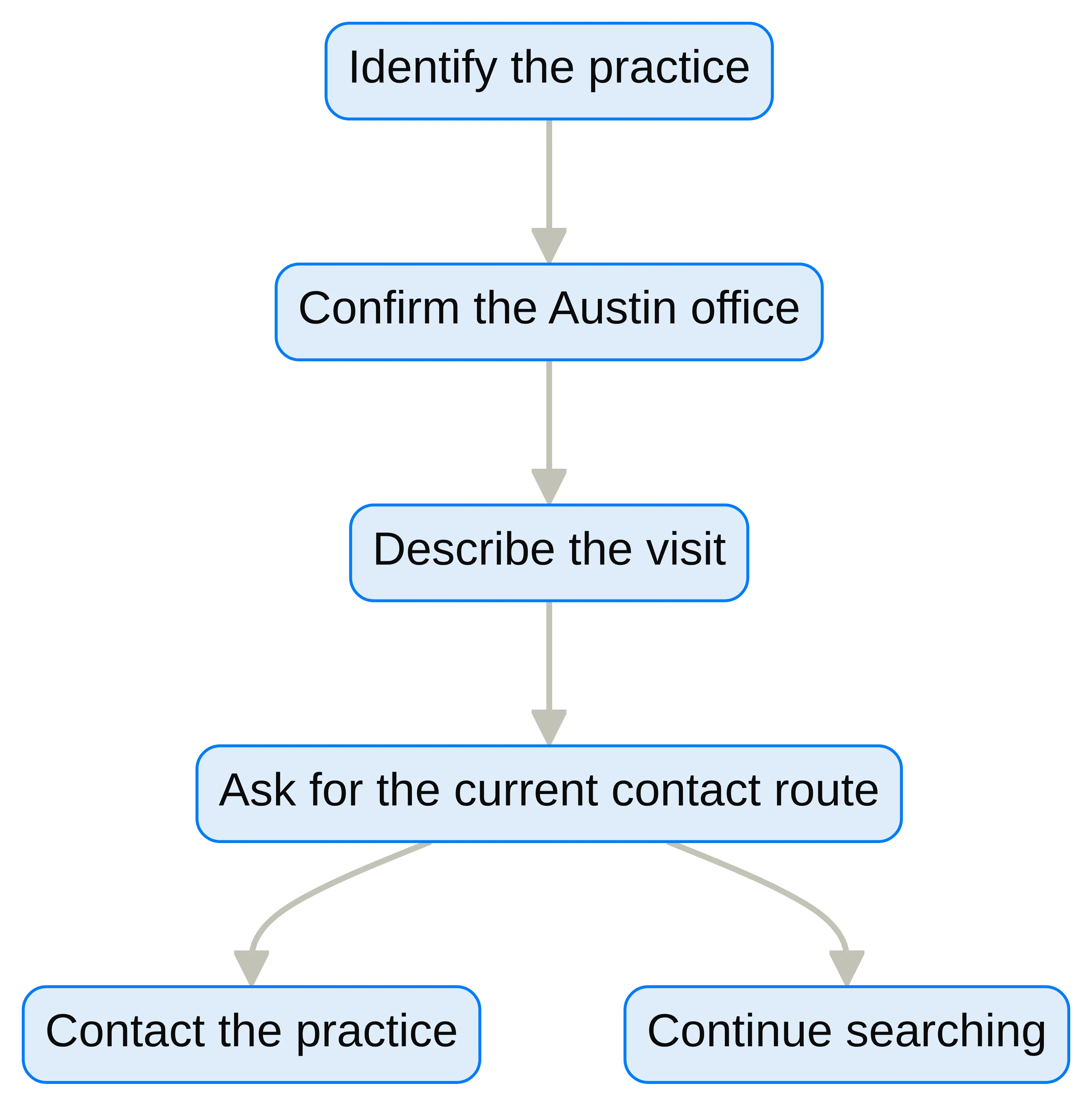
    Process chart showing how to verify a pediatric preventive-care listing by identifying the practice, confirming the Austin office, describing the visit, asking for the current contact route, and then contacting the practice or continuing the search.
    Use the verification checks to decide whether to contact the practice or keep searching.

    Make the next step based on what you can verify today

    The decision does not depend on finding the most detailed profile. It depends on confirming the details that affect your child’s care: the practice identity, the Austin office, the current pediatric scope, the type of visit, and the route for contact. AAP guidance can help you describe preventive visits, health assessments, developmental questions, and priority concerns. The practice must still confirm what it handles, where the appointment occurs, and how you should proceed.


    Questions Austin parents may still have before contacting a practice

    What should I verify before contacting the practice for my child's care?

    Confirm the practice name, clinician association, Austin location, pediatric care scope, and current contact route before reaching out.

    How can I check if the practice provides the pediatric services my child needs?

    Ask directly whether the practice handles routine check-ups, health assessments, vaccinations, or developmental screenings for your child’s age.

    What information should I prepare before calling Balderas Family Medicine?

    Have your child’s age, the reason for the visit, and three to five priority questions ready to discuss during the call.

    How can I confirm the current office location for the practice?

    Contact the practice directly to confirm the complete street address and whether it has multiple locations in Austin.

    How can I verify that I have the correct contact information for the practice?

    Verify the phone number and booking route with the practice before using them to schedule an appointment.

    What should I do if I cannot confirm the practice's details?

    If any key detail remains unclear, continue searching for accurate information rather than proceeding with a booking.


  • Complete Health in Ormond Beach: How to Decide Whether Tely Health Fits Your Primary-Care Needs

    Complete Health in Ormond Beach: How to Decide Whether Tely Health Fits Your Primary-Care Needs

    Start with the location and care-fit question

    Searching for “complete health Ormond Beach” does not, by itself, answer the more useful question: what kind of primary-care support do you need, and does the clinic you are considering describe services that match it? For people in or near Port Orange, Florida, the decision can be approached in two stages. First, identify whether you are looking for broad family-medicine support, help with an ongoing condition such as diabetes or hypertension, or a general health assessment for yourself or your family. Then verify that the practice’s current location, booking process, and stated scope fit that need.

    Tely Health describes itself as a family medicine clinic offering primary care, chronic disease management, and pediatric care for families. Its chronic disease management description is narrower: it refers to tailored care plans and regular monitoring for people managing diabetes or hypertension. Those statements can help you decide whether a conversation is relevant, but they do not determine whether a particular assessment, test, treatment, or follow-up plan is appropriate for you.

    The practical answer is therefore a fit check, not a location assumption. If you need general primary-care support or want to discuss ongoing diabetes or hypertension management, compare that need with the clinic’s stated scope. If you are considering a family health assessment, confirm the current booking and location details before requesting it. If your symptoms are urgent, severe, or worsening, seek appropriate immediate medical care rather than relying on an educational article or waiting for a routine assessment.

    A useful way to organize the decision is:

    • Broad concern or family health planning: look for a primary-care conversation that can address the concern in context rather than treating the search phrase as a diagnosis.
    • Diabetes or hypertension management: ask whether tailored care plans and regular monitoring are the type of ongoing support you are seeking.
    • Need for continuity: consider whether you want a relationship that can continue across preventive, acute, and chronic needs.
    • Unclear fit: prepare your main questions and verify the clinic’s current details before choosing a booking route.

    The rest of this guide applies those branches to Tely Health’s stated scope without treating the information as an individualized medical recommendation.

    Match your needs to the stated primary-care scope

    Family medicine is general medical care for patients across ages and can include tracking a returning patient’s overall health. Primary care commonly serves as an initial point of contact for health concerns that are not yet diagnosed and addresses whole-person concerns rather than limiting the conversation to one organ system or an established diagnosis.

    That combination matters when your need is broad or still taking shape. You may know that something about your health needs attention without knowing which type of clinician or service is required. A primary-care discussion can provide a place to describe the concern, review relevant background, and clarify what kind of follow-up should be considered. The existence of that first conversation does not mean the eventual explanation or plan will be the same for every patient.

    To assess fit, describe the need in ordinary terms before focusing on the keyword. Ask yourself:

    1. What do I want reviewed? This might be a general concern, a pattern you have noticed, or the health needs of more than one family member.
    2. Is this a new concern, an ongoing condition, or routine planning? The answer affects what information will be useful to discuss.
    3. Am I seeking a general assessment or condition-focused follow-up? These are related but not interchangeable goals.
    4. Do I need care for one person or help organizing care for a family? The clinic’s description includes family medicine and pediatric care, but the details for a particular person should be confirmed directly.
    5. What would make the conversation useful? Define the questions you want answered without assuming that a specific examination, test, referral, or treatment will follow.

    If your answers point to a broad primary-care conversation, Tely Health’s stated family-medicine scope may be relevant to explore. The next action is to write down the main concern and confirm that the current practice details support the type of visit you want.

    Family medicine may address conditions such as high blood pressure, and family medicine care can cover patients across ages. That describes the field in general; it does not establish that every concern can be handled in one visit or that a particular patient’s condition belongs in routine primary care. Use the scope as a reason to ask a focused question, not as a conclusion about your diagnosis or care plan.

    For a reader in the Port Orange area using an Ormond Beach search phrase, the geographic decision is separate from the clinical fit decision. The phrase can describe what you are looking for online, but it does not establish that Tely Health is located in Ormond Beach or operates a specific facility there. Keep the care question and the location check separate, then verify both before arranging an assessment.

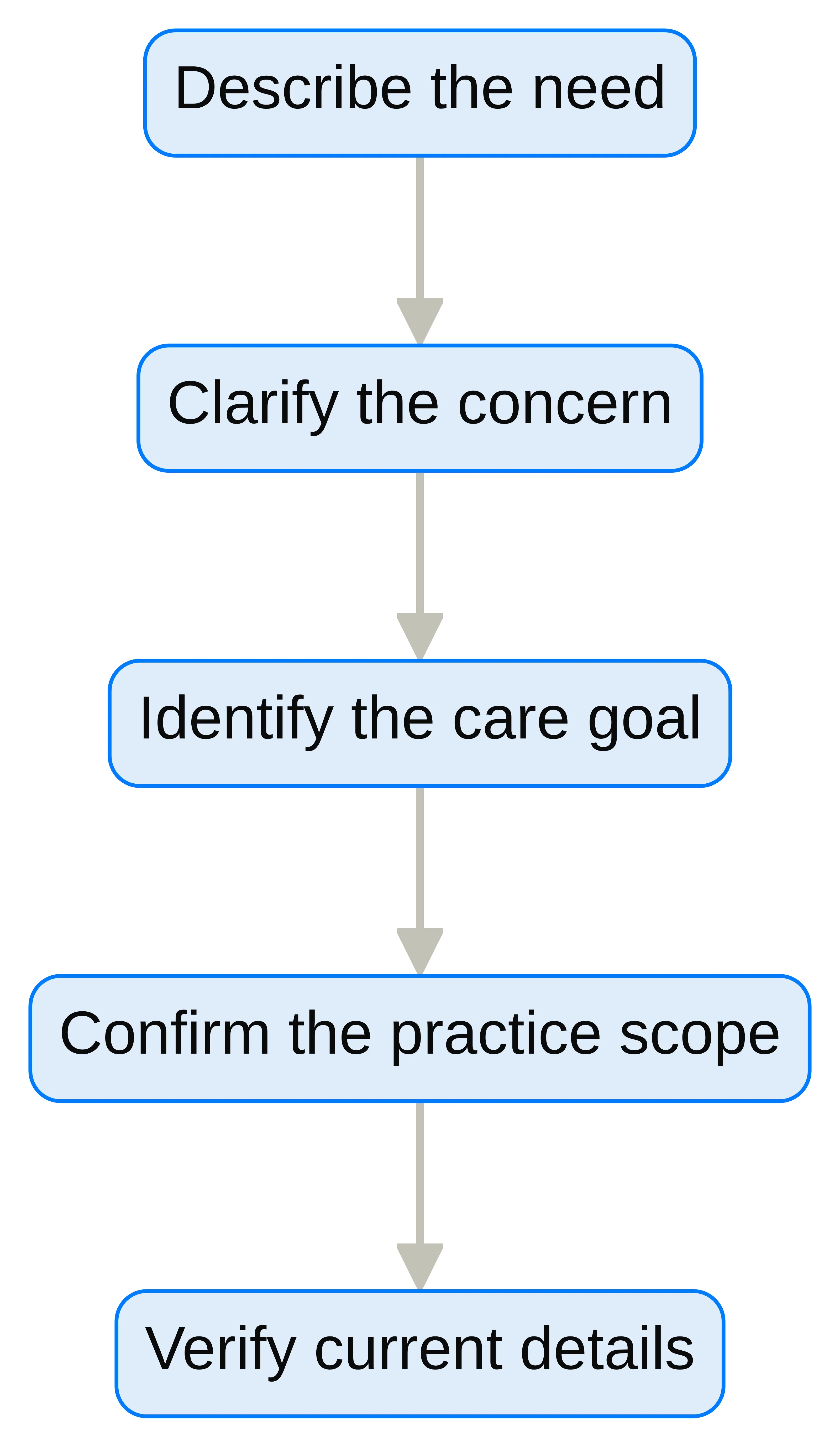
    Process chart showing how to assess primary-care fit: describe the need, clarify the concern, identify the care goal, confirm the practice scope, and verify current details.
    A focused sequence helps separate the care question from assumptions about diagnosis, services, or location.

    Check whether diabetes or hypertension monitoring is the relevant fit

    Tely Health describes its chronic disease management service as providing tailored care plans and regular monitoring for people managing diabetes or hypertension. This makes the service potentially relevant when you are already managing one of those conditions and want to discuss an organized primary-care relationship. It is not an eligibility determination, and it does not say that the same approach applies to every chronic condition.

    The fit question is specific: are you looking for ongoing support around diabetes or hypertension, rather than an immediate response to a severe or worsening problem? If yes, prepare a concise account of what you want to review and ask the practice how its current service is structured. If the concern is urgent or severe, use appropriate immediate medical care instead of treating routine booking as the answer.

    A primary-care framework for hypertension and diabetes management identifies healthy-lifestyle counseling as a foundational element of care. In practical terms, that means a management conversation may include discussion of daily health habits alongside the condition itself. The framework does not turn general counseling into a personal instruction for you, and this article cannot determine which changes, if any, would fit your health circumstances.

    The same framework says routine primary-care workflows can help detect hypertension, diabetes, and chronic kidney disease. That statement describes what a workflow may facilitate; it is not a promise that a particular visit will identify a condition, include every relevant evaluation, or produce a particular result. Ask what the planned assessment is intended to address and what follow-up would be considered if the clinician identifies a concern.

    Before contacting a practice about ongoing management, use this short preparation checklist:

    • Name the condition you want to discuss: diabetes, hypertension, or both.
    • Note whether your purpose is general review, follow-up, questions about monitoring, or a broader family health assessment.
    • Write down the changes or concerns you want to mention, using your own words.
    • Gather relevant health history and prior information that you can provide accurately.
    • List questions about the type of care, expected follow-up, and who to contact if your concern changes.
    • Separate routine planning from any symptom that feels urgent, severe, or worsening.

    This checklist is a communication aid. It does not diagnose a condition, select a treatment, tell you to change medication, or determine whether you qualify for a particular service. If the condition-focused branch matches your needs, take the checklist to a conversation with a qualified healthcare professional and confirm the current scope before booking.

    A search for complete health may lead you to a general assessment, while a known diabetes or hypertension concern may call for a more focused discussion. Those purposes can overlap, but they should not be treated as identical. Tell the practice which purpose you have in mind so the visit can be discussed in the right context. Discuss fit and the current process with the practice; do not infer a personal monitoring schedule or treatment plan from general service language.

    Decide whether ongoing primary-care support matters

    Primary care can provide continuity over time while addressing preventive, acute, and chronic health needs. For a person or family, continuity may matter when the goal is not only to handle one question but also to keep relevant health concerns connected across future conversations. It can help you explain what has changed since an earlier discussion and keep the focus on the person’s broader circumstances.

    Continuity does not mean every issue is managed in the same setting or by the same clinician. It means that an ongoing primary-care relationship can be part of how needs are addressed over time. Ask the practice what ongoing primary-care support means in its current model rather than assuming the answer from the word “comprehensive.”

    Primary care may include coordinating a patient’s care with specialists, hospitals, and community services. That role can be relevant if your health questions involve more than one setting or if you are trying to understand how different parts of care fit together. Coordination is a possible part of primary care, not a guarantee that a referral, hospital connection, or community service will be needed or arranged for every patient.

    When evaluating fit, ask practical questions such as:

    • Who should receive information from another clinician or facility?
    • How should you share relevant records or updates?
    • What is the process for discussing follow-up after care elsewhere?
    • Which concerns belong in a routine primary-care conversation, and which require more immediate attention?

    Keep the questions general until a clinician reviews your situation. The next action is to identify whether continuity and coordination are priorities for you, then raise those priorities when confirming the practice’s current service details.

    Ongoing support may be a stronger fit when you want one place to discuss general health, a continuing diabetes or hypertension concern, and questions that may develop over time. A single-purpose request may need a different type of service or a more focused conversation. Neither choice can be made from the search phrase alone.

    Choose the continuity branch if you want to establish a longer-term primary-care relationship and are prepared to discuss your broader health context. Choose the narrower information-gathering branch if you first need to clarify what type of visit is appropriate. In either case, confirm the current process directly and avoid assuming that a general assessment includes a fixed set of services.

    Prepare the information that can make an assessment useful

    Preparation should make it easier to explain why you are seeking care. A family-medicine visit may include recording vital signs and reviewing medical history. You can therefore organize the information you already know before requesting an assessment, while recognizing that the clinician will decide what is relevant to the individual visit.

    Start with a one-sentence purpose: “I want a general health assessment,” “I want to discuss diabetes management,” or “I want to discuss hypertension management.” Add the main concern, how long it has been on your mind if you know that, and the questions you want answered. Keep the description factual and avoid trying to reach a diagnosis before the conversation.

    A simple preparation note can include:

    • The person or family member the appointment concerns.
    • The main reason for seeking care.
    • Relevant medical history you can describe accurately.
    • Current concerns, changes, or questions.
    • Information from other healthcare settings that may help explain the situation.
    • Whether the request is for broad primary care, diabetes or hypertension support, or a family health assessment.
    • Questions about the current visit type, follow-up process, location, and booking steps.

    Bring only information you are comfortable sharing through the practice’s current process, and confirm how the practice wants appointment information provided. The purpose of this note is to support a clear conversation; it does not guarantee a particular examination, diagnosis, referral, or outcome.

    Use the note as a prompt rather than a script. If you are arranging care for a family member, make sure you can explain whose needs are being discussed and what that person wants reviewed. If the request concerns diabetes or hypertension, state that directly so the practice can explain whether its current chronic disease management scope is relevant.

    If you cannot describe the need clearly yet, that is a reason to ask a general fit question before selecting a visit type. If you can describe it, use the note when verifying the current booking route and location details.

    Know what a family-medicine visit may include

    Before scheduling, ask what you can reasonably expect from the visit without assuming a particular result. Questions may include:

    • Is the requested appointment intended as a general health assessment or a chronic disease management discussion?
    • What information should be available before the visit?
    • Will the practice review the concerns of more than one family member through the same booking process?
    • What follow-up questions should be directed to the practice after the assessment?
    • Which current location and contact details should you use?

    These questions help distinguish the administrative purpose of the appointment from the clinical decisions that can only be made after an individualized evaluation. Do not treat a general description of family medicine as a complete account of an individual visit.

    For a routine or non-urgent question, use your prepared purpose and questions to request clarification from the practice.

    Separate general information from an individual care recommendation

    The information in this guide helps you decide what to ask and which service description to examine. It does not establish that you have diabetes, hypertension, or any other condition. It does not determine whether a family health assessment is medically appropriate for you, whether a specific evaluation is needed, or what treatment should be followed.

    A general statement such as “primary care may address high blood pressure” describes the field, not your health status. A service description mentioning tailored care plans and regular monitoring describes what Tely Health says it offers for diabetes or hypertension; it does not create a personal plan for any reader. Keep those levels separate when deciding what to do next.

    Use three questions to keep the boundary clear:

    1. What do I know? State the concern, history, or request without adding a diagnosis you have not received.
    2. What do I need to ask? Identify whether you need general assessment information, condition-focused support, or clarification about ongoing care.
    3. What must a clinician decide? Leave diagnosis, examination choices, treatment changes, monitoring schedules, and individualized recommendations to a healthcare professional.

    This approach is especially important when reading broad terms such as “complete health.” The phrase can describe a search goal, but it is not a clinical category that determines what you need.

    If your concern is routine, bring the questions and background that will help a clinician understand it. If the concern is urgent, severe, or worsening, seek appropriate immediate medical care. If you are uncertain which route applies, do not use this article to make a clinical judgment; contact an appropriate healthcare professional or local medical service for guidance.

    Verify booking and location details before requesting care

    The discussion concerns Port Orange, Florida, although the search phrase mentions Ormond Beach. Do not assume that a phrase used to find care identifies a clinic’s address, service area, or availability. Tely Health’s primary-care and chronic-disease-management services do not establish a specific Ormond Beach facility.

    Before you request an assessment, verify the current details that affect whether the next step is practical:

    • The clinic’s current physical location and whether it is the location you intend to use.
    • The current booking route and the type of assessment or visit being requested.
    • Whether the practice’s present scope includes the concern you want to discuss.
    • How to provide information for each family member if more than one person needs care.
    • What contact method should be used for questions before booking.

    These checks are administrative and fit-related. They do not determine medical eligibility or replace an individual clinical evaluation.

    When you contact the practice, keep the request concrete: identify whether you are asking about broad primary care, a family health assessment, or ongoing support for diabetes or hypertension. Clarify what information the practice needs to discuss the request and whether the current booking route matches that purpose. If the practice’s current details do not match your need or location, pause and look for an option that does.

    Do not infer insurance acceptance, pricing, credentials, appointment times, or availability from the article, the search phrase, or a general description of services. Confirm those details through the practice’s current communication channel if they matter to your decision. Verification should come before traveling, submitting information, or treating the request as confirmed.

    The result of this check should be a clear choice: proceed with a verified request for the type of conversation you want, or continue looking for care that matches the location and purpose. If the need is urgent, severe, or worsening, use appropriate immediate medical care rather than a routine booking route. If it is a routine primary-care question, proceed only after the current details and scope are clear.

    Use the fit check to choose your next care step

    A “complete health Ormond Beach” search does not establish where care is provided or what care you need. For someone in or near Port Orange, the useful decision is whether the stated scope matches the purpose of the request: broad family-medicine support, a general health assessment, or tailored care plans and regular monitoring for diabetes or hypertension. Continuity and possible care coordination may also matter if you are looking for support over time.

    Prepare the concern, relevant history, and questions you want to discuss. Keep general information separate from individualized medical decisions, verify the current location and booking process, and use immediate medical care for urgent, severe, or worsening concerns. A fit-based decision keeps the search phrase in perspective: choose care that matches the concern, the desired continuity, and the information you are ready to discuss, then confirm the clinic details before moving forward.


    Questions to resolve before arranging a family health assessment

    How can I prepare for a family medicine visit?

    Before your visit, prepare by gathering relevant medical history, a list of medications, and any questions you want to discuss with the clinician.

    What should I verify before scheduling an appointment with Tely Health?

    Confirm the clinic’s current location, the type of assessment you want, and whether their services align with your health needs.

    How does primary care support continuity of care?

    Primary care supports continuity by maintaining ongoing relationships with patients, allowing for comprehensive management of preventive, acute, and chronic health needs.

    What is the difference between a general health assessment and condition-focused follow-up?

    A general health assessment addresses overall health concerns, while condition-focused follow-up specifically targets ongoing management of conditions like diabetes or hypertension.


  • What Is the Latest Treatment for Chronic Kidney Disease? A Purpose-Based Guide

    What Is the Latest Treatment for Chronic Kidney Disease? A Purpose-Based Guide

    What “latest treatment” means for chronic kidney disease

    One disease-specific example is guidance for ADPKD from KDIGO. It covers therapies intended to delay progression, CKD management, kidney failure, and kidney replacement therapy. The relevant topic depends on the diagnosis and clinical context, so discuss how it applies with a healthcare provider.

    These areas serve different treatment goals. An approach discussed for one cause, stage, or level of kidney function may not fit another situation, and other health conditions can also affect the discussion.

    For people with CKD and their caregivers, the practical goal is not to choose a treatment independently. It is to identify the topics that deserve a focused discussion with a healthcare provider.

    When a provider mentions a newer development, ask where it fits in relation to established care, whether it applies to the specific diagnosis, and what monitoring or safety information accompanies it. Treatment approvals, guideline recommendations, and safety information can change, so the status of an approach should be confirmed at the time of the clinical discussion.

    Use the map below to prepare questions. Do not start, stop, or change CKD treatment based only on a general description.

    Four purposes organize the CKD treatment conversation

    1. Address the cause. CKD can arise from different underlying conditions. The first treatment question may therefore be, “What is causing or contributing to the kidney disease?” The answer helps determine which treatment topics are relevant and which are not. Ask the healthcare provider what cause has been identified, what remains uncertain, and whether the next step is intended to clarify the cause or address it.

    2. Slow progression. Some CKD discussions focus on delaying further loss of kidney function. This is a treatment purpose rather than the name of one universal therapy. The appropriate conversation depends on the cause of CKD, its stage, the person’s kidney-function level, and other health conditions. Ask, “Is slowing progression a goal in my situation, and how will we judge whether the plan remains appropriate?” Do not assume that an approach used for one kidney disease applies to every form of CKD.

    3. Manage CKD-related complications or effects. A plan may also focus on a problem associated with CKD rather than on the underlying cause itself. Ask what issue the proposed treatment is intended to address, what is being monitored, and what would lead the provider to adjust the plan. Keep this purpose separate from a progression discussion so that a treatment’s intended role is clear.

    4. Support care when kidney disease is advanced. Advanced CKD creates a different planning conversation. The questions may concern how care will be monitored, what future decisions could become relevant, and how the person’s preferences should be included. Ask which topics should be discussed now and which decisions are not yet relevant. This category does not establish that a particular person needs advanced kidney care or determine eligibility for any option.

    These purposes provide a simple appointment structure: begin with the cause, identify the immediate goal, discuss how the plan fits the person’s kidney function and other conditions, and agree on monitoring and follow-up questions. Bring the purpose that best matches the current concern to the healthcare provider rather than trying to rank treatments from a general list.

    Process chart showing four purposes in the CKD treatment conversation: address the cause, slow progression, manage CKD-related complications or effects, and support care when kidney disease is advanced, followed by agreeing on monitoring and follow-up questions.
    The purposes provide an appointment structure for clarifying what a CKD treatment plan is meant to do.

    How CKD cause, stage, kidney function, and other health conditions inform treatment discussions

    CKD has multiple possible causes, including inherited, autoimmune, glomerular, infectious, obstructive, malignant, and stone-related conditions. Examples include polycystic kidney disease, lupus nephritis, glomerulonephritis, IgA nephropathy, severe infections, kidney cancer, kidney stones, long-lasting urinary tract infections, and hydronephrosis.

    That range matters when someone asks for the latest treatment. A treatment discussion should start by identifying whether the CKD is linked to an inherited condition, an autoimmune process, a glomerular disease, an infection, an obstruction, a stone-related problem, or another cause. The relevant treatment questions can differ across those categories.

    If the cause is known, ask how it changes the treatment plan. If the cause is uncertain, ask what information the provider is using, what still needs clarification, and whether the uncertainty changes the next step. A caregiver can help by keeping a record of the diagnosis wording, prior evaluations, and questions that arise between visits.

    The direct action is to ask, “What is the likely cause of CKD, and which part of my plan addresses that cause?” Treat the answer as specific to the person’s clinical assessment; do not use a list of possible causes to self-diagnose or select a treatment.

    Progression-slowing treatments depend on clinical context

    A progression-slowing discussion should connect the proposed approach to the person’s diagnosis and current clinical picture. Important context includes the cause of CKD, the stage, the level and pattern of kidney function, other health conditions, and the medicines already being used. These factors help a provider decide which treatment purposes are relevant and what follow-up is needed.

    Ask the provider to explain the purpose in plain language: Is the approach intended to slow progression, address another problem, or serve more than one role? Also ask what information supports using it in this particular situation and what would make the plan change. This keeps a promising development from being treated as a universal answer.

    For autosomal dominant polycystic kidney disease (ADPKD), the KDIGO guideline addresses therapies intended to delay kidney disease progression as well as CKD management, kidney failure, and kidney replacement therapy. That scope makes it relevant to discussions about ADPKD, but it does not turn an ADPKD recommendation into a general recommendation for every type of CKD.

    If a provider raises a progression-slowing option, ask which diagnosis and clinical findings make it relevant, how the response will be monitored, and what safety issues need attention. Do not apply an approach discussed for ADPKD, or for another person, to your own CKD without a provider’s assessment.

    Disease-specific guidelines help frame newer developments

    Disease-specific guidance can organize more than a list of treatments. The KDIGO guideline for ADPKD covers evaluation, prognosis, kidney manifestations, CKD management and progression, kidney failure, kidney replacement therapy, and therapies intended to delay progression. It was developed with patients, healthcare professionals, and researchers and based on a formal systematic literature review.

    For a reader, the important distinction is between an established approach that is being considered for the relevant diagnosis and a newer or investigational approach whose status and fit need closer review. A guideline may help frame a disease-specific conversation, while the individual plan still depends on the person’s cause, stage, kidney-function level, other conditions, and treatment history.

    When a new development is mentioned, separate four questions:

    • Is it intended for the person’s specific kidney disease or only being studied in a different condition?
    • Is it an established treatment, a newer approved option, or an investigational approach?
    • What monitoring and safety information accompany it?
    • What alternatives or supportive parts of care remain relevant regardless of the development?

    Ask the provider, “Does disease-specific guidance apply to my diagnosis, and what part of it is relevant to my current stage and kidney function?” If the answer is uncertain, ask what needs to be confirmed before making a treatment decision. Do not treat the existence of a guideline or a research development as a personal recommendation.

    Complication management and advanced kidney care are separate treatment goals

    The latest treatment conversation should not focus only on slowing progression. Another part of care may address a complication or other effect associated with CKD. To understand that part of the plan, ask:

    • What problem is this treatment meant to address?
    • What finding, symptom, or monitoring result led to the discussion?
    • What benefit is the provider seeking?
    • What side effects or changes should be reported?
    • When will the plan be reviewed?

    These questions help distinguish treatment of a current problem from treatment intended to change the longer-term course of kidney disease.

    Advanced kidney care has its own purpose: preparing for decisions that may become relevant as kidney disease becomes more advanced. The appropriate timing and content of that discussion depend on the person’s assessment. A provider can explain which planning topics belong in the current visit, which options require further evaluation, and how the person’s preferences should be considered.

    In ADPKD, the KDIGO guideline specifically includes kidney failure and kidney replacement therapy within its scope. That statement describes the subjects addressed by the disease-specific guideline; it does not determine whether any individual with ADPKD needs a particular therapy or when such planning should occur.

    Ask, “Which treatment goal are we addressing now, and what future care topics should we understand?” Keep the provider’s explanation tied to the current clinical situation. Do not interpret a discussion of advanced kidney care as a diagnosis, prognosis, or eligibility decision.

    Medication safety and monitoring should accompany every CKD treatment discussion

    People with CKD should recognize that medicines can cause side effects or other safety concerns, and some can harm the kidneys.

    Because many medicines are cleared by the kidneys, they may build up as CKD becomes more advanced. The relevance of that concern depends on the medicine and the person’s kidney-function level, so a general treatment article cannot determine an appropriate medicine or dose.

    A useful medication review should cover:

    • the purpose of each medicine being considered;
    • whether kidney function affects how it is handled;
    • what monitoring the provider expects;
    • which side effects or other changes should be reported;
    • whether another clinician, pharmacist, or caregiver needs the same information; and
    • what to do if a dose is missed, a new medicine is suggested, or a medicine is difficult to tolerate.

    Bring an up-to-date list of medicines to the appointment and include the questions you want answered about safety. Ask the healthcare provider or pharmacist to explain any change before acting on it.

    The direct safety step is to discuss medicines, monitoring, side effects, and proposed changes with a healthcare professional who can review the person’s CKD and full clinical context. Do not start, stop, substitute, or change a treatment based on a general description of what may be current.

    Questions to bring about cause, stage, treatment fit, and monitoring

    Questions about the diagnosis and cause

    • What is the likely cause of my CKD?
    • Is the cause inherited, autoimmune, glomerular, infectious, obstructive, stone-related, or another type of condition?
    • What information supports that explanation?
    • Does the cause make any treatment purpose more relevant than another?
    • What remains uncertain, and what should I ask about at the next visit?

    Questions about stage and treatment fit

    • What stage of CKD and level of kidney function are being used in this discussion?
    • Is the proposed approach intended to address the cause, slow progression, manage a complication, or support advanced kidney care?
    • How do my other health conditions affect the options being considered?
    • Is this approach established for my diagnosis, newer, or investigational?
    • What would make this approach unsuitable or cause the plan to change?

    These questions help keep the conversation specific to the person rather than to a headline about the latest development.

    Questions about guidelines and newer developments

    • Is there disease-specific guidance that applies to my diagnosis?
    • If ADPKD is part of my diagnosis, which parts of the KDIGO guidance are relevant to my situation?
    • What does the guidance say about the treatment purpose being discussed?
    • Is the development available as an established treatment, or is it still investigational?
    • What current approval, guideline, or safety information should we confirm before considering it?
    • What questions should I bring to a kidney specialist if the treatment decision is complex?

    Questions about medicines and monitoring

    • Could my kidney-function level affect how this medicine is handled?
    • Could the medicine build up as CKD becomes more advanced?
    • What side effects or other safety concerns should I discuss promptly?
    • What monitoring is needed, and when will the plan be reviewed?
    • Which medicines or proposed changes should be reviewed with a healthcare professional before I act?
    • What should I do if I have difficulty taking the medicine as directed or if another provider suggests a change?

    Choose the questions that match the current concern and write down the answers, follow-up timing, and any instructions that need to be shared with a caregiver. If several treatment purposes are being discussed, ask the provider to identify the main goal first. That simple clarification can make it easier to understand what a proposed treatment is meant to do and what it does not decide.

    Use the treatment map to plan your next clinical discussion

    The latest CKD treatment discussion is most useful when it is organized around purpose rather than novelty alone. Start with the cause, then ask whether the immediate goal is to slow progression, manage a CKD-related problem, or plan for advanced kidney care. From there, review how stage, kidney-function level, other health conditions, medication safety, monitoring, and disease-specific guidance affect the conversation.

    Bring the questions that fit your situation to a healthcare provider, and keep the final decision tied to an individualized clinical assessment. General information can help you prepare; it cannot select treatment, determine eligibility, change a dose, or provide a prognosis.

    A focused health assessment can provide a structured opportunity to review family health concerns and care planning with a healthcare professional.


    Practical questions about newer CKD treatments

    How can I prepare for a discussion about the latest treatments for chronic kidney disease with my healthcare provider?

    Prepare by identifying your CKD cause, understanding your current stage and kidney function, and bringing specific questions about treatment options, monitoring, and safety concerns.

    What should I ask my healthcare provider about the cause of my chronic kidney disease?

    You should ask what is likely causing your CKD, whether it is inherited, autoimmune, or related to another condition, and what information supports that diagnosis.

    What safety considerations should I keep in mind regarding medications for chronic kidney disease?

    People with CKD should recognize that medicines can cause side effects or other safety concerns, and some can harm the kidneys. Because many medicines are cleared by the kidneys, they may build up as CKD becomes more advanced. Discuss these concerns with your healthcare provider.

    What questions should I bring to my healthcare appointment regarding chronic kidney disease treatment?

    Consider asking about the specific treatment goals, how your other health conditions affect treatment options, and what monitoring will be needed for any prescribed medications.


  • Breast Implant Terminology Decoder: What Each Device Term Actually Describes

    Breast Implant Terminology Decoder: What Each Device Term Actually Describes

    Breast Implant Terms Name Separate Attributes, Not One Best Choice

    A proposed implant name can combine several descriptions, so begin by separating the terms before treating them as a single choice. FDA identifies saline-filled and silicone gel-filled implants as the two breast implant fill categories approved for sale in the United States, and notes that both use a silicone outer shell.

    FDA also describes differences in implant size, shell thickness, shell surface texture, and shape. Record those characteristics in separate lines rather than assuming that one term explains the entire device. The purpose of this decoder is to identify which device attribute a term names and which questions still require a discussion of the specific implant, its current labeling, and the individual circumstances of the person considering it.

    Use the note as a terminology check: write the exact term, classify the attribute it appears to name, and leave unresolved any safety, monitoring, or individualized planning question that the term cannot answer by itself.

    A descriptor can explain one feature of a device, but it cannot forecast your personal appearance, comfort, recovery, complication experience, or long-term satisfaction. A personalized discussion should connect fill, shape, surface, size and base width, and profile with your goals, anatomy, and the current information for the specific device under consideration.

    Translate Fill Terms Without Treating Them as a Complete Device Choice

    For the consultation note, begin by translating the fill term into a material description, then leave separate spaces for shape, surface, dimensions, and follow-up. The fill entry answers only what the shell contains; it does not complete the device description.

    A saline implant has a silicone shell filled with sterile saltwater. FDA notes that some saline implants are pre-filled and others are filled during surgery. A silicone gel-filled implant has a silicone outer shell filled with silicone gel. Either category may still have different shapes, shell surfaces, sizes, and profiles.

    Fill term to translate Material description U.S. augmentation indication listed by FDA Unresolved device question to carry forward
    Saline-filled A silicone shell containing sterile saline; some are filled during surgery. Women age 18 or older. “How would deflation be recognized, and what would the next clinical step be?”
    Silicone gel-filled A silicone shell containing silicone gel. Women age 22 or older. “What monitoring may be recommended for rupture or other complications with this device?”

    FDA lists deflation with a visible change in breast size as a potential complication of saline-filled implants. It also lists silent rupture—rupture without symptoms—as a potential complication of silicone gel-filled implants. That distinction is a reason to ask about detection and follow-up; it is not, by itself, a rule for choosing one fill category over the other.

    Bring these fill-specific questions to a consultation:

    • Which fill category is being discussed, and why is it relevant to my stated priorities and anatomy?
    • What changes could be noticeable with this device, and what changes might require imaging or a clinical examination to assess?
    • If silicone gel is proposed, what MRI or ultrasound monitoring might the clinician recommend for rupture and other complications?
    • Which current manufacturer patient labeling applies to the exact implant under discussion?

    The final question matters because manufacturer materials address the specific device’s materials, characteristics, indications, risks, warnings, precautions, and approval studies.

    A bar chart comparing FDA breast augmentation age indications for saline and silicone gel implants.
    FDA lists different age indications for the two fill categories.

    Build Separate Attribute Lines for Every Other Implant Term

    Use this decoder as a classification record, not as a ranking of implant options. Put each term in the attribute column it actually describes, then write the question that remains open.

    Term to translate Attribute it names What the approved information supports Question that remains open
    Gummy bear Gel consistency within the silicone category A plastic-surgery source describes this term as a silicone-implant subset with thicker gel consistency, described as firmer and shape-maintaining. What other device characteristics and individual factors belong in the discussion?
    Round Shape ASPS states that round implants tend to appear fuller than form-stable implants. How does the proposed shape relate to the person’s goals and anatomy?
    Form-stable Shape-related description The term belongs in the shape discussion rather than being treated as a separate fill category. What does the specific device labeling say about its characteristics?
    Smooth or textured Shell surface FDA describes smooth and textured shell options in both saline and silicone gel categories. What current safety and follow-up information applies to the proposed surface and model?
    Size or volume Dimension Size is one device characteristic recorded separately from fill, shape, and surface. What does the clinician need to assess before discussing dimensions for an individual?
    Base width Dimension Base width is a device dimension that can affect the relationship between volume and projection. How does the proposed width relate to the person’s chest characteristics?
    Profile Dimension Profile describes forward projection from the chest wall when standing. Which other dimensions and measurements must be considered alongside it?

    A term can therefore be accurate without being complete. The useful next step is not to rank the rows, but to ask which row the clinician is addressing and which unresolved question still needs an explanation.

    Size and profile are often blended together in casual conversation, but they answer different questions. Profile concerns forward projection from the chest wall. For implants with the same volume, different base widths can produce different projection; the cited plastic-surgery source says a smaller base width provides greater projection than a wider one.

    Use a separate note for each dimension before comparing them. Ask the clinician to identify the proposed volume, base width, and profile, then record which appearance or planning question each measurement is meant to address and which question it cannot answer alone.

    Use an Unresolved Column for What Device Terms Cannot Settle

    After classifying the terms, use a three-pass decision path for the unresolved column:

    1. Name the attribute. State whether the term concerns fill, gel consistency, shape, shell surface, size, base width, or profile.
    2. State the limit. Record what the term does not establish about an individual plan or result.
    3. Route the question. Send device-specific labeling questions to the current manufacturer and FDA information, and send questions about anatomy, goals, and the proposed plan to the qualified clinician.

    This path keeps a device description separate from an individualized recommendation. It also prevents a familiar label from silently becoming a prediction about appearance, comfort, recovery, complications, or long-term satisfaction. Complete the unresolved column only with questions that the relevant device information or consultation can address.

    Instead of asking only, “Which implant is best?” translate your preference into questions a clinician can evaluate:

    • What kind of fullness, projection, or contour am I trying to describe?
    • Which aspects of my chest characteristics and existing breast tissue affect the options being discussed?
    • Is the proposed device being chosen for fill, shape, dimensions, surface, or a combination of these factors?
    • Which part of the expected result remains uncertain even after measurements and planning?

    A clear answer should distinguish the clinician’s reasoning from a promise about the result. If the explanation only repeats a device label, ask which actual attribute is meant and how it relates to your circumstances.

    Why Shell Surface Requires a Separate Safety Discussion

    Shell surface deserves its own conversation. Smooth and textured describe the outside surface of the implant shell; they do not tell you whether an implant is saline-filled or silicone gel-filled. Both fill categories can have smooth or textured shell options.

    In the consultation note, give surface its own safety line rather than attaching its implications to an appearance label. FDA describes breast implant-associated anaplastic large cell lymphoma, or BIA-ALCL, as a T-cell lymphoma associated with breast implants; it is not breast cancer. ASPS states that BIA-ALCL occurs most frequently in people with textured-surface breast implants. Discuss this in the context of the current device information and the particular implant being considered.

    For people who have implants, FDA identifies persistent swelling, a mass, or pain near an implant as symptoms that warrant discussion with a health care provider for further evaluation. Do not use a terminology guide to interpret symptoms yourself.

    FDA also says reported cases of squamous cell carcinoma and various lymphomas in the capsule around breast implants may be rare, and recommends that clinicians discuss these reports with people considering implants. These reports are separate from BIA-ALCL and belong in an informed device discussion.

    When surface is part of the proposal, ask:

    • Is the shell smooth or textured?
    • Why is that surface being discussed for my plan?
    • What current device-specific safety information applies to this surface and model?
    • What are the relevant BIA-ALCL questions for this device?
    • Where can I review the current patient labeling before deciding?

    Device labeling can change as FDA learns new safety information. Confirm the current labeling for the exact implant, rather than relying on an older article, a broad category label, or a past consultation.

    Add a Responsibility Line for Future Care

    Complete the decoder with a responsibility line for what follows surgery, so the device note records ongoing care as a separate discussion rather than treating it as part of the implant name. FDA states that breast implants are not lifetime devices. Longer implantation is associated with a greater likelihood of removal or replacement and of complications or adverse outcomes.

    Potential complications listed by FDA include capsular contracture, additional surgery or removal, rupture or deflation, pain, changes in nipple or breast sensation, infection, asymmetry, and dissatisfaction with size or appearance. FDA defines capsular contracture as tightening of the tissue capsule around an implant that can cause firmness or hardening and may squeeze the implant when severe. These possibilities do not predict what will happen to an individual, but they are material considerations in any device discussion.

    Follow-up may differ by device. For silicone gel-filled implants, a health care provider may recommend regular MRI or ultrasound examinations to screen for rupture and other complications. Ask what monitoring the clinician recommends for the proposed device and what changes should prompt contact.

    FDA notes reports of symptoms sometimes called breast implant illness, while stating that the symptoms and their causes are poorly understood and continue to be investigated. Bring health concerns to an appropriate clinician rather than assuming a cause from general information.

    Continue breast-health screening as directed by the appropriate clinician, and tell the mammography facility that you have implants when scheduling. Keep the device manufacturer and model information for future reference; it may be included on a patient device card or in operative records.

    Before deciding, add these responsibility questions to the same attribute note and mark any answer that still needs clarification:

    1. What is the exact manufacturer, model, fill category, shell surface, shape, volume, base width, and profile being discussed?
    2. What labeling and patient materials apply to that exact device?
    3. What monitoring may be recommended, especially if silicone gel is proposed?
    4. What complications and possible future procedures should I understand before proceeding?
    5. How should I continue routine breast-health screening, and what should the mammography facility know?
    6. Where will I keep my device card or operative information?

    This checklist does not decide whether an implant is appropriate. Its immediate use is to help you spot which parts of the plan still need a specific explanation.

    Carry the Completed Attribute Note Into the Consultation

    Bring the completed attribute note to a consultation rather than comparing labels in isolation. For every proposed device, move through the same four fields:

    1. What does this term describe? Is it fill, gel consistency, shape, shell surface, volume, base width, or profile?
    2. What does it not predict? Ask the clinician to separate a device fact from an individualized expectation.
    3. Why is it being considered for me? Request an explanation that connects the proposed characteristics with your anatomy and stated priorities.
    4. What current information applies? Review current manufacturer patient labeling and FDA safety-and-effectiveness information for the specific device, then bring unresolved questions back to the surgeon.

    In the United States, FDA restrictions require that device risk-and-benefit information specified in approved labeling be provided before breast implant use. Take time to read it. A device name is only the start of an informed discussion; the important next step is understanding the full, current plan and its longer-term responsibilities.

    For adults who want to discuss implant characteristics in relation to their own anatomy, goals, and circumstances, an individualized conversation can clarify what general terminology cannot.


    Frequently Asked Questions About Implant Terms and Device Information

    What is the difference between saline and silicone gel implants?

    Saline implants have a silicone shell filled with sterile saltwater, while silicone gel implants have a silicone shell filled with silicone gel. They are different fill categories, but each can still vary by shape, surface, size, base width, and profile.

    Does a device label tell you how an implant will look on a specific person?

    No. A label can describe the device, but it cannot replace an individualized measurement- and goals-based discussion.

    How should shell surface be part of the consultation?

    Ask whether the shell is smooth or textured and why that surface is being considered. Surface is separate from fill, and it deserves its own safety discussion, including current device-specific information and any relevant follow-up questions.

    What should you ask about monitoring after silicone gel implants?

    Ask what follow-up the clinician recommends for rupture or other complications, including whether MRI or ultrasound may be suggested. Also confirm how any changes in symptoms or breast appearance should be reported.

    What records should you keep after implant surgery?

    Keep the manufacturer and model information, such as the patient device card or operative record, and save the current labeling and safety information for the specific implant. That makes later follow-up and device questions easier to address.

    Do implant discussions replace routine breast-health screening?

    No. Continue screening as directed by the appropriate clinician, and tell the mammography facility that you have breast implants when scheduling. Implant planning and routine screening should stay separate but coordinated.


  • Augmentation Before and After: What to Expect, How Results Change, and What Shapes the Outcome

    Augmentation Before and After: What to Expect, How Results Change, and What Shapes the Outcome

    Using a Change-Tracking Journal to Organize Before-and-After Expectations

    Before-and-after expectations for augmentation can be organized with a dynamic, self-guided observation record. Instead of focusing on interpreting device information or labeling, use a "change-tracking journal" to document your own experiences, questions, and evolving priorities throughout the process. This journal is not a checklist or a worksheet to fill out in advance; it is a living record that adapts as you move from initial research through consultation, surgery, and recovery.

    With a change-tracking journal, you:

    • Describe your starting context: Write down what you notice about your body and what changes you are considering.
    • Log observations at each stage: After each appointment or milestone, record what you see, feel, or learn—such as new questions, unexpected changes, or support needs.
    • Note uncertainties and follow-up topics: Use the journal to highlight areas where outcomes are variable or where you want more explanation.
    • Reflect on priorities and decisions: As your understanding grows, update your journal to capture shifting goals or new concerns.

    This approach allows you to recognize patterns in your own experience, organize questions for your provider, and make the before-and-after process more transparent and personally relevant. It is intended to support your decision-making by focusing on your lived experience and evolving needs, rather than on interpreting technical device details.

    What Augmentation Involves: Methods and Goals

    Augmentation procedures may use implants or fat transfer. Using a worksheet, you can record your appearance goal, note which procedure options fit your anatomy and priorities, and identify what general information clarifies versus what needs clinical input. This record helps you prepare for a more focused discussion with your provider.

    How Choices Shape the Outcome

    Use your worksheet to record the choices that shape your outcome: implant type, size, placement, incision, and technique. For each, write what you know, what remains uncertain, and what you want clarified. Instead of treating these as a checklist, organize them as separate entries in your record. This method turns the planning conversation into a practical tool for comparing options and tracking what needs further discussion.

    Visualizing Changes: Sizers and Reference Images

    When visualizing changes, use your worksheet to record what reference images or sizer trials clarify for you and what remains uncertain. Note which examples are comparable to your anatomy, what questions they raise, and which features you want to discuss. This method turns visual preferences into practical questions for your provider.

    Incision and Placement Choices Affect Scarring and Appearance

    There are four main incision types for breast augmentation:

    • Inframammary: Under the breast fold (most common)
    • Periareolar: Around the lower edge of the areola (also common)
    • Transaxillary: Through the armpit (less common, used with saline implants)
    • Trans-umbilical (TUBA): Through the navel (rare, used with saline implants)

    The choice of incision depends on your anatomy, implant type, and surgeon-patient preference. Placement method (above or below the muscle) also affects the final look and feel. Each approach has trade-offs in terms of scar visibility, healing, and the ability to achieve your desired result. Discussing these options with your surgeon helps clarify what to expect for your own body.

    Implant Shape, Feel, and Longevity

    Implants come in two main shapes: round and shaped (teardrop). Round implants can look as natural as anatomical (teardrop) implants, depending on your anatomy and the technique used. Shaped implants were developed to mimic the natural slope of the breast and are used in both reconstruction and cosmetic cases.

    Modern silicone gel implants are designed to feel more natural and have a lower risk of visible rippling compared to older saline types. However, no implant is considered a lifetime device—most last more than a decade, but may eventually require replacement. Your surgeon will discuss the expected feel, appearance, and longevity of different implant options during your consultation.

    Immediate Postoperative Changes

    Record immediate postoperative changes in your worksheet as observations, not as fixed expectations. Note what you experience—grogginess, soreness, tightness, swelling—and compare these with your written instructions. Use the worksheet to track what needs clarification or follow-up, and to organize questions for your provider about support needs and early recovery.

    Recovery and Cosmetic Changes: A Personalized Timeline

    Early recovery after augmentation is influenced by the choices made before and during surgery, including implant type, placement, and your personal health context. Swelling, tightness, and changes in sensation are common, but the degree and duration can differ from person to person. Swelling may peak within the first few days, and your chest could appear larger or firmer than the final result. Pain management strategies and the timeline for returning to daily activities should be tailored to your needs and discussed with your surgeon. Some people return to light work within a week, while others may need more time. During this phase, implants often remain high and firm, and sensation changes may occur as tissues heal.

    It is normal to experience fatigue, limited range of motion, and a need for extra rest during the first week or two. You may be advised to sleep on your back and avoid raising your arms above shoulder level. Most people are encouraged to walk and perform gentle movements to support circulation, but should avoid strenuous activity. Over-the-counter pain relievers are often sufficient after the initial days, but always follow your provider’s recommendations. Noticing gradual improvement in comfort and mobility is a positive sign, but any new or worsening symptoms—such as increasing redness, swelling, or pain—should be reported promptly. Early follow-up appointments are an opportunity to review your progress and clarify any questions about activity or wound care.

    A timeline showing the main recovery stages after augmentation, from immediate grogginess and swelling to about six weeks of recovery.
    Recovery after augmentation usually improves in stages over the first several weeks.

    Activity Restrictions and Support Needs

    The activity restrictions and support you need after augmentation are shaped by your surgical plan and individual recovery progress. Planning for time off work or school, arranging home support, and understanding which activities are safe to resume should be based on your provider’s instructions and your own healing response. While some people can return to light activities after a week, others may require a longer period of rest. Strenuous exercise, heavy lifting, and jarring movements should be avoided until your surgeon provides clearance, as the appropriate timeline can vary. Adapting your recovery plan to your specific situation helps support healing and reduces the risk of complications.

    In addition to physical restrictions, consider the practical aspects of recovery: you may need help with childcare, meal preparation, and household tasks during the first days or weeks. Preparing your recovery space with items like extra pillows, ice packs, and loose clothing can make the process more comfortable. If you have a physically demanding job or responsibilities that cannot be postponed, discuss these with your provider to set realistic expectations for your return. Remember that even after you feel better, your tissues may still be healing, so gradual resumption of activities is important. Following your provider’s written instructions and attending scheduled follow-up appointments are key steps in ensuring a safe and smooth recovery.

    Implant Settling and Cosmetic Evolution

    The cosmetic evolution after augmentation is shaped by both the choices made during planning and your individual healing process. As swelling and bruising subside, implants may gradually settle into a lower, more natural position—a process sometimes called "drop and fluff." The timeline for these changes is not fixed: some people notice visible changes within weeks, while for others, settling and softening may continue for several months. Scars and sensation changes also evolve at different rates depending on your anatomy, surgical technique, and recovery. Tracking your own progress and discussing any concerns with your provider can help you understand what is typical for your situation and what may require further attention.

    It is also common for the appearance of the breasts to change in subtle ways as the tissues adapt to the new implant. For example, the lower portion of the breast may gradually fill out, and the upper pole may become less prominent as swelling decreases. Some people notice that their breasts look or feel uneven during the early weeks, but this often improves as healing continues. The process of scar maturation can take several months to a year, with scars typically fading and flattening over time. Sensation changes—such as numbness or hypersensitivity—may resolve gradually, but some differences can persist. Keeping a photo record or written log of changes can help you notice gradual improvements and provide useful information for follow-up visits. If you experience any unexpected or concerning changes, such as persistent firmness, increasing asymmetry, or new lumps, bring these to your provider’s attention for assessment.

    Recovery Timeline Variation

    Instead of following a standard recovery calendar, use your worksheet to document how your own experience unfolds at each stage. Record when you notice changes in comfort, activity level, or appearance, and highlight any milestones or concerns that matter to you. This personalized record can help you prepare for follow-up visits and clarify which aspects of your recovery need more discussion with your provider.

    Risks, Complications, and When to Contact Your Surgeon

    All surgeries carry risks. After augmentation, some patients experience persistent sensitivity or unusual changes—especially if these occur on one side. These should be reported to your surgeon promptly. Infection is a known risk, with up to 4% of patients experiencing acute infection in the first month and up to 9% of procedures involving infection overall. Signs of early infection include swelling, redness, pain, discharge, fever, or a rapid heartbeat. Rarely, patients may report systemic symptoms (sometimes called "breast implant illness"), such as fatigue or joint pain, but there is currently no formal medical diagnosis for these symptoms and research findings are inconsistent. Very rarely, a type of cancer called squamous cell carcinoma can develop in the capsule around an implant, with symptoms like swelling, pain, or lumps that may appear years after surgery. If you notice any concerning changes, contact your surgical team without delay.

    Individual Factors That Influence Results

    Your outcome is shaped not only by surgical choices but also by individual factors. Age, health status, anatomy, education, and even personality traits can influence how you perceive risks, your recovery experience, and your satisfaction with results. For example, your chest width, breast tissue, and skin quality affect implant selection and final appearance. Emotional stability and openness to experience may shape your expectations and willingness to recommend the procedure. Discussing your personal context with your surgeon helps tailor the plan to your needs.

    Questions to Ask Providers About Before-and-After Expectations

    To make your worksheet more useful during a consultation, add questions such as:

    • What changes should I expect immediately after surgery and over the following months?
    • How will my anatomy influence the recommended approach and likely results?
    • What are the main risks and how are complications handled?
    • What is the expected recovery timeline for my situation?
    • How will scars and sensation change over time?
    • What support and follow-up care are provided?
    • How long do implants typically last, and what signs should I watch for in the future?

    Bringing your worksheet and these questions to your consultation can help you organize information and clarify what matters most for your decision.

    Setting Realistic Expectations and Deciding on Consultation

    Using a worksheet to track before-and-after changes, recovery needs, and influencing factors can help you organize your priorities and decide whether to move forward. Reflect on your goals, recovery process, and questions, then use your worksheet to guide your next steps. If you want to explore augmentation further, a consultation with a qualified provider is the next step.

    Frequently Asked Questions About Augmentation Before and After

    What changes are normal right after augmentation surgery?

    Right after surgery, it is common to feel groggy, sore, and tight across the chest. Swelling can make the area look larger or firmer than the final result, and a surgical bra is often used for support and swelling control.

    When do the final results usually become easier to see?

    The look changes gradually as swelling goes down and the implants settle. Many people notice the breasts soften over weeks, while cosmetic settling can continue for several months before the result looks more natural.

    What factors can change how augmentation looks on different people?

    Several choices and body-specific factors matter, including implant type, size, shape, incision, placement, your chest width, breast tissue, and skin quality. Technique and the overall surgical plan also affect the result.

    What should I ask about before-and-after expectations at a consultation?

    Ask what changes are likely immediately after surgery and over time, how your anatomy affects the plan, what recovery usually involves, how scars and sensation may change, and what follow-up care and warning signs the practice wants you to know about.

    Which recovery changes should prompt a call to the surgeon?

    Contact the surgeon if you notice persistent or unusual sensitivity, especially on one side, or signs of infection such as swelling, redness, pain, discharge, fever, or a rapid heartbeat. Any new or concerning change deserves prompt review.

    Can breast augmentation be done with something other than implants?

    Yes. Augmentation can also be done with fat transfer in some cases. The right approach depends on the change you want, your anatomy, and the discussion you have with the surgeon about goals and trade-offs.

  • Breast Augmentation: Build a Responsibility Profile Before a Consultation

    Breast Augmentation: Build a Responsibility Profile Before a Consultation

    Define the Terms Before Assigning Responsibilities

    Breast augmentation is surgery intended to increase breast size. Although people often use “breast augmentation” and “breast implants” as if they mean the same thing, they describe different things: augmentation is the procedure, while implants are prosthetic devices that may be used during it.

    That distinction matters before you decide whether to book a consultation. The first question is not simply, “Which implant should I get?” It is, “What change am I hoping to discuss, and which approach might fit that conversation?” Implant-based augmentation is one pathway, but it is not the only one. Fat transfer and a discussion of breast lift surgery may also be relevant depending on the change a person wants to explore.

    General information can help you arrive prepared to discuss those pathways. It cannot determine whether surgery is appropriate for you, select an approach, predict a visual result, or replace a clinical assessment. Your anatomy, health history, breast tissue, goals, prior procedures, reproductive plans, and tolerance for future care all belong in an individualized conversation with a qualified clinician.

    A useful starting point is to write a short description of your goal without naming a solution: for example, whether you want to discuss added volume, a change in shape, concerns about breast position, or more than one of these. That keeps the consultation centered on the change you want to understand rather than on a device or procedure chosen before the assessment.

    Map the Responsibilities Attached to Each Discussion Pathway

    Use these categories to identify terms that need explanation, not to select a procedure for yourself. A clinical consultation is where their different purposes, trade-offs, and responsibilities can be discussed in relation to your situation.

    Pathway to discuss What it involves Questions and boundaries to carry forward
    Implant-based augmentation In implant-based augmentation, implants are placed under breast tissue or chest muscles. Implant options are commonly described as silicone or saline. Ask how the proposed device, placement, incision, risks, breast screening communication, and long-term follow-up relate to your goals. Implant-specific responsibilities should be part of the decision from the outset.
    Fat transfer Augmentation may also be performed with fat transfer, using fat taken from the body and injected into the breasts. Ask what this method is intended to address in your individual situation and what trade-offs the clinician considers relevant. Do not assume it is interchangeable with implant-based augmentation simply because both are forms of augmentation.
    Breast lift discussion A breast lift is distinct from implant augmentation: it reshapes existing breast tissue and does not itself use implants. If breast position or sagging is part of your concern, ask whether a lift should be discussed alongside or instead of augmentation. Implants do not prevent breast sagging. A clinician may discuss a lift in addition to augmentation after an individual assessment.

    The practical takeaway is that “more volume,” “more upper fullness,” and “a breast position concern” are not automatically the same problem. Rather than treating implants and fat transfer as competing answers, use the consultation to identify the responsibilities and unanswered questions each pathway introduces. A lift has a separate purpose from implant augmentation. Bringing those distinctions into the consultation helps prevent a narrow conversation in which the method is assumed before the goal is clear.

    If you are unsure which pathway applies, that uncertainty is itself worth bringing forward. State what you notice, what you hope to change, and what you do not want to assume. The clinician’s role is to assess the relevant options; your role is to make sure the discussion addresses the questions that matter to you.

    A mindmap showing three breast augmentation discussion pathways: implant-based augmentation, fat transfer, and breast lift discussion.
    Breast augmentation can lead to different consultation pathways, each with its own questions and trade-offs.

    Build a Breast Augmentation Responsibility Profile

    Use this as a responsibility-routing profile, not as a candidacy checklist or a way to compare yourself with another patient. Instead of ranking pathways or predicting an outcome, place each question in the lane that can answer it: general information, individualized clinical planning, or implant-specific device information. Then connect the unresolved questions to the pathway that creates them. The purpose is to prevent a general fact, a device document, or a personal clinical decision from being treated as interchangeable.

    1. Name the question before naming the pathway. Write the change you want to discuss in ordinary language, such as volume, shape, position, or asymmetry. Then create three notes for it: what general information can clarify, what requires individualized clinical planning, and what device information would matter if implants enter the discussion.

    2. Separate the pathways. Keep implant-based augmentation, fat transfer, and a lift discussion in separate entries. For implants, the profile must include device information and long-term care; for fat transfer, it must include the separate questions created by using fat taken from another body area; for a lift, it must preserve the distinction between position and implant-based volume.

    3. Mark plan-dependent responsibilities. Record the incision, placement, and anesthesia questions only as items for clinical explanation. General descriptions can show what needs discussion but cannot establish a plan for you.

    4. Attach device duties only where they belong. If implants are under consideration, add patient-labeling materials, implant-specific complications, breast-screening communication, and the possibility of future procedures. Breast implants are not lifetime devices, and future surgery may be needed for reasons including rupture or changes in the breasts or body.

    5. Record life considerations separately. Keep breastfeeding questions and practical recovery-support questions distinct from device information. Breastfeeding after augmentation is possible for some people but can be challenging for others.

    6. Test the routing, not just the list. Ask whether each entry is assigned to the right answer source: general explanation, clinician discussion, or approved device labeling. If travel or distance could affect care, place continuity and follow-up questions in the clinician-discussion lane rather than assuming an arrangement.

    7. Set a discussion boundary. End with the responsibility you would need explained before deciding whether to continue exploring that pathway. An unresolved material responsibility is a reason to seek clarification, not a conclusion about suitability.

    This profile does not tell you which option to choose. It helps you test whether you understand the terms, uncertainties, and responsibilities well enough to have a more informed clinical conversation. Signed documentation alone may not establish understanding; ask for clarification when you cannot explain a material point in your own words.

    Reserve Surgical-Plan Choices for Individual Explanation

    It is tempting to turn procedural details into preferences before meeting a clinician. In practice, they are planning questions. The cited clinical source lists incision locations at the breast crease, under the arm, and around the nipple. It also notes that anesthesia planning varies: local anesthesia may be used, while general anesthesia is often used.

    Those facts are useful because they show that breast augmentation is not a single, standardized sequence of choices. They are not a basis for choosing an incision or anesthesia plan for yourself. The relevant decision depends on the procedure being discussed and on individual clinical planning.

    Use the consultation to ask direct, bounded questions: Which incision locations are being considered in my case? What factors are shaping that discussion? What anesthesia approach is planned, and who will explain its role? What should I understand about the surgical plan before consenting? Ask for explanations in language you can repeat back. A clear answer should help you understand the proposed plan and its rationale, not merely give you a term to search online.

    It is also reasonable to pause if a material choice remains unclear. Elective surgery allows room to seek clarification, review information, and decide whether you understand the proposed approach well enough to proceed.

    Add Implant-Specific Safety Responsibilities to the Profile

    For someone considering implant-based augmentation, safety is not a short disclosure at the end of the consultation. It is part of deciding whether the pathway fits your priorities. In the United States, the FDA lists breast pain, changes in nipple or breast sensation, additional surgery, capsular contracture, rupture or deflation, and possible breastfeeding impact among implant risks and complications.

    Some terms deserve plain-language discussion. FDA defines capsular contracture as tightening of tissue around an implant that can cause firmness or hardening and, when severe, squeeze the implant. FDA defines rupture as a tear or hole in an implant’s outer shell. FDA states that severe capsular contracture may require reoperation and can recur after corrective surgery.

    The FDA also identifies BIA-ALCL, a type of non-Hodgkin lymphoma, among breast-implant-associated risks. It lists reports of squamous cell carcinoma, lymphomas other than BIA-ALCL, and mesenchymal tumors including sarcoma among breast-implant concerns. These are consequential topics to review carefully in a device-specific conversation; they should not be minimized, generalized into a prediction about an individual, or treated as a reason to skip informed discussion.

    Long-term planning also includes the possibility of later procedures.

    FDA directs readers to approved implant patient labeling for complete complication lists and rates. Ask for the patient labeling for any implant under discussion and review it before making a final decision. In 2021, FDA strengthened breast-implant risk-communication requirements, including sales and distribution restrictions intended to support informed decisions.

    A productive consultation question is not “Will I need another surgery?” because no one can promise a personal answer. Ask instead: “What future procedures might become relevant, what circumstances could lead to them, and what does the device labeling say about complications and rates?” That question keeps uncertainty visible without converting it into either reassurance or alarm.

    Keep Variable Implant Lifespan and Consent Questions Visible

    Do not treat an implant as a lifetime purchase with a fixed expiration date. Available clinical information gives different typical estimates—about 10 years in one source and about 10–15 years for possible replacement or revision in another—so implant lifespan should be treated as variable rather than fixed. The same source notes that rupture and changes in the breasts or body can lead to further surgery. The more useful planning stance is to understand that implant-based augmentation can involve long-term attention and that future decisions may be necessary.

    Meaningful consent is more than signing a form. The cited informed-consent article describes inconsistency in cosmetic-surgery consent practices and cautions that signed documentation alone may not establish understanding. If you cannot explain the proposed procedure, alternatives, material risks, expected follow-up, and future-care responsibilities in your own words, ask for a slower explanation.

    In one international respondent survey, 63.2% reported two face-to-face consultations with physical examination before cosmetic surgery, while 31.2% reported one. This describes respondents’ practices, not a universal requirement. Likewise, most respondents believed the performing surgeon should be responsible for consent and postoperative management, including in surgical-tourism cases; that is a survey finding rather than a universal legal or clinical standard.

    For a reader, the practical lesson is straightforward: prioritize continuity, clarity, and enough time to consider what you have learned. If travel is part of your plan, ask specifically who handles postoperative management, how follow-up is arranged, and what information should travel with you. Do not rely on an online exchange alone to settle questions that require physical examination and individualized planning.

    Turn the Responsibility Profile Into a Consultation Agenda

    Before scheduling or after a consultation, use a short written routing agenda organized by answer source and pathway. You do not need to know the answers in advance. Its purpose is to show which points belong in general education, which require individualized explanation, which should be checked against implant labeling, and which pathway-specific responsibilities remain unresolved.

    • What change do I want to discuss, and what responsibility might that discussion introduce without selecting a procedure in advance?
    • Which pathway is being discussed—implant-based augmentation, fat transfer, or a lift—and what purpose does each term describe?
    • If implants are under consideration, what device information and patient labeling should I review?
    • Which responsibilities belong specifically to the implant, including capsular contracture, rupture or deflation, sensation changes, breast screening communication, and possible additional surgery?
    • What questions about fat transfer or a lift should remain separate from implant responsibilities?
    • Which incision, placement, and anesthesia choices require an individualized explanation?
    • What recovery-support, follow-up, and continuity questions remain unanswered?
    • What future revision or removal possibilities should I understand without treating them as a prediction?
    • Which responsibility would I need explained before deciding whether to continue exploring this pathway?

    A useful consultation should help you complete your responsibility profile by showing which pathway is being discussed, what responsibilities it creates, and which questions remain individualized. Take time to review device information when implants are discussed, keep alternatives distinct, and pause when you cannot explain a material part of the proposed plan to your satisfaction.


    Frequently Asked Questions About Breast Augmentation Responsibilities

    What is the difference between breast augmentation and breast implants?

    Augmentation is the procedure intended to increase breast size, while implants are the prosthetic devices often used in that procedure. The terms are often used together, but they are not the same thing.

    What options are usually discussed besides implant-based augmentation?

    Fat transfer and a breast lift may also come up, depending on the change you want to discuss. Each pathway has different trade-offs, so it helps to clarify whether your main concern is volume, shape, position, or more than one of these.

    What should I ask about implant safety if implants are part of the discussion?

    Ask about the risks and complications that are most relevant to the specific device and plan being discussed, including capsular contracture, rupture or deflation, sensation changes, and the possibility of additional surgery. It is also reasonable to ask for the patient labeling and to review it before deciding.

    Will implants stop breast sagging?

    No. Implants do not prevent sagging. If breast position is part of your concern, a clinician may discuss whether a lift should be considered along with or instead of augmentation after an individual assessment.

    What long-term issues should I bring up if I am considering surgery?

    Plan to discuss breast screening, possible future procedures, and any breastfeeding concerns that matter to you. Breast implants may require additional mammographic views, and future surgery can become relevant if the implant or breast changes over time.


  • Breast Augmentation: How to Read Procedure, Device, and Outcome Information Before a Consultation

    Breast Augmentation: How to Read Procedure, Device, and Outcome Information Before a Consultation

    Start With What Each Source Can Actually Establish

    Breast augmentation information comes from different kinds of sources, and each source answers a different kind of question. A procedure description can define terms. FDA materials can identify device-specific responsibilities and risks. Research can describe findings across groups. None of those sources can determine whether a procedure is appropriate for you.

    This guide focuses on how to read that information before deciding whether to seek a consultation. The central question is not which source sounds most reassuring. It is what the source can establish, what it cannot establish, and which questions still need individualized discussion.

    Breast augmentation is a broad procedure category, not a synonym for breast implants. It can use breast implants or fat transfer to increase breast size, and it is also known as augmentation mammoplasty. When a person’s own fat is used to add breast volume, the procedure is called fat-transfer breast augmentation.

    As you encounter a claim, identify its source type before relying on it:

    1. Procedure background defines a treatment category or describes what it involves.
    2. Device and regulatory material addresses the particular responsibilities and risk information associated with implants.
    3. Research evidence reports patterns in studied groups, not an individual forecast.
    4. Clinical discussion is where health history, examination findings, anatomy, and personal priorities can be considered together.

    Keeping those roles distinct helps prevent a general statement from becoming a personal conclusion. It also keeps “breast implants” in its proper place: one possible approach within breast augmentation, rather than another name for every augmentation procedure.

    Read Goal Statements and Procedure Limits Separately

    A statement about what breast augmentation may address is useful background, but it is not evidence that it will address every concern a reader has. Potential goals discussed for breast augmentation can include restoring volume after weight reduction or pregnancy, changing breast shape, or addressing natural size asymmetry. Read those as examples of topics for discussion, not as promised results.

    It is equally important to notice when a source states a limit. Breast augmentation alone does not correct severe breast drooping. That tells readers that volume and breast position are not interchangeable questions. It does not establish what combination of procedures, if any, belongs in an individual plan.

    When reviewing a website, article, or image, test the claim with three questions:

    • Does it describe a general purpose of augmentation, or does it imply an outcome for a particular person?
    • Does it identify a limitation as clearly as it identifies a possible benefit?
    • Does it explain whether the issue being discussed is volume, shape, asymmetry, position, or more than one of these?

    Reference images can help someone describe a visible feature, but they do not establish a personal result. If an image is useful, use it to name the feature you want to ask about rather than as proof that the same appearance can be achieved. A responsible source leaves room for anatomy, examination findings, and professional judgment rather than presenting an appearance concern as though it has one automatic solution.

    This approach preserves the value of general information without asking it to settle a clinical question it cannot answer.

    Compare Procedure Descriptions Without Treating Them as Selection Advice

    Procedure descriptions are most useful when they explain what a label means without implying that the label selects itself. Implant-based augmentation and fat-transfer augmentation involve different background information, but neither description determines which approach is appropriate for a particular person.

    Information to check Implant-based augmentation Fat-transfer augmentation
    What the label establishes In the United States, FDA-approved breast implants for sale are saline-filled or silicone gel-filled. Both types have a silicone outer shell and vary in size, shell thickness, surface texture, and shape. Fat-transfer augmentation uses liposuction to collect fat from elsewhere in the body for injection into the breasts.
    What the label does not establish A device category does not determine whether a specific device or surgical plan fits an individual’s anatomy, health history, or goals. A description of the process does not determine whether a person is suitable for a two-area procedure.
    What needs further explanation The relevant labeling, risks, monitoring, and potential future device responsibilities. The questions raised by both the donor area and the breast-volume discussion.

    ASPS describes fat transfer as an option often discussed for relatively small increases in size. That is a description of the context in which it may be discussed, not a recommendation or a prediction of an individual result.

    A useful source comparison does not rank these pathways. Instead, it makes clear whether the material is defining a procedure, describing an FDA-regulated device, or making a claim that depends on individual evaluation. If a source moves quickly from a broad description to a conclusion about what you should choose, treat that conclusion as a question to examine in a consultation rather than as settled information.

    Recognize When General Material Reaches Its Limit

    General educational material has a clear boundary: it cannot combine your health information and anatomy into a surgical conclusion. A breast-augmentation consultation may review general health, pre-existing conditions and risk factors, breast anatomy and measurements, options, likely outcomes, and potential complications. Those are not details an online article can evaluate for an individual reader.

    This is a useful standard for judging the limits of a source. Reliable general information can help you recognize which categories belong in a consultation, but it should not tell you that a medication, prior procedure, body feature, or future plan makes an approach right or wrong for you.

    Before a visit, prepare a factual account of relevant medical history, prior breast procedures, medications or supplements, and future considerations that matter to you. The purpose is not to self-screen. It is to make sure the clinician has the information needed for an individualized discussion.

    If breastfeeding is a future consideration, ask about potential implant-related impacts. The FDA identifies possible impacts on breastfeeding among the issues to consider with breast implants. That statement is not a prediction about an individual’s ability to breastfeed.

    A source is being appropriately cautious when it distinguishes background information from the evaluation needed to apply it. Look for that distinction whenever a claim refers to anatomy, health history, likely outcomes, or personal suitability.

    Read Research Findings as Context, Not a Personal Prediction

    Research can add useful context to an augmentation discussion, but study findings need to be read at the level they were produced. They describe results in groups under particular study conditions; they do not predict satisfaction, well-being, or complications for one reader.

    One systematic review and meta-analysis synthesized 39 studies involving 18,322 patients. It found improvements in several patient-reported outcomes on average, including satisfaction with breasts and psychosocial and sexual well-being. Physical well-being findings were mixed and varied by technique and follow-up. The appropriate takeaway is neither that benefits are assured nor that research is irrelevant. It is that favorable average findings coexist with variation and uncertainty.

    A multicenter observational study reached a related limit: measured preoperative patient, anatomy, and implant-related factors explained only a limited share of variation in satisfaction at six months. That finding is a reason to avoid treating a checklist of preoperative traits as a personal forecast.

    Regulatory risk information should be read with the same care. For implant-based augmentation, FDA-listed risks include pain or changes in nipple or breast sensation, capsular contracture, rupture or deflation, and possible additional surgery or removal. These are recognized risk categories, not a way to calculate a reader’s personal likelihood of experiencing them.

    For device-specific complication lists and rates, consult the patient labeling for the particular approved implant under consideration. The FDA directs readers to those materials because risk information is tied to a particular device, not to a general idea of implants. A source that names a risk while omitting its device-specific context may be incomplete; a source that turns a group result into an individual promise goes beyond what the evidence can support.

    Use FDA Device Materials for Long-Term Implant Questions

    Implant information should be read as long-term device information, not merely as a description of surgery day. FDA labeling recommendations for saline and silicone gel-filled implants include a patient decision checklist and patient device card information. These materials are valuable because they connect a proposed device to its warnings, information, and ongoing responsibilities.

    If implants are being considered, ask to review the implant labeling, including the patient decision checklist and device card information. Keep the manufacturer and model information for an implant, such as the information provided on a patient device card. Retaining that information supports later conversations about the device.

    The FDA advises that implant discussions include goals and expectations, benefits and risks, monitoring for complications for as long as implants are present, and the possibility of eventual removal or replacement. This framing is important when assessing promotional material: a complete explanation should not describe an implant only in terms of an immediate appearance goal while leaving out continuing responsibilities.

    BIA-ALCL is a T-cell lymphoma that can develop following breast implants. FDA states that it appears more often in patients with textured implants and that most cases occur years after placement and present with changes around the implant. Persistent swelling, a mass, or pain around an implant warrants discussion with a healthcare provider for evaluation. For people without symptoms, FDA does not recommend removal solely over BIA-ALCL concern; individual concerns should be discussed with a healthcare professional.

    Recovery instructions require individualized guidance from the clinical team. General online material should not be treated as a personal timetable, activity clearance, or substitute for procedure-specific instructions. Keep recovery questions separate from the device materials so that neither is mistaken for the other.

    Use What You Learned to Prepare a Focused Consultation

    A consultation is the place to test whether the information you found is complete, applicable, and clearly explained. Bring the sources or claims that influenced your thinking, especially any that seemed to promise a result, minimize a limitation, or make a device choice sound automatic.

    Use the conversation to ask what a statement actually refers to. Is it a general procedure definition, a device-specific labeling point, a research finding across groups, or an explanation based on your own health history and examination? That distinction can clarify why a persuasive online claim may still be insufficient for a decision.

    ASPS recommends selecting a board-certified plastic surgeon and suggests considering an ASPS member. A consultation may review health history and risk factors, breast anatomy and measurements, options, likely outcomes, and potential complications. Use the consultation to ask questions and document answers.

    Useful questions include:

    • Which statements from the materials I reviewed apply generally, and which require individualized interpretation?
    • If implants are discussed, which labeling and device records should I review and retain?
    • What limitations, risks, follow-up responsibilities, and possible future procedures need explanation before I decide whether to continue?
    • Which unanswered questions depend on examination findings or other clinical information?

    You may decide to pause after the visit if important information remains unclear. The goal is not to collect more claims than you can assess; it is to leave with a clearer understanding of the evidence, the limits of general information, and the questions that need professional evaluation.

    Frequently Asked Questions About Sorting Breast Augmentation Information

    What is the difference between breast augmentation and breast implants?

    Breast augmentation is the broader procedure category. It can be done with implants or with fat transfer, while breast implants are one option within that category.

    How can I tell whether a proposed approach has been explained clearly?

    Ask what concern it is intended to address, what general information supports discussing it, what still requires individual evaluation, and what commitments or limitations come with it. A clear explanation should distinguish those categories.

    What should I review if implants are being discussed?

    Review the specific implant type and its labeling, including the patient decision checklist and device card information. Discuss the main risks, how follow-up works over time, what changes warrant evaluation, and which device records to retain.

    How do saline and silicone gel implants differ in a consultation?

    Both are FDA-approved implant types in the United States and both have a silicone outer shell. A consultation may also cover size, shell thickness, surface texture, and shape in relation to the goals and anatomy being evaluated.

    Can research predict whether I will be satisfied after breast augmentation?

    No. A meta-analysis found improvements in several patient-reported outcomes on average, but those findings do not predict an individual experience. An observational study also found that measured preoperative factors explained only a limited share of variation in satisfaction at six months.

    What should I do if I still do not understand why an option was raised?

    Ask for the reasoning in plain language and request that the explanation connect your stated concern, the information considered, the limits of the option, and the responsibilities involved. General information cannot replace an individualized clinical explanation.

  • Three Starting Points for a Breast Implant Consultation in Beverly Hills

    Three Starting Points for a Breast Implant Consultation in Beverly Hills

    Anatomy Sets the Frame for a Breast Implant Consultation

    A breast implant consultation in Beverly Hills can begin with what a person sees rather than with a number: a narrow breast base that still feels as though it needs fullness, a visible difference between the breasts, or limited upper-pole coverage paired with a preference for a softer transition. Each starting point changes what “more volume” needs to mean.

    Planning can consider skin and soft tissue, breast and chest-wall dimensions, breast shape, and the patient’s goals. Measurements establish planning boundaries rather than supplying a single answer. The visible feature a person wants to discuss gives those boundaries a purpose. A research review reported that tissue-based planning appeared preferable to approaches led primarily by preference, while also noting that further study was needed to clarify effects on outcomes.

    This feature follows three visible starting points through the planning conversation. In each, a desired amount of fullness remains relevant, but volume alone does not predict bra cup size, implant width, forward projection, or how an implant may appear on a particular body. Two implants with the same volume may have different widths and projection, and the same volume can appear differently with different breast width, chest-wall shape, tissue coverage, and profile.

    The Factors Behind the Conversation

    The same request for fullness can describe different visual concerns. One person may be focused on how far the breast projects forward, another on a difference from side to side, and another on the transition from chest to upper breast. The consultation has to distinguish those observations before treating them as one implant-sizing question.

    That distinction brings several features into view: breast-base width, tissue thickness, skin envelope, nipple level, lower-pole tissue, breast-fold support, and chest-wall symmetry. The skin envelope has its own degree of tightness or laxity, and the breast base sits on a chest wall with its own curvature and side-to-side differences. Skin excess or droop may be relevant because a volume concern and a positional concern are not necessarily the same concern. More significant droop may bring a lift into the discussion rather than being treated as an implant-size issue alone.

    These features are not a scorecard and do not supply a personal recommendation. They help separate the part of an appearance concern that relates to volume from the parts that may relate to position, coverage, shape, or the underlying chest wall.

    From a visible starting point to the features discussed

    “I want fullness without more width” → breast base width + profile + projection
    “One side looks different” → volume + shape + nipple level + chest-wall differences
    “I want a softer upper transition” → tissue coverage + dimensions + placement
    Skin envelope + nipple-to-fold relationship → position and shape considerations

    Nipple level in relation to the breast fold is a material measurement for implant-position planning. Existing lower-pole tissue and skin, implant characteristics, tissue compliance, and fold support may also be relevant to breast shape and implant position. The map does not turn an observation into a diagnosis; it shows why similar requests for volume can lead to different planning discussions.

    A mind map showing how breast base width, tissue coverage, skin envelope, nipple-to-fold relationship, chest-wall differences, and the aesthetic goal shape breast implant consultation planning.
    A consultation starts with anatomy, then narrows the discussion to implant width, coverage, position, symmetry, and projection trade-offs.

    A Narrow Breast Base With a Wish for Fullness

    A narrow breast base can make a wish for fullness more specific. The person may be looking for more presence in clothing, greater forward fullness, or an upper-breast change without a broader appearance across the chest. Those are related preferences, but they are not interchangeable descriptions of volume.

    The visible starting point directs attention to the breast footprint: its horizontal width and its relationship to the chest wall. That footprint helps establish which implant widths can be discussed. From there, profile describes forward projection in relation to base width, not volume alone. At a fixed volume, width and projection trade off: spreading volume over a wider base produces less projection, while concentrating it in a narrower base produces more.

    This is why a matching volume number can represent different visual directions. An overly wide implant may extend laterally beyond the natural breast border or make edges more apparent. An implant that is too narrow may not fill the breast base and can leave an under-filled appearance. These are planning trade-offs, not instructions about what any one person should choose.

    In this scenario, the meaningful discussion is not simply whether a larger volume is available. It is whether the desired kind of fullness means more forward projection, a broader footprint, upper-pole emphasis, or some combination of those features. A cup-size target cannot answer that question, because bra sizing does not describe how an implant will sit on an individual frame.

    Visible Asymmetry or Uneven Volume

    When one breast looks different from the other, “uneven volume” may be the first description, but it is not always the complete one. Asymmetry can involve size, shape, position, volume, nipple level, or the chest wall beneath the breasts. Some degree of asymmetry is common and may be a normal variation.

    The visual detail that draws attention can guide the assessment. Unequal fullness in a bra may point the conversation toward volume. One breast sitting differently on the chest, or nipples that do not appear level, brings shape and position into the picture. Assessment may examine breast dimensions, volume, shape, nipple position, chest-wall symmetry, and relevant history because these features can contribute to what is seen.

    Implants alone do not correct nipple asymmetry. Added volume and projection can sometimes make an existing difference more apparent. A source also notes that residual differences may remain noticeable even when objective symmetry improves. The value of naming the visible difference precisely is that it prevents a volume change from being treated as an answer to every part of the asymmetry.

    A plan may address one part of the picture while leaving another relevant. Where skin excess or more significant droop is part of the starting picture, a lift may enter the discussion. The central question is which feature a proposed direction is intended to address, rather than whether asymmetry can be made to disappear.

    Thinner Tissue and a Softer Upper-Pole Preference

    A softer upper-pole preference often starts with an observation about the transition from the chest to the breast. A person may notice little tissue over the upper breast, worry about a sharply defined edge, or prefer less conspicuous upper-pole fullness. That visual priority makes coverage part of the conversation, alongside volume.

    With thinner tissue, visible implant edges, stepping, or rippling may be part of the coverage-and-projection discussion, particularly near the upper and lateral breast. Higher projection can concentrate volume forward, but it does not erase the importance of the tissue overlying it. The same desired volume may therefore be discussed differently for people with different tissue coverage.

    For thin upper-pole tissue, muscle coverage may be discussed as one way to soften transitions and reduce visible edges. Placement does not promise a particular aesthetic result, however. Technique, implant width, and tissue behavior also matter. More coverage does not assure a specific look or remove every trade-off associated with thin tissue.

    Here, the stated preference is a way to clarify what deserves explanation: how tissue coverage, width, projection, and the proposed placement relate to the upper-pole appearance being discussed, along with the limitations of that direction.

    Why Shape, Nipple Level, and Skin Envelope Cannot Be Separated From Volume

    The three starting points overlap at the breast shape, nipple level, and skin envelope. A person seeking fullness may also be noticing a nipple that appears low, lower-pole looseness, or a breast contour that relates differently to the chest wall. These observations do not all describe the same planning issue.

    Nipple level in relation to the inframammary fold is relevant to implant-position planning. Lower-pole skin and soft tissue, the starting nipple-to-fold distance, implant shape and projection, tissue compliance, and fold support can all influence where an implant sits and how the breast takes shape. This is why a visible concern that sounds like “more fullness” may also require attention to breast position and support.

    Skin behavior adds another layer. A tighter envelope and a more compliant envelope do not present the same planning conditions. One study found that postoperative lower-pole stretch materially affected final implant position, supporting discussion of tissue behavior rather than treating the position achieved during surgery as the sole determinant. That finding does not predict an individual outcome.

    An implant and a lift do not answer the same visual concern. An implant discussion addresses added volume and dimensions. A skin or positional concern may require a separate discussion of whether an implant alone is an appropriate tool. When significant droop is present, a pocket strategy is not presented as a reliable substitute for every skin-envelope issue.

    A Plan Includes Its Limits and Longer-Term Questions

    The three scenarios show why a plan needs limits stated alongside its intended purpose. A direction that addresses forward fullness may not resolve a positional concern. A direction that narrows a volume difference may not eliminate nipple asymmetry or chest-wall differences. More coverage may change the discussion of visible edges without assuring a particular upper-pole appearance.

    Recovery belongs in the consultation as a plan-specific conversation. Ask how the proposed direction may affect recovery expectations and what follow-up communication the practice recommends. The appropriate details depend on the proposed surgery and the clinician’s instructions; this article cannot supply an individualized recovery schedule or activity restrictions.

    Longer-term device considerations also belong beside the visible priority that first led someone to consider implants. FDA materials list risks and complications that include breast pain, changes in nipple and breast sensation, additional surgery with or without device removal, capsular contracture, rupture or deflation, BIA-ALCL, systemic symptoms, and possible effects on breastfeeding. The FDA strengthened breast-implant risk-communication requirements in 2021 to support informed decision-making.

    For device-specific complication information and rates, consult the FDA-linked patient labeling for approved implants and discuss the selected device with a qualified clinician. A proposed direction should include its trade-offs, risks, possible future surgery, recovery expectations, and follow-up—not only the appearance concern it is intended to address.

    The Useful Next Step Is a Plan That Fits the Whole Picture

    A narrow base, visible asymmetry, and thinner tissue can all lead someone to ask about breast implants, yet they change the meaning of that question. The common thread is not a universally best volume. It is the need to connect the feature a person sees with the anatomy that may shape the discussion.

    A consultation can use that connection to distinguish forward fullness from width, uneven volume from positional asymmetry, and a softer upper-pole preference from a promise about appearance. Proposed width, profile, projection, coverage, placement, breast shape, nipple level, skin envelope, and chest-wall anatomy all belong to that fuller picture. Schedule a breast augmentation consultation.


    Breast Implant Consultation FAQ

    What should a breast implant consultation focus on besides the volume you want?

    It should connect your goals to breast width, tissue coverage, skin envelope, nipple level, and chest-wall shape. Those factors help set the practical boundaries for what different implant dimensions may or may not do.

    Can implants correct visible asymmetry on their own?

    Not always. Volume differences may be part of the issue, but nipple position, breast shape, skin excess, and chest-wall differences can also matter. In some cases, implants may improve one part of the picture without fully resolving every difference.

    Why does tissue thickness matter when someone wants a softer upper pole?

    Thinner tissue can make edges or rippling more noticeable, so coverage becomes part of the discussion. Placement and implant dimensions may be considered to soften the transition, but no single choice guarantees a specific look.

    How are implant width and profile discussed for a narrow breast base?

    Width should fit the breast footprint first, because width and projection trade off at a given volume.

    What recovery and follow-up questions are worth asking during planning?

    Ask how the proposed plan may affect recovery expectations, what follow-up is recommended, and how the team handles longer-term monitoring. It is also reasonable to review device-related risks and possible future surgery as part of informed decision-making.