
Three appearance goals, each with a different trade-off
Words such as fullness, unevenness, and softness can seem self-explanatory in a breast-augmentation conversation. They are not. Each can describe more than one visible feature, and those features may lead attention to different anatomical reference points.
This feature uses three illustrative, non-identifying narratives as a language-to-anatomy reading exercise. They are not patient cases, a self-assessment method, or a recommendation for a particular procedure. In each narrative, an ordinary appearance word is separated into the features it may be describing before considering what a surgeon may evaluate.
Fullness may refer to the breast’s horizontal footprint, forward projection, or upper-breast contour. Unevenness may refer to volume, nipple level, breast-fold position, skin excess, or how each breast sits on the chest. Softness may refer to a preferred upper-pole transition, tissue coverage, or both. The point is not to assign a technical explanation to a reader’s observation. It is to keep different meanings from being compressed into one conclusion.
Across all three narratives, breast shape after augmentation reflects both the implant and the existing skin, glandular tissue, and fat coverage. Planning may consider those features with breast shape and a person’s goals. General information can clarify the meaning of an appearance word; it cannot determine an individual plan.
The reference points that keep one visual goal from standing in for another
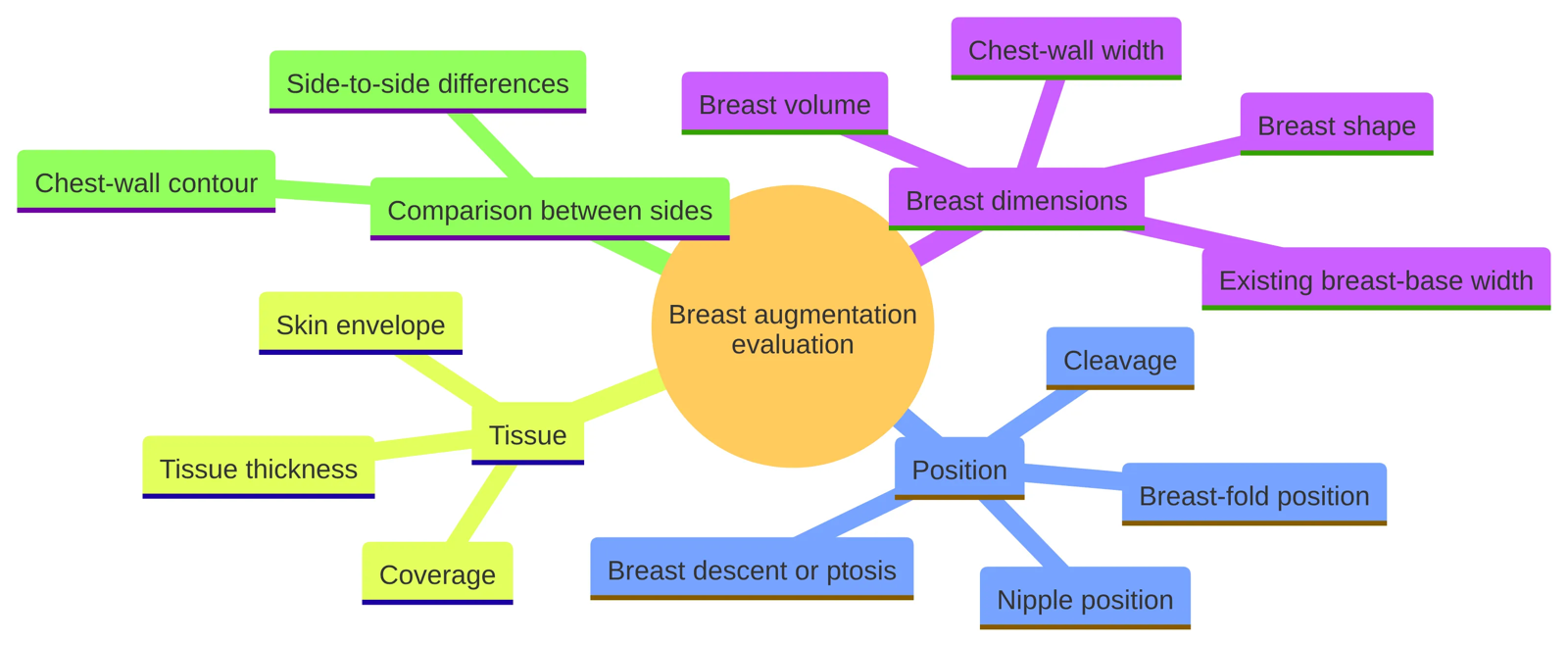
A visual description becomes more useful when it identifies the feature it is describing. A surgeon may evaluate chest-wall width, breast-base width, nipple and breast-fold measurements, tissue thickness in several areas, cleavage, and nipple position relative to the sternal notch. These observations may help guide discussion of implant width, height, and projection.
Rather than treating these as a formula, this article uses them as a way to distinguish meanings that everyday appearance words can combine. A request for “more fullness,” for example, may be about horizontal breadth, forward projection, or upper-breast contour. The same stated volume can therefore leave the central visual priority unclear. In the cited planning approach, breast dimensions provide the starting context for considering volume, along with implant width and, where relevant, height and tissue characteristics.
Vertical landmarks add another layer of meaning. Nipple level, the nipple-to-inframammary-fold relationship, breast descent, and skin excess may all be relevant to how shape is discussed. The breast fold helps define the lower boundary of the breast, and its position may differ between sides. A description of one breast as “lower” may therefore refer to more than one landmark.
The chest also changes how a visual word is read. Chest-wall contour and side-to-side rib-cage differences may influence breast position, spacing, and direction. An apparent gap or directional difference is not necessarily a statement about breast volume.
This creates a different kind of reading task. First, identify the appearance word being used. Next, separate the distinct features that word could describe: horizontal setting, vertical position, coverage, or side-to-side context. Then recognize that a clinical evaluation is needed to establish which features are relevant. The purpose is not to select a technique or turn anatomy into a reader exercise. It is to make the observation itself clearer.
For example, breast-base and chest-wall width can provide context when “fullness” means breadth. Nipple level and the breast fold can provide context when “uneven” means one breast appears higher or lower. Tissue thickness can provide context when “soft” refers to the transition over the upper breast. Cleavage and chest-wall contour can help distinguish spacing from breast size. Skin excess or breast descent may add yet another meaning to a description of shape.
A single visual concern can include several of these meanings at once. The point is not to isolate one feature as the answer or rank one feature above another. It is to avoid converting an ambiguous appearance word into a premature technical conclusion. General information can clarify the vocabulary of a concern; individualized evaluation is what connects that concern with planning.
A narrow base: balancing breadth, projection, and upper contour
Consider an illustrative person with a relatively narrow breast footprint who wants more fullness. The important tension is not simply whether more volume is desired. It is whether the desired change is mainly about a broader horizontal presence, more forward projection, a fuller upper contour, or a combination of those priorities.
A surgeon may evaluate breast-base width with chest-wall width and contour, then consider breast shape, cleavage, tissue thickness, nipple-to-fold relationships, and the skin envelope. Those observations describe the horizontal and vertical setting in which a fullness goal is being considered. Measurements may help guide discussion of implant width, height, and projection.
Breadth, projection, and upper-pole contour are related but distinct visual directions. Greater breadth concerns how the breast occupies space across the chest. Projection concerns forward contour. Upper-breast fullness concerns the transition above the nipple. Breast shape, tissue characteristics, and the skin envelope can add context to each direction, while nipple level and fold position keep the discussion connected to the breast’s vertical frame.
The trade-off revealed by this narrative is one of emphasis. A person may use one word, fullness, for several priorities that cannot be assumed to carry equal weight. Evaluation does not convert those priorities into an automatic answer. It makes the competing meanings visible so that fit, shape, and contour can be discussed as separate parts of the same goal.
Unevenness: separating volume from the breast’s vertical frame
Consider an illustrative person who notices that one breast appears smaller or lower than the other. Volume may be part of what is visible, but the central trade-off is between describing the difference as size alone and preserving the several landmarks that can contribute to apparent unevenness.
A surgeon may compare breast-base dimensions, nipple and fold relationships, tissue thickness, cleavage, and the position of each breast on the chest. Skin excess or breast descent may also be relevant. Chest-wall contour and side-to-side rib-cage differences may influence spacing and direction, providing context that a volume comparison alone cannot supply.
The breast fold helps define the lower boundary of the breast, while nipple level is a separate vertical reference. Along with breast shape and the skin envelope, these landmarks can help distinguish whether the visible difference concerns position, shape, volume, or more than one feature. They do not establish how an individual difference would be addressed.
This narrative therefore keeps asymmetry descriptive rather than reductive. Existing asymmetry and overall chest and body shape may remain noticeable or become more apparent. That is not an individual forecast. It explains why a discussion centered on one side appearing lower or smaller may need to retain the breast’s vertical frame and chest-wall setting rather than treating unevenness as a single volume problem.
Softness: distinguishing a contour preference from tissue coverage
The third illustration begins with soft. A person may mean a softer upper-pole transition, may notice relatively thin tissue over the upper breast, or may be describing both. The trade-off is between treating these as one preference and recognizing that contour and coverage refer to different parts of the planning picture.
Evaluation may include tissue thickness in several areas, breast-base dimensions, breast shape, the skin envelope, and nipple and fold relationships. A desired upper-breast transition is an appearance priority. Coverage concerns the tissue environment in which that priority is considered.
When soft-tissue coverage is limited, implant palpability, visible edges, and rippling may become relevant considerations. This does not establish that these features will occur for a particular person, and it does not identify a particular surgical response. It explains why a description of a preferred contour can lead to a separate discussion about coverage.
The trade-off is not between fixed labels such as “natural” and “full.” It may involve upper-pole fullness, slope, softness, edge visibility, and the coverage already present. Surgical planning can include decisions about implant dimensions and type, pocket position, and incision location, but the word soft does not determine one technique.
Coverage is a consideration, not a built-in solution
Once limited coverage is part of the anatomical picture, the appropriate next step is still not to assign a procedure. The literature describes several clinical approaches that may be discussed when soft-tissue coverage is limited, including different implant-pocket strategies and, in some circumstances, combining an implant with a person’s own fat.
Composite augmentation refers to combining an implant with a person’s own fat, with distinct roles for core volume and overlying soft-tissue or shape refinement. That definition clarifies the subject under discussion without making composite augmentation a default answer to thin tissue, an upper-pole preference, or any other visible concern. Whether an approach is relevant depends on individualized evaluation.
The evidence base also requires caution. A 2019 systematic review of primary composite augmentation identified five studies totaling 382 patients. The available literature was largely retrospective, single-institution case series, and the review noted that higher-level evidence is needed. Composite augmentation is therefore an evolving clinical topic rather than a general planning endpoint.
In this feature, the value of raising coverage is narrower: it shows why tissue thickness may be a separate reference point from volume and contour. Naming that distinction can make the anatomy behind a planning conversation clearer.
The cross-case lesson: identify the trade-off before naming the goal
These three narratives do not sort people into procedure categories. They show how three ordinary appearance words can point in different directions. Fullness may point to breadth, projection, or upper contour. Unevenness may point to volume, vertical landmarks, or the chest beneath the breasts. Softness may point to contour preference, tissue coverage, or both.
The same visual description can involve more than one reference point. Breast shape, nipple and fold position, skin excess or descent, tissue coverage, breast-base fit, and chest-wall differences may overlap in a single discussion. The useful distinction is not which feature is the answer, but which feature gives the stated word its most specific meaning.
For women in Beverly Hills considering breast augmentation, general information can help separate what is being noticed from the conclusion that might otherwise be attached to it. A qualified surgeon can then connect the clarified observation with an individualized evaluation and explain which planning considerations are relevant. General information cannot produce a guaranteed contour, identical breasts, or an individual outcome.
Schedule a breast augmentation consultation.
Frequently asked questions about anatomy-related trade-offs in breast augmentation
What anatomical reference points may be reviewed during breast augmentation planning?
A surgeon may evaluate chest-wall width, breast-base width, nipple and fold position, tissue thickness, cleavage, skin excess or breast descent, and side-to-side differences. These observations provide context for discussing volume, shape, and contour.
How do breast-base and chest-wall dimensions affect a fullness discussion?
They provide context for the breast’s horizontal setting. A concern about fullness may involve breadth across the chest, forward projection, upper-breast contour, or more than one of these features. Measurements may help guide discussion of implant width, height, and projection.
Why are nipple level and breast-fold position relevant when breasts appear uneven?
They are separate vertical landmarks. Differences in nipple level, fold position, breast shape, skin excess, breast descent, and chest-wall contour can each contribute to an uneven appearance beyond a difference in volume.
How is tissue coverage different from a softer upper-pole preference?
Tissue coverage concerns the layer over an implant, while a softer upper-pole preference concerns contour. When coverage is limited, palpability, visible edges, and rippling may become relevant considerations without predicting that they will occur for an individual.
Does limited tissue coverage determine a particular technique?
No. Clinicians may discuss different approaches, including implant-pocket strategies and, in some circumstances, composite augmentation. Whether any approach is relevant requires individualized evaluation, and the evidence for composite approaches has important limitations.
What is the main purpose of an anatomy-first planning discussion?
It connects a visible concern with the breast footprint, vertical landmarks, coverage, and chest-wall context that may be relevant. It does not select a procedure or predict an individual outcome.
Leave a Reply