
Tag: breast augmentation planning

  • Three Anatomical Trade-Offs Behind Breast-Augmentation Goals

    Three Anatomical Trade-Offs Behind Breast-Augmentation Goals

    Three appearance goals, each with a different trade-off

    Words such as fullness, unevenness, and softness can seem self-explanatory in a breast-augmentation conversation. They are not. Each can describe more than one visible feature, and those features may lead attention to different anatomical reference points.

    This feature uses three illustrative, non-identifying narratives as a language-to-anatomy reading exercise. They are not patient cases, a self-assessment method, or a recommendation for a particular procedure. In each narrative, an ordinary appearance word is separated into the features it may be describing before considering what a surgeon may evaluate.

    Fullness may refer to the breast’s horizontal footprint, forward projection, or upper-breast contour. Unevenness may refer to volume, nipple level, breast-fold position, skin excess, or how each breast sits on the chest. Softness may refer to a preferred upper-pole transition, tissue coverage, or both. The point is not to assign a technical explanation to a reader’s observation. It is to keep different meanings from being compressed into one conclusion.

    Across all three narratives, breast shape after augmentation reflects both the implant and the existing skin, glandular tissue, and fat coverage. Planning may consider those features with breast shape and a person’s goals. General information can clarify the meaning of an appearance word; it cannot determine an individual plan.

    The reference points that keep one visual goal from standing in for another

    A visual description becomes more useful when it identifies the feature it is describing. A surgeon may evaluate chest-wall width, breast-base width, nipple and breast-fold measurements, tissue thickness in several areas, cleavage, and nipple position relative to the sternal notch. These observations may help guide discussion of implant width, height, and projection.

    Rather than treating these as a formula, this article uses them as a way to distinguish meanings that everyday appearance words can combine. A request for “more fullness,” for example, may be about horizontal breadth, forward projection, or upper-breast contour. The same stated volume can therefore leave the central visual priority unclear. In the cited planning approach, breast dimensions provide the starting context for considering volume, along with implant width and, where relevant, height and tissue characteristics.

    Vertical landmarks add another layer of meaning. Nipple level, the nipple-to-inframammary-fold relationship, breast descent, and skin excess may all be relevant to how shape is discussed. The breast fold helps define the lower boundary of the breast, and its position may differ between sides. A description of one breast as “lower” may therefore refer to more than one landmark.

    The chest also changes how a visual word is read. Chest-wall contour and side-to-side rib-cage differences may influence breast position, spacing, and direction. An apparent gap or directional difference is not necessarily a statement about breast volume.

    This creates a different kind of reading task. First, identify the appearance word being used. Next, separate the distinct features that word could describe: horizontal setting, vertical position, coverage, or side-to-side context. Then recognize that a clinical evaluation is needed to establish which features are relevant. The purpose is not to select a technique or turn anatomy into a reader exercise. It is to make the observation itself clearer.

    For example, breast-base and chest-wall width can provide context when “fullness” means breadth. Nipple level and the breast fold can provide context when “uneven” means one breast appears higher or lower. Tissue thickness can provide context when “soft” refers to the transition over the upper breast. Cleavage and chest-wall contour can help distinguish spacing from breast size. Skin excess or breast descent may add yet another meaning to a description of shape.

    A single visual concern can include several of these meanings at once. The point is not to isolate one feature as the answer or rank one feature above another. It is to avoid converting an ambiguous appearance word into a premature technical conclusion. General information can clarify the vocabulary of a concern; individualized evaluation is what connects that concern with planning.
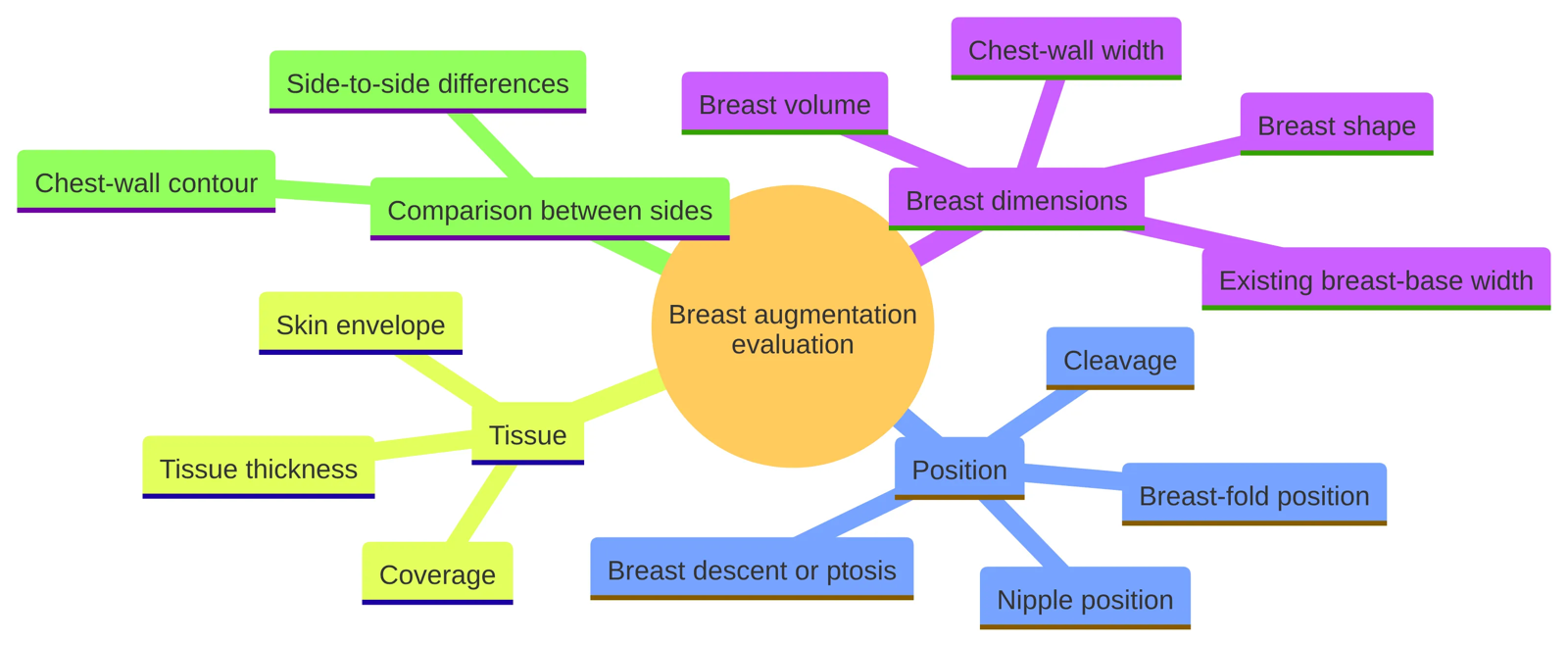
    A mind map of the factors a surgeon may evaluate when a desired breast volume is considered: breast dimensions, position, tissue, and side-to-side differences.
    A volume preference is assessed alongside breast shape, tissue, position, and chest-wall differences.

    A narrow base: balancing breadth, projection, and upper contour

    Consider an illustrative person with a relatively narrow breast footprint who wants more fullness. The important tension is not simply whether more volume is desired. It is whether the desired change is mainly about a broader horizontal presence, more forward projection, a fuller upper contour, or a combination of those priorities.

    A surgeon may evaluate breast-base width with chest-wall width and contour, then consider breast shape, cleavage, tissue thickness, nipple-to-fold relationships, and the skin envelope. Those observations describe the horizontal and vertical setting in which a fullness goal is being considered. Measurements may help guide discussion of implant width, height, and projection.

    Breadth, projection, and upper-pole contour are related but distinct visual directions. Greater breadth concerns how the breast occupies space across the chest. Projection concerns forward contour. Upper-breast fullness concerns the transition above the nipple. Breast shape, tissue characteristics, and the skin envelope can add context to each direction, while nipple level and fold position keep the discussion connected to the breast’s vertical frame.

    The trade-off revealed by this narrative is one of emphasis. A person may use one word, fullness, for several priorities that cannot be assumed to carry equal weight. Evaluation does not convert those priorities into an automatic answer. It makes the competing meanings visible so that fit, shape, and contour can be discussed as separate parts of the same goal.

    Unevenness: separating volume from the breast’s vertical frame

    Consider an illustrative person who notices that one breast appears smaller or lower than the other. Volume may be part of what is visible, but the central trade-off is between describing the difference as size alone and preserving the several landmarks that can contribute to apparent unevenness.

    A surgeon may compare breast-base dimensions, nipple and fold relationships, tissue thickness, cleavage, and the position of each breast on the chest. Skin excess or breast descent may also be relevant. Chest-wall contour and side-to-side rib-cage differences may influence spacing and direction, providing context that a volume comparison alone cannot supply.

    The breast fold helps define the lower boundary of the breast, while nipple level is a separate vertical reference. Along with breast shape and the skin envelope, these landmarks can help distinguish whether the visible difference concerns position, shape, volume, or more than one feature. They do not establish how an individual difference would be addressed.

    This narrative therefore keeps asymmetry descriptive rather than reductive. Existing asymmetry and overall chest and body shape may remain noticeable or become more apparent. That is not an individual forecast. It explains why a discussion centered on one side appearing lower or smaller may need to retain the breast’s vertical frame and chest-wall setting rather than treating unevenness as a single volume problem.

    Softness: distinguishing a contour preference from tissue coverage

    The third illustration begins with soft. A person may mean a softer upper-pole transition, may notice relatively thin tissue over the upper breast, or may be describing both. The trade-off is between treating these as one preference and recognizing that contour and coverage refer to different parts of the planning picture.

    Evaluation may include tissue thickness in several areas, breast-base dimensions, breast shape, the skin envelope, and nipple and fold relationships. A desired upper-breast transition is an appearance priority. Coverage concerns the tissue environment in which that priority is considered.

    When soft-tissue coverage is limited, implant palpability, visible edges, and rippling may become relevant considerations. This does not establish that these features will occur for a particular person, and it does not identify a particular surgical response. It explains why a description of a preferred contour can lead to a separate discussion about coverage.

    The trade-off is not between fixed labels such as “natural” and “full.” It may involve upper-pole fullness, slope, softness, edge visibility, and the coverage already present. Surgical planning can include decisions about implant dimensions and type, pocket position, and incision location, but the word soft does not determine one technique.

    Coverage is a consideration, not a built-in solution

    Once limited coverage is part of the anatomical picture, the appropriate next step is still not to assign a procedure. The literature describes several clinical approaches that may be discussed when soft-tissue coverage is limited, including different implant-pocket strategies and, in some circumstances, combining an implant with a person’s own fat.

    Composite augmentation refers to combining an implant with a person’s own fat, with distinct roles for core volume and overlying soft-tissue or shape refinement. That definition clarifies the subject under discussion without making composite augmentation a default answer to thin tissue, an upper-pole preference, or any other visible concern. Whether an approach is relevant depends on individualized evaluation.

    The evidence base also requires caution. A 2019 systematic review of primary composite augmentation identified five studies totaling 382 patients. The available literature was largely retrospective, single-institution case series, and the review noted that higher-level evidence is needed. Composite augmentation is therefore an evolving clinical topic rather than a general planning endpoint.

    In this feature, the value of raising coverage is narrower: it shows why tissue thickness may be a separate reference point from volume and contour. Naming that distinction can make the anatomy behind a planning conversation clearer.

    The cross-case lesson: identify the trade-off before naming the goal

    These three narratives do not sort people into procedure categories. They show how three ordinary appearance words can point in different directions. Fullness may point to breadth, projection, or upper contour. Unevenness may point to volume, vertical landmarks, or the chest beneath the breasts. Softness may point to contour preference, tissue coverage, or both.

    The same visual description can involve more than one reference point. Breast shape, nipple and fold position, skin excess or descent, tissue coverage, breast-base fit, and chest-wall differences may overlap in a single discussion. The useful distinction is not which feature is the answer, but which feature gives the stated word its most specific meaning.

    For women in Beverly Hills considering breast augmentation, general information can help separate what is being noticed from the conclusion that might otherwise be attached to it. A qualified surgeon can then connect the clarified observation with an individualized evaluation and explain which planning considerations are relevant. General information cannot produce a guaranteed contour, identical breasts, or an individual outcome.

    Schedule a breast augmentation consultation.


    Frequently asked questions about anatomy-related trade-offs in breast augmentation

    What anatomical reference points may be reviewed during breast augmentation planning?

    A surgeon may evaluate chest-wall width, breast-base width, nipple and fold position, tissue thickness, cleavage, skin excess or breast descent, and side-to-side differences. These observations provide context for discussing volume, shape, and contour.

    How do breast-base and chest-wall dimensions affect a fullness discussion?

    They provide context for the breast’s horizontal setting. A concern about fullness may involve breadth across the chest, forward projection, upper-breast contour, or more than one of these features. Measurements may help guide discussion of implant width, height, and projection.

    Why are nipple level and breast-fold position relevant when breasts appear uneven?

    They are separate vertical landmarks. Differences in nipple level, fold position, breast shape, skin excess, breast descent, and chest-wall contour can each contribute to an uneven appearance beyond a difference in volume.

    How is tissue coverage different from a softer upper-pole preference?

    Tissue coverage concerns the layer over an implant, while a softer upper-pole preference concerns contour. When coverage is limited, palpability, visible edges, and rippling may become relevant considerations without predicting that they will occur for an individual.

    Does limited tissue coverage determine a particular technique?

    No. Clinicians may discuss different approaches, including implant-pocket strategies and, in some circumstances, composite augmentation. Whether any approach is relevant requires individualized evaluation, and the evidence for composite approaches has important limitations.

    What is the main purpose of an anatomy-first planning discussion?

    It connects a visible concern with the breast footprint, vertical landmarks, coverage, and chest-wall context that may be relevant. It does not select a procedure or predict an individual outcome.

  • Breast Implants Consultation Checklist: How to Prepare for an Informed Discussion

    Breast Implants Consultation Checklist: How to Prepare for an Informed Discussion

    Use the Consultation to Build an Individualized Decision Plan

    A breast implants consultation is a planning conversation: a time to explain what you hope to change, learn what may be relevant in your situation, and decide whether you have enough information to take a next step. It is not a verdict on your candidacy, and it cannot promise a particular appearance, recovery experience, or long-term result.

    The most useful consultation is a two-way discussion. You bring clear priorities, a complete health history, and questions that matter to you. The clinician may review your health, assess breast characteristics, discuss options, and explain likely outcomes alongside risks and potential complications. Individualized procedure details should be confirmed directly with the provider after they have reviewed your circumstances.

    This matters because breast implants are a long-term decision rather than a single appointment. In 2021, the FDA took actions intended to strengthen breast-implant risk communication and support informed decision-making in the United States. Use that principle as your guide: do not rush toward a choice simply because you have gathered information. Leave room to understand the trade-offs, ask follow-up questions, and review the answers before deciding.

    Before the Visit: Prepare Your Goals, Health History, and Records

    Preparation helps the appointment focus on your actual goals instead of broad assumptions about what you want. You do not need to arrive with a preferred implant or surgical plan. You do need a straightforward account of your priorities and health background. Write notes in advance if that makes it easier to speak clearly during the visit.

    Clarify your goals and expectations

    • Write down why you are considering breast augmentation now.
    • Describe the changes you hope to discuss in your own words. Focus on your priorities rather than trying to use technical terminology.
    • Separate your must-haves from preferences you are still exploring.
    • Note any concerns about how you may feel about the result over time.
    • Bring examples that help communicate your aesthetic preferences, while recognizing that another person’s result is not a prediction of yours.
    • Be prepared to discuss your expectations and desired outcome. A useful question to ask yourself beforehand is: “What information would I need to hear to feel ready, and what information would make me pause?”

    This preparation is not about proving that one choice is correct. It gives the clinician a clearer starting point for explaining what may be realistic in your circumstances.

    Gather the health information that belongs in the conversation

    Bring records when you have them, or be ready to describe the information accurately:

    • Medical conditions, drug allergies, and previous medical treatments.
    • Current medicines, vitamins, and herbal supplements.
    • Alcohol, tobacco, and drug use.
    • Family history of breast cancer.
    • Results of mammograms or prior biopsies.
    • Any prior breast procedures, surgery, implants, or treatment affecting the breast area. If you are unsure what is relevant, mention it and let the clinician determine whether it needs further discussion.

    Completeness is more helpful than trying to predict which detail will matter. Do not stop or change medicines, supplements, or personal habits based on a checklist alone. Instead, provide an accurate picture and ask the provider what information or preparation is relevant to their plan.

    Make the visit easier to use

    Bring a written question list, your imaging or biopsy information if available, and any notes about prior breast procedures. If you tend to forget details during important conversations, ask whether you may take notes or bring a support person, subject to the practice’s policies. Before you leave home, identify the decisions you are not ready to make that day. That boundary can help you listen without feeling pressured to reach a conclusion immediately.

    Your goal is not to turn the consultation into self-diagnosis. Your goal is to make sure the discussion starts with the facts, preferences, and questions that are specific to you.

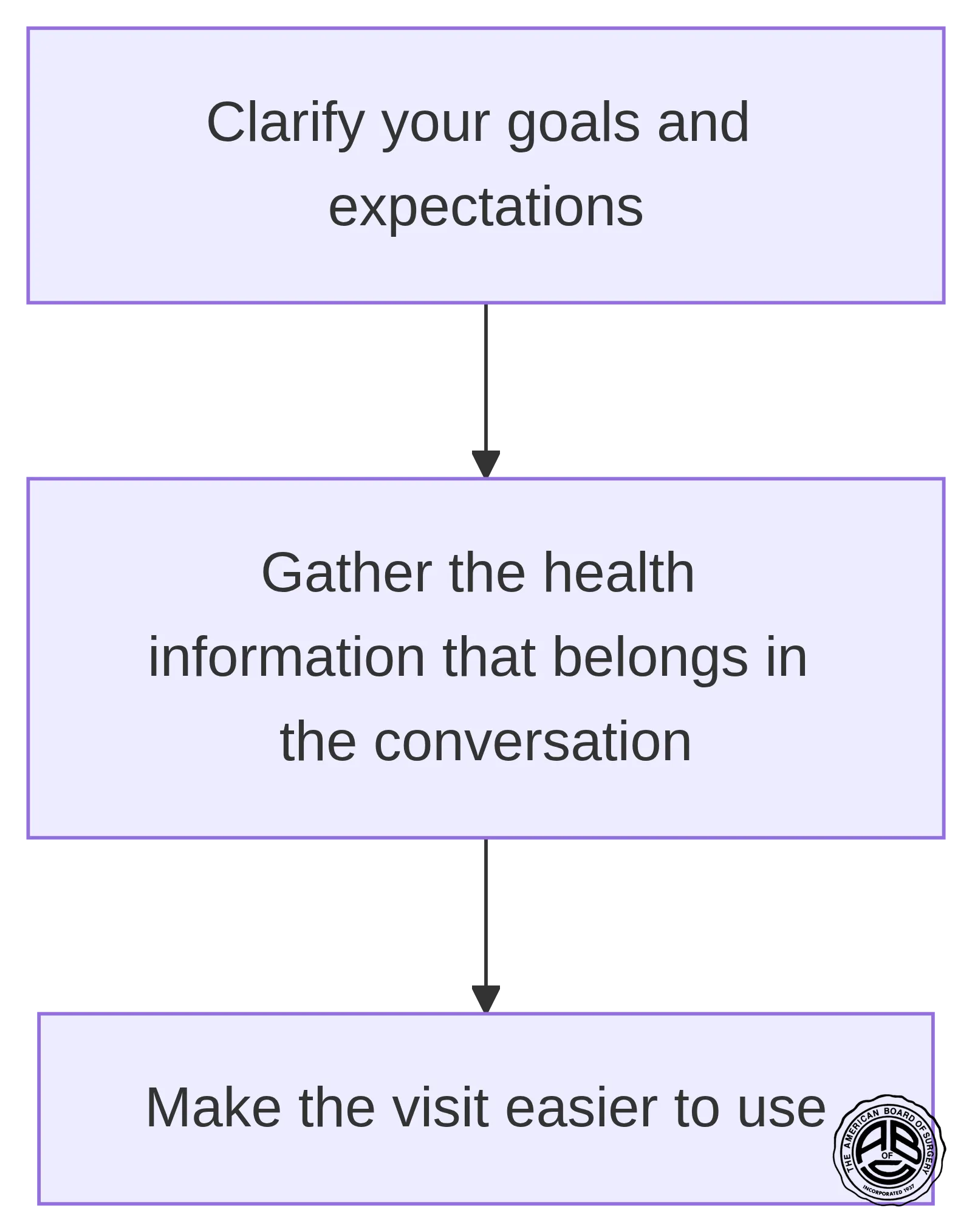
    A three-step consultation-preparation checklist: clarify goals and expectations, gather relevant health information, and make the visit easier to use.
    Prepare your priorities, health information, and questions before the consultation.

    During the Visit: Understand What Individualized Planning May Include

    Individualized planning may involve more than talking about a desired size or shape. A consultation may include an evaluation of general health and relevant pre-existing conditions or risk factors. It may also include an examination and measurements of breast size, shape, skin quality, and nipple and areola placement. These steps give the clinician information for a more tailored discussion; they do not guarantee that a particular option is appropriate or that a particular result will occur.

    Use this checklist while the plan is being discussed

    • Ask what information from your goals and health history is shaping the discussion.
    • Notice whether the explanation connects your priorities to the options being considered.
    • Ask for plain-language clarification when a term, measurement, or recommendation is unclear.
    • Confirm whether photographs may be taken as part of the consultation process and ask how they will be used in the planning discussion.
    • Ask the clinician to distinguish between what can be discussed generally and what depends on a fuller evaluation or later planning.
    • Request a clear explanation of the options, likely outcomes, risks, and potential complications being considered for you.

    A strong consultation should make you more informed, not merely more persuaded. If an answer feels incomplete, ask what additional information would help you understand it. If you need time, take time. A decision that affects your body and future planning deserves a pace you can live with.

    The clinician’s examination and recommendations are part of individualized medical care. This checklist cannot determine candidacy, select an implant, or interpret your health information. Use it to organize the conversation, then rely on the provider’s direct assessment for decisions that depend on your anatomy, health, and goals.

    Ask About Implant Options, Credentials, and Safety Information

    Questions work best when they ask for reasoning, not just a yes-or-no answer. Rather than asking which option is “best,” ask what the clinician recommends for you and why. That invites a discussion of your stated priorities, the procedure plan, and the limitations that may matter in your case.

    Questions about the surgeon and surgical setting

    • Are you certified by the American Board of Plastic Surgery?
    • Were you trained specifically in plastic surgery?
    • Do you have hospital privileges to perform this procedure?
    • Where and how would the procedure be performed?
    • If an office-based surgical facility is involved, what is its accreditation, licensing, or certification status?

    These questions are particularly relevant in the United States. Ask for a direct explanation if you do not understand how the surgical setting relates to the proposed plan.

    Questions about implant and surgical planning

    • Which implant characteristics would you recommend for me, and why?
    • What shape, size, surface texturing, incision site, and placement site are being considered?
    • What alternatives are relevant to my goals, and what are the important differences I should understand?
    • Can you explain the relevant information for saline-filled and silicone gel-filled implants?
    • For FDA-regulated saline-filled and silicone gel-filled implants, can we review the patient decision checklist, labeling information, and any applicable screening recommendations?
    • What implant-associated risks should I understand, including BIA-ALCL?

    Do not treat a technical explanation as something you must accept immediately. Ask the clinician to restate the point in everyday language and explain how it applies to the choices under discussion. If you are given decision materials, review them carefully before making a decision.

    Risk communication should be specific enough to support an informed discussion. Ask what risks and potential complications are associated with the procedure being proposed and what information you should review before proceeding. A consultation can inform your choice, but it cannot eliminate uncertainty or assure a particular outcome.

    Ask Questions That Look Beyond Surgery Day

    A decision about implants should include questions about the period after surgery and the possibility of future decisions. This is not a reason to assume that a complication or additional procedure will happen. It is a reason to understand the plan, the uncertainties, and the questions you may need answered later.

    Questions about recovery, follow-up, and support

    • What recovery period and type of help may be expected in my situation?
    • What follow-up should I expect to discuss with the practice?
    • What risks and complications are associated with my procedure?
    • How are complications handled?
    • What should I understand about the possibility of additional implant-related operations over my lifetime?

    Recovery varies by individual. Ask for an explanation that helps you plan conversations with the people who may support you, while avoiding assumptions that another patient’s experience will be yours.

    Questions about future changes and choices

    • How may the procedure affect breastfeeding?
    • How may breasts with implants change over time, including after pregnancy or breastfeeding?
    • What options may exist if I am dissatisfied with the cosmetic outcome?
    • What may be expected if implants are removed without replacement in the future?
    • May I review before-and-after photographs for this procedure and discuss what results may be reasonable in my circumstances?

    Photographs can help you discuss a clinician’s work and your expectations, but they are not a promise. Ask what differences between patients may affect the relevance of any image you are shown. Keep the focus on understanding what is reasonable to discuss for you, not on securing certainty that medicine cannot provide.

    Before moving forward, make sure you can state the answers back in your own words: the proposed approach, the recovery and support discussion, the risks raised, the follow-up plan, and the future questions you may need to revisit. If you cannot, ask for clarification or pause the decision.

    Raise Implant Reservations and Alternatives Openly

    Breast augmentation may involve breast implants or fat transfer. If interest in fat transfer reflects reservations about implants, discuss those reservations with a plastic surgeon before surgery. The useful starting point is not to assume one option resolves every concern; it is to name the concern clearly.

    You might say: “I am interested in this alternative because I am uncertain about implants. Can we talk through that uncertainty before discussing a decision?” This keeps the conversation centered on your reasons, rather than on a label or trend.

    Reservation checklist

    • Identify what specifically gives you pause: the device, the surgical plan, long-term considerations, recovery, appearance, or something else.
    • Ask whether your concern changes the options that warrant discussion.
    • Ask what questions remain unanswered after the alternatives are explained.
    • Do not proceed until you understand the relevant reasons for and limitations of the approach being discussed.

    A provider can help explain options, but the decision remains yours. If your reservations are still substantial after a clear discussion, that is a boundary worth respecting.

    Leave With Answers You Can Review Before Deciding

    Bring this checklist to the appointment and use it as a record of what was discussed. Before deciding whether to move forward, review your notes away from the pressure of the visit. You should be able to identify your goals, describe the proposed approach, explain the risks and potential complications discussed, and name the questions that still need answers.

    Ask the provider directly for the individualized procedure information you need. If an answer is unclear, request clarification. If you need another conversation, ask for one. The right next step is an informed one, taken only after you have had the opportunity to understand the discussion in the context of your own health and priorities.

    Frequently Asked Questions About Preparing for a Breast Implants Consultation

    What should I bring to a breast implants consultation?

    Bring your goals, a list of current medicines and supplements, any drug allergies, relevant medical history, and records of prior breast imaging or biopsies if you have them. It also helps to note any previous breast procedures and the questions you most want answered.

    What may the clinician assess during the visit?

    The consultation may include a review of your general health, relevant risk factors, and an exam that looks at breast size, shape, skin quality, and nipple and areola placement. Photographs may also be taken as part of the planning process.

    Which implant and surgical planning questions are useful to ask?

    Ask which implant characteristics, incision site, and placement site are being considered for you, and why. You can also ask about the differences between saline-filled and silicone gel-filled implants and any labeling or checklist information that should be reviewed.

    What safety information should I ask about before deciding?

    Ask about the risks and potential complications of the procedure, how complications are handled, and what implant-related risks may apply, including BIA-ALCL. It is also reasonable to ask what information you should review before moving forward.

    What long-term questions belong in the discussion?

    Ask how the procedure may affect breastfeeding, how implants may change over time, and what options may exist if you are dissatisfied later. You can also ask what may be expected if implants are removed without replacement and whether before-and-after photos can help set realistic expectations.