Match your loved one’s needs to the right type of home-based care
Choosing home-based care starts with identifying the kind of help your loved one needs. Home health care nursing refers to skilled medical support delivered in the home, often as part of broader home health care. Home health care may involve licensed nurses or therapists and can address medical needs related to recovery, chronic disease management, or serious-illness symptoms. Caregiving, by contrast, focuses on everyday care and daily needs. A family-medicine home visit is a medical visit at home rather than an ongoing caregiving service.
For a Denver family, the central question is not simply whether care happens at home. The central question is whether the requested support is medical care, everyday assistance, or a primary-care encounter. A loved one who needs medication assistance or wound care may need a skilled medical provider. A loved one who needs help with daily routines or companionship may need non-medical home care. A loved one whose family wants to discuss a medical concern with a primary-care practice may need a family-medicine home visit.
The distinctions guide the first conversation, but the distinctions do not determine eligibility or confirm a particular service. Describe the care purpose to the provider and ask the provider to confirm the appropriate scope before scheduling.
Home health care nursing brings skilled medical care into the home
Home health care nursing is the nursing portion of medical care delivered in a patient’s home. Home health care is often provided by licensed nurses or therapists, while skilled nursing addresses medical needs such as medication assistance, wound care, and recovery-related care. The term skilled describes the medical nature of the support rather than the amount of time a caregiver spends in the home.
A family considering skilled nursing at home should describe the medical task rather than rely on a broad label. Medication assistance, wound care, and recovery support communicate a different need from meal preparation, conversation, or help with basic household activities. Clear wording helps a provider explain whether the requested service belongs within nursing care, another home health discipline, or a separate type of support.
Skilled nursing at home also differs from a brief clinician appointment. A nurse may provide skilled care in the home as part of a home health service, while a family-medicine clinician conducts a primary-care encounter. Both forms of care take place at home, but the provider role and purpose are different. A family should ask who will provide the service, what medical need the service addresses, and whether the requested support is included before making arrangements.
The practical boundary is straightforward: use skilled nursing as a category for medical support, not as a general term for every service delivered in a home. Ask a qualified provider to confirm the service scope for the individual care situation.
Skilled home health care can address recovery and ongoing medical needs
Home health care can support recovery from illness or injury, chronic-disease management, and management of serious-illness symptoms. The broader home health category can include more than nursing alone. Examples can include medication management, physical therapy, speech therapy, occupational therapy, wound care, disease-management education, and nutritional counseling.
Skilled nursing represents one part of that wider range. Skilled nursing addresses medical needs such as medication assistance, wound care, and other recovery-related care. Therapy, education, and nutritional counseling involve different kinds of professional support, even when the services are organized under home health care. A family should therefore ask about the specific discipline involved rather than assume that every home health provider offers every listed service.
A useful planning conversation separates three questions:
- What is the medical purpose? Describe whether the concern involves recovery, ongoing disease management, symptoms of a serious illness, medication support, wound care, or another medical need.
- What kind of professional support is being requested? Ask whether the requested help involves nursing, physical therapy, speech therapy, occupational therapy, education, nutritional counseling, or another service.
- What does the provider actually include? Ask the provider to explain the available service, the provider role, and the boundaries of the visit or care plan.
These questions help a family discuss care accurately without trying to determine a clinical need independently. A general description of home health care cannot establish whether a particular loved one qualifies for a service. A home health provider must confirm the appropriate service and scope.
Caregiving focuses on everyday support rather than skilled medical care
Caregiving focuses on everyday support rather than skilled medical care. Non-skilled home care may assist an older adult with supervision, basic activities around the home, conversation, and support for continuing to live at home. Companion care is one example of non-medical support. Companion care may give an older adult regular company while helping with ordinary household needs, but companion care is not the same as nursing care.
Skilled nursing addresses medical needs such as medication assistance, wound care, and recovery-related care. Non-skilled home care focuses on daily support. The difference matters because a caregiver should not be assumed to provide skilled nursing, and a nurse should not be assumed to provide ongoing companionship or household assistance. In-home nursing and non-medical home care are distinct services delivered by different provider types.
A family can use the loved one’s daily routine to clarify the caregiving question. If the main request involves supervision, conversation, or basic household activities, ask a non-medical home-care provider whether the service plan can be tailored to those needs. If the main request involves medication assistance, wound care, or recovery-related medical support, ask a skilled medical provider about the appropriate home health service. If the main request is a clinician’s medical evaluation or primary-care discussion at home, ask a family-medicine practice about a home visit.
The word caregiving should not be used as a substitute for medical care. A family should explain the requested tasks and ask the provider to confirm which provider type can address the request.
A family-medicine home visit is a clinician-led medical encounter
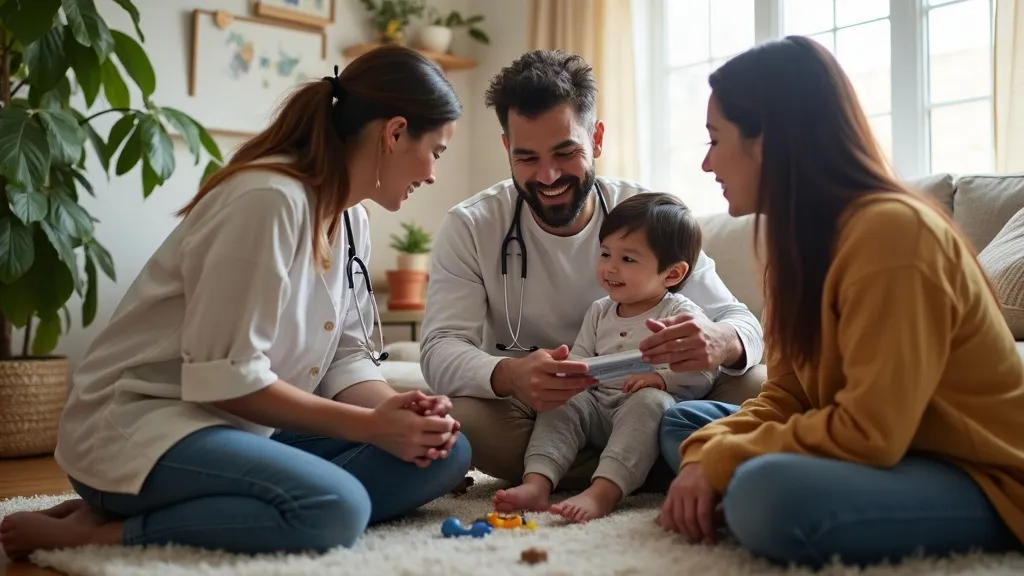
A family-medicine home visit is a clinician-led medical visit conducted in the patient’s home. A family-medicine home visit is not the same as everyday caregiving, companion care, or ongoing skilled home-health nursing. The visit centers on a medical encounter, while caregiving centers on daily support and home health nursing centers on skilled medical care delivered through a home health service.
Primary care can involve family medicine, internal medicine, pediatrics, or senior health. Primary-care physicians may also coordinate referrals for additional care. Physician assistants and nurse practitioners may be part of a primary-care team and may provide common medical services. The clinician role can therefore vary within a primary-care practice, so a family should ask which professional will conduct the home visit and what the visit is designed to address.
A home visit may be the relevant category when the family wants to discuss a medical concern with a primary-care practice without bringing the loved one to a clinic. A home visit is not a general household-support arrangement. A home visit also does not, by itself, establish that nursing, therapy, wound care, or other home health services are included. The family should name the medical purpose and ask the practice to confirm the visit’s scope.
For a planned, non-urgent care discussion, a family-medicine home visit can be considered alongside home health nursing and caregiving as a separate option. The appropriate conversation depends on whether the family is seeking a clinician encounter, skilled home health support, or everyday assistance.
Use the care purpose to decide which provider to contact
Use the care purpose as the first screening question. A Denver family can compare the three categories by the kind of support requested, the provider role, and the question that should guide the first contact.
| Care purpose | Home-based care category | Provider role to discuss | Direct reader action |
|---|---|---|---|
| Skilled medical support, such as medication assistance, wound care, or recovery-related care | Home health care nursing or another skilled home health service | A licensed nurse, therapist, or other relevant home health professional | Ask a home health provider whether the requested medical support is within the provider’s scope |
| Supervision, conversation, or basic activities around the home | Non-skilled home care or companion care | A non-medical home-care provider or caregiver | Ask whether the provider can tailor the service plan to the loved one’s everyday needs |
| A primary-care medical discussion conducted at home | Family-medicine home visit | A primary-care physician, physician assistant, or nurse practitioner | Contact a family-medicine practice and describe the medical purpose of the requested visit |
The table separates service categories; the table does not determine which service a particular person should receive. A family should avoid selecting a provider based only on the phrase home care because the phrase can refer to skilled medical support or everyday assistance. A family should also avoid assuming that a family-medicine home visit includes ongoing caregiving or skilled home-health nursing.
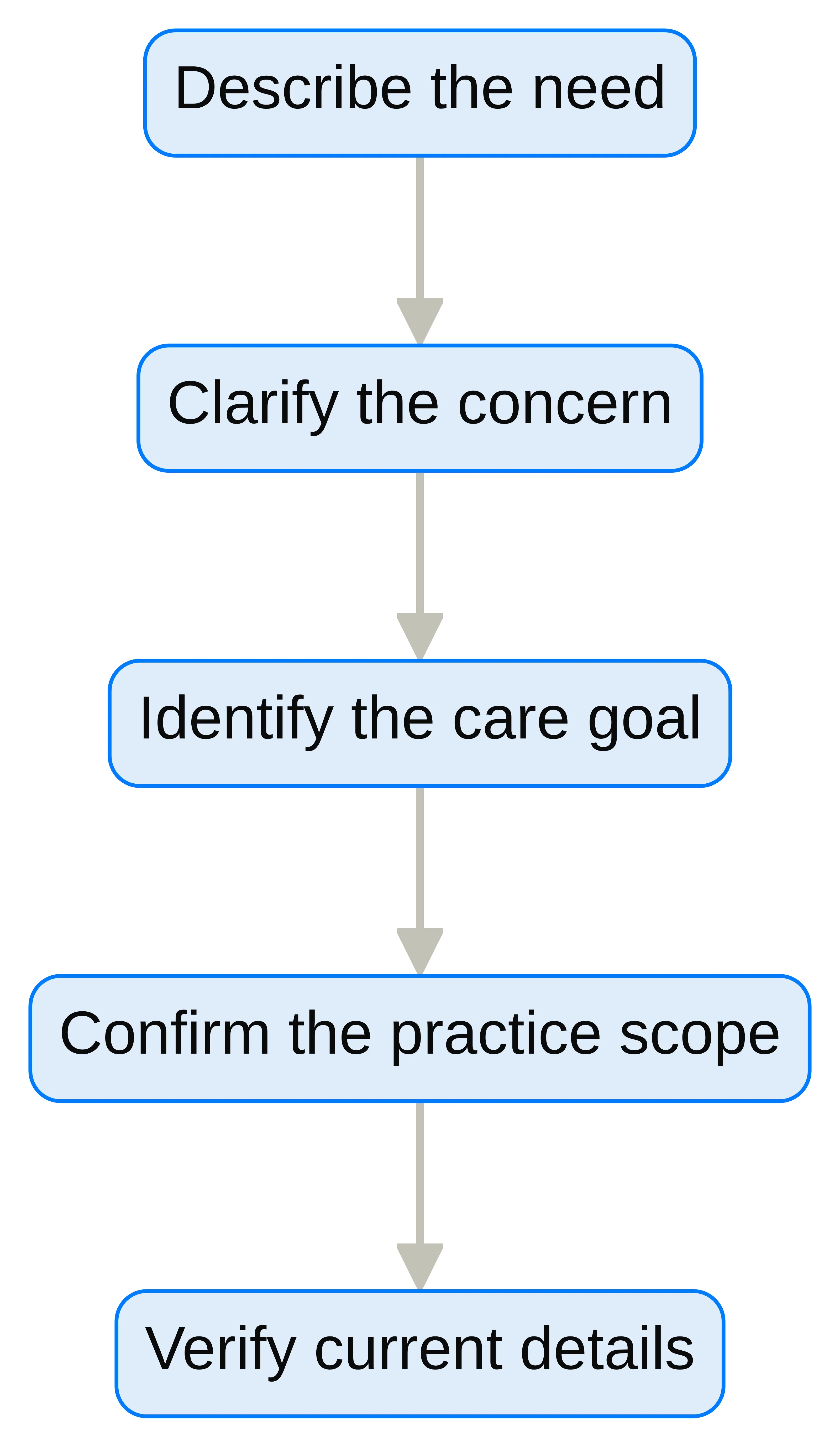
The next step is to write one plain-language sentence about the requested help. For example, a family might describe a need for wound-care support, daily supervision, or a primary-care conversation at home. The family can use the sentence when contacting a provider and ask the provider to confirm the appropriate category and scope.
Ask these questions before arranging care at home
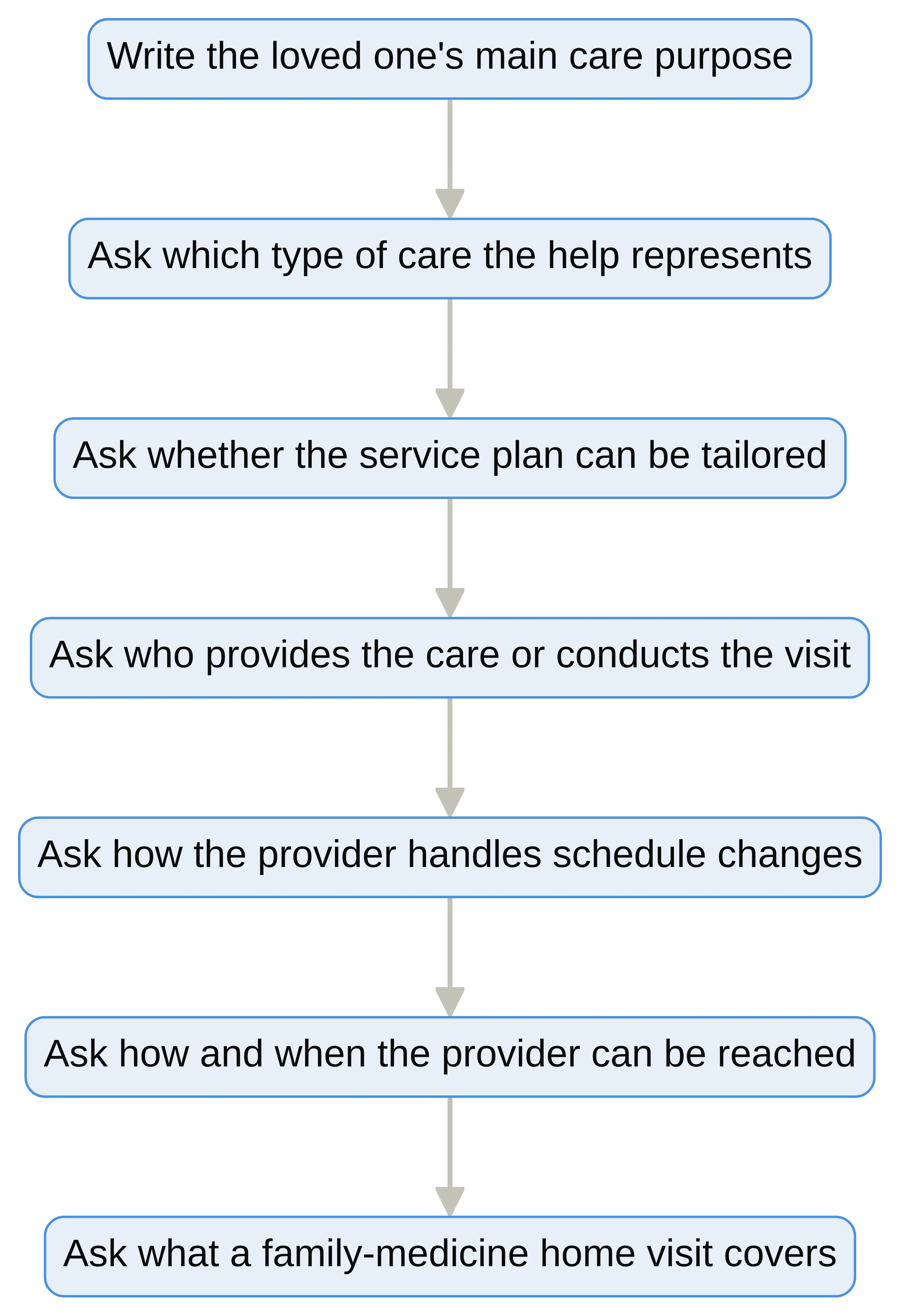
A short provider checklist can keep the first conversation focused. Write the loved one’s main care purpose and use the following questions when speaking with a home-care provider or family-medicine practice:
- Which type of care does the requested help represent? Ask whether the request is skilled medical care, everyday assistance, companion care, or a family-medicine home visit. Different provider types deliver in-home nursing and non-medical home care, while a family-medicine home visit is a medical visit at home.
- Can the service plan be tailored to the loved one’s care needs? A provider should explain how the provider matches the requested support with the individual situation. Ask for a clear description of what the service plan includes.
- Who provides the care or conducts the visit? Ask whether the service involves a nurse, therapist, caregiver, physician, physician assistant, or nurse practitioner. The provider role helps distinguish skilled medical support from everyday assistance and a primary-care encounter.
- How does the provider handle schedule changes? Ask how the provider handles cancellations, changes to the planned schedule, or requests for additional care.
- How and when can the provider be reached for scheduling requests? Ask for the appropriate contact method and scheduling hours so the family knows how to communicate a change.
- What does a family-medicine home visit cover? If a primary-care visit is under consideration, ask the practice to explain the visit purpose, clinician role, and boundaries before scheduling.
The checklist is a conversation aid. The checklist does not determine medical eligibility or replace a provider’s explanation of available care.
Confirm what Paragon’s home visit service includes before scheduling
A family-medicine home visit is a medical visit at home rather than everyday caregiving. Paragon Family Medicine’s Home Visits service should therefore be discussed as a clinician-led home-visit option. A family should not assume that a home visit includes nursing, skilled home-health care, therapy, wound care, or ongoing household assistance. Ask Paragon Family Medicine to confirm the requested service scope directly.
Paragon Family Medicine describes its care offering with personalized healthcare, flexible scheduling, same-day or next-day appointments, a family medicine plus model, and health education resources. Use those service descriptions as prompts for a specific conversation rather than as a reason to assume that every feature applies to every home visit.
Before making plans, ask Paragon Family Medicine five focused questions:
- Can a clinician-led home visit address the loved one’s stated medical purpose?
- Which clinician or primary-care team member conducts the visit?
- What is included in the home visit, and what falls outside the visit’s scope?
- What appointment timing and flexible scheduling options are available for the requested visit?
- Are health education resources part of the conversation or a separate offering?
A clear answer to each question lets the family compare the requested care with the actual service being discussed. Paragon Family Medicine should confirm current timing, scope, provider role, and any applicable charges before the family schedules care. The family should contact a different type of provider when the primary need is ongoing caregiving or skilled home-health nursing rather than a family-medicine home visit.
Contact Paragon to discuss whether a home visit fits your loved one’s needs
Home health care nursing, caregiving, and family-medicine home visits serve different purposes. Skilled medical support belongs in a home health conversation, everyday assistance belongs in a caregiving conversation, and a clinician-led medical encounter at home belongs in a family-medicine conversation. Write down the loved one’s main care purpose, share the purpose with the practice, and ask the practice to confirm the current scope before making plans. A precise care description gives the family a clear starting point for discussing whether a home visit fits the situation.
Questions families commonly ask about home-based care
What is home health care nursing?
Home health care nursing refers to skilled medical support delivered in a patient’s home, often by licensed nurses or therapists. It addresses medical needs related to recovery, chronic disease management, or serious-illness symptoms.
How does home health care differ from caregiving?
Home health care focuses on skilled medical support, such as medication assistance and wound care, while caregiving provides everyday support like supervision and help with basic activities.
What should I ask a provider before scheduling a home visit?
Inquire about the type of care being offered, whether the service plan can be tailored to your loved one’s needs, who will provide the care, how schedule changes are handled, and how to reach the provider for scheduling requests.
What is a family-medicine home visit?
A family-medicine home visit is a clinician-led medical encounter conducted in the patient’s home, distinct from everyday caregiving or skilled nursing care.
How can I confirm what services are included in a home visit with Paragon Family Medicine?
Ask Paragon Family Medicine to clarify the scope of the home visit, including which clinician will conduct it, what is included, and any scheduling options available.
How do I schedule a home visit with Paragon Family Medicine?
To schedule a home visit, contact Paragon Family Medicine directly and discuss your loved one’s needs to confirm the service scope and appointment timing.