Author: telyadmin

  • How to Interpret Breast Augmentation Before-and-After Photos

    How to Interpret Breast Augmentation Before-and-After Photos

    Use Before-and-After Photos as Discussion Examples, Not Personal Forecasts

    Before-and-after photos can be useful as discussion examples, not as forecasts of your own result. They can show that breast augmentation can create visible changes in volume, proportion, and the way the breasts relate to the chest. They can also help you notice the kinds of appearances you are drawn to, the changes you would rather avoid, and the questions you need answered before a consultation.

    A photo pair is still a record of one person’s starting point, procedure, healing, and photography session. The American Society of Plastic Surgeons notes that gallery images may represent typical results, but not everyone who has plastic surgery achieves the same result. The FDA similarly says that a surgeon should be able to provide other patients’ before-and-after pictures to help a prospective patient discuss expectations and potential outcomes. Those are valuable uses of images; neither makes another person’s after photo a promise about yours.

    Start with a simple rule: an image is an example, not an estimate. This protects you from turning a visual preference into an expectation that may not fit your anatomy, health history, goals, or surgical circumstances. It also leaves room for a clinician to explain what may be reasonable in your particular situation.

    Use photos to do three jobs:

    1. Observe: What can you actually see in the pair?
    2. Compare cautiously: Are the before and after images presented under conditions that make the visual comparison meaningful?
    3. Prepare: What preferences, concerns, and unanswered questions should you bring to a consultation?

    That approach is more useful than trying to identify a single “ideal” result. A result that appeals to one viewer may not match another person’s goals, starting anatomy, lifestyle, or comfort with the tradeoffs involved. Photos can help you develop better language for a consultation, but they cannot determine candidacy, select an implant, determine a surgical plan, or show every aspect of recovery and long-term responsibility.

    Record What the Images Show Without Ranking the Result

    The first part of a photo-review worksheet is an observation column. Its purpose is to slow down the jump from “I like this” to “I want this exact outcome.” Write down visible details in neutral language before deciding what they mean to you.

    Breast augmentation may involve implants or fat transfer. A gallery may not always make the procedure details clear, so avoid assuming that every visible difference came from the same approach. Instead, record only what the images appear to show.

    For each pair, note observations such as:

    • the apparent change in breast volume;
    • the relationship of the breasts to the chest and upper torso in the available views;
    • the apparent fullness in areas visible in the images;
    • whether the breasts appear more or less similar to one another in the photographs;
    • the visibility of incision lines, if they are shown;
    • the patient’s posture, clothing, and image crop; and
    • details that cannot be determined from the images, such as the procedure used, timing, or whether a lift or another procedure was involved.

    Use descriptive wording rather than value judgments. For example, write “the after image appears to show more upper-breast fullness from this angle” rather than “this is a better shape.” Write “the incision area is not visible in this crop” rather than assuming there is no scar. The goal is not to grade another person’s body or result. It is to identify what you are seeing and what remains unknown.

    Then create a separate preference column. This is where you can write statements such as: “I prefer a change that looks modest in fitted clothing,” “I am concerned about a very noticeable change,” or “I want to understand how a result like this might look from more than one angle.” Separating observation from preference matters. The first is a note about a photograph; the second is a topic for a personal discussion.

    Finally, add a question column. If a photo leads you to wonder about scar placement, recovery timing, procedure approach, or whether the result is representative of the patient’s longer-term appearance, write the question down. A useful worksheet does not fill in missing information. It makes the missing information visible.

    Check Whether the Before-and-After Pair Is Fair to Compare

    Before drawing conclusions from a pair, look at the conditions of the images. This is a reader-facing consistency check, not a professional photography standard and not a way to decide whether an image is authentic. It simply helps you recognize when visual differences may be harder to interpret.

    Review these six items:

    • Viewpoint: Are the photographs taken from a similar front, side, or angled view?
    • Pose: Does the person appear to be standing in a similar position, with similar arm placement and shoulder position?
    • Framing: Is a similar amount of the chest and torso shown in both images?
    • Lighting: Does lighting create noticeably different shadow, contour, or skin-tone effects?
    • Timing: Is the timing after surgery stated? If so, is it early in healing or later?
    • Procedure context: Is there any disclosed information about the procedure, such as implants or fat transfer, or whether another breast procedure was involved?

    A pair does not have to look identical in every photographic detail to be worth discussing. But if viewpoint, pose, crop, or lighting differ substantially, treat conclusions about contour, symmetry, size, or scar visibility as limited. The appropriate response is not to accuse anyone of manipulation or to decide that a result is inferior. It is to ask for clarification, additional views, or more context before treating the comparison as meaningful.

    Timing deserves special attention. ASPS notes that enlargement is immediate after breast augmentation, while final appearance may take weeks as swelling subsides and skin stretches. Incision lines may take several months, and sometimes a couple of years, to fade. An early after image and a later after image can therefore answer different questions. An early image may illustrate immediate postoperative change, while a later image may offer more context about how the appearance evolved. Neither one establishes your personal timeline.

    Add a short conclusion to each worksheet entry: comparable enough to discuss, partly comparable, or unclear—ask for context. This prevents a polished photo pair from carrying more weight than the information behind it. When timing or image conditions are unclear, keep the visual lesson narrow: “I would like to ask about this feature,” not “this is what will happen to me.”
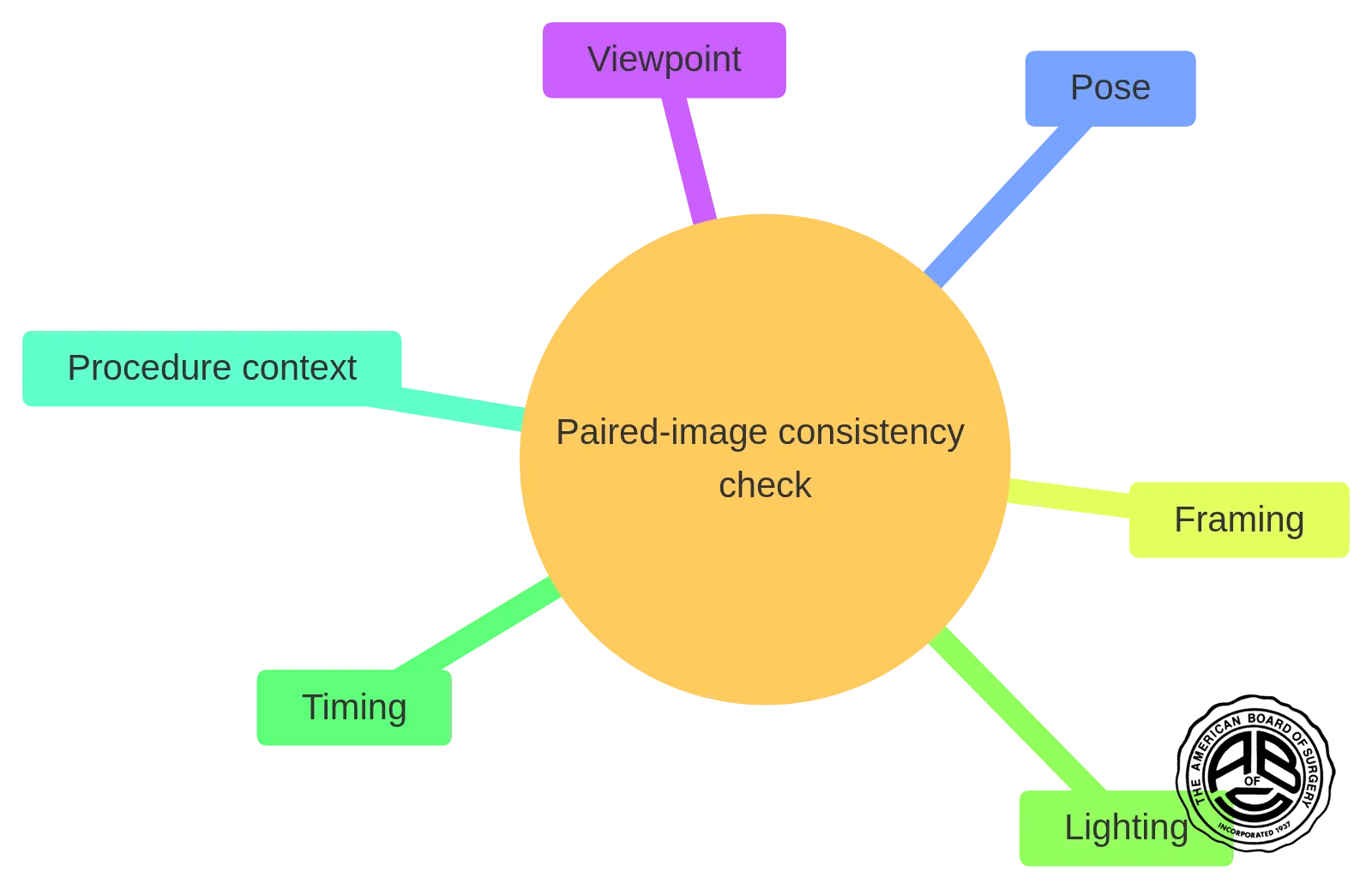
    A mind map showing the six consistency checks for comparing before-and-after breast augmentation photos: viewpoint, pose, framing, lighting, timing, and procedure context.
    Use these six checks to judge whether a before-and-after pair is fair to compare.

    Identify Why Another Patient’s Images May Not Transfer to You

    Once you have recorded what a photo shows and whether the pair is reasonably comparable, ask a different question: how transferable is this example to me? Usually, the answer is limited. Another patient’s image may help you express a preference, but it cannot settle what outcome is reasonable for you.

    A cited plastic surgeon notes that surgical results are affected by unique anatomy, healing, and surgical variables. Those factors help explain why two people who want a similar-looking change may not have the same visible result. Starting anatomy can differ, including the existing breast shape, breast-tissue characteristics, skin, chest structure, and baseline asymmetry. Goals may differ as well: one person may seek a subtle change, while another may prioritize a different degree or distribution of volume. Procedure approach and the details of the surgical plan also matter, and healing introduces another source of variation.

    This means that an image can be personally relevant without being personally predictive. You might write, “I am interested in the overall proportion shown here,” while also writing, “I do not know whether my starting anatomy or recommended approach would make this appearance reasonable for me.” That is an informed distinction.

    The same boundary applies to computer-generated imaging. It may help a discussion about what breasts could look like after surgery, but it cannot predict or guarantee an actual surgical outcome. Treat an image simulation as a communication aid, not a commitment. Ask what assumptions it reflects, what it cannot show, and how it relates to the clinician’s assessment of your circumstances.

    ASPS also emphasizes realistic expectations because an outcome may not match a person’s goals. Realistic does not mean settling for vague answers. It means asking for clear explanations of what the clinician believes may be achievable, what limitations may apply, and where uncertainty remains.

    A practical transferability note can include four prompts:

    • What aspect of this example do I want to discuss?
    • What visible feature worries me or feels important to understand?
    • What about this patient’s starting point, goals, procedure, or healing may differ from mine?
    • What would I need to know before treating this image as relevant to my own decision?

    Bring those prompts to consultation rather than trying to resolve them from a gallery alone. A qualified clinician can listen to your goals and concerns and may make recommendations based on medical history and other factors.

    Turn Photo Notes Into Focused Consultation Questions

    Your worksheet becomes most valuable when it leads to a focused consultation discussion. ASPS advises thinking through and writing down questions ahead of time. Rather than arriving with a demand to reproduce a single photo, arrive with notes about your preferences, concerns, and the image conditions you want explained.

    You can organize questions into four groups.

    1. Expectations and relevance

    • Which changes in these examples may be reasonable to discuss in light of my circumstances?
    • What features of my starting anatomy affect the range of appearances we should discuss?
    • Which details in these photos are not useful for predicting my result?
    • Can you explain the benefits, limitations, and uncertainty associated with the plan you are discussing?

    2. Proposed approach

    FDA consultation questions can cover the recommended implant shape, size, surface texture, incision site, and placement, as well as why those recommendations are being made. If implants are part of the discussion, ask how the clinician connects the recommendation to your goals and circumstances. If you have brought an image, use it as a visual reference for a conversation, not as a specification for surgery.

    3. Recovery and daily life

    Recovery timing varies by procedure, medical history, and other factors. Ask how recovery may affect your work, caregiving, exercise, and other usual activities. Ask what the displayed timing of a gallery image means, if it is provided, and what changes may occur as healing progresses. A photo can show an appearance at one moment; it cannot show the full experience of recovery.

    4. Safety and decision-making

    Ask about the risks and complications associated with breast implants if implants are being considered. Ask what follow-up may be needed, what longer-term considerations matter, and what options exist if your expectations and the outcome do not align. These questions belong beside aesthetic preferences, not after them.

    Keep the worksheet short enough to use. For each image or group of images, bring one observation, one comparability concern, one preference, and one question. For example: “These images appear to show a change I find proportionate; the side views are not comparable; I prefer a natural-looking change in clothing; what may be reasonable for my starting anatomy, and what recommendation would you make?”

    A consultation should help refine your goals, not simply confirm them. If an explanation is unclear, ask for it in plain language and write down the answer. The point is to make a decision with a fuller understanding of what is proposed, what is uncertain, and what responsibilities may continue after surgery.

    Keep Benefits, Limitations, Risks, and Long-Term Responsibilities in View

    A gallery is designed to show visible results. It cannot fully show the decision-making, recovery demands, device information, monitoring, or possible complications that belong in an informed discussion. Keep that broader context beside every photo you save.

    For breast implants in the United States, FDA materials describe a boxed warning, a patient decision checklist, device-material information, and a patient device card. These materials are not decorative paperwork. They are part of understanding the risks, benefits, and device-specific information before deciding.

    The FDA says breast implants are not lifetime devices and that additional surgery may be needed over time. It also says implants need monitoring for as long as a person has them. FDA materials identify capsular contracture, reoperation, and implant removal among the most common local complications and adverse outcomes. They also list risks and complications that include pain or changes in nipple or breast sensation, rupture or deflation, BIA-ALCL, systemic symptoms, and potential effects on breastfeeding.

    A before-and-after photo cannot tell you whether a patient had complications, what follow-up was needed, how the result may change over time, or how the person weighed benefits and tradeoffs. It also cannot answer which risks apply to you or how they should be considered in your circumstances. Those are clinical questions for a qualified clinician.

    If silicone gel-filled implants are being considered, a health care provider may recommend regular MRI or ultrasound screening for rupture and other complications. Ask how ongoing monitoring would fit into your longer-term plan. Ask what you should understand about the device’s labeling and what follow-up the clinician recommends.

    Use a separate “beyond the photo” section in your notes:

    • benefits I hope to discuss;
    • limitations I need explained;
    • recovery questions;
    • risks and complications to review;
    • follow-up and monitoring questions; and
    • longer-term questions, including how breasts may look over time, after pregnancy or breastfeeding, or after implant removal without replacement.

    This does not mean a photo gallery is unhelpful. It means the gallery should occupy its proper place: one input in a larger decision. A clear consultation should connect your visual goals with realistic expectations, procedure options, recovery, risks, and the ongoing responsibilities associated with the option under consideration.

    Use Your Notes to Support a More Useful Consultation Discussion

    Bring your completed notes with you: the details you observed, whether the images seemed comparable, the preferences you identified, and the questions that remain. This gives you a practical starting point for discussing what may be reasonable in your circumstances rather than trying to make a gallery image carry the entire decision.

    It is also appropriate to ask about the clinician’s certification and training, hospital privileges, and the surgical facility’s accreditation or licensing status. Ask to review before-and-after photos and discuss which results may be reasonable for you. Include questions about longer-term appearance, pregnancy and breastfeeding, removal without replacement, and the options available if you are dissatisfied with the outcome.

    A photo review can end with clearer questions rather than a personal prediction. Use the images to describe your priorities, then discuss benefits, limitations, risks, recovery, and expectations with a qualified clinician.

    Frequently Asked Questions About Breast Augmentation Photo Review

    What can I reasonably learn from breast augmentation before-and-after photos?

    They can show the kinds of visible changes a procedure may create, such as volume, proportion, and overall contour. They are best used to identify patterns you like or want to avoid, not to forecast your own result.

    Why can’t one person’s after photo predict my result?

    Results vary because each person starts with different anatomy, goals, healing, and surgical variables. A photo may be informative, but it cannot account for those differences or guarantee a matching outcome.

    How should I compare before-and-after photos more fairly?

    Check whether the viewpoint, pose, framing, lighting, timing, and disclosed procedure context are similar. If those conditions differ a lot or are unclear, treat the comparison as limited and ask for more context.

    How long can the visible result keep changing after surgery?

    The appearance may continue to change as swelling subsides and the skin stretches. Incision lines can also take a long time to fade, so an early after photo may not reflect a later look.

    What should I ask in a consultation after reviewing photos?

    Bring questions about what results may be reasonable for you, how the proposed approach fits your anatomy and goals, what recovery may involve, and what risks or longer-term responsibilities you should understand.

    Can computer-generated imaging be used the same way as real before-and-after photos?

    It can help you talk about possible appearance, but it cannot predict or guarantee an actual outcome. Use it as a discussion aid, not as a promise of what will happen.


  • Psychosis: signs, safety and next steps

    Psychosis: signs, safety and next steps

    Psychosis is a symptom pattern, not a diagnosis

    Psychosis is a group of symptoms in which a person has some difficulty distinguishing what is real from what is not. During an episode, changes in thoughts and perceptions can make it hard to recognize what is real.

    This can be frightening for the person experiencing it and for people close to them. A practical first step is not to decide what diagnosis fits. Psychosis describes a symptom pattern, not a diagnosis by itself; a qualified clinician needs to evaluate what may be causing it.

    If there is immediate danger, seek emergency help now. If there is no immediate danger, arrange professional assessment promptly rather than trying to manage psychotic symptoms alone. This article offers general education, not an individual diagnosis, safety assessment or treatment plan. For complex or unresolved concerns, you can request an appointment with Mayo Clinic experts to discuss your situation, including questions about multidisciplinary care, medical research or International Services.

    What psychosis can look like

    Experiences related to psychosis differ from person to person and can change over time. Three common features are hallucinations, delusions and confused or disturbed thinking. A person does not need to have every feature for their experiences to deserve attention.

    • Hallucinations may involve hearing, seeing, feeling, smelling or tasting something that is not actually present. Hearing voices is one example.
    • Delusions are strongly held beliefs or interpretations that are not based in reality. They can include beliefs that someone intends harm or that outside forces are controlling events.
    • Disorganized thinking or speech can make thoughts difficult to organize. Speech may seem fast, confusing, fragmented or incoherent.
    • Changes others may notice can include suspiciousness, withdrawal from family or friends, or less attention to self-care and daily activities.

    A person may also seem unusually uneasy around others, lose interest in familiar activities, or have difficulty managing ordinary responsibilities.
    These changes are not proof of psychosis or any particular condition. Cultural and spiritual context also matters when interpreting behavior and experiences. Focus on what has changed, how it affects daily life and whether the person seems frightened, confused or unsafe. Those concrete observations are more useful than trying to apply a label.

    What may happen during a psychotic episode

    A psychotic episode is a period when a person is actively experiencing psychosis-related symptoms or showing related changes in speech or behavior. A person may not recognize that a hallucination or delusion is not real. To them, the experience can feel convincing and can leave them frightened or distressed.

    Changes may develop gradually. Family members may notice less specific changes in thoughts, perceptions, social connection or functioning before a more obvious crisis occurs. In young people especially, these shifts can be difficult to distinguish from typical developmental changes. Concerning changes do not establish a diagnosis, but they are a reason to seek professional assessment.

    A limited emotional response does not necessarily mean the person is unaffected or unable to understand. Give them time to process what you say and avoid overwhelming them with questions or explanations.

    Avoid treating a person’s experience as a debate to win. You do not have to agree with a belief to acknowledge that the person is upset and needs support. Keep the immediate goal practical: safety, calm communication and connection with appropriate help.

    Why the cause should not be assumed

    Psychotic symptoms can have many possible contributors, including mental health conditions, physical illness or injury, and substance use. Some physical illnesses or injuries, including brain injury and stroke, can sometimes contribute to psychotic symptoms. This is one reason a medical evaluation matters.

    Hallucinations or delusions can sometimes be related to the direct effects of a substance, withdrawal or medication. Mental health conditions can also involve psychosis. None of these possibilities can be sorted out reliably through self-diagnosis, a conversation at home or an online symptom list.

    Do not assume that unusual behavior has a psychiatric cause, and do not assume it has a medical or substance-related cause. A qualified medical professional can assess the full picture. Tell the clinician about recent changes in health, injuries, substance use, withdrawal and medication changes, but do not stop, start or change medication without guidance from the prescribing clinician.

    The person’s cultural and spiritual background also belongs in that assessment. An experience or behavior should be understood in context rather than judged from a single isolated observation. Share context with the clinician, while leaving the cause and diagnosis to professional evaluation.

    Choose the next step by safety level

    Use safety—not a guess about diagnosis—to decide what to do next.

    Immediate emergency help

    Call 911 in a life-threatening emergency or when there is a risk that the person may harm themselves or others. If you are in the U.S. and suicide-related crisis support is needed, call or text 988. If safety is at risk, call 911 now.

    Do not leave someone alone when it is not safe for them to be alone. Protect the person, yourself and others from immediate harm, and keep enough space to leave safely. Tell responders what you observe and what danger is present rather than trying to determine a diagnosis.

    Prompt professional assessment

    Psychotic symptoms should not be self-diagnosed or managed alone. Contact a qualified medical or mental health professional for an evaluation.

    Planned follow-up for complex or unresolved concerns

    When symptoms or their cause remain unclear after initial care, a more comprehensive review may help bring together mental health, medical, medication and family observations. A second opinion can be a collaborative way to clarify questions, not a judgment on the existing care team. Ask the current clinician what additional evaluation or consultation may be appropriate.

    A three-path safety flow showing when to seek immediate emergency help, prompt professional assessment, or planned follow-up for complex concerns.
    Use safety level, not a guessed diagnosis, to choose the next step.

    How family members can respond in the moment

    Your approach can reduce added distress while help is being arranged. Remain as calm as possible, use simple and brief communication, and give the person time to respond. Disorganized speech or a limited response does not mean the person cannot understand you.

    Try a response such as: “I can see this is upsetting. I’m here with you. What would help you feel safer right now?” Keep your voice low and your statements concrete. Let the person set the pace of the interaction when possible.

    Respect personal space. Do not touch the person without permission, and do not crowd them if they seem suspicious or avoid eye contact. Describe specific changes you have observed rather than arguing about beliefs or assigning a diagnosis.

    Offer choices when it is safe to do so, such as whether to sit in a quieter place or which trusted person to call. At the same time, focus first on immediate safety, including whether there is a risk of harm and whether it is safe for the person to be alone. If you cannot safely de-escalate the situation, call for emergency assistance.

    What to communicate in an emergency

    In the U.S., 988 provides suicide-related crisis support by call or text. Call 911 for a life-threatening emergency. When contacting emergency services about a possible psychotic episode, describe what you are observing and any immediate safety concern; do not assume or state a diagnosis.

    Be concise and specific. You might share:

    • what the person is saying or doing that concerns you;
    • whether there have been threats of self-harm, harm to others or violence;
    • whether the person can safely be left alone;
    • whether there is access to a weapon or another immediate danger;
    • when the change began and whether it became worse quickly; and
    • relevant recent injury, illness, substance use, withdrawal or medication change, if known.

    Tell responders that you are seeking medical help for a mental health crisis. If it is safe, explain to the person who unfamiliar responders are and that they are there to help. For immediate danger or a life-threatening situation, call 911.

    Prepare for a professional evaluation

    A clinician determines the cause of psychotic symptoms. You can make the evaluation more informative by bringing a short factual record. Family observations about when changes began and how they developed can help describe the presentation and course.

    Prepare the following, if available:

    • Observed changes: Write down specific examples of changes in perceptions, beliefs, speech, behavior, self-care, sleep, social connection or daily functioning.
    • Timing: Note when changes began, whether they were gradual or sudden, and what was happening around that time.
    • Safety concerns: Include any statements or actions involving self-harm, harm to others, inability to care for basic needs, severe agitation or aggression.
    • Health context: List recent illnesses, injuries, medical events and any other relevant changes in health.
    • Substances and medications: Record known substance use, possible withdrawal, prescribed medicines, over-the-counter products and recent medication changes. Do not change medication on your own.
    • Medical records: Bring relevant medical records, current medication lists and prior evaluation information when possible.

    Use plain descriptions rather than conclusions. Describe the words, actions, timing and functional changes you observed. Include the person’s own account when they are willing to share it, along with relevant cultural or spiritual context. This information helps the clinician consider the full picture without asking family members to determine the cause. Bring your observations and medical records to the evaluation.

    What professional care may address

    The plan depends on the person’s symptoms, possible contributors, preferences and circumstances.

    Care may include therapy, family education and support, medication management, help with work or school, and case management. Family education can help relatives understand psychosis and build communication and problem-solving skills. Support for education or employment may also be part of a person’s broader goals.

    When needs are complex, coordinated assessment can help the care team consider mental health, physical health, medications, substance exposure, family observations and daily functioning together. That does not replace individualized clinical judgment or guarantee a particular diagnosis or outcome.

    Medication decisions should be individualized. Antipsychotic medications have potential benefits and risks. Discuss benefits, risks, side effects, costs and dosage preferences with the prescribing clinician rather than changing medication on your own.

    It is reasonable to ask the care team: “What concerns are you evaluating?” “Are there coexisting health issues to consider?” “How can family members support the plan?” and “What should prompt urgent reassessment?” Use the appointment to clarify the plan with the clinician responsible for care.

    Moving forward when concerns remain complex

    Psychosis is serious enough to deserve professional evaluation, but it does not tell you by itself what is causing the symptoms or what the outcome will be. Start with the safety level: emergency help for immediate danger, prompt assessment for concerning symptoms, and organized follow-up when questions remain unresolved.

    Concrete observations, a timeline of changes and relevant medical records can help a care team understand a complex situation. When concerns involve multiple possible contributors or unanswered questions, coordinated assessment and a second opinion may help clarify care needs. A second opinion is a collaborative review to support clearer questions and planning, not a promise of a different diagnosis or treatment. Mayo Clinic experts can be a resource for serious or complex medical challenges; suitability and next steps require individual discussion.


    Frequently asked questions about psychosis

    How is psychosis different from a diagnosis?

    Psychosis is a group of symptoms, not a diagnosis by itself. A clinician needs to evaluate what may be causing the symptoms before a diagnosis or treatment plan can be made.

    What should I do if someone may be having a psychotic episode?

    Start with safety. Stay calm, use brief and simple language, respect personal space, and avoid arguing about beliefs or naming a diagnosis.

    When does psychosis require emergency care?

    Seek emergency help right away if there is risk of self-harm or harm to others, severe agitation, uncontrollable aggression, or threats of violence. In the U.S., call or text 988 for suicide-related crisis support and call 911 for a life-threatening emergency.

    Can psychotic symptoms have causes other than a mental health condition?

    Yes. They can be related to mental health conditions, physical illness or injury, substance use, withdrawal, or medication effects. That is why professional evaluation matters and self-diagnosis can be misleading.

    What should we bring to a professional evaluation?

    Bring a short record of what changed, when it started, how quickly it changed, any safety concerns, recent illness or injury, substance use, medication changes, and relevant medical records. Concrete observations are often more helpful than conclusions.

    Why might a second opinion help with complex concerns?

    A second opinion can be a collaborative review when symptoms, causes, or next steps are still unclear. It may help the care team consider mental health, physical health, medications, family observations, and other possible contributors together.


  • Breast Anatomy, Normal Variation, and Changes to Discuss With a Clinician

    Breast Anatomy, Normal Variation, and Changes to Discuss With a Clinician

    Start With Breast Awareness, Not Self-Diagnosis

    Breast awareness means knowing what is familiar for your own body and taking a meaningful change seriously. It does not mean trying to decide at home whether a breast looks healthy or whether a lump is harmless. What is normal for one person may not be normal for another, and breasts can naturally differ in appearance, texture, and sensitivity.

    A useful way to think about breast health is to separate a familiar pattern from a change in that pattern. A long-standing difference in size, an uneven texture you recognize, or tenderness that predictably accompanies your menstrual cycle may be part of your usual baseline. A new, persistent, or concerning difference deserves a conversation with a qualified healthcare professional. Contact a healthcare provider when you notice a change in how your breasts look or feel.

    This overview explains the basic structures of the breast, why normal variation is common, and which changes merit clinical attention. It cannot diagnose a symptom, determine an individual cancer risk, or replace an examination by a clinician. Breast awareness involves noticing and communicating, not using a home test for disease.

    What Breasts Are Made Of and What They Do

    Breasts are made of several kinds of tissue rather than one uniform structure. In female breasts, much of the volume outside pregnancy and lactation comes from adipose, or fatty, tissue and collagenous tissue. Mammary glands make up a relatively small proportion of that volume. Muscles connect the breasts to the ribs.

    The visible parts include the nipple and the areola, the more deeply colored skin around the nipple. Nipples have many nerves, so sensitivity to stimulation varies widely from person to person. Under the skin, milk ducts and glandular tissue are part of the breast’s feeding-related anatomy. Mammary glands are modified sweat glands.

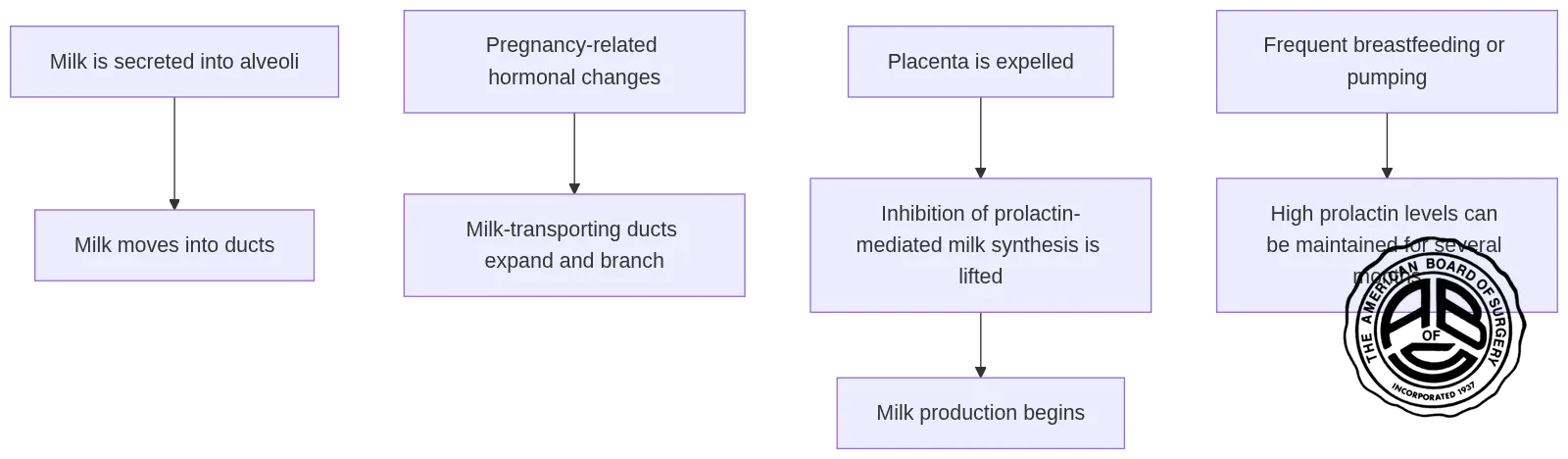
    During lactation, milk is secreted into tiny milk-producing spaces called alveoli and moved into ducts. Pregnancy-related hormonal changes expand and branch these milk-transporting ducts. After the placenta is expelled, the inhibition of prolactin-mediated milk synthesis is lifted and milk production begins.
    People of all sexes have breast tissue. Male breasts have nipples and areolae externally, with undeveloped milk ducts and no glandular tissue internally. During puberty, testosterone usually limits breast development in males. Gynecomastia is a noncancerous condition that can enlarge male breast tissue. Breast tissue can become cancerous in people of any sex, so a concerning breast change should not be dismissed based on sex.

    The feeding-related parts of the breast are not a separate structure that can be judged from the outside. During lactation, milk-producing alveoli are grouped into lobules and drain toward the nipple through ducts. This helps explain why pregnancy can involve changes in breast tissue as ducts expand and branch in response to hormonal changes. Frequent removal of milk through nursing or pumping can maintain high prolactin levels for several months. These general physiological details do not establish whether a particular person will produce milk or explain a specific feeding concern. Questions about lactation, milk production, pain, or a breast change during pregnancy or after delivery need individualized guidance from an appropriate healthcare professional.

    A flowchart showing milk moving from alveoli into ducts during lactation, pregnancy-related duct changes, milk production beginning after the placenta is expelled, and frequent breastfeeding or pumping maintaining high prolactin levels for several months.
    Breastfeeding-related anatomy and hormone changes follow connected physiological pathways.

    Why Breasts Can Differ in Size, Shape, Texture, and Sensitivity

    There is no single breast size, shape, or feel that defines health. One breast may be somewhat larger, sit differently, or have a different contour than the other. This is called breast asymmetry: the breasts are not exactly the same on each side. Asymmetry is common and is usually not a concern, particularly when it developed during puberty and has remained familiar. It may be influenced by genes.

    Texture also differs. Many women say their breasts feel lumpy or uneven. That observation alone does not identify a condition. The important question is whether the texture is typical for you or whether there is a new, localized, or persistent difference.

    Breasts can change over time for ordinary reasons. Periods, having children, weight changes, certain medications, and aging can affect how breasts look and feel. Temporary hormonal changes during menstrual cycles, pregnancy, or hormone replacement therapy can make breasts grow, sometimes unevenly.
    Sensitivity can vary as well. Some people notice more tenderness or awareness at particular times, while others do not. A familiar pattern can be useful context to share with a clinician, but it is not a way to rule out a problem. If a difference is new, persists beyond what is usual for you, or feels concerning, bring it to a healthcare professional rather than assuming it is hormonal.

    A practical baseline is not a rigid checklist of how breasts should look. It is your own usual pattern: their typical symmetry, texture, sensitivity, and appearance. Knowing that baseline helps you recognize when something is meaningfully different. It is also reasonable to record when you first notice a change and whether it continues, so you can describe the pattern clearly during an appointment.

    Why Appearance or Feel Alone Cannot Confirm Breast Health

    Looking at or feeling the breasts can help you notice a change, but it cannot confirm the cause of that change. A breast can look typical and still require routine health care, and a breast can look or feel different for reasons that are not cancer. The role of breast awareness is observation and timely communication—not self-diagnosis.

    Breast density is one example of why appearance and touch have limits. Dense breasts have more glandular and fibrous tissue and less fatty tissue. Breast density is not determined by breast size, appearance, or feel. It is information that may appear in a mammogram report, not something a person can reliably determine by looking at or examining the breasts.

    Density is a description of tissue composition, not a description of whether a breast feels firm, looks full, or appears symmetrical. It also does not tell a person what a new lump or other symptom means. Dense tissue and tumors can both look white on mammograms, which can make cancer harder to detect on those images. People with very dense breasts have a slightly higher breast-cancer risk, but individual risk needs discussion with a healthcare provider in the context of the person’s own health information. A density finding should therefore be treated as clinical information to discuss, not as a conclusion drawn from appearance or touch.

    For the same reason, a soft area is not automatically reassuring and an uneven area is not automatically dangerous. People have different tissue patterns, and changes related to life stages can be real without being visually dramatic. If you are uncertain whether a change is new or important, discuss it with a clinician.

    Breast cancer symptoms also vary among people, and some people have no signs or symptoms. That is another reason not to use appearance or sensation alone as a complete assessment of breast health. Follow individualized advice from your healthcare professional about screening and raise any new breast concern between routine visits.

    A Lump Can Have Many Causes, but It Still Needs Evaluation

    Finding a lump can be unsettling, but a lump is a finding—not a diagnosis. Breast lumps can have many causes. Although cancer is one possibility, many lumps result from other medical conditions, and most breast lumps are noncancerous.

    For example, fibrocystic breast condition can cause noncancerous changes that make breasts feel lumpy, tender, or sore. Breast cysts are small fluid-filled sacs that can develop in the breast. These are examples of why a person cannot determine the cause of a lump simply by its feel, shape, or tenderness.

    The balanced response is neither panic nor delay. Avoid trying to label a lump at home or waiting for certainty before seeking help. A healthcare provider can evaluate a breast lump or other change and determine whether tests or treatment are needed. If you notice a lump in the breast or underarm, make an appointment for clinical evaluation.

    When you speak with a clinician, it can help to describe what you noticed in plain terms: where it is, whether it seems new, whether it has persisted, and whether you have noticed any accompanying change in the breast or nipple. That information supports an evaluation; it does not replace one.

    Breast Changes That Merit Prompt Clinical Attention

    A concerning breast symptom is not proof of cancer. Many symptoms have other explanations. Still, the following changes merit prompt discussion with a healthcare professional because they need clinical assessment rather than self-diagnosis:

    • A new lump in the breast or underarm.
    • Thickening or swelling of part of the breast.
    • Dimpling or irritation of breast skin.
    • Redness or flaky skin on the breast or in the nipple area.
    • A nipple that is pulling inward, or new pain in the nipple area.
    • Nipple discharge other than breast milk, including bloody discharge.
    • A new change in breast size or shape.

    New asymmetry deserves attention as well. Long-standing unevenness is common, but if you notice new asymmetry without recent breast growth, there may be a medical cause and it should be discussed with a healthcare provider.

    Do not use this list to sort symptoms into “serious” and “safe” categories on your own. Its purpose is to help you recognize when to make contact. If you notice a breast lump or other change, talk with a healthcare provider rather than trying to determine the cause yourself.

    What Clinical Evaluation Can Help Determine

    Clinical evaluation gives a breast change the context that self-assessment cannot. A healthcare provider can ask about the timing and pattern of a symptom, examine the area, and decide whether further testing or treatment is needed. The purpose is to identify the cause as accurately as possible and determine an appropriate next step.

    For a palpable breast mass, clinical evaluation commonly includes a detailed history, a clinical breast examination, and, for almost all women, imaging. The precise approach depends on the person and the finding, so it is not something to prescribe from a general article. A suspicious mass identified on examination or imaging may require biopsy under clinical guidance.

    Bring questions, note when you first noticed the change, and share relevant changes in appearance, sensation, discharge, medication use, or timing. This information supports an evaluation; it does not replace one.

    The distinction matters: noticing is valuable; diagnosing is a clinical task. The next step should be based on professional evaluation rather than on appearance, feel, or an internet description.

    Let Your Usual Baseline Guide Your Next Step

    A practical breast-awareness habit is straightforward: recognize what is familiar for you, then act on a meaningful difference. Breasts normally vary in size, shape, texture, and sensitivity, and they can change across life stages. Those facts are reassuring context, not a diagnosis.

    If you notice a new or persistent lump, an underarm change, skin or nipple changes, non-milk discharge, a new shift in size or shape, or breast pain that concerns you, contact a qualified healthcare professional. Breastfeeding questions likewise deserve individualized guidance. Professional assessment is the appropriate next step for any symptom you cannot confidently recognize as your usual pattern.

    This general information is not a substitute for diagnosis or care. Address a new or concerning breast symptom with an appropriate healthcare professional before pursuing unrelated elective planning.


    Frequently Asked Questions About Breast Changes and Density

    What is the breast made of?

    Breasts are made of several tissues, including fatty and collagenous tissue, milk ducts, glandular tissue, skin, nerves, and supporting muscles. Outside pregnancy and lactation, much of the volume is usually fatty and fibrous tissue, while the milk-producing tissue is a smaller part.

    Is it normal for breasts to be different from each other?

    Yes. Some asymmetry is common, and breasts can differ in size, shape, texture, and sensitivity. Long-standing differences are often part of a person’s usual baseline, while a new change is the part that deserves attention.

    What should I do if I find a lump in my breast?

    A lump should be evaluated by a healthcare professional rather than guessed at from touch or appearance. Many breast lumps are noncancerous, but a clinician can determine whether testing or treatment is needed.

    Which breast changes need medical attention?

    A new lump, thickening, swelling, skin dimpling, redness or flaky skin, nipple pulling-in, bloody or other non-milk discharge, a new change in size or shape, or persistent breast pain should be discussed with a healthcare provider.

    Can breast cancer be present without obvious symptoms?

    Yes. Breast cancer symptoms vary, and some people have no signs or symptoms. That is one reason breast awareness should focus on noticing changes and following up with a clinician when something seems new or different.

    Does breast density change how breasts look or feel?

    Not necessarily. Dense breasts have more glandular and fibrous tissue, but density is not determined by breast size, appearance, or feel.


  • Breast Augmentation in Beverly Hills: A Decision Path for Volume, Position, and Implant Responsibility

    Breast Augmentation in Beverly Hills: A Decision Path for Volume, Position, and Implant Responsibility

    Start With the Question You Want Surgery to Answer

    Breast augmentation is elective surgery that uses implants or, less commonly, fat transfer to enhance breast size. For many people, the more useful starting point is not “Which implant should I choose?” but “What change am I hoping to see in my proportions, clothing fit, or breast volume?”

    That distinction matters because implant selection is only one part of an individualized treatment plan. A thoughtful discussion connects your goals with your existing breast shape, tissue coverage, skin quality, symmetry, lifestyle, recovery needs, and willingness to manage an implant over time—what would you want surgery to answer for you?

    Natural-looking results can be a planning goal, not a promise. Open discussion of your motivation, expectations, and concerns can help you and a surgeon decide whether surgery is appropriate, while realistic expectations matter because an outcome may not fully match every imagined goal—are you ready to describe both what you hope will change and what you want to preserve?

    If you are also considering facial rejuvenation, body contouring, or med spa care, keep those topics separate from your breast augmentation goals—would separating these priorities make the discussion clearer?

    If surgeon credentials or travel access matter to you, ask directly whether the clinician is a double board-certified plastic surgeon and confirm whether a virtual consultation or Destination Surgery applies to your circumstances—what details would you want verified before scheduling?

    Decision One: Is Added Volume the Change You Want to Evaluate?

    The first decision is whether added volume is the change you want to evaluate. Breast augmentation is designed to add volume, while a lift may be discussed when significant sagging is present because implants alone may not correct that concern—does added volume address the concern you see?

    That distinction cannot be settled by a cup-size goal, a photograph, or general information. An individualized examination is needed to determine whether a lift belongs in the discussion—would you be open to a different approach if it better matched your anatomy?

    Breast revision is a separate consideration for someone with existing implants. It may involve revising, replacing, or removing implants; some cases involve replacement alone, while others require work on soft tissue or breast structure—if you have implants, what change are you trying to evaluate now?

    This first decision is not about choosing a procedure from a list. It is about naming the concern clearly enough to understand whether volume, breast position, or an existing implant result is central—can you state that concern without assuming the answer in advance?

    What Your Starting Anatomy Can and Cannot Answer

    A desired size is useful information, but it cannot determine a surgical plan by itself. During a consultation, you can discuss your goals and concerns, and recommendations may take your medical history and other factors into account—what would make a proposed size feel proportionate to you?

    Bring attention to your starting point: breast width, existing volume, the amount of natural tissue coverage, skin quality, and baseline differences between the breasts. Natural tissue coverage is one consideration when discussing placement, while pre-existing asymmetry may remain after surgery even with careful planning—have you considered which differences you would accept as part of your own anatomy?

    Body proportion and lifestyle also belong in the conversation. For an active patient, exercise and possible muscle interference can be discussion points when considering placement, so your work, training, childcare, and everyday movement are relevant planning details—what activities would you want to protect during recovery and afterward?

    A useful consultation does not promise an identical result to an image or another person’s outcome. Instead, it asks whether your goals, expectations, and motivation align with what surgery can reasonably aim to achieve—can you describe your priorities in terms of balance and proportion rather than a single measurement?

    Decision Two: Weigh Implant Features Only After Defining the Goal

    Once the change being considered is clear, implant features can be considered in context. In the United States, breast implants are FDA-approved devices for augmentation and reconstruction—what information would help you understand the device decision?

    Implants may be saline-filled or silicone-filled, and both have an outer silicone shell. Silicone implants contain cohesive gel, while saline implants are filled with sterile saltwater after placement and may feel firmer; neither option is universally better because anatomy, preferences, and goals matter—what trade-off matters most to you?

    A proposed size, shape, or profile has meaning only in relation to the volume goal and the breast that will support it. Ask for an explanation of how breast width, tissue coverage, body proportion, and desired change informed the recommendation—would the reasoning make sense without relying on a generic ideal?

    Placement, surface, and incision location also belong to the clinical discussion. For someone with little natural breast tissue, submuscular placement may be discussed as a way to help conceal implant edges, but no single feature determines the entire plan—does the proposed approach account for the limits as well as the intended change?

    Decision Three: Consider the Long-Term Device Commitment

    Recovery is not a single standard timetable. Timing varies by procedure, medical history, and other individual factors, so ask how recovery could affect work, childcare, exercise, sleep arrangements, transportation, and the activities that matter in your day-to-day life—who could support you while you recover?

    Implants are not lifetime devices, and future surgery to replace one or both implants may be needed. Pregnancy, weight loss, and menopause may also influence the appearance of augmented breasts over time, which is why the decision is about more than the immediate surgical result—are you comfortable considering the longer arc of this choice?

    For silicone implants, discuss the current FDA-recommended MRI or ultrasound screening schedule with a qualified clinician: five to six years after placement and every two to three years thereafter. Routine screening can assess implant integrity and identify rupture or silicone leakage, and rupture may be asymptomatic for some women—have you included future screening in your planning?

    This is general educational information, not a personal monitoring plan. Ask the clinician who knows your health history and implant details how follow-up, routine breast health care, and implant screening should fit together—do you know which follow-up questions you would want answered before proceeding?

    A practical way to assess the long-term commitment is to separate three responsibilities: keeping scheduled follow-up discussions, maintaining routine breast health care, and understanding when implant screening may be relevant. This does not mean every future change requires surgery, but it does mean the initial decision should leave room for future evaluation if your priorities, breast appearance, or implant condition changes—would you be prepared to revisit the plan if circumstances change over time?

    Monitoring is different from waiting until you notice a problem. Because rupture may be asymptomatic for some women, follow-up discussions can help you understand how implant integrity may be evaluated even when you do not notice a change; for silicone implants, ask who will help you keep track of the current FDA-recommended imaging schedule—would you be able to keep that information accessible over time?

    It can also help to regard a future implant discussion as an evaluation rather than a predetermined outcome. A later conversation may be relevant after a complication, a change in breast appearance, or a change in your own priorities, and the appropriate next step depends on the reason and an individualized assessment—does this longer perspective fit your expectations for an elective device decision?

    Understand the Uncertainty That Remains With Any Plan

    A plan can be carefully individualized and still involve uncertainty. Potential surgical and implant-related complications include anesthesia-related risks, bleeding, infection, fluid collections, hematoma, sensation changes, capsular contracture, leakage or rupture, implant malposition, persistent pain, poor scarring, and possible revision surgery—what uncertainties would be most important for you to understand?

    BIA-ALCL is a type of T-cell lymphoma that can develop following breast implants. FDA materials state that it appears more often in patients with textured implants, making the surface of a proposed device an important topic for a current discussion—would you want to understand the safety information for the device being considered?

    Breast implants and breast surgery may interfere with successful breastfeeding. Sensation changes may be temporary or permanent and may affect sexual response or nursing, while implants can interfere with mammography and breast exams; patients should tell their mammography technician about implants—how do these considerations relate to your present or future priorities?

    Implant removal can also change breast appearance, including size or shape, dimpling, puckering, sagging, chest-wall concavity, or incision appearance. These possibilities do not predict an individual outcome, but they show why the device decision includes more than the initial operation—does knowing the range of future possibilities change how you view the decision?

    Baseline asymmetry may remain after surgery, and implant displacement can contribute to asymmetry or other cosmetic concerns. A proposed plan cannot erase every variable, so realistic expectations should include what may remain outside a surgeon’s control—can you distinguish a planning goal from an assured appearance?

    Use the Three Decisions to Decide Whether to Continue

    Write down questions before your consultation. The answers may help you clarify or refine your goals, especially when you feel pulled between a desired look, practical recovery needs, and uncertainty about future surgery—what do you need to understand to make an unhurried decision?

    Use this list to connect the proposed plan to your priorities:

    • What are your qualifications in plastic surgery, and where would the procedure be performed?
    • What about my breast anatomy, tissue coverage, skin quality, asymmetry, and body proportion supports this recommendation?
    • Why are you recommending this implant fill, size, shape, profile, surface, incision, and placement for me?
    • What realistic expectations should I have, including differences that may remain after surgery?
    • How might recovery affect work, childcare, exercise, and other usual responsibilities?
    • What are the important risks in my situation, and how are complications handled?
    • How could surgery affect breastfeeding, nipple or breast sensation, mammography, and routine breast care?
    • What follow-up and silicone-implant screening discussions should I plan for?
    • What future surgeries might become relevant, and what are my options if I am dissatisfied?

    A surgeon should be able to explain the reasoning behind a recommendation in language you understand. If an answer does not connect the plan to your stated goals and practical circumstances, ask for clarification before deciding—can you repeat back the plan and why it was chosen?

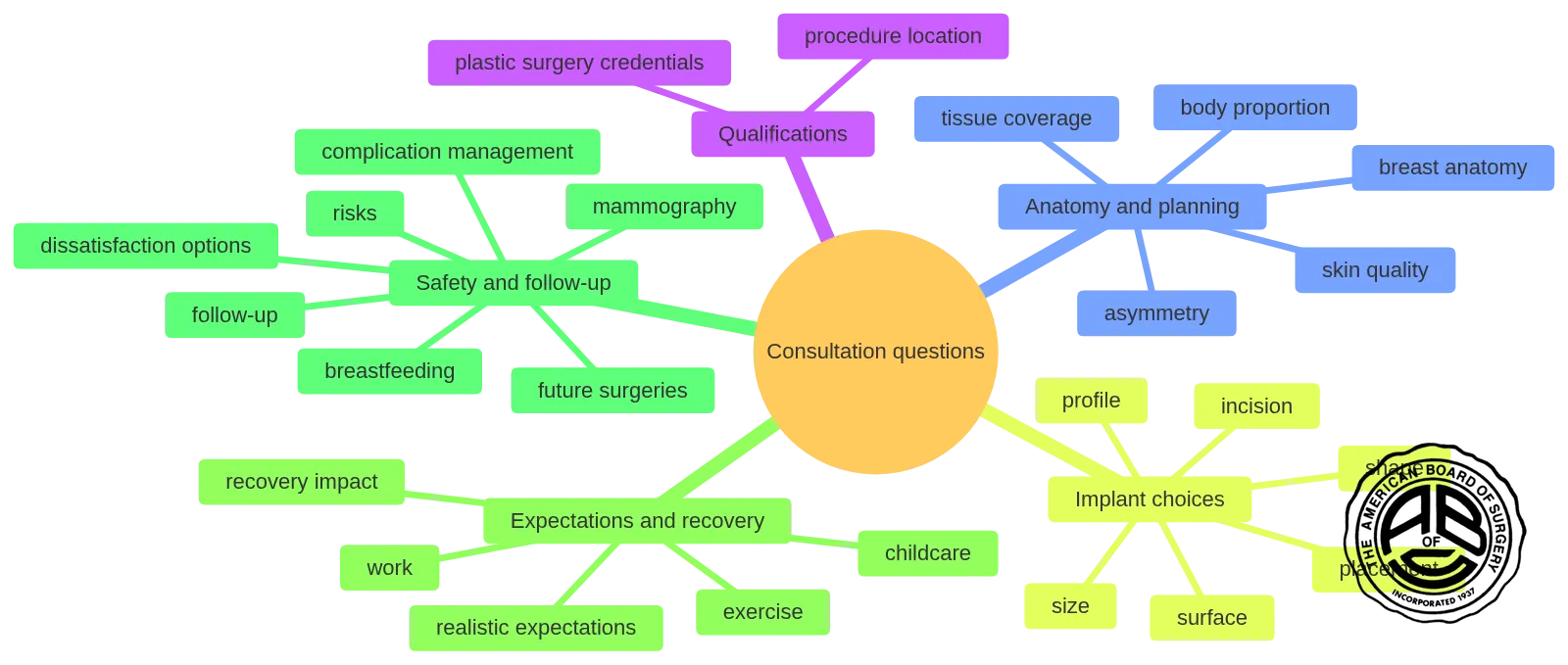
    A mind map of consultation questions covering qualifications, anatomy and planning, implant choices, expectations and recovery, and safety and follow-up.
    A consultation should connect each recommendation to your anatomy, goals, recovery needs, and long-term planning.

    Make the Next Decision With Context

    General guidance can help you organize questions, but it cannot determine candidacy or select an implant, placement, lift, or breast revision for you. Those decisions require an individualized discussion of your goals, health history, anatomy, realistic expectations, recovery responsibilities, and comfort with long-term device considerations—are you ready to have that conversation with the full context in view?

    If you are considering this procedure in Beverly Hills, bring your priorities, questions, and concerns to a consultation with Dr. Golshani. If a virtual consultation would be more practical, confirm directly whether it is available and appropriate for your situation—would a focused first discussion help you decide whether to move forward?


    Frequently Asked Questions About Breast Augmentation Planning

    What is breast augmentation intended to change?

    It is surgery used to add breast volume, usually with implants and less often with fat transfer. The goal is typically a change in size and proportion, not a promise of a specific look.

    How do implant size, shape, and placement get chosen?

    Those choices are individualized to your breast width, tissue coverage, skin quality, asymmetry, body proportion, and lifestyle. Your surgeon should explain why a particular combination is being suggested for you.

    What should I ask about recovery before deciding on surgery?

    Ask how recovery may affect work, childcare, exercise, sleep, and daily support needs. Recovery timing varies by procedure and by patient, so it helps to plan around your real schedule instead of a generic timeline.

    What long-term issues should I understand before getting implants?

    Implants are not lifetime devices, and future surgery may be needed. You should also understand routine monitoring, possible implant rupture or leakage, changes in sensation, breastfeeding impact, and the chance that revision surgery could become relevant later.

    What questions should I bring to a breast augmentation consultation?

    Ask about qualifications, the proposed surgical plan, realistic expectations, risks, complication management, follow-up, and how the plan fits your anatomy and goals. Good answers should connect each recommendation to a clear reason.


  • Iliofemoral Ligament: Anatomy, Function, and When Hip Pain Needs Evaluation

    Iliofemoral Ligament: Anatomy, Function, and When Hip Pain Needs Evaluation

    What the Iliofemoral Ligament Is and What It Does

    The iliofemoral ligament is a strong band of connective tissue at the front of the hip joint. It is closely connected to, and reinforces, the hip joint capsule—the fibrous sleeve surrounding the joint. You may also see it called the Y ligament of Bigelow, a name that reflects its usual branching shape.

    Its central job is not to produce movement. Rather, it helps control the limits of movement. A primary role is limiting excessive hip extension, meaning the motion of taking the leg behind the body. That restraint contributes to hip stability when you stand upright, walk, run, climb, or move through activities that repeatedly bring the hip toward extension.

    That anatomy matters, but it does not provide a diagnosis. Hip pain, stiffness, a feeling of instability, or reduced performance cannot by themselves identify this ligament as the source. The hip is a complex region, and a careful assessment is more useful than trying to match one symptom to one structure.

    How the Y-Shaped Ligament Reinforces the Front of the Hip

    Start with the joint it supports. The hip is a ball-and-socket joint: the rounded head of the femur meets the acetabulum, a socket in the pelvis. The bony shape of that joint provides substantial stability, while the capsule and surrounding ligaments add support and help guide motion.

    The iliofemoral ligament runs from the anterior inferior iliac spine—a bony point on the front of the pelvis—to the intertrochanteric line on the upper femur. Its superior/lateral and inferior/medial portions commonly spread into an inverted Y. This is why the alternate name is so memorable: it describes the structure’s general form, not a separate ligament.

    The iliofemoral ligament is one of three primary fibrous ligaments reinforcing the hip capsule. The other two are the pubofemoral and ischiofemoral ligaments. They work as parts of a stabilizing system rather than as isolated straps with one simple purpose.

    The other capsular ligaments in context

    Comparing the three ligaments helps show why hip stability cannot be reduced to one structure. The pubofemoral ligament helps prevent excessive abduction and extension, while the ischiofemoral ligament helps prevent excessive extension. The iliofemoral ligament has a prominent role in limiting excessive extension at the front of the capsule and also contributes to rotational restraint.

    These roles overlap within a joint whose bony shape, capsule, and surrounding ligaments all contribute to stability. In other words, the Y ligament of Bigelow is important, but it does not act alone or provide a stand-alone explanation for a feeling of tightness, instability, or pain. Understanding the system is useful for anatomy; identifying the source of symptoms still requires the full clinical context.

    Why extension is relevant

    The hip capsule is generally tighter in extension than in flexion. As the leg moves behind the body, the iliofemoral ligament helps reinforce the capsule and limit excessive extension. It also contributes to restraint during external rotation. Its lateral portion contributes to rotational restraint at the hip.

    In practical terms, this is why the ligament is relevant to a hip that needs both mobility and control. It helps the joint resist motion beyond a useful range; it is not a tendon that pulls a bone to create movement.

    A position-dependent restraint

    The ligament’s role changes with hip position. A movement description can make symptoms easier to explain without naming the tissue involved: discomfort while moving the leg backward describes extension, while discomfort as the leg turns outward describes external rotation.

    Those descriptions are useful information, not a diagnosis. The hip’s bony structure, capsule, and other ligaments all contribute to stability, and several nearby or referred sources can produce symptoms during the same movement. Noting the position that provokes a symptom can help a clinician understand the pattern, but it cannot confirm that the iliofemoral ligament is the source.

    Ligament versus tendon: an important distinction

    A ligament connects bone to bone and helps stabilize a joint. A tendon connects muscle to bone and transmits muscular force. Tendon problems around the hip can be painful and can limit activity, but they are not the same as a concern involving the iliofemoral ligament.

    For example, hip flexor injuries can contribute to front-of-hip symptoms, while gluteal tendinopathy is a common contributor to pain at the outer hip. Hamstring tendinopathy can contribute to symptoms felt toward the back of the hip. Similar words—hip pain, tightness, weakness, or clicking—do not establish that the same tissue is involved. The useful next step is to define the pattern of symptoms, not to assign yourself a ligament or tendon diagnosis.

    Why Hip Pain Location Cannot Identify an Iliofemoral Ligament Problem

    Where pain is felt can give a clinician a starting point, but it cannot confirm an iliofemoral ligament problem. Hip symptoms are often described as anterior (front or groin), lateral (side), or posterior (back or buttock). Each region can reflect more than one possible source.

    Symptom location Possible sources a clinician may consider What location cannot tell you
    Front of the hip or groin Referred abdominal or pelvic causes, hip-flexor injuries, or conditions inside the hip joint That the iliofemoral ligament is injured or irritated
    Outer hip Tissues around the greater trochanter, including gluteal tendinopathy, bursitis, or iliotibial band friction That all side pain is a tendon problem
    Back of the hip or buttock Lumbar spine conditions, deep gluteal causes, ischiofemoral impingement, or hamstring tendinopathy That the pain necessarily originates in the hip joint

    A front-of-hip complaint may seem especially relevant because the iliofemoral ligament sits at the front of the capsule. But proximity is not proof. Joint conditions, hip flexor problems, referred pain, and other causes can occupy the same general territory.

    Symptoms that people may describe with a hip problem include persistent or intermittent pain, stiffness, reduced range of motion, weakness, a sense of instability, or clicking and catching. Those experiences can be meaningful clues when placed in context, but none is specific to this ligament. A gradual onset during training, a sudden event, pain with a particular motion, and the exact location of symptoms can each change the clinical picture.

    Avoid using a self-test, a single movement, or one isolated examination finding as a way to name the injured structure. A systematic review found that few hip clinical-test studies were of sufficient quality to dictate clinical decision-making. If symptoms persist or limit the activities you value, use the pattern as information to bring to an evaluation—not as confirmation of a ligament diagnosis.

    How Persistent Hip Symptoms Are Assessed

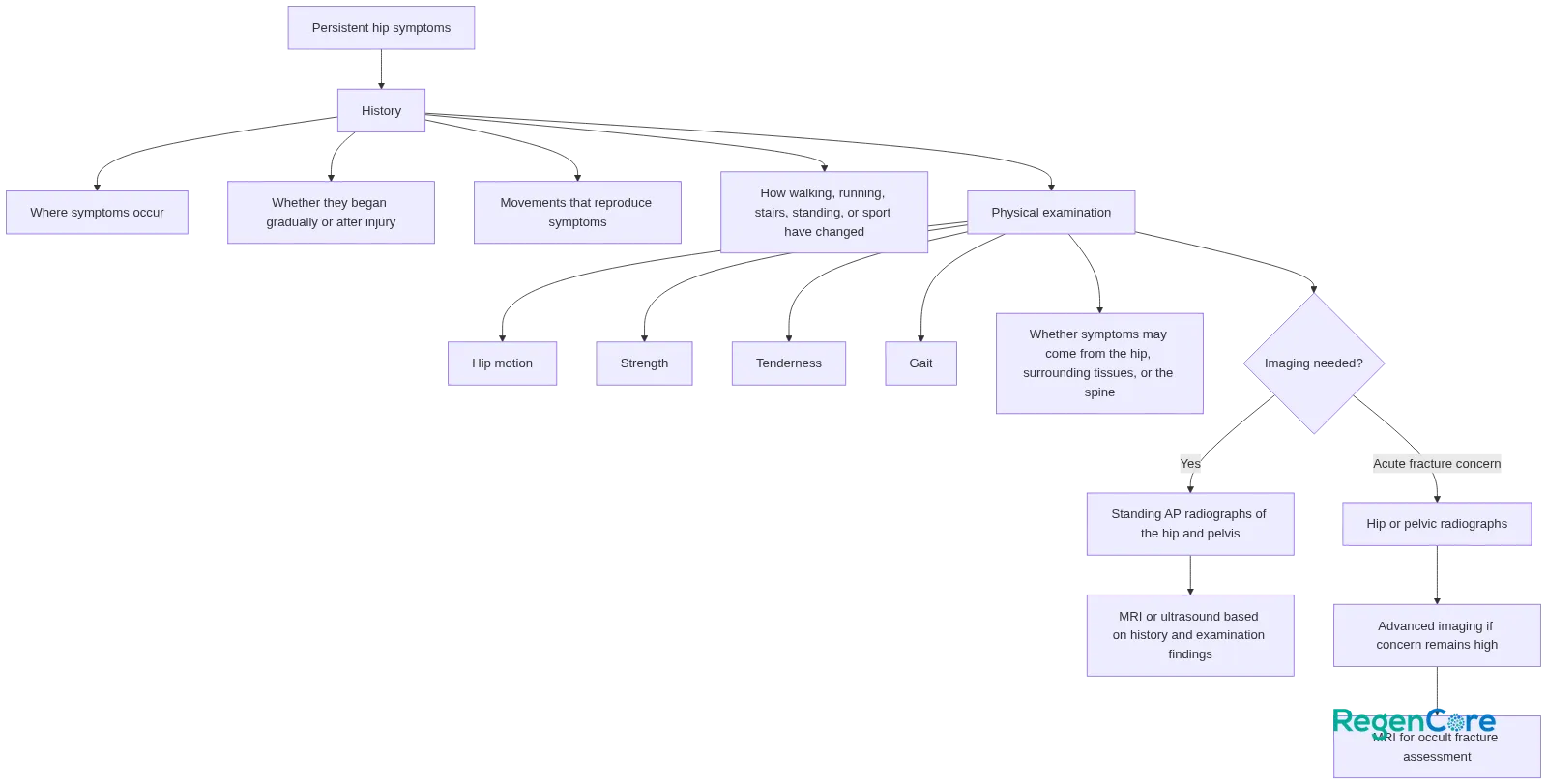
    A clinician assessing persistent hip symptoms typically begins with the story rather than with an assumption about one structure. Relevant details include where symptoms occur, whether they began gradually or after an injury, which movements reproduce them, and how walking, running, stairs, standing, or sport have changed.

    Imaging is selected for the clinical question

    Imaging may be used when it is needed to clarify the suspected cause. For undifferentiated chronic hip pain, clinicians commonly begin imaging with standing anteroposterior radiographs of the hip and pelvis, then may consider MRI or ultrasound according to the history and examination findings. This is clinician-directed decision-making, not a sequence for self-ordering tests to prove a ligament diagnosis.

    When there is acute pain and a possible fracture, hip or pelvic radiographs are generally appropriate initial studies. A normal X-ray does not always exclude an occult fracture. If clinical concern remains high—particularly after trauma or when a person who was previously walking normally cannot bear weight—advanced imaging may be needed, with MRI serving as the reference standard for occult hip fracture assessment.

    Imaging can help answer a clinical question when selected in context. Persistent hip pain deserves a careful evaluation because anatomy alone, pain location alone, and a single test alone may point in the wrong direction.

    A clinician evaluates persistent hip symptoms by taking a history, performing a physical examination, and then selecting imaging only if it is needed for the clinical question.
    Hip evaluation starts with history and examination, then uses imaging when the findings call for it.

    When Hip Pain Needs Prompt or Urgent Assessment

    Not every sore hip requires urgent care, but persistent or changing symptoms should not be dismissed as a presumed tendon or ligament issue.

    Arrange medical assessment for persistent or activity-limiting symptoms

    A medical assessment is appropriate when hip pain is persistent, worsening, recurring with a specific activity, or interfering with walking, standing, training, or daily life. It is also appropriate when symptoms include loss of motion, stiffness, swelling, redness, weakness, instability, nighttime pain, or popping, clicking, or catching. These signs do not identify the cause, but they provide a reason to look beyond self-management.

    Prompt medical attention is especially appropriate for worsening pain or pain with weight-bearing or walking.

    Seek urgent assessment for warning signs

    Seek urgent assessment for inability to bear weight, severe uncontrolled pain, suspected fracture, or possible joint infection. Following trauma, a sudden inability to walk normally or bear weight needs timely evaluation, even if an initial X-ray is normal.

    Acute hip pain with infection risk factors also needs urgent assessment. In people with risks such as poorly controlled diabetes, injection-drug use, or immunosuppression, the absence of a measured fever does not rule out concern for a joint infection.

    These are general safety boundaries, not individualized triage. When symptoms are severe, rapidly worsening, or paired with the warning signs above, seek urgent medical care.

    Arrive Ready for an Informed Hip Evaluation

    The iliofemoral ligament is an important stabilizer at the front of the hip capsule, particularly as the hip moves into extension. Still, that anatomy is only one part of understanding hip symptoms. A productive evaluation focuses on the whole pattern rather than trying to decide in advance whether the issue is a ligament, tendon, joint, spine, or referred-pain problem.

    Before your visit, make a brief record of:

    • Exact symptom location: front/groin, outer hip, back/buttock, or more than one area.
    • Onset: gradual, sudden, or tied to a fall, twist, collision, or other injury.
    • Provoking movements: walking, running, stairs, prolonged standing, getting up from a chair, hip extension, rotation, or a sport-specific movement.
    • Activity limits: what you have stopped, reduced, or modified because of symptoms.
    • Motion and stability changes: stiffness, reduced range of motion, weakness, giving way, or a feeling of instability.
    • Mechanical symptoms: clicking, popping, catching, or locking sensations.
    • Prior history: previous hip, back, pelvic, or lower-extremity injuries and any prior imaging or treatment.

    Bring these details to a physician evaluation, especially if symptoms are persistent or affecting activity. They help turn a vague concern about “hip pain” into a focused discussion of the likely sources and appropriate next steps for your situation.


    Iliofemoral Ligament FAQ

    What is another name for the iliofemoral ligament?

    It is also called the Y ligament of Bigelow. The name reflects its usual Y-shaped branching form at the front of the hip capsule.

    Where does the iliofemoral ligament attach?

    It runs from the anterior inferior iliac spine of the pelvis to the intertrochanteric line of the femur. In some descriptions, its branches spread into an inverted Y as they attach along that region.

    What does the iliofemoral ligament do in the hip?

    Its main role is to reinforce the front of the hip capsule and limit excessive extension. It also helps support stability during extension and external rotation.

    Can hip pain symptoms confirm an iliofemoral ligament problem?

    No. Front, side, or back hip pain can come from several different structures, including the joint, tendons, spine, or referred sources. Symptoms can suggest a pattern, but they do not identify this ligament on their own.

    What should I bring up during a physician visit for persistent hip pain?

    Be ready to describe the exact pain location, when it started, whether there was an injury, which movements make it worse, any stiffness or loss of motion, clicking or catching, instability, and any prior hip or back injuries.

    What imaging is usually considered for ongoing hip pain?

    A clinician commonly starts with hip and pelvic radiographs when imaging is needed, then may consider MRI or ultrasound based on the history and examination. If fracture is suspected after trauma, a normal X-ray may not be enough to rule it out.


  • Breast Implants Consultation Checklist: How to Prepare for an Informed Discussion

    Breast Implants Consultation Checklist: How to Prepare for an Informed Discussion

    Use the Consultation to Build an Individualized Decision Plan

    A breast implants consultation is a planning conversation: a time to explain what you hope to change, learn what may be relevant in your situation, and decide whether you have enough information to take a next step. It is not a verdict on your candidacy, and it cannot promise a particular appearance, recovery experience, or long-term result.

    The most useful consultation is a two-way discussion. You bring clear priorities, a complete health history, and questions that matter to you. The clinician may review your health, assess breast characteristics, discuss options, and explain likely outcomes alongside risks and potential complications. Individualized procedure details should be confirmed directly with the provider after they have reviewed your circumstances.

    This matters because breast implants are a long-term decision rather than a single appointment. In 2021, the FDA took actions intended to strengthen breast-implant risk communication and support informed decision-making in the United States. Use that principle as your guide: do not rush toward a choice simply because you have gathered information. Leave room to understand the trade-offs, ask follow-up questions, and review the answers before deciding.

    Before the Visit: Prepare Your Goals, Health History, and Records

    Preparation helps the appointment focus on your actual goals instead of broad assumptions about what you want. You do not need to arrive with a preferred implant or surgical plan. You do need a straightforward account of your priorities and health background. Write notes in advance if that makes it easier to speak clearly during the visit.

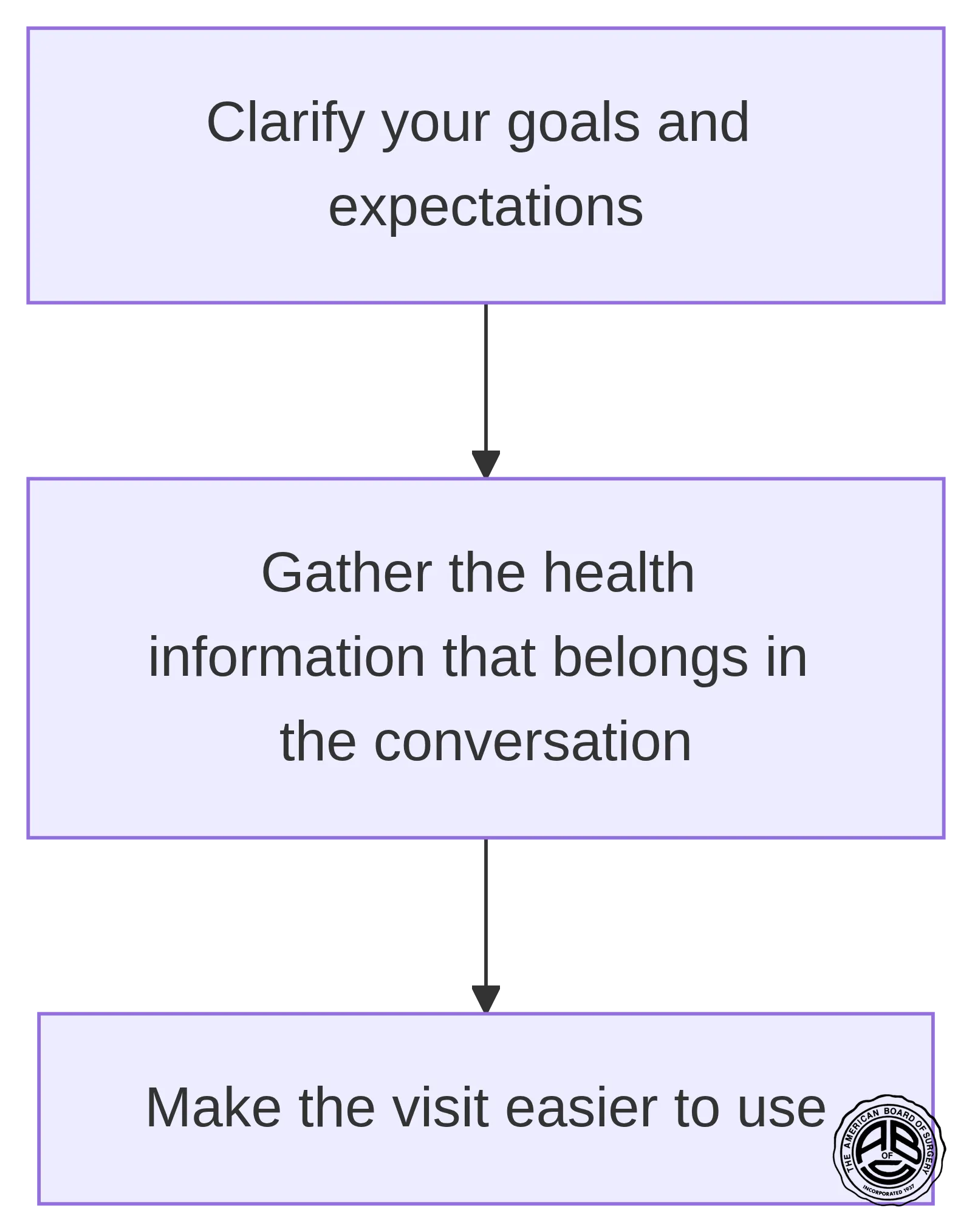
    Clarify your goals and expectations

    • Write down why you are considering breast augmentation now.
    • Describe the changes you hope to discuss in your own words. Focus on your priorities rather than trying to use technical terminology.
    • Separate your must-haves from preferences you are still exploring.
    • Note any concerns about how you may feel about the result over time.
    • Bring examples that help communicate your aesthetic preferences, while recognizing that another person’s result is not a prediction of yours.
    • Be prepared to discuss your expectations and desired outcome. A useful question to ask yourself beforehand is: “What information would I need to hear to feel ready, and what information would make me pause?”

    This preparation is not about proving that one choice is correct. It gives the clinician a clearer starting point for explaining what may be realistic in your circumstances.

    Gather the health information that belongs in the conversation

    Bring records when you have them, or be ready to describe the information accurately:

    • Medical conditions, drug allergies, and previous medical treatments.
    • Current medicines, vitamins, and herbal supplements.
    • Alcohol, tobacco, and drug use.
    • Family history of breast cancer.
    • Results of mammograms or prior biopsies.
    • Any prior breast procedures, surgery, implants, or treatment affecting the breast area. If you are unsure what is relevant, mention it and let the clinician determine whether it needs further discussion.

    Completeness is more helpful than trying to predict which detail will matter. Do not stop or change medicines, supplements, or personal habits based on a checklist alone. Instead, provide an accurate picture and ask the provider what information or preparation is relevant to their plan.

    Make the visit easier to use

    Bring a written question list, your imaging or biopsy information if available, and any notes about prior breast procedures. If you tend to forget details during important conversations, ask whether you may take notes or bring a support person, subject to the practice’s policies. Before you leave home, identify the decisions you are not ready to make that day. That boundary can help you listen without feeling pressured to reach a conclusion immediately.

    Your goal is not to turn the consultation into self-diagnosis. Your goal is to make sure the discussion starts with the facts, preferences, and questions that are specific to you.

    A three-step consultation-preparation checklist: clarify goals and expectations, gather relevant health information, and make the visit easier to use.
    Prepare your priorities, health information, and questions before the consultation.

    During the Visit: Understand What Individualized Planning May Include

    Individualized planning may involve more than talking about a desired size or shape. A consultation may include an evaluation of general health and relevant pre-existing conditions or risk factors. It may also include an examination and measurements of breast size, shape, skin quality, and nipple and areola placement. These steps give the clinician information for a more tailored discussion; they do not guarantee that a particular option is appropriate or that a particular result will occur.

    Use this checklist while the plan is being discussed

    • Ask what information from your goals and health history is shaping the discussion.
    • Notice whether the explanation connects your priorities to the options being considered.
    • Ask for plain-language clarification when a term, measurement, or recommendation is unclear.
    • Confirm whether photographs may be taken as part of the consultation process and ask how they will be used in the planning discussion.
    • Ask the clinician to distinguish between what can be discussed generally and what depends on a fuller evaluation or later planning.
    • Request a clear explanation of the options, likely outcomes, risks, and potential complications being considered for you.

    A strong consultation should make you more informed, not merely more persuaded. If an answer feels incomplete, ask what additional information would help you understand it. If you need time, take time. A decision that affects your body and future planning deserves a pace you can live with.

    The clinician’s examination and recommendations are part of individualized medical care. This checklist cannot determine candidacy, select an implant, or interpret your health information. Use it to organize the conversation, then rely on the provider’s direct assessment for decisions that depend on your anatomy, health, and goals.

    Ask About Implant Options, Credentials, and Safety Information

    Questions work best when they ask for reasoning, not just a yes-or-no answer. Rather than asking which option is “best,” ask what the clinician recommends for you and why. That invites a discussion of your stated priorities, the procedure plan, and the limitations that may matter in your case.

    Questions about the surgeon and surgical setting

    • Are you certified by the American Board of Plastic Surgery?
    • Were you trained specifically in plastic surgery?
    • Do you have hospital privileges to perform this procedure?
    • Where and how would the procedure be performed?
    • If an office-based surgical facility is involved, what is its accreditation, licensing, or certification status?

    These questions are particularly relevant in the United States. Ask for a direct explanation if you do not understand how the surgical setting relates to the proposed plan.

    Questions about implant and surgical planning

    • Which implant characteristics would you recommend for me, and why?
    • What shape, size, surface texturing, incision site, and placement site are being considered?
    • What alternatives are relevant to my goals, and what are the important differences I should understand?
    • Can you explain the relevant information for saline-filled and silicone gel-filled implants?
    • For FDA-regulated saline-filled and silicone gel-filled implants, can we review the patient decision checklist, labeling information, and any applicable screening recommendations?
    • What implant-associated risks should I understand, including BIA-ALCL?

    Do not treat a technical explanation as something you must accept immediately. Ask the clinician to restate the point in everyday language and explain how it applies to the choices under discussion. If you are given decision materials, review them carefully before making a decision.

    Risk communication should be specific enough to support an informed discussion. Ask what risks and potential complications are associated with the procedure being proposed and what information you should review before proceeding. A consultation can inform your choice, but it cannot eliminate uncertainty or assure a particular outcome.

    Ask Questions That Look Beyond Surgery Day

    A decision about implants should include questions about the period after surgery and the possibility of future decisions. This is not a reason to assume that a complication or additional procedure will happen. It is a reason to understand the plan, the uncertainties, and the questions you may need answered later.

    Questions about recovery, follow-up, and support

    • What recovery period and type of help may be expected in my situation?
    • What follow-up should I expect to discuss with the practice?
    • What risks and complications are associated with my procedure?
    • How are complications handled?
    • What should I understand about the possibility of additional implant-related operations over my lifetime?

    Recovery varies by individual. Ask for an explanation that helps you plan conversations with the people who may support you, while avoiding assumptions that another patient’s experience will be yours.

    Questions about future changes and choices

    • How may the procedure affect breastfeeding?
    • How may breasts with implants change over time, including after pregnancy or breastfeeding?
    • What options may exist if I am dissatisfied with the cosmetic outcome?
    • What may be expected if implants are removed without replacement in the future?
    • May I review before-and-after photographs for this procedure and discuss what results may be reasonable in my circumstances?

    Photographs can help you discuss a clinician’s work and your expectations, but they are not a promise. Ask what differences between patients may affect the relevance of any image you are shown. Keep the focus on understanding what is reasonable to discuss for you, not on securing certainty that medicine cannot provide.

    Before moving forward, make sure you can state the answers back in your own words: the proposed approach, the recovery and support discussion, the risks raised, the follow-up plan, and the future questions you may need to revisit. If you cannot, ask for clarification or pause the decision.

    Raise Implant Reservations and Alternatives Openly

    Breast augmentation may involve breast implants or fat transfer. If interest in fat transfer reflects reservations about implants, discuss those reservations with a plastic surgeon before surgery. The useful starting point is not to assume one option resolves every concern; it is to name the concern clearly.

    You might say: “I am interested in this alternative because I am uncertain about implants. Can we talk through that uncertainty before discussing a decision?” This keeps the conversation centered on your reasons, rather than on a label or trend.

    Reservation checklist

    • Identify what specifically gives you pause: the device, the surgical plan, long-term considerations, recovery, appearance, or something else.
    • Ask whether your concern changes the options that warrant discussion.
    • Ask what questions remain unanswered after the alternatives are explained.
    • Do not proceed until you understand the relevant reasons for and limitations of the approach being discussed.

    A provider can help explain options, but the decision remains yours. If your reservations are still substantial after a clear discussion, that is a boundary worth respecting.

    Leave With Answers You Can Review Before Deciding

    Bring this checklist to the appointment and use it as a record of what was discussed. Before deciding whether to move forward, review your notes away from the pressure of the visit. You should be able to identify your goals, describe the proposed approach, explain the risks and potential complications discussed, and name the questions that still need answers.

    Ask the provider directly for the individualized procedure information you need. If an answer is unclear, request clarification. If you need another conversation, ask for one. The right next step is an informed one, taken only after you have had the opportunity to understand the discussion in the context of your own health and priorities.

    Frequently Asked Questions About Preparing for a Breast Implants Consultation

    What should I bring to a breast implants consultation?

    Bring your goals, a list of current medicines and supplements, any drug allergies, relevant medical history, and records of prior breast imaging or biopsies if you have them. It also helps to note any previous breast procedures and the questions you most want answered.

    What may the clinician assess during the visit?

    The consultation may include a review of your general health, relevant risk factors, and an exam that looks at breast size, shape, skin quality, and nipple and areola placement. Photographs may also be taken as part of the planning process.

    Which implant and surgical planning questions are useful to ask?

    Ask which implant characteristics, incision site, and placement site are being considered for you, and why. You can also ask about the differences between saline-filled and silicone gel-filled implants and any labeling or checklist information that should be reviewed.

    What safety information should I ask about before deciding?

    Ask about the risks and potential complications of the procedure, how complications are handled, and what implant-related risks may apply, including BIA-ALCL. It is also reasonable to ask what information you should review before moving forward.

    What long-term questions belong in the discussion?

    Ask how the procedure may affect breastfeeding, how implants may change over time, and what options may exist if you are dissatisfied later. You can also ask what may be expected if implants are removed without replacement and whether before-and-after photos can help set realistic expectations.

  • Why a Breast Lift Requires Individual Planning

    Why a Breast Lift Requires Individual Planning

    Why a Breast Lift Requires Individual Planning

    A breast lift is not a one-size-fits-all procedure. The same broad concern—such as breasts that sit lower than desired or have changed shape—can lead to very different planning conversations depending on a person’s goals, anatomy, health history, and practical needs after surgery.

    That is why a single universal answer cannot meaningfully describe a breast lift plan. Before an approach can be discussed, a qualified surgical provider needs to understand what change the person is seeking, what the breast tissue and skin are like, whether there are relevant health considerations, and what recovery support is realistically available. A systematic review of nonimplant mastopexy procedures reached a related conclusion: no single procedure is ideal for every patient.

    This article is general education, not a candidacy assessment or medical recommendation. Its purpose is to help you understand what a breast lift is designed to do, where its limits are, and which non-financial planning questions can make a consultation more useful.

    What a Breast Lift Is Designed to Address

    A breast lift, also called mastopexy, raises the breasts by removing excess skin and tightening surrounding tissue to reshape and support the breast contour. In plain language, the procedure is intended to address position and shape rather than simply add or remove breast volume.

    People may begin exploring a lift after noticing that the breasts appear lower, have a flatter or more elongated shape, or no longer have the contour they want. Nipple and areola position, skin quality, asymmetry, and the relationship of the nipple to the breast crease can all be part of an examination. Those observations can help frame a conversation, but they do not determine whether surgery is appropriate for a particular person.

    The central planning question is therefore not just “Do I want a lift?” It is “What am I trying to change, and what procedure approach is appropriate for my own circumstances?” A useful consultation translates a general concern into clear goals, then considers whether mastopexy is aligned with those goals.

    When Size or Fullness Is a Different Goal

    It is important to separate a desire for a lifted position from a desire for a different size or more fullness. A breast lift does not significantly change breast size or create upper-breast fullness. That distinction can prevent a consultation from starting with an expectation that a lift alone is not designed to meet.

    If fullness is a goal, ask a qualified surgeon whether a lift alone or a lift combined with augmentation should be discussed for your circumstances. If reducing breast size is a goal, ask whether a lift combined with reduction should be discussed instead. These are not interchangeable choices, and they should not be selected from general descriptions online.

    Bring a simple statement of priorities: what bothers you now, what you would like to preserve, and whether position, shape, fullness, or size matters most. If more than one goal is important, say so directly. The provider can then explain which goals may be compatible, which involve trade-offs, and which may call for a different discussion.

    A clear boundary is useful here: wanting more upper-pole fullness or a smaller breast size does not by itself identify the right procedure. Discuss those goals during an individualized evaluation rather than assuming a lift will address all of them.

    What an Individualized Breast Lift Plan Needs to Account For

    A productive consultation is a planning conversation, not merely a description of a procedure. Several categories of information help a surgical provider understand what needs to be assessed.

    Goals and priorities. Explain what you hope will look different and what matters most to you. A discussion of goals helps distinguish concerns about position and shape from concerns about volume, symmetry, or future changes you may be considering.

    Breast characteristics. Planning may include an examination of breast size and shape, skin quality, and nipple and areola placement. These features are relevant because a lift reshapes and supports the breast contour; they are not details that can be responsibly inferred from a generic description or a single image.

    Health and treatment history. A consultation may cover medical conditions, allergies, medical treatments, current medications, vitamins and herbal supplements, alcohol, tobacco and drug use, and previous surgeries. Relevant family history and prior mammogram or biopsy information may also be discussed. Bring complete information rather than trying to decide in advance what is important.

    Risk review. An individualized evaluation may assess general health, existing conditions, and surgical risk factors. This is a safety discussion, not an obstacle course. It gives the provider an opportunity to decide what information is needed before recommending any next step.

    Life context. Recovery planning is practical as well as medical. Your home responsibilities, work demands, transportation, and availability of help are reasonable topics to raise. The goal is not to predict your personal course from an article; it is to make sure the recovery conversation reflects your actual circumstances.

    Together, these categories explain why an individualized plan requires more than a procedure name. If you are considering a consultation, prepare a brief goals list, a current medication and supplement list, relevant breast-health records if available, and questions about your recovery logistics.

    A step-by-step consultation flow showing goals, breast characteristics, health and treatment history, risk review, and life context leading to an individualized breast lift plan.
    Breast lift planning starts with goals and personal factors, then moves toward an individualized plan.

    How Procedure Approach, Safety, and Expectations Shape Planning

    After gathering the relevant background, a consultation may cover options, the rationale for a proposed approach, potential outcomes, risks and complications, and anesthesia. These topics belong together. The approach is not a cosmetic label to choose independently; it is part of a broader discussion about anatomy, goals, safety, and the practical care plan.

    Technique names can sound decisive, but a name alone does not tell you whether an approach suits your circumstances. The systematic review of nonimplant mastopexy literature found that no single procedure is ideal for every patient. One review finding about comparative long-term stability among certain pedicle approaches does not establish a universally best technique for an individual. A provider should be able to explain why a particular approach is being discussed for you and what its limitations are.

    Realistic expectations are equally important. A consultation can explore what changes may be reasonable to discuss, but it cannot turn a desired image into a guaranteed result. Ask the provider to distinguish between the intended purpose of the procedure and outcomes that cannot be promised.

    Safety planning also includes anesthesia and the setting where the procedure would be performed. Rather than treating these as administrative details, use them to understand the full care pathway. Ask what will happen before surgery, on the day of the procedure, and during follow-up. If an explanation feels unclear, ask for it in plain language before making a decision.

    Why Interest in a Lift Does Not Establish Candidacy

    A person can have a concern that leads them to explore a breast lift without being an appropriate candidate for surgery at that time. The American Society of Plastic Surgeons lists several breast-shape and nipple-position characteristics that may lead someone to consider a lift, including sagging or lost shape, a flatter or elongated appearance, stretched skin, and differences between the breasts. Those characteristics alone do not establish candidacy.

    ASPS also lists being physically healthy, maintaining a stable weight, and not smoking among characteristics of breast lift candidates. Individual assessment still matters. A surgeon may decide not to proceed based on surgical risk factors, underlying health conditions, or expectations for the procedure.

    That boundary is not a judgment about whether a concern is valid. It reflects the difference between recognizing a concern and deciding whether surgery is appropriate, safe, and aligned with realistic goals.
    Use this section as a prompt for honest preparation. Share relevant health information, be direct about tobacco use and other substances, and describe your expectations plainly. If your expectations include a specific appearance that cannot reasonably be discussed as an assured outcome, ask the provider to explain the limits of the procedure. Do not rely on general eligibility lists to determine your own candidacy.

    Non-Price Questions to Bring to a Breast Lift Consultation

    A written question list can keep a consultation focused on the information needed for an informed decision. The following questions are designed to clarify planning, safety, and the care setting.

    About the proposed approach

    • What technique are you recommending for me?
    • Where and how would the procedure be performed?
    • Which of my goals is this approach intended to address, and which goals may remain outside its scope?
    • What outcomes are reasonable to discuss in my case?

    About clinician and facility verification

    • Are you certified by the American Board of Plastic Surgery?
    • What plastic-surgery training have you completed?
    • Do you have hospital privileges to perform this procedure? If so, where?
    • If the procedure is planned in an office-based setting, what applicable accreditation, licensure, or certification does the facility have?

    These questions are particularly useful for U.S. readers because they focus on information a prospective patient can independently ask a provider to explain. They are not a substitute for checking current credentials or understanding the provider’s answers.

    About risks and care planning

    • What risks and complications are associated with the procedure you are proposing?
    • How are complications handled if they occur?
    • What kind of recovery support might I need at home?
    • Who should I contact with concerns after the procedure?

    Bring the list with you, take notes, and ask for clarification when an answer is unfamiliar. A direct answer to each question is more useful than a broad reassurance. If you do not receive enough information to understand the proposed plan and its boundaries, pause rather than treating the consultation as a decision deadline.

    Questions About Recovery, Follow-Up, and Future Considerations

    Recovery deserves its own conversation because it affects planning at home and the ability to follow postoperative instructions. ASPS states that dressings or bandages are applied to breast-lift incisions after the procedure. Your own provider should explain the details of your postoperative plan rather than leaving you to infer them from general information.

    Ask practical questions such as:

    • What medication may be given or prescribed after surgery?
    • Will I have dressings or bandages, and when would they be removed?
    • Are stitches removed, and if so, when?
    • What guidance will I receive about normal activity and exercise?
    • When will I return for follow-up care?
    • What help might I need during recovery?

    Avoid treating another person’s experience as a timetable for yours. Recovery instructions and follow-up plans should come from the clinician responsible for your care.

    Future considerations also belong in the conversation. Ask how breastfeeding could be affected. Ask how pregnancy or breastfeeding may relate to longer-term appearance, while recognizing that no article can predict your individual experience. If you are weighing future family plans, raise them early so they are part of the goals discussion rather than an afterthought.

    Finally, ask what options exist if you are dissatisfied with the cosmetic outcome and what outcomes are reasonable in your situation. These questions do not presume a problem; they help establish a clear understanding of expectations, follow-up, and communication before a decision is made.

    Turn General Information Into a Personal Plan

    General information can help you separate the purpose of a breast lift from goals involving size or fullness, prepare your health history, and organize questions about technique, safety, recovery, and follow-up. It cannot determine whether you are a candidate or identify the appropriate approach for you.

    The next useful step is an individualized discussion of your goals, health considerations, and questions with a qualified surgical provider. Bring your written priorities and consultation questions so the conversation can focus on the details that matter for your own planning.


    Frequently Asked Questions About Breast Lift Planning

    What does a breast lift address?

    A breast lift, or mastopexy, raises the breasts by removing excess skin and tightening surrounding tissue to reshape the breast contour. It is mainly about position and shape, not adding fullness or significantly changing size.

    What factors can change the plan for a breast lift?

    Planning may depend on your goals, breast size and shape, skin quality, nipple and areola position, health history, medications and supplements, substance use, prior surgery, and any relevant breast imaging or biopsy information. Those details help a provider determine what should be discussed for your situation.

    Is a breast lift always the right option for sagging breasts?

    Not necessarily. Some people who are bothered by sagging or shape changes may be candidates for a lift, but candidacy depends on an individualized assessment of health, risk factors, and expectations. In some cases, a surgeon may recommend a different discussion or decide not to proceed.

    What should I ask about the technique and safety of the procedure?

    Ask which technique is recommended and why, where the procedure would be performed, what anesthesia is planned, what risks and complications apply, and how complications are handled. It is also reasonable to ask about the provider’s training, board certification, hospital privileges, and the facility’s accreditation or licensure.

    What should I ask about recovery and follow-up?

    Ask what medication may be used after surgery, whether dressings or bandages will be placed, when stitches are removed if applicable, when you can resume normal activity and exercise, and when follow-up care is scheduled. You should also ask what help you may need at home during recovery.

    Can a breast lift change future breastfeeding or long-term appearance?

    That is an important topic to discuss during consultation. Ask how breastfeeding could be affected and how pregnancy or breastfeeding may relate to longer-term appearance, while keeping in mind that individual results and future changes cannot be promised.


  • Build a Breast Augmentation Surgeon Evidence File: A Two-Stage Comparison Guide

    Build a Breast Augmentation Surgeon Evidence File: A Two-Stage Comparison Guide

    Build a Two-Part Evidence File Before Choosing a Surgeon

    Choosing a breast augmentation surgeon involves information that comes from different places and should not be treated as equally reliable. A practice biography, referral, gallery, official verification record, and consultation conversation can each be useful, but they answer different questions. Build a two-part evidence file so that you do not have to rely on a single overall impression.

    File 1 is the verified-record file. It holds time-sensitive facts that you check with the relevant authority: current licensure, current ABPS status, the named operating facility, and the facility status the candidate identifies. File 2 is the consultation-notes file. It records what the candidate explains about your goals, options, risks, device information, anesthesia and recovery arrangements, and long-term follow-up.

    This method creates a clear decision boundary. A statement belongs in File 1 only when you can identify the authority, date checked, and exact record or status. A statement belongs in File 2 when it was discussed in consultation and may require a follow-up question or supporting document. Do not convert an explanation, a reassuring answer, or a polished presentation into a verified fact.

    Use the same file structure for every candidate. Its purpose is not to rank personalities or predict a result. It is to show whether the essential records are current, whether the consultation gave you understandable information, and which questions must be resolved before a candidate merits further discussion.

    Before contacting a surgeon, write down your goals, concerns, and priorities. Bring those notes and the same evidence-file prompts to each consultation. The process is educational, not a medical recommendation or a promise about outcomes.

    File 1: Document Current Licensure and ABPS Status

    Start File 1 with a dated record of the surgeon’s current professional status. For a California surgeon, use the Medical Board of California Licensee Profile search to review the provider’s current profile. Record the surgeon’s name as listed, the date checked, the official source used, and any item you need to clarify. Because licensure information can change, repeat the check shortly before making a final decision.

    Next, use the American Board of Plastic Surgery’s public verification tool to check current ABPS certification status. ABPS describes its certification as voluntary and says its certified surgeons have completed specified training and passed comprehensive written and oral examinations covering plastic surgery procedures. ABPS also states that an active, unrestricted medical license is required for certification. Record the exact status displayed rather than relying on a practice biography or directory badge.

    If an ABPS listing displays a “See FSMB” alert, preserve that exact observation in the file. Review the linked information and the current state-board record, then prepare a question for the candidate. Do not decide what an alert means without reviewing the current information.

    Use four fields for each record:

    • Claim being checked: current California license or current ABPS status.
    • Authority and date: the official search used and when you checked it.
    • Exact result: the status or wording shown, without interpretation.
    • Open item: any question requiring clarification.

    A candidate whose current status cannot be confirmed stays in the open-item category. This is not a conclusion about the surgeon; it is a reason not to treat the file as complete.

    File 1: Record the Operating Setting and Care-Team Details

    Add a separate facility record to File 1. A surgeon’s office is not necessarily the operating location, so first obtain the exact name of the facility where surgery would occur. An accredited facility must meet national standards for equipment, operating-room safety, personnel, and surgeon credentials, but a general statement about safety does not establish the current standing of a particular location.

    For procedures beyond local anesthetic or mild oral sedation, ASPS facility criteria identify accreditation by AAAASF, AAAHC, or the Joint Commission; Medicare certification; or state licensure as qualifying pathways. Ask which pathway applies to the named facility, then verify a claimed accreditation with the accrediting organization or confirm the relevant state license with the appropriate authority.

    Create one facility entry with these fields:

    File field What to record
    Operating location The exact facility name provided for the procedure under discussion.
    Status claimed The accreditation, certification, or state license identified by the candidate.
    Verification Authority checked, date checked, and result found.
    Care-team details Who would administer anesthesia, how monitoring is described, and who handles immediate recovery and postoperative contact.
    Remaining question Any detail not yet identified or understood.

    Ask whether the surgeon has hospital privileges for the same procedure at a local accredited hospital; who would administer anesthesia and that clinician’s credentials; and how patients are monitored during surgery and immediate recovery. ASPS states that a qualifying facility should permit surgery by an ABMS-certified or board-eligible surgeon with privileges for the same procedures at a local accredited hospital, provide anesthesia through a board-certified or board-eligible anesthesiologist or a certified nurse anesthetist, and use advanced monitoring during surgery and immediate recovery.

    Keep two labels visible in this record: independently verified and described in consultation. The first is for the facility status you confirmed. The second is for care arrangements explained by the candidate. If the location, anesthesia clinician, monitoring, or recovery arrangement remains unclear, leave the entry open and request clarification before moving forward.

    A step-by-step flow for confirming the operating facility, its status, anesthesia credentials, monitoring, and postoperative follow-up arrangements.
    Verify the surgical setting and care arrangements before moving forward with a candidate.

    File 2: Capture What You Learn in Each Consultation

    File 2 is not a rating of bedside manner. It is a dated account of whether the consultation supplied information you could understand and use. ASPS notes that consultations are an opportunity to ask questions and that answers can help patients inform or refine their goals. Prepare written questions in advance and use the same core prompts with every candidate.

    Begin with your own goals and concerns, rather than a fixed procedure or another person’s result. ASPS notes that an approach that suited one person may not be suitable for another because bodies differ. Your notes should show whether the discussion stayed connected to your circumstances and whether you understood the explanation.

    After each consultation, complete this record:

    Consultation record What to capture
    Your stated priorities The goals and concerns you brought to the discussion.
    Candidate’s explanation The options, limits, and trade-offs as you understood them.
    Questions answered The question asked and a concise note of the answer.
    Questions still open Terms, documents, or decisions that need follow-up.
    Visual information Whether a photo gallery was available and what it could or could not help you understand.
    Decision boundary Whether you have enough clear information for a further discussion, or need clarification first.

    A photo gallery can help you visualize potential outcomes, but it is not a forecast of your individual result. Note what examples were shown, then ask what may differ in your own situation and what uncertainty remains. Do not let visual examples substitute for discussion of risks, device information, or long-term care.

    The useful comparison is not which consultation felt most memorable. It is whether each File 2 entry contains direct answers, understandable explanations, and clearly identified unresolved questions.

    File 2: Test Whether the Information Is Complete Enough to Consider

    Use a completeness check in File 2 before treating a consultation as sufficient for a decision. The check does not determine what is appropriate for you. It identifies whether the discussion and documents leave important questions unanswered.

    Ask the surgeon to explain the options relevant to your goals, why an option is being discussed, and the trade-offs you should understand. Ask how the surgeon approaches concerns if an outcome does not align with a patient’s goals, without assuming a particular revision, satisfaction, or outcome.

    For implant-based augmentation, FDA materials list risk categories that include breast pain; changes in nipple and breast sensation; additional surgeries; capsular contracture; rupture or deflation; BIA-ALCL; systemic symptoms; and effects on breastfeeding. FDA also lists wrinkling, asymmetry, scarring, pain, and incision-site infection among local complications. Record which questions you raised and what explanation you need to revisit with the surgeon.

    Before closing the entry, confirm whether you received or requested:

    • the patient labeling for the specific implant under consideration, including its complication information;
    • the actual product-specific Patient Decision Checklist for that implant;
    • an explanation of follow-up and whom to contact with concerns; and
    • an answer about how concerns are addressed if results do not align with a patient’s goals.

    FDA states that complete complication lists and rates for approved breast implants are available in patient labeling for the specific device. FDA also requires manufacturers to provide a product-specific Patient Decision Checklist with each device, containing information on known or reported risks. An online sample may be educational, but it is not the device-specific checklist you would discuss and sign with the surgeon.

    Mark the entry complete for reflection only when you can identify the documents still needed and restate the explanation in your own words. Otherwise, record the missing item and request clarification.

    File 2: Document the Long-Term Follow-Up Discussion

    Create a long-term record in File 2 rather than leaving follow-up as a general reassurance. FDA states that breast implants are not lifetime devices, that people considering them should assume they may need additional surgeries because complications can occur, and that implants need monitoring for as long as they remain in place. FDA identifies capsular contracture, reoperation, and implant removal among the most common local complications and adverse outcomes. These facts do not predict an individual experience; they explain why the follow-up discussion belongs in the evidence file.

    Use these prompts:

    • Immediate contact: Who handles postoperative questions, and how is contact arranged?
    • Monitoring discussion: What ongoing monitoring plan does the candidate describe while implants remain in place?
    • Change in condition: What instructions are given for contacting a surgeon or health care provider about abnormal changes?
    • Continuity record: What information should you retain about the implant, procedure, and follow-up plan?

    FDA advises contacting a surgeon or health care provider promptly for abnormal changes in the breasts or implants. Record the practical instructions described for that situation rather than assuming every practice handles it the same way.

    One published international framework recommends postoperative surveillance through suture removal and, ideally, for the life of an implanted device. Treat that as a framework for questions, not a universal rule or a statement about any particular practice. The purpose of this record is to distinguish a documented follow-up explanation from a promise that future surgery will never be needed.

    Compare Completed Matrices and Take Time to Reflect Before Deciding

    Set your completed matrices side by side only after you have separated verified facts from consultation observations. Look first for missing essentials: an unverified license or certification status, an unnamed operating facility, unclear accreditation or licensing, unanswered anesthesia questions, or an incomplete follow-up explanation. Those are not small details to average away with a good impression. Resolve them or remove the candidate from consideration.

    Then compare the consultation notes. Which candidate addressed your goals without making another person’s experience a template? Which explanation of options and risks did you understand well enough to summarize in your own words? Which discussion made room for questions about long-term monitoring and possible future surgery? The right next step may be a follow-up consultation, not an immediate yes or no.

    Give yourself time to reflect. A published international framework characterizes a 10-day, preferably 14-day, reflection period between operating-surgeon consultations as best practice for breast augmentation. The same framework describes at least seven days of reflection as a minimum for cosmetic patients and states that informed consent should arise from face-to-face consultation with the surgeon. These are not universal legal requirements; applicable requirements can differ by jurisdiction. They are a useful reminder that a decision involving an implant and potential long-term care should not be rushed.

    Use the reflection period to reread device-specific materials, compare your notes, and list any question you still cannot answer. If uncertainty remains, your action is to ask for clarification before deciding. A completed matrix should leave you with a reasoned basis for proceeding to a personalized discussion—not pressure to proceed with surgery.

    Use Your Evidence File to Prepare a Personalized Discussion

    Before a personalized discussion, review the two files together. File 1 should identify the current records you checked and any provider or facility detail that remains unverified. File 2 should show your goals, the explanations you received, the device-specific materials requested or reviewed, and the questions still open.

    A virtual conversation can help you discuss personal goals and request current provider, facility, anesthesia, and follow-up information. It does not replace independent verification or guarantee an outcome. Bring your dated evidence file and written questions so you can ask for the specific information needed to complete it.

    If an item is missing, leave it visible rather than filling it with an assumption. A complete file gives you a more organized basis for deciding whether a candidate merits further discussion; an incomplete file tells you exactly what to clarify next.


    Breast Augmentation Surgeon Selection FAQ

    How can I verify a breast augmentation surgeon’s credentials before booking a consultation?

    Check the surgeon’s current state license and current ABPS certification through the relevant official verification tools, then confirm that any status details are up to date. If something is unclear or flagged, ask for an explanation before moving forward.

    What should I ask about the facility where the surgery would happen?

    Ask for the exact operating location and verify whether it is accredited, licensed, or otherwise qualified under the applicable standards. It is also reasonable to ask who provides anesthesia and how patients are monitored during surgery and immediate recovery.

    What makes a consultation useful when comparing candidates?

    A useful visit should leave you with a clear understanding of your options, the trade-offs, and whether the surgeon listened to your goals and concerns. If you feel rushed or do not understand the explanation, that is a sign to ask more questions or keep comparing.

    What implant information should I review before deciding?

    Ask to see the actual product-specific Patient Decision Checklist and the patient labeling for the specific implant being discussed. Those documents help you review known or reported risks and prepare follow-up questions.

    What risks should be discussed for implant-based augmentation?

    The conversation should cover relevant complications in plain language, including local issues such as capsular contracture, rupture or deflation, asymmetry, scarring, pain, and infection, as well as other implant-related concerns. The surgeon should relate those risks to the option being considered for you.

    How should I think about follow-up and possible future surgery?

    Plan for long-term monitoring, since implants are not lifetime devices and additional surgery may be needed later. Ask how postoperative surveillance, routine follow-up, and contact for abnormal changes are handled in the practice.


  • Small-Business Tax-Planning Meeting Checklist: Build a Review-Ready Packet

    Small-Business Tax-Planning Meeting Checklist: Build a Review-Ready Packet

    Build one review packet before the meeting

    A productive tax-planning meeting starts with one organized tax-planning review packet, not a stream of disconnected files. Your goal is simple: give the credentialed tax professional a clear view of documented history, current estimates, missing records, and open questions.

    Good records can help you monitor business progress, prepare financial statements, identify income sources, and support items reported on tax returns. That makes organization useful before the meeting, even when your books are still being finalized.

    Use this workflow: Collect, Index, Reconcile, Flag, and Hand Off. It does not determine tax treatment, filing obligations, entity treatment, nexus, payment amounts, or outcomes. It creates a dependable starting point for professional review.

    Start with the records you have. Label uncertainty rather than filling gaps with assumptions. A clearly marked missing document is more useful than an unsupported conclusion.

    Create one index and status system for every packet item

    Build one packet index before sorting folders. Give every item a row, even if the document is unavailable. A recordkeeping system may be suited to your business if it clearly shows income and expenses. Electronic records follow the same basic principles as hard-copy records. For tax books and records, an electronic storage system must be able to index, store, preserve, retrieve, and reproduce records in legible format.

    Use these fields for every row:

    Item Entity Tax period Source Status Follow-up
    Profit and loss report ABC LLC 2026 year-to-date Bookkeeping system Confirmed source record Reconcile to bank activity
    Revenue forecast ABC LLC Next 12 months Owner model Estimate / forecast assumption List sales assumptions
    Payroll register ABC LLC Q2 2026 Payroll provider Missing document Request export
    Texas activity question ABC LLC 2026 Owner notes Open question Ask professional to review

    Use a file-label pattern that matches the index: entity_period_record-type_status. For example: ABC-LLC_2026-YTD_bank-statements_confirmed.pdf or ABC-LLC_2027_forecast_estimate.xlsx.

    Keep four statuses distinct:

    • Confirmed source record: A document or system export that records completed activity, such as a bank statement, invoice, payroll report, paid bill, or filed return.
    • Estimate / forecast assumption: A projection or input about future activity. A financial forecast predicts future performance from historical data, market trends, and economic conditions. It is not historical proof.
    • Missing document: A record you expect should exist but cannot currently provide. State who may have it and what you will request.
    • Open question: A fact, classification, timing issue, or rule question that needs professional review. Write the question plainly and attach the relevant documents.

    Forecasts are inherently uncertain. If you bring scenarios, label each one, such as most likely, lower, or higher activity. Keep the assumptions beside the forecast rather than mixing them into source records.

    A five-step packet workflow from collect to hand off, with four item statuses used in the index.
    Use one workflow to separate confirmed records, estimates, missing items, and open questions before review.

    Confirm the entity, tax period, and coverage frame first

    Before gathering transactions, define what the packet covers. This prevents records for different businesses, periods, or owners from being blended together.

    Create a one-page cover entry for each entity:

    • Legal and working name used in the records.
    • Entity covered by the packet.
    • Tax period covered, such as calendar year, year-to-date, or a defined forecast period.
    • Bookkeeping-file location and the person who maintains it.
    • Business bank and card accounts included in the books.
    • Known business changes during the period.
    • Questions about entity treatment, period coverage, or records that belong elsewhere.

    Your recordkeeping system should include a summary of business transactions, ordinarily in books such as journals and ledgers. IRS guidance states that business books must show gross income, deductions, and credits. For most small businesses, the business checking account is the main source for book entries.

    The business you are in affects the records needed for federal tax purposes. If you operate more than one business, keep a separate packet and separate index for each one. If a document relates to both business and personal activity, label the distinction for review. Do not decide the treatment yourself when the facts are incomplete.

    Action: complete the entity-and-period cover page first. Flag any uncertain ownership, entity, or coverage fact as an open question for the credentialed tax professional.

    Collect bookkeeping, income, expense, and payment support

    Next, collect the bookkeeping summaries and the source records behind material activity. Purchases, sales, payroll, and other business transactions generate supporting documents. These can include sales slips, paid bills, invoices, receipts, deposit slips, and canceled checks. They support entries in business books and on tax returns.

    Organize documents by tax period and by income or expense type. The IRS offers organizing by year and type of income or expense as an example. Use folders that make the source easy to locate during the meeting.

    Gather and index:

    • Profit and loss, balance sheet, general ledger, and available account-detail reports from your bookkeeping system.
    • Business bank statements, card statements, and payment-processor summaries.
    • Income support, including invoices, deposit information, receipt books, sales reports, and applicable forms received.
    • Purchase and expense support, including paid bills, invoices, receipts, statements, and payment confirmations.
    • Records of payments made during the tax period, labeled by payee, date, amount, and source.
    • Notes identifying transactions that are not yet reconciled or that have incomplete support.

    For gross receipts, retain documents that show both amounts and sources. Purchase and expense support should identify the payee, amount, proof of payment, date, and a description showing the business purpose. More than one document may be needed to show the full transaction.

    Reconcile means comparing a summary to its accessible source support and noting a difference. Do not force totals to match by changing a label or guessing at a category. Instead, create an index row describing the difference, the affected period, the available support, and the needed follow-up.

    Action: bring the bookkeeping reports plus the source trail for significant or unresolved entries. Mark unexplained differences as open questions.

    Add payroll records and business-asset documentation

    Create separate modules for payroll records and business assets. Both areas often need documents from more than one system, so an index is especially useful.

    Payroll records are documents created through employee compensation and related reporting. For each entity and tax period, gather available payroll registers, provider reports, payment confirmations, and notices. List the payroll provider and any period that is incomplete. IRS guidance says to keep employment tax records for at least four years. Ask the credentialed tax professional about any retention or reporting question tied to your facts.

    Business assets are property you own and use in the business, such as machinery, furniture, equipment, or other documented property. For each asset, index the available acquisition document, date, cost information, payment support, and any sale or disposition record. Asset records are needed to compute annual depreciation and gain or loss when an asset is sold. Generally, property records should be kept until the limitations period expires for the year of disposal.

    Do not infer an asset’s treatment from a bank description alone. If an invoice, purchase date, ownership detail, or disposition record is unavailable, use the missing-document status.

    Action: provide available payroll and asset records by entity and tax period. Put missing details in the follow-up column rather than assigning treatment yourself.

    Compare prior-year records with current payment evidence

    Prior-year records establish the meeting’s documented starting point. Add a distinct module rather than burying older files inside the current-year folder.

    Include:

    • Filed prior-year returns available to the business.
    • Prior-year financial statements and year-end bookkeeping reports, if available.
    • Current-period payment confirmations and account statements.
    • Notices, correspondence, or account records requiring discussion.
    • A list of payments you believe relate to the business, with date, amount, source, and the reason you believe they matter.

    Keep copies of filed tax returns because they can help prepare future returns and computations for an amended return. Generally, keep records that support an income, deduction, or credit item until the limitations period for that return expires.

    A payment confirmation is evidence that a payment was made. It is not, by itself, a conclusion about how the payment should be applied. If the purpose, period, entity, or balance is uncertain, state that uncertainty directly.

    Action: place prior-year records and current payment evidence in separate indexed folders. Give the professional a list of payment questions instead of a guessed reconciliation.

    Keep forecasts separate from historical records and business changes

    Historical source records describe completed activity. Forecast assumptions describe possible future activity. Keep them in separate folders and use different statuses throughout the packet.

    For the forecast module, include:

    • The forecast period.
    • The preparer and date prepared.
    • Historical reports used as inputs.
    • Assumptions about sales, costs, staffing, financing, or other expected changes.
    • Scenarios, if used, with each scenario clearly named.
    • Questions the credentialed tax professional should review.

    A projected balance sheet estimates end-of-period assets, liabilities, and equity using historical data and financial assumptions. That makes assumptions part of the forecast record, not confirmed facts.

    Create a separate business-changes log. Record facts and attach available documents for events such as ownership changes, new locations, a new line of business, new accounts, acquisitions, asset sales, restructuring, or plans to end operations. Avoid conclusions about the tax effect. The useful meeting question is: “What records and rules should we review for this change?”

    Action: label every projection as an estimate and every completed change as a documented fact. Route the possible tax effect of either item to professional review.

    Document Texas activity without deciding applicability

    If your entity is organized in Texas, operates there, or has activity connected to Texas, create a Texas module. This is a documentation exercise, not a conclusion about a filing obligation.

    The Texas Comptroller describes Texas franchise tax as a privilege tax imposed on taxable entities formed or organized in Texas or doing business in Texas.
    Collect and index:

    • Entity formation and registration documents available to you.
    • A factual summary of Texas locations, employees, property, customers, operations, and relevant dates.
    • Available Texas franchise-tax reports, correspondence, account information, and payment evidence.
    • Available Texas Franchise Tax Account Status results, labeled with the date viewed.
    • Documents for a termination, conversion, merger, withdrawal, or other organizational change.
    • Open questions about Texas activity, nexus, entity type, reports, account status, or organizational changes.

    Texas Franchise Tax Account Status reflects an entity’s right to transact business in Texas and the Comptroller’s records at the time of the query. For listed entity types organized in Texas or having Texas nexus, the Comptroller states that Form 05-102 is filed annually; have a credentialed tax professional confirm whether it applies to your entity and circumstances.

    For a Texas entity planning to terminate, convert, or merge, the Comptroller states that a final report and any amount due are required before obtaining a Certificate of Account Status. Confirm the entity’s circumstances with a credentialed tax professional.

    Action: provide facts and available Texas records, then ask the professional to assess applicability. Do not treat Texas activity alone as proof of a filing result.

    Finish with a clear professional-review handoff

    Finish the packet with a one-page handoff summary. It should help the meeting begin with priorities rather than document hunting.

    Use four headings:

    1. Ready: confirmed source records, organized by entity and tax period, with their source locations.
    2. Missing: documents requested or still being located, with the responsible person or system.
    3. Estimated: forecasts, assumptions, scenarios, and projected figures kept apart from historical records.
    4. Awaiting professional review: open questions about facts, entity treatment, payments, business changes, Texas activity, nexus, reports, or other tax-rule issues.

    Bring the cover sheet, packet index, and labeled folders together. A packet can be useful before every item is found if its status is clear. The handoff is complete enough when the credentialed tax professional can see what is documented, what needs follow-up, and what requires a professional conclusion.


    Tax-planning packet FAQ

    What should be in a tax-planning review packet?

    Include the entity, tax period, bookkeeping reports, payroll records, payment support, business assets, prior-year records, forecasts, business changes, and any Texas-related materials. Keep confirmed source records separate from estimates and open questions.

    How should I label items in the packet?

    Use one row for each item with item, entity, tax period, source, status, and follow-up. A file name that mirrors those fields makes the packet easier to review.

    What counts as a confirmed source record versus an estimate?

    A confirmed source record is completed activity supported by documents or system exports. An estimate is a forecast or assumption about future activity, so it should stay labeled as projected rather than factual.

    Why do prior-year returns and older records matter?

    They help the professional compare periods, prepare future returns, and work through amended-return questions if needed. Property records also stay important for depreciation and gain-or-loss questions.

    What payroll records should I bring?

    Bring available payroll registers, provider reports, payment confirmations, and any notices for the entity and tax period. If a period is incomplete, mark it as missing and note the follow-up needed.

    How should I handle business assets in the packet?

    List each asset with the acquisition record, date, cost support, payment evidence, and any sale or disposal record. Those documents help the professional review depreciation and disposition questions.

    What Texas items are useful to include?

    Include factual records for Texas activity, available franchise-tax reports, account-status results, payment evidence, and documents tied to formation, withdrawal, conversion, merger, or termination. Treat them as review items, not conclusions about filing responsibility.


  • Breast Augmentation Recovery Timeline: A Planning-First Guide to Healing and Support

    Breast Augmentation Recovery Timeline: A Planning-First Guide to Healing and Support

    Recovery Is a Guide, Not a Guaranteed Schedule

    A breast augmentation recovery timeline can serve as a planning tool, not a promise about exactly how you will feel on a particular day. Recovery varies between people, and general timelines cannot predict an individual course. Implant details, implant placement, tissue tightness, lifestyle, and personal goals can all shape recovery planning.

    A practical way to use the timeline is to make three decisions before surgery: arrange help for the first days at home, protect healing by following your operating surgeon’s instructions, and know which changes require a call versus emergency evaluation. This guide describes commonly reported stages, but your surgeon’s written directions take priority over every general milestone here.

    Think of recovery in two tracks. Early functional recovery is about rest, basic comfort, and gradually resuming light daily tasks when your surgeon permits it. Longer healing continues after daily life starts to feel easier. That distinction can help you plan realistically without treating an early improvement—or a slower day—as a verdict on your healing.

    Plan Before Surgery for Supported Rest at Home

    The first days are easier to manage when practical support is arranged before surgery. Decide in advance who can assist with meals, household tasks, children or pets, and other responsibilities that could require lifting, reaching, or sustained activity.

    Set up the items you expect to need regularly where you can reach them without stretching or repeatedly getting up. Loose, comfortable clothing and a simple resting area can make the first days less demanding. Complete routine household tasks ahead of time where possible, and make sure your support person knows how to reach the surgical team if you are unable to do so comfortably.

    Work and school planning should reflect what your day actually requires. Physically demanding work may require more time away than desk-based work. Rather than choosing a return date solely from a generic timeline, discuss your actual duties with the operating surgeon and ask what restrictions apply to your role.

    Before-surgery preparation checklist

    • Confirm your ride home and the person who will stay or check in during the early recovery period.
    • Arrange help with routine responsibilities that could involve lifting, reaching, driving, cooking, or caregiving.
    • Place frequently used necessities within easy reach in your recovery area.
    • Tell work or school that your timing may need flexibility, especially if your duties are physical.
    • Save the surgical team’s contact information and understand how to reach them after hours.
    • Bring your questions about restrictions, follow-up, and symptoms to report to your preoperative visit.

    This preparation does not replace individualized postoperative directions. It gives you the space to follow them without having to solve logistics while you are recovering.

    Make the Operating Surgeon’s Instructions Your Recovery Roadmap

    Your operating surgeon’s protocol is the recovery plan to follow. Before you leave after surgery, expect individualized postoperative instructions and follow-up planning from the surgical team. Those directions may address medications, garment use, incision care, bathing, activity, lifting, arm movement, and the timing of follow-up visits.

    A support bra, elastic bandage, or other support garment may be part of postoperative care. The type of garment and how long to wear it are not details to copy from another patient or an online checklist. Follow your surgeon’s directions about garment type, fit, and wear.

    The same principle applies to incisions. Some surgeons may give instructions involving cleansing and ointment; others may direct patients to leave tape or a bandage in place. Do not substitute a general article for the specific instructions you received. If a written direction is unclear, contact the surgical team for clarification rather than guessing.

    Follow-up timing is also surgeon-specific. One postoperative practice schedules a physician visit approximately five to seven days after surgery, but your own appointment schedule may differ. Keep every scheduled follow-up, and use it to review healing, restrictions, comfort, and questions about returning to normal routines.

    A helpful question for every instruction is: What should I do, what should I avoid, and what change means I should call? Write down the answers. This makes your surgeon’s advice easier to follow when you are tired or uncomfortable.

    The First 48 Hours and Early Days: Common Experiences and Rest

    During the first 24 to 48 hours, swelling, soreness, and tightness are commonly reported. The first few days are also commonly the period of greatest discomfort. These experiences can make rest, a calm environment, and early support especially important.

    Breasts can initially appear high on the chest and may change position as healing progresses. That early appearance is one reason not to judge the longer healing process from the first days alone. Your surgeon can tell you what is expected for your procedure and when they want to hear about a change.

    Use this period to focus on the basics: rest, follow the prescribed plan, attend to incision and garment instructions exactly as given, and accept help with tasks that could strain your chest or arms. Do not use how another person felt after surgery as a standard for what you should be able to do.

    Comfort should generally move in the direction of improvement, but recovery is not necessarily linear from hour to hour. If you are unsure whether a symptom fits your instructions, contact the surgical team. A question asked early is more useful than trying to self-interpret a change.

    A recovery timeline showing common breast augmentation stages from the first 24 to 48 hours through several months.
    A general breast augmentation recovery timeline can help patients plan for early rest, gradual functional improvement, and longer healing.

    When Light Daily Routines May Start to Feel More Manageable

    For some patients, the second week starts to feel easier as soreness, tightness, and early swelling begin to improve. That can be an encouraging shift, but the breasts and implant pockets are still healing. Feeling more independent is not the same as being cleared for every routine, workout, or work duty.

    Some people may be ready for desk work or light daily routines around the second week, subject to their surgeon’s guidance. A job with physical duties, a longer commute, frequent lifting, or repeated overhead reaching may call for a different plan. Ask the surgeon to translate restrictions into the activities you actually perform rather than relying on a broad “back to normal” label.

    Use gradual progress as a reason to reassess, not to accelerate. At follow-up, ask whether you may increase walking, driving, work tasks, household responsibilities, or other activities that matter to your routine. If you have not received clearance, keep the activity on hold.

    Some people also report temporary emotional changes, such as moodiness or anxiety, during recovery. If your emotional state feels difficult to manage or concerns you, bring it to the attention of your surgical team or an appropriate healthcare professional. Recovery planning includes support for how you feel, not only what you can physically do.

    Protect Healing Before Advancing Lifting, Reaching, or Exercise

    Activity restrictions are not a test of willpower. They are part of protecting healing while your body recovers. Overhead reaching may remain limited during the second week, and exercise, heavy lifting, chest workouts, and high-impact movement should wait until the operating surgeon clears them.

    Avoid using a generic lifting number as your personal rule. One source describes an approximately 8-pound limit as a common postoperative restriction for several weeks, but individual lifting restrictions are surgeon-specific. Your procedure and recovery plan determine what applies to you.

    When deciding whether to do an activity, use this simple sequence:

    1. Identify the demand. Does it involve lifting, pushing, pulling, repetitive arm use, overhead reaching, chest strain, impact, or a risk of being bumped?
    2. Compare it with your written instructions. If the instructions do not clearly cover it, do not assume it is allowed.
    3. Ask before advancing. Contact the surgical team for guidance and wait for clearance.

    This approach applies to gym sessions, carrying groceries, lifting children, moving luggage, cleaning, yoga positions, and sports. A temporary boundary is easier to manage when it is planned for ahead of time. Build help into your schedule rather than trying to work around a restriction.

    Longer-Term Healing Continues After Daily Life Feels Easier

    Early functional recovery and longer-term healing are different phases. Even after you begin resuming selected daily routines, swelling, scar healing, implant settling, and breast softness may continue to change for several months. Chest tightness and temporary tingling or electrical sensations in the breast or nipple can also occur in the weeks after surgery.

    The practical takeaway is to keep following your plan after the most restrictive early period has passed. Continue attending follow-ups, use garments as directed, and obtain clearance before adding activities. Do not treat a changing appearance, sensation, or level of comfort as proof that you should independently change your care routine.

    Longer healing is also why it helps to bring focused questions to follow-up appointments: What changes are expected at this stage? Which activities remain restricted? What should prompt a call? What is the next milestone for reassessing activity? Your surgeon can answer those questions in the context of your own procedure and examination.

    Changes to Promptly Report to the Surgical Team

    Recovery should generally move toward improvement. Promptly contact the surgical team about new, worsening, or returning symptoms, particularly after you had begun to feel better. The team is the right first contact for a concern that is not clearly an emergency but does not fit your written recovery plan.

    Report severe or increasing pain, feverishness, spreading redness, breast warmth, a red rash, or concerning wound drainage promptly. Also contact the team for changes in nipple color or appearance, increasing asymmetry, or markedly increased pain, bruising, swelling, or bloody drainage.

    When you call, give a clear timeline: when the change started, whether it is getting worse, whether one side differs from the other, and what instructions or medications you have already followed. Do not attempt to diagnose the cause yourself. Your role is to notice and report the change; the surgical team’s role is to advise you on the next step.

    If you are uncertain whether a symptom is important, use the safer boundary: contact the surgical team. General guidance cannot determine what is normal for your individual recovery.

    Symptoms That Need Emergency Evaluation

    Some symptoms require emergency evaluation rather than waiting for a routine callback. A breast that is rapidly or progressively enlarging after surgery requires immediate contact with the surgeon or emergency evaluation.

    Seek emergency care for sudden breathing difficulty, unexplained shortness of breath, chest pain, coughing up blood, fainting, or severe lightheadedness. These can signal a serious postoperative complication.

    Seek urgent medical assessment for possible clot symptoms, including swelling, pain, tenderness, warmth, or discoloration in one leg. Sudden shortness of breath or chest pain requires emergency care.

    If you have severe breathing or chest symptoms, fainting, or another immediate emergency, seek emergency help first. Notify the surgical team as soon as it is safe to do so.

    Use This Roadmap to Prepare for a Safer Conversation

    A useful timeline helps you prepare; it does not replace your individualized care plan. Before surgery, make a list of the practical questions that affect your home, work, and support system: Who will help me in the first days? What can I lift or reach for? When should I ask about returning to work or exercise? How should I use my garment and care for my incisions? Who do I contact after hours, and which symptoms require emergency care?

    Bring that list to your consultation and keep the postoperative instructions somewhere accessible at home. Recovery varies, and surgeon-specific directions and follow-up planning are important for your own situation.


    Frequently Asked Questions About Breast Augmentation Recovery

    What should I have ready at home before breast augmentation surgery?

    Plan for a ride home, early at-home support, and a recovery area with the things you use most often within easy reach. It also helps to arrange time away from work or school, especially if your duties involve lifting or other physical tasks.

    How strict are activity restrictions during recovery?

    They are usually important, especially early on. Lifting, overhead reaching, exercise, chest workouts, and high-impact activity should wait until the operating surgeon clears them, and the exact limits should come from your own postoperative instructions.

    What is commonly felt in the first few days after surgery?

    Swelling, soreness, tightness, and the greatest discomfort are commonly reported early on. Breasts can also sit high on the chest at first and then change position as healing progresses.

    When might light daily routines start to feel manageable again?

    For some people, the second week feels easier as soreness, tightness, and early swelling begin to improve. Even then, healing is still underway, so return to work, driving, and household tasks should follow your surgeon’s guidance.

    How long can healing keep changing after the early recovery period?

    Longer healing can continue for several months. Swelling, scar healing, implant settling, and breast softness may keep evolving even after basic daily routines start to feel more comfortable.

    Which changes should prompt a call to the surgical team?

    Contact the team promptly for new or worsening pain, feverishness, spreading redness, breast warmth, a red rash, concerning drainage, increasing asymmetry, changes in nipple color or appearance, or marked swelling or bruising that is getting worse.

    Which symptoms need emergency care instead of a routine call?

    Seek emergency evaluation for rapid breast enlargement, sudden shortness of breath, chest pain, coughing up blood, fainting, severe lightheadedness, or possible clot symptoms such as one-sided leg swelling, pain, warmth, or discoloration.