
Author: telyadmin

  • When Are Taxes Due in 2026? A Federal and Texas Small-Business Deadline Reference

    When Are Taxes Due in 2026? A Federal and Texas Small-Business Deadline Reference

    Start with a deadline-to-action map, not a single list of tax dates

    For 2026 cash planning, the useful question is not “What is the tax deadline?” It is “Which action is due for this entity, and what cash or records must be ready?” A return filing, a tax payment, an estimated-tax installment, a payroll deposit, and an extension request are separate actions.

    Start by making one calendar line for each date that may apply to you. Label it with the period, entity, source, and status. For example: “2026 Q2 | Clinic LLC | payroll register and bank confirmation | open for review.” This keeps a hiring forecast from being confused with completed payroll, and a future equipment purchase from being confused with historical records.

    The IRS notes that some taxpayers need more than one calendar. Employers may need the Employer’s Tax Calendar, and excise-tax payers may need an additional calendar. If the business uses a fiscal tax year rather than a calendar year, confirm adjusted dates instead of relying on the calendar-year dates below.

    What each deadline means for filing, payment, estimated tax, payroll, and extensions

    Use these distinctions when building your calendar:

    • Filing a return means submitting the required tax form and related schedules. A filing date can apply even when no new payment is planned.
    • Paying tax means sending an amount due. For an individual federal return, the April 15 deadline is both a filing and payment date.
    • Estimated tax is the IRS method for paying tax on income not subject to withholding, including self-employment income. It is a forward-looking payment process, not a completed annual return.
    • Payroll deposits are deposits of employment taxes under the employer’s applicable deposit schedule. They are not the same as filing a quarterly Form 941.
    • An extension request asks for more time to file. It does not automatically create more time to pay.

    That final distinction matters for cash planning. The IRS states that an individual extension provides additional time to file, not additional time to pay. Amounts owed remain due by April 15, 2026. The IRS lists three ways to request an individual automatic extension by the return due date: make an extension-designated payment, e-file Form 4868, or file paper Form 4868. For a fiscal-year individual, the IRS says the request must use paper Form 4868.

    For estimates, begin with prior-year return information, then separate it from your forecasts and assumptions. The IRS says prior-year income, deductions, credits, and the prior-year federal return can be a starting point for a current-year estimate. Update later-quarter estimates when revenue, hiring, compensation, or purchasing assumptions change. Form 1040-ES permits payment of 2026 estimated tax in full by April 15 or in four equal amounts under its schedule. Bring the assumptions and the historical records to a credentialed tax professional for review.

    2026 federal dates for individuals, calendar-year S corporations, and partnerships

    These dates are a calendar-year reference. They do not determine whether you must file a particular form, how your entity is classified, or what you owe.

    Date Commonly affected Required action to calendar Packet status
    January 15, 2026 Individuals making estimates Final 2025 individual estimated-tax installment using Form 1040-ES. Match payment confirmation to the 2025 estimate record.
    March 16, 2026 Calendar-year S corporations File Form 1120S, pay any tax due, and furnish Schedule K-1 or K-3 to shareholders. The IRS calendar lists Form 7004 and an estimated-tax deposit for an automatic six-month extension. Confirm return owner, shareholder delivery records, and extension status.
    March 16, 2026 Calendar-year partnerships File Form 1065 and furnish Schedule K-1 or K-3 to partners. The IRS calendar lists Form 7004 for an automatic six-month Form 1065 extension. Confirm partner information and extension status.
    April 15, 2026 Individuals File Form 1040 or 1040-SR and pay tax due. An individual extension request must be made by this due date. Separate completed 2025 records from 2026 forecasts.
    June 15, 2026 Individuals making estimates Second 2026 estimated-tax installment using Form 1040-ES. Update cash forecast and supporting assumptions.
    September 15, 2026 Individuals making estimates Third 2026 estimated-tax installment using Form 1040-ES. Reconcile year-to-date results against forecast.
    September 15, 2026 Calendar-year S corporations and partnerships with timely six-month extensions Listed extended filing date for Forms 1120S and 1065. Confirm the extension was timely and assemble final records.

    A calendar-year S corporation or partnership should not treat the March and September entries as interchangeable. March is the original filing point described in the IRS calendar. September is the listed extended filing date only when a timely six-month extension was requested.

    If your business is planning a new hire, owner-compensation change, or major purchase, place a review meeting before the next estimated-tax date. Attach a forecast showing the expected timing and amount, then label it Forecast rather than documented activity.
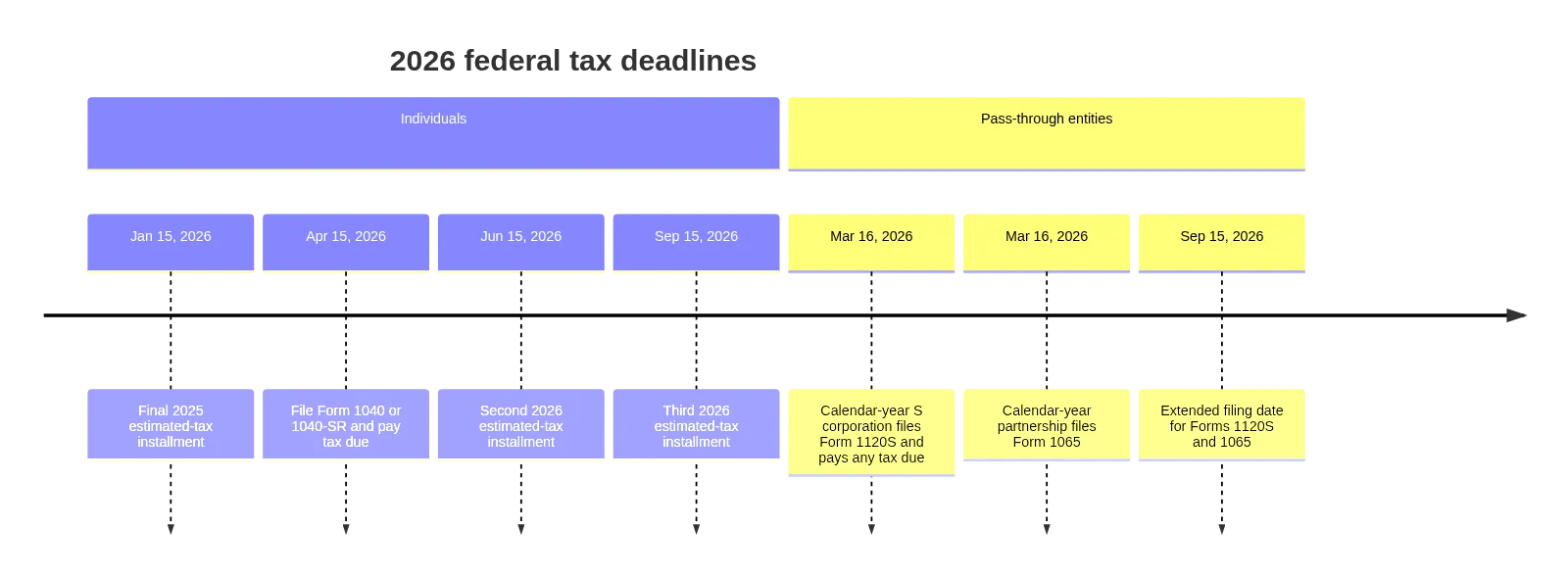
    A 2026 timeline of selected federal tax deadlines for individuals, calendar-year S corporations, and calendar-year partnerships.
    These are the key federal 2026 dates highlighted in the article for individuals and pass-through entities.

    Employer deadlines: separate payroll deposits from quarterly employment-tax returns

    If the business pays employees, keep payroll deposits and employment-tax returns on separate calendar lines. Employers generally report wages, tips, and other compensation using Form 941. Certain small employers may use Form 944 if the IRS approves that filing arrangement.

    Selected 2026 employer dates

    • January 15: For employers on the monthly deposit rule, the IRS lists this as the deposit date for December 2025 payroll taxes.
    • February 10: Forms 940, 941, 943, 944, and/or 945 are due on this date only if all required payments were timely deposited.
    • February 17: For the monthly deposit rule, this is the listed deposit date for January payroll taxes.
    • April 30: Listed Form 941 deadline for the first quarter.
    • July 31: Listed Form 941 deadline for the second quarter.
    • July 31: Deposit FUTA tax owed through June if it exceeds $500.

    The IRS employment-tax calendar also lists quarterly due dates of April 30, July 31, October 31, and January 31 for the prior calendar year’s fourth quarter. Deposit timing can differ from those return dates. For FUTA, timing depends on quarterly liability and prior undeposited amounts; confirm whether the $500 threshold is met.

    Create a payroll record group for each period. Include payroll registers, bank statements, payroll-provider reports, withholding deposit confirmations, and filed-return copies. Mark each item Documented, Needs source, or Open question. Keep contractor payment confirmations in a separate payroll and contractor records folder. Contractor classification is the question of whether a worker should be treated as a contractor or employee; flag that question for a credentialed tax professional rather than deciding it from payment records alone.

    If payroll is new or changing, calendar the applicable deposit schedule only after confirming it. Do not use a quarterly return date as a substitute for a payroll deposit date.

    Texas franchise-tax dates and reporting questions for 2026

    Texas franchise tax is a privilege tax for taxable entities formed or organized in Texas or doing business in Texas. Whether a particular business is a taxable entity, has Texas nexus, or has a specific reporting obligation requires entity-specific confirmation.

    The annual Texas franchise-tax report is due May 15, or the next business day if May 15 falls on a weekend or holiday. For 2026 reports, Texas states that the No Tax Due Report is not available. The stated no-tax-due threshold is $2.65 million in annualized total revenue. An entity at or below that threshold is not required to file a No Tax Due Report, but it generally remains required to file a Public Information Report (PIR) or Ownership Information Report (OIR) unless an exception applies.

    The Texas E-Z Computation option may be available when annualized total revenue is $20 million or less. Eligibility and the remaining reporting requirements should be confirmed before you choose a report.

    A Texas franchise-tax extension is tentatively granted upon a valid, timely online extension payment or request on the Comptroller’s form. The request or payment must be received or postmarked by the original report due date. If an online extension payment is made, the Comptroller says not to also submit paper Form 05-164.

    Use a separate Texas franchise tax branch in your calendar:

    1. Label the item “2026 Texas franchise tax | [entity name] | Comptroller filing records | open for review.”
    2. Attach annualized revenue support, prior-year documents, PIR or OIR information, and any extension confirmation.
    3. Flag a termination, conversion, or merger. Texas requires a final report and payment in the year a Texas entity plans that transaction.
    4. If an out-of-state entity is ending Texas nexus, flag the cessation date. Texas lists a final report and payment due within 60 days after sufficient nexus ends.

    Texas franchise tax is a separate business branch from federal income-tax filing. Calendar both where applicable, but do not assume one filing resolves the other.

    Link each applicable date to a review-ready Tax Planning Packet

    A Tax Planning Packet is an organized set of calendar items, records, assumptions, and questions prepared for discussion with a credentialed tax professional. Its purpose is to make the period, entity, source, and status visible before a deadline or planning meeting.

    Use this four-step workflow.

    1. Create the date record. For each applicable deadline, record the date, action type, entity, responsible person, and status. Use status labels such as Documented, Forecast, Needs source, and Open question.
    2. Attach historical records. Keep bookkeeping records and source documents together by period. Useful examples include bank statements, reconciliations, invoices, receipts, payroll registers, contractor payment confirmations, financing documents, filed returns, and payment confirmations.
    3. Create a separate forecast page. List expected revenue, proposed hiring dates, compensation changes, equipment purchases, financing cash needs, and estimated-payment assumptions. Do not mix these forecasts and assumptions into historical records.
    4. Prepare the review agenda. For every unresolved item, name the follow-up owner and the decision needed. Example: “Q3 2026 | PLLC | proposed equipment financing | Forecast | owner to provide term sheet; ask about timing.”

    A business asset activity file should cover purchases, sales, trade-ins, financing, or disposal of business property. An asset disposition means selling, trading, or otherwise disposing of an asset. Attach the invoice, receipt, financing document, and any sale or trade-in records. Flag the intended transaction date and treatment questions for professional review.

    This structure supports a clearer estimate update. Prior-year records provide a starting point; current-year historical records show what has happened; forecasts show what may happen next. Each category has a different status and should remain separate.

    Open questions to bring to a credentialed tax professional

    Bring a short agenda with your Tax Planning Packet. These questions help connect deadlines to planned business changes:

    • Does the business use a calendar tax year or a fiscal tax year? If it is fiscal-year, which dates change?
    • Which federal returns and estimated-tax dates apply to each entity and owner?
    • Is an individual extension needed, and what payment amount should be reviewed by April 15? If the individual is fiscal-year, confirm use of paper Form 4868.
    • What payroll deposit schedule applies to the business? Are payroll registers and deposit confirmations complete for each period?
    • Are any workers paid as contractors, and is contractor classification a question requiring review?
    • Does planned hiring or a compensation change alter the cash forecast before the next estimate or payroll date?
    • Does business asset activity include a purchase, financing arrangement, sale, trade-in, or other disposition? Which source documents are still needed?
    • Which prior-year documents support the current estimate, and what assumptions changed since that return?
    • Is the entity potentially subject to Texas franchise tax? What PIR or OIR requirement, threshold, exception, or extension step should be confirmed?
    • Is the business terminating, converting, merging, or ending Texas nexus? If so, what final-report timing applies?

    For fiscal-year estimated-tax taxpayers, the IRS says a payment date that falls on a weekend or legal holiday moves to the next business day. Confirm the relevant period and date calculation rather than copying calendar-year dates into a fiscal-year calendar.

    End the meeting agenda with a named owner for every open question. A question without an owner is easy to carry past the next deadline.

    Use the calendar as a cash-planning and review tool

    A useful 2026 tax calendar shows more than dates. It shows the action, entity, cash need, supporting records, current status, and person responsible for follow-up.

    Calendar the applicable filing, payment, estimated-tax, payroll, and Texas franchise-tax actions separately. For each one, attach the related source documents and identify whether the figure is historical, documented, forecast, or unresolved. Keep cash reserved for a payment distinct from work still needed to file a return. If an extension is under consideration, treat the filing timeline and payment timeline as separate review items.

    Before a hiring decision, purchase, financing change, or owner-compensation change, update the forecast page and compare it with current bookkeeping records. Then bring the packet and its open questions to a credentialed tax professional for entity-specific review.

    Frequently asked questions about 2026 tax deadlines

    Does an extension give more time to pay federal income tax?

    No. An individual extension gives more time to file, not more time to pay. If tax is owed, the payment is still due by the original deadline, so keep the payment and filing timelines separate.

    Who usually needs to make estimated tax payments in 2026?

    Estimated tax is used for income not subject to withholding, including self-employment income. If your income, deductions, or credits change during the year, use prior-year records as a starting point and update later estimates for review.

    How should payroll deposit dates be tracked alongside quarterly payroll returns?

    Track them as separate items. Payroll deposits follow the employer’s deposit schedule, while Form 941 and similar returns have their own filing dates. Keep payroll registers, deposit confirmations, and filed returns together by period.

    When might a Texas business need to review franchise tax reporting?

    If the business is formed in Texas or doing business in Texas, franchise tax may be relevant. The annual report is due May 15, and the entity’s reporting, PIR or OIR, and extension steps should be confirmed for the business type.

    What should be included in a Tax Planning Packet before a review meeting?

    Include historical bookkeeping records, source documents, prior-year documents, payroll and contractor records, business asset activity, and a separate page for forecasts and assumptions. Label each item by period, entity, source, and status, and list open questions with a follow-up owner.


  • Breast Augmentation Revision Assurance Program in Beverly Hills: What the Stated Terms Mean

    Breast Augmentation Revision Assurance Program in Beverly Hills: What the Stated Terms Mean

    A limited revision-fee program can support planning without promising a result

    If a revision policy is part of how you are comparing breast augmentation surgeons in Beverly Hills, it is reasonable to ask what it actually covers—and what it does not. A limited program may offer useful reassurance about one narrow part of the financial discussion. It should not replace careful surgical planning or be treated as a promise of a particular appearance.

    Confirm the current written terms directly with the practice before relying on the program.

    Most importantly, a revision-fee program is not an outcome guarantee. Breast augmentation involves decisions about implant characteristics, placement, anatomy, recovery, and realistic expectations. Results vary, and a policy does not mean that a particular size, shape, symmetry, sensation, or recovery experience can be assured.

    It is also different from a manufacturer warranty, which concerns the implant device under its own terms, and from insurance coverage. The FDA notes that insurance may not cover implant removal or replacement, even when complications occur. Breast implants are not lifetime devices, and the FDA advises prospective patients to assume that additional operations may be needed over time. Those broader long-term considerations remain relevant even when a practice offers a short-term revision-fee policy.

    The practical question is not whether a policy makes surgery consequence-free. It is whether the current written terms provide meaningful, limited reassurance for your exact planned primary breast augmentation at the Beverly Hills office. That requires two conversations: one about whether the surgical plan suits you, and another about whether the stated program applies.

    Why breast revision belongs in an informed implant discussion

    A breast revision, also called revision mammaplasty, is surgery that may address unsatisfactory results after a prior breast augmentation or breast lift. Raising the subject before primary surgery is not a prediction that you will need another operation. It is part of understanding that implants require ongoing attention and that future changes, concerns, or complications may lead to another decision.

    Depending on the situation, revision surgery may involve changing implant size or position, treating scar tissue, using internal suturing, performing a breast lift, or selecting a different implant style. These are possible surgical approaches, not a menu of preapproved solutions. The appropriate response to a concern depends on a clinician’s evaluation of the individual situation.

    Revision discussions may arise for aesthetic or clinical reasons. Examples cited in breast revision information include capsular contracture, implant-position changes, rupture or deflation, discomfort, asymmetry, implant visibility or rippling, and an unanticipated breast shape. The FDA lists capsular contracture, reoperation, and implant removal among common local complications or adverse outcomes. Its materials also list risks including rupture or deflation, wrinkling, asymmetry, scarring, pain, and infection.

    That context helps put a 90-day policy in perspective. A stated short-term program does not establish coverage for every future concern, and it does not change the fact that implants are not lifetime devices. Rather than viewing revision as evidence that a primary procedure has necessarily failed, treat it as one of the subjects that belongs in informed planning.

    A productive consultation makes room for both hopes and limits. You can explain the proportions and degree of fullness you prefer, ask what may be realistic for your anatomy, and discuss what outcomes would concern you during recovery. You can also ask how the practice distinguishes normal healing from an issue that merits evaluation. That discussion is educational and individualized; it cannot predict a specific result or determine in advance whether a revision would be appropriate.

    The stated coverage boundary for the Beverly Hills program

    The program has a defined boundary rather than open-ended protection. Read the following as the stated scope to confirm in writing with Golshani Plastic Surgery for your planned procedure:

    • Procedure: The program is stated to be limited to a primary breast augmentation case.
    • Location: The primary procedure is stated to need to be performed at the Beverly Hills office.
    • Timeframe: The summary states a 90-day period beginning on the original surgery date.
    • Number of revisions: It states that there may be one revision under the program.
    • Fee described: The program is stated to waive the standard surgeon’s fee for the revision procedure.

    The phrase “no-cost revision” needs careful reading in context. The supplied summary specifically identifies a waiver of the standard surgeon’s fee. It does not establish that every cost associated with a revision is covered. Nor does it define how dissatisfaction is evaluated, who determines eligibility, whether medical or timing exceptions apply, or whether an in-person assessment is required.

    For that reason, a practical way to use the program in your decision is as a question set, not as an assumption. Ask for the current written terms and have the practice confirm that your procedure is a qualifying primary augmentation at the Beverly Hills office. Ask how the 90 days are calculated and what steps are required if you have a concern during that period.

    This focused approach is especially helpful when you are weighing an individualized treatment plan. Implant planning may consider chest-wall anatomy, existing breast tissue, skin quality and laxity, and aesthetic goals. A policy boundary cannot determine those choices. It may be relevant once a plan is proposed, but it should not drive a decision toward an implant size, shape, or procedure that does not fit your goals and clinical evaluation.

    What the stated terms exclude and do not establish

    Procedures performed at another location or by another surgeon are excluded. If you are considering surgery outside the Beverly Hills office, or you are seeking correction of an operation performed elsewhere, do not assume this stated program applies. Request confirmation of the current written terms directly from the practice.

    There is a second boundary that matters just as much: the supplied information identifies only the standard surgeon’s fee as waived. It does not establish coverage for facility fees, anesthesia, implants or other devices, medications, imaging, laboratory work, travel, postoperative care, or other non-surgeon costs. It also does not establish whether those items would be needed in a particular circumstance.

    That is not a minor administrative detail. A patient deciding whether the program offers relevant reassurance needs to understand the difference between a surgeon-fee waiver and comprehensive financial coverage. The latter should not be inferred from the stated program summary.

    Use this checklist when asking for clarification:

    1. Confirm the exact qualifying procedure. Is my proposed operation classified as a primary breast augmentation under the current policy?
    2. Confirm the site and surgeon. Will the planned surgery be performed at the Beverly Hills office by the surgeon covered by the policy?
    3. Confirm the clock. What is the exact start and end date of the 90-day period for my surgery date?
    4. Confirm the decision process. How are concerns, dissatisfaction, timing, and eligibility assessed under the current written terms?
    5. Request an itemized cost boundary. Which costs, if any, remain the patient’s responsibility if a revision is considered?
    6. Ask about the one-revision limit. How is the stated one-revision limit applied if a patient has more than one concern?

    A clear answer to these questions lets you compare the program accurately with other considerations, including surgical planning, recovery arrangements, implant-specific information, and your tolerance for the possibility of future procedures. If the terms are not clear enough for you to make an informed choice, pause before treating the program as a deciding benefit.

    Use the consultation to confirm both the surgical plan and program fit

    A consultation is not a single yes-or-no conversation about a policy. It is a two-track decision: first, whether the proposed breast augmentation plan fits your body and priorities; second, whether the current written program applies to that exact plan.

    Track one: Is the proposed primary augmentation plan appropriate to discuss further?

    The FDA says a preoperative consultation should cover candidacy, implant choices, placement, and risks and benefits in light of the patient’s circumstances. FDA materials also advise patients to discuss their goals and expectations with their surgeon and to read implant-specific labeling and educational materials before deciding.

    At Dr. Golshani’s practice, the breast augmentation page states that implant planning considers chest-wall anatomy, existing breast tissue, skin quality and laxity, and aesthetic goals. This is why a photo, a cup-size preference, or a friend’s result cannot by itself determine the right plan for another person.

    Bring questions that help you understand the recommendation:

    • What goals can this plan reasonably aim to address, and what should I not expect it to change?
    • How do my chest-wall anatomy, existing breast tissue, skin quality, and goals influence implant type, size, shape, and placement?
    • What are the meaningful tradeoffs among the options being discussed for me?
    • What recovery restrictions, follow-up needs, and uncertainties should I plan around?
    • What risks are most relevant to the procedure under consideration, and what changes should prompt me to contact the practice?
    • Can I review the manufacturer’s patient labeling and ask questions before making a decision?

    For FDA-approved breast implants, FDA materials state that the prospective patient and implanting physician must review and sign the patient decision checklist. Treat that checklist as an opportunity to slow down and ask for plain-language explanations, rather than as paperwork to rush through.

    Breast augmentation alone does not correct significant breast sagging, according to Dr. Golshani’s breast augmentation page. In appropriate cases, a breast lift may be combined with augmentation. This does not mean a combined procedure is right for everyone; it means that the consultation should separate the goal of adding volume from the goal of changing breast position.

    Track two: Does the current program apply to this exact plan?

    After you understand the surgical recommendation, ask the practice to confirm the policy terms for that proposed primary procedure. Keep the questions specific:

    • Is this planned operation eligible under the current Revision Assurance Program?
    • Does the current written policy apply because the procedure will be performed at the Beverly Hills office?
    • What does the practice mean by dissatisfaction or eligibility within the stated 90-day period?
    • Does a concern require a clinical evaluation before any revision decision is made?
    • Does the policy waive only the standard surgeon’s fee, and what costs are not included?
    • Can I receive the current written terms before scheduling surgery?

    Ending each track with a clear boundary protects against confusion. If you do not understand the individualized surgical rationale, ask for clarification before deciding. If the policy’s current applicability or costs are not confirmed in writing, do not treat the stated program as confirmed coverage.

    Move forward with clarity and confirmed terms

    A 90-day revision-fee program may be one consideration when choosing a primary breast augmentation consultation in Beverly Hills. It is not a promise of a specific aesthetic outcome, a substitute for implant-specific informed consent, or a complete answer to future implant-related costs and decisions.

    The stronger basis for moving forward is clarity on both sides of the decision. You should understand why a proposed plan reflects your anatomy and goals, what recovery and risks deserve consideration, and what realistic expectations look like. You should also have the current written program terms, including confirmation that the planned procedure qualifies and a clear explanation of any costs outside the stated surgeon-fee waiver.

    Educational information cannot determine candidacy, predict outcomes, or decide whether a revision would be appropriate for an individual patient. A consultation with Dr. Golshani in Beverly Hills can address your goals, recovery questions, risks, implant planning, and the current applicability of the stated program to your planned procedure.

    Questions to bring to Dr. Golshani about augmentation and the stated program

    What does a breast revision usually address after augmentation?

    It is surgery used to address concerns after a prior breast augmentation or lift. Depending on the situation, it may involve changing implant size or position, treating scar tissue, internal suturing, a breast lift, or a different implant style.

    Does the stated 90-day program cover every revision cost?

    No. The program waives the standard surgeon’s fee. It does not establish coverage for facility, anesthesia, implant or device costs, medications, imaging, travel, or postoperative care.

    Who is the stated program meant to apply to?

    The program is limited to primary breast augmentation cases performed at the Beverly Hills office. It does not apply to procedures done elsewhere or by another surgeon.

    What should I confirm during consultation before relying on the program?

    Ask whether your planned procedure qualifies, how the 90 days are counted, how dissatisfaction or eligibility is assessed, whether any evaluation is required, and which costs are included or excluded in writing.

    Why do implants need long-term follow-up even if a revision policy is offered?

    Breast implants are not lifetime devices, and the FDA advises patients to assume additional surgery may be needed over time.

    Can breast augmentation address sagging as well as fullness?

    If sagging is part of your concern, a breast lift may be discussed with augmentation so volume and position are addressed together when appropriate.

  • A Post-Consultation Audit for Beverly Hills Breast Augmentation Revision Assurance Terms

    A Post-Consultation Audit for Beverly Hills Breast Augmentation Revision Assurance Terms

    Set Up a Dated Policy Audit File

    A revision assurance policy can be one document in a primary breast augmentation decision, but it should not be read in isolation. After consultation, assemble a reconciliation record that compares three separate document sets: the current written policy, the materials describing the planned surgery, and any separate cost information. The goal is not to interpret a program label broadly. It is to identify where the documents agree, where they address different subjects, and where a needed answer is absent.

    The supplied policy statement describes a complimentary 90-day Revision Assurance Program for primary breast augmentation at the Beverly Hills office. It says the program is intended to provide prospective patients additional confidence. That stated purpose does not make the policy a prediction of a surgical result.

    Date each item in your record and retain the version you received. Because the supplied statement is undated, obtain the current written version from the Beverly Hills office before treating it as part of a surgical or financial decision. If an office discussion supplies information that is not in the written policy, record it separately rather than treating it as though it were policy language.

    Audit Entry 1: Record the Express Terms Without Expanding Them

    Start the reconciliation record with a direct transcription of the limited terms stated in the policy material. Do not expand a stated term to resolve a question that the document does not answer.

    Policy field Stated term to record Leave unresolved unless current written material answers it
    Eligible procedure Primary breast augmentation performed at the Beverly Hills office Whether a combined procedure or another procedure classification is included
    Time reference Dissatisfaction within 90 days of the original surgery date What event must occur before the 90-day period ends
    Revision limit One no-cost revision surgery for an eligible patient Any continuing or repeated revision arrangement
    Named fee Waiver of the standard surgeon’s fee for the revision procedure Coverage of every revision-related expense

    The supplied statement describes one revision for a patient dissatisfied with results within 90 days of the original surgery date and separately states that the standard surgeon’s fee for the revision procedure is waived. Preserve those as separate entries. The phrase “no-cost revision” should not be used to fill in the separate question of which revision-related charges, if any, are addressed elsewhere.

    If later written material uses different wording, retain both versions with their dates. Ask the Beverly Hills office which current wording governs instead of combining portions of different documents into a single assumed term.

    Audit Entry 2: Verify Whether the Surgery Identifiers Match

    Next, compare the identifiers in the policy material with the identifiers in the surgical materials. The supplied policy states that it is limited to primary breast augmentation at the Beverly Hills office and excludes procedures performed at another location or by another surgeon.

    Create a side-by-side entry for the procedure description, office, and surgeon named in each document. The purpose is to spot a mismatch, not to infer that similar wording means the same thing. For example, if the policy and surgical materials do not use the same procedure description, retain the difference and ask which current policy terms apply.

    Do not use the supplied statement to transfer the program to another office or to care performed by another surgeon. It also does not explain how later care elsewhere would be handled. If either issue matters to your plans, leave it unresolved until the Beverly Hills office provides the applicable current written terms.

    Audit Entry 3: Separate Policy Language From Treatment Decisions

    A reconciliation record works only when each document stays in its own lane. The policy may address a limited revision opportunity and a named fee term. Surgical materials and consultation discussions address the proposed procedure, goals, anatomy, risks, and likely outcomes. Cost information may address charges separately. A statement in one set of materials should not be copied into another category merely because it affects the same decision.

    Based on the supplied statement, the policy record can contain a narrow note about a stated opportunity for one revision when dissatisfaction occurs within 90 days, together with a waiver of the standard surgeon’s fee for that revision. It does not establish whether revision will be appropriate, available in a particular circumstance, or sufficient to address a concern. The supplied statement does not define dissatisfaction, identify qualifying revisions, or state what review process applies to a revision request.

    A cited article on cosmetic-surgery informed consent notes that completed documentation may not demonstrate patient understanding of treatment risks and benefits. In this setting, the practical response is not to treat a policy document as clinical consent material. Keep unanswered questions about surgical expectations, candidacy, safety, and clinical appropriateness in the surgical-discussion portion of the record, even when the policy is relevant to financial planning.

    Create an Exceptions Log for Missing or Conflicting Terms

    Use this reference when reviewing the current policy. The first column reflects the supplied statement. The second identifies matters that need clarification; an unlisted item should not be treated as either covered or excluded until the office explains the current terms.

    Expressly stated in the supplied policy statement Obtain written clarification before relying on the policy
    It applies to primary breast augmentation at the Beverly Hills office. How primary augmentation is defined and whether any planned combination affects eligibility.
    It describes dissatisfaction within 90 days of the original surgery date. Whether notice, evaluation, scheduling, approval, or completion of a revision must occur within 90 days.
    It describes one no-cost revision surgery. What qualifies as dissatisfaction or a qualifying revision, and whether approval is required.
    It states that the standard surgeon’s fee for the revision procedure is waived. Whether facility, anesthesia, implants, medication, testing, pathology, travel, postoperative care, or other charges are included.
    It is limited to the Beverly Hills office and excludes procedures by another surgeon or at another location. The request process, exclusions, effective date, and amendment terms.

    The fee distinction deserves particular attention. A waiver of the standard surgeon’s fee is not the same as a statement that all costs connected with revision are waived. The supplied statement names the surgeon’s fee; it does not identify facility, anesthesia, implant, medication, testing, pathology, travel, postoperative care, or other potential charges. Do not assume any of those items are included or excluded. Ask for an itemized explanation of the current policy and a separate explanation of any expected costs.

    Timing also requires precision. “Within 90 days of the original surgery date” is the stated timeframe, but the summary does not explain whether the deadline concerns reporting dissatisfaction, being examined, receiving approval, scheduling, or undergoing a revision. Ask the office to identify the operative date for the calculation and every action required before the deadline.

    Likewise, the statement does not explain how a requested preference change, a complication, implant type, combined procedure, or another circumstance might affect eligibility. Those subjects should remain open questions rather than assumptions. Ask which exclusions or conditions apply to your planned procedure.

    Complete the Audit Before You Rely on the Policy

    Build the record after consultation, when you can compare the materials rather than relying on memory of a single discussion. The practice’s breast augmentation page describes consultation as a time to review goals, medical history, anatomy, breast dimensions and shape, and breast laxity. Keep those treatment-planning notes separate from the policy and cost documents.

    The resulting record has a distinct practical purpose: it shows which statements came from which document, whether their dates and identifiers align, and which important questions still need a written answer. It is not a tool for determining candidacy, coverage, or whether a particular concern requires revision.

    Use the following four-part record to set a reliance boundary.

    1. Match the stated procedure. Obtain the current written policy and record its effective date. Then note whether the planned procedure is described as primary breast augmentation at the Beverly Hills office.
    2. Match the named parties. Record the office and surgeon identified in the surgical materials. The supplied statement says the program does not apply to procedures performed at another location or by another surgeon.
    3. Copy only the stated financial term. Write that the standard surgeon’s fee for the revision procedure is waived, then separately list every cost category for which the current written policy gives an answer. Do not convert the stated surgeon-fee waiver into an all-inclusive cost assumption.
    4. Mark the reliance limit. Record the stated reference to dissatisfaction within 90 days of the original surgery date and one no-cost revision. In a separate unresolved-items field, list any missing information about timing mechanics, conditions, exclusions, request steps, or charges beyond the named surgeon’s fee.

    For each entry, note the date, document version, and whether the information appears in the written policy or was provided separately by the office. Keep clinical planning notes apart from this record. The completed sheet does not establish candidacy, coverage, or whether a particular concern requires revision; it shows whether the stated policy is documented enough to be treated as a limited financial-planning input.

    Use the Completed Audit to Set a Reliance Limit

    The four-question test produces a decision boundary, not a prediction about revision. If the planned surgery, Beverly Hills office, and surgeon match the current written terms, you can recognize the supplied statement as a limited policy input: it describes a complimentary 90-day program for primary breast augmentation, one potential revision for dissatisfaction within 90 days of the original surgery date, and a waiver of the standard surgeon’s fee for that revision.

    That limited input should carry no further meaning until the written terms address the open items that matter to you. Before using the policy in a financial decision, identify whether the current version explains timing mechanics, the process for raising a concern, conditions or exclusions, and charges beyond the named surgeon-fee waiver. If it does not, treat the policy as incomplete for that purpose rather than filling the gaps with assumptions.

    Keep the final record in three parts: the policy language, the surgical discussion, and any separate cost information. This does not establish candidacy, coverage, or whether a particular concern requires revision. It helps you decide whether the available written information supports only a limited planning note or whether further confirmation from the Beverly Hills office is necessary before proceeding.


    Frequently Asked Questions About the Policy Audit

    Why compare the policy with my surgical and cost discussions?

    The policy statement addresses limited policy terms, while the surgical discussion addresses your planned procedure and expectations. Keeping those records separate helps prevent a policy term from being treated as a promise about results or as an answer to an unlisted cost question.

    What details should match the policy before I rely on it?

    Compare the planned procedure, Beverly Hills office, and surgeon with the current written policy. The supplied statement is limited to primary breast augmentation at the Beverly Hills office and does not apply to procedures at another location or by another surgeon.

    Does the stated surgeon-fee waiver settle every revision-related charge?

    No. The supplied statement identifies a waiver of the standard surgeon’s fee for the revision procedure. It does not identify other possible charges, so request a written explanation of how the current policy addresses them.

    What should I do if the written policy does not answer an important question?

    Keep the issue marked as unresolved and ask the Beverly Hills office for the current written terms or a direct clarification. Do not assume an unlisted item is covered, excluded, or applicable to your planned procedure.

    Can this comparison tell me whether I qualify for a revision?

    No. It is a record-comparison tool, not an eligibility decision or medical assessment. Ask the Beverly Hills office to apply the current written policy to your planned procedure and to address any revision concern.


  • Breast Augmentation Decision Guide: Goals, Trade-Offs, and Revision Questions

    Breast Augmentation Decision Guide: Goals, Trade-Offs, and Revision Questions

    Decide What You Want Breast Augmentation to Address

    It can use breast implants or fat transfer to increase breast size. People may consider it to restore volume after weight reduction or pregnancy, create a rounder shape, or address natural differences in breast size. The first decision is therefore not simply which implant to choose. It is whether the change you want is primarily about volume, shape, asymmetry, or a combination of concerns.

    A useful consultation begins with a short written description of your goal. For example: “I want more upper-breast fullness,” “I want to restore volume after pregnancy,” or “I want to address asymmetry.” Avoid treating a desired cup size as the entire plan; your surgeon will need to relate your goal to your anatomy, available tissue, and the procedure options that may be appropriate for you.

    This guide is for preparing questions, not determining candidacy or selecting treatment. Bring your goals, concerns, and willingness to accept long-term responsibilities to a qualified plastic surgeon. The discussion should cover both the appearance you hope to change and the trade-offs involved in achieving it.

    Test Your Goal Against the Procedure’s Limits

    Augmentation is not a universal solution for every breast-shape concern. Breast augmentation does not correct severely drooping breasts. When sagging is a significant part of the concern, a surgeon may discuss whether a breast lift should be performed alongside augmentation.

    This distinction matters because adding volume and lifting the breast address different aspects of appearance. If your main concern is loss of fullness, augmentation may be the central topic. If your concern is that the breast sits lower, the nipple position has changed, or the skin envelope feels substantially stretched, ask directly whether augmentation alone addresses that concern. Do not assume that a larger implant will substitute for a lift.

    Use these questions to define the boundary of your goal:

    • Is my primary concern volume, shape, asymmetry, sagging, or several of these?
    • Would augmentation alone address the concern I am describing?
    • Should a breast lift be discussed, and if so, how would that change the procedure and its trade-offs?
    • Would fat transfer be relevant to my stated goal, or is an implant discussion more appropriate?

    The practical next step is to ask the surgeon to separate what augmentation may address from what it cannot address by itself. That keeps the consultation focused on your actual concern rather than on a presumed procedure.

    Build Your Goals, Trade-Offs, and Long-Term Responsibilities Worksheet

    Bring a two-part worksheet to the consultation. The first part connects your desired change to surgical planning. The second addresses the responsibilities that continue after surgery.

    Part one: goals and planning

    Write down the change you want, how subtle or noticeable you want it to be, and any concerns about symmetry, shape, scars, or future activity. Then ask:

    • What options could address my goal: implants, fat transfer, augmentation with a lift, or another approach?
    • How do my anatomy and body type affect the available options?
    • What implant characteristics, if any, should we compare, and what are their relevant benefits and risks?
    • Where would an incision be considered, and how does incision planning relate to implant type, desired enlargement, anatomy, and surgeon preference?
    • How would implant insertion and positioning be planned for my body type and desired enlargement?
    • What recovery restrictions and follow-up visits should I plan for, and which aspects of recovery are individualized?

    Incision planning varies with the implant type, the enlargement sought, anatomy, and patient-surgeon preference. Implant placement planning likewise depends on the implant, desired enlargement, body type, and the surgeon’s recommendations. These are consultation decisions, not choices that can be made responsibly from a general guide.

    Part two: long-term responsibilities

    Add questions about device-specific labeling, monitoring, breast-cancer screening, possible reoperation, and financial responsibility. Ask the surgeon to identify which recommendations apply to the implant option under discussion and what costs may arise over time.

    Before deciding, review the manufacturer’s patient labeling and educational materials, and discuss questions with the surgeon. In the United States, the FDA requires a device-specific Patient Decision Checklist describing known or reported risks. Ask to review the checklist for the specific device being considered, rather than relying on general descriptions of implants.

    The worksheet is complete when you can explain your goal, the planning variables that may affect the procedure, the risks you have discussed, the follow-up you may need, and the questions you still want answered. It is a preparation tool, not a prediction of your result or recovery.

    Weigh Risks, Financial Responsibilities, and Possible Future Surgery

    The central long-term trade-off is that breast implants are not lifetime devices. FDA says that the longer implants are in place, the more likely removal or replacement becomes, and advises prospective patients to assume that additional operations may be needed over time. That possibility should be part of the decision before an initial procedure, not considered only if a problem develops.

    FDA identifies capsular contracture, reoperation, and implant removal among the most common local complications and adverse outcomes. Other listed local complications include rupture or deflation, wrinkling, asymmetry, scarring, pain, and infection at the incision site. The list describes possible complications, not a prediction that any particular patient will experience them.

    Financial planning also belongs in the risk discussion. FDA notes that insurance may not cover implant removal or replacement, including when complications occur. Ask for a clear explanation of anticipated surgical, facility, anesthesia, device, imaging, medication, and follow-up costs. Ask separately what happens financially if an implant must be removed, replaced, or revised.

    A responsible decision does not require certainty that every future event can be predicted. It does require accepting that implants may involve future monitoring, complications, additional operations, and expenses.

    Plan for Monitoring, Screening, and Changes That Need Evaluation

    Implants need monitoring for as long as they remain in place. If silicone gel-filled implants are being considered, confirm with your health care provider whether regular ultrasound or MRI monitoring is recommended and whether that monitoring is covered by insurance. The appropriate schedule and imaging decisions should come from your health care provider.

    Breast implants also affect how you communicate about breast-cancer screening. Follow your provider’s instructions for screening and tell the mammography facility that you have implants when making an appointment. Clarify with the facility what to expect for mammography with implants.

    Make a plan for contacting a surgeon or other health care provider if you notice abnormal changes in your breasts or implants.
    These points are not an emergency diagnosis or a substitute for medical evaluation. They are questions to place in your long-term-responsibility section:

    • What monitoring do you recommend for the specific implant being discussed?
    • How should I coordinate implant monitoring with breast-cancer screening?
    • What changes should prompt a call, and whom should I contact?
    • What imaging, evaluation, or follow-up costs should I anticipate?

    Leave the consultation with a written follow-up plan and a clear route for raising concerns.

    Review Device-Specific Information Before You Decide

    Implant decisions should be based on the labeling and risk information for the specific device under consideration. Review the manufacturer’s patient labeling and educational materials, then discuss questions with the surgeon before deciding. The Patient Decision Checklist is intended to support that discussion by presenting known or reported risks for the device.

    One risk that should be addressed directly is BIA-ALCL. FDA describes it as a cancer of the immune system that can occur in the breast or scar tissue surrounding an implant; it is not breast cancer. ASPS notes that BIA-ALCL occurs most frequently in patients with textured-surface implants. Ask which implant surfaces and characteristics are being considered, why, and what information applies to each option.

    Useful questions include:

    • Can I review the manufacturer’s current patient labeling for this device?
    • Can we go through the device-specific Patient Decision Checklist together?
    • What is known about the device’s surface, rupture or deflation concerns, monitoring, and possible reoperation?
    • What symptoms or changes should lead me to contact the practice?
    • Which risks are specific to this device, and which are general surgical risks?

    The goal is not to memorize every complication. It is to understand the device-specific information well enough to make a deliberate decision and to know what follow-up responsibilities may continue after surgery.

    Confirm the Stated Revision Assurance Terms in Writing

    Golshani Plastic Surgery states that a 90-day Revision Assurance Program is available for breast augmentation at its Beverly Hills location. The stated terms limit it to primary procedures performed at that office, not procedures performed elsewhere or by another surgeon. The practice also states that patients dissatisfied within 90 days of the original surgery date may be eligible for one revision and that the standard surgeon’s fee is waived.

    Treat these as practice-stated terms that require current written confirmation. The supplied policy information does not establish that every revision-related expense is covered. In particular, do not assume that facility, anesthesia, implant, medication, pathology, imaging, or other costs are included in the surgeon-fee waiver.

    Ask these questions before relying on the program in your decision:

    • Is the program currently effective, and can I receive the complete written policy?
    • Does it apply to my planned primary procedure at the Beverly Hills office?
    • How is the 90-day period calculated, and what notice or evaluation process is required?
    • What does “one revision” mean, and who determines whether a revision is indicated or eligible?
    • Does the waiver cover only the standard surgeon’s fee?
    • Which facility, anesthesia, implant, medication, pathology, imaging, or other costs remain my responsibility?
    • What exclusions, circumstances, timing requirements, or documentation rules apply?
    • What happens if I receive care at another location or from another surgeon?

    The program should be one item in a broader decision, not a substitute for risk counseling or a guarantee of a particular aesthetic result, satisfaction, candidacy, or coverage. Obtain the current terms and exclusions in writing during consultation.

    Make a More Informed Consultation Decision

    This procedure may align with your goals if you can clearly describe the change you want and are prepared to discuss its limits, planning variables, risks, monitoring, possible future operations, and financial responsibilities. A consultation is a reasonable next step when you want individualized answers—but it should leave you with informed questions, not pressure to decide immediately.

    Bring the completed worksheet, manufacturer information, and the written questions about the stated Revision Assurance Program. Use the consultation to determine whether the proposed approach addresses your concern, what trade-offs it involves, and which terms and follow-up responsibilities apply to you. A consultation can support individualized discussion, but it does not guarantee candidacy, outcomes, safety, satisfaction, or eligibility for revision coverage.


    Frequently Asked Questions About Preparing for Breast Augmentation

    What does breast augmentation involve?

    It is a procedure that uses breast implants or fat transfer to increase breast size.

    How do surgeons decide between implants, fat transfer, or a lift?

    That depends on the change you want, your anatomy, and the concern being addressed. If sagging is a major issue, a surgeon may discuss whether a breast lift should be part of the plan rather than augmentation alone.

    Are breast implants considered permanent?

    No. FDA states that breast implants are not lifetime devices, so additional surgery may be needed over time. The possibility of removal or replacement should be part of the decision from the start.

    What follow-up is usually discussed after breast augmentation?

    Follow-up usually includes ongoing monitoring while implants are in place, plus guidance on screening and what changes should prompt a call. If silicone gel-filled implants are being considered, ask whether ultrasound or MRI monitoring is recommended and how it is handled.

    What should I clarify about the Beverly Hills revision program?

    Ask for the current written terms and confirm whether the program applies to a primary procedure at that office. Also clarify the 90-day window, the one-revision limit, whether only the surgeon’s fee is waived, and which other costs would still be your responsibility.


  • C Corp vs. S Corp: A Review-Packet Comparison for Your Accountant Meeting

    C Corp vs. S Corp: A Review-Packet Comparison for Your Accountant Meeting

    Start by separating entity form from federal tax treatment

    The useful first question is not “Which label is better?” It is “What is this business legally organized as, and what federal tax treatment is currently in place?” Those are related facts, but they are not interchangeable.

    An LLC is an entity created under state law. For federal income-tax purposes, its treatment can depend on member count and elections. A domestic LLC with two or more members generally defaults to partnership treatment unless it elects corporate treatment on Form 8832. A single-member LLC generally defaults to disregarded-entity treatment unless it makes that election. An eligible LLC that timely elects S corporation treatment on Form 2553 is generally deemed to have elected corporate classification, subject to applicable requirements.

    That means an LLC should not be assumed to be automatically a C corporation or an S corporation. Its federal income-tax classification also does not, by itself, settle employment-tax and certain excise-tax treatment.

    Start the review packet with confirmed facts, not conclusions. Record the entity form reported by the owner, the source for that information, the federal return filed for the prior year, and any available election records. If those facts conflict or are incomplete, document the uncertainty and send it to a credentialed professional. Do not ask a record organizer to determine entity status.

    Put these items at the front of the packet:

    • Entity form reported by the owner, such as corporation or LLC.
    • Source for that statement, such as formation records, prior-year return, or owner-provided records.
    • Federal return filed for the most recent year, if available.
    • Any available Form 8832 or Form 2553 records.
    • Ownership list and changes during the period.
    • A short note identifying what is confirmed, missing, or unclear.

    A useful index entry might read: “Entity form reported: LLC. Source: owner statement and prior-year return. Federal treatment shown on return: needs credentialed-professional confirmation.” That preserves the fact without asserting a filing result.

    Compare federal tax reporting and shareholder tax items

    The central federal difference is how the business and its shareholders report income-tax items. It is not, by itself, a recommendation for either treatment.

    Shared criterion C corporation treatment S corporation treatment What to bring for review
    Federal taxpayer A C corporation is a separate taxpayer for federal income-tax purposes. An S corporation elects federal pass-through treatment for income, losses, deductions, and credits. Prior-year federal return and current entity records.
    Federal return A C corporation’s federal income-tax return is Form 1120. Complete prior-year return, extensions, and available workpapers.
    Shareholder reporting The corporation reports its own taxable income. Shareholders report allocated flow-through income and losses on personal returns, subject to individual tax rates. Shareholder list and each available Schedule K-1.
    Distributions The IRS describes corporate profit as taxed to the corporation when earned and again to shareholders when distributed as dividends. The corporation does not deduct dividends it distributes. A Schedule K-1 reports each shareholder’s share of specified corporate tax items. A distribution amount may require separate basis review. Distribution records, board or owner records, and bank support.
    Corporate losses The IRS states that shareholders cannot deduct a C corporation’s loss. Loss and deduction items can be limited by shareholder stock and debt basis. Prior-year basis records, loans, and loss carryforward information.

    This comparison explains why a simple comparison of business income is not enough. The accountant will need to see who owns the business, what was filed before, whether income was retained or distributed, and what shareholder-level records exist.

    For a small-business owner, the practical task is to separate business-level records from shareholder-level records. Place the Form 1120 or Form 1120-S in the prior-year section. Keep Schedule K-1 materials with the shareholder section. Then label each document with its tax year, entity, owner where relevant, and source location.

    Do not treat a tax forecast as a confirmed historical record. A forecast can show expected income, planned distributions, anticipated expenses, or cash needs. It should be clearly labeled with the period, assumptions, preparer, and date created. A credentialed professional can then compare the forecast with completed bookkeeping records and prior-year filings.

    S corporation eligibility limits to verify

    S corporation treatment comes with federal eligibility requirements that should be verified before anyone reaches a conclusion. The IRS lists domestic-corporation status, allowable shareholders, a maximum of 100 shareholders, and one class of stock among the requirements. Allowable shareholders include individuals and certain trusts and estates; partnerships, corporations, and nonresident aliens are excluded. The IRS also identifies certain financial institutions, insurance companies, and domestic international sales corporations as ineligible.

    These limits make ownership facts a central part of the comparison. If the business has changing ownership, entity investors, prospective investors, trusts, different economic rights, or uncertainty about stock terms, put those facts in the open-question list. Do not resolve eligibility from a spreadsheet or an informal owner conversation.

    Prepare these ownership facts for the accountant meeting:

    • Names of current and former owners during the review period.
    • Ownership percentages and effective dates, if available.
    • Whether any owner is an individual, trust, estate, partnership, corporation, or another type of entity.
    • Available stock, membership, or ownership agreements.
    • Any planned ownership transfer, new investor, redemption, or change in economic rights.
    • Any question about whether the business has more than one class of stock.

    The IRS states that Form 2553, signed by all shareholders, is required to make an S corporation election. Applicability and timing should be verified by a credentialed professional. The right packet action is to include available election documents and identify missing signatures, dates, or ownership facts for review.

    Flag basis, distributions, and loss limits for professional review

    Pass-through treatment does not settle every shareholder tax question. The IRS identifies certain built-in gains and passive income taxes that can apply at the S corporation level. At the shareholder level, basis can matter when distributions, losses, deductions, or shareholder loans are involved.

    An S corporation Schedule K-1 can show a non-dividend distribution amount without determining its taxable amount. The IRS states that the taxable amount of a distribution depends on the shareholder’s stock basis. It also states that stock basis changes each year and must be computed annually. Loss and deduction items are limited by shareholder stock and debt basis; items disallowed because of those limitations are carried forward.

    These are reasons to preserve the records, not reasons to make a self-directed tax conclusion. A distribution is not fully explained by its bank transfer alone, and a K-1 is not a substitute for the supporting basis history.

    Flag these items for credentialed-professional review:

    • Prior-year Schedule K-1 forms and shareholder tax records.
    • Any available stock-basis or debt-basis schedules.
    • Shareholder loans, repayments, and supporting agreements.
    • Distributions by date, amount, recipient, and bank-record location.
    • Prior-year losses, deductions, or carryforward information.
    • Questions about whether a distribution, loss, or deduction has a particular tax result.

    Use factual wording in the question list. For example: “Distribution of $[amount] to [owner] on [date]; bank record in folder [location]; please review shareholder basis implications.” Do not label it taxable or nontaxable in the packet.

    Assemble a review packet that supports the comparison

    A review packet is a meeting tool. It organizes evidence and questions so a credentialed professional can focus on the decisions that require judgment. The IRS identifies good recordkeeping as a factor that can make tax filing easier.

    Build one index, but separate its contents into five statuses: confirmed historical records, supporting source documents, tax forecasts, missing items, and open questions. A payment is confirmed only when supporting evidence is available. When records are incomplete, retain what you have and mark the gap rather than filling it with an assumption.

    Use these index columns for each item: section, entity, period, account or owner, amount where relevant, source document, document location, status, missing-document owner, and credentialed-professional question.

    1. Entity and ownership

    Include entity records, ownership information, prior election documents if available, and a list of changes. Mark conflicting information as an open question.

    2. Prior-year materials

    Include the prior-year return, available schedules, Schedule K-1 forms where applicable, extensions, notices, and prior basis schedules. Keep the original source document with the index entry.

    3. Income and expenses

    Include reconciled bookkeeping records, bank and payment-platform summaries, and source documents supporting material entries. Separate completed records from current-year forecasts.

    4. Payroll and contractors

    Keep employee wage and payroll records separate from contractor payment records. This packet workflow uses separate record groups so classification questions remain visible for review. Include available payroll reports, contractor invoices, payment support, and any unresolved classification questions.

    5. Estimated payments

    For each estimated-payment record, list the date, amount, source-identified period, payment system or payee, and location of the confirmation or bank record. If confirmation is missing, preserve the available record and label the item for follow-up.

    6. Asset activity

    For each asset, identify available purchase support, recorded cost, placed-in-service date if available, and applicable period. Asset records can be organized in the packet, but asset tax treatment should be reviewed by a credentialed professional.

    7. Tax forecast and cash needs

    Provide a dated forecast separately from historical bookkeeping records. Identify assumptions, planned purchases, expected income changes, expected owner cash needs, and the person who prepared the estimate.

    8. Open questions

    Place unresolved entity, ownership, payroll, distribution, estimated-payment, asset, Texas, and multistate issues in one list. Each question should point to its supporting documents.

    Example of a complete item: “Asset purchase; entity: [name]; period: [year]; recorded cost: $[amount]; invoice and payment record stored in Assets/Equipment; placed-in-service date: [date if available].”

    Example of a missing item: “Estimated payment shown in bookkeeping; amount: $[amount]; period: unclear; bank confirmation not located; owner assigned to retrieve support; credentialed-professional question: confirm treatment after records are located.”

    The difference is not whether every document is present today. It is whether the packet accurately distinguishes evidence from uncertainty.

    Document Texas and multistate activity without assuming a tax outcome

    For an Austin business, Texas franchise tax belongs on the question list when entity treatment is under discussion. Do not assume that a federal classification, an LLC label, or a prior filing pattern determines the current Texas outcome. Document the facts and ask a credentialed tax professional to review current Texas rules.

    For activity outside Texas, include where work was performed, where customers were located, where workers were located, and the applicable period. Add available contracts, invoices, payroll records, registration records, and correspondence that identify the location or dates. Those facts help the reviewer determine whether current multistate rules require further analysis.

    A concise entry can read: “Customer activity outside Texas: [state], [period], invoices in folder [location], customer location supported by available records; please review whether further multistate analysis is needed.” This is a request for review, not a statement of obligation.

    Questions to place in the packet:

    • Does the current Texas franchise-tax treatment require review for this entity and period?
    • Did the business have work, customers, workers, or other activity outside Texas during the period?
    • What records support each location and date range?
    • Did ownership, entity status, payroll, or filing history change during the period?
    • Are there any current-rule questions that need Texas or multistate analysis?

    A credentialed tax professional should evaluate these questions under current rules.

    Arrive ready for a focused professional conversation

    Begin a C corporation versus S corporation comparison with the entity record, prior federal return, ownership facts, shareholder materials, bookkeeping records, payroll and contractor records, asset activity, forecasts, and location facts. The packet helps separate record retrieval from tax determinations.

    Use the meeting to review documented ownership changes, planned investor or economic-rights changes, prior return history, distributions, shareholder loans, payroll records, expected owner cash needs, filing periods, Texas franchise tax, and multistate activity. These records help a credentialed professional identify which treatment questions warrant further analysis. For each unresolved issue, state the fact, identify its source, and name the requested reviewer rather than asserting a filing conclusion. Convert gaps and uncertainty into open questions.

    Preparation does not replace tax, legal, filing, or professional review. It gives the reviewer a clearer starting point and gives you a more focused conversation.


    Frequently asked questions before comparing C corp and S corp treatment

    How should I record whether my business is a C corporation or S corporation in the review packet?

    Record the entity form the owner reports, the source for that fact, and the most recent federal return or election record. If the information conflicts or is incomplete, mark it as an open question for credentialed-professional review.

    What is the main tax reporting difference between C corporation and S corporation treatment?

    A C corporation is taxed as a separate federal taxpayer and uses Form 1120. An S corporation generally passes income, losses, deductions, and credits through to shareholders, who report their share on personal returns through Schedule K-1 and related records.

    What ownership facts should I gather before asking about S corporation eligibility?

    Include current and former owners, ownership percentages, owner type, any available stock or ownership agreements, and any planned transfers or changes. Also flag anything that could affect the one-class-of-stock rule or the shareholder limit.

    How should I handle Texas franchise tax or activity outside Texas in the packet?

    Document the facts and leave the conclusion open. Note the entity, the period, where work or customers were located, and any supporting records, then ask a credentialed tax professional to review current Texas and multistate rules.

    Can I treat an LLC as a C corporation or S corporation without checking more facts?

    No. An LLC’s federal tax treatment depends on its elections and other facts, so it should not be assumed to fit either category automatically. Put the LLC records, elections, and any uncertainty in the packet for review.


  • Small Business Tax Deductions Checklist for a Status-Labeled Tax-Planning Packet

    Small Business Tax Deductions Checklist for a Status-Labeled Tax-Planning Packet

    Prepare a review packet before discussing potential deductions

    Use this small business tax deductions checklist to organize records and questions for a potential deduction review before meeting with a credentialed professional.

    For an Austin healthcare business, organize five folders: Bookkeeping, Payments, Payroll/Contractors, Assets, and Forecasts. Add a short change log and a review agenda. This approach gives your bookkeeper, CPA, EA, attorney, or other credentialed professional a clear starting point without treating a working note as proof or a possible expense as a deduction.

    The IRS says you may use a recordkeeping system suited to your business when it clearly shows income and expenses. The business you operate affects the records needed for federal tax purposes. Electronic records must meet the same basic recordkeeping principles as paper records.

    Use one label on every item in your packet:

    • Confirmed information: A dated source record supports the fact.
    • Assumption: A planning note or expectation that has not been supported by records.
    • Missing record: You know an item occurred, but the source document is not in the packet.
    • Needs verification: A record exists, but the applicable tax-year rule, timing, classification, or treatment needs current review.
    • Unresolved question: A fact-specific issue for credentialed professional review.

    This packet is preparation, not a tax result. Current federal and Texas rules, filing periods, business activity, entity facts, and record support still matter.

    Pair every checklist item with a dated source record

    Use a simple rule throughout the packet: a working note identifies an issue; a dated source record supports review. Purchases, sales, payroll, and other business transactions generate supporting documents. Examples include sales slips, paid bills, invoices, receipts, deposit slips, and canceled checks.

    For each potential expense-related item, create one line in your checklist with:

    1. The item or service.
    2. The affected period.
    3. The payee.
    4. The amount.
    5. Payment evidence.
    6. The date incurred.
    7. A short business-purpose description.
    8. The folder and file name for the source record.
    9. A status label.
    10. A question for review, if needed.

    For example, a note reading “new treatment-room equipment” is not enough by itself. Pair it with the invoice, payment record, acquisition date, and any available use or disposal information. Mark treatment as Needs verification rather than assigning a deduction category yourself.

    One document may not establish every relevant element. A receipt may show an amount, while a bank or card record shows payment; an invoice may provide the service description. Keep related documents together. Organize supporting documents by year and by income or expense type because they support entries in your books and tax return.

    For travel, gifts, or transportation being considered for deduction, create an Unresolved question for your tax professional about the substantiation that applies to your tax year and facts. Do not rely on a general expense list to settle those requirements.

    Gather current bookkeeping records and payment evidence

    Start with records that show how money moved through the business. Keep a transaction summary in business books, such as accounting journals and ledgers. IRS guidance states that business books must show gross income, deductions, and credits.

    Bookkeeping folder

    Gather current bookkeeping records for the review period:

    • General ledger or transaction-detail reports.
    • Profit-and-loss statement and balance sheet, if maintained.
    • Business bank-account activity and reconciliations.
    • Credit-card account activity used for business transactions.
    • Revenue summaries by service line, payer, or location when your records use those categories.
    • Notes identifying unusual, corrected, duplicated, or unreconciled entries.

    Label a report Confirmed information only when it is dated, identifies its period, and can be traced to underlying records. Mark an unreconciled balance, an uncategorized transaction, or a report prepared from incomplete data as Needs verification.

    Payments folder

    For gross receipts, keep records showing the amount and source. Depending on your practice, this may include invoices, deposit information, receipt records, payment-platform reports, cash-receipt summaries, or payer remittance records.

    For outgoing payments, gather invoices, paid bills, receipts, account statements, card statements, canceled checks, and electronic-payment confirmations. Keep each record with its period and transaction reference where possible.

    Use a short exception list rather than silently filling gaps. For example:

    Status Item Source record needed Review question
    Missing record Vendor payment in bookkeeping Invoice or receipt What service or item was received?
    Needs verification Payment split between personal and business activity Dated allocation support What facts should be reviewed?
    Assumption Planned recurring subscription Contract or invoice when available Did the service begin in this period?

    The goal is traceability. Do not convert an unclear payment into a claimed business expense merely because it appears in a business account.

    Separate payroll and contractor records from worker classification questions

    Keep payroll records and contractor payment records in the same folder only if they remain clearly separated. The packet can show what happened; it should not decide worker classification, compensation treatment, payment-reporting obligations, or filing consequences.

    Payroll records

    Gather payroll registers, payroll-provider reports, wage summaries, tax-payment confirmations, benefit records, and records of owner compensation where applicable. Note the covered pay periods and the source system. IRS guidance states that employment tax records must be retained at least four years after the tax is due or paid, whichever is later.

    Contractor records

    Gather contracts, invoices, payment confirmations, vendor details, and any payment summaries maintained by the business. Keep contractor records distinct from employee payroll records. If the same person’s role, pay arrangement, duties, or work location changed, place that change in the change log.

    Use these escalation prompts:

    • Worker classification: “What current facts and records should be reviewed before determining worker status?”
    • Payment reporting: “Which payments and payees require current review for reporting purposes?”
    • Owner compensation: “What changed in amount, timing, or method of payment?”
    • Missing support: “Which payroll or contractor records must be obtained before review?”

    Send the supporting facts and the question for credentialed professional review.

    Document asset activity from purchase through disposition

    Create an Assets folder for equipment, furniture, technology, and other business property. Asset records may be needed to compute depreciation and gain or loss on disposition. That does not mean a purchase has a particular tax treatment; treatment and timing need current review.

    For each asset, assemble the following as applicable:

    • Acquisition date and method.
    • Purchase invoice and purchase price.
    • Payment evidence.
    • Improvement records.
    • Description of business use.
    • Prior depreciation, Section 179, casualty-loss, or other deduction records, if any exist.
    • Sale, trade-in, retirement, or other disposition date.
    • Sale price and selling-expense records.

    A practical asset line might read: “Ultrasound unit; acquired March 2026; invoice and payment confirmation attached; placed-in-service date needs verification; no disposition.” This keeps confirmed facts separate from tax conclusions.

    Also flag planned purchases. A signed quote, budget, or vendor proposal can be useful planning context, but label it Assumption or Needs verification unless it documents a completed transaction. Ask your credentialed professional which current-year facts, dates, and records are needed to discuss treatment.

    Generally keep property records through the limitations period for the year of disposition. Retention can depend on the event and the return involved, so keep the asset file intact and obtain current advice before destroying records.

    Add prior-year returns and a dated cash-flow forecast

    Add copies of filed prior-year tax returns to the packet. The IRS advises keeping filed returns because they can help prepare future returns and make amended-return computations. Treat them as reference records, not as a template that automatically fits this year.

    Then prepare a dated cash-flow forecast. Keep it simple and identify the date prepared, period covered, preparer, source assumptions, and version. Include expected receipts, major operating costs, payroll changes, contractor payments, planned purchases, financing activity, and known changes in owner compensation where relevant.

    A prior-year federal return can be a starting record for an estimated-tax discussion. Current-year income and facts still require review. Do not calculate an estimated-tax amount in this checklist or assume that last year’s pattern continues.

    Use a forecast status block:

    • Confirmed information: Actual current-year results supported by current bookkeeping records.
    • Assumption: Expected collections, planned hiring, expected purchases, or projected expenses.
    • Missing record: A prior-year return, current financial report, or source document not yet obtained.
    • Needs verification: A forecast item that may affect estimated tax, entity-level reporting, or tax treatment.
    • Unresolved question: “What information is needed to discuss estimated tax for the remaining period?”

    Bring both the prior-year return and the dated forecast to review. The useful action is to document what changed, not to turn the forecast into a payment instruction.

    Log business changes that may affect the review

    Your folders show individual records. The change log shows what is different from the prior period and where review may be needed. It is especially useful when several people maintain records or when the business changed during the year.

    Use one row for each material change:

    Change area What changed Affected period Source record Status Question for review
    Income New payer, service, or collection pattern Month or quarter Dated revenue report Confirmed information Does this change require any current review?
    Expenses New recurring cost or unusual payment Month or quarter Invoice and payment evidence Needs verification What records establish the business purpose?
    Payroll Hiring, pay, benefit, or owner-compensation change Pay period Payroll register Confirmed information What facts require review?
    Contractors New vendor or changed arrangement Period Contract and payments Unresolved question Are classification or reporting issues present?
    Assets Purchase, improvement, sale, or trade-in Date Invoice, payment, sale record Needs verification What treatment and timing should be reviewed?
    Entity facts Ownership, legal structure, or operating change Effective date Governing or business record Unresolved question What federal or Texas consequences require review?
    Multistate activity New location, remote work, or out-of-state activity Start date Lease, payroll, contract, or sales record Needs verification Which jurisdictions should be reviewed?

    Do not use the log to resolve the issue. Its job is to connect a change to evidence, a period, a status, and a specific professional question.

    List Texas franchise tax and multistate questions separately

    Keep Texas franchise tax and multistate activity on a separate escalation page. These questions can depend on entity status, where the entity is formed or organized, business activity, revenue, locations, and current report-year rules.

    For 2024 report years and later, verify the current threshold and whether the entity must file a Texas information report even when no No Tax Due Report is required. The Texas Comptroller provides current report-year forms and instructions.

    Place these records on the escalation page:

    • Legal entity name and entity type.
    • Texas formation or registration details, if applicable.
    • Current and prior operating locations.
    • Locations of employees, contractors, and owners performing work.
    • Revenue and activity by state, if maintained.
    • Leases, contracts, registrations, or correspondence relevant to a new location or jurisdiction.
    • Prior Texas franchise-tax filings and current notices, if any.
    • The current report-year forms or instructions being reviewed.

    For multistate activity, write the facts first and the conclusion last. Example: “Therapist performed services from another state beginning in May; agreement and payment records attached; Texas and other-state implications need review.” The Texas Comptroller provides a Nexus Questionnaire for specified non-Texas entities, but whether it applies to your facts is an unresolved question for credentialed professional review.

    Do not infer nexus, taxable-entity status, report type, or filing obligation from a single record. Bring the entity facts and operating facts to review.

    Bring a clear agenda to credentialed professional review

    Before the meeting, place a one-page agenda at the front of the packet. Group it under four headings:

    1. Confirmed information: Records attached and periods covered.
    2. Assumptions to test: Forecast items, planned purchases, or expected changes.
    3. Missing records to obtain: The specific invoice, statement, return, payroll report, or asset document still needed.
    4. Unresolved questions: Worker classification, estimated tax, asset treatment, Texas franchise tax, multistate activity, payment reporting, and any entity-specific issue.

    For each question, state the affected period and point to the folder or change-log row. This lets the review focus on facts that matter rather than reconstructing the business from memory.

    Keep the packet after review as part of your records. Generally retain records supporting return items until the applicable period of limitations expires. Retention details can vary by event and return, so preserve the source records and confirm the appropriate retention approach for your circumstances.

    A well-labeled tax-planning packet does not determine whether an item is deductible or what you owe. It gives Austin Small Business Tax Advisors and your credentialed professional review team a clearer record trail: what is confirmed, what is assumed, what is missing, and what requires current judgment.

    Tax-planning packet FAQ

    What should be in a tax-planning packet for a small business review?

    Include current bookkeeping records, payment records, payroll records, asset activity, prior-year returns, and a dated cash-flow forecast. Label each item as confirmed information, assumption, missing record, needs verification, or unresolved question.

    How should I document expenses so they can be reviewed properly?

    Pair each expense with the payee, amount, proof of payment, date incurred, and a description of the business purpose. One document may not show every detail, so keep invoices, receipts, statements, and confirmations together.

    What records help with payroll and contractor questions?

    Keep payroll registers, wage summaries, tax payment confirmations, and related benefit records separate from contractor invoices, contracts, and payment records. If a role or arrangement changed, note the change and flag it for review.

    What should I collect for asset purchases or sales?

    Gather acquisition date, purchase price, payment evidence, improvement records, business-use details, and any sale or disposition information. Those records may be needed to review depreciation or gain or loss later.

    Can I rely on last year's return when planning this year's taxes?

    Use it as a reference, not as a final answer. A prior-year return can help frame an estimated-tax discussion, but current-year income, expenses, and other facts still need review.

    When should Texas franchise tax or multistate activity be flagged for review?

    Those facts can affect filing questions, so keep them separate as unresolved questions for credentialed professional review.

  • Depreciation for Austin Healthcare Business Owners: Build an Asset Register for Tax Review

    Depreciation for Austin Healthcare Business Owners: Build an Asset Register for Tax Review

    Understand depreciation as an asset-cost allocation

    Depreciation is a way of allocating an asset’s cost across the time it is expected to be productively used in operations. In bookkeeping, it is not a prediction of what the asset will sell for later or how its fair market value may change.

    For an Austin healthcare business owner, the practical task is not to decide a tax result from a purchase list. It is to identify possible business assets and assemble records that let a credentialed professional review the facts. Equipment, furniture, technology, vehicles, property-related items, and mixed-use purchases can raise different questions.

    Confirmed information is supported by records you can identify and date. Assumptions are working notes that still need support. Missing records are documents or details you do not yet have. Unresolved questions are matters for credentialed professional review under current federal and Texas guidance.

    Useful life, in the bookkeeping sense, means the length of time an asset is expected to be productively used in operations. That concept helps explain why an asset’s recorded cost may be allocated over time. It does not establish the useful life, tax method, recovery period, basis, or tax treatment for any asset in your practice.

    Start with one simple boundary: a tax-planning packet organizes facts for review. It does not determine tax liability, establish a deduction, or replace professional judgment. Keep current bookkeeping records, payment records, payroll records, asset activity, and a dated cash-flow forecast available alongside the asset information.

    See a clearly labeled bookkeeping allocation example

    A hypothetical bookkeeping example can make the allocation idea easier to see.

    Illustrative input Example amount What it shows
    Asset cost $50,000 The starting historical cost in this example
    Anticipated salvage value $10,000 A hypothetical amount expected at the end of use
    Depreciable base $40,000 The difference to allocate over the use period

    In this illustration, a $50,000 asset with an anticipated $10,000 salvage value has a $40,000 depreciable base. That $40,000 may be allocated over the asset’s period of use in the bookkeeping example.

    The table is educational only. It does not say that your purchase has a salvage value, qualifies for depreciation, uses a particular allocation method, or receives a particular tax treatment. Do not enter an assumed value or period into your records merely to complete the table.

    Instead, use the example to separate two tasks. First, preserve what you can verify: the item, cost, invoice, payment, dates, and use information. Second, flag the accounting and tax decisions that need review. If a prior fixed-asset schedule already contains a cost, date, method, or accumulated depreciation amount, attach that schedule and label it Confirmed information only after matching it to the underlying records.

    Find depreciation in current bookkeeping records

    Book depreciation is the amount recorded in financial statements for a business fixed asset and allocated over its useful life. It is a non-cash business expense under applicable accounting principles and standards. Depreciation expense commonly appears on an income statement.

    A balance sheet may show the asset at historical cost and show accumulated depreciation as an offset to that cost. The resulting book value is the portion of historical cost not yet allocated to depreciation expense. These labels are bookkeeping terms; they are useful clues for your packet, not proof of tax reporting treatment.

    Gather existing records before trying to recreate a schedule from memory:

    • Current and prior-year income statements that show depreciation expense, if available.
    • Current and prior-year balance sheets that show fixed assets and accumulated depreciation, if available.
    • Fixed-asset schedules, depreciation reports, general-ledger detail, and accountant-prepared workpapers you already possess.
    • Prior-year tax returns and supporting schedules when available, kept separate from financial-statement reports.
    • Vendor invoices, receipts, paid bills, credit-card statements, bank records, and other payment records tied to each listed item.

    Use an asset register entry to connect the bookkeeping label to its source. For example, note the exact report name, reporting period, account name, and the location of the supporting invoice. If you see a balance in a fixed-asset account but cannot identify the related item, call that Missing record rather than assigning a description from memory.

    A current bookkeeping record can show what has been recorded. It may not establish ownership, business use, the actual date an item was placed in service, or whether book and tax treatment match. Preserve the report, note the gap, and bring it forward for credentialed professional review.

    Keep bookkeeping entries separate from tax treatment

    Book depreciation and tax depreciation can be calculated differently. Tax depreciation is reported on a tax return for a tax period and relates to tangible assets used in income-generating activities. A cited accounting source describes straight-line depreciation as common for book depreciation and MACRS as an accelerated tax-depreciation approach. Current, fact-specific review is required before applying any tax approach.

    The difference matters because a financial-statement entry is not a direction to use the same amount or timing on a tax return. Keep book records and tax records in the same packet, but label them by source and period. A credentialed professional can assess the applicable current rules and the facts for the entity and filing period.

    Several decision points should stay open until reviewed:

    • Purchase versus repair or maintenance: Federal tax law distinguishes certain currently deductible business costs from costs of acquiring, producing, or improving tangible property that must be capitalized. Whether a cost is a repair, maintenance expense, or capitalized improvement requires a facts-and-circumstances review. Document the work performed, invoices, and any description of what changed.
    • Owned versus leased property: Under cited IRS guidance, property leased from another party generally is not depreciated by the lessee because the lessee lacks the incidents of ownership. Capital improvements made to leased property may be depreciable. Record the lease, the owner named on the invoice, and a clear question for review; do not infer treatment from where the item sits.
    • Timing and use: A purchase date and payment date may be documented, while placed-in-service information or business-use details remain unclear. Keep each date in its own field and mark uncertainty.
    • Prior treatment: A prior return or depreciation schedule may show an amount without explaining every underlying fact. Attach it, identify the period, and ask whether it should be carried forward or reviewed.

    These are not reasons to discard a record. They are reasons to preserve the record with a precise label. Also bring forward questions about current federal rules, Texas franchise tax context, estimated tax, worker classification, multistate activity, entity facts, and filing periods where they affect the broader review. The asset register should document the question, not answer it without support.

    Build one status-labeled entry for each possible asset

    Build one entry for each possible asset or property-related item. The goal is traceability: someone reviewing the packet should be able to see what the item is, which period it belongs to, what documents support it, and what still needs confirmation.

    For federal tax purposes, a recordkeeping system should be suited to the business, clearly show income and expenses, and include a summary of business transactions. Electronic accounting records follow the same basic recordkeeping principles as hard-copy records. Choose a format your practice can maintain: a spreadsheet, accounting-system export, or organized register with document links.

    Use these fields for every entry:

    Register field What to enter or attach Status to apply
    Item description Plain-language item name, vendor description, and internal identifier if used Confirmed information when matched to a source document
    Source and date Invoice or receipt location, purchase date, and date shown on each record Confirmed information or Missing record
    Cost and payment Amount, payee, proof of payment, and payment-record location Confirmed information when documents support it
    Invoice or receipt File name, paper location, vendor invoice, receipt, or paid bill Confirmed information or Missing record
    Placed-in-service information Known date and source, or a note that the date is not documented Confirmed information, Assumption, or Missing record
    Ownership or lease details Purchaser, titled owner if relevant, lease reference, and improvement details Confirmed information or Unresolved question
    Business-use information Operational use described in plain language and any mixed-use note Confirmed information, Assumption, or Unresolved question
    Prior treatment Prior fixed-asset schedule, book records, prior return support, or “not located” Confirmed information or Missing record
    Review question A concise question tied to the specific item and period Unresolved question

    Supporting documents from purchases, sales, payroll, and other transactions support entries in business books and on a tax return. Keep documents orderly and safe. Organizing by year and income or expense type is one IRS example.

    For purchase and expense records, gather documents that show the payee, amount paid, proof of payment, date incurred, and a description of the item or service. One document may not establish every detail. An invoice may identify the item and payee, while a bank or card record shows payment. Keep both with the entry when they support different facts.

    The IRS describes business assets as property a business owns and uses, such as machinery and furniture, and notes that records are needed to compute annual depreciation and gain or loss when assets are sold. Your register should therefore preserve the record trail even when you cannot yet determine the treatment.

    Do not combine a laptop, equipment bundle, furniture purchase, software-related charge, vehicle-related item, or leasehold work into a single vague line merely because the payment cleared together. Create separate entries when the documents identify separate items. If the documents do not permit a clear separation, retain the bundle record and document the limitation for review.

    Label gaps and document questions for professional review

    The status labels make the register usable in a review meeting. They prevent an unsupported detail from being mistaken for a verified fact.

    Confirmed information

    Use this label for a fact supported by a record you can identify. Example: “Invoice dated [date] identifies [item]; payment record dated [date] shows [amount].” Attach or locate the documents.

    Assumption

    Use this label for a working statement that seems plausible but lacks complete support. Example: “Assumption: item began operational use during [month]; source has not been located.” Do not convert an assumption into a placed-in-service date, ownership conclusion, or business-use percentage.

    Missing record

    Use this label when the needed document or data point is unavailable. Example: “Missing record: vendor invoice for general-ledger entry dated [date].” State what is missing and where you looked, if useful. The direct action is to request or locate the record before review when possible.

    Unresolved question

    Use this label for a fact pattern or rule application that requires professional judgment. Keep the question specific enough to answer from the packet.

    Document questions such as:

    1. Who owns this item, and is there a lease or financing arrangement that changes the ownership analysis?
    2. What record supports the purchase date, payment date, and placed-in-service information for this item?
    3. Is the stated business use supported, or is the item used partly outside the business?
    4. Does a prior fixed-asset schedule or prior-year return show prior treatment that needs to be reconciled?
    5. Does the work described in the invoice appear to involve a repair or maintenance expense, an improvement, or another treatment requiring facts-and-circumstances review?
    6. Is the item connected to a filing period, entity fact, Texas franchise tax context, estimated tax issue, worker classification question, or multistate activity that needs current review?

    Where leased property is involved, attach the lease and identify any capital-improvement records separately. Where a repair or improvement is unclear, attach the vendor scope, invoices, photos or project records already maintained, and payment evidence. End each entry with a direct boundary: “Await credentialed professional review before determining treatment.”

    Turn asset records into a review-ready packet

    A review-ready packet does not need to resolve every depreciation issue in advance. It needs to make the record trail and uncertainty easy to see.

    Before the meeting, assemble these materials by period:

    • The completed asset register, with one status-labeled entry for each possible asset.
    • Current bookkeeping records, including available income statements, balance sheets, fixed-asset schedules, and general-ledger detail.
    • Payment records, invoices, receipts, paid bills, bank or card records, and other documents supporting each entry.
    • Prior-year returns and prior depreciation records when available, clearly identified by source and year.
    • Payroll records and other transaction records that may provide context for business activity.
    • A dated cash-flow forecast, separated from confirmed historical records.
    • A short list of unresolved questions about ownership, leasing, use, timing, prior treatment, repairs versus improvements, filing periods, Texas franchise tax context, estimated tax, worker classification, and multistate activity.

    Keep the packet factual. Mark unknowns instead of filling them with estimates. A credentialed professional can then review the current federal and Texas rules alongside the entity facts, business activity, and supporting documents.

    Bring the asset register and its documented questions to Austin Small Business Tax Advisors or another credentialed professional for review.

    Frequently asked questions about asset records and depreciation review

    What records should I gather for a depreciable asset review?

    Gather the item description, invoice or receipt, payment record, purchase date, placed-in-service information, business-use notes, and any prior depreciation schedule. Keep each item tied to its source so the reviewer can separate confirmed information from assumptions and missing records.

    How does depreciation usually appear in bookkeeping?

    In bookkeeping, depreciation is commonly recorded as an expense on the income statement, while accumulated depreciation offsets the asset’s historical cost on the balance sheet. That shows what portion of cost has been allocated so far, but it does not settle the tax treatment.

    How should I handle an asset that is used partly for business and partly for personal use?

    Treat mixed use as an unresolved question unless the records clearly support the business portion. Note the use pattern, keep the supporting documents, and ask a credentialed professional how the facts affect the record and any tax reporting.

    Can I depreciate property that I lease from someone else?

    Generally, the lessee does not depreciate leased property because ownership is not retained. If you made capital improvements to leased property, keep those records separate and flag the ownership issue for review.

    What is the difference between a repair and an improvement in the packet?

    A repair or maintenance cost may be currently deductible, while an improvement may need different treatment. The label depends on the facts and circumstances, so document the work performed, the invoice detail, and any project records rather than deciding from the payment alone.

    What should I include if my prior return or fixed-asset schedule shows depreciation already?

    Include the prior schedule or return, identify the year and source, and attach the supporting asset records if you have them. If the earlier treatment cannot be matched to the underlying facts, mark it as a question for your tax professional.

  • Turn Tax-Planning Exceptions Into Review Briefs for Austin Businesses

    Turn Tax-Planning Exceptions Into Review Briefs for Austin Businesses

    Start with what needs explanation

    A tax-planning packet can begin with the records that need explanation rather than with a complete inventory of files. An exception may be an unexplained bookkeeping balance, a source record that does not match a summary, a missing document, a planning assumption, or a business fact that requires professional judgment.

    Turn each material exception into a short review brief. The brief identifies the period and entity, preserves the available records, states the break in the evidence trail, and asks one focused question. This approach keeps current bookkeeping, payment activity, payroll information, asset events, forecasts, and Texas or federal concerns attached to the business item that prompted review.

    The IRS says a business may use a recordkeeping system suited to the business if it clearly shows income and expenses, and the records needed for federal tax purposes can vary with the business. A review-brief format uses that flexibility to make the meeting agenda visible without assuming that every business needs the same file set.

    The briefs organize facts and unresolved matters for review. They do not determine deductions, filing obligations, taxability, worker status, or deadlines.

    Sort exceptions before assembling the packet

    Sort the work by the kind of exception before collecting supporting files. This creates a meeting agenda from the business items that need attention instead of a general document-gathering exercise.

    1. Name the exception. Identify whether the issue is an unexplained total, incomplete support, a mismatch between records, a future scenario, or a rule-dependent question.

    2. Set the factual boundary. Record the entity, period, business activity, and bookkeeping reference. Keep known facts separate from information supplied by recollection or projection.

    3. Attach the available trail. Link the item to statements, invoices, receipts, payment confirmations, reports, agreements, or other records already available.

    4. Describe the break. State exactly what is missing, inconsistent, estimated, or still unknown. Do not supply a tax answer to make the brief appear complete.

    5. Assign the next factual step. Identify who can locate a record, explain an entry, confirm an event, or provide further details.

    6. Frame one review question. Ask what must be verified, evaluated, or discussed by the credentialed professional.

    Prioritize briefs where missing evidence, a material discrepancy, a planned transaction, or a time-sensitive dependency could affect the discussion. The result is a set of discrete review paths, each moving from a business item to its evidence and then to its unresolved question.

    Use one brief for one unresolved business item

    Use an exception-brief register as the meeting cover sheet. Each row should represent one unresolved business item, not one folder or every document in the packet. A short register lets the reviewer see why a record matters before opening it.

    Give each brief these fields:

    • Exception type: unexplained amount, missing support, record mismatch, planning scenario, or judgment question.
    • Business item: the balance, transaction group, activity, or forecast that triggered the brief.
    • Period and entity: the relevant dates and entity, business line, or operating unit.
    • Bookkeeping context: the account, report, transaction detail, or other summary where the item appears.
    • Available source trail: attached or missing statements, invoices, receipts, payment detail, reports, or other support.
    • Evidence position: confirmed by source document, estimate or assumption, needs documentation, or open question for credentialed professional review.
    • Factual owner and next step: the person who can supply a record or clarify the underlying event.
    • Review question: the single matter requiring discussion.

    Organize supporting documents in an orderly fashion, such as by year and type of income or expense. The register is not a substitute for those records; it is a map of the exceptions they need to address.

    Separate evidence gaps from judgment questions

    Use two distinct labels in every brief: an evidence position and an exception type. The evidence position tells the reviewer what support exists. The exception type tells the reviewer why the item needs attention. Neither label makes a tax conclusion.

    Evidence positions

    • Confirmed by source document: Available records connect the item to the relevant transaction, period, and entity.
    • Estimate or assumption: The amount or fact comes from a projection, allocation, recollection, or preliminary calculation. State its basis.
    • Needs documentation: The activity is known, but supporting material needed to explain it is unavailable.
    • Open question for credentialed professional review: The facts available do not resolve a classification, filing, treatment, or other judgment-dependent issue.

    An item can have more than one issue without changing its evidence position. For example, a documented planned purchase can remain an estimate or assumption because the event has not occurred; a known payment can need documentation because its invoice is absent.

    Do not use an estimate to fill a missing record or combine either with a documented amount. Some circumstances may also be subject to specific documentation rules.

    For any brief that is not confirmed, identify the available support, missing fact, factual owner, and the question that remains.

    Brief unexplained income and expense differences

    Create financial exception briefs only for totals or transaction groups that need an explanation. Rather than repeating the full profit-and-loss statement in the packet, use it to identify material changes, unsupported balances, unusual activity, or differences between bookkeeping and available records.

    IRS guidance says business books must show gross income, deductions, and credits, and that supporting documents from purchases, sales, payroll, and other transactions support entries in books and on tax returns.

    For an income or expense brief, attach the relevant:

    • General-ledger detail and the current-year summary where the item appears.
    • Bank, credit-card, payment-platform, or merchant-processor activity tied to the item.
    • Sales reports, invoices, receipt books, deposit information, or other records showing gross-receipt amounts and sources.
    • Vendor bills, purchase invoices, receipts, account statements, and proof-of-payment records.
    • A short note identifying the unexplained difference, unavailable support, or factual question.

    For gross receipts, IRS guidance calls for supporting documents showing amounts and sources. For purchases and expenses, it identifies payee, amount, proof of payment, date, and a business-purpose description as key details. More than one supporting document may be needed to substantiate all elements of a purchase or expense.

    If the available trail does not explain the item, leave the brief open and state what evidence or factual clarification is needed.

    Brief payment, payroll, and contractor exceptions

    Use separate exception categories for payments, payroll, and contractor activity because each category creates different factual questions. Do not create a category merely because records exist; create a brief when the item needs explanation, support, or professional review.

    Payment exception brief: Identify the unexplained payment, duplicate-looking transaction, amount difference, or absent support. Attach account activity, an invoice, paid bill, check image, electronic-payment confirmation, card statement, payee, and business-purpose detail where available. Mark missing source material as needs documentation.

    Payroll or compensation exception brief: Identify the compensation change, payroll-to-bookkeeping difference, benefit or reimbursement item, or other issue. Attach payroll summaries, provider reports, payment confirmations, and the relevant bookkeeping detail. Preserve the period and entity. IRS guidance states that employment records must be kept for at least four years; confirm current retention requirements for the circumstances with a credentialed professional.

    Contractor exception brief: Attach invoices, agreements or scopes of work if relevant, payment detail, and information already maintained for reporting purposes. The IRS states that worker classification as an employee or independent contractor depends on the facts in each case. Record the available facts, the missing facts, and the question for review rather than assigning a status to the worker.

    Rank these briefs by the importance of the record break or the judgment required, not by the number of documents attached.

    Brief completed asset events and future changes separately

    Use different brief types for an event that has occurred and a change that is only being considered. This prevents historical source records from being confused with planning assumptions.

    A completed asset-event brief can address an acquisition, sale, retirement, trade, damage, or other change. Record the entity, event date, known business use, bookkeeping reference, purchase documents, invoices, payment support, sale records, and any facts still unavailable. The IRS says asset records are needed to calculate annual depreciation and gain or loss upon sale. If a fact is absent, identify the gap rather than assigning treatment.

    A planning-change brief can address expected revenue, anticipated expenses, planned hiring or compensation changes, contemplated purchases or disposals, financing changes, expansion, multistate activity, or another expected transaction. Record the expected period, entity, basis, owner, and the review question.

    The distinction is practical: a completed event asks whether the existing records explain what happened; a planning change asks whether the forecast assumptions and business facts are sufficiently clear for discussion. Keep a planning item labeled estimate or assumption until its factual basis changes, and leave its tax effect open for credentialed professional review.

    Create an agenda for federal and Texas dependencies

    Use the final register as a dependency agenda: questions that cannot be resolved by locating another business record. For each one, identify the entity, period, source records, evidence position, and exact fact requiring verification. This keeps general tax background from becoming an answer for a specific business.

    Federal dependency prompts

    • Which worker-status or payment facts remain unclear after reviewing payroll and contractor records?
    • Which material transactions still lack complete payment, invoice, or business-purpose support?
    • Which ownership, entity, financing, asset, location, or planned-transaction facts require professional evaluation?
    • Which estimates, allocations, reimbursements, or personal-business mixes need a stated basis or more documentation?

    Texas dependency prompts

    • Does the entity’s formation, organization, or business activity require a franchise-tax status review? The Texas Comptroller describes franchise tax as a privilege tax imposed on taxable entities formed or organized in Texas or doing business in Texas.
    • Does the applicable report year raise a franchise-tax or no-tax-due question? For reports originally due on or after January 1, 2024, the Comptroller says an entity at or below the no-tax-due threshold is no longer required to file a No Tax Due Report. This does not determine the entity’s status or whether another report is required.
    • Does business activity require a sales-and-use-tax applicability review? The Comptroller states a 6.25% state rate, with local taxes of up to 2% and a maximum combined rate of 8.25%, for covered transactions; that does not establish whether a particular transaction is taxable.
    • What filing frequency has been assigned, and are current reporting dates verified? Comptroller guidance lists different due dates for quarterly, monthly, and yearly filers.

    The Comptroller states that annual franchise-tax reports are due May 15, moving to the next business day when May 15 is a weekend or holiday. Verify the applicable report year, entity status, filing frequency, taxability, and current deadlines before relying on any date or requirement.

    Hand off a prioritized set of review briefs

    Before the meeting, inspect the reconciliation ledger from priority items to lower-priority items. Each row should show the period, entity, bookkeeping reference, source trail, evidence position, unresolved point, review question, and owner. Confirmed rows provide context; estimates state their basis; missing records identify the gap; and judgment-dependent matters remain open.

    Electronic and paper records can both support this process. The same basic recordkeeping requirements apply to electronic and hard-copy business records, and the IRS says an electronic system must provide a complete, accurate record accessible to the IRS. Keep records as long as needed to prove income or deductions on a tax return, and verify current retention requirements where they apply.

    The completed ledger does not decide tax treatment, filing obligations, deadlines, or legal conclusions. It gives the reviewer a direct route from each selected business item to the evidence and facts that still need discussion.


    Tax packet preparation FAQ

    What should be in a review-ready tax packet for a small business?

    Include the bookkeeping summary, the source records behind key totals, payment records, payroll and contractor information, asset activity, forecasts, and a short list of federal or Texas questions that still need review.

    How should I separate confirmed records from estimates and missing documentation?

    Use clear labels. Mark items as confirmed by source document, estimate or assumption, needs documentation, or open question so the reviewer can see what is solid and what still needs support.

    How should payroll and contractor records be organized?

    Keep payroll reports, payment confirmations, compensation changes, and any related employment records in one module, and keep contractor invoices, agreements, and payment detail in a separate one. If worker status is unclear, flag it as a question rather than deciding it in the packet.

    What belongs in the asset and forecast sections?

    Put historical asset purchases, sales, retirements, and related support in the asset section. Put planned purchases, expected revenue, hiring changes, and other future assumptions in the forecast section, and label those items as estimates.

    What Texas issues should be flagged for professional review?

    Flag franchise-tax status, sales-and-use-tax applicability, filing frequency, and any entity or location changes that may affect Texas treatment. Those questions should stay open until current rules are verified for the business and period.


  • Tax Packet Preparation: A Checklist for Your Austin Tax-Planning Meeting

    Tax Packet Preparation: A Checklist for Your Austin Tax-Planning Meeting

    Build a review packet, not a document pile

    A tax-planning meeting is more useful when the information arrives as a review packet rather than a folder of unconnected files. The goal is not to decide tax treatment yourself or to assemble a return. It is to give a credentialed professional a clear view of the business period, the records behind the numbers, the estimates being used for planning, and the questions that still need an answer.

    Start with one packet for the meeting period and one simple rule: every item should be easy to find, easy to classify, and honest about its level of support. Good records are needed to prepare a return and support reported income, expenses, and credits. That is why an organized packet matters even at the planning stage: it keeps documented information distinct from forecasts, incomplete records, and rule-dependent decisions.

    Your packet should answer six practical questions for each item:

    • What period does this cover?
    • Which business entity does it belong to?
    • What is the document or input?
    • Where is the underlying source located?
    • What is its current status?
    • Who owns the next question or follow-up?

    This approach prevents a common meeting problem: a number appears in a report, but nobody can tell whether it came from a reconciled transaction, an unverified spreadsheet entry, a forecast, or a missing document. A packet does not make an uncertain item certain. It makes the uncertainty visible and ready for review.

    Use the checklist below to gather records across bookkeeping, payments, payroll, assets, forecasts, prior-year materials, Texas matters, and open questions. Keep it focused on preparation. Questions about current filing requirements, deadlines, entity treatment, deductions, or tax liability belong with a credentialed tax professional.

    Use this checklist to gather each packet module

    Create a top-level folder or binder for the meeting, then add the modules below. A digital packet, a paper packet, or a combination can work; the important point is that the contents are organized and indexed.

    1. Current bookkeeping and source records

    Include the current-period profit and loss report, balance sheet, cash-flow information if available, general ledger or transaction summary, and bank and credit-card activity used to prepare the books. Add the underlying records needed to explain material entries: invoices, receipts, sales reports, deposit information, paid bills, and payment confirmations. Purchases, sales, payroll, and other transactions can all generate supporting documents.

    2. Income and payment evidence

    Gather customer invoices, sales summaries, deposit records, merchant-processor reports, payment-platform reports, and other records that explain business receipts. Add a list or export of payments made during the period, including any payments you believe may relate to estimated taxes. Do not label a payment as satisfying a particular obligation unless that treatment has been confirmed.

    3. Payroll and contractor materials

    Include payroll registers, payroll provider reports, wage and withholding summaries, employer payment confirmations, and any available contractor payment records. If an item is not available, list it as missing rather than trying to fill the gap from memory. Keep contractor questions separate from employee payroll questions when you can, and bring any classification or reporting uncertainty to the meeting.

    4. Asset activity

    List equipment, furniture, technology, vehicles, or other business property acquired, improved, sold, traded, or removed from service during the period. Attach available invoices, financing documents, sale records, and descriptions of business use. The point is to identify activity for review, not to decide how it should be treated.

    5. Forecasts and planning inputs

    Add your current revenue outlook, anticipated major expenses, hiring plans, owner-compensation expectations, expected purchases, and cash needs. Put these in a clearly separate forecast section. A projection can be useful for planning, but it is not source evidence.

    6. Prior-year materials

    Include the prior-year return if available, prior-year financial statements, and any prior-year issue list or correspondence you want the professional to understand. A copy of the prior-year return can help an accountant become familiar with the business’s financial health. Prior-year documentation can also help a tax professional understand financial history and spot recurring tax-related issues.

    7. Texas matters and business changes

    Create a short section for entity changes, ownership changes, new locations, out-of-state activity, mergers, conversions, planned termination, or changes in where the business operates. Include formation or transaction documents that relate to those events. These records create a focused basis for questions about Texas applicability and reporting.

    8. Open questions

    Reserve a final page for questions that cannot be answered from the records. Write the question, identify the affected period and entity, name the related documents, and state who can provide more information. This is the part of the packet that turns uncertainty into an efficient meeting agenda.

    Pair bookkeeping summaries with receipts and transaction support

    A summary report is the map; supporting records are the trail behind it. Bring both. The IRS says a business may use a recordkeeping system suited to its needs if it clearly shows income and expenses, and that the system should include a summary of business transactions in books such as accounting journals and ledgers. For many small businesses, the business checking account is a major source for book entries, but a bank feed alone may not explain the business purpose of a transaction.

    For each bookkeeping report, identify the period, entity, report date, and whether the books have been reconciled or are still in progress. Then organize support by year and by income or expense type. The IRS advises keeping supporting documents orderly and safe because they support book entries and tax-return items. Electronic records follow the same basic recordkeeping principles and requirements as hard-copy records.

    Use this pairing method:

    Bookkeeping area Bring the summary Pair it with source support Review boundary
    Revenue and receipts Income statement, sales summary, or revenue detail Invoices, deposit information, merchant reports, receipt books, or sales records For gross receipts, retain records showing both amount and source. Ask about unexplained deposits.
    Purchases Expense detail or vendor report Invoices, payment proof, receipts, and descriptions Records should identify payee, amount, proof of payment, date, and item description; more than one document may be needed.
    Operating expenses Expense detail by category Paid bills, account statements, credit-card records, invoices, and receipts Record the payee, amount, payment proof, date, and business purpose of the item or service.
    Cash and cards Reconciliations and account activity Bank statements, credit-card statements, deposit detail, and payment confirmations Flag unreconciled, personal, duplicate, or unexplained entries for discussion.

    Do not try to make every small transaction a meeting topic. Instead, flag items that are material to your planning, unusual for the business, missing support, or difficult to classify. Keep personal activity out of the business-record section and place any mixed or unclear transactions on the open-question list. For Schedule C preparation, the IRS says business records should not include personal expenses; confirm current applicability and treatment with a professional.

    For travel, gifts, and transportation, do not assume an ordinary receipt resolves the issue. Those deductions have specific substantiation requirements. Keep the available records together, describe the business context in your index, and ask a credentialed professional to verify the current rules that apply.

    Create one index that maps every packet item

    A single document index is the control sheet for the entire packet. It can be a spreadsheet, a table in a shared workspace, or a cover page for a paper binder. Its job is not to replace your accounting system. Its job is to show the reviewer what exists, where it lives, and what still needs attention.

    Use one row per document, report, estimate, or question. Add these fields:

    • Period: month, quarter, year, or transaction date range.
    • Entity: the legal business or owner-related context the item concerns.
    • Document type: for example, profit and loss report, payroll register, equipment invoice, payment confirmation, forecast, or prior-year return.
    • Source location: folder path, file name, binder tab, system name, or person holding the record.
    • Status: Confirmed, Assumption, Needs Documentation, or Open Question.
    • Question or owner: the exact question, or the person responsible for obtaining support.

    A useful row might read: “Current year / ABC Business / equipment invoice / Assets folder, vendor PDF / Needs Documentation / locate payment confirmation—owner: operations manager.” This tells the reviewer more than a bare note saying “new equipment.”

    Keep source locations practical. If a report came from accounting software, record the report name and export date. If a receipt is in email, identify the sender and date or save a PDF copy. If a paper document is in a binder, use a tab name and page reference. Electronic records can be used, but they should be organized with the same discipline as paper records.

    Before the meeting, sort the index by status. Review the unresolved and missing items first. That short list becomes your preparation plan; the confirmed rows become the evidence trail.

    Label each item as confirmed, estimated, missing, or unresolved

    A four-status method keeps planning useful without overstating what the records prove. Apply one primary label to every index row. If an item changes, update the label rather than leaving an old assumption embedded in a report.

    Confirmed

    Use Confirmed when the item is supported by an identifiable record and can be traced to its source. Examples include a reconciled bank statement, a dated invoice with payment evidence, a payroll report, or a prior-year return copy. “Confirmed” describes documentation status, not a conclusion about tax treatment.

    Reader action: Link the supporting file or binder location in the index and note the period and entity.

    Assumption

    Use Assumption for a planning input that is not yet a completed transaction or established record. Examples include a revenue forecast, an expected equipment purchase, a proposed hiring date, or an owner’s estimate of future cash needs. State the basis for the estimate, such as a signed proposal, current pipeline, management forecast, or preliminary budget.

    Reader action: Keep assumptions in the forecast module, not inside historical bookkeeping. Mark the source and the person who can revise the estimate.

    Needs Documentation

    Use Needs Documentation when you know an event or transaction occurred but cannot yet locate adequate support. For example, you may know an asset was purchased but not have the invoice or proof of payment, or know payroll was processed but lack the relevant report.

    Reader action: Assign an owner and a retrieval task. If the record cannot be found before the meeting, bring the indexed gap rather than silently treating the item as complete.

    Open Question

    Use Open Question when the facts are incomplete, the record is ambiguous, or the answer depends on current tax rules or professional judgment. Examples include whether a payment relates to a particular obligation, how a business change affects reporting, or whether a transaction needs additional substantiation.

    Reader action: Write the question in plain language, attach the available facts, and route it to credentialed professional review.

    If records are incomplete, partial documentation may provide a basis for reconstructing a sound and reasonable estimate of business income and expenses. That does not make reconstruction a do-it-yourself tax conclusion. Any reconstruction intended for tax reporting should be reviewed professionally. In the packet, preserve the distinction: source records belong in the evidence section; reconstructed figures and forecasts belong in clearly labeled planning or question sections.

    Flag payroll, assets, payments, and business changes for review

    Some packet modules deserve a separate review page because the underlying facts often span several systems or create questions that cannot be resolved from bookkeeping alone.

    Payroll and contractor records

    Bring payroll reports, wage and withholding information, payroll tax payment confirmations, contractor payment detail, and any relevant correspondence or provider exports. The IRS says to keep employment records for at least four years; verify the current retention requirement for the business’s circumstances. If records are held by a payroll provider, note the provider and report location in the index instead of assuming the professional can access them.

    Add questions about changed pay practices, new workers, payments that lack clear records, or uncertainty about whether an item belongs in payroll or contractor materials. Do not resolve classification or reporting treatment inside the packet; identify the facts and request review.

    Assets and disposals

    Create an asset activity sheet with a row for each acquisition, improvement, sale, trade, or disposal. Include date, description, vendor or buyer, amount if documented, source location, and status. The IRS says records verifying business-asset information are needed to compute depreciation and gain or loss on sale. The packet should therefore preserve invoices, financing records, sale documentation, and available business-use information for professional review.

    Payments and cash forecasts

    List payment confirmations by date, amount, payee, and source location. Separately list forecasted cash needs and expected future payments. The IRS states that taxes generally must be paid as income is earned or received through withholding or estimated payments, but whether and how that applies to a particular owner or business requires current professional confirmation. The IRS divides the estimated-tax year into four payment periods with specific due dates; confirm current dates and obligations before relying on them.

    Noteworthy business changes

    Add a one-page change log covering new products or services, changes in ownership, a new location, changed operations, asset sales, financing, or plans to merge, convert, terminate, or expand outside Texas. Specific questions about significant changes can help a tax professional identify updates that may affect filing status, deductions, credits, or tax liability. Your role is to describe what changed and provide records; the professional’s role is to determine the consequences.

    Convert federal and Texas uncertainties into meeting questions

    The packet should produce questions, not conclusions. Put rule-dependent questions beside the documents that prompted them, then collect them on one meeting page. This keeps the conversation grounded in facts and avoids treating a general checklist as individualized advice.

    Use prompts such as these:

    • Based on the current books, owner income information, withholding, and payment history, should we review estimated-tax obligations or timing? What current records would you need to assess that question?
    • We have these payment confirmations and these forecasts. Which items are documented payments, and which are only planning assumptions?
    • Does our entity status or activity create a Texas franchise-tax question that needs review? Texas describes franchise tax as a privilege tax on each taxable entity formed or organized in Texas or doing business in Texas; ask a credentialed professional to confirm whether and how current rules apply to your entity.
    • Have ownership, formation, conversion, merger, termination, or Texas activity changed during the period? Which documents should we provide to evaluate any reporting implications?
    • If we have activity outside Texas, what facts are needed to assess Texas nexus or the end of nexus?
    • Are any current Texas deadlines relevant to our situation? The Texas Comptroller page states that the annual franchise-tax report is due May 15, moving to the next business day when May 15 is a weekend or holiday. Verify the applicable report year and current deadline before acting.
    • If the business is terminating, converting, or merging, what current Texas final-report requirements should we confirm? The Comptroller states that a Texas entity involved in those transactions must file a final report and pay any amount due in that year; obtain transaction-specific professional confirmation.
    • If an out-of-state entity is ending Texas nexus, what facts establish the cessation date and what current final-report rule applies? The Comptroller states a 60-day final-report timeframe in that circumstance, but nexus and current requirements require verification.

    A concise question is better than a vague concern. Instead of writing “Texas taxes?” write: “ABC Business began operating from a new location during the current period; documents are in the entity-change folder. Please confirm whether this affects Texas filing or reporting requirements.” End each question with the relevant record location and the person who can supply missing facts.

    Leave the meeting ready for a clearer review

    Before handing off the packet, run one final check:

    • The packet identifies the business entity and period being reviewed.
    • Bookkeeping summaries are paired with accessible supporting records.
    • Payment, payroll, contractor, and asset materials are in their own modules.
    • Forecasts and planning assumptions are separate from historical source records.
    • Every item appears in the index with a period, source location, status, and next owner or question.
    • Missing records are labeled rather than buried.
    • Open questions are specific, factual, and attached to the relevant documents.
    • Texas and federal concerns are framed for professional confirmation, not treated as settled requirements.

    A meeting-ready packet does not need to be perfect. It needs to be legible: the reviewer can see what is supported, what is estimated, what is missing, and what needs judgment. That standard helps the professional spend meeting time on the decisions and facts that matter instead of searching for files or untangling unstated assumptions.


    Tax packet preparation FAQ

    What should I bring to a small-business tax-planning meeting?

    Bring your current bookkeeping summaries, the source records behind them, payment confirmations, payroll and contractor reports, asset activity, forecasts, prior-year materials, and any Texas-related business change documents. The goal is to let the reviewer see what is documented, what is estimated, and what still needs follow-up.

    How should I separate confirmed items from estimates in the packet?

    Use one clear status for each entry. Mark items as confirmed when they are supported by a source record, use assumption for planning inputs and forecasts, use needs documentation when you know something happened but lack support, and use open question when the answer depends on missing facts or professional judgment.

    What if I cannot find a receipt, invoice, or payroll report before the meeting?

    List the item as missing rather than treating it as complete. Include whatever partial information you do have, note the source location or likely holder, and flag it for follow-up so the professional can decide whether it needs more support or a separate review.

    Is a prior-year return useful even if the current year is different?

    Yes. A prior-year return can help a tax professional understand the business’s financial history and spot recurring issues. It is especially helpful when paired with any prior-year questions, correspondence, or changes in the business since then.

    How should I handle estimated tax and Texas questions in the packet?

    Keep those items in a separate questions section and attach the records that prompted them. For estimated-tax or Texas franchise-tax issues, note the facts, the period involved, and the document location, then ask for current rule verification instead of trying to settle the treatment yourself.


  • What Is a Taxpayer W-9 Form? A Practical Record Workflow for Austin Small-Business Owners

    What Is a Taxpayer W-9 Form? A Practical Record Workflow for Austin Small-Business Owners

    What a W-9 does—and what it does not determine

    A taxpayer W-9 form is a record used to provide a correct taxpayer identification number, or TIN, to a requester that is required to file an IRS information return. In plain language, it gives the requester identifying taxpayer information that may be needed to handle certain payments and related reporting.

    That purpose matters because a W-9 is not a tax bill. Receiving one does not, by itself, establish that you owe tax, that a payment is taxable, that a deduction is available, or that a particular information return will be filed. It is also not a substitute for deciding whether someone is an employee, independent contractor, corporation, partnership, or another type of payee. Those questions depend on facts and current rules.

    For Form W-9 purposes, IRS requester instructions describe the requester as someone required to file an information return and the payee as someone required to provide a TIN to that requester. In a routine business setting, the payee may be a contractor, vendor, or another person receiving payment. The requester may be the business, bank, platform, or other organization asking for taxpayer information.

    For Austin small-business owners preparing a tax-planning review, treat the W-9 as one controlled record in the tax packet. Pair it with the payee’s payment records, identify the current filing period, and keep open questions visible. That approach gives a credentialed tax professional a clearer starting point than a folder containing forms without payment context or status labels.

    First, identify whether you are the payee or the requester

    Start by identifying your role. The next responsible action is different when you are being asked for information than when your business needs to collect it.

    You are the payee

    You are the payee when another business or organization asks you to provide a W-9. Your job is to confirm that the request is legitimate, use the current official form and instructions, provide the requested taxpayer information through an appropriate secure process, and retain a record of what you sent. The completed form goes to the requester, not directly to the IRS.

    Do not guess at entity classification, TIN treatment, U.S. or foreign status, certification language, or withholding-related items. If any of those facts are unclear, mark the item as an unresolved question and obtain credentialed tax professional review before treating the form as complete.

    You are the requester

    You are the requester when your business needs taxpayer information from a payee. IRS guidance says that after a business has made the relevant independent-contractor determination, it should obtain a completed W-9 from the contractor to request the payee’s correct name and TIN.

    The important boundary is timing: collecting a W-9 does not make the worker-classification decision for you. Do not use a W-9 as proof that a person is properly treated as a contractor rather than an employee. If classification remains uncertain, preserve the payment facts and route that issue for professional judgment.

    A vendor relationship can also raise questions beyond worker status. A payment may involve an entity, a service, an account, or facts that need separate review. Your immediate action is to collect or provide the record only after confirming your role, then label any unsettled issue rather than forcing a conclusion.

    If you received a W-9 request: verify, complete, and return it securely

    When you receive a W-9 request, slow the process down enough to protect sensitive information. A TIN is sensitive personal information, and the right response is not simply to send a completed form through the first channel offered.

    1. Confirm the requester. Use contact information you independently recognize or verify through an established business relationship. If the request is unexpected, unclear, or comes from an unfamiliar address, pause and confirm who is requesting the form and why.

    2. Use the current official form and instructions. The cited March 2024 form collects identifying and federal tax-classification information, including a required name entry, possible business or disregarded-entity name, classification information, and TIN information. Field-level completion can be rule-dependent. Review the current IRS form and instructions before completing it, especially if your business name, entity facts, or taxpayer information are not straightforward.

    3. Complete only from confirmed records. Use records that support the name and TIN you provide. Do not rely on memory, an old invoice, or an assumption about your federal classification. For some payments reportable on Form 1099, IRS guidance describes providing a written TIN and certification; whether that guidance applies depends on the payment and payee facts.

    4. Return the form to the requester through an appropriate secure process. The cited W-9 directs the person completing it to give the form to the requester, not the IRS. Confirm the delivery method with the legitimate requester. For electronic transmission or storage, use appropriate encryption and security controls for sensitive taxpayer information.

    5. Create a packet entry. Record the requester, current filing period, date sent, delivery method, and secure-storage location. If you are unsure whether a new form is needed, whether a certification applies, or how the requester will use the information, label the issue for professional review.

    This is preparation, not a tax determination. The useful endpoint is a controlled record and a visible list of questions, not an unsupported conclusion about tax owed or reporting.

    If you need a W-9 from a payee: collect the record without assuming the reporting outcome

    If your business is collecting information from a payee, make the request part of an orderly contractor-record process. The W-9 helps you obtain the name and TIN that may be needed for potential information reporting. It does not settle whether reporting is required for a particular payment.

    Use this sequence after the relevant independent-contractor determination has already been made:

    1. Confirm the payee record. Match the request to the contract, invoice, vendor setup, or payment relationship. Record the legal or business name used in your files, but do not infer a tax classification from a trade name or invoice heading.

    2. Request the current official W-9. State that the form should be returned through your approved secure process. Keep the request focused on the taxpayer-information record; do not promise an outcome about reporting, withholding, or tax treatment.

    3. Track receipt separately from payment activity. A returned W-9 is one status. Payments, invoices, proof of payment, and the description of services are separate records. IRS guidance says that certain nonemployee service payments may require Form 1099-NEC reporting when current rules and applicable thresholds are met. Current thresholds, exceptions, filing methods, and deadlines require official verification.

    4. Do not use the W-9 to classify a worker. IRS guidance generally distinguishes employee wage reporting on Form W-2 from Form 1099-NEC reporting for certain nonemployee payments. Whether a person is an employee or independent contractor depends on the actual relationship and needs appropriate review.

    5. Escalate exceptions. Route uncertain entity classification, foreign-payee status, backup-withholding questions, missing certifications, or unclear payment treatment to a credentialed tax professional. Do not substitute a completed form for professional judgment.

    For a missing W-9, use a clear status such as Needs documentation. Record the date requested, contact responsible, and the payment records already received. That gives your tax-planning review a defined follow-up item instead of an unexplained gap.

    Handle W-9 information as a sensitive business record

    A W-9 often contains a TIN, so its storage and movement deserve more care than an ordinary invoice. The FTC advises businesses to inventory where sensitive data is received and stored, including computers, mobile devices, backups, paper files, and systems used by service providers. It also advises giving special attention to personally identifying information such as Social Security numbers and financial information.

    Build a simple handling routine around that guidance:

    • Map the record path. Note how W-9s arrive, where the original is saved, who can access it, and whether copies exist in email, shared drives, paper files, or bookkeeping systems.
    • Limit access. Restrict paper and electronic W-9 access to people with a legitimate business need. For paper records, use locked storage when the file is not in use.
    • Protect electronic copies. Use appropriate encryption and security controls when transmitting or storing sensitive taxpayer information electronically. Avoid leaving forms in broadly accessible folders or on unmanaged personal devices.
    • Keep the document index separate from the sensitive form. Your index can identify the payee, filing period, status, and storage location without repeating the TIN. This lets a bookkeeper and tax professional see what is missing while limiting routine exposure to the form itself.
    • Set a process for corrections. If a form is replaced or updated, retain a clear record of the version and date received, subject to your retention policy and professional guidance.

    The goal is controlled access and traceability. Security practices should fit your business systems, but a casual email trail or an unprotected catch-all folder is not a sound place to manage taxpayer-identification records.

    Track each W-9 in a status-labeled tax packet document index

    A tax packet works better when it distinguishes what you have from what you think you know. IRS recordkeeping guidance allows a system suited to the business if it clearly shows income and expenses and includes a transaction summary. The same basic recordkeeping principles apply to electronic and hard-copy records. Supporting documents should be orderly and safe, such as organized by year and type of income or expense.

    Use one document-index line for each payee or W-9 request. Keep the index practical: it should help you prepare for review, not make tax conclusions.

    Document-index field What to record Status label to use
    Payee or requester Name used in your business records; role in the transaction Confirmed records / Open question
    Current filing period The period the request or payment activity relates to Confirmed records
    W-9 status Received, requested, needs documentation, or update needed Confirmed records / Needs documentation
    Payment-record status Invoices, paid bills, proof of payment, dates, amounts, and service description Confirmed records / Needs documentation
    Secure-storage location Controlled file location or approved system reference; do not put the TIN in the index Confirmed records
    Classification basis Client-reported information or facts awaiting review Assumptions / Professional judgment
    Unresolved question Specific issue, owner, and next review step Open question

    For business expenses, IRS guidance describes retaining records that show the payee, amount paid, evidence of payment, date incurred, and a description of the item or service showing the business purpose. Those records belong beside, not inside, the W-9 analysis. A completed W-9 identifies the payee; it does not replace invoices, payment evidence, or a description of what was purchased.

    Use four labels consistently:

    • Confirmed records: You have the W-9 or a documented request, plus identifiable supporting records.
    • Needs documentation: The W-9, payment evidence, invoice, or other supporting item has not been received or located.
    • Assumptions: A client-reported fact has not been verified, such as an assumed classification or entity detail.
    • Open question / Professional judgment: A fact-dependent issue needs credentialed tax professional review, including worker classification, withholding, reporting, multistate review, or Texas treatment.

    This distinction prevents a common packet problem: treating an incomplete file as if it were a settled tax position.

    Keep the packet current and route open questions for review

    Before your tax-planning review, scan the document index for records that have changed or still need support. The cited March 2024 W-9 says a new form is required when an account name or TIN changes. Confirm the current official form and instructions before acting on any field-level requirement, then mark the prior record and updated record clearly in your controlled files.

    For a contractor record, IRS independent-contractor guidance says to keep the W-9 in the business files for four years for future reference. Retention is not one universal rule, however. IRS guidance says the period for keeping a document depends on the action, expense, or event it records, and records supporting a tax-return item generally should be kept through the applicable limitation period. Use a written retention policy that identifies what sensitive information to keep, how to secure it, how long to retain it, and how to dispose of it securely when it is no longer needed.

    Your final review list should separate three categories:

    1. Ready: W-9 status, payment records, filing period, and secure location are documented.
    2. Follow up: A form or payment record is missing, outdated, or not yet matched to the correct payee.
    3. Escalate: Classification, entity, withholding, reporting, Texas, or multistate questions need current-rule verification and professional judgment.

    Update the document index, attach only the supporting records you can confirm, and send the open-question list to a credentialed tax professional for review.

    W-9 recordkeeping FAQ

    Who generally fills out Form W-9?

    Usually, the payee completes it for the requester that needs taxpayer information. In a business setting, that often means a contractor, vendor, or other payee providing a correct name and TIN for recordkeeping and possible information reporting.

    Why would a business ask for a W-9 before making a payment?

    A business may need the form to collect the correct name and TIN for its files. It supports later reporting questions, but it does not by itself decide whether a payment is reportable or how it must be treated.

    Should a W-9 be kept with contractor records or payroll records?

    Keep it with the contractor or vendor file, together with invoices, payment evidence, and the document index entry. It should be separate from payroll records unless a credentialed tax professional says the facts require a different treatment.

    How should a W-9 be stored after it is received?

    Treat it as sensitive personal information. Limit access, keep paper copies in locked storage, and use appropriate security controls for electronic copies. The document index can note the status and location without repeating the TIN.

    When should a new W-9 be requested?

    Request an updated form when the name or TIN changes, or when other facts make the old record unreliable. If the change is unclear, mark it as an open question and send it for professional review.

    Does having a W-9 mean a Form 1099-NEC must be filed?

    No. The W-9 supports gathering payee information, but reporting depends on the payment facts and current rules. If the payee classification, threshold, or reporting category is uncertain, treat it as an unresolved question.