Blog

  • Build a Breast Augmentation Surgeon Evidence File: A Two-Stage Comparison Guide

    Build a Breast Augmentation Surgeon Evidence File: A Two-Stage Comparison Guide

    Build a Two-Part Evidence File Before Choosing a Surgeon

    Choosing a breast augmentation surgeon involves information that comes from different places and should not be treated as equally reliable. A practice biography, referral, gallery, official verification record, and consultation conversation can each be useful, but they answer different questions. Build a two-part evidence file so that you do not have to rely on a single overall impression.

    File 1 is the verified-record file. It holds time-sensitive facts that you check with the relevant authority: current licensure, current ABPS status, the named operating facility, and the facility status the candidate identifies. File 2 is the consultation-notes file. It records what the candidate explains about your goals, options, risks, device information, anesthesia and recovery arrangements, and long-term follow-up.

    This method creates a clear decision boundary. A statement belongs in File 1 only when you can identify the authority, date checked, and exact record or status. A statement belongs in File 2 when it was discussed in consultation and may require a follow-up question or supporting document. Do not convert an explanation, a reassuring answer, or a polished presentation into a verified fact.

    Use the same file structure for every candidate. Its purpose is not to rank personalities or predict a result. It is to show whether the essential records are current, whether the consultation gave you understandable information, and which questions must be resolved before a candidate merits further discussion.

    Before contacting a surgeon, write down your goals, concerns, and priorities. Bring those notes and the same evidence-file prompts to each consultation. The process is educational, not a medical recommendation or a promise about outcomes.

    File 1: Document Current Licensure and ABPS Status

    Start File 1 with a dated record of the surgeon’s current professional status. For a California surgeon, use the Medical Board of California Licensee Profile search to review the provider’s current profile. Record the surgeon’s name as listed, the date checked, the official source used, and any item you need to clarify. Because licensure information can change, repeat the check shortly before making a final decision.

    Next, use the American Board of Plastic Surgery’s public verification tool to check current ABPS certification status. ABPS describes its certification as voluntary and says its certified surgeons have completed specified training and passed comprehensive written and oral examinations covering plastic surgery procedures. ABPS also states that an active, unrestricted medical license is required for certification. Record the exact status displayed rather than relying on a practice biography or directory badge.

    If an ABPS listing displays a “See FSMB” alert, preserve that exact observation in the file. Review the linked information and the current state-board record, then prepare a question for the candidate. Do not decide what an alert means without reviewing the current information.

    Use four fields for each record:

    • Claim being checked: current California license or current ABPS status.
    • Authority and date: the official search used and when you checked it.
    • Exact result: the status or wording shown, without interpretation.
    • Open item: any question requiring clarification.

    A candidate whose current status cannot be confirmed stays in the open-item category. This is not a conclusion about the surgeon; it is a reason not to treat the file as complete.

    File 1: Record the Operating Setting and Care-Team Details

    Add a separate facility record to File 1. A surgeon’s office is not necessarily the operating location, so first obtain the exact name of the facility where surgery would occur. An accredited facility must meet national standards for equipment, operating-room safety, personnel, and surgeon credentials, but a general statement about safety does not establish the current standing of a particular location.

    For procedures beyond local anesthetic or mild oral sedation, ASPS facility criteria identify accreditation by AAAASF, AAAHC, or the Joint Commission; Medicare certification; or state licensure as qualifying pathways. Ask which pathway applies to the named facility, then verify a claimed accreditation with the accrediting organization or confirm the relevant state license with the appropriate authority.

    Create one facility entry with these fields:

    File field What to record
    Operating location The exact facility name provided for the procedure under discussion.
    Status claimed The accreditation, certification, or state license identified by the candidate.
    Verification Authority checked, date checked, and result found.
    Care-team details Who would administer anesthesia, how monitoring is described, and who handles immediate recovery and postoperative contact.
    Remaining question Any detail not yet identified or understood.

    Ask whether the surgeon has hospital privileges for the same procedure at a local accredited hospital; who would administer anesthesia and that clinician’s credentials; and how patients are monitored during surgery and immediate recovery. ASPS states that a qualifying facility should permit surgery by an ABMS-certified or board-eligible surgeon with privileges for the same procedures at a local accredited hospital, provide anesthesia through a board-certified or board-eligible anesthesiologist or a certified nurse anesthetist, and use advanced monitoring during surgery and immediate recovery.

    Keep two labels visible in this record: independently verified and described in consultation. The first is for the facility status you confirmed. The second is for care arrangements explained by the candidate. If the location, anesthesia clinician, monitoring, or recovery arrangement remains unclear, leave the entry open and request clarification before moving forward.
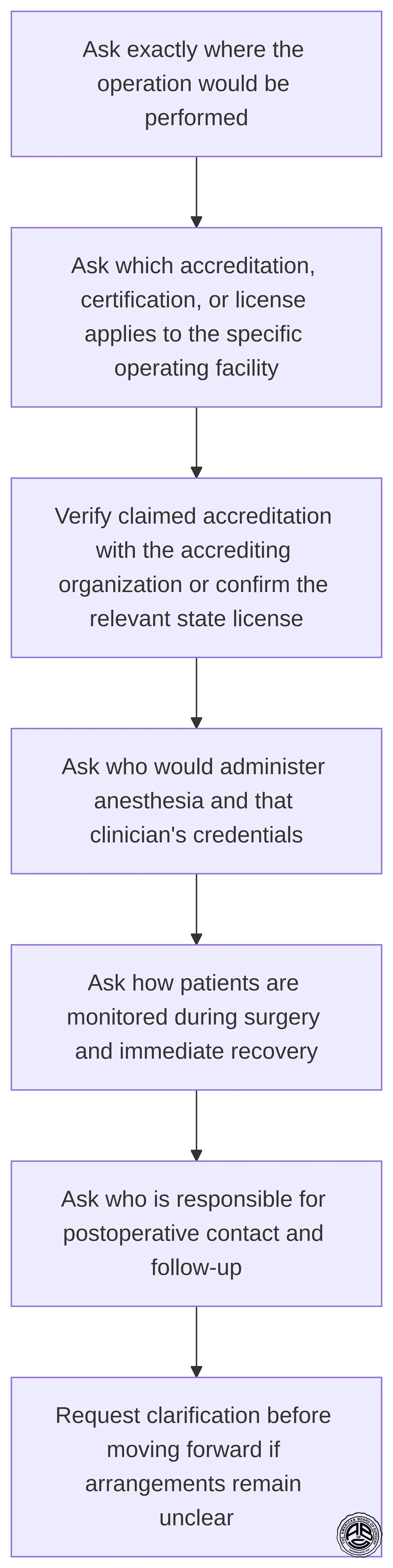
    A step-by-step flow for confirming the operating facility, its status, anesthesia credentials, monitoring, and postoperative follow-up arrangements.
    Verify the surgical setting and care arrangements before moving forward with a candidate.

    File 2: Capture What You Learn in Each Consultation

    File 2 is not a rating of bedside manner. It is a dated account of whether the consultation supplied information you could understand and use. ASPS notes that consultations are an opportunity to ask questions and that answers can help patients inform or refine their goals. Prepare written questions in advance and use the same core prompts with every candidate.

    Begin with your own goals and concerns, rather than a fixed procedure or another person’s result. ASPS notes that an approach that suited one person may not be suitable for another because bodies differ. Your notes should show whether the discussion stayed connected to your circumstances and whether you understood the explanation.

    After each consultation, complete this record:

    Consultation record What to capture
    Your stated priorities The goals and concerns you brought to the discussion.
    Candidate’s explanation The options, limits, and trade-offs as you understood them.
    Questions answered The question asked and a concise note of the answer.
    Questions still open Terms, documents, or decisions that need follow-up.
    Visual information Whether a photo gallery was available and what it could or could not help you understand.
    Decision boundary Whether you have enough clear information for a further discussion, or need clarification first.

    A photo gallery can help you visualize potential outcomes, but it is not a forecast of your individual result. Note what examples were shown, then ask what may differ in your own situation and what uncertainty remains. Do not let visual examples substitute for discussion of risks, device information, or long-term care.

    The useful comparison is not which consultation felt most memorable. It is whether each File 2 entry contains direct answers, understandable explanations, and clearly identified unresolved questions.

    File 2: Test Whether the Information Is Complete Enough to Consider

    Use a completeness check in File 2 before treating a consultation as sufficient for a decision. The check does not determine what is appropriate for you. It identifies whether the discussion and documents leave important questions unanswered.

    Ask the surgeon to explain the options relevant to your goals, why an option is being discussed, and the trade-offs you should understand. Ask how the surgeon approaches concerns if an outcome does not align with a patient’s goals, without assuming a particular revision, satisfaction, or outcome.

    For implant-based augmentation, FDA materials list risk categories that include breast pain; changes in nipple and breast sensation; additional surgeries; capsular contracture; rupture or deflation; BIA-ALCL; systemic symptoms; and effects on breastfeeding. FDA also lists wrinkling, asymmetry, scarring, pain, and incision-site infection among local complications. Record which questions you raised and what explanation you need to revisit with the surgeon.

    Before closing the entry, confirm whether you received or requested:

    • the patient labeling for the specific implant under consideration, including its complication information;
    • the actual product-specific Patient Decision Checklist for that implant;
    • an explanation of follow-up and whom to contact with concerns; and
    • an answer about how concerns are addressed if results do not align with a patient’s goals.

    FDA states that complete complication lists and rates for approved breast implants are available in patient labeling for the specific device. FDA also requires manufacturers to provide a product-specific Patient Decision Checklist with each device, containing information on known or reported risks. An online sample may be educational, but it is not the device-specific checklist you would discuss and sign with the surgeon.

    Mark the entry complete for reflection only when you can identify the documents still needed and restate the explanation in your own words. Otherwise, record the missing item and request clarification.

    File 2: Document the Long-Term Follow-Up Discussion

    Create a long-term record in File 2 rather than leaving follow-up as a general reassurance. FDA states that breast implants are not lifetime devices, that people considering them should assume they may need additional surgeries because complications can occur, and that implants need monitoring for as long as they remain in place. FDA identifies capsular contracture, reoperation, and implant removal among the most common local complications and adverse outcomes. These facts do not predict an individual experience; they explain why the follow-up discussion belongs in the evidence file.

    Use these prompts:

    • Immediate contact: Who handles postoperative questions, and how is contact arranged?
    • Monitoring discussion: What ongoing monitoring plan does the candidate describe while implants remain in place?
    • Change in condition: What instructions are given for contacting a surgeon or health care provider about abnormal changes?
    • Continuity record: What information should you retain about the implant, procedure, and follow-up plan?

    FDA advises contacting a surgeon or health care provider promptly for abnormal changes in the breasts or implants. Record the practical instructions described for that situation rather than assuming every practice handles it the same way.

    One published international framework recommends postoperative surveillance through suture removal and, ideally, for the life of an implanted device. Treat that as a framework for questions, not a universal rule or a statement about any particular practice. The purpose of this record is to distinguish a documented follow-up explanation from a promise that future surgery will never be needed.

    Compare Completed Matrices and Take Time to Reflect Before Deciding

    Set your completed matrices side by side only after you have separated verified facts from consultation observations. Look first for missing essentials: an unverified license or certification status, an unnamed operating facility, unclear accreditation or licensing, unanswered anesthesia questions, or an incomplete follow-up explanation. Those are not small details to average away with a good impression. Resolve them or remove the candidate from consideration.

    Then compare the consultation notes. Which candidate addressed your goals without making another person’s experience a template? Which explanation of options and risks did you understand well enough to summarize in your own words? Which discussion made room for questions about long-term monitoring and possible future surgery? The right next step may be a follow-up consultation, not an immediate yes or no.

    Give yourself time to reflect. A published international framework characterizes a 10-day, preferably 14-day, reflection period between operating-surgeon consultations as best practice for breast augmentation. The same framework describes at least seven days of reflection as a minimum for cosmetic patients and states that informed consent should arise from face-to-face consultation with the surgeon. These are not universal legal requirements; applicable requirements can differ by jurisdiction. They are a useful reminder that a decision involving an implant and potential long-term care should not be rushed.

    Use the reflection period to reread device-specific materials, compare your notes, and list any question you still cannot answer. If uncertainty remains, your action is to ask for clarification before deciding. A completed matrix should leave you with a reasoned basis for proceeding to a personalized discussion—not pressure to proceed with surgery.

    Use Your Evidence File to Prepare a Personalized Discussion

    Before a personalized discussion, review the two files together. File 1 should identify the current records you checked and any provider or facility detail that remains unverified. File 2 should show your goals, the explanations you received, the device-specific materials requested or reviewed, and the questions still open.

    A virtual conversation can help you discuss personal goals and request current provider, facility, anesthesia, and follow-up information. It does not replace independent verification or guarantee an outcome. Bring your dated evidence file and written questions so you can ask for the specific information needed to complete it.

    If an item is missing, leave it visible rather than filling it with an assumption. A complete file gives you a more organized basis for deciding whether a candidate merits further discussion; an incomplete file tells you exactly what to clarify next.


    Breast Augmentation Surgeon Selection FAQ

    How can I verify a breast augmentation surgeon’s credentials before booking a consultation?

    Check the surgeon’s current state license and current ABPS certification through the relevant official verification tools, then confirm that any status details are up to date. If something is unclear or flagged, ask for an explanation before moving forward.

    What should I ask about the facility where the surgery would happen?

    Ask for the exact operating location and verify whether it is accredited, licensed, or otherwise qualified under the applicable standards. It is also reasonable to ask who provides anesthesia and how patients are monitored during surgery and immediate recovery.

    What makes a consultation useful when comparing candidates?

    A useful visit should leave you with a clear understanding of your options, the trade-offs, and whether the surgeon listened to your goals and concerns. If you feel rushed or do not understand the explanation, that is a sign to ask more questions or keep comparing.

    What implant information should I review before deciding?

    Ask to see the actual product-specific Patient Decision Checklist and the patient labeling for the specific implant being discussed. Those documents help you review known or reported risks and prepare follow-up questions.

    What risks should be discussed for implant-based augmentation?

    The conversation should cover relevant complications in plain language, including local issues such as capsular contracture, rupture or deflation, asymmetry, scarring, pain, and infection, as well as other implant-related concerns. The surgeon should relate those risks to the option being considered for you.

    How should I think about follow-up and possible future surgery?

    Plan for long-term monitoring, since implants are not lifetime devices and additional surgery may be needed later. Ask how postoperative surveillance, routine follow-up, and contact for abnormal changes are handled in the practice.


  • Small-Business Tax-Planning Meeting Checklist: Build a Review-Ready Packet

    Small-Business Tax-Planning Meeting Checklist: Build a Review-Ready Packet

    Build one review packet before the meeting

    A productive tax-planning meeting starts with one organized tax-planning review packet, not a stream of disconnected files. Your goal is simple: give the credentialed tax professional a clear view of documented history, current estimates, missing records, and open questions.

    Good records can help you monitor business progress, prepare financial statements, identify income sources, and support items reported on tax returns. That makes organization useful before the meeting, even when your books are still being finalized.

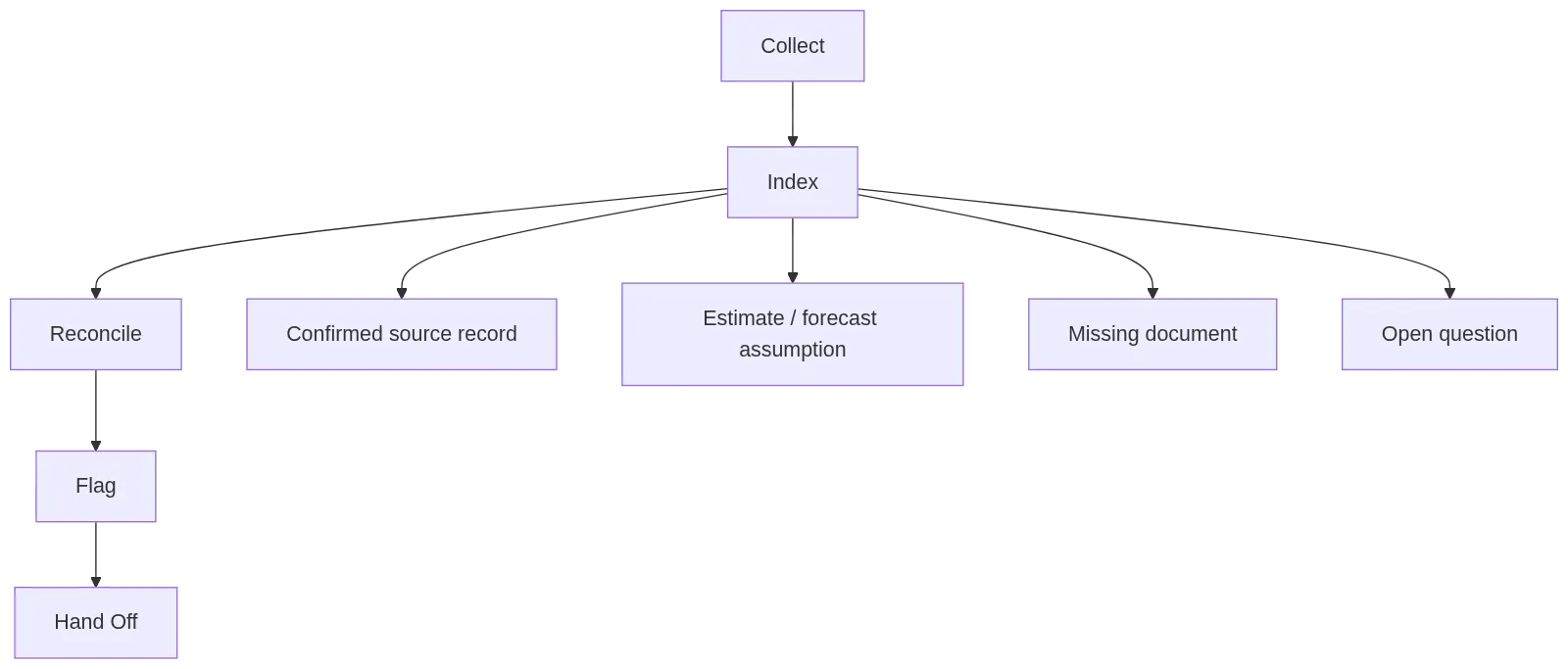
    Use this workflow: Collect, Index, Reconcile, Flag, and Hand Off. It does not determine tax treatment, filing obligations, entity treatment, nexus, payment amounts, or outcomes. It creates a dependable starting point for professional review.

    Start with the records you have. Label uncertainty rather than filling gaps with assumptions. A clearly marked missing document is more useful than an unsupported conclusion.

    Create one index and status system for every packet item

    Build one packet index before sorting folders. Give every item a row, even if the document is unavailable. A recordkeeping system may be suited to your business if it clearly shows income and expenses. Electronic records follow the same basic principles as hard-copy records. For tax books and records, an electronic storage system must be able to index, store, preserve, retrieve, and reproduce records in legible format.

    Use these fields for every row:

    Item Entity Tax period Source Status Follow-up
    Profit and loss report ABC LLC 2026 year-to-date Bookkeeping system Confirmed source record Reconcile to bank activity
    Revenue forecast ABC LLC Next 12 months Owner model Estimate / forecast assumption List sales assumptions
    Payroll register ABC LLC Q2 2026 Payroll provider Missing document Request export
    Texas activity question ABC LLC 2026 Owner notes Open question Ask professional to review

    Use a file-label pattern that matches the index: entity_period_record-type_status. For example: ABC-LLC_2026-YTD_bank-statements_confirmed.pdf or ABC-LLC_2027_forecast_estimate.xlsx.

    Keep four statuses distinct:

    • Confirmed source record: A document or system export that records completed activity, such as a bank statement, invoice, payroll report, paid bill, or filed return.
    • Estimate / forecast assumption: A projection or input about future activity. A financial forecast predicts future performance from historical data, market trends, and economic conditions. It is not historical proof.
    • Missing document: A record you expect should exist but cannot currently provide. State who may have it and what you will request.
    • Open question: A fact, classification, timing issue, or rule question that needs professional review. Write the question plainly and attach the relevant documents.

    Forecasts are inherently uncertain. If you bring scenarios, label each one, such as most likely, lower, or higher activity. Keep the assumptions beside the forecast rather than mixing them into source records.

    A five-step packet workflow from collect to hand off, with four item statuses used in the index.
    Use one workflow to separate confirmed records, estimates, missing items, and open questions before review.

    Confirm the entity, tax period, and coverage frame first

    Before gathering transactions, define what the packet covers. This prevents records for different businesses, periods, or owners from being blended together.

    Create a one-page cover entry for each entity:

    • Legal and working name used in the records.
    • Entity covered by the packet.
    • Tax period covered, such as calendar year, year-to-date, or a defined forecast period.
    • Bookkeeping-file location and the person who maintains it.
    • Business bank and card accounts included in the books.
    • Known business changes during the period.
    • Questions about entity treatment, period coverage, or records that belong elsewhere.

    Your recordkeeping system should include a summary of business transactions, ordinarily in books such as journals and ledgers. IRS guidance states that business books must show gross income, deductions, and credits. For most small businesses, the business checking account is the main source for book entries.

    The business you are in affects the records needed for federal tax purposes. If you operate more than one business, keep a separate packet and separate index for each one. If a document relates to both business and personal activity, label the distinction for review. Do not decide the treatment yourself when the facts are incomplete.

    Action: complete the entity-and-period cover page first. Flag any uncertain ownership, entity, or coverage fact as an open question for the credentialed tax professional.

    Collect bookkeeping, income, expense, and payment support

    Next, collect the bookkeeping summaries and the source records behind material activity. Purchases, sales, payroll, and other business transactions generate supporting documents. These can include sales slips, paid bills, invoices, receipts, deposit slips, and canceled checks. They support entries in business books and on tax returns.

    Organize documents by tax period and by income or expense type. The IRS offers organizing by year and type of income or expense as an example. Use folders that make the source easy to locate during the meeting.

    Gather and index:

    • Profit and loss, balance sheet, general ledger, and available account-detail reports from your bookkeeping system.
    • Business bank statements, card statements, and payment-processor summaries.
    • Income support, including invoices, deposit information, receipt books, sales reports, and applicable forms received.
    • Purchase and expense support, including paid bills, invoices, receipts, statements, and payment confirmations.
    • Records of payments made during the tax period, labeled by payee, date, amount, and source.
    • Notes identifying transactions that are not yet reconciled or that have incomplete support.

    For gross receipts, retain documents that show both amounts and sources. Purchase and expense support should identify the payee, amount, proof of payment, date, and a description showing the business purpose. More than one document may be needed to show the full transaction.

    Reconcile means comparing a summary to its accessible source support and noting a difference. Do not force totals to match by changing a label or guessing at a category. Instead, create an index row describing the difference, the affected period, the available support, and the needed follow-up.

    Action: bring the bookkeeping reports plus the source trail for significant or unresolved entries. Mark unexplained differences as open questions.

    Add payroll records and business-asset documentation

    Create separate modules for payroll records and business assets. Both areas often need documents from more than one system, so an index is especially useful.

    Payroll records are documents created through employee compensation and related reporting. For each entity and tax period, gather available payroll registers, provider reports, payment confirmations, and notices. List the payroll provider and any period that is incomplete. IRS guidance says to keep employment tax records for at least four years. Ask the credentialed tax professional about any retention or reporting question tied to your facts.

    Business assets are property you own and use in the business, such as machinery, furniture, equipment, or other documented property. For each asset, index the available acquisition document, date, cost information, payment support, and any sale or disposition record. Asset records are needed to compute annual depreciation and gain or loss when an asset is sold. Generally, property records should be kept until the limitations period expires for the year of disposal.

    Do not infer an asset’s treatment from a bank description alone. If an invoice, purchase date, ownership detail, or disposition record is unavailable, use the missing-document status.

    Action: provide available payroll and asset records by entity and tax period. Put missing details in the follow-up column rather than assigning treatment yourself.

    Compare prior-year records with current payment evidence

    Prior-year records establish the meeting’s documented starting point. Add a distinct module rather than burying older files inside the current-year folder.

    Include:

    • Filed prior-year returns available to the business.
    • Prior-year financial statements and year-end bookkeeping reports, if available.
    • Current-period payment confirmations and account statements.
    • Notices, correspondence, or account records requiring discussion.
    • A list of payments you believe relate to the business, with date, amount, source, and the reason you believe they matter.

    Keep copies of filed tax returns because they can help prepare future returns and computations for an amended return. Generally, keep records that support an income, deduction, or credit item until the limitations period for that return expires.

    A payment confirmation is evidence that a payment was made. It is not, by itself, a conclusion about how the payment should be applied. If the purpose, period, entity, or balance is uncertain, state that uncertainty directly.

    Action: place prior-year records and current payment evidence in separate indexed folders. Give the professional a list of payment questions instead of a guessed reconciliation.

    Keep forecasts separate from historical records and business changes

    Historical source records describe completed activity. Forecast assumptions describe possible future activity. Keep them in separate folders and use different statuses throughout the packet.

    For the forecast module, include:

    • The forecast period.
    • The preparer and date prepared.
    • Historical reports used as inputs.
    • Assumptions about sales, costs, staffing, financing, or other expected changes.
    • Scenarios, if used, with each scenario clearly named.
    • Questions the credentialed tax professional should review.

    A projected balance sheet estimates end-of-period assets, liabilities, and equity using historical data and financial assumptions. That makes assumptions part of the forecast record, not confirmed facts.

    Create a separate business-changes log. Record facts and attach available documents for events such as ownership changes, new locations, a new line of business, new accounts, acquisitions, asset sales, restructuring, or plans to end operations. Avoid conclusions about the tax effect. The useful meeting question is: “What records and rules should we review for this change?”

    Action: label every projection as an estimate and every completed change as a documented fact. Route the possible tax effect of either item to professional review.

    Document Texas activity without deciding applicability

    If your entity is organized in Texas, operates there, or has activity connected to Texas, create a Texas module. This is a documentation exercise, not a conclusion about a filing obligation.

    The Texas Comptroller describes Texas franchise tax as a privilege tax imposed on taxable entities formed or organized in Texas or doing business in Texas.
    Collect and index:

    • Entity formation and registration documents available to you.
    • A factual summary of Texas locations, employees, property, customers, operations, and relevant dates.
    • Available Texas franchise-tax reports, correspondence, account information, and payment evidence.
    • Available Texas Franchise Tax Account Status results, labeled with the date viewed.
    • Documents for a termination, conversion, merger, withdrawal, or other organizational change.
    • Open questions about Texas activity, nexus, entity type, reports, account status, or organizational changes.

    Texas Franchise Tax Account Status reflects an entity’s right to transact business in Texas and the Comptroller’s records at the time of the query. For listed entity types organized in Texas or having Texas nexus, the Comptroller states that Form 05-102 is filed annually; have a credentialed tax professional confirm whether it applies to your entity and circumstances.

    For a Texas entity planning to terminate, convert, or merge, the Comptroller states that a final report and any amount due are required before obtaining a Certificate of Account Status. Confirm the entity’s circumstances with a credentialed tax professional.

    Action: provide facts and available Texas records, then ask the professional to assess applicability. Do not treat Texas activity alone as proof of a filing result.

    Finish with a clear professional-review handoff

    Finish the packet with a one-page handoff summary. It should help the meeting begin with priorities rather than document hunting.

    Use four headings:

    1. Ready: confirmed source records, organized by entity and tax period, with their source locations.
    2. Missing: documents requested or still being located, with the responsible person or system.
    3. Estimated: forecasts, assumptions, scenarios, and projected figures kept apart from historical records.
    4. Awaiting professional review: open questions about facts, entity treatment, payments, business changes, Texas activity, nexus, reports, or other tax-rule issues.

    Bring the cover sheet, packet index, and labeled folders together. A packet can be useful before every item is found if its status is clear. The handoff is complete enough when the credentialed tax professional can see what is documented, what needs follow-up, and what requires a professional conclusion.


    Tax-planning packet FAQ

    What should be in a tax-planning review packet?

    Include the entity, tax period, bookkeeping reports, payroll records, payment support, business assets, prior-year records, forecasts, business changes, and any Texas-related materials. Keep confirmed source records separate from estimates and open questions.

    How should I label items in the packet?

    Use one row for each item with item, entity, tax period, source, status, and follow-up. A file name that mirrors those fields makes the packet easier to review.

    What counts as a confirmed source record versus an estimate?

    A confirmed source record is completed activity supported by documents or system exports. An estimate is a forecast or assumption about future activity, so it should stay labeled as projected rather than factual.

    Why do prior-year returns and older records matter?

    They help the professional compare periods, prepare future returns, and work through amended-return questions if needed. Property records also stay important for depreciation and gain-or-loss questions.

    What payroll records should I bring?

    Bring available payroll registers, provider reports, payment confirmations, and any notices for the entity and tax period. If a period is incomplete, mark it as missing and note the follow-up needed.

    How should I handle business assets in the packet?

    List each asset with the acquisition record, date, cost support, payment evidence, and any sale or disposal record. Those documents help the professional review depreciation and disposition questions.

    What Texas items are useful to include?

    Include factual records for Texas activity, available franchise-tax reports, account-status results, payment evidence, and documents tied to formation, withdrawal, conversion, merger, or termination. Treat them as review items, not conclusions about filing responsibility.


  • Breast Augmentation Recovery Timeline: A Planning-First Guide to Healing and Support

    Breast Augmentation Recovery Timeline: A Planning-First Guide to Healing and Support

    Recovery Is a Guide, Not a Guaranteed Schedule

    A breast augmentation recovery timeline can serve as a planning tool, not a promise about exactly how you will feel on a particular day. Recovery varies between people, and general timelines cannot predict an individual course. Implant details, implant placement, tissue tightness, lifestyle, and personal goals can all shape recovery planning.

    A practical way to use the timeline is to make three decisions before surgery: arrange help for the first days at home, protect healing by following your operating surgeon’s instructions, and know which changes require a call versus emergency evaluation. This guide describes commonly reported stages, but your surgeon’s written directions take priority over every general milestone here.

    Think of recovery in two tracks. Early functional recovery is about rest, basic comfort, and gradually resuming light daily tasks when your surgeon permits it. Longer healing continues after daily life starts to feel easier. That distinction can help you plan realistically without treating an early improvement—or a slower day—as a verdict on your healing.

    Plan Before Surgery for Supported Rest at Home

    The first days are easier to manage when practical support is arranged before surgery. Decide in advance who can assist with meals, household tasks, children or pets, and other responsibilities that could require lifting, reaching, or sustained activity.

    Set up the items you expect to need regularly where you can reach them without stretching or repeatedly getting up. Loose, comfortable clothing and a simple resting area can make the first days less demanding. Complete routine household tasks ahead of time where possible, and make sure your support person knows how to reach the surgical team if you are unable to do so comfortably.

    Work and school planning should reflect what your day actually requires. Physically demanding work may require more time away than desk-based work. Rather than choosing a return date solely from a generic timeline, discuss your actual duties with the operating surgeon and ask what restrictions apply to your role.

    Before-surgery preparation checklist

    • Confirm your ride home and the person who will stay or check in during the early recovery period.
    • Arrange help with routine responsibilities that could involve lifting, reaching, driving, cooking, or caregiving.
    • Place frequently used necessities within easy reach in your recovery area.
    • Tell work or school that your timing may need flexibility, especially if your duties are physical.
    • Save the surgical team’s contact information and understand how to reach them after hours.
    • Bring your questions about restrictions, follow-up, and symptoms to report to your preoperative visit.

    This preparation does not replace individualized postoperative directions. It gives you the space to follow them without having to solve logistics while you are recovering.

    Make the Operating Surgeon’s Instructions Your Recovery Roadmap

    Your operating surgeon’s protocol is the recovery plan to follow. Before you leave after surgery, expect individualized postoperative instructions and follow-up planning from the surgical team. Those directions may address medications, garment use, incision care, bathing, activity, lifting, arm movement, and the timing of follow-up visits.

    A support bra, elastic bandage, or other support garment may be part of postoperative care. The type of garment and how long to wear it are not details to copy from another patient or an online checklist. Follow your surgeon’s directions about garment type, fit, and wear.

    The same principle applies to incisions. Some surgeons may give instructions involving cleansing and ointment; others may direct patients to leave tape or a bandage in place. Do not substitute a general article for the specific instructions you received. If a written direction is unclear, contact the surgical team for clarification rather than guessing.

    Follow-up timing is also surgeon-specific. One postoperative practice schedules a physician visit approximately five to seven days after surgery, but your own appointment schedule may differ. Keep every scheduled follow-up, and use it to review healing, restrictions, comfort, and questions about returning to normal routines.

    A helpful question for every instruction is: What should I do, what should I avoid, and what change means I should call? Write down the answers. This makes your surgeon’s advice easier to follow when you are tired or uncomfortable.

    The First 48 Hours and Early Days: Common Experiences and Rest

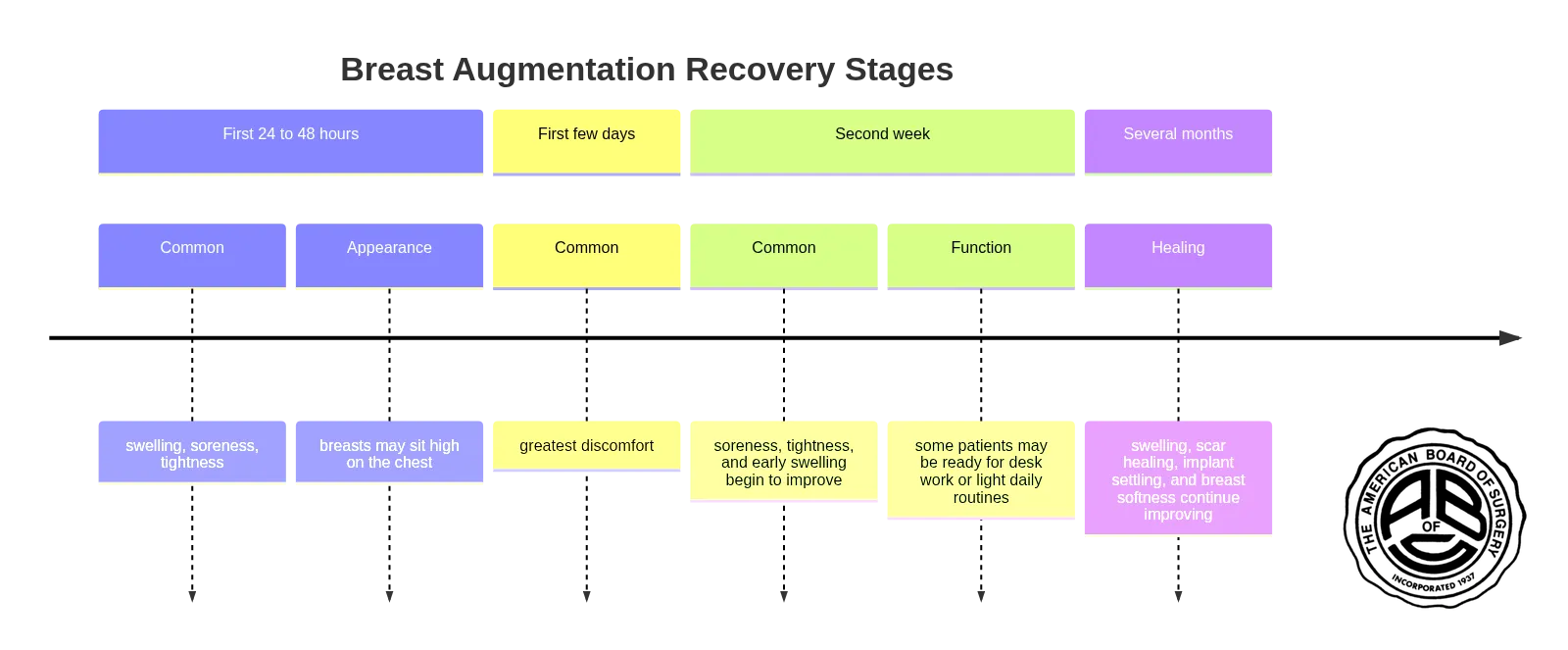
    During the first 24 to 48 hours, swelling, soreness, and tightness are commonly reported. The first few days are also commonly the period of greatest discomfort. These experiences can make rest, a calm environment, and early support especially important.

    Breasts can initially appear high on the chest and may change position as healing progresses. That early appearance is one reason not to judge the longer healing process from the first days alone. Your surgeon can tell you what is expected for your procedure and when they want to hear about a change.

    Use this period to focus on the basics: rest, follow the prescribed plan, attend to incision and garment instructions exactly as given, and accept help with tasks that could strain your chest or arms. Do not use how another person felt after surgery as a standard for what you should be able to do.

    Comfort should generally move in the direction of improvement, but recovery is not necessarily linear from hour to hour. If you are unsure whether a symptom fits your instructions, contact the surgical team. A question asked early is more useful than trying to self-interpret a change.

    A recovery timeline showing common breast augmentation stages from the first 24 to 48 hours through several months.
    A general breast augmentation recovery timeline can help patients plan for early rest, gradual functional improvement, and longer healing.

    When Light Daily Routines May Start to Feel More Manageable

    For some patients, the second week starts to feel easier as soreness, tightness, and early swelling begin to improve. That can be an encouraging shift, but the breasts and implant pockets are still healing. Feeling more independent is not the same as being cleared for every routine, workout, or work duty.

    Some people may be ready for desk work or light daily routines around the second week, subject to their surgeon’s guidance. A job with physical duties, a longer commute, frequent lifting, or repeated overhead reaching may call for a different plan. Ask the surgeon to translate restrictions into the activities you actually perform rather than relying on a broad “back to normal” label.

    Use gradual progress as a reason to reassess, not to accelerate. At follow-up, ask whether you may increase walking, driving, work tasks, household responsibilities, or other activities that matter to your routine. If you have not received clearance, keep the activity on hold.

    Some people also report temporary emotional changes, such as moodiness or anxiety, during recovery. If your emotional state feels difficult to manage or concerns you, bring it to the attention of your surgical team or an appropriate healthcare professional. Recovery planning includes support for how you feel, not only what you can physically do.

    Protect Healing Before Advancing Lifting, Reaching, or Exercise

    Activity restrictions are not a test of willpower. They are part of protecting healing while your body recovers. Overhead reaching may remain limited during the second week, and exercise, heavy lifting, chest workouts, and high-impact movement should wait until the operating surgeon clears them.

    Avoid using a generic lifting number as your personal rule. One source describes an approximately 8-pound limit as a common postoperative restriction for several weeks, but individual lifting restrictions are surgeon-specific. Your procedure and recovery plan determine what applies to you.

    When deciding whether to do an activity, use this simple sequence:

    1. Identify the demand. Does it involve lifting, pushing, pulling, repetitive arm use, overhead reaching, chest strain, impact, or a risk of being bumped?
    2. Compare it with your written instructions. If the instructions do not clearly cover it, do not assume it is allowed.
    3. Ask before advancing. Contact the surgical team for guidance and wait for clearance.

    This approach applies to gym sessions, carrying groceries, lifting children, moving luggage, cleaning, yoga positions, and sports. A temporary boundary is easier to manage when it is planned for ahead of time. Build help into your schedule rather than trying to work around a restriction.

    Longer-Term Healing Continues After Daily Life Feels Easier

    Early functional recovery and longer-term healing are different phases. Even after you begin resuming selected daily routines, swelling, scar healing, implant settling, and breast softness may continue to change for several months. Chest tightness and temporary tingling or electrical sensations in the breast or nipple can also occur in the weeks after surgery.

    The practical takeaway is to keep following your plan after the most restrictive early period has passed. Continue attending follow-ups, use garments as directed, and obtain clearance before adding activities. Do not treat a changing appearance, sensation, or level of comfort as proof that you should independently change your care routine.

    Longer healing is also why it helps to bring focused questions to follow-up appointments: What changes are expected at this stage? Which activities remain restricted? What should prompt a call? What is the next milestone for reassessing activity? Your surgeon can answer those questions in the context of your own procedure and examination.

    Changes to Promptly Report to the Surgical Team

    Recovery should generally move toward improvement. Promptly contact the surgical team about new, worsening, or returning symptoms, particularly after you had begun to feel better. The team is the right first contact for a concern that is not clearly an emergency but does not fit your written recovery plan.

    Report severe or increasing pain, feverishness, spreading redness, breast warmth, a red rash, or concerning wound drainage promptly. Also contact the team for changes in nipple color or appearance, increasing asymmetry, or markedly increased pain, bruising, swelling, or bloody drainage.

    When you call, give a clear timeline: when the change started, whether it is getting worse, whether one side differs from the other, and what instructions or medications you have already followed. Do not attempt to diagnose the cause yourself. Your role is to notice and report the change; the surgical team’s role is to advise you on the next step.

    If you are uncertain whether a symptom is important, use the safer boundary: contact the surgical team. General guidance cannot determine what is normal for your individual recovery.

    Symptoms That Need Emergency Evaluation

    Some symptoms require emergency evaluation rather than waiting for a routine callback. A breast that is rapidly or progressively enlarging after surgery requires immediate contact with the surgeon or emergency evaluation.

    Seek emergency care for sudden breathing difficulty, unexplained shortness of breath, chest pain, coughing up blood, fainting, or severe lightheadedness. These can signal a serious postoperative complication.

    Seek urgent medical assessment for possible clot symptoms, including swelling, pain, tenderness, warmth, or discoloration in one leg. Sudden shortness of breath or chest pain requires emergency care.

    If you have severe breathing or chest symptoms, fainting, or another immediate emergency, seek emergency help first. Notify the surgical team as soon as it is safe to do so.

    Use This Roadmap to Prepare for a Safer Conversation

    A useful timeline helps you prepare; it does not replace your individualized care plan. Before surgery, make a list of the practical questions that affect your home, work, and support system: Who will help me in the first days? What can I lift or reach for? When should I ask about returning to work or exercise? How should I use my garment and care for my incisions? Who do I contact after hours, and which symptoms require emergency care?

    Bring that list to your consultation and keep the postoperative instructions somewhere accessible at home. Recovery varies, and surgeon-specific directions and follow-up planning are important for your own situation.


    Frequently Asked Questions About Breast Augmentation Recovery

    What should I have ready at home before breast augmentation surgery?

    Plan for a ride home, early at-home support, and a recovery area with the things you use most often within easy reach. It also helps to arrange time away from work or school, especially if your duties involve lifting or other physical tasks.

    How strict are activity restrictions during recovery?

    They are usually important, especially early on. Lifting, overhead reaching, exercise, chest workouts, and high-impact activity should wait until the operating surgeon clears them, and the exact limits should come from your own postoperative instructions.

    What is commonly felt in the first few days after surgery?

    Swelling, soreness, tightness, and the greatest discomfort are commonly reported early on. Breasts can also sit high on the chest at first and then change position as healing progresses.

    When might light daily routines start to feel manageable again?

    For some people, the second week feels easier as soreness, tightness, and early swelling begin to improve. Even then, healing is still underway, so return to work, driving, and household tasks should follow your surgeon’s guidance.

    How long can healing keep changing after the early recovery period?

    Longer healing can continue for several months. Swelling, scar healing, implant settling, and breast softness may keep evolving even after basic daily routines start to feel more comfortable.

    Which changes should prompt a call to the surgical team?

    Contact the team promptly for new or worsening pain, feverishness, spreading redness, breast warmth, a red rash, concerning drainage, increasing asymmetry, changes in nipple color or appearance, or marked swelling or bruising that is getting worse.

    Which symptoms need emergency care instead of a routine call?

    Seek emergency evaluation for rapid breast enlargement, sudden shortness of breath, chest pain, coughing up blood, fainting, severe lightheadedness, or possible clot symptoms such as one-sided leg swelling, pain, warmth, or discoloration.


  • When Are Taxes Due in 2026? A Federal and Texas Small-Business Deadline Reference

    When Are Taxes Due in 2026? A Federal and Texas Small-Business Deadline Reference

    Start with a deadline-to-action map, not a single list of tax dates

    For 2026 cash planning, the useful question is not “What is the tax deadline?” It is “Which action is due for this entity, and what cash or records must be ready?” A return filing, a tax payment, an estimated-tax installment, a payroll deposit, and an extension request are separate actions.

    Start by making one calendar line for each date that may apply to you. Label it with the period, entity, source, and status. For example: “2026 Q2 | Clinic LLC | payroll register and bank confirmation | open for review.” This keeps a hiring forecast from being confused with completed payroll, and a future equipment purchase from being confused with historical records.

    The IRS notes that some taxpayers need more than one calendar. Employers may need the Employer’s Tax Calendar, and excise-tax payers may need an additional calendar. If the business uses a fiscal tax year rather than a calendar year, confirm adjusted dates instead of relying on the calendar-year dates below.

    What each deadline means for filing, payment, estimated tax, payroll, and extensions

    Use these distinctions when building your calendar:

    • Filing a return means submitting the required tax form and related schedules. A filing date can apply even when no new payment is planned.
    • Paying tax means sending an amount due. For an individual federal return, the April 15 deadline is both a filing and payment date.
    • Estimated tax is the IRS method for paying tax on income not subject to withholding, including self-employment income. It is a forward-looking payment process, not a completed annual return.
    • Payroll deposits are deposits of employment taxes under the employer’s applicable deposit schedule. They are not the same as filing a quarterly Form 941.
    • An extension request asks for more time to file. It does not automatically create more time to pay.

    That final distinction matters for cash planning. The IRS states that an individual extension provides additional time to file, not additional time to pay. Amounts owed remain due by April 15, 2026. The IRS lists three ways to request an individual automatic extension by the return due date: make an extension-designated payment, e-file Form 4868, or file paper Form 4868. For a fiscal-year individual, the IRS says the request must use paper Form 4868.

    For estimates, begin with prior-year return information, then separate it from your forecasts and assumptions. The IRS says prior-year income, deductions, credits, and the prior-year federal return can be a starting point for a current-year estimate. Update later-quarter estimates when revenue, hiring, compensation, or purchasing assumptions change. Form 1040-ES permits payment of 2026 estimated tax in full by April 15 or in four equal amounts under its schedule. Bring the assumptions and the historical records to a credentialed tax professional for review.

    2026 federal dates for individuals, calendar-year S corporations, and partnerships

    These dates are a calendar-year reference. They do not determine whether you must file a particular form, how your entity is classified, or what you owe.

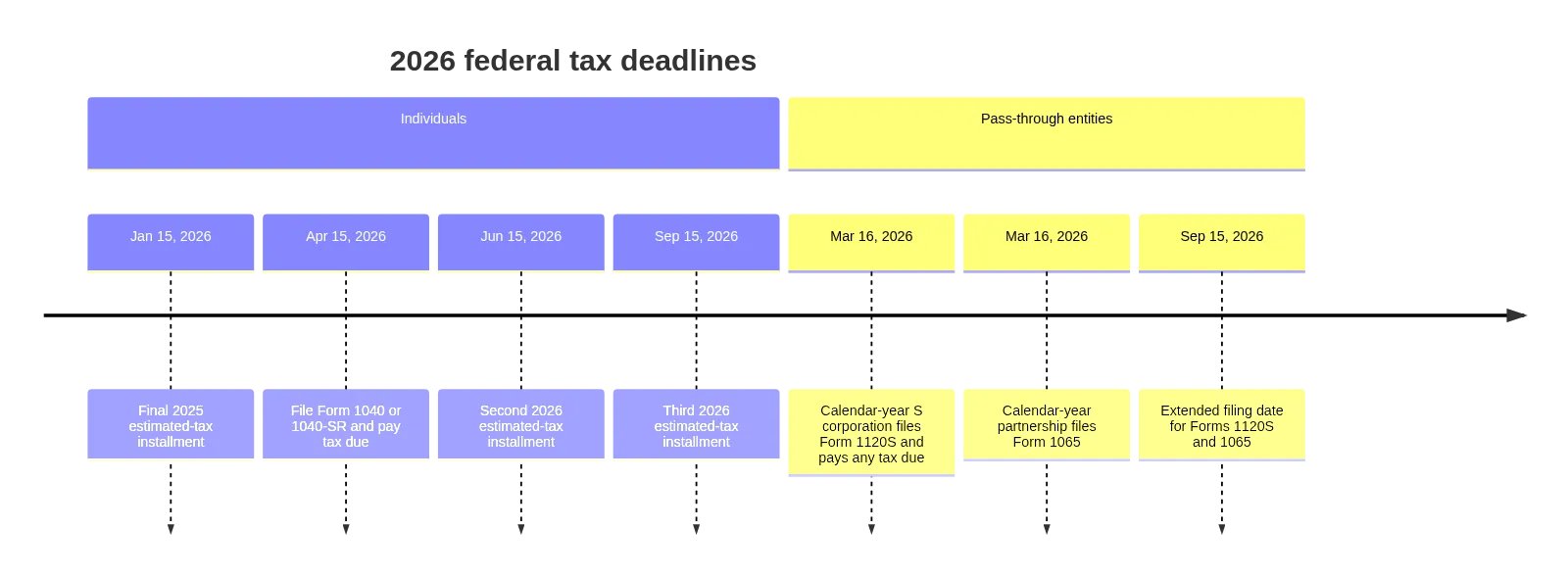
    Date Commonly affected Required action to calendar Packet status
    January 15, 2026 Individuals making estimates Final 2025 individual estimated-tax installment using Form 1040-ES. Match payment confirmation to the 2025 estimate record.
    March 16, 2026 Calendar-year S corporations File Form 1120S, pay any tax due, and furnish Schedule K-1 or K-3 to shareholders. The IRS calendar lists Form 7004 and an estimated-tax deposit for an automatic six-month extension. Confirm return owner, shareholder delivery records, and extension status.
    March 16, 2026 Calendar-year partnerships File Form 1065 and furnish Schedule K-1 or K-3 to partners. The IRS calendar lists Form 7004 for an automatic six-month Form 1065 extension. Confirm partner information and extension status.
    April 15, 2026 Individuals File Form 1040 or 1040-SR and pay tax due. An individual extension request must be made by this due date. Separate completed 2025 records from 2026 forecasts.
    June 15, 2026 Individuals making estimates Second 2026 estimated-tax installment using Form 1040-ES. Update cash forecast and supporting assumptions.
    September 15, 2026 Individuals making estimates Third 2026 estimated-tax installment using Form 1040-ES. Reconcile year-to-date results against forecast.
    September 15, 2026 Calendar-year S corporations and partnerships with timely six-month extensions Listed extended filing date for Forms 1120S and 1065. Confirm the extension was timely and assemble final records.

    A calendar-year S corporation or partnership should not treat the March and September entries as interchangeable. March is the original filing point described in the IRS calendar. September is the listed extended filing date only when a timely six-month extension was requested.

    If your business is planning a new hire, owner-compensation change, or major purchase, place a review meeting before the next estimated-tax date. Attach a forecast showing the expected timing and amount, then label it Forecast rather than documented activity.

    A 2026 timeline of selected federal tax deadlines for individuals, calendar-year S corporations, and calendar-year partnerships.
    These are the key federal 2026 dates highlighted in the article for individuals and pass-through entities.

    Employer deadlines: separate payroll deposits from quarterly employment-tax returns

    If the business pays employees, keep payroll deposits and employment-tax returns on separate calendar lines. Employers generally report wages, tips, and other compensation using Form 941. Certain small employers may use Form 944 if the IRS approves that filing arrangement.

    Selected 2026 employer dates

    • January 15: For employers on the monthly deposit rule, the IRS lists this as the deposit date for December 2025 payroll taxes.
    • February 10: Forms 940, 941, 943, 944, and/or 945 are due on this date only if all required payments were timely deposited.
    • February 17: For the monthly deposit rule, this is the listed deposit date for January payroll taxes.
    • April 30: Listed Form 941 deadline for the first quarter.
    • July 31: Listed Form 941 deadline for the second quarter.
    • July 31: Deposit FUTA tax owed through June if it exceeds $500.

    The IRS employment-tax calendar also lists quarterly due dates of April 30, July 31, October 31, and January 31 for the prior calendar year’s fourth quarter. Deposit timing can differ from those return dates. For FUTA, timing depends on quarterly liability and prior undeposited amounts; confirm whether the $500 threshold is met.

    Create a payroll record group for each period. Include payroll registers, bank statements, payroll-provider reports, withholding deposit confirmations, and filed-return copies. Mark each item Documented, Needs source, or Open question. Keep contractor payment confirmations in a separate payroll and contractor records folder. Contractor classification is the question of whether a worker should be treated as a contractor or employee; flag that question for a credentialed tax professional rather than deciding it from payment records alone.

    If payroll is new or changing, calendar the applicable deposit schedule only after confirming it. Do not use a quarterly return date as a substitute for a payroll deposit date.

    Texas franchise-tax dates and reporting questions for 2026

    Texas franchise tax is a privilege tax for taxable entities formed or organized in Texas or doing business in Texas. Whether a particular business is a taxable entity, has Texas nexus, or has a specific reporting obligation requires entity-specific confirmation.

    The annual Texas franchise-tax report is due May 15, or the next business day if May 15 falls on a weekend or holiday. For 2026 reports, Texas states that the No Tax Due Report is not available. The stated no-tax-due threshold is $2.65 million in annualized total revenue. An entity at or below that threshold is not required to file a No Tax Due Report, but it generally remains required to file a Public Information Report (PIR) or Ownership Information Report (OIR) unless an exception applies.

    The Texas E-Z Computation option may be available when annualized total revenue is $20 million or less. Eligibility and the remaining reporting requirements should be confirmed before you choose a report.

    A Texas franchise-tax extension is tentatively granted upon a valid, timely online extension payment or request on the Comptroller’s form. The request or payment must be received or postmarked by the original report due date. If an online extension payment is made, the Comptroller says not to also submit paper Form 05-164.

    Use a separate Texas franchise tax branch in your calendar:

    1. Label the item “2026 Texas franchise tax | [entity name] | Comptroller filing records | open for review.”
    2. Attach annualized revenue support, prior-year documents, PIR or OIR information, and any extension confirmation.
    3. Flag a termination, conversion, or merger. Texas requires a final report and payment in the year a Texas entity plans that transaction.
    4. If an out-of-state entity is ending Texas nexus, flag the cessation date. Texas lists a final report and payment due within 60 days after sufficient nexus ends.

    Texas franchise tax is a separate business branch from federal income-tax filing. Calendar both where applicable, but do not assume one filing resolves the other.

    Link each applicable date to a review-ready Tax Planning Packet

    A Tax Planning Packet is an organized set of calendar items, records, assumptions, and questions prepared for discussion with a credentialed tax professional. Its purpose is to make the period, entity, source, and status visible before a deadline or planning meeting.

    Use this four-step workflow.

    1. Create the date record. For each applicable deadline, record the date, action type, entity, responsible person, and status. Use status labels such as Documented, Forecast, Needs source, and Open question.
    2. Attach historical records. Keep bookkeeping records and source documents together by period. Useful examples include bank statements, reconciliations, invoices, receipts, payroll registers, contractor payment confirmations, financing documents, filed returns, and payment confirmations.
    3. Create a separate forecast page. List expected revenue, proposed hiring dates, compensation changes, equipment purchases, financing cash needs, and estimated-payment assumptions. Do not mix these forecasts and assumptions into historical records.
    4. Prepare the review agenda. For every unresolved item, name the follow-up owner and the decision needed. Example: “Q3 2026 | PLLC | proposed equipment financing | Forecast | owner to provide term sheet; ask about timing.”

    A business asset activity file should cover purchases, sales, trade-ins, financing, or disposal of business property. An asset disposition means selling, trading, or otherwise disposing of an asset. Attach the invoice, receipt, financing document, and any sale or trade-in records. Flag the intended transaction date and treatment questions for professional review.

    This structure supports a clearer estimate update. Prior-year records provide a starting point; current-year historical records show what has happened; forecasts show what may happen next. Each category has a different status and should remain separate.

    Open questions to bring to a credentialed tax professional

    Bring a short agenda with your Tax Planning Packet. These questions help connect deadlines to planned business changes:

    • Does the business use a calendar tax year or a fiscal tax year? If it is fiscal-year, which dates change?
    • Which federal returns and estimated-tax dates apply to each entity and owner?
    • Is an individual extension needed, and what payment amount should be reviewed by April 15? If the individual is fiscal-year, confirm use of paper Form 4868.
    • What payroll deposit schedule applies to the business? Are payroll registers and deposit confirmations complete for each period?
    • Are any workers paid as contractors, and is contractor classification a question requiring review?
    • Does planned hiring or a compensation change alter the cash forecast before the next estimate or payroll date?
    • Does business asset activity include a purchase, financing arrangement, sale, trade-in, or other disposition? Which source documents are still needed?
    • Which prior-year documents support the current estimate, and what assumptions changed since that return?
    • Is the entity potentially subject to Texas franchise tax? What PIR or OIR requirement, threshold, exception, or extension step should be confirmed?
    • Is the business terminating, converting, merging, or ending Texas nexus? If so, what final-report timing applies?

    For fiscal-year estimated-tax taxpayers, the IRS says a payment date that falls on a weekend or legal holiday moves to the next business day. Confirm the relevant period and date calculation rather than copying calendar-year dates into a fiscal-year calendar.

    End the meeting agenda with a named owner for every open question. A question without an owner is easy to carry past the next deadline.

    Use the calendar as a cash-planning and review tool

    A useful 2026 tax calendar shows more than dates. It shows the action, entity, cash need, supporting records, current status, and person responsible for follow-up.

    Calendar the applicable filing, payment, estimated-tax, payroll, and Texas franchise-tax actions separately. For each one, attach the related source documents and identify whether the figure is historical, documented, forecast, or unresolved. Keep cash reserved for a payment distinct from work still needed to file a return. If an extension is under consideration, treat the filing timeline and payment timeline as separate review items.

    Before a hiring decision, purchase, financing change, or owner-compensation change, update the forecast page and compare it with current bookkeeping records. Then bring the packet and its open questions to a credentialed tax professional for entity-specific review.

    Frequently asked questions about 2026 tax deadlines

    Does an extension give more time to pay federal income tax?

    No. An individual extension gives more time to file, not more time to pay. If tax is owed, the payment is still due by the original deadline, so keep the payment and filing timelines separate.

    Who usually needs to make estimated tax payments in 2026?

    Estimated tax is used for income not subject to withholding, including self-employment income. If your income, deductions, or credits change during the year, use prior-year records as a starting point and update later estimates for review.

    How should payroll deposit dates be tracked alongside quarterly payroll returns?

    Track them as separate items. Payroll deposits follow the employer’s deposit schedule, while Form 941 and similar returns have their own filing dates. Keep payroll registers, deposit confirmations, and filed returns together by period.

    When might a Texas business need to review franchise tax reporting?

    If the business is formed in Texas or doing business in Texas, franchise tax may be relevant. The annual report is due May 15, and the entity’s reporting, PIR or OIR, and extension steps should be confirmed for the business type.

    What should be included in a Tax Planning Packet before a review meeting?

    Include historical bookkeeping records, source documents, prior-year documents, payroll and contractor records, business asset activity, and a separate page for forecasts and assumptions. Label each item by period, entity, source, and status, and list open questions with a follow-up owner.

  • Breast Augmentation Revision Assurance Program in Beverly Hills: What the Stated Terms Mean

    Breast Augmentation Revision Assurance Program in Beverly Hills: What the Stated Terms Mean

    A limited revision-fee program can support planning without promising a result

    If a revision policy is part of how you are comparing breast augmentation surgeons in Beverly Hills, it is reasonable to ask what it actually covers—and what it does not. A limited program may offer useful reassurance about one narrow part of the financial discussion. It should not replace careful surgical planning or be treated as a promise of a particular appearance.

    Confirm the current written terms directly with the practice before relying on the program.

    Most importantly, a revision-fee program is not an outcome guarantee. Breast augmentation involves decisions about implant characteristics, placement, anatomy, recovery, and realistic expectations. Results vary, and a policy does not mean that a particular size, shape, symmetry, sensation, or recovery experience can be assured.

    It is also different from a manufacturer warranty, which concerns the implant device under its own terms, and from insurance coverage. The FDA notes that insurance may not cover implant removal or replacement, even when complications occur. Breast implants are not lifetime devices, and the FDA advises prospective patients to assume that additional operations may be needed over time. Those broader long-term considerations remain relevant even when a practice offers a short-term revision-fee policy.

    The practical question is not whether a policy makes surgery consequence-free. It is whether the current written terms provide meaningful, limited reassurance for your exact planned primary breast augmentation at the Beverly Hills office. That requires two conversations: one about whether the surgical plan suits you, and another about whether the stated program applies.

    Why breast revision belongs in an informed implant discussion

    A breast revision, also called revision mammaplasty, is surgery that may address unsatisfactory results after a prior breast augmentation or breast lift. Raising the subject before primary surgery is not a prediction that you will need another operation. It is part of understanding that implants require ongoing attention and that future changes, concerns, or complications may lead to another decision.

    Depending on the situation, revision surgery may involve changing implant size or position, treating scar tissue, using internal suturing, performing a breast lift, or selecting a different implant style. These are possible surgical approaches, not a menu of preapproved solutions. The appropriate response to a concern depends on a clinician’s evaluation of the individual situation.

    Revision discussions may arise for aesthetic or clinical reasons. Examples cited in breast revision information include capsular contracture, implant-position changes, rupture or deflation, discomfort, asymmetry, implant visibility or rippling, and an unanticipated breast shape. The FDA lists capsular contracture, reoperation, and implant removal among common local complications or adverse outcomes. Its materials also list risks including rupture or deflation, wrinkling, asymmetry, scarring, pain, and infection.

    That context helps put a 90-day policy in perspective. A stated short-term program does not establish coverage for every future concern, and it does not change the fact that implants are not lifetime devices. Rather than viewing revision as evidence that a primary procedure has necessarily failed, treat it as one of the subjects that belongs in informed planning.

    A productive consultation makes room for both hopes and limits. You can explain the proportions and degree of fullness you prefer, ask what may be realistic for your anatomy, and discuss what outcomes would concern you during recovery. You can also ask how the practice distinguishes normal healing from an issue that merits evaluation. That discussion is educational and individualized; it cannot predict a specific result or determine in advance whether a revision would be appropriate.

    The stated coverage boundary for the Beverly Hills program

    The program has a defined boundary rather than open-ended protection. Read the following as the stated scope to confirm in writing with Golshani Plastic Surgery for your planned procedure:

    • Procedure: The program is stated to be limited to a primary breast augmentation case.
    • Location: The primary procedure is stated to need to be performed at the Beverly Hills office.
    • Timeframe: The summary states a 90-day period beginning on the original surgery date.
    • Number of revisions: It states that there may be one revision under the program.
    • Fee described: The program is stated to waive the standard surgeon’s fee for the revision procedure.

    The phrase “no-cost revision” needs careful reading in context. The supplied summary specifically identifies a waiver of the standard surgeon’s fee. It does not establish that every cost associated with a revision is covered. Nor does it define how dissatisfaction is evaluated, who determines eligibility, whether medical or timing exceptions apply, or whether an in-person assessment is required.

    For that reason, a practical way to use the program in your decision is as a question set, not as an assumption. Ask for the current written terms and have the practice confirm that your procedure is a qualifying primary augmentation at the Beverly Hills office. Ask how the 90 days are calculated and what steps are required if you have a concern during that period.

    This focused approach is especially helpful when you are weighing an individualized treatment plan. Implant planning may consider chest-wall anatomy, existing breast tissue, skin quality and laxity, and aesthetic goals. A policy boundary cannot determine those choices. It may be relevant once a plan is proposed, but it should not drive a decision toward an implant size, shape, or procedure that does not fit your goals and clinical evaluation.

    What the stated terms exclude and do not establish

    Procedures performed at another location or by another surgeon are excluded. If you are considering surgery outside the Beverly Hills office, or you are seeking correction of an operation performed elsewhere, do not assume this stated program applies. Request confirmation of the current written terms directly from the practice.

    There is a second boundary that matters just as much: the supplied information identifies only the standard surgeon’s fee as waived. It does not establish coverage for facility fees, anesthesia, implants or other devices, medications, imaging, laboratory work, travel, postoperative care, or other non-surgeon costs. It also does not establish whether those items would be needed in a particular circumstance.

    That is not a minor administrative detail. A patient deciding whether the program offers relevant reassurance needs to understand the difference between a surgeon-fee waiver and comprehensive financial coverage. The latter should not be inferred from the stated program summary.

    Use this checklist when asking for clarification:

    1. Confirm the exact qualifying procedure. Is my proposed operation classified as a primary breast augmentation under the current policy?
    2. Confirm the site and surgeon. Will the planned surgery be performed at the Beverly Hills office by the surgeon covered by the policy?
    3. Confirm the clock. What is the exact start and end date of the 90-day period for my surgery date?
    4. Confirm the decision process. How are concerns, dissatisfaction, timing, and eligibility assessed under the current written terms?
    5. Request an itemized cost boundary. Which costs, if any, remain the patient’s responsibility if a revision is considered?
    6. Ask about the one-revision limit. How is the stated one-revision limit applied if a patient has more than one concern?

    A clear answer to these questions lets you compare the program accurately with other considerations, including surgical planning, recovery arrangements, implant-specific information, and your tolerance for the possibility of future procedures. If the terms are not clear enough for you to make an informed choice, pause before treating the program as a deciding benefit.

    Use the consultation to confirm both the surgical plan and program fit

    A consultation is not a single yes-or-no conversation about a policy. It is a two-track decision: first, whether the proposed breast augmentation plan fits your body and priorities; second, whether the current written program applies to that exact plan.

    Track one: Is the proposed primary augmentation plan appropriate to discuss further?

    The FDA says a preoperative consultation should cover candidacy, implant choices, placement, and risks and benefits in light of the patient’s circumstances. FDA materials also advise patients to discuss their goals and expectations with their surgeon and to read implant-specific labeling and educational materials before deciding.

    At Dr. Golshani’s practice, the breast augmentation page states that implant planning considers chest-wall anatomy, existing breast tissue, skin quality and laxity, and aesthetic goals. This is why a photo, a cup-size preference, or a friend’s result cannot by itself determine the right plan for another person.

    Bring questions that help you understand the recommendation:

    • What goals can this plan reasonably aim to address, and what should I not expect it to change?
    • How do my chest-wall anatomy, existing breast tissue, skin quality, and goals influence implant type, size, shape, and placement?
    • What are the meaningful tradeoffs among the options being discussed for me?
    • What recovery restrictions, follow-up needs, and uncertainties should I plan around?
    • What risks are most relevant to the procedure under consideration, and what changes should prompt me to contact the practice?
    • Can I review the manufacturer’s patient labeling and ask questions before making a decision?

    For FDA-approved breast implants, FDA materials state that the prospective patient and implanting physician must review and sign the patient decision checklist. Treat that checklist as an opportunity to slow down and ask for plain-language explanations, rather than as paperwork to rush through.

    Breast augmentation alone does not correct significant breast sagging, according to Dr. Golshani’s breast augmentation page. In appropriate cases, a breast lift may be combined with augmentation. This does not mean a combined procedure is right for everyone; it means that the consultation should separate the goal of adding volume from the goal of changing breast position.

    Track two: Does the current program apply to this exact plan?

    After you understand the surgical recommendation, ask the practice to confirm the policy terms for that proposed primary procedure. Keep the questions specific:

    • Is this planned operation eligible under the current Revision Assurance Program?
    • Does the current written policy apply because the procedure will be performed at the Beverly Hills office?
    • What does the practice mean by dissatisfaction or eligibility within the stated 90-day period?
    • Does a concern require a clinical evaluation before any revision decision is made?
    • Does the policy waive only the standard surgeon’s fee, and what costs are not included?
    • Can I receive the current written terms before scheduling surgery?

    Ending each track with a clear boundary protects against confusion. If you do not understand the individualized surgical rationale, ask for clarification before deciding. If the policy’s current applicability or costs are not confirmed in writing, do not treat the stated program as confirmed coverage.

    Move forward with clarity and confirmed terms

    A 90-day revision-fee program may be one consideration when choosing a primary breast augmentation consultation in Beverly Hills. It is not a promise of a specific aesthetic outcome, a substitute for implant-specific informed consent, or a complete answer to future implant-related costs and decisions.

    The stronger basis for moving forward is clarity on both sides of the decision. You should understand why a proposed plan reflects your anatomy and goals, what recovery and risks deserve consideration, and what realistic expectations look like. You should also have the current written program terms, including confirmation that the planned procedure qualifies and a clear explanation of any costs outside the stated surgeon-fee waiver.

    Educational information cannot determine candidacy, predict outcomes, or decide whether a revision would be appropriate for an individual patient. A consultation with Dr. Golshani in Beverly Hills can address your goals, recovery questions, risks, implant planning, and the current applicability of the stated program to your planned procedure.

    Questions to bring to Dr. Golshani about augmentation and the stated program

    What does a breast revision usually address after augmentation?

    It is surgery used to address concerns after a prior breast augmentation or lift. Depending on the situation, it may involve changing implant size or position, treating scar tissue, internal suturing, a breast lift, or a different implant style.

    Does the stated 90-day program cover every revision cost?

    No. The program waives the standard surgeon’s fee. It does not establish coverage for facility, anesthesia, implant or device costs, medications, imaging, travel, or postoperative care.

    Who is the stated program meant to apply to?

    The program is limited to primary breast augmentation cases performed at the Beverly Hills office. It does not apply to procedures done elsewhere or by another surgeon.

    What should I confirm during consultation before relying on the program?

    Ask whether your planned procedure qualifies, how the 90 days are counted, how dissatisfaction or eligibility is assessed, whether any evaluation is required, and which costs are included or excluded in writing.

    Why do implants need long-term follow-up even if a revision policy is offered?

    Breast implants are not lifetime devices, and the FDA advises patients to assume additional surgery may be needed over time.

    Can breast augmentation address sagging as well as fullness?

    If sagging is part of your concern, a breast lift may be discussed with augmentation so volume and position are addressed together when appropriate.

  • A Post-Consultation Audit for Beverly Hills Breast Augmentation Revision Assurance Terms

    A Post-Consultation Audit for Beverly Hills Breast Augmentation Revision Assurance Terms

    Set Up a Dated Policy Audit File

    A revision assurance policy can be one document in a primary breast augmentation decision, but it should not be read in isolation. After consultation, assemble a reconciliation record that compares three separate document sets: the current written policy, the materials describing the planned surgery, and any separate cost information. The goal is not to interpret a program label broadly. It is to identify where the documents agree, where they address different subjects, and where a needed answer is absent.

    The supplied policy statement describes a complimentary 90-day Revision Assurance Program for primary breast augmentation at the Beverly Hills office. It says the program is intended to provide prospective patients additional confidence. That stated purpose does not make the policy a prediction of a surgical result.

    Date each item in your record and retain the version you received. Because the supplied statement is undated, obtain the current written version from the Beverly Hills office before treating it as part of a surgical or financial decision. If an office discussion supplies information that is not in the written policy, record it separately rather than treating it as though it were policy language.

    Audit Entry 1: Record the Express Terms Without Expanding Them

    Start the reconciliation record with a direct transcription of the limited terms stated in the policy material. Do not expand a stated term to resolve a question that the document does not answer.

    Policy field Stated term to record Leave unresolved unless current written material answers it
    Eligible procedure Primary breast augmentation performed at the Beverly Hills office Whether a combined procedure or another procedure classification is included
    Time reference Dissatisfaction within 90 days of the original surgery date What event must occur before the 90-day period ends
    Revision limit One no-cost revision surgery for an eligible patient Any continuing or repeated revision arrangement
    Named fee Waiver of the standard surgeon’s fee for the revision procedure Coverage of every revision-related expense

    The supplied statement describes one revision for a patient dissatisfied with results within 90 days of the original surgery date and separately states that the standard surgeon’s fee for the revision procedure is waived. Preserve those as separate entries. The phrase “no-cost revision” should not be used to fill in the separate question of which revision-related charges, if any, are addressed elsewhere.

    If later written material uses different wording, retain both versions with their dates. Ask the Beverly Hills office which current wording governs instead of combining portions of different documents into a single assumed term.

    Audit Entry 2: Verify Whether the Surgery Identifiers Match

    Next, compare the identifiers in the policy material with the identifiers in the surgical materials. The supplied policy states that it is limited to primary breast augmentation at the Beverly Hills office and excludes procedures performed at another location or by another surgeon.

    Create a side-by-side entry for the procedure description, office, and surgeon named in each document. The purpose is to spot a mismatch, not to infer that similar wording means the same thing. For example, if the policy and surgical materials do not use the same procedure description, retain the difference and ask which current policy terms apply.

    Do not use the supplied statement to transfer the program to another office or to care performed by another surgeon. It also does not explain how later care elsewhere would be handled. If either issue matters to your plans, leave it unresolved until the Beverly Hills office provides the applicable current written terms.

    Audit Entry 3: Separate Policy Language From Treatment Decisions

    A reconciliation record works only when each document stays in its own lane. The policy may address a limited revision opportunity and a named fee term. Surgical materials and consultation discussions address the proposed procedure, goals, anatomy, risks, and likely outcomes. Cost information may address charges separately. A statement in one set of materials should not be copied into another category merely because it affects the same decision.

    Based on the supplied statement, the policy record can contain a narrow note about a stated opportunity for one revision when dissatisfaction occurs within 90 days, together with a waiver of the standard surgeon’s fee for that revision. It does not establish whether revision will be appropriate, available in a particular circumstance, or sufficient to address a concern. The supplied statement does not define dissatisfaction, identify qualifying revisions, or state what review process applies to a revision request.

    A cited article on cosmetic-surgery informed consent notes that completed documentation may not demonstrate patient understanding of treatment risks and benefits. In this setting, the practical response is not to treat a policy document as clinical consent material. Keep unanswered questions about surgical expectations, candidacy, safety, and clinical appropriateness in the surgical-discussion portion of the record, even when the policy is relevant to financial planning.

    Create an Exceptions Log for Missing or Conflicting Terms

    Use this reference when reviewing the current policy. The first column reflects the supplied statement. The second identifies matters that need clarification; an unlisted item should not be treated as either covered or excluded until the office explains the current terms.

    Expressly stated in the supplied policy statement Obtain written clarification before relying on the policy
    It applies to primary breast augmentation at the Beverly Hills office. How primary augmentation is defined and whether any planned combination affects eligibility.
    It describes dissatisfaction within 90 days of the original surgery date. Whether notice, evaluation, scheduling, approval, or completion of a revision must occur within 90 days.
    It describes one no-cost revision surgery. What qualifies as dissatisfaction or a qualifying revision, and whether approval is required.
    It states that the standard surgeon’s fee for the revision procedure is waived. Whether facility, anesthesia, implants, medication, testing, pathology, travel, postoperative care, or other charges are included.
    It is limited to the Beverly Hills office and excludes procedures by another surgeon or at another location. The request process, exclusions, effective date, and amendment terms.

    The fee distinction deserves particular attention. A waiver of the standard surgeon’s fee is not the same as a statement that all costs connected with revision are waived. The supplied statement names the surgeon’s fee; it does not identify facility, anesthesia, implant, medication, testing, pathology, travel, postoperative care, or other potential charges. Do not assume any of those items are included or excluded. Ask for an itemized explanation of the current policy and a separate explanation of any expected costs.

    Timing also requires precision. “Within 90 days of the original surgery date” is the stated timeframe, but the summary does not explain whether the deadline concerns reporting dissatisfaction, being examined, receiving approval, scheduling, or undergoing a revision. Ask the office to identify the operative date for the calculation and every action required before the deadline.

    Likewise, the statement does not explain how a requested preference change, a complication, implant type, combined procedure, or another circumstance might affect eligibility. Those subjects should remain open questions rather than assumptions. Ask which exclusions or conditions apply to your planned procedure.

    Complete the Audit Before You Rely on the Policy

    Build the record after consultation, when you can compare the materials rather than relying on memory of a single discussion. The practice’s breast augmentation page describes consultation as a time to review goals, medical history, anatomy, breast dimensions and shape, and breast laxity. Keep those treatment-planning notes separate from the policy and cost documents.

    The resulting record has a distinct practical purpose: it shows which statements came from which document, whether their dates and identifiers align, and which important questions still need a written answer. It is not a tool for determining candidacy, coverage, or whether a particular concern requires revision.

    Use the following four-part record to set a reliance boundary.

    1. Match the stated procedure. Obtain the current written policy and record its effective date. Then note whether the planned procedure is described as primary breast augmentation at the Beverly Hills office.
    2. Match the named parties. Record the office and surgeon identified in the surgical materials. The supplied statement says the program does not apply to procedures performed at another location or by another surgeon.
    3. Copy only the stated financial term. Write that the standard surgeon’s fee for the revision procedure is waived, then separately list every cost category for which the current written policy gives an answer. Do not convert the stated surgeon-fee waiver into an all-inclusive cost assumption.
    4. Mark the reliance limit. Record the stated reference to dissatisfaction within 90 days of the original surgery date and one no-cost revision. In a separate unresolved-items field, list any missing information about timing mechanics, conditions, exclusions, request steps, or charges beyond the named surgeon’s fee.

    For each entry, note the date, document version, and whether the information appears in the written policy or was provided separately by the office. Keep clinical planning notes apart from this record. The completed sheet does not establish candidacy, coverage, or whether a particular concern requires revision; it shows whether the stated policy is documented enough to be treated as a limited financial-planning input.

    Use the Completed Audit to Set a Reliance Limit

    The four-question test produces a decision boundary, not a prediction about revision. If the planned surgery, Beverly Hills office, and surgeon match the current written terms, you can recognize the supplied statement as a limited policy input: it describes a complimentary 90-day program for primary breast augmentation, one potential revision for dissatisfaction within 90 days of the original surgery date, and a waiver of the standard surgeon’s fee for that revision.

    That limited input should carry no further meaning until the written terms address the open items that matter to you. Before using the policy in a financial decision, identify whether the current version explains timing mechanics, the process for raising a concern, conditions or exclusions, and charges beyond the named surgeon-fee waiver. If it does not, treat the policy as incomplete for that purpose rather than filling the gaps with assumptions.

    Keep the final record in three parts: the policy language, the surgical discussion, and any separate cost information. This does not establish candidacy, coverage, or whether a particular concern requires revision. It helps you decide whether the available written information supports only a limited planning note or whether further confirmation from the Beverly Hills office is necessary before proceeding.


    Frequently Asked Questions About the Policy Audit

    Why compare the policy with my surgical and cost discussions?

    The policy statement addresses limited policy terms, while the surgical discussion addresses your planned procedure and expectations. Keeping those records separate helps prevent a policy term from being treated as a promise about results or as an answer to an unlisted cost question.

    What details should match the policy before I rely on it?

    Compare the planned procedure, Beverly Hills office, and surgeon with the current written policy. The supplied statement is limited to primary breast augmentation at the Beverly Hills office and does not apply to procedures at another location or by another surgeon.

    Does the stated surgeon-fee waiver settle every revision-related charge?

    No. The supplied statement identifies a waiver of the standard surgeon’s fee for the revision procedure. It does not identify other possible charges, so request a written explanation of how the current policy addresses them.

    What should I do if the written policy does not answer an important question?

    Keep the issue marked as unresolved and ask the Beverly Hills office for the current written terms or a direct clarification. Do not assume an unlisted item is covered, excluded, or applicable to your planned procedure.

    Can this comparison tell me whether I qualify for a revision?

    No. It is a record-comparison tool, not an eligibility decision or medical assessment. Ask the Beverly Hills office to apply the current written policy to your planned procedure and to address any revision concern.


  • Breast Augmentation Decision Guide: Goals, Trade-Offs, and Revision Questions

    Breast Augmentation Decision Guide: Goals, Trade-Offs, and Revision Questions

    Decide What You Want Breast Augmentation to Address

    It can use breast implants or fat transfer to increase breast size. People may consider it to restore volume after weight reduction or pregnancy, create a rounder shape, or address natural differences in breast size. The first decision is therefore not simply which implant to choose. It is whether the change you want is primarily about volume, shape, asymmetry, or a combination of concerns.

    A useful consultation begins with a short written description of your goal. For example: “I want more upper-breast fullness,” “I want to restore volume after pregnancy,” or “I want to address asymmetry.” Avoid treating a desired cup size as the entire plan; your surgeon will need to relate your goal to your anatomy, available tissue, and the procedure options that may be appropriate for you.

    This guide is for preparing questions, not determining candidacy or selecting treatment. Bring your goals, concerns, and willingness to accept long-term responsibilities to a qualified plastic surgeon. The discussion should cover both the appearance you hope to change and the trade-offs involved in achieving it.

    Test Your Goal Against the Procedure’s Limits

    Augmentation is not a universal solution for every breast-shape concern. Breast augmentation does not correct severely drooping breasts. When sagging is a significant part of the concern, a surgeon may discuss whether a breast lift should be performed alongside augmentation.

    This distinction matters because adding volume and lifting the breast address different aspects of appearance. If your main concern is loss of fullness, augmentation may be the central topic. If your concern is that the breast sits lower, the nipple position has changed, or the skin envelope feels substantially stretched, ask directly whether augmentation alone addresses that concern. Do not assume that a larger implant will substitute for a lift.

    Use these questions to define the boundary of your goal:

    • Is my primary concern volume, shape, asymmetry, sagging, or several of these?
    • Would augmentation alone address the concern I am describing?
    • Should a breast lift be discussed, and if so, how would that change the procedure and its trade-offs?
    • Would fat transfer be relevant to my stated goal, or is an implant discussion more appropriate?

    The practical next step is to ask the surgeon to separate what augmentation may address from what it cannot address by itself. That keeps the consultation focused on your actual concern rather than on a presumed procedure.

    Build Your Goals, Trade-Offs, and Long-Term Responsibilities Worksheet

    Bring a two-part worksheet to the consultation. The first part connects your desired change to surgical planning. The second addresses the responsibilities that continue after surgery.

    Part one: goals and planning

    Write down the change you want, how subtle or noticeable you want it to be, and any concerns about symmetry, shape, scars, or future activity. Then ask:

    • What options could address my goal: implants, fat transfer, augmentation with a lift, or another approach?
    • How do my anatomy and body type affect the available options?
    • What implant characteristics, if any, should we compare, and what are their relevant benefits and risks?
    • Where would an incision be considered, and how does incision planning relate to implant type, desired enlargement, anatomy, and surgeon preference?
    • How would implant insertion and positioning be planned for my body type and desired enlargement?
    • What recovery restrictions and follow-up visits should I plan for, and which aspects of recovery are individualized?

    Incision planning varies with the implant type, the enlargement sought, anatomy, and patient-surgeon preference. Implant placement planning likewise depends on the implant, desired enlargement, body type, and the surgeon’s recommendations. These are consultation decisions, not choices that can be made responsibly from a general guide.

    Part two: long-term responsibilities

    Add questions about device-specific labeling, monitoring, breast-cancer screening, possible reoperation, and financial responsibility. Ask the surgeon to identify which recommendations apply to the implant option under discussion and what costs may arise over time.

    Before deciding, review the manufacturer’s patient labeling and educational materials, and discuss questions with the surgeon. In the United States, the FDA requires a device-specific Patient Decision Checklist describing known or reported risks. Ask to review the checklist for the specific device being considered, rather than relying on general descriptions of implants.

    The worksheet is complete when you can explain your goal, the planning variables that may affect the procedure, the risks you have discussed, the follow-up you may need, and the questions you still want answered. It is a preparation tool, not a prediction of your result or recovery.

    Weigh Risks, Financial Responsibilities, and Possible Future Surgery

    The central long-term trade-off is that breast implants are not lifetime devices. FDA says that the longer implants are in place, the more likely removal or replacement becomes, and advises prospective patients to assume that additional operations may be needed over time. That possibility should be part of the decision before an initial procedure, not considered only if a problem develops.

    FDA identifies capsular contracture, reoperation, and implant removal among the most common local complications and adverse outcomes. Other listed local complications include rupture or deflation, wrinkling, asymmetry, scarring, pain, and infection at the incision site. The list describes possible complications, not a prediction that any particular patient will experience them.

    Financial planning also belongs in the risk discussion. FDA notes that insurance may not cover implant removal or replacement, including when complications occur. Ask for a clear explanation of anticipated surgical, facility, anesthesia, device, imaging, medication, and follow-up costs. Ask separately what happens financially if an implant must be removed, replaced, or revised.

    A responsible decision does not require certainty that every future event can be predicted. It does require accepting that implants may involve future monitoring, complications, additional operations, and expenses.

    Plan for Monitoring, Screening, and Changes That Need Evaluation

    Implants need monitoring for as long as they remain in place. If silicone gel-filled implants are being considered, confirm with your health care provider whether regular ultrasound or MRI monitoring is recommended and whether that monitoring is covered by insurance. The appropriate schedule and imaging decisions should come from your health care provider.

    Breast implants also affect how you communicate about breast-cancer screening. Follow your provider’s instructions for screening and tell the mammography facility that you have implants when making an appointment. Clarify with the facility what to expect for mammography with implants.

    Make a plan for contacting a surgeon or other health care provider if you notice abnormal changes in your breasts or implants.
    These points are not an emergency diagnosis or a substitute for medical evaluation. They are questions to place in your long-term-responsibility section:

    • What monitoring do you recommend for the specific implant being discussed?
    • How should I coordinate implant monitoring with breast-cancer screening?
    • What changes should prompt a call, and whom should I contact?
    • What imaging, evaluation, or follow-up costs should I anticipate?

    Leave the consultation with a written follow-up plan and a clear route for raising concerns.

    Review Device-Specific Information Before You Decide

    Implant decisions should be based on the labeling and risk information for the specific device under consideration. Review the manufacturer’s patient labeling and educational materials, then discuss questions with the surgeon before deciding. The Patient Decision Checklist is intended to support that discussion by presenting known or reported risks for the device.

    One risk that should be addressed directly is BIA-ALCL. FDA describes it as a cancer of the immune system that can occur in the breast or scar tissue surrounding an implant; it is not breast cancer. ASPS notes that BIA-ALCL occurs most frequently in patients with textured-surface implants. Ask which implant surfaces and characteristics are being considered, why, and what information applies to each option.

    Useful questions include:

    • Can I review the manufacturer’s current patient labeling for this device?
    • Can we go through the device-specific Patient Decision Checklist together?
    • What is known about the device’s surface, rupture or deflation concerns, monitoring, and possible reoperation?
    • What symptoms or changes should lead me to contact the practice?
    • Which risks are specific to this device, and which are general surgical risks?

    The goal is not to memorize every complication. It is to understand the device-specific information well enough to make a deliberate decision and to know what follow-up responsibilities may continue after surgery.

    Confirm the Stated Revision Assurance Terms in Writing

    Golshani Plastic Surgery states that a 90-day Revision Assurance Program is available for breast augmentation at its Beverly Hills location. The stated terms limit it to primary procedures performed at that office, not procedures performed elsewhere or by another surgeon. The practice also states that patients dissatisfied within 90 days of the original surgery date may be eligible for one revision and that the standard surgeon’s fee is waived.

    Treat these as practice-stated terms that require current written confirmation. The supplied policy information does not establish that every revision-related expense is covered. In particular, do not assume that facility, anesthesia, implant, medication, pathology, imaging, or other costs are included in the surgeon-fee waiver.

    Ask these questions before relying on the program in your decision:

    • Is the program currently effective, and can I receive the complete written policy?
    • Does it apply to my planned primary procedure at the Beverly Hills office?
    • How is the 90-day period calculated, and what notice or evaluation process is required?
    • What does “one revision” mean, and who determines whether a revision is indicated or eligible?
    • Does the waiver cover only the standard surgeon’s fee?
    • Which facility, anesthesia, implant, medication, pathology, imaging, or other costs remain my responsibility?
    • What exclusions, circumstances, timing requirements, or documentation rules apply?
    • What happens if I receive care at another location or from another surgeon?

    The program should be one item in a broader decision, not a substitute for risk counseling or a guarantee of a particular aesthetic result, satisfaction, candidacy, or coverage. Obtain the current terms and exclusions in writing during consultation.

    Make a More Informed Consultation Decision

    This procedure may align with your goals if you can clearly describe the change you want and are prepared to discuss its limits, planning variables, risks, monitoring, possible future operations, and financial responsibilities. A consultation is a reasonable next step when you want individualized answers—but it should leave you with informed questions, not pressure to decide immediately.

    Bring the completed worksheet, manufacturer information, and the written questions about the stated Revision Assurance Program. Use the consultation to determine whether the proposed approach addresses your concern, what trade-offs it involves, and which terms and follow-up responsibilities apply to you. A consultation can support individualized discussion, but it does not guarantee candidacy, outcomes, safety, satisfaction, or eligibility for revision coverage.


    Frequently Asked Questions About Preparing for Breast Augmentation

    What does breast augmentation involve?

    It is a procedure that uses breast implants or fat transfer to increase breast size.

    How do surgeons decide between implants, fat transfer, or a lift?

    That depends on the change you want, your anatomy, and the concern being addressed. If sagging is a major issue, a surgeon may discuss whether a breast lift should be part of the plan rather than augmentation alone.

    Are breast implants considered permanent?

    No. FDA states that breast implants are not lifetime devices, so additional surgery may be needed over time. The possibility of removal or replacement should be part of the decision from the start.

    What follow-up is usually discussed after breast augmentation?

    Follow-up usually includes ongoing monitoring while implants are in place, plus guidance on screening and what changes should prompt a call. If silicone gel-filled implants are being considered, ask whether ultrasound or MRI monitoring is recommended and how it is handled.

    What should I clarify about the Beverly Hills revision program?

    Ask for the current written terms and confirm whether the program applies to a primary procedure at that office. Also clarify the 90-day window, the one-revision limit, whether only the surgeon’s fee is waived, and which other costs would still be your responsibility.


  • C Corp vs. S Corp: A Review-Packet Comparison for Your Accountant Meeting

    C Corp vs. S Corp: A Review-Packet Comparison for Your Accountant Meeting

    Start by separating entity form from federal tax treatment

    The useful first question is not “Which label is better?” It is “What is this business legally organized as, and what federal tax treatment is currently in place?” Those are related facts, but they are not interchangeable.

    An LLC is an entity created under state law. For federal income-tax purposes, its treatment can depend on member count and elections. A domestic LLC with two or more members generally defaults to partnership treatment unless it elects corporate treatment on Form 8832. A single-member LLC generally defaults to disregarded-entity treatment unless it makes that election. An eligible LLC that timely elects S corporation treatment on Form 2553 is generally deemed to have elected corporate classification, subject to applicable requirements.

    That means an LLC should not be assumed to be automatically a C corporation or an S corporation. Its federal income-tax classification also does not, by itself, settle employment-tax and certain excise-tax treatment.

    Start the review packet with confirmed facts, not conclusions. Record the entity form reported by the owner, the source for that information, the federal return filed for the prior year, and any available election records. If those facts conflict or are incomplete, document the uncertainty and send it to a credentialed professional. Do not ask a record organizer to determine entity status.

    Put these items at the front of the packet:

    • Entity form reported by the owner, such as corporation or LLC.
    • Source for that statement, such as formation records, prior-year return, or owner-provided records.
    • Federal return filed for the most recent year, if available.
    • Any available Form 8832 or Form 2553 records.
    • Ownership list and changes during the period.
    • A short note identifying what is confirmed, missing, or unclear.

    A useful index entry might read: “Entity form reported: LLC. Source: owner statement and prior-year return. Federal treatment shown on return: needs credentialed-professional confirmation.” That preserves the fact without asserting a filing result.

    Compare federal tax reporting and shareholder tax items

    The central federal difference is how the business and its shareholders report income-tax items. It is not, by itself, a recommendation for either treatment.

    Shared criterion C corporation treatment S corporation treatment What to bring for review
    Federal taxpayer A C corporation is a separate taxpayer for federal income-tax purposes. An S corporation elects federal pass-through treatment for income, losses, deductions, and credits. Prior-year federal return and current entity records.
    Federal return A C corporation’s federal income-tax return is Form 1120. Complete prior-year return, extensions, and available workpapers.
    Shareholder reporting The corporation reports its own taxable income. Shareholders report allocated flow-through income and losses on personal returns, subject to individual tax rates. Shareholder list and each available Schedule K-1.
    Distributions The IRS describes corporate profit as taxed to the corporation when earned and again to shareholders when distributed as dividends. The corporation does not deduct dividends it distributes. A Schedule K-1 reports each shareholder’s share of specified corporate tax items. A distribution amount may require separate basis review. Distribution records, board or owner records, and bank support.
    Corporate losses The IRS states that shareholders cannot deduct a C corporation’s loss. Loss and deduction items can be limited by shareholder stock and debt basis. Prior-year basis records, loans, and loss carryforward information.

    This comparison explains why a simple comparison of business income is not enough. The accountant will need to see who owns the business, what was filed before, whether income was retained or distributed, and what shareholder-level records exist.

    For a small-business owner, the practical task is to separate business-level records from shareholder-level records. Place the Form 1120 or Form 1120-S in the prior-year section. Keep Schedule K-1 materials with the shareholder section. Then label each document with its tax year, entity, owner where relevant, and source location.

    Do not treat a tax forecast as a confirmed historical record. A forecast can show expected income, planned distributions, anticipated expenses, or cash needs. It should be clearly labeled with the period, assumptions, preparer, and date created. A credentialed professional can then compare the forecast with completed bookkeeping records and prior-year filings.

    S corporation eligibility limits to verify

    S corporation treatment comes with federal eligibility requirements that should be verified before anyone reaches a conclusion. The IRS lists domestic-corporation status, allowable shareholders, a maximum of 100 shareholders, and one class of stock among the requirements. Allowable shareholders include individuals and certain trusts and estates; partnerships, corporations, and nonresident aliens are excluded. The IRS also identifies certain financial institutions, insurance companies, and domestic international sales corporations as ineligible.

    These limits make ownership facts a central part of the comparison. If the business has changing ownership, entity investors, prospective investors, trusts, different economic rights, or uncertainty about stock terms, put those facts in the open-question list. Do not resolve eligibility from a spreadsheet or an informal owner conversation.

    Prepare these ownership facts for the accountant meeting:

    • Names of current and former owners during the review period.
    • Ownership percentages and effective dates, if available.
    • Whether any owner is an individual, trust, estate, partnership, corporation, or another type of entity.
    • Available stock, membership, or ownership agreements.
    • Any planned ownership transfer, new investor, redemption, or change in economic rights.
    • Any question about whether the business has more than one class of stock.

    The IRS states that Form 2553, signed by all shareholders, is required to make an S corporation election. Applicability and timing should be verified by a credentialed professional. The right packet action is to include available election documents and identify missing signatures, dates, or ownership facts for review.

    Flag basis, distributions, and loss limits for professional review

    Pass-through treatment does not settle every shareholder tax question. The IRS identifies certain built-in gains and passive income taxes that can apply at the S corporation level. At the shareholder level, basis can matter when distributions, losses, deductions, or shareholder loans are involved.

    An S corporation Schedule K-1 can show a non-dividend distribution amount without determining its taxable amount. The IRS states that the taxable amount of a distribution depends on the shareholder’s stock basis. It also states that stock basis changes each year and must be computed annually. Loss and deduction items are limited by shareholder stock and debt basis; items disallowed because of those limitations are carried forward.

    These are reasons to preserve the records, not reasons to make a self-directed tax conclusion. A distribution is not fully explained by its bank transfer alone, and a K-1 is not a substitute for the supporting basis history.

    Flag these items for credentialed-professional review:

    • Prior-year Schedule K-1 forms and shareholder tax records.
    • Any available stock-basis or debt-basis schedules.
    • Shareholder loans, repayments, and supporting agreements.
    • Distributions by date, amount, recipient, and bank-record location.
    • Prior-year losses, deductions, or carryforward information.
    • Questions about whether a distribution, loss, or deduction has a particular tax result.

    Use factual wording in the question list. For example: “Distribution of $[amount] to [owner] on [date]; bank record in folder [location]; please review shareholder basis implications.” Do not label it taxable or nontaxable in the packet.

    Assemble a review packet that supports the comparison

    A review packet is a meeting tool. It organizes evidence and questions so a credentialed professional can focus on the decisions that require judgment. The IRS identifies good recordkeeping as a factor that can make tax filing easier.

    Build one index, but separate its contents into five statuses: confirmed historical records, supporting source documents, tax forecasts, missing items, and open questions. A payment is confirmed only when supporting evidence is available. When records are incomplete, retain what you have and mark the gap rather than filling it with an assumption.

    Use these index columns for each item: section, entity, period, account or owner, amount where relevant, source document, document location, status, missing-document owner, and credentialed-professional question.

    1. Entity and ownership

    Include entity records, ownership information, prior election documents if available, and a list of changes. Mark conflicting information as an open question.

    2. Prior-year materials

    Include the prior-year return, available schedules, Schedule K-1 forms where applicable, extensions, notices, and prior basis schedules. Keep the original source document with the index entry.

    3. Income and expenses

    Include reconciled bookkeeping records, bank and payment-platform summaries, and source documents supporting material entries. Separate completed records from current-year forecasts.

    4. Payroll and contractors

    Keep employee wage and payroll records separate from contractor payment records. This packet workflow uses separate record groups so classification questions remain visible for review. Include available payroll reports, contractor invoices, payment support, and any unresolved classification questions.

    5. Estimated payments

    For each estimated-payment record, list the date, amount, source-identified period, payment system or payee, and location of the confirmation or bank record. If confirmation is missing, preserve the available record and label the item for follow-up.

    6. Asset activity

    For each asset, identify available purchase support, recorded cost, placed-in-service date if available, and applicable period. Asset records can be organized in the packet, but asset tax treatment should be reviewed by a credentialed professional.

    7. Tax forecast and cash needs

    Provide a dated forecast separately from historical bookkeeping records. Identify assumptions, planned purchases, expected income changes, expected owner cash needs, and the person who prepared the estimate.

    8. Open questions

    Place unresolved entity, ownership, payroll, distribution, estimated-payment, asset, Texas, and multistate issues in one list. Each question should point to its supporting documents.

    Example of a complete item: “Asset purchase; entity: [name]; period: [year]; recorded cost: $[amount]; invoice and payment record stored in Assets/Equipment; placed-in-service date: [date if available].”

    Example of a missing item: “Estimated payment shown in bookkeeping; amount: $[amount]; period: unclear; bank confirmation not located; owner assigned to retrieve support; credentialed-professional question: confirm treatment after records are located.”

    The difference is not whether every document is present today. It is whether the packet accurately distinguishes evidence from uncertainty.

    Document Texas and multistate activity without assuming a tax outcome

    For an Austin business, Texas franchise tax belongs on the question list when entity treatment is under discussion. Do not assume that a federal classification, an LLC label, or a prior filing pattern determines the current Texas outcome. Document the facts and ask a credentialed tax professional to review current Texas rules.

    For activity outside Texas, include where work was performed, where customers were located, where workers were located, and the applicable period. Add available contracts, invoices, payroll records, registration records, and correspondence that identify the location or dates. Those facts help the reviewer determine whether current multistate rules require further analysis.

    A concise entry can read: “Customer activity outside Texas: [state], [period], invoices in folder [location], customer location supported by available records; please review whether further multistate analysis is needed.” This is a request for review, not a statement of obligation.

    Questions to place in the packet:

    • Does the current Texas franchise-tax treatment require review for this entity and period?
    • Did the business have work, customers, workers, or other activity outside Texas during the period?
    • What records support each location and date range?
    • Did ownership, entity status, payroll, or filing history change during the period?
    • Are there any current-rule questions that need Texas or multistate analysis?

    A credentialed tax professional should evaluate these questions under current rules.

    Arrive ready for a focused professional conversation

    Begin a C corporation versus S corporation comparison with the entity record, prior federal return, ownership facts, shareholder materials, bookkeeping records, payroll and contractor records, asset activity, forecasts, and location facts. The packet helps separate record retrieval from tax determinations.

    Use the meeting to review documented ownership changes, planned investor or economic-rights changes, prior return history, distributions, shareholder loans, payroll records, expected owner cash needs, filing periods, Texas franchise tax, and multistate activity. These records help a credentialed professional identify which treatment questions warrant further analysis. For each unresolved issue, state the fact, identify its source, and name the requested reviewer rather than asserting a filing conclusion. Convert gaps and uncertainty into open questions.

    Preparation does not replace tax, legal, filing, or professional review. It gives the reviewer a clearer starting point and gives you a more focused conversation.


    Frequently asked questions before comparing C corp and S corp treatment

    How should I record whether my business is a C corporation or S corporation in the review packet?

    Record the entity form the owner reports, the source for that fact, and the most recent federal return or election record. If the information conflicts or is incomplete, mark it as an open question for credentialed-professional review.

    What is the main tax reporting difference between C corporation and S corporation treatment?

    A C corporation is taxed as a separate federal taxpayer and uses Form 1120. An S corporation generally passes income, losses, deductions, and credits through to shareholders, who report their share on personal returns through Schedule K-1 and related records.

    What ownership facts should I gather before asking about S corporation eligibility?

    Include current and former owners, ownership percentages, owner type, any available stock or ownership agreements, and any planned transfers or changes. Also flag anything that could affect the one-class-of-stock rule or the shareholder limit.

    How should I handle Texas franchise tax or activity outside Texas in the packet?

    Document the facts and leave the conclusion open. Note the entity, the period, where work or customers were located, and any supporting records, then ask a credentialed tax professional to review current Texas and multistate rules.

    Can I treat an LLC as a C corporation or S corporation without checking more facts?

    No. An LLC’s federal tax treatment depends on its elections and other facts, so it should not be assumed to fit either category automatically. Put the LLC records, elections, and any uncertainty in the packet for review.


  • Small Business Tax Deductions Checklist for a Status-Labeled Tax-Planning Packet

    Small Business Tax Deductions Checklist for a Status-Labeled Tax-Planning Packet

    Prepare a review packet before discussing potential deductions

    Use this small business tax deductions checklist to organize records and questions for a potential deduction review before meeting with a credentialed professional.

    For an Austin healthcare business, organize five folders: Bookkeeping, Payments, Payroll/Contractors, Assets, and Forecasts. Add a short change log and a review agenda. This approach gives your bookkeeper, CPA, EA, attorney, or other credentialed professional a clear starting point without treating a working note as proof or a possible expense as a deduction.

    The IRS says you may use a recordkeeping system suited to your business when it clearly shows income and expenses. The business you operate affects the records needed for federal tax purposes. Electronic records must meet the same basic recordkeeping principles as paper records.

    Use one label on every item in your packet:

    • Confirmed information: A dated source record supports the fact.
    • Assumption: A planning note or expectation that has not been supported by records.
    • Missing record: You know an item occurred, but the source document is not in the packet.
    • Needs verification: A record exists, but the applicable tax-year rule, timing, classification, or treatment needs current review.
    • Unresolved question: A fact-specific issue for credentialed professional review.

    This packet is preparation, not a tax result. Current federal and Texas rules, filing periods, business activity, entity facts, and record support still matter.

    Pair every checklist item with a dated source record

    Use a simple rule throughout the packet: a working note identifies an issue; a dated source record supports review. Purchases, sales, payroll, and other business transactions generate supporting documents. Examples include sales slips, paid bills, invoices, receipts, deposit slips, and canceled checks.

    For each potential expense-related item, create one line in your checklist with:

    1. The item or service.
    2. The affected period.
    3. The payee.
    4. The amount.
    5. Payment evidence.
    6. The date incurred.
    7. A short business-purpose description.
    8. The folder and file name for the source record.
    9. A status label.
    10. A question for review, if needed.

    For example, a note reading “new treatment-room equipment” is not enough by itself. Pair it with the invoice, payment record, acquisition date, and any available use or disposal information. Mark treatment as Needs verification rather than assigning a deduction category yourself.

    One document may not establish every relevant element. A receipt may show an amount, while a bank or card record shows payment; an invoice may provide the service description. Keep related documents together. Organize supporting documents by year and by income or expense type because they support entries in your books and tax return.

    For travel, gifts, or transportation being considered for deduction, create an Unresolved question for your tax professional about the substantiation that applies to your tax year and facts. Do not rely on a general expense list to settle those requirements.

    Gather current bookkeeping records and payment evidence

    Start with records that show how money moved through the business. Keep a transaction summary in business books, such as accounting journals and ledgers. IRS guidance states that business books must show gross income, deductions, and credits.

    Bookkeeping folder

    Gather current bookkeeping records for the review period:

    • General ledger or transaction-detail reports.
    • Profit-and-loss statement and balance sheet, if maintained.
    • Business bank-account activity and reconciliations.
    • Credit-card account activity used for business transactions.
    • Revenue summaries by service line, payer, or location when your records use those categories.
    • Notes identifying unusual, corrected, duplicated, or unreconciled entries.

    Label a report Confirmed information only when it is dated, identifies its period, and can be traced to underlying records. Mark an unreconciled balance, an uncategorized transaction, or a report prepared from incomplete data as Needs verification.

    Payments folder

    For gross receipts, keep records showing the amount and source. Depending on your practice, this may include invoices, deposit information, receipt records, payment-platform reports, cash-receipt summaries, or payer remittance records.

    For outgoing payments, gather invoices, paid bills, receipts, account statements, card statements, canceled checks, and electronic-payment confirmations. Keep each record with its period and transaction reference where possible.

    Use a short exception list rather than silently filling gaps. For example:

    Status Item Source record needed Review question
    Missing record Vendor payment in bookkeeping Invoice or receipt What service or item was received?
    Needs verification Payment split between personal and business activity Dated allocation support What facts should be reviewed?
    Assumption Planned recurring subscription Contract or invoice when available Did the service begin in this period?

    The goal is traceability. Do not convert an unclear payment into a claimed business expense merely because it appears in a business account.

    Separate payroll and contractor records from worker classification questions

    Keep payroll records and contractor payment records in the same folder only if they remain clearly separated. The packet can show what happened; it should not decide worker classification, compensation treatment, payment-reporting obligations, or filing consequences.

    Payroll records

    Gather payroll registers, payroll-provider reports, wage summaries, tax-payment confirmations, benefit records, and records of owner compensation where applicable. Note the covered pay periods and the source system. IRS guidance states that employment tax records must be retained at least four years after the tax is due or paid, whichever is later.

    Contractor records

    Gather contracts, invoices, payment confirmations, vendor details, and any payment summaries maintained by the business. Keep contractor records distinct from employee payroll records. If the same person’s role, pay arrangement, duties, or work location changed, place that change in the change log.

    Use these escalation prompts:

    • Worker classification: “What current facts and records should be reviewed before determining worker status?”
    • Payment reporting: “Which payments and payees require current review for reporting purposes?”
    • Owner compensation: “What changed in amount, timing, or method of payment?”
    • Missing support: “Which payroll or contractor records must be obtained before review?”

    Send the supporting facts and the question for credentialed professional review.

    Document asset activity from purchase through disposition

    Create an Assets folder for equipment, furniture, technology, and other business property. Asset records may be needed to compute depreciation and gain or loss on disposition. That does not mean a purchase has a particular tax treatment; treatment and timing need current review.

    For each asset, assemble the following as applicable:

    • Acquisition date and method.
    • Purchase invoice and purchase price.
    • Payment evidence.
    • Improvement records.
    • Description of business use.
    • Prior depreciation, Section 179, casualty-loss, or other deduction records, if any exist.
    • Sale, trade-in, retirement, or other disposition date.
    • Sale price and selling-expense records.

    A practical asset line might read: “Ultrasound unit; acquired March 2026; invoice and payment confirmation attached; placed-in-service date needs verification; no disposition.” This keeps confirmed facts separate from tax conclusions.

    Also flag planned purchases. A signed quote, budget, or vendor proposal can be useful planning context, but label it Assumption or Needs verification unless it documents a completed transaction. Ask your credentialed professional which current-year facts, dates, and records are needed to discuss treatment.

    Generally keep property records through the limitations period for the year of disposition. Retention can depend on the event and the return involved, so keep the asset file intact and obtain current advice before destroying records.

    Add prior-year returns and a dated cash-flow forecast

    Add copies of filed prior-year tax returns to the packet. The IRS advises keeping filed returns because they can help prepare future returns and make amended-return computations. Treat them as reference records, not as a template that automatically fits this year.

    Then prepare a dated cash-flow forecast. Keep it simple and identify the date prepared, period covered, preparer, source assumptions, and version. Include expected receipts, major operating costs, payroll changes, contractor payments, planned purchases, financing activity, and known changes in owner compensation where relevant.

    A prior-year federal return can be a starting record for an estimated-tax discussion. Current-year income and facts still require review. Do not calculate an estimated-tax amount in this checklist or assume that last year’s pattern continues.

    Use a forecast status block:

    • Confirmed information: Actual current-year results supported by current bookkeeping records.
    • Assumption: Expected collections, planned hiring, expected purchases, or projected expenses.
    • Missing record: A prior-year return, current financial report, or source document not yet obtained.
    • Needs verification: A forecast item that may affect estimated tax, entity-level reporting, or tax treatment.
    • Unresolved question: “What information is needed to discuss estimated tax for the remaining period?”

    Bring both the prior-year return and the dated forecast to review. The useful action is to document what changed, not to turn the forecast into a payment instruction.

    Log business changes that may affect the review

    Your folders show individual records. The change log shows what is different from the prior period and where review may be needed. It is especially useful when several people maintain records or when the business changed during the year.

    Use one row for each material change:

    Change area What changed Affected period Source record Status Question for review
    Income New payer, service, or collection pattern Month or quarter Dated revenue report Confirmed information Does this change require any current review?
    Expenses New recurring cost or unusual payment Month or quarter Invoice and payment evidence Needs verification What records establish the business purpose?
    Payroll Hiring, pay, benefit, or owner-compensation change Pay period Payroll register Confirmed information What facts require review?
    Contractors New vendor or changed arrangement Period Contract and payments Unresolved question Are classification or reporting issues present?
    Assets Purchase, improvement, sale, or trade-in Date Invoice, payment, sale record Needs verification What treatment and timing should be reviewed?
    Entity facts Ownership, legal structure, or operating change Effective date Governing or business record Unresolved question What federal or Texas consequences require review?
    Multistate activity New location, remote work, or out-of-state activity Start date Lease, payroll, contract, or sales record Needs verification Which jurisdictions should be reviewed?

    Do not use the log to resolve the issue. Its job is to connect a change to evidence, a period, a status, and a specific professional question.

    List Texas franchise tax and multistate questions separately

    Keep Texas franchise tax and multistate activity on a separate escalation page. These questions can depend on entity status, where the entity is formed or organized, business activity, revenue, locations, and current report-year rules.

    For 2024 report years and later, verify the current threshold and whether the entity must file a Texas information report even when no No Tax Due Report is required. The Texas Comptroller provides current report-year forms and instructions.

    Place these records on the escalation page:

    • Legal entity name and entity type.
    • Texas formation or registration details, if applicable.
    • Current and prior operating locations.
    • Locations of employees, contractors, and owners performing work.
    • Revenue and activity by state, if maintained.
    • Leases, contracts, registrations, or correspondence relevant to a new location or jurisdiction.
    • Prior Texas franchise-tax filings and current notices, if any.
    • The current report-year forms or instructions being reviewed.

    For multistate activity, write the facts first and the conclusion last. Example: “Therapist performed services from another state beginning in May; agreement and payment records attached; Texas and other-state implications need review.” The Texas Comptroller provides a Nexus Questionnaire for specified non-Texas entities, but whether it applies to your facts is an unresolved question for credentialed professional review.

    Do not infer nexus, taxable-entity status, report type, or filing obligation from a single record. Bring the entity facts and operating facts to review.

    Bring a clear agenda to credentialed professional review

    Before the meeting, place a one-page agenda at the front of the packet. Group it under four headings:

    1. Confirmed information: Records attached and periods covered.
    2. Assumptions to test: Forecast items, planned purchases, or expected changes.
    3. Missing records to obtain: The specific invoice, statement, return, payroll report, or asset document still needed.
    4. Unresolved questions: Worker classification, estimated tax, asset treatment, Texas franchise tax, multistate activity, payment reporting, and any entity-specific issue.

    For each question, state the affected period and point to the folder or change-log row. This lets the review focus on facts that matter rather than reconstructing the business from memory.

    Keep the packet after review as part of your records. Generally retain records supporting return items until the applicable period of limitations expires. Retention details can vary by event and return, so preserve the source records and confirm the appropriate retention approach for your circumstances.

    A well-labeled tax-planning packet does not determine whether an item is deductible or what you owe. It gives Austin Small Business Tax Advisors and your credentialed professional review team a clearer record trail: what is confirmed, what is assumed, what is missing, and what requires current judgment.

    Tax-planning packet FAQ

    What should be in a tax-planning packet for a small business review?

    Include current bookkeeping records, payment records, payroll records, asset activity, prior-year returns, and a dated cash-flow forecast. Label each item as confirmed information, assumption, missing record, needs verification, or unresolved question.

    How should I document expenses so they can be reviewed properly?

    Pair each expense with the payee, amount, proof of payment, date incurred, and a description of the business purpose. One document may not show every detail, so keep invoices, receipts, statements, and confirmations together.

    What records help with payroll and contractor questions?

    Keep payroll registers, wage summaries, tax payment confirmations, and related benefit records separate from contractor invoices, contracts, and payment records. If a role or arrangement changed, note the change and flag it for review.

    What should I collect for asset purchases or sales?

    Gather acquisition date, purchase price, payment evidence, improvement records, business-use details, and any sale or disposition information. Those records may be needed to review depreciation or gain or loss later.

    Can I rely on last year's return when planning this year's taxes?

    Use it as a reference, not as a final answer. A prior-year return can help frame an estimated-tax discussion, but current-year income, expenses, and other facts still need review.

    When should Texas franchise tax or multistate activity be flagged for review?

    Those facts can affect filing questions, so keep them separate as unresolved questions for credentialed professional review.

  • Depreciation for Austin Healthcare Business Owners: Build an Asset Register for Tax Review

    Depreciation for Austin Healthcare Business Owners: Build an Asset Register for Tax Review

    Understand depreciation as an asset-cost allocation

    Depreciation is a way of allocating an asset’s cost across the time it is expected to be productively used in operations. In bookkeeping, it is not a prediction of what the asset will sell for later or how its fair market value may change.

    For an Austin healthcare business owner, the practical task is not to decide a tax result from a purchase list. It is to identify possible business assets and assemble records that let a credentialed professional review the facts. Equipment, furniture, technology, vehicles, property-related items, and mixed-use purchases can raise different questions.

    Confirmed information is supported by records you can identify and date. Assumptions are working notes that still need support. Missing records are documents or details you do not yet have. Unresolved questions are matters for credentialed professional review under current federal and Texas guidance.

    Useful life, in the bookkeeping sense, means the length of time an asset is expected to be productively used in operations. That concept helps explain why an asset’s recorded cost may be allocated over time. It does not establish the useful life, tax method, recovery period, basis, or tax treatment for any asset in your practice.

    Start with one simple boundary: a tax-planning packet organizes facts for review. It does not determine tax liability, establish a deduction, or replace professional judgment. Keep current bookkeeping records, payment records, payroll records, asset activity, and a dated cash-flow forecast available alongside the asset information.

    See a clearly labeled bookkeeping allocation example

    A hypothetical bookkeeping example can make the allocation idea easier to see.

    Illustrative input Example amount What it shows
    Asset cost $50,000 The starting historical cost in this example
    Anticipated salvage value $10,000 A hypothetical amount expected at the end of use
    Depreciable base $40,000 The difference to allocate over the use period

    In this illustration, a $50,000 asset with an anticipated $10,000 salvage value has a $40,000 depreciable base. That $40,000 may be allocated over the asset’s period of use in the bookkeeping example.

    The table is educational only. It does not say that your purchase has a salvage value, qualifies for depreciation, uses a particular allocation method, or receives a particular tax treatment. Do not enter an assumed value or period into your records merely to complete the table.

    Instead, use the example to separate two tasks. First, preserve what you can verify: the item, cost, invoice, payment, dates, and use information. Second, flag the accounting and tax decisions that need review. If a prior fixed-asset schedule already contains a cost, date, method, or accumulated depreciation amount, attach that schedule and label it Confirmed information only after matching it to the underlying records.

    Find depreciation in current bookkeeping records

    Book depreciation is the amount recorded in financial statements for a business fixed asset and allocated over its useful life. It is a non-cash business expense under applicable accounting principles and standards. Depreciation expense commonly appears on an income statement.

    A balance sheet may show the asset at historical cost and show accumulated depreciation as an offset to that cost. The resulting book value is the portion of historical cost not yet allocated to depreciation expense. These labels are bookkeeping terms; they are useful clues for your packet, not proof of tax reporting treatment.

    Gather existing records before trying to recreate a schedule from memory:

    • Current and prior-year income statements that show depreciation expense, if available.
    • Current and prior-year balance sheets that show fixed assets and accumulated depreciation, if available.
    • Fixed-asset schedules, depreciation reports, general-ledger detail, and accountant-prepared workpapers you already possess.
    • Prior-year tax returns and supporting schedules when available, kept separate from financial-statement reports.
    • Vendor invoices, receipts, paid bills, credit-card statements, bank records, and other payment records tied to each listed item.

    Use an asset register entry to connect the bookkeeping label to its source. For example, note the exact report name, reporting period, account name, and the location of the supporting invoice. If you see a balance in a fixed-asset account but cannot identify the related item, call that Missing record rather than assigning a description from memory.

    A current bookkeeping record can show what has been recorded. It may not establish ownership, business use, the actual date an item was placed in service, or whether book and tax treatment match. Preserve the report, note the gap, and bring it forward for credentialed professional review.

    Keep bookkeeping entries separate from tax treatment

    Book depreciation and tax depreciation can be calculated differently. Tax depreciation is reported on a tax return for a tax period and relates to tangible assets used in income-generating activities. A cited accounting source describes straight-line depreciation as common for book depreciation and MACRS as an accelerated tax-depreciation approach. Current, fact-specific review is required before applying any tax approach.

    The difference matters because a financial-statement entry is not a direction to use the same amount or timing on a tax return. Keep book records and tax records in the same packet, but label them by source and period. A credentialed professional can assess the applicable current rules and the facts for the entity and filing period.

    Several decision points should stay open until reviewed:

    • Purchase versus repair or maintenance: Federal tax law distinguishes certain currently deductible business costs from costs of acquiring, producing, or improving tangible property that must be capitalized. Whether a cost is a repair, maintenance expense, or capitalized improvement requires a facts-and-circumstances review. Document the work performed, invoices, and any description of what changed.
    • Owned versus leased property: Under cited IRS guidance, property leased from another party generally is not depreciated by the lessee because the lessee lacks the incidents of ownership. Capital improvements made to leased property may be depreciable. Record the lease, the owner named on the invoice, and a clear question for review; do not infer treatment from where the item sits.
    • Timing and use: A purchase date and payment date may be documented, while placed-in-service information or business-use details remain unclear. Keep each date in its own field and mark uncertainty.
    • Prior treatment: A prior return or depreciation schedule may show an amount without explaining every underlying fact. Attach it, identify the period, and ask whether it should be carried forward or reviewed.

    These are not reasons to discard a record. They are reasons to preserve the record with a precise label. Also bring forward questions about current federal rules, Texas franchise tax context, estimated tax, worker classification, multistate activity, entity facts, and filing periods where they affect the broader review. The asset register should document the question, not answer it without support.

    Build one status-labeled entry for each possible asset

    Build one entry for each possible asset or property-related item. The goal is traceability: someone reviewing the packet should be able to see what the item is, which period it belongs to, what documents support it, and what still needs confirmation.

    For federal tax purposes, a recordkeeping system should be suited to the business, clearly show income and expenses, and include a summary of business transactions. Electronic accounting records follow the same basic recordkeeping principles as hard-copy records. Choose a format your practice can maintain: a spreadsheet, accounting-system export, or organized register with document links.

    Use these fields for every entry:

    Register field What to enter or attach Status to apply
    Item description Plain-language item name, vendor description, and internal identifier if used Confirmed information when matched to a source document
    Source and date Invoice or receipt location, purchase date, and date shown on each record Confirmed information or Missing record
    Cost and payment Amount, payee, proof of payment, and payment-record location Confirmed information when documents support it
    Invoice or receipt File name, paper location, vendor invoice, receipt, or paid bill Confirmed information or Missing record
    Placed-in-service information Known date and source, or a note that the date is not documented Confirmed information, Assumption, or Missing record
    Ownership or lease details Purchaser, titled owner if relevant, lease reference, and improvement details Confirmed information or Unresolved question
    Business-use information Operational use described in plain language and any mixed-use note Confirmed information, Assumption, or Unresolved question
    Prior treatment Prior fixed-asset schedule, book records, prior return support, or “not located” Confirmed information or Missing record
    Review question A concise question tied to the specific item and period Unresolved question

    Supporting documents from purchases, sales, payroll, and other transactions support entries in business books and on a tax return. Keep documents orderly and safe. Organizing by year and income or expense type is one IRS example.

    For purchase and expense records, gather documents that show the payee, amount paid, proof of payment, date incurred, and a description of the item or service. One document may not establish every detail. An invoice may identify the item and payee, while a bank or card record shows payment. Keep both with the entry when they support different facts.

    The IRS describes business assets as property a business owns and uses, such as machinery and furniture, and notes that records are needed to compute annual depreciation and gain or loss when assets are sold. Your register should therefore preserve the record trail even when you cannot yet determine the treatment.

    Do not combine a laptop, equipment bundle, furniture purchase, software-related charge, vehicle-related item, or leasehold work into a single vague line merely because the payment cleared together. Create separate entries when the documents identify separate items. If the documents do not permit a clear separation, retain the bundle record and document the limitation for review.

    Label gaps and document questions for professional review

    The status labels make the register usable in a review meeting. They prevent an unsupported detail from being mistaken for a verified fact.

    Confirmed information

    Use this label for a fact supported by a record you can identify. Example: “Invoice dated [date] identifies [item]; payment record dated [date] shows [amount].” Attach or locate the documents.

    Assumption

    Use this label for a working statement that seems plausible but lacks complete support. Example: “Assumption: item began operational use during [month]; source has not been located.” Do not convert an assumption into a placed-in-service date, ownership conclusion, or business-use percentage.

    Missing record

    Use this label when the needed document or data point is unavailable. Example: “Missing record: vendor invoice for general-ledger entry dated [date].” State what is missing and where you looked, if useful. The direct action is to request or locate the record before review when possible.

    Unresolved question

    Use this label for a fact pattern or rule application that requires professional judgment. Keep the question specific enough to answer from the packet.

    Document questions such as:

    1. Who owns this item, and is there a lease or financing arrangement that changes the ownership analysis?
    2. What record supports the purchase date, payment date, and placed-in-service information for this item?
    3. Is the stated business use supported, or is the item used partly outside the business?
    4. Does a prior fixed-asset schedule or prior-year return show prior treatment that needs to be reconciled?
    5. Does the work described in the invoice appear to involve a repair or maintenance expense, an improvement, or another treatment requiring facts-and-circumstances review?
    6. Is the item connected to a filing period, entity fact, Texas franchise tax context, estimated tax issue, worker classification question, or multistate activity that needs current review?

    Where leased property is involved, attach the lease and identify any capital-improvement records separately. Where a repair or improvement is unclear, attach the vendor scope, invoices, photos or project records already maintained, and payment evidence. End each entry with a direct boundary: “Await credentialed professional review before determining treatment.”

    Turn asset records into a review-ready packet

    A review-ready packet does not need to resolve every depreciation issue in advance. It needs to make the record trail and uncertainty easy to see.

    Before the meeting, assemble these materials by period:

    • The completed asset register, with one status-labeled entry for each possible asset.
    • Current bookkeeping records, including available income statements, balance sheets, fixed-asset schedules, and general-ledger detail.
    • Payment records, invoices, receipts, paid bills, bank or card records, and other documents supporting each entry.
    • Prior-year returns and prior depreciation records when available, clearly identified by source and year.
    • Payroll records and other transaction records that may provide context for business activity.
    • A dated cash-flow forecast, separated from confirmed historical records.
    • A short list of unresolved questions about ownership, leasing, use, timing, prior treatment, repairs versus improvements, filing periods, Texas franchise tax context, estimated tax, worker classification, and multistate activity.

    Keep the packet factual. Mark unknowns instead of filling them with estimates. A credentialed professional can then review the current federal and Texas rules alongside the entity facts, business activity, and supporting documents.

    Bring the asset register and its documented questions to Austin Small Business Tax Advisors or another credentialed professional for review.

    Frequently asked questions about asset records and depreciation review

    What records should I gather for a depreciable asset review?

    Gather the item description, invoice or receipt, payment record, purchase date, placed-in-service information, business-use notes, and any prior depreciation schedule. Keep each item tied to its source so the reviewer can separate confirmed information from assumptions and missing records.

    How does depreciation usually appear in bookkeeping?

    In bookkeeping, depreciation is commonly recorded as an expense on the income statement, while accumulated depreciation offsets the asset’s historical cost on the balance sheet. That shows what portion of cost has been allocated so far, but it does not settle the tax treatment.

    How should I handle an asset that is used partly for business and partly for personal use?

    Treat mixed use as an unresolved question unless the records clearly support the business portion. Note the use pattern, keep the supporting documents, and ask a credentialed professional how the facts affect the record and any tax reporting.

    Can I depreciate property that I lease from someone else?

    Generally, the lessee does not depreciate leased property because ownership is not retained. If you made capital improvements to leased property, keep those records separate and flag the ownership issue for review.

    What is the difference between a repair and an improvement in the packet?

    A repair or maintenance cost may be currently deductible, while an improvement may need different treatment. The label depends on the facts and circumstances, so document the work performed, the invoice detail, and any project records rather than deciding from the payment alone.

    What should I include if my prior return or fixed-asset schedule shows depreciation already?

    Include the prior schedule or return, identify the year and source, and attach the supporting asset records if you have them. If the earlier treatment cannot be matched to the underlying facts, mark it as a question for your tax professional.