
Three Visual Priorities, Not One Standard Fat-Transfer Decision
Fat transfer for breast enlargement uses liposuction to harvest fat from another body area and inject it into the breasts. Because the procedure involves both a donor area and the breasts, it is not simply another way to request a certain amount of volume.
This article uses three visual priorities to make the subject more specific: fullness across a narrow breast base, visible unevenness between the breasts, and an upper-pole preference in thinner tissue. Each priority changes the meaning of “more volume.” It may point toward a localized contour concern, a broader-volume goal, or a concern involving shape and tissue coverage as well as volume. These general descriptions do not predict a cup size or an individual result.
Fat can be placed with attention to selected breast areas, making it relevant to a contour-focused discussion. The amount of grafted fat retained over time remains uncertain, however. Reading the three priorities separately helps show why the same uncertainty matters differently when the desired change concerns fullness, unevenness, or an upper-pole transition.
Reading Breast Features Within Each Visual Priority
Each visual priority directs attention to different features of the existing breast, but none supplies a conclusion on its own. Fullness across a narrow base raises a different descriptive question from uneven volume between the breasts or a preference for a softer-looking upper-pole transition. A qualified surgeon assesses breast base and overall shape, nipple level or position, skin excess, chest-wall differences, tissue coverage, and available donor fat in person.
These features help describe what is being seen rather than serving as a reader-operated test. A narrow base does not establish that fat transfer is appropriate. Visible asymmetry does not establish that one technique will make breasts match. Thin tissue does not establish that fat will create a particular feel. Their value is in showing why a request that sounds simple can contain more than one visual concern.
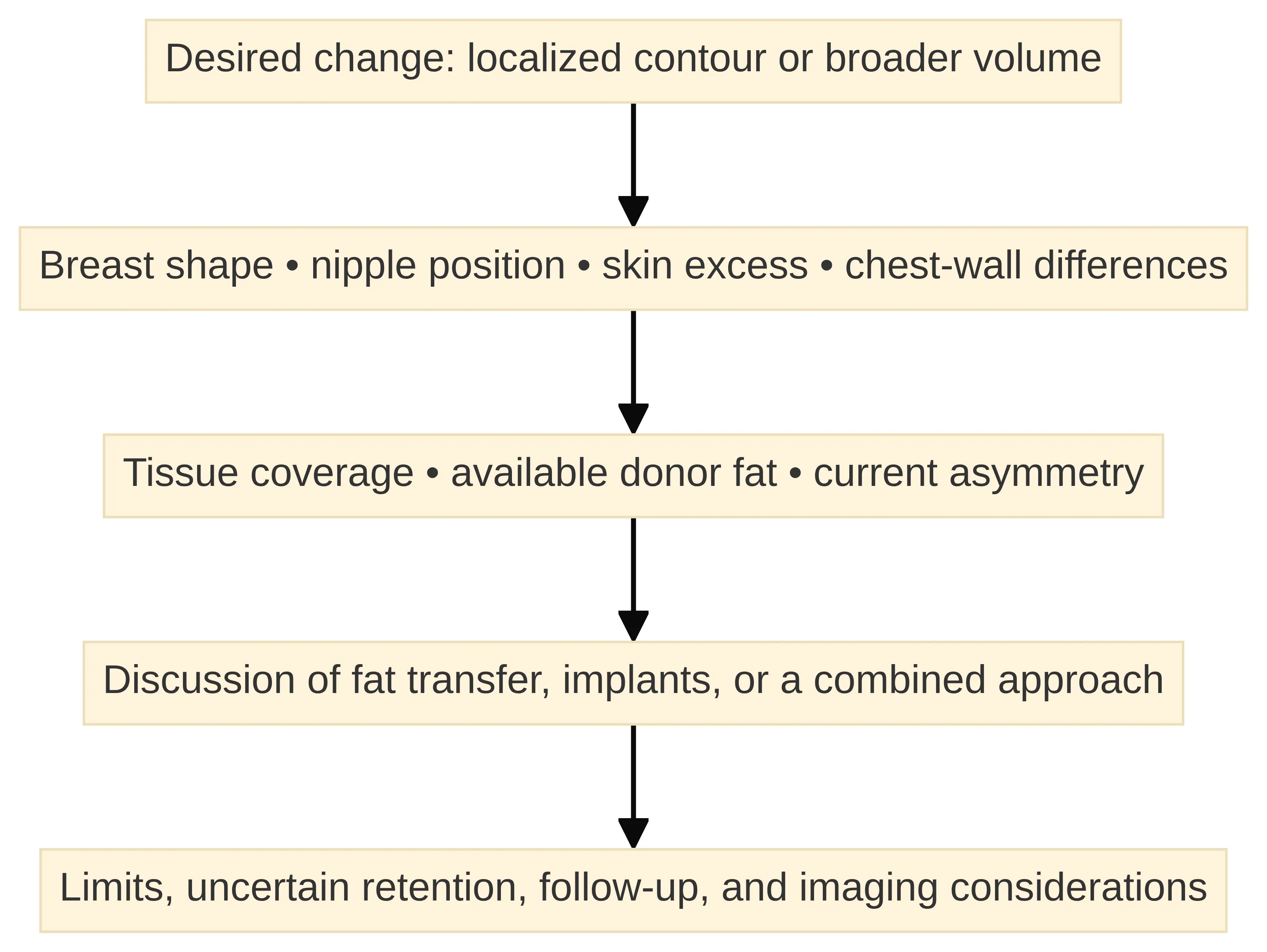
A concise consultation map
Desired change: localized contour or broader volume
                    ↓
Breast shape • nipple position • skin excess • chest-wall differences
                    ↓
Tissue coverage • available donor fat • current asymmetry
                    ↓
Discussion of fat transfer, implants, or a combined approach
                    ↓
Limits, uncertain retention, follow-up, and imaging considerations
The map is deliberately sequential. A desired look starts the conversation, but it does not settle the technique. In particular, available donor fat is not a minor detail added after breast planning; it is part of what makes a fat-transfer discussion possible at all. Likewise, breast features may explain why a surgeon discusses trade-offs rather than presenting a single visual goal as straightforwardly achievable.
For a productive appointment, it can help to describe the change in visual terms: more fullness across the breast, a softer transition in the upper portion, less noticeable unevenness, or a small adjustment to contour. Then ask how those goals relate to your existing shape, tissue coverage, and donor-fat availability. Ask what limitations would matter most in your case, and which parts of the goal should remain uncertain until examination.
A Narrow Breast Base With a Wish for Fullness
With a narrow breast base, “more fullness” can describe very different visual priorities. One person may mean a small contour change in a selected area; another may mean more fullness across the breast; another may be seeking a broader increase in overall volume. These requests need to be separated before choosing an approach.
For localized contour, targeted fat placement is one option. The surgeon examines the starting shape and identifies where fullness is wanted, while explaining that fat grafting is generally framed as a modest-volume option. A narrow base does not determine placement, candidacy, or a personal limit on the result.
When fullness means a broader volume goal, implants may enter the comparison because fat transfer may not be as effective for larger breasts or a larger overall increase. This is a difference in what each approach may be intended to address, not a ranking of one approach over another. In some circumstances, an implant may be paired with fat grafting for additional shaping.
This scenario gives the reader a specific way to describe the goal: identify whether the desired change is localized, distributed across the breast, or broadly volumizing. The surgeon can then explain how that distinction relates to the existing breast shape, available donor fat, and the uncertainty of retained volume.
Visible Asymmetry or Uneven Volume
Visible asymmetry can look like a volume issue while also reflecting differences in breast shape, nipple position, skin excess, or the way each breast sits on the chest wall. That is why this scenario begins by separating an observation—one side looks different—from a conclusion about which procedure should be used.
Fat may be placed with attention to a selected contour area, so it can be part of a conversation about uneven volume or contour. But targeted placement does not guarantee symmetry. The amount of grafted fat retained over time is uncertain, and a difference between the breasts may involve features that are not resolved by adding volume.
An in-person assessment can consider breast base, existing tissue, volume distribution, nipple level or direction, skin excess, and chest-wall differences. Those findings can clarify whether the visible concern is mainly about a localized contour, broader volume, or several features together. Fat transfer, implants, or a combined approach may then be discussed in relation to those limits and to available donor fat.
A useful description for this scenario is concrete rather than diagnostic: note whether the difference appears to involve volume, contour, nipple position, or how each breast sits. The clinical discussion can then address what may remain visible as well as what options can reasonably be considered.
Thinner Tissue or a Preference for a Softer Upper Pole
A reader who prefers a softer-looking upper-pole transition may wonder whether fat transfer should replace implants. The preference itself does not establish what any technique will look or feel like. It instead gives the consultation a visual priority to examine alongside tissue coverage, existing breast shape, volume goals, and donor-fat availability.
When tissue is thinner, coverage can become a central planning topic. A review of autologous fat grafting describes combined implant-and-fat grafting as an option used to improve implant coverage or camouflage implant edges in very thin patients with little subcutaneous fat or breast tissue. This does not mean thin tissue requires a combined procedure, and it does not predict a particular appearance or feel.
Here, the key distinction is contour refinement versus broader volume. Fat transfer directs volume to selected areas for contour-focused shaping. Broader overall volume brings implants into the comparison. A combined approach pairs volume with additional shaping, although retained fat volume remains uncertain.
The relevant questions are therefore specific: Is the upper-pole request about localized shaping, broader volume, or both? How do tissue coverage and available donor fat affect the options being considered? Which aspects of the desired appearance cannot be forecast reliably? These questions keep a preference from becoming a promise.
Retention Is the Variable Behind Every Visual Priority
Retention is not a separate technical footnote after a visual goal has been named. It changes how each of the three priorities can be discussed. With a narrow base and a wish for fullness, it limits certainty about how a contour-focused change may persist. With visible unevenness, it is one reason that added volume cannot be presented as a way to make breasts match. With an upper-pole preference, it limits how confidently additional shaping or coverage can be anticipated over time.
Published group findings provide context, not a personal forecast. One literature review reported mean retention of 62.4% after cosmetic breast fat grafting, with or without implants, over a mean follow-up of 16.6 months. The review also identifies important limits in those estimates: injected material may contain an unknown amount of fluid; imaging measurements can be affected by weight change or edema; follow-up is limited; and studies include different patient and clinical variables. A 2024 narrative review likewise found wide variation in reported first-year graft loss and noted that standardized protocols for collection, preparation, and injection remain lacking.
The practical implication is not to convert an average into a predicted breast change. It is to ask how retention uncertainty changes the particular visual priority under discussion and which aspects of that priority cannot be forecast reliably.
A clear comparison separates three issues that can otherwise become blurred together: the amount of volume being sought, the location where additional contour is wanted, and the uncertainty a person is prepared to discuss. Fat transfer may be relevant when the conversation centers on modest, contour-focused volume, but retained volume remains a limitation even when the desired change is localized. When the goal depends on a broader overall increase, the discussion may also include implants or a combined approach. This is not a self-selection rule; it is a way to make the trade-off explicit before an in-person assessment.
Why Follow-Up and Breast Imaging Belong in the Decision
A visual priority is only one part of the decision. Fat grafting can create nodules or calcifications that may resemble concerning findings on an examination or imaging. A review notes that these findings can mimic breast cancer and potentially delay diagnosis, so future breast evaluation belongs alongside the conversation about contour or volume.
This does not mean every person follows the same imaging path. A 2024 narrative review describes MRI as a precise method for volume assessment and for detecting complications such as oil cysts and necrosis, but that finding does not prescribe routine MRI for every patient. The appropriate follow-up and imaging discussion depends on the treating clinicians and the individual clinical context.
Complications also need to be considered without turning pooled research into an individual prediction. A systematic review summarized in a conference poster reported complications, including fat necrosis, among its included studies. These findings support a discussion of risks, follow-up, and communication with clinicians involved in later breast care; they do not calculate a personal outcome.
General information cannot evaluate a new breast finding or establish an individual screening schedule.
What the Three Visual Priorities Leave Open
The three visual priorities do not produce one standard answer. Fullness across a narrow base may clarify the difference between localized contour and broader volume. Unevenness may involve volume alongside shape, nipple position, skin excess, or chest-wall differences. An upper-pole preference brings tissue coverage and the difference between contour refinement and overall volume into view.
A modest, contour-focused goal can lead to a conversation about fat transfer. Broader volume goals bring implants into the comparison, while an implant-and-fat approach can pair volume with additional shaping. A qualified surgeon evaluates breast shape, nipple position, skin excess, chest-wall differences, tissue coverage, available donor fat, and retention uncertainty in person.
If concerns about implants are driving interest in fat transfer, discuss those concerns directly before surgery rather than assuming fat transfer resolves them. Include risks, follow-up, and breast-imaging considerations in the same conversation as the visual change you want to understand.
Frequently Asked Questions About Fat Transfer for Breast Enlargement
How does a visual priority change a fat-transfer discussion?
A request for fullness, less noticeable unevenness, or a different upper-pole transition may raise different questions about contour, broader volume, existing breast features, and the limits of general information. An in-person assessment is needed to determine what may be appropriate to discuss.
Is fat transfer intended for a large breast-volume increase?
For broader volume goals, implants may enter the discussion. Neither general description predicts an individual result.
Why is retained volume important to every visual priority?
The amount of grafted fat retained over time is uncertain. That uncertainty means a contour change, an attempt to address unevenness, or additional shaping should not be treated as a predictable outcome.
Can fat transfer and implants be discussed together?
Yes. A combined approach can pair an implant with fat grafting for additional breast shaping. Whether that approach is relevant requires clinical assessment.
Why should later breast imaging be part of the conversation?
Fat grafting can create nodules or calcifications that may resemble concerning findings on examination or imaging. Discussing treatment history, follow-up, and coordination with clinicians involved in future breast care can help place later findings in context.
Leave a Reply