
Tag: fat transfer breast augmentation

  • Breast Augmentation: Build a Responsibility Profile Before a Consultation

    Breast Augmentation: Build a Responsibility Profile Before a Consultation

    Define the Terms Before Assigning Responsibilities

    Breast augmentation is surgery intended to increase breast size. Although people often use “breast augmentation” and “breast implants” as if they mean the same thing, they describe different things: augmentation is the procedure, while implants are prosthetic devices that may be used during it.

    That distinction matters before you decide whether to book a consultation. The first question is not simply, “Which implant should I get?” It is, “What change am I hoping to discuss, and which approach might fit that conversation?” Implant-based augmentation is one pathway, but it is not the only one. Fat transfer and a discussion of breast lift surgery may also be relevant depending on the change a person wants to explore.

    General information can help you arrive prepared to discuss those pathways. It cannot determine whether surgery is appropriate for you, select an approach, predict a visual result, or replace a clinical assessment. Your anatomy, health history, breast tissue, goals, prior procedures, reproductive plans, and tolerance for future care all belong in an individualized conversation with a qualified clinician.

    A useful starting point is to write a short description of your goal without naming a solution: for example, whether you want to discuss added volume, a change in shape, concerns about breast position, or more than one of these. That keeps the consultation centered on the change you want to understand rather than on a device or procedure chosen before the assessment.

    Map the Responsibilities Attached to Each Discussion Pathway

    Use these categories to identify terms that need explanation, not to select a procedure for yourself. A clinical consultation is where their different purposes, trade-offs, and responsibilities can be discussed in relation to your situation.

    Pathway to discuss What it involves Questions and boundaries to carry forward
    Implant-based augmentation In implant-based augmentation, implants are placed under breast tissue or chest muscles. Implant options are commonly described as silicone or saline. Ask how the proposed device, placement, incision, risks, breast screening communication, and long-term follow-up relate to your goals. Implant-specific responsibilities should be part of the decision from the outset.
    Fat transfer Augmentation may also be performed with fat transfer, using fat taken from the body and injected into the breasts. Ask what this method is intended to address in your individual situation and what trade-offs the clinician considers relevant. Do not assume it is interchangeable with implant-based augmentation simply because both are forms of augmentation.
    Breast lift discussion A breast lift is distinct from implant augmentation: it reshapes existing breast tissue and does not itself use implants. If breast position or sagging is part of your concern, ask whether a lift should be discussed alongside or instead of augmentation. Implants do not prevent breast sagging. A clinician may discuss a lift in addition to augmentation after an individual assessment.

    The practical takeaway is that “more volume,” “more upper fullness,” and “a breast position concern” are not automatically the same problem. Rather than treating implants and fat transfer as competing answers, use the consultation to identify the responsibilities and unanswered questions each pathway introduces. A lift has a separate purpose from implant augmentation. Bringing those distinctions into the consultation helps prevent a narrow conversation in which the method is assumed before the goal is clear.

    If you are unsure which pathway applies, that uncertainty is itself worth bringing forward. State what you notice, what you hope to change, and what you do not want to assume. The clinician’s role is to assess the relevant options; your role is to make sure the discussion addresses the questions that matter to you.
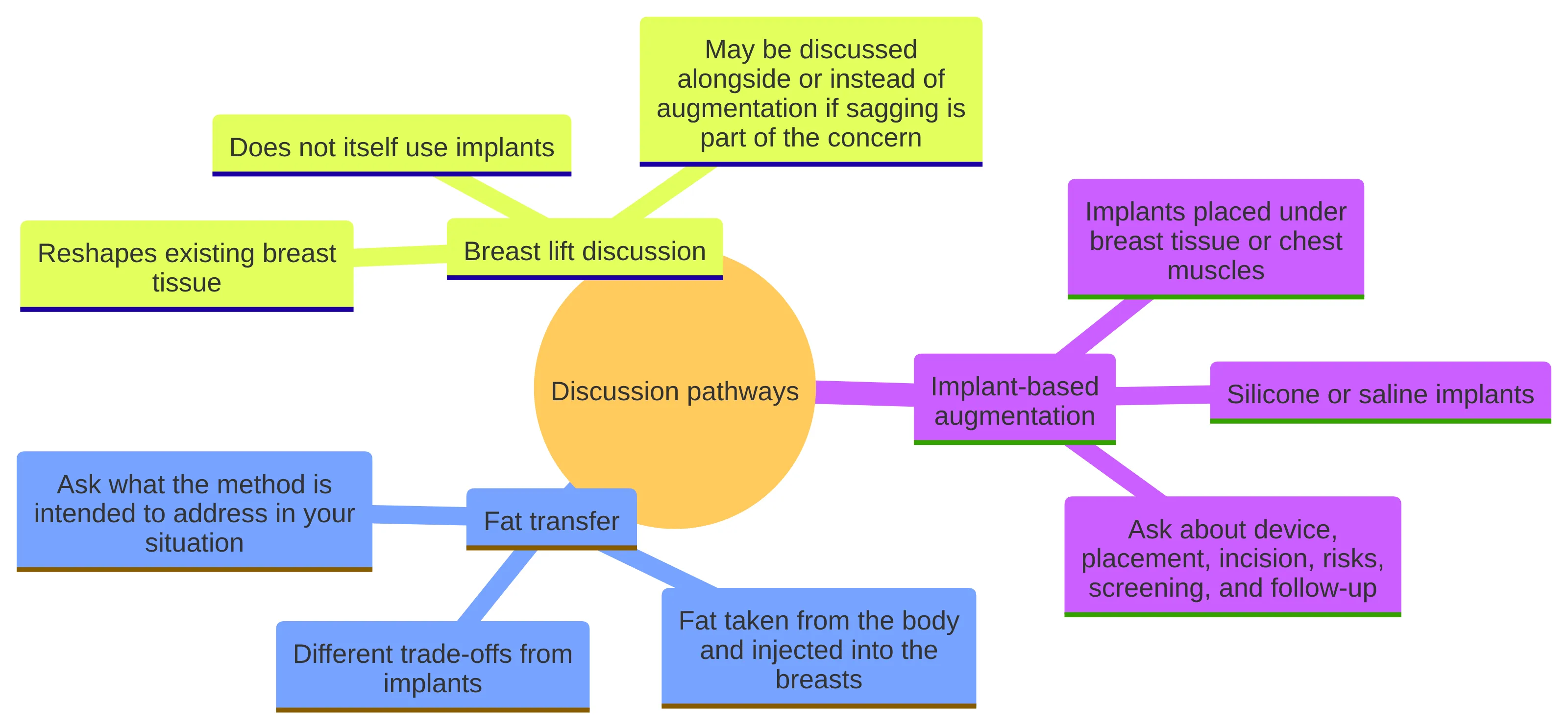
    A mindmap showing three breast augmentation discussion pathways: implant-based augmentation, fat transfer, and breast lift discussion.
    Breast augmentation can lead to different consultation pathways, each with its own questions and trade-offs.

    Build a Breast Augmentation Responsibility Profile

    Use this as a responsibility-routing profile, not as a candidacy checklist or a way to compare yourself with another patient. Instead of ranking pathways or predicting an outcome, place each question in the lane that can answer it: general information, individualized clinical planning, or implant-specific device information. Then connect the unresolved questions to the pathway that creates them. The purpose is to prevent a general fact, a device document, or a personal clinical decision from being treated as interchangeable.

    1. Name the question before naming the pathway. Write the change you want to discuss in ordinary language, such as volume, shape, position, or asymmetry. Then create three notes for it: what general information can clarify, what requires individualized clinical planning, and what device information would matter if implants enter the discussion.

    2. Separate the pathways. Keep implant-based augmentation, fat transfer, and a lift discussion in separate entries. For implants, the profile must include device information and long-term care; for fat transfer, it must include the separate questions created by using fat taken from another body area; for a lift, it must preserve the distinction between position and implant-based volume.

    3. Mark plan-dependent responsibilities. Record the incision, placement, and anesthesia questions only as items for clinical explanation. General descriptions can show what needs discussion but cannot establish a plan for you.

    4. Attach device duties only where they belong. If implants are under consideration, add patient-labeling materials, implant-specific complications, breast-screening communication, and the possibility of future procedures. Breast implants are not lifetime devices, and future surgery may be needed for reasons including rupture or changes in the breasts or body.

    5. Record life considerations separately. Keep breastfeeding questions and practical recovery-support questions distinct from device information. Breastfeeding after augmentation is possible for some people but can be challenging for others.

    6. Test the routing, not just the list. Ask whether each entry is assigned to the right answer source: general explanation, clinician discussion, or approved device labeling. If travel or distance could affect care, place continuity and follow-up questions in the clinician-discussion lane rather than assuming an arrangement.

    7. Set a discussion boundary. End with the responsibility you would need explained before deciding whether to continue exploring that pathway. An unresolved material responsibility is a reason to seek clarification, not a conclusion about suitability.

    This profile does not tell you which option to choose. It helps you test whether you understand the terms, uncertainties, and responsibilities well enough to have a more informed clinical conversation. Signed documentation alone may not establish understanding; ask for clarification when you cannot explain a material point in your own words.

    Reserve Surgical-Plan Choices for Individual Explanation

    It is tempting to turn procedural details into preferences before meeting a clinician. In practice, they are planning questions. The cited clinical source lists incision locations at the breast crease, under the arm, and around the nipple. It also notes that anesthesia planning varies: local anesthesia may be used, while general anesthesia is often used.

    Those facts are useful because they show that breast augmentation is not a single, standardized sequence of choices. They are not a basis for choosing an incision or anesthesia plan for yourself. The relevant decision depends on the procedure being discussed and on individual clinical planning.

    Use the consultation to ask direct, bounded questions: Which incision locations are being considered in my case? What factors are shaping that discussion? What anesthesia approach is planned, and who will explain its role? What should I understand about the surgical plan before consenting? Ask for explanations in language you can repeat back. A clear answer should help you understand the proposed plan and its rationale, not merely give you a term to search online.

    It is also reasonable to pause if a material choice remains unclear. Elective surgery allows room to seek clarification, review information, and decide whether you understand the proposed approach well enough to proceed.

    Add Implant-Specific Safety Responsibilities to the Profile

    For someone considering implant-based augmentation, safety is not a short disclosure at the end of the consultation. It is part of deciding whether the pathway fits your priorities. In the United States, the FDA lists breast pain, changes in nipple or breast sensation, additional surgery, capsular contracture, rupture or deflation, and possible breastfeeding impact among implant risks and complications.

    Some terms deserve plain-language discussion. FDA defines capsular contracture as tightening of tissue around an implant that can cause firmness or hardening and, when severe, squeeze the implant. FDA defines rupture as a tear or hole in an implant’s outer shell. FDA states that severe capsular contracture may require reoperation and can recur after corrective surgery.

    The FDA also identifies BIA-ALCL, a type of non-Hodgkin lymphoma, among breast-implant-associated risks. It lists reports of squamous cell carcinoma, lymphomas other than BIA-ALCL, and mesenchymal tumors including sarcoma among breast-implant concerns. These are consequential topics to review carefully in a device-specific conversation; they should not be minimized, generalized into a prediction about an individual, or treated as a reason to skip informed discussion.

    Long-term planning also includes the possibility of later procedures.

    FDA directs readers to approved implant patient labeling for complete complication lists and rates. Ask for the patient labeling for any implant under discussion and review it before making a final decision. In 2021, FDA strengthened breast-implant risk-communication requirements, including sales and distribution restrictions intended to support informed decisions.

    A productive consultation question is not “Will I need another surgery?” because no one can promise a personal answer. Ask instead: “What future procedures might become relevant, what circumstances could lead to them, and what does the device labeling say about complications and rates?” That question keeps uncertainty visible without converting it into either reassurance or alarm.

    Keep Variable Implant Lifespan and Consent Questions Visible

    Do not treat an implant as a lifetime purchase with a fixed expiration date. Available clinical information gives different typical estimates—about 10 years in one source and about 10–15 years for possible replacement or revision in another—so implant lifespan should be treated as variable rather than fixed. The same source notes that rupture and changes in the breasts or body can lead to further surgery. The more useful planning stance is to understand that implant-based augmentation can involve long-term attention and that future decisions may be necessary.

    Meaningful consent is more than signing a form. The cited informed-consent article describes inconsistency in cosmetic-surgery consent practices and cautions that signed documentation alone may not establish understanding. If you cannot explain the proposed procedure, alternatives, material risks, expected follow-up, and future-care responsibilities in your own words, ask for a slower explanation.

    In one international respondent survey, 63.2% reported two face-to-face consultations with physical examination before cosmetic surgery, while 31.2% reported one. This describes respondents’ practices, not a universal requirement. Likewise, most respondents believed the performing surgeon should be responsible for consent and postoperative management, including in surgical-tourism cases; that is a survey finding rather than a universal legal or clinical standard.

    For a reader, the practical lesson is straightforward: prioritize continuity, clarity, and enough time to consider what you have learned. If travel is part of your plan, ask specifically who handles postoperative management, how follow-up is arranged, and what information should travel with you. Do not rely on an online exchange alone to settle questions that require physical examination and individualized planning.

    Turn the Responsibility Profile Into a Consultation Agenda

    Before scheduling or after a consultation, use a short written routing agenda organized by answer source and pathway. You do not need to know the answers in advance. Its purpose is to show which points belong in general education, which require individualized explanation, which should be checked against implant labeling, and which pathway-specific responsibilities remain unresolved.

    • What change do I want to discuss, and what responsibility might that discussion introduce without selecting a procedure in advance?
    • Which pathway is being discussed—implant-based augmentation, fat transfer, or a lift—and what purpose does each term describe?
    • If implants are under consideration, what device information and patient labeling should I review?
    • Which responsibilities belong specifically to the implant, including capsular contracture, rupture or deflation, sensation changes, breast screening communication, and possible additional surgery?
    • What questions about fat transfer or a lift should remain separate from implant responsibilities?
    • Which incision, placement, and anesthesia choices require an individualized explanation?
    • What recovery-support, follow-up, and continuity questions remain unanswered?
    • What future revision or removal possibilities should I understand without treating them as a prediction?
    • Which responsibility would I need explained before deciding whether to continue exploring this pathway?

    A useful consultation should help you complete your responsibility profile by showing which pathway is being discussed, what responsibilities it creates, and which questions remain individualized. Take time to review device information when implants are discussed, keep alternatives distinct, and pause when you cannot explain a material part of the proposed plan to your satisfaction.


    Frequently Asked Questions About Breast Augmentation Responsibilities

    What is the difference between breast augmentation and breast implants?

    Augmentation is the procedure intended to increase breast size, while implants are the prosthetic devices often used in that procedure. The terms are often used together, but they are not the same thing.

    What options are usually discussed besides implant-based augmentation?

    Fat transfer and a breast lift may also come up, depending on the change you want to discuss. Each pathway has different trade-offs, so it helps to clarify whether your main concern is volume, shape, position, or more than one of these.

    What should I ask about implant safety if implants are part of the discussion?

    Ask about the risks and complications that are most relevant to the specific device and plan being discussed, including capsular contracture, rupture or deflation, sensation changes, and the possibility of additional surgery. It is also reasonable to ask for the patient labeling and to review it before deciding.

    Will implants stop breast sagging?

    No. Implants do not prevent sagging. If breast position is part of your concern, a clinician may discuss whether a lift should be considered along with or instead of augmentation after an individual assessment.

    What long-term issues should I bring up if I am considering surgery?

    Plan to discuss breast screening, possible future procedures, and any breastfeeding concerns that matter to you. Breast implants may require additional mammographic views, and future surgery can become relevant if the implant or breast changes over time.


  • Breast Augmentation: How to Read Procedure, Device, and Outcome Information Before a Consultation

    Breast Augmentation: How to Read Procedure, Device, and Outcome Information Before a Consultation

    Start With What Each Source Can Actually Establish

    Breast augmentation information comes from different kinds of sources, and each source answers a different kind of question. A procedure description can define terms. FDA materials can identify device-specific responsibilities and risks. Research can describe findings across groups. None of those sources can determine whether a procedure is appropriate for you.

    This guide focuses on how to read that information before deciding whether to seek a consultation. The central question is not which source sounds most reassuring. It is what the source can establish, what it cannot establish, and which questions still need individualized discussion.

    Breast augmentation is a broad procedure category, not a synonym for breast implants. It can use breast implants or fat transfer to increase breast size, and it is also known as augmentation mammoplasty. When a person’s own fat is used to add breast volume, the procedure is called fat-transfer breast augmentation.

    As you encounter a claim, identify its source type before relying on it:

    1. Procedure background defines a treatment category or describes what it involves.
    2. Device and regulatory material addresses the particular responsibilities and risk information associated with implants.
    3. Research evidence reports patterns in studied groups, not an individual forecast.
    4. Clinical discussion is where health history, examination findings, anatomy, and personal priorities can be considered together.

    Keeping those roles distinct helps prevent a general statement from becoming a personal conclusion. It also keeps “breast implants” in its proper place: one possible approach within breast augmentation, rather than another name for every augmentation procedure.

    Read Goal Statements and Procedure Limits Separately

    A statement about what breast augmentation may address is useful background, but it is not evidence that it will address every concern a reader has. Potential goals discussed for breast augmentation can include restoring volume after weight reduction or pregnancy, changing breast shape, or addressing natural size asymmetry. Read those as examples of topics for discussion, not as promised results.

    It is equally important to notice when a source states a limit. Breast augmentation alone does not correct severe breast drooping. That tells readers that volume and breast position are not interchangeable questions. It does not establish what combination of procedures, if any, belongs in an individual plan.

    When reviewing a website, article, or image, test the claim with three questions:

    • Does it describe a general purpose of augmentation, or does it imply an outcome for a particular person?
    • Does it identify a limitation as clearly as it identifies a possible benefit?
    • Does it explain whether the issue being discussed is volume, shape, asymmetry, position, or more than one of these?

    Reference images can help someone describe a visible feature, but they do not establish a personal result. If an image is useful, use it to name the feature you want to ask about rather than as proof that the same appearance can be achieved. A responsible source leaves room for anatomy, examination findings, and professional judgment rather than presenting an appearance concern as though it has one automatic solution.

    This approach preserves the value of general information without asking it to settle a clinical question it cannot answer.

    Compare Procedure Descriptions Without Treating Them as Selection Advice

    Procedure descriptions are most useful when they explain what a label means without implying that the label selects itself. Implant-based augmentation and fat-transfer augmentation involve different background information, but neither description determines which approach is appropriate for a particular person.

    Information to check Implant-based augmentation Fat-transfer augmentation
    What the label establishes In the United States, FDA-approved breast implants for sale are saline-filled or silicone gel-filled. Both types have a silicone outer shell and vary in size, shell thickness, surface texture, and shape. Fat-transfer augmentation uses liposuction to collect fat from elsewhere in the body for injection into the breasts.
    What the label does not establish A device category does not determine whether a specific device or surgical plan fits an individual’s anatomy, health history, or goals. A description of the process does not determine whether a person is suitable for a two-area procedure.
    What needs further explanation The relevant labeling, risks, monitoring, and potential future device responsibilities. The questions raised by both the donor area and the breast-volume discussion.

    ASPS describes fat transfer as an option often discussed for relatively small increases in size. That is a description of the context in which it may be discussed, not a recommendation or a prediction of an individual result.

    A useful source comparison does not rank these pathways. Instead, it makes clear whether the material is defining a procedure, describing an FDA-regulated device, or making a claim that depends on individual evaluation. If a source moves quickly from a broad description to a conclusion about what you should choose, treat that conclusion as a question to examine in a consultation rather than as settled information.

    Recognize When General Material Reaches Its Limit

    General educational material has a clear boundary: it cannot combine your health information and anatomy into a surgical conclusion. A breast-augmentation consultation may review general health, pre-existing conditions and risk factors, breast anatomy and measurements, options, likely outcomes, and potential complications. Those are not details an online article can evaluate for an individual reader.

    This is a useful standard for judging the limits of a source. Reliable general information can help you recognize which categories belong in a consultation, but it should not tell you that a medication, prior procedure, body feature, or future plan makes an approach right or wrong for you.

    Before a visit, prepare a factual account of relevant medical history, prior breast procedures, medications or supplements, and future considerations that matter to you. The purpose is not to self-screen. It is to make sure the clinician has the information needed for an individualized discussion.

    If breastfeeding is a future consideration, ask about potential implant-related impacts. The FDA identifies possible impacts on breastfeeding among the issues to consider with breast implants. That statement is not a prediction about an individual’s ability to breastfeed.

    A source is being appropriately cautious when it distinguishes background information from the evaluation needed to apply it. Look for that distinction whenever a claim refers to anatomy, health history, likely outcomes, or personal suitability.

    Read Research Findings as Context, Not a Personal Prediction

    Research can add useful context to an augmentation discussion, but study findings need to be read at the level they were produced. They describe results in groups under particular study conditions; they do not predict satisfaction, well-being, or complications for one reader.

    One systematic review and meta-analysis synthesized 39 studies involving 18,322 patients. It found improvements in several patient-reported outcomes on average, including satisfaction with breasts and psychosocial and sexual well-being. Physical well-being findings were mixed and varied by technique and follow-up. The appropriate takeaway is neither that benefits are assured nor that research is irrelevant. It is that favorable average findings coexist with variation and uncertainty.

    A multicenter observational study reached a related limit: measured preoperative patient, anatomy, and implant-related factors explained only a limited share of variation in satisfaction at six months. That finding is a reason to avoid treating a checklist of preoperative traits as a personal forecast.

    Regulatory risk information should be read with the same care. For implant-based augmentation, FDA-listed risks include pain or changes in nipple or breast sensation, capsular contracture, rupture or deflation, and possible additional surgery or removal. These are recognized risk categories, not a way to calculate a reader’s personal likelihood of experiencing them.

    For device-specific complication lists and rates, consult the patient labeling for the particular approved implant under consideration. The FDA directs readers to those materials because risk information is tied to a particular device, not to a general idea of implants. A source that names a risk while omitting its device-specific context may be incomplete; a source that turns a group result into an individual promise goes beyond what the evidence can support.

    Use FDA Device Materials for Long-Term Implant Questions

    Implant information should be read as long-term device information, not merely as a description of surgery day. FDA labeling recommendations for saline and silicone gel-filled implants include a patient decision checklist and patient device card information. These materials are valuable because they connect a proposed device to its warnings, information, and ongoing responsibilities.

    If implants are being considered, ask to review the implant labeling, including the patient decision checklist and device card information. Keep the manufacturer and model information for an implant, such as the information provided on a patient device card. Retaining that information supports later conversations about the device.

    The FDA advises that implant discussions include goals and expectations, benefits and risks, monitoring for complications for as long as implants are present, and the possibility of eventual removal or replacement. This framing is important when assessing promotional material: a complete explanation should not describe an implant only in terms of an immediate appearance goal while leaving out continuing responsibilities.

    BIA-ALCL is a T-cell lymphoma that can develop following breast implants. FDA states that it appears more often in patients with textured implants and that most cases occur years after placement and present with changes around the implant. Persistent swelling, a mass, or pain around an implant warrants discussion with a healthcare provider for evaluation. For people without symptoms, FDA does not recommend removal solely over BIA-ALCL concern; individual concerns should be discussed with a healthcare professional.

    Recovery instructions require individualized guidance from the clinical team. General online material should not be treated as a personal timetable, activity clearance, or substitute for procedure-specific instructions. Keep recovery questions separate from the device materials so that neither is mistaken for the other.

    Use What You Learned to Prepare a Focused Consultation

    A consultation is the place to test whether the information you found is complete, applicable, and clearly explained. Bring the sources or claims that influenced your thinking, especially any that seemed to promise a result, minimize a limitation, or make a device choice sound automatic.

    Use the conversation to ask what a statement actually refers to. Is it a general procedure definition, a device-specific labeling point, a research finding across groups, or an explanation based on your own health history and examination? That distinction can clarify why a persuasive online claim may still be insufficient for a decision.

    ASPS recommends selecting a board-certified plastic surgeon and suggests considering an ASPS member. A consultation may review health history and risk factors, breast anatomy and measurements, options, likely outcomes, and potential complications. Use the consultation to ask questions and document answers.

    Useful questions include:

    • Which statements from the materials I reviewed apply generally, and which require individualized interpretation?
    • If implants are discussed, which labeling and device records should I review and retain?
    • What limitations, risks, follow-up responsibilities, and possible future procedures need explanation before I decide whether to continue?
    • Which unanswered questions depend on examination findings or other clinical information?

    You may decide to pause after the visit if important information remains unclear. The goal is not to collect more claims than you can assess; it is to leave with a clearer understanding of the evidence, the limits of general information, and the questions that need professional evaluation.

    Frequently Asked Questions About Sorting Breast Augmentation Information

    What is the difference between breast augmentation and breast implants?

    Breast augmentation is the broader procedure category. It can be done with implants or with fat transfer, while breast implants are one option within that category.

    How can I tell whether a proposed approach has been explained clearly?

    Ask what concern it is intended to address, what general information supports discussing it, what still requires individual evaluation, and what commitments or limitations come with it. A clear explanation should distinguish those categories.

    What should I review if implants are being discussed?

    Review the specific implant type and its labeling, including the patient decision checklist and device card information. Discuss the main risks, how follow-up works over time, what changes warrant evaluation, and which device records to retain.

    How do saline and silicone gel implants differ in a consultation?

    Both are FDA-approved implant types in the United States and both have a silicone outer shell. A consultation may also cover size, shell thickness, surface texture, and shape in relation to the goals and anatomy being evaluated.

    Can research predict whether I will be satisfied after breast augmentation?

    No. A meta-analysis found improvements in several patient-reported outcomes on average, but those findings do not predict an individual experience. An observational study also found that measured preoperative factors explained only a limited share of variation in satisfaction at six months.

    What should I do if I still do not understand why an option was raised?

    Ask for the reasoning in plain language and request that the explanation connect your stated concern, the information considered, the limits of the option, and the responsibilities involved. General information cannot replace an individualized clinical explanation.

  • Fat Transfer for Breast Enlargement: How Three Visual Priorities Change the Conversation

    Fat Transfer for Breast Enlargement: How Three Visual Priorities Change the Conversation

    Three Visual Priorities, Not One Standard Fat-Transfer Decision

    Fat transfer for breast enlargement uses liposuction to harvest fat from another body area and inject it into the breasts. Because the procedure involves both a donor area and the breasts, it is not simply another way to request a certain amount of volume.

    This article uses three visual priorities to make the subject more specific: fullness across a narrow breast base, visible unevenness between the breasts, and an upper-pole preference in thinner tissue. Each priority changes the meaning of “more volume.” It may point toward a localized contour concern, a broader-volume goal, or a concern involving shape and tissue coverage as well as volume. These general descriptions do not predict a cup size or an individual result.

    Fat can be placed with attention to selected breast areas, making it relevant to a contour-focused discussion. The amount of grafted fat retained over time remains uncertain, however. Reading the three priorities separately helps show why the same uncertainty matters differently when the desired change concerns fullness, unevenness, or an upper-pole transition.

    Reading Breast Features Within Each Visual Priority

    Each visual priority directs attention to different features of the existing breast, but none supplies a conclusion on its own. Fullness across a narrow base raises a different descriptive question from uneven volume between the breasts or a preference for a softer-looking upper-pole transition. A qualified surgeon assesses breast base and overall shape, nipple level or position, skin excess, chest-wall differences, tissue coverage, and available donor fat in person.

    These features help describe what is being seen rather than serving as a reader-operated test. A narrow base does not establish that fat transfer is appropriate. Visible asymmetry does not establish that one technique will make breasts match. Thin tissue does not establish that fat will create a particular feel. Their value is in showing why a request that sounds simple can contain more than one visual concern.

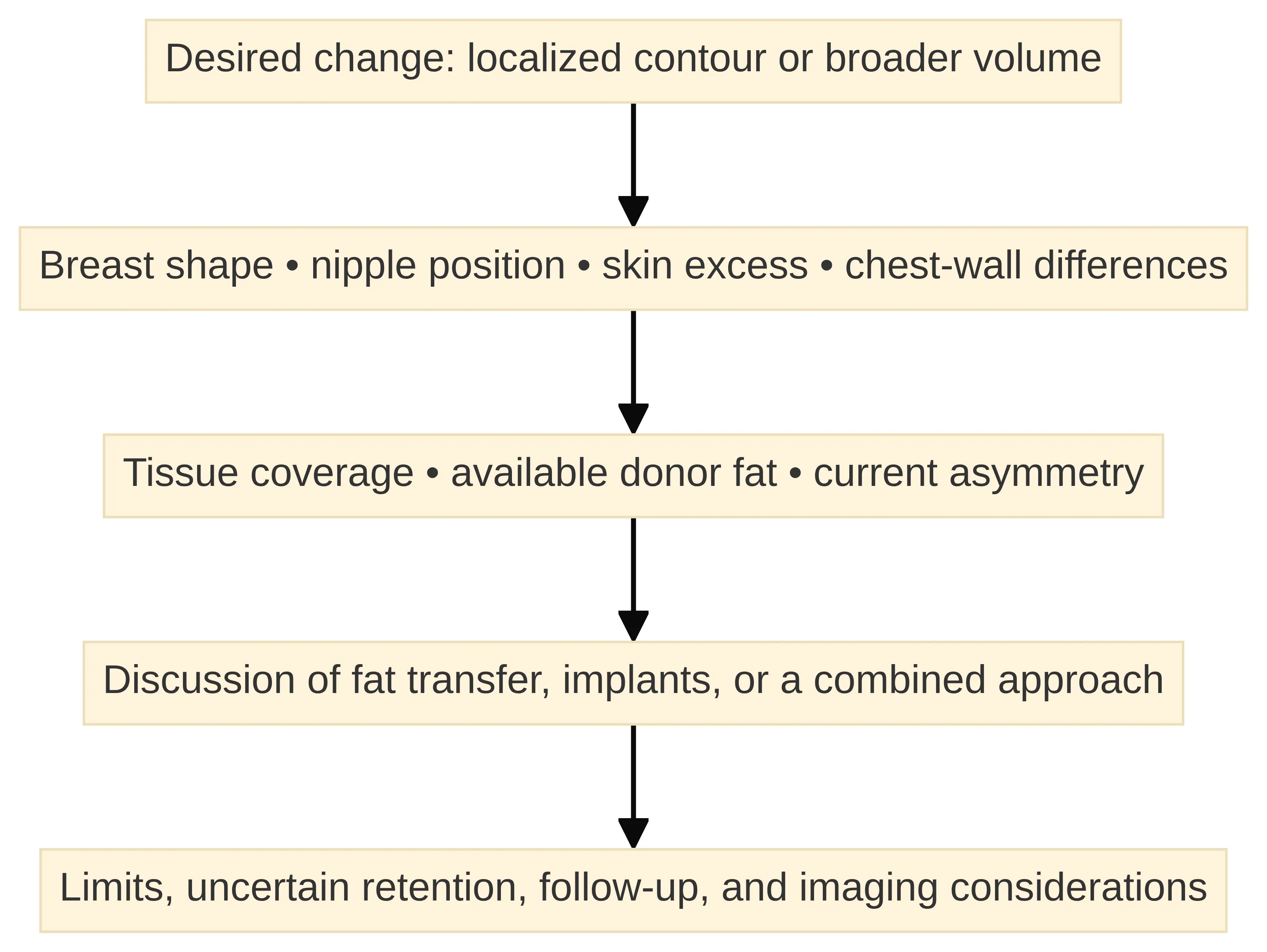
    A concise consultation map

    Desired change: localized contour or broader volume
                        ↓
    Breast shape • nipple position • skin excess • chest-wall differences
                        ↓
    Tissue coverage • available donor fat • current asymmetry
                        ↓
    Discussion of fat transfer, implants, or a combined approach
                        ↓
    Limits, uncertain retention, follow-up, and imaging considerations
    

    The map is deliberately sequential. A desired look starts the conversation, but it does not settle the technique. In particular, available donor fat is not a minor detail added after breast planning; it is part of what makes a fat-transfer discussion possible at all. Likewise, breast features may explain why a surgeon discusses trade-offs rather than presenting a single visual goal as straightforwardly achievable.

    For a productive appointment, it can help to describe the change in visual terms: more fullness across the breast, a softer transition in the upper portion, less noticeable unevenness, or a small adjustment to contour. Then ask how those goals relate to your existing shape, tissue coverage, and donor-fat availability. Ask what limitations would matter most in your case, and which parts of the goal should remain uncertain until examination.

    A four-step consultation flow from the desired breast change to anatomy factors, donor fat and tissue coverage, treatment options, and follow-up considerations.
    A consultation should move from the desired change to anatomy, donor fat, option selection, and follow-up concerns.

    A Narrow Breast Base With a Wish for Fullness

    With a narrow breast base, “more fullness” can describe very different visual priorities. One person may mean a small contour change in a selected area; another may mean more fullness across the breast; another may be seeking a broader increase in overall volume. These requests need to be separated before choosing an approach.

    For localized contour, targeted fat placement is one option. The surgeon examines the starting shape and identifies where fullness is wanted, while explaining that fat grafting is generally framed as a modest-volume option. A narrow base does not determine placement, candidacy, or a personal limit on the result.

    When fullness means a broader volume goal, implants may enter the comparison because fat transfer may not be as effective for larger breasts or a larger overall increase. This is a difference in what each approach may be intended to address, not a ranking of one approach over another. In some circumstances, an implant may be paired with fat grafting for additional shaping.

    This scenario gives the reader a specific way to describe the goal: identify whether the desired change is localized, distributed across the breast, or broadly volumizing. The surgeon can then explain how that distinction relates to the existing breast shape, available donor fat, and the uncertainty of retained volume.

    Visible Asymmetry or Uneven Volume

    Visible asymmetry can look like a volume issue while also reflecting differences in breast shape, nipple position, skin excess, or the way each breast sits on the chest wall. That is why this scenario begins by separating an observation—one side looks different—from a conclusion about which procedure should be used.

    Fat may be placed with attention to a selected contour area, so it can be part of a conversation about uneven volume or contour. But targeted placement does not guarantee symmetry. The amount of grafted fat retained over time is uncertain, and a difference between the breasts may involve features that are not resolved by adding volume.

    An in-person assessment can consider breast base, existing tissue, volume distribution, nipple level or direction, skin excess, and chest-wall differences. Those findings can clarify whether the visible concern is mainly about a localized contour, broader volume, or several features together. Fat transfer, implants, or a combined approach may then be discussed in relation to those limits and to available donor fat.

    A useful description for this scenario is concrete rather than diagnostic: note whether the difference appears to involve volume, contour, nipple position, or how each breast sits. The clinical discussion can then address what may remain visible as well as what options can reasonably be considered.

    Thinner Tissue or a Preference for a Softer Upper Pole

    A reader who prefers a softer-looking upper-pole transition may wonder whether fat transfer should replace implants. The preference itself does not establish what any technique will look or feel like. It instead gives the consultation a visual priority to examine alongside tissue coverage, existing breast shape, volume goals, and donor-fat availability.

    When tissue is thinner, coverage can become a central planning topic. A review of autologous fat grafting describes combined implant-and-fat grafting as an option used to improve implant coverage or camouflage implant edges in very thin patients with little subcutaneous fat or breast tissue. This does not mean thin tissue requires a combined procedure, and it does not predict a particular appearance or feel.

    Here, the key distinction is contour refinement versus broader volume. Fat transfer directs volume to selected areas for contour-focused shaping. Broader overall volume brings implants into the comparison. A combined approach pairs volume with additional shaping, although retained fat volume remains uncertain.

    The relevant questions are therefore specific: Is the upper-pole request about localized shaping, broader volume, or both? How do tissue coverage and available donor fat affect the options being considered? Which aspects of the desired appearance cannot be forecast reliably? These questions keep a preference from becoming a promise.

    Retention Is the Variable Behind Every Visual Priority

    Retention is not a separate technical footnote after a visual goal has been named. It changes how each of the three priorities can be discussed. With a narrow base and a wish for fullness, it limits certainty about how a contour-focused change may persist. With visible unevenness, it is one reason that added volume cannot be presented as a way to make breasts match. With an upper-pole preference, it limits how confidently additional shaping or coverage can be anticipated over time.

    Published group findings provide context, not a personal forecast. One literature review reported mean retention of 62.4% after cosmetic breast fat grafting, with or without implants, over a mean follow-up of 16.6 months. The review also identifies important limits in those estimates: injected material may contain an unknown amount of fluid; imaging measurements can be affected by weight change or edema; follow-up is limited; and studies include different patient and clinical variables. A 2024 narrative review likewise found wide variation in reported first-year graft loss and noted that standardized protocols for collection, preparation, and injection remain lacking.

    The practical implication is not to convert an average into a predicted breast change. It is to ask how retention uncertainty changes the particular visual priority under discussion and which aspects of that priority cannot be forecast reliably.

    A clear comparison separates three issues that can otherwise become blurred together: the amount of volume being sought, the location where additional contour is wanted, and the uncertainty a person is prepared to discuss. Fat transfer may be relevant when the conversation centers on modest, contour-focused volume, but retained volume remains a limitation even when the desired change is localized. When the goal depends on a broader overall increase, the discussion may also include implants or a combined approach. This is not a self-selection rule; it is a way to make the trade-off explicit before an in-person assessment.

    Why Follow-Up and Breast Imaging Belong in the Decision

    A visual priority is only one part of the decision. Fat grafting can create nodules or calcifications that may resemble concerning findings on an examination or imaging. A review notes that these findings can mimic breast cancer and potentially delay diagnosis, so future breast evaluation belongs alongside the conversation about contour or volume.

    This does not mean every person follows the same imaging path. A 2024 narrative review describes MRI as a precise method for volume assessment and for detecting complications such as oil cysts and necrosis, but that finding does not prescribe routine MRI for every patient. The appropriate follow-up and imaging discussion depends on the treating clinicians and the individual clinical context.

    Complications also need to be considered without turning pooled research into an individual prediction. A systematic review summarized in a conference poster reported complications, including fat necrosis, among its included studies. These findings support a discussion of risks, follow-up, and communication with clinicians involved in later breast care; they do not calculate a personal outcome.

    General information cannot evaluate a new breast finding or establish an individual screening schedule.

    What the Three Visual Priorities Leave Open

    The three visual priorities do not produce one standard answer. Fullness across a narrow base may clarify the difference between localized contour and broader volume. Unevenness may involve volume alongside shape, nipple position, skin excess, or chest-wall differences. An upper-pole preference brings tissue coverage and the difference between contour refinement and overall volume into view.

    A modest, contour-focused goal can lead to a conversation about fat transfer. Broader volume goals bring implants into the comparison, while an implant-and-fat approach can pair volume with additional shaping. A qualified surgeon evaluates breast shape, nipple position, skin excess, chest-wall differences, tissue coverage, available donor fat, and retention uncertainty in person.

    If concerns about implants are driving interest in fat transfer, discuss those concerns directly before surgery rather than assuming fat transfer resolves them. Include risks, follow-up, and breast-imaging considerations in the same conversation as the visual change you want to understand.


    Frequently Asked Questions About Fat Transfer for Breast Enlargement

    How does a visual priority change a fat-transfer discussion?

    A request for fullness, less noticeable unevenness, or a different upper-pole transition may raise different questions about contour, broader volume, existing breast features, and the limits of general information. An in-person assessment is needed to determine what may be appropriate to discuss.

    Is fat transfer intended for a large breast-volume increase?

    For broader volume goals, implants may enter the discussion. Neither general description predicts an individual result.

    Why is retained volume important to every visual priority?

    The amount of grafted fat retained over time is uncertain. That uncertainty means a contour change, an attempt to address unevenness, or additional shaping should not be treated as a predictable outcome.

    Can fat transfer and implants be discussed together?

    Yes. A combined approach can pair an implant with fat grafting for additional breast shaping. Whether that approach is relevant requires clinical assessment.

    Why should later breast imaging be part of the conversation?

    Fat grafting can create nodules or calcifications that may resemble concerning findings on examination or imaging. Discussing treatment history, follow-up, and coordination with clinicians involved in future breast care can help place later findings in context.