
Tag: fat transfer vs implants

  • Fat Transfer for Breast Enlargement: How Three Visual Priorities Change the Conversation

    Fat Transfer for Breast Enlargement: How Three Visual Priorities Change the Conversation

    Three Visual Priorities, Not One Standard Fat-Transfer Decision

    Fat transfer for breast enlargement uses liposuction to harvest fat from another body area and inject it into the breasts. Because the procedure involves both a donor area and the breasts, it is not simply another way to request a certain amount of volume.

    This article uses three visual priorities to make the subject more specific: fullness across a narrow breast base, visible unevenness between the breasts, and an upper-pole preference in thinner tissue. Each priority changes the meaning of “more volume.” It may point toward a localized contour concern, a broader-volume goal, or a concern involving shape and tissue coverage as well as volume. These general descriptions do not predict a cup size or an individual result.

    Fat can be placed with attention to selected breast areas, making it relevant to a contour-focused discussion. The amount of grafted fat retained over time remains uncertain, however. Reading the three priorities separately helps show why the same uncertainty matters differently when the desired change concerns fullness, unevenness, or an upper-pole transition.

    Reading Breast Features Within Each Visual Priority

    Each visual priority directs attention to different features of the existing breast, but none supplies a conclusion on its own. Fullness across a narrow base raises a different descriptive question from uneven volume between the breasts or a preference for a softer-looking upper-pole transition. A qualified surgeon assesses breast base and overall shape, nipple level or position, skin excess, chest-wall differences, tissue coverage, and available donor fat in person.

    These features help describe what is being seen rather than serving as a reader-operated test. A narrow base does not establish that fat transfer is appropriate. Visible asymmetry does not establish that one technique will make breasts match. Thin tissue does not establish that fat will create a particular feel. Their value is in showing why a request that sounds simple can contain more than one visual concern.

    A concise consultation map

    Desired change: localized contour or broader volume
                        ↓
    Breast shape • nipple position • skin excess • chest-wall differences
                        ↓
    Tissue coverage • available donor fat • current asymmetry
                        ↓
    Discussion of fat transfer, implants, or a combined approach
                        ↓
    Limits, uncertain retention, follow-up, and imaging considerations
    

    The map is deliberately sequential. A desired look starts the conversation, but it does not settle the technique. In particular, available donor fat is not a minor detail added after breast planning; it is part of what makes a fat-transfer discussion possible at all. Likewise, breast features may explain why a surgeon discusses trade-offs rather than presenting a single visual goal as straightforwardly achievable.

    For a productive appointment, it can help to describe the change in visual terms: more fullness across the breast, a softer transition in the upper portion, less noticeable unevenness, or a small adjustment to contour. Then ask how those goals relate to your existing shape, tissue coverage, and donor-fat availability. Ask what limitations would matter most in your case, and which parts of the goal should remain uncertain until examination.
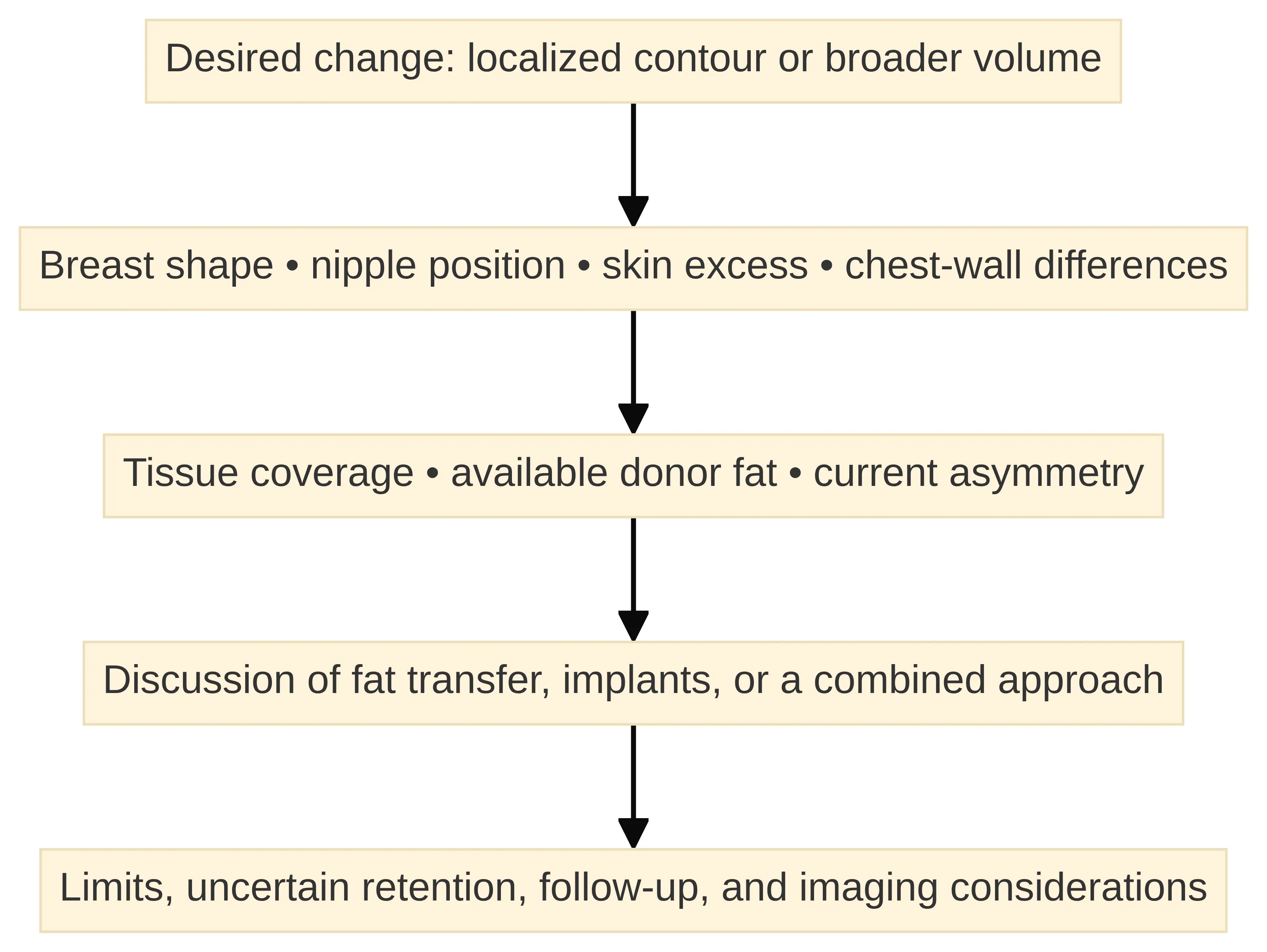
    A four-step consultation flow from the desired breast change to anatomy factors, donor fat and tissue coverage, treatment options, and follow-up considerations.
    A consultation should move from the desired change to anatomy, donor fat, option selection, and follow-up concerns.

    A Narrow Breast Base With a Wish for Fullness

    With a narrow breast base, “more fullness” can describe very different visual priorities. One person may mean a small contour change in a selected area; another may mean more fullness across the breast; another may be seeking a broader increase in overall volume. These requests need to be separated before choosing an approach.

    For localized contour, targeted fat placement is one option. The surgeon examines the starting shape and identifies where fullness is wanted, while explaining that fat grafting is generally framed as a modest-volume option. A narrow base does not determine placement, candidacy, or a personal limit on the result.

    When fullness means a broader volume goal, implants may enter the comparison because fat transfer may not be as effective for larger breasts or a larger overall increase. This is a difference in what each approach may be intended to address, not a ranking of one approach over another. In some circumstances, an implant may be paired with fat grafting for additional shaping.

    This scenario gives the reader a specific way to describe the goal: identify whether the desired change is localized, distributed across the breast, or broadly volumizing. The surgeon can then explain how that distinction relates to the existing breast shape, available donor fat, and the uncertainty of retained volume.

    Visible Asymmetry or Uneven Volume

    Visible asymmetry can look like a volume issue while also reflecting differences in breast shape, nipple position, skin excess, or the way each breast sits on the chest wall. That is why this scenario begins by separating an observation—one side looks different—from a conclusion about which procedure should be used.

    Fat may be placed with attention to a selected contour area, so it can be part of a conversation about uneven volume or contour. But targeted placement does not guarantee symmetry. The amount of grafted fat retained over time is uncertain, and a difference between the breasts may involve features that are not resolved by adding volume.

    An in-person assessment can consider breast base, existing tissue, volume distribution, nipple level or direction, skin excess, and chest-wall differences. Those findings can clarify whether the visible concern is mainly about a localized contour, broader volume, or several features together. Fat transfer, implants, or a combined approach may then be discussed in relation to those limits and to available donor fat.

    A useful description for this scenario is concrete rather than diagnostic: note whether the difference appears to involve volume, contour, nipple position, or how each breast sits. The clinical discussion can then address what may remain visible as well as what options can reasonably be considered.

    Thinner Tissue or a Preference for a Softer Upper Pole

    A reader who prefers a softer-looking upper-pole transition may wonder whether fat transfer should replace implants. The preference itself does not establish what any technique will look or feel like. It instead gives the consultation a visual priority to examine alongside tissue coverage, existing breast shape, volume goals, and donor-fat availability.

    When tissue is thinner, coverage can become a central planning topic. A review of autologous fat grafting describes combined implant-and-fat grafting as an option used to improve implant coverage or camouflage implant edges in very thin patients with little subcutaneous fat or breast tissue. This does not mean thin tissue requires a combined procedure, and it does not predict a particular appearance or feel.

    Here, the key distinction is contour refinement versus broader volume. Fat transfer directs volume to selected areas for contour-focused shaping. Broader overall volume brings implants into the comparison. A combined approach pairs volume with additional shaping, although retained fat volume remains uncertain.

    The relevant questions are therefore specific: Is the upper-pole request about localized shaping, broader volume, or both? How do tissue coverage and available donor fat affect the options being considered? Which aspects of the desired appearance cannot be forecast reliably? These questions keep a preference from becoming a promise.

    Retention Is the Variable Behind Every Visual Priority

    Retention is not a separate technical footnote after a visual goal has been named. It changes how each of the three priorities can be discussed. With a narrow base and a wish for fullness, it limits certainty about how a contour-focused change may persist. With visible unevenness, it is one reason that added volume cannot be presented as a way to make breasts match. With an upper-pole preference, it limits how confidently additional shaping or coverage can be anticipated over time.

    Published group findings provide context, not a personal forecast. One literature review reported mean retention of 62.4% after cosmetic breast fat grafting, with or without implants, over a mean follow-up of 16.6 months. The review also identifies important limits in those estimates: injected material may contain an unknown amount of fluid; imaging measurements can be affected by weight change or edema; follow-up is limited; and studies include different patient and clinical variables. A 2024 narrative review likewise found wide variation in reported first-year graft loss and noted that standardized protocols for collection, preparation, and injection remain lacking.

    The practical implication is not to convert an average into a predicted breast change. It is to ask how retention uncertainty changes the particular visual priority under discussion and which aspects of that priority cannot be forecast reliably.

    A clear comparison separates three issues that can otherwise become blurred together: the amount of volume being sought, the location where additional contour is wanted, and the uncertainty a person is prepared to discuss. Fat transfer may be relevant when the conversation centers on modest, contour-focused volume, but retained volume remains a limitation even when the desired change is localized. When the goal depends on a broader overall increase, the discussion may also include implants or a combined approach. This is not a self-selection rule; it is a way to make the trade-off explicit before an in-person assessment.

    Why Follow-Up and Breast Imaging Belong in the Decision

    A visual priority is only one part of the decision. Fat grafting can create nodules or calcifications that may resemble concerning findings on an examination or imaging. A review notes that these findings can mimic breast cancer and potentially delay diagnosis, so future breast evaluation belongs alongside the conversation about contour or volume.

    This does not mean every person follows the same imaging path. A 2024 narrative review describes MRI as a precise method for volume assessment and for detecting complications such as oil cysts and necrosis, but that finding does not prescribe routine MRI for every patient. The appropriate follow-up and imaging discussion depends on the treating clinicians and the individual clinical context.

    Complications also need to be considered without turning pooled research into an individual prediction. A systematic review summarized in a conference poster reported complications, including fat necrosis, among its included studies. These findings support a discussion of risks, follow-up, and communication with clinicians involved in later breast care; they do not calculate a personal outcome.

    General information cannot evaluate a new breast finding or establish an individual screening schedule.

    What the Three Visual Priorities Leave Open

    The three visual priorities do not produce one standard answer. Fullness across a narrow base may clarify the difference between localized contour and broader volume. Unevenness may involve volume alongside shape, nipple position, skin excess, or chest-wall differences. An upper-pole preference brings tissue coverage and the difference between contour refinement and overall volume into view.

    A modest, contour-focused goal can lead to a conversation about fat transfer. Broader volume goals bring implants into the comparison, while an implant-and-fat approach can pair volume with additional shaping. A qualified surgeon evaluates breast shape, nipple position, skin excess, chest-wall differences, tissue coverage, available donor fat, and retention uncertainty in person.

    If concerns about implants are driving interest in fat transfer, discuss those concerns directly before surgery rather than assuming fat transfer resolves them. Include risks, follow-up, and breast-imaging considerations in the same conversation as the visual change you want to understand.


    Frequently Asked Questions About Fat Transfer for Breast Enlargement

    How does a visual priority change a fat-transfer discussion?

    A request for fullness, less noticeable unevenness, or a different upper-pole transition may raise different questions about contour, broader volume, existing breast features, and the limits of general information. An in-person assessment is needed to determine what may be appropriate to discuss.

    Is fat transfer intended for a large breast-volume increase?

    For broader volume goals, implants may enter the discussion. Neither general description predicts an individual result.

    Why is retained volume important to every visual priority?

    The amount of grafted fat retained over time is uncertain. That uncertainty means a contour change, an attempt to address unevenness, or additional shaping should not be treated as a predictable outcome.

    Can fat transfer and implants be discussed together?

    Yes. A combined approach can pair an implant with fat grafting for additional breast shaping. Whether that approach is relevant requires clinical assessment.

    Why should later breast imaging be part of the conversation?

    Fat grafting can create nodules or calcifications that may resemble concerning findings on examination or imaging. Discussing treatment history, follow-up, and coordination with clinicians involved in future breast care can help place later findings in context.

  • Breast Fat Transfer Consultation Brief: A Two-Area Guide for Beverly Hills

    Breast Fat Transfer Consultation Brief: A Two-Area Guide for Beverly Hills

    Start With a Two-Area Trade-Off

    Before comparing procedures, write two short statements: what you want changed, and what uncertainty you can discuss. Keep those statements separate.

    Statement one: your breast-area goal. Note whether you want to discuss fullness, cleavage, contour, or symmetry. Do not turn that preference into a predicted result. [cont10-retest-20260906]

    Statement two: your trade-off question. Ask whether donor-area liposuction and possible fat resorption fit the conversation, or whether an implant device and its ongoing responsibilities also need review.

    This sequence creates a clearer consultation starting point. First, describe the breast change. Next, identify the trade-off that matters most. Then ask whether fat transfer, implants, or both approaches should be discussed.

    Fat transfer uses liposuction to remove fat from another area, then places it in the breasts. ASPS describes it as an option for women seeking a relatively small size increase and natural results. Another ASPS source describes fat grafting as providing moderate enlargement and shape improvement. Some transferred fat is resorbed after surgery.

    Implants create a separate device discussion. FDA materials state that breast implants are not lifetime devices. They also require ongoing monitoring. If implants remain part of your questions, record those device responsibilities separately.

    Bring your two statements to a consultation with a board-certified plastic surgeon. Ask which parts require personal assessment, what remains uncertain, and how each option would address the goal you described.

    How Breast Fat Transfer Works

    Fat transfer is a two-area procedure. It involves a donor area and the breasts.

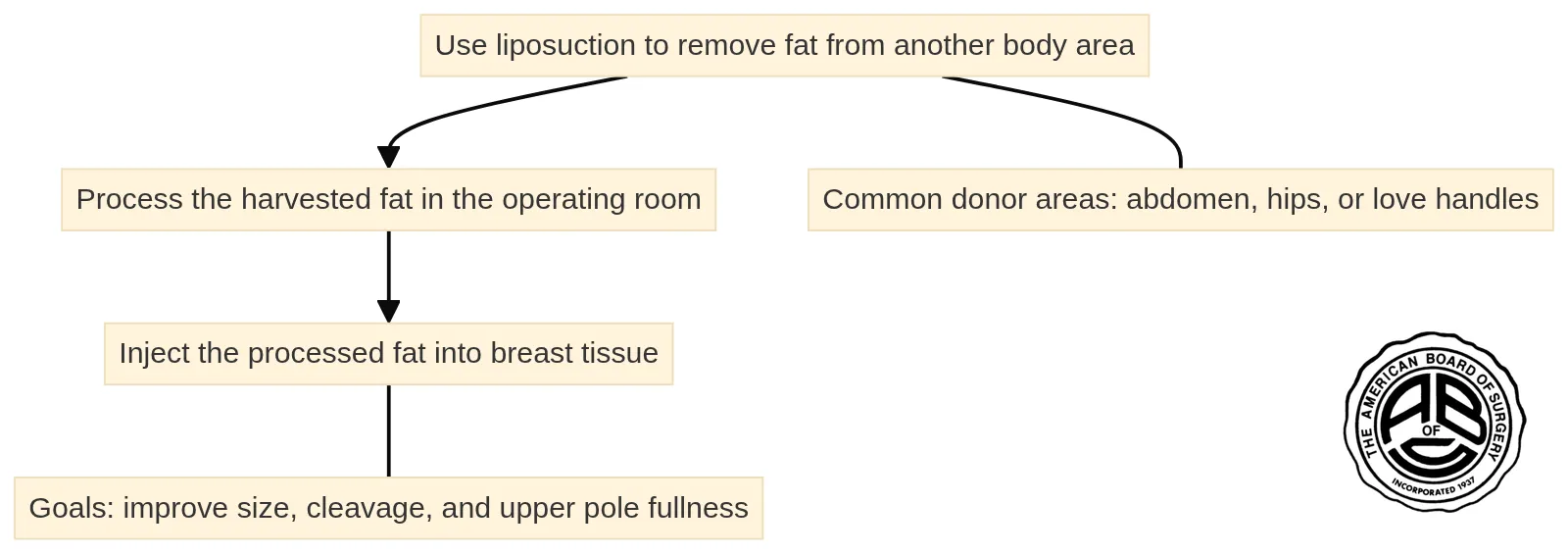
    First, a surgeon uses liposuction to remove fat from another part of your body. Common donor areas described by ASPS include the abdomen, hips, and love handles. The available donor area is therefore part of the consultation. It is not a separate detail.

    Next, the harvested fat is processed in the operating room. In the described process, the surgeon places processed fat into small syringes. The fat is then injected into breast tissue.

    This sequence matters when you compare options. Fat transfer does not only concern breast shape. It also includes liposuction in the selected donor area. Ask the surgeon to explain how both areas fit into the proposed plan.

    Useful questions include:

    • Which donor areas would you assess for me?
    • Why are those areas appropriate for discussion?
    • How would the fat be processed and placed?
    • What breast-shape goals can the proposed placement address?
    • How would you assess existing breast asymmetry?
    • What should I understand about the donor-area portion of surgery?

    A consultation should make the steps understandable in plain language. You should be able to repeat back the plan: where fat may come from, how it is handled, and what it is intended to add to the breast. If that description remains unclear, pause and ask for clarification before choosing an approach.

    A three-step breast fat transfer process: remove fat with liposuction, process it in the operating room, and inject it into breast tissue.
    Breast fat transfer follows a simple donor-to-processing-to-injection sequence.

    Match Your Goal to the Fat-Transfer Path

    Use the comparison as a note-taking tool. It separates questions by where they belong.

    Question lane Fat-transfer notes Implant notes
    What is involved? Liposuction removes fat from another body area. Processed fat is injected into the breasts. A breast implant device is used.
    What change is described? ASPS sources describe relatively small or moderate enlargement and shape improvement. Review the specific device and its labeling.
    What needs careful discussion? Donor areas, breast shape, symmetry, and resorption uncertainty. Risks, monitoring, and possible future surgery.
    What belongs in your record? The intended breast change and questions about both procedure areas. The proposed device and its patient information.

    This format does not decide which approach fits you. It helps prevent one broad preference, such as “natural,” from hiding several different questions.

    For the breast portion, describe the appearance you want to discuss. You might note fullness, cleavage, contour, or balance between breasts. For the donor-area portion, ask what role liposuction would play in the proposed plan. If implants remain under consideration, use a separate device note rather than blending those questions into the fat-transfer discussion.

    Visual references can help explain a preference. Describe what you notice in them instead of treating them as a personal forecast. A clear description gives the surgeon a better starting point for discussing options and limitations.

    Fat Retention Is an Important Uncertainty

    Fat retention deserves a direct discussion. Some transferred fat is resorbed after surgery. That is a core limitation of fat grafting.

    A 2016 systematic review included 22 articles involving 3,565 patients. Follow-up ranged from 12 to 136 months. The review reported mean retained volume of 62.4%, with wide variation across included studies. The reported range was 44.7% to 82.6%.

    Those figures are not a forecast for you. They summarize older, study-level findings across different included studies. They do show why a consultation should not promise a precise final volume or a fixed degree of retained fat. The review also called for more research into factors affecting retention.

    Ask direct questions instead:

    • How do you explain resorption uncertainty to patients?
    • What change is realistic to discuss for my goals?
    • How would uncertainty affect the plan?
    • Could more than one procedure become a discussion point?
    • How would you assess whether my donor areas support the goal?
    • What would you consider a reasonable expectation in my case?

    You do not need a guaranteed number to make progress. You need a clear explanation of what remains uncertain. A useful consultation separates the intended change from what cannot be predicted in advance. That distinction helps you compare fat transfer with implants without assuming either option provides certainty.

    Fat-Transfer Risks, Imaging, and Evidence Gaps to Discuss

    Ask about risks and follow-up without expecting a one-size-fits-all answer. The available evidence here needs careful interpretation.

    The 2016 systematic review reported a pooled complication rate of 17.2% in cosmetic breast fat-grafting studies. This is study-level evidence, not an individual risk prediction. The review identified indurations, persistent pain, and hematoma among the most frequently reported complications.

    The same review reported mammographic micro-calcifications and macro-calcifications in included fat-grafting studies. It also called for further research on cancer occurrence and detection after cosmetic breast fat grafting.

    These findings are reasons for a focused discussion. They are not a basis for predicting what will happen to you. Ask the surgeon how they address risk, what follow-up they recommend, and how you should communicate your surgical history to clinicians involved in future breast imaging.

    Use this question set:

    • What risks do you discuss for breast fat transfer?
    • Which risks relate to the breasts, donor areas, or both?
    • How are complications handled if they occur?
    • What breast imaging or screening questions should I raise?
    • What records should I keep for future care?
    • What follow-up plan would you recommend after surgery?

    A clinician should tailor those answers to your medical assessment. Do not rely on a review statistic, online images, or another person’s experience to replace that assessment. Clear uncertainty is part of informed decision-making.

    If You Also Review Implants

    If an implant option remains part of your visit, request the specific patient labeling and safety information. FDA materials advise reviewing these records for the implant under consideration.

    Keep breast-imaging questions in that same implant note. If you have implants, follow your clinician’s imaging instructions and tell the mammography facility about them. For silicone gel-filled implants, clarify whether MRI or ultrasound monitoring is recommended.

    FDA materials list BIA-ALCL among implant risks. Have the clinician explain relevant risks for the option under review. Keep this device review separate from your questions about donor areas, fat placement, and resorption.

    When a Combined Fat-Transfer and Implant Approach Is Worth Discussing

    A combined plan has separate parts to explain. Some surgeons use fat transfer with implants for additional breast shaping.

    Use a three-part note if this option is raised. Label the parts implant, donor area, and fat placement. Under each label, record its intended purpose in the proposed plan.

    The implant note should cover the specific device, its labeling, risks, monitoring, and possible future surgery. The donor-area note should cover the liposuction portion of surgery. The fat-placement note should cover the breast-shape goal and the uncertainty created by fat resorption.

    This structure matters because one explanation should not stand in for all three parts. Ask the surgeon to state the purpose of each part in plain language. Record whether it is intended to address volume, shaping, symmetry, or another stated goal.

    Questions for this format include:

    • What purpose does the implant serve?
    • What purpose does the fat placement serve?
    • Which donor areas are part of the discussion?
    • Which uncertainties apply to each part?
    • How would follow-up address the implant and fat-transfer portions?

    Leave any unanswered item open. A combined plan needs a clear explanation before it can be compared with either approach alone.

    Build a Fat-Transfer Consultation Brief

    Bring a short two-area consultation brief. It organizes the questions that fat transfer creates before any implant discussion begins.

    Breast-area page. State the change you want to discuss. Note shape, cleavage, upper-breast fullness, and asymmetry if relevant. Add what you do not want. Then ask what the proposed fat placement is intended to address.

    Donor-area page. List the areas you want explained. Ask how liposuction would fit into the proposed procedure. Write down questions about the donor-area portion of surgery and its follow-up.

    Uncertainty line. Write that some transferred fat is resorbed after surgery. Ask how the surgeon explains that uncertainty in relation to your stated goals. Do not turn a study average into a personal prediction.

    Optional implant page. Add this page only if an implant remains under review. Request the specific device labeling and safety information. Record questions about monitoring, complications, and possible future surgery separately from your fat-transfer notes.

    Safety and setting line. Confirm whether the surgeon is certified by the American Board of Plastic Surgery. Review relevant training, hospital privileges, and facility accreditation or licensing.

    Support and follow-up line. Clarify where and how the procedure would be performed. Discuss recovery support, complication handling, and follow-up.

    This brief is not a scorecard or a candidacy test. It gives you a clear record of the questions tied to each part of the discussion. Bring it to a board-certified plastic surgeon and leave space for answers in the surgeon’s own words.

    Turn Your Priorities Into a Clear Discussion

    A productive consultation begins with a clear trade-off. Fat transfer involves donor-area liposuction, breast injection, and resorption uncertainty. Implants require a device-specific discussion, monitoring, and review of possible complications. A combined approach may also deserve discussion when both volume and shaping matter.

    Bring your written priorities. Include breast shape, symmetry, donor areas, implant concerns, follow-up, imaging questions, and the recovery support you may need. Ask how the procedure would be performed, how complications are handled, and what results are reasonable for you.

    Choose a board-certified plastic surgeon for the discussion. The goal is not to select an option from a checklist. It is to understand which questions need an individualized medical assessment before you move forward.


    Frequently Asked Questions About Choosing a Surgeon and Facility

    What does breast fat transfer involve?

    It uses liposuction to remove fat from one area. The fat is then processed and injected into the breasts.

    How is fat transfer different from implants?

    Fat transfer uses your own tissue. Implants use a device and come with ongoing monitoring needs.

    What should you expect from fat transfer results?

    It may suit a smaller increase and shape improvement. Some transferred fat is resorbed after surgery.

    What risks should you discuss before choosing fat transfer?

    Ask about donor-area healing, breast changes, and complications. Also ask how follow-up and imaging are handled.

    What should you ask about if implants are part of the discussion?

    Ask for the specific implant labeling, risks, and monitoring plan. Implants are not lifetime devices.

    Can fat transfer and implants be used together?

    Yes, some surgeons discuss both together. The plan should clearly explain each part’s purpose and trade-offs.

    Who should you choose for this consultation?

    Choose a board-certified plastic surgeon. Ask open questions about goals, expectations, and reasonable results.