
Choose the tool category before comparing tax prep programs
The best tax prep program is not a universal vendor choice. It is the category of tool that fits the return context you need to prepare while keeping your records and unresolved questions available for a credentialed tax professional.
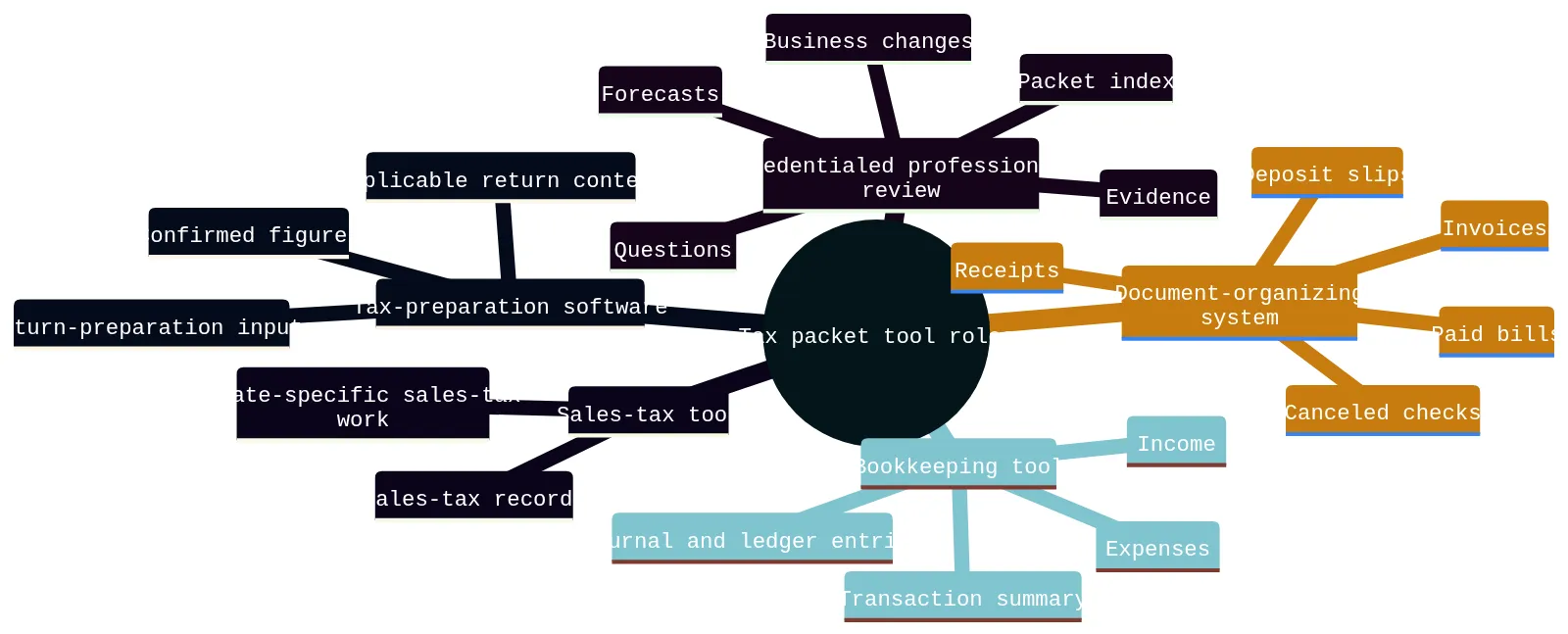
Start by mapping five distinct jobs:
- Bookkeeping tools summarize transactions in books, journals, or ledgers.
- Document-organizing systems retain payment evidence and other source material behind those transactions, such as invoices, receipts, paid bills, deposit records, payroll materials, and business assets records.
- Tax-preparation software uses entered information to prepare annual income-tax return information. The IRS describes commercial software as using a question-and-answer format.
- Sales-tax tools address collected sales tax, which Quicken distinguishes from annual federal and state income-tax preparation.
- Credentialed professional review considers the facts and questions that a program cannot settle from an entry screen.
This map changes the comparison question. Rather than asking which product is best, ask which category you need for the applicable entity, period, and return context. CNBC Select describes tax software as a quick, inexpensive option for straightforward situations, using a single-owner Schedule C business with no employees and minimal expenses as an example. The same source notes that a CPA or other tax professional provides customized care that software cannot replicate.
Choose the return-preparation category first. Then confirm a specific program’s applicable tax year, entity support, return context, and service scope before relying on it.
Compare what bookkeeping, document systems, tax software, and professional review each do
Compare tool categories by the output each one should produce for the next category. The IRS permits a recordkeeping system suited to the business when it clearly presents income and expenses. It also says that a system should include a transaction summary, ordinarily in books such as journals and ledgers. Electronic systems follow the same basic recordkeeping principles as hard-copy records.
| Tool category | Useful output | Do not expect it to settle |
|---|---|---|
| Bookkeeping tool | A transaction summary for the entity and period | Unreconciled activity or unclear classifications |
| Document-organizing system | Retrievable source files connected to transactions | Whether a record’s tax treatment is correct |
| Tax-preparation software | Prompts and entered return-preparation information | Missing evidence, mixed entities, or unresolved facts |
| Sales-tax tool | A separate sales-tax workflow where applicable | Annual income-tax preparation or professional determinations |
| Credentialed professional review | Discussion of records, facts, and questions | A substitute for maintaining source records |
A transaction summary and its source material have different roles: one summarizes activity, while the other supports the underlying entries.
Use this as a handoff chain. First produce a readable transaction summary. Next retain the supporting documents outside the filing program. Enter only information that is ready for the applicable preparation task, and reserve unresolved matters for professional review. This keeps a program choice tied to what it can receive and produce, rather than treating it as the place where every business record must live.
Match the program type to your entity, period, and return context
Before comparing program screens, identify two facts: which entity generated the activity and which period the packet covers. Put both at the top of your packet index. If you operate more than one business, keep records separate by business rather than combining activity because it shares an owner or bank login.
Your entity and return context narrow the field. According to Quicken, most consumer-facing tools handle an individual Form 1040 that may include Schedule C business income, rather than separate entity-level returns for partnerships, S corporations, or C corporations. Quicken also states that TurboTax Business desktop and TaxAct business products handle entity returns separately from personal returns. These are category-level starting points, not a current eligibility determination. Confirm applicable-year forms, entity support, state availability, and product scope directly with the vendor before relying on a program.
Use this decision boundary:
- Single-owner activity tied to an individual return: a consumer-facing individual-return tool may be worth evaluating if your records are complete and the situation is straightforward. Confirm current form support.
- Separate partnership, S-corporation, or C-corporation return context: begin with programs that explicitly support the separate entity return for the applicable year. Do not assume an individual-return product covers it.
- More than one entity or a recent entity change: maintain separate folders, separate transaction summaries, and separate question lists. Ask a credentialed tax professional how the facts should be handled.
- Unclear entity or period: pause program selection. Mark the item Needs confirmation and establish the entity and period first.
A tax program may ask questions efficiently, but it cannot repair a packet that mixes entities, combines years, or substitutes estimates for records.
Use five questions to narrow your tax prep program options
Use this path before committing time to a specific program.
-
What entity and period does this packet cover? Write the legal or operating entity name used in your records and the exact tax year or other review period. If business activity changed entities during the period, keep the change visible and add a professional-review question.
-
Are the bookkeeping records complete enough to summarize activity? Identify the transaction summary, the accounts included, and any unreconciled or uncategorized activity. Do not use a tax program as a substitute for locating the underlying bookkeeping records.
-
Can you find prior-year documents? Prior-year documents provide context for the next review. Compatibility can change by version and return type, so confirm current import limitations before making it a deciding factor.
-
Do you need professional review rather than software prompts alone? A program may be a preparation tool, while a credentialed tax professional reviews the factual context and questions. This matters when records are incomplete, the entity is unclear, activity spans locations, or a business change needs discussion.
-
Does the vendor currently support this exact use? Confirm the applicable tax year, entity return type, state scope, imports, service limits, and any professional-assistance boundaries. For example, TurboTax lists current limitations for its Expert Assist Business and Expert Full Service Business products that include C corporations and entities electing C-corporation treatment, trusts and estates, tax-exempt entities or nonprofits, and returns requiring more than five state filings. Treat vendor statements as product-specific and time-sensitive.
If one answer remains uncertain, your next step is not to guess. Add the uncertainty to the packet index, assign a follow-up owner, and bring it to professional review.
Build a tax-planning review packet index for records and questions
Use a tax-planning review packet index as a program-selection record, not as a filing checklist. Its purpose is to show which information is ready for a program, which material remains supporting evidence, and which items should go to a credentialed tax professional before you select a product.
| Information group | Selection question | What to record |
|---|---|---|
| Transaction summary | Does the program fit the entity and period shown in the summary? | Entity, period, report name, and included accounts |
| Supporting documents | Can the source material remain retrievable outside the program? | Source location and related transaction group |
| Prior-year documents | Is a usable prior-year file format available for the program you are considering? | Return type, tax year, and file format |
| Forecasts and open questions | Should this stay outside completed-period preparation pending review? | Assumption or factual question, period, and follow-up owner |
For every row, record the entity, period, source, status, file location, and follow-up owner. This makes the program decision depend on the information you actually hold rather than on a broad product description.
Use the index to define program inputs
Transaction summaries identify the preparation context. The IRS says a suitable recordkeeping system clearly shows income and expenses and includes a transaction summary, ordinarily in books such as journals and ledgers. Identify the summary for the selected entity and period before evaluating program prompts.
Supporting documents remain evidence. Keep the source files connected to the related transaction summary.
Prior-year files are only one comparison factor. Note whether you have a prior-year data file, PDF return, or scanned paper return. Confirm current version and return-type limitations before using any prior-year import capability as a deciding factor.
Forecasts are not completed-period inputs. Record the forecast period and source, then keep unresolved questions available for credentialed professional review. A program choice should not turn a forecast or an unanswered question into a documented fact.
Keep Ready, Missing, and Needs confirmation items separate
Apply an input-boundary test to each information group before using it to compare or enter information in a tax-preparation workflow. This is not a conclusion about tax treatment. It identifies whether the item helps establish program fit, remains evidence, or requires professional review.
| Input boundary | Use it when | Effect on program selection |
|---|---|---|
| Ready to evaluate | The item has an identified source and belongs to one entity and period | Compare the program against the applicable input and return context |
| Evidence retained | The file supports a figure or explains activity | Keep it retrievable with the related transaction summary |
| Needs confirmation | The entity, period, purpose, amount, or factual context is unclear | Do not treat a program prompt as an answer to the question |
| Source unavailable | Expected material is unavailable | Record what is absent before relying on the information |
| Outside this comparison | The item belongs to another entity or period, or does not apply | Exclude it from this program decision and retain the reason |
For example, an account-statement payment can show that a payment occurred while its business purpose still needs confirmation. A projected equipment purchase belongs in a forecast discussion, not in completed-period asset information. A remembered expense without available support should remain marked Source unavailable rather than becoming a program entry.
It also says that retention depends on what a document records and that records must be kept as long as needed to prove income or deductions on a return.
This test distinguishes a program-selection decision from a record-review process. Select a program only when you can identify the entity and period it must address, the information it may receive, the evidence that stays available, and the questions that remain for professional confirmation.
Recognize what tax software cannot settle
Treat the limits of a program as part of the selection decision. Commercial tax-preparation software can support electronic filing, and the IRS describes commercial software as using a question-and-answer format. Those functions organize preparation only after you identify the correct entity, period, and available information.
Use three stop checks before relying on a program answer:
- Input stop: Do you have a documented answer for this prompt? FreeTaxUSA states that users are responsible for complete and accurate entries and that it does not assume liability for user-generated errors.
- Context stop: Does the answer belong to this entity, period, and return context? A prompt cannot resolve mixed-entity records, a missing source document, or an unclear business change.
- Scope stop: Is this the right workflow for the obligation in question? Quicken distinguishes annual federal and state income-tax preparation software from sales-tax compliance software; do not assume one workflow completes the other.
Nor does a program’s ability to accept an entry establish that the entry is complete or supported.
CNBC Select states that a CPA or other tax professional offers customized care that tax software cannot replicate. For Texas franchise tax, nexus, entity changes, locations, or out-of-state activity, document the relevant facts and use professional review to confirm what those facts mean. Do not select an answer merely because a generic program prompt appears to fit.
Choose a program with defined input boundaries
Choose among tax prep program types by defining the preparation boundary first. Identify the entity and period, locate the transaction summary, and decide whether the available information belongs in a preparation workflow, remains supporting evidence, or needs professional confirmation.
A tax-planning review packet supports that decision without becoming the decision itself. Use the packet index to compare each program against the inputs you have, not to assume that every file belongs in the program. Keep forecasts separate from completed-period information, and leave unavailable or unclear material visible. For electronic records, IRS Publication 583 says a storage system must index, store, preserve, retrieve, and reproduce records in legible format.
Bring these professional-review questions when relevant:
- What facts should we provide about Texas franchise tax?
- Do our activities, customers, locations, or out-of-state operations raise a nexus question?
- Did an entity change, new location, or business expansion create information that needs review?
- Which missing records or unclear payments should be resolved before preparation proceeds?
The useful outcome is not a universal program recommendation. It is a program type selected for a defined entity, period, and preparation context, with evidence and unresolved questions kept available for credentialed tax professional review.
Frequently asked questions about tax prep programs and review packets
What should I put in a tax-planning review packet before a meeting?
Label each item by entity, period, source, status, and follow-up owner so the reviewer can see what is documented and what still needs confirmation.
How do I tell whether a tax prep program fits my business entity?
Start with the entity that created the activity and the period the packet covers. Consumer-facing tools often handle individual returns with business income, while separate entity returns need products that explicitly support that return type for the applicable year. Confirm current form support before relying on any program.
Can bookkeeping software replace tax-preparation software?
No. Bookkeeping tools summarize transactions and help you keep the source records organized. Tax-preparation software uses the information you enter to prepare return inputs. Keep the two jobs separate so your records stay usable for professional review.
What should stay marked as missing or needs confirmation?
Anything without a readable source, a clear period, or a clear business purpose should stay visible as missing or needs confirmation. Do not fill gaps with estimates, memory, or assumed treatment. That keeps the packet honest and easier to review.
What records are most important for receipts, payroll, and assets?
For payments and expenses, keep proof of payment, dates, amounts, payee details, and a description of the item or service. For payroll and contractor records, keep the available payroll materials and related payment records. For assets, keep the records needed to identify the property and support depreciation or sale calculations.
When should I raise Texas franchise tax, nexus, or location questions?
Bring them up whenever the business has Texas activity, out-of-state activity, entity changes, or new locations. Document the facts in the packet and ask the credentialed tax professional to confirm the tax implications rather than guessing from the software.
Leave a Reply