
Anatomy Sets the Frame for a Breast Implant Consultation
A breast implant consultation in Beverly Hills can begin with what a person sees rather than with a number: a narrow breast base that still feels as though it needs fullness, a visible difference between the breasts, or limited upper-pole coverage paired with a preference for a softer transition. Each starting point changes what “more volume” needs to mean.
Planning can consider skin and soft tissue, breast and chest-wall dimensions, breast shape, and the patient’s goals. Measurements establish planning boundaries rather than supplying a single answer. The visible feature a person wants to discuss gives those boundaries a purpose. A research review reported that tissue-based planning appeared preferable to approaches led primarily by preference, while also noting that further study was needed to clarify effects on outcomes.
This feature follows three visible starting points through the planning conversation. In each, a desired amount of fullness remains relevant, but volume alone does not predict bra cup size, implant width, forward projection, or how an implant may appear on a particular body. Two implants with the same volume may have different widths and projection, and the same volume can appear differently with different breast width, chest-wall shape, tissue coverage, and profile.
The Factors Behind the Conversation
The same request for fullness can describe different visual concerns. One person may be focused on how far the breast projects forward, another on a difference from side to side, and another on the transition from chest to upper breast. The consultation has to distinguish those observations before treating them as one implant-sizing question.
That distinction brings several features into view: breast-base width, tissue thickness, skin envelope, nipple level, lower-pole tissue, breast-fold support, and chest-wall symmetry. The skin envelope has its own degree of tightness or laxity, and the breast base sits on a chest wall with its own curvature and side-to-side differences. Skin excess or droop may be relevant because a volume concern and a positional concern are not necessarily the same concern. More significant droop may bring a lift into the discussion rather than being treated as an implant-size issue alone.
These features are not a scorecard and do not supply a personal recommendation. They help separate the part of an appearance concern that relates to volume from the parts that may relate to position, coverage, shape, or the underlying chest wall.
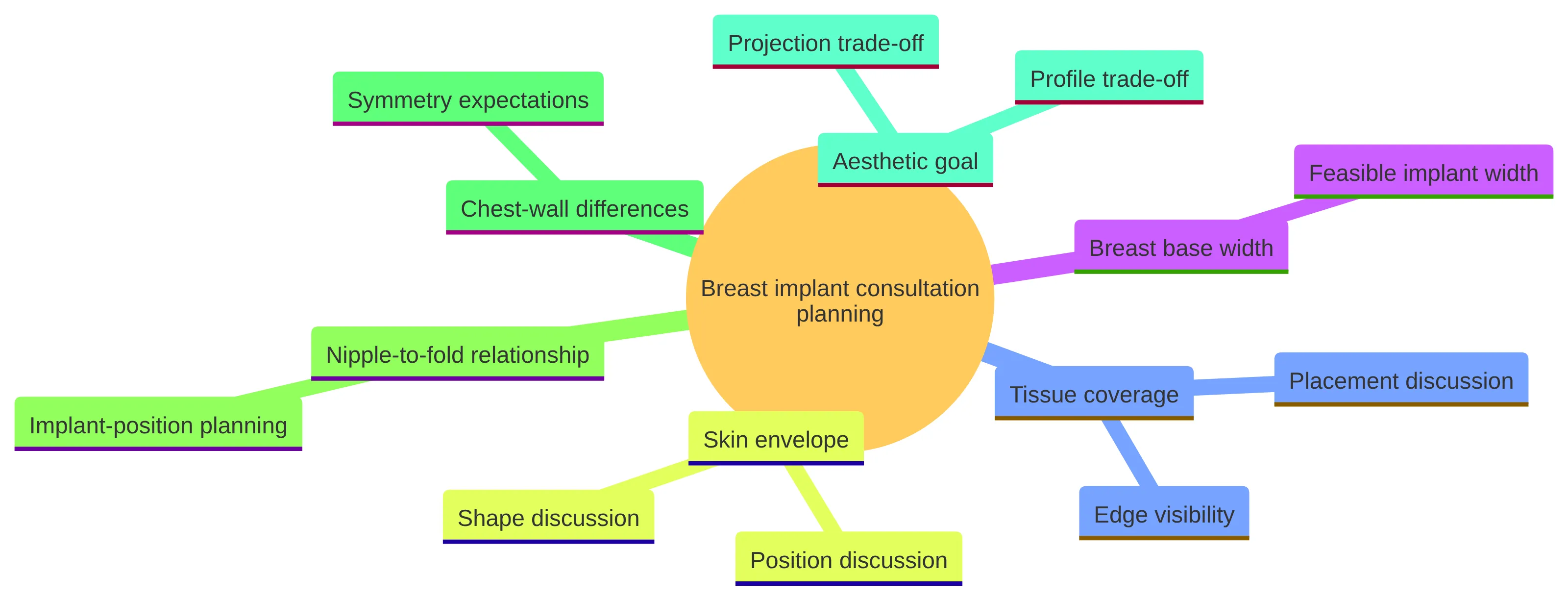
From a visible starting point to the features discussed
“I want fullness without more width” → breast base width + profile + projection
“One side looks different” → volume + shape + nipple level + chest-wall differences
“I want a softer upper transition” → tissue coverage + dimensions + placement
Skin envelope + nipple-to-fold relationship → position and shape considerations
Nipple level in relation to the breast fold is a material measurement for implant-position planning. Existing lower-pole tissue and skin, implant characteristics, tissue compliance, and fold support may also be relevant to breast shape and implant position. The map does not turn an observation into a diagnosis; it shows why similar requests for volume can lead to different planning discussions.
A Narrow Breast Base With a Wish for Fullness
A narrow breast base can make a wish for fullness more specific. The person may be looking for more presence in clothing, greater forward fullness, or an upper-breast change without a broader appearance across the chest. Those are related preferences, but they are not interchangeable descriptions of volume.
The visible starting point directs attention to the breast footprint: its horizontal width and its relationship to the chest wall. That footprint helps establish which implant widths can be discussed. From there, profile describes forward projection in relation to base width, not volume alone. At a fixed volume, width and projection trade off: spreading volume over a wider base produces less projection, while concentrating it in a narrower base produces more.
This is why a matching volume number can represent different visual directions. An overly wide implant may extend laterally beyond the natural breast border or make edges more apparent. An implant that is too narrow may not fill the breast base and can leave an under-filled appearance. These are planning trade-offs, not instructions about what any one person should choose.
In this scenario, the meaningful discussion is not simply whether a larger volume is available. It is whether the desired kind of fullness means more forward projection, a broader footprint, upper-pole emphasis, or some combination of those features. A cup-size target cannot answer that question, because bra sizing does not describe how an implant will sit on an individual frame.
Visible Asymmetry or Uneven Volume
When one breast looks different from the other, “uneven volume” may be the first description, but it is not always the complete one. Asymmetry can involve size, shape, position, volume, nipple level, or the chest wall beneath the breasts. Some degree of asymmetry is common and may be a normal variation.
The visual detail that draws attention can guide the assessment. Unequal fullness in a bra may point the conversation toward volume. One breast sitting differently on the chest, or nipples that do not appear level, brings shape and position into the picture. Assessment may examine breast dimensions, volume, shape, nipple position, chest-wall symmetry, and relevant history because these features can contribute to what is seen.
Implants alone do not correct nipple asymmetry. Added volume and projection can sometimes make an existing difference more apparent. A source also notes that residual differences may remain noticeable even when objective symmetry improves. The value of naming the visible difference precisely is that it prevents a volume change from being treated as an answer to every part of the asymmetry.
A plan may address one part of the picture while leaving another relevant. Where skin excess or more significant droop is part of the starting picture, a lift may enter the discussion. The central question is which feature a proposed direction is intended to address, rather than whether asymmetry can be made to disappear.
Thinner Tissue and a Softer Upper-Pole Preference
A softer upper-pole preference often starts with an observation about the transition from the chest to the breast. A person may notice little tissue over the upper breast, worry about a sharply defined edge, or prefer less conspicuous upper-pole fullness. That visual priority makes coverage part of the conversation, alongside volume.
With thinner tissue, visible implant edges, stepping, or rippling may be part of the coverage-and-projection discussion, particularly near the upper and lateral breast. Higher projection can concentrate volume forward, but it does not erase the importance of the tissue overlying it. The same desired volume may therefore be discussed differently for people with different tissue coverage.
For thin upper-pole tissue, muscle coverage may be discussed as one way to soften transitions and reduce visible edges. Placement does not promise a particular aesthetic result, however. Technique, implant width, and tissue behavior also matter. More coverage does not assure a specific look or remove every trade-off associated with thin tissue.
Here, the stated preference is a way to clarify what deserves explanation: how tissue coverage, width, projection, and the proposed placement relate to the upper-pole appearance being discussed, along with the limitations of that direction.
Why Shape, Nipple Level, and Skin Envelope Cannot Be Separated From Volume
The three starting points overlap at the breast shape, nipple level, and skin envelope. A person seeking fullness may also be noticing a nipple that appears low, lower-pole looseness, or a breast contour that relates differently to the chest wall. These observations do not all describe the same planning issue.
Nipple level in relation to the inframammary fold is relevant to implant-position planning. Lower-pole skin and soft tissue, the starting nipple-to-fold distance, implant shape and projection, tissue compliance, and fold support can all influence where an implant sits and how the breast takes shape. This is why a visible concern that sounds like “more fullness” may also require attention to breast position and support.
Skin behavior adds another layer. A tighter envelope and a more compliant envelope do not present the same planning conditions. One study found that postoperative lower-pole stretch materially affected final implant position, supporting discussion of tissue behavior rather than treating the position achieved during surgery as the sole determinant. That finding does not predict an individual outcome.
An implant and a lift do not answer the same visual concern. An implant discussion addresses added volume and dimensions. A skin or positional concern may require a separate discussion of whether an implant alone is an appropriate tool. When significant droop is present, a pocket strategy is not presented as a reliable substitute for every skin-envelope issue.
A Plan Includes Its Limits and Longer-Term Questions
The three scenarios show why a plan needs limits stated alongside its intended purpose. A direction that addresses forward fullness may not resolve a positional concern. A direction that narrows a volume difference may not eliminate nipple asymmetry or chest-wall differences. More coverage may change the discussion of visible edges without assuring a particular upper-pole appearance.
Recovery belongs in the consultation as a plan-specific conversation. Ask how the proposed direction may affect recovery expectations and what follow-up communication the practice recommends. The appropriate details depend on the proposed surgery and the clinician’s instructions; this article cannot supply an individualized recovery schedule or activity restrictions.
Longer-term device considerations also belong beside the visible priority that first led someone to consider implants. FDA materials list risks and complications that include breast pain, changes in nipple and breast sensation, additional surgery with or without device removal, capsular contracture, rupture or deflation, BIA-ALCL, systemic symptoms, and possible effects on breastfeeding. The FDA strengthened breast-implant risk-communication requirements in 2021 to support informed decision-making.
For device-specific complication information and rates, consult the FDA-linked patient labeling for approved implants and discuss the selected device with a qualified clinician. A proposed direction should include its trade-offs, risks, possible future surgery, recovery expectations, and follow-up—not only the appearance concern it is intended to address.
The Useful Next Step Is a Plan That Fits the Whole Picture
A narrow base, visible asymmetry, and thinner tissue can all lead someone to ask about breast implants, yet they change the meaning of that question. The common thread is not a universally best volume. It is the need to connect the feature a person sees with the anatomy that may shape the discussion.
A consultation can use that connection to distinguish forward fullness from width, uneven volume from positional asymmetry, and a softer upper-pole preference from a promise about appearance. Proposed width, profile, projection, coverage, placement, breast shape, nipple level, skin envelope, and chest-wall anatomy all belong to that fuller picture. Schedule a breast augmentation consultation.
Breast Implant Consultation FAQ
What should a breast implant consultation focus on besides the volume you want?
It should connect your goals to breast width, tissue coverage, skin envelope, nipple level, and chest-wall shape. Those factors help set the practical boundaries for what different implant dimensions may or may not do.
Can implants correct visible asymmetry on their own?
Not always. Volume differences may be part of the issue, but nipple position, breast shape, skin excess, and chest-wall differences can also matter. In some cases, implants may improve one part of the picture without fully resolving every difference.
Why does tissue thickness matter when someone wants a softer upper pole?
Thinner tissue can make edges or rippling more noticeable, so coverage becomes part of the discussion. Placement and implant dimensions may be considered to soften the transition, but no single choice guarantees a specific look.
How are implant width and profile discussed for a narrow breast base?
Width should fit the breast footprint first, because width and projection trade off at a given volume.
What recovery and follow-up questions are worth asking during planning?
Ask how the proposed plan may affect recovery expectations, what follow-up is recommended, and how the team handles longer-term monitoring. It is also reasonable to review device-related risks and possible future surgery as part of informed decision-making.
Leave a Reply