
Build a Two-Part Evidence File Before Choosing a Surgeon
Choosing a breast augmentation surgeon involves information that comes from different places and should not be treated as equally reliable. A practice biography, referral, gallery, official verification record, and consultation conversation can each be useful, but they answer different questions. Build a two-part evidence file so that you do not have to rely on a single overall impression.
File 1 is the verified-record file. It holds time-sensitive facts that you check with the relevant authority: current licensure, current ABPS status, the named operating facility, and the facility status the candidate identifies. File 2 is the consultation-notes file. It records what the candidate explains about your goals, options, risks, device information, anesthesia and recovery arrangements, and long-term follow-up.
This method creates a clear decision boundary. A statement belongs in File 1 only when you can identify the authority, date checked, and exact record or status. A statement belongs in File 2 when it was discussed in consultation and may require a follow-up question or supporting document. Do not convert an explanation, a reassuring answer, or a polished presentation into a verified fact.
Use the same file structure for every candidate. Its purpose is not to rank personalities or predict a result. It is to show whether the essential records are current, whether the consultation gave you understandable information, and which questions must be resolved before a candidate merits further discussion.
Before contacting a surgeon, write down your goals, concerns, and priorities. Bring those notes and the same evidence-file prompts to each consultation. The process is educational, not a medical recommendation or a promise about outcomes.
File 1: Document Current Licensure and ABPS Status
Start File 1 with a dated record of the surgeon’s current professional status. For a California surgeon, use the Medical Board of California Licensee Profile search to review the provider’s current profile. Record the surgeon’s name as listed, the date checked, the official source used, and any item you need to clarify. Because licensure information can change, repeat the check shortly before making a final decision.
Next, use the American Board of Plastic Surgery’s public verification tool to check current ABPS certification status. ABPS describes its certification as voluntary and says its certified surgeons have completed specified training and passed comprehensive written and oral examinations covering plastic surgery procedures. ABPS also states that an active, unrestricted medical license is required for certification. Record the exact status displayed rather than relying on a practice biography or directory badge.
If an ABPS listing displays a “See FSMB” alert, preserve that exact observation in the file. Review the linked information and the current state-board record, then prepare a question for the candidate. Do not decide what an alert means without reviewing the current information.
Use four fields for each record:
- Claim being checked: current California license or current ABPS status.
- Authority and date: the official search used and when you checked it.
- Exact result: the status or wording shown, without interpretation.
- Open item: any question requiring clarification.
A candidate whose current status cannot be confirmed stays in the open-item category. This is not a conclusion about the surgeon; it is a reason not to treat the file as complete.
File 1: Record the Operating Setting and Care-Team Details
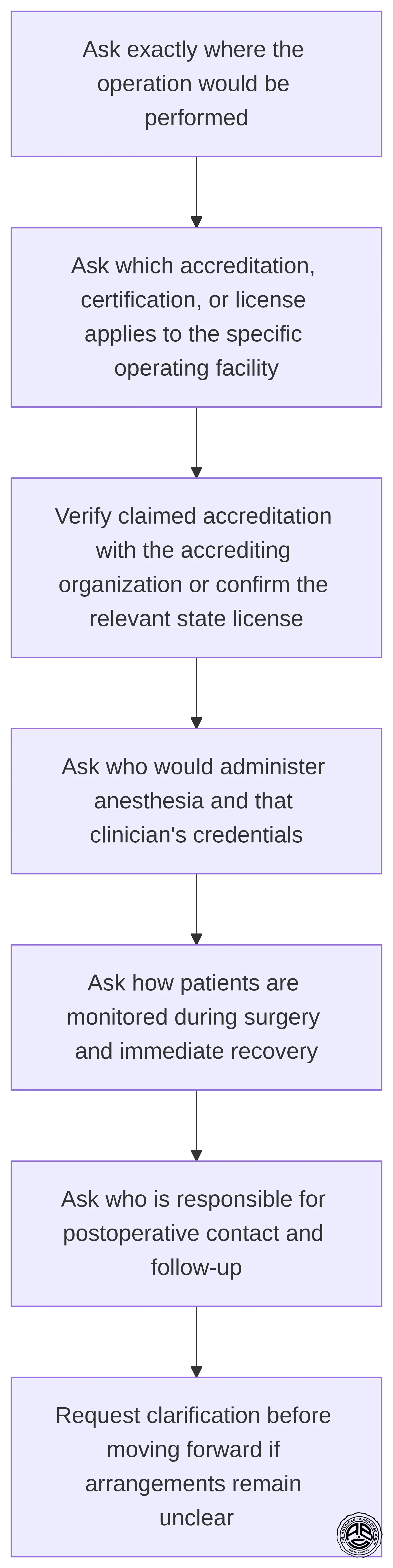
Add a separate facility record to File 1. A surgeon’s office is not necessarily the operating location, so first obtain the exact name of the facility where surgery would occur. An accredited facility must meet national standards for equipment, operating-room safety, personnel, and surgeon credentials, but a general statement about safety does not establish the current standing of a particular location.
For procedures beyond local anesthetic or mild oral sedation, ASPS facility criteria identify accreditation by AAAASF, AAAHC, or the Joint Commission; Medicare certification; or state licensure as qualifying pathways. Ask which pathway applies to the named facility, then verify a claimed accreditation with the accrediting organization or confirm the relevant state license with the appropriate authority.
Create one facility entry with these fields:
| File field | What to record |
|---|---|
| Operating location | The exact facility name provided for the procedure under discussion. |
| Status claimed | The accreditation, certification, or state license identified by the candidate. |
| Verification | Authority checked, date checked, and result found. |
| Care-team details | Who would administer anesthesia, how monitoring is described, and who handles immediate recovery and postoperative contact. |
| Remaining question | Any detail not yet identified or understood. |
Ask whether the surgeon has hospital privileges for the same procedure at a local accredited hospital; who would administer anesthesia and that clinician’s credentials; and how patients are monitored during surgery and immediate recovery. ASPS states that a qualifying facility should permit surgery by an ABMS-certified or board-eligible surgeon with privileges for the same procedures at a local accredited hospital, provide anesthesia through a board-certified or board-eligible anesthesiologist or a certified nurse anesthetist, and use advanced monitoring during surgery and immediate recovery.
Keep two labels visible in this record: independently verified and described in consultation. The first is for the facility status you confirmed. The second is for care arrangements explained by the candidate. If the location, anesthesia clinician, monitoring, or recovery arrangement remains unclear, leave the entry open and request clarification before moving forward.
File 2: Capture What You Learn in Each Consultation
File 2 is not a rating of bedside manner. It is a dated account of whether the consultation supplied information you could understand and use. ASPS notes that consultations are an opportunity to ask questions and that answers can help patients inform or refine their goals. Prepare written questions in advance and use the same core prompts with every candidate.
Begin with your own goals and concerns, rather than a fixed procedure or another person’s result. ASPS notes that an approach that suited one person may not be suitable for another because bodies differ. Your notes should show whether the discussion stayed connected to your circumstances and whether you understood the explanation.
After each consultation, complete this record:
| Consultation record | What to capture |
|---|---|
| Your stated priorities | The goals and concerns you brought to the discussion. |
| Candidate’s explanation | The options, limits, and trade-offs as you understood them. |
| Questions answered | The question asked and a concise note of the answer. |
| Questions still open | Terms, documents, or decisions that need follow-up. |
| Visual information | Whether a photo gallery was available and what it could or could not help you understand. |
| Decision boundary | Whether you have enough clear information for a further discussion, or need clarification first. |
A photo gallery can help you visualize potential outcomes, but it is not a forecast of your individual result. Note what examples were shown, then ask what may differ in your own situation and what uncertainty remains. Do not let visual examples substitute for discussion of risks, device information, or long-term care.
The useful comparison is not which consultation felt most memorable. It is whether each File 2 entry contains direct answers, understandable explanations, and clearly identified unresolved questions.
File 2: Test Whether the Information Is Complete Enough to Consider
Use a completeness check in File 2 before treating a consultation as sufficient for a decision. The check does not determine what is appropriate for you. It identifies whether the discussion and documents leave important questions unanswered.
Ask the surgeon to explain the options relevant to your goals, why an option is being discussed, and the trade-offs you should understand. Ask how the surgeon approaches concerns if an outcome does not align with a patient’s goals, without assuming a particular revision, satisfaction, or outcome.
For implant-based augmentation, FDA materials list risk categories that include breast pain; changes in nipple and breast sensation; additional surgeries; capsular contracture; rupture or deflation; BIA-ALCL; systemic symptoms; and effects on breastfeeding. FDA also lists wrinkling, asymmetry, scarring, pain, and incision-site infection among local complications. Record which questions you raised and what explanation you need to revisit with the surgeon.
Before closing the entry, confirm whether you received or requested:
- the patient labeling for the specific implant under consideration, including its complication information;
- the actual product-specific Patient Decision Checklist for that implant;
- an explanation of follow-up and whom to contact with concerns; and
- an answer about how concerns are addressed if results do not align with a patient’s goals.
FDA states that complete complication lists and rates for approved breast implants are available in patient labeling for the specific device. FDA also requires manufacturers to provide a product-specific Patient Decision Checklist with each device, containing information on known or reported risks. An online sample may be educational, but it is not the device-specific checklist you would discuss and sign with the surgeon.
Mark the entry complete for reflection only when you can identify the documents still needed and restate the explanation in your own words. Otherwise, record the missing item and request clarification.
File 2: Document the Long-Term Follow-Up Discussion
Create a long-term record in File 2 rather than leaving follow-up as a general reassurance. FDA states that breast implants are not lifetime devices, that people considering them should assume they may need additional surgeries because complications can occur, and that implants need monitoring for as long as they remain in place. FDA identifies capsular contracture, reoperation, and implant removal among the most common local complications and adverse outcomes. These facts do not predict an individual experience; they explain why the follow-up discussion belongs in the evidence file.
Use these prompts:
- Immediate contact: Who handles postoperative questions, and how is contact arranged?
- Monitoring discussion: What ongoing monitoring plan does the candidate describe while implants remain in place?
- Change in condition: What instructions are given for contacting a surgeon or health care provider about abnormal changes?
- Continuity record: What information should you retain about the implant, procedure, and follow-up plan?
FDA advises contacting a surgeon or health care provider promptly for abnormal changes in the breasts or implants. Record the practical instructions described for that situation rather than assuming every practice handles it the same way.
One published international framework recommends postoperative surveillance through suture removal and, ideally, for the life of an implanted device. Treat that as a framework for questions, not a universal rule or a statement about any particular practice. The purpose of this record is to distinguish a documented follow-up explanation from a promise that future surgery will never be needed.
Compare Completed Matrices and Take Time to Reflect Before Deciding
Set your completed matrices side by side only after you have separated verified facts from consultation observations. Look first for missing essentials: an unverified license or certification status, an unnamed operating facility, unclear accreditation or licensing, unanswered anesthesia questions, or an incomplete follow-up explanation. Those are not small details to average away with a good impression. Resolve them or remove the candidate from consideration.
Then compare the consultation notes. Which candidate addressed your goals without making another person’s experience a template? Which explanation of options and risks did you understand well enough to summarize in your own words? Which discussion made room for questions about long-term monitoring and possible future surgery? The right next step may be a follow-up consultation, not an immediate yes or no.
Give yourself time to reflect. A published international framework characterizes a 10-day, preferably 14-day, reflection period between operating-surgeon consultations as best practice for breast augmentation. The same framework describes at least seven days of reflection as a minimum for cosmetic patients and states that informed consent should arise from face-to-face consultation with the surgeon. These are not universal legal requirements; applicable requirements can differ by jurisdiction. They are a useful reminder that a decision involving an implant and potential long-term care should not be rushed.
Use the reflection period to reread device-specific materials, compare your notes, and list any question you still cannot answer. If uncertainty remains, your action is to ask for clarification before deciding. A completed matrix should leave you with a reasoned basis for proceeding to a personalized discussion—not pressure to proceed with surgery.
Use Your Evidence File to Prepare a Personalized Discussion
Before a personalized discussion, review the two files together. File 1 should identify the current records you checked and any provider or facility detail that remains unverified. File 2 should show your goals, the explanations you received, the device-specific materials requested or reviewed, and the questions still open.
A virtual conversation can help you discuss personal goals and request current provider, facility, anesthesia, and follow-up information. It does not replace independent verification or guarantee an outcome. Bring your dated evidence file and written questions so you can ask for the specific information needed to complete it.
If an item is missing, leave it visible rather than filling it with an assumption. A complete file gives you a more organized basis for deciding whether a candidate merits further discussion; an incomplete file tells you exactly what to clarify next.
Breast Augmentation Surgeon Selection FAQ
How can I verify a breast augmentation surgeon’s credentials before booking a consultation?
Check the surgeon’s current state license and current ABPS certification through the relevant official verification tools, then confirm that any status details are up to date. If something is unclear or flagged, ask for an explanation before moving forward.
What should I ask about the facility where the surgery would happen?
Ask for the exact operating location and verify whether it is accredited, licensed, or otherwise qualified under the applicable standards. It is also reasonable to ask who provides anesthesia and how patients are monitored during surgery and immediate recovery.
What makes a consultation useful when comparing candidates?
A useful visit should leave you with a clear understanding of your options, the trade-offs, and whether the surgeon listened to your goals and concerns. If you feel rushed or do not understand the explanation, that is a sign to ask more questions or keep comparing.
What implant information should I review before deciding?
Ask to see the actual product-specific Patient Decision Checklist and the patient labeling for the specific implant being discussed. Those documents help you review known or reported risks and prepare follow-up questions.
What risks should be discussed for implant-based augmentation?
The conversation should cover relevant complications in plain language, including local issues such as capsular contracture, rupture or deflation, asymmetry, scarring, pain, and infection, as well as other implant-related concerns. The surgeon should relate those risks to the option being considered for you.
How should I think about follow-up and possible future surgery?
Plan for long-term monitoring, since implants are not lifetime devices and additional surgery may be needed later. Ask how postoperative surveillance, routine follow-up, and contact for abnormal changes are handled in the practice.
Leave a Reply