
Tag: breast implant consultation

  • How to Interpret Breast Augmentation Before-and-After Photos

    How to Interpret Breast Augmentation Before-and-After Photos

    Use Before-and-After Photos as Discussion Examples, Not Personal Forecasts

    Before-and-after photos can be useful as discussion examples, not as forecasts of your own result. They can show that breast augmentation can create visible changes in volume, proportion, and the way the breasts relate to the chest. They can also help you notice the kinds of appearances you are drawn to, the changes you would rather avoid, and the questions you need answered before a consultation.

    A photo pair is still a record of one person’s starting point, procedure, healing, and photography session. The American Society of Plastic Surgeons notes that gallery images may represent typical results, but not everyone who has plastic surgery achieves the same result. The FDA similarly says that a surgeon should be able to provide other patients’ before-and-after pictures to help a prospective patient discuss expectations and potential outcomes. Those are valuable uses of images; neither makes another person’s after photo a promise about yours.

    Start with a simple rule: an image is an example, not an estimate. This protects you from turning a visual preference into an expectation that may not fit your anatomy, health history, goals, or surgical circumstances. It also leaves room for a clinician to explain what may be reasonable in your particular situation.

    Use photos to do three jobs:

    1. Observe: What can you actually see in the pair?
    2. Compare cautiously: Are the before and after images presented under conditions that make the visual comparison meaningful?
    3. Prepare: What preferences, concerns, and unanswered questions should you bring to a consultation?

    That approach is more useful than trying to identify a single “ideal” result. A result that appeals to one viewer may not match another person’s goals, starting anatomy, lifestyle, or comfort with the tradeoffs involved. Photos can help you develop better language for a consultation, but they cannot determine candidacy, select an implant, determine a surgical plan, or show every aspect of recovery and long-term responsibility.

    Record What the Images Show Without Ranking the Result

    The first part of a photo-review worksheet is an observation column. Its purpose is to slow down the jump from “I like this” to “I want this exact outcome.” Write down visible details in neutral language before deciding what they mean to you.

    Breast augmentation may involve implants or fat transfer. A gallery may not always make the procedure details clear, so avoid assuming that every visible difference came from the same approach. Instead, record only what the images appear to show.

    For each pair, note observations such as:

    • the apparent change in breast volume;
    • the relationship of the breasts to the chest and upper torso in the available views;
    • the apparent fullness in areas visible in the images;
    • whether the breasts appear more or less similar to one another in the photographs;
    • the visibility of incision lines, if they are shown;
    • the patient’s posture, clothing, and image crop; and
    • details that cannot be determined from the images, such as the procedure used, timing, or whether a lift or another procedure was involved.

    Use descriptive wording rather than value judgments. For example, write “the after image appears to show more upper-breast fullness from this angle” rather than “this is a better shape.” Write “the incision area is not visible in this crop” rather than assuming there is no scar. The goal is not to grade another person’s body or result. It is to identify what you are seeing and what remains unknown.

    Then create a separate preference column. This is where you can write statements such as: “I prefer a change that looks modest in fitted clothing,” “I am concerned about a very noticeable change,” or “I want to understand how a result like this might look from more than one angle.” Separating observation from preference matters. The first is a note about a photograph; the second is a topic for a personal discussion.

    Finally, add a question column. If a photo leads you to wonder about scar placement, recovery timing, procedure approach, or whether the result is representative of the patient’s longer-term appearance, write the question down. A useful worksheet does not fill in missing information. It makes the missing information visible.

    Check Whether the Before-and-After Pair Is Fair to Compare

    Before drawing conclusions from a pair, look at the conditions of the images. This is a reader-facing consistency check, not a professional photography standard and not a way to decide whether an image is authentic. It simply helps you recognize when visual differences may be harder to interpret.

    Review these six items:

    • Viewpoint: Are the photographs taken from a similar front, side, or angled view?
    • Pose: Does the person appear to be standing in a similar position, with similar arm placement and shoulder position?
    • Framing: Is a similar amount of the chest and torso shown in both images?
    • Lighting: Does lighting create noticeably different shadow, contour, or skin-tone effects?
    • Timing: Is the timing after surgery stated? If so, is it early in healing or later?
    • Procedure context: Is there any disclosed information about the procedure, such as implants or fat transfer, or whether another breast procedure was involved?

    A pair does not have to look identical in every photographic detail to be worth discussing. But if viewpoint, pose, crop, or lighting differ substantially, treat conclusions about contour, symmetry, size, or scar visibility as limited. The appropriate response is not to accuse anyone of manipulation or to decide that a result is inferior. It is to ask for clarification, additional views, or more context before treating the comparison as meaningful.

    Timing deserves special attention. ASPS notes that enlargement is immediate after breast augmentation, while final appearance may take weeks as swelling subsides and skin stretches. Incision lines may take several months, and sometimes a couple of years, to fade. An early after image and a later after image can therefore answer different questions. An early image may illustrate immediate postoperative change, while a later image may offer more context about how the appearance evolved. Neither one establishes your personal timeline.

    Add a short conclusion to each worksheet entry: comparable enough to discuss, partly comparable, or unclear—ask for context. This prevents a polished photo pair from carrying more weight than the information behind it. When timing or image conditions are unclear, keep the visual lesson narrow: “I would like to ask about this feature,” not “this is what will happen to me.”
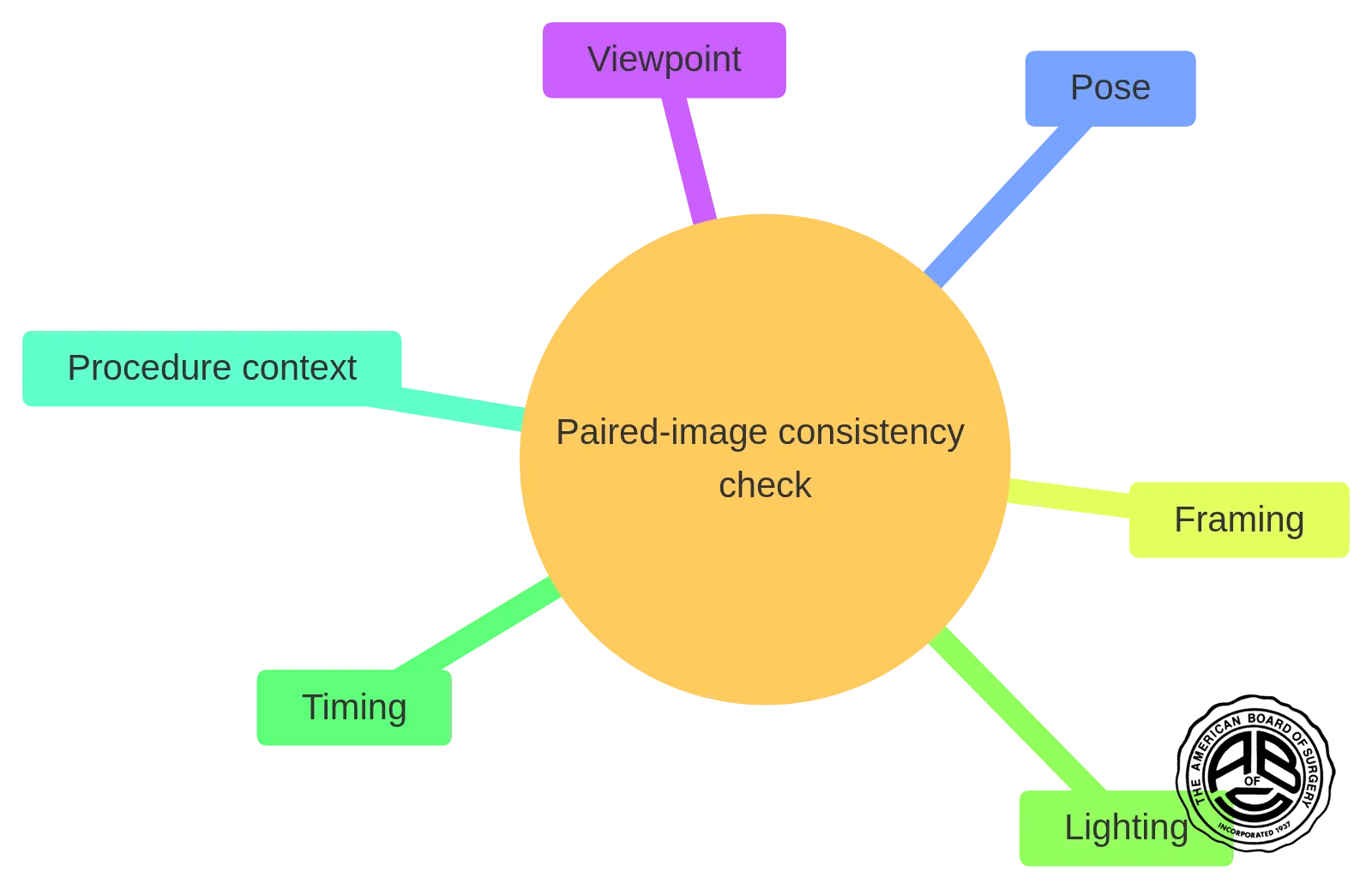
    A mind map showing the six consistency checks for comparing before-and-after breast augmentation photos: viewpoint, pose, framing, lighting, timing, and procedure context.
    Use these six checks to judge whether a before-and-after pair is fair to compare.

    Identify Why Another Patient’s Images May Not Transfer to You

    Once you have recorded what a photo shows and whether the pair is reasonably comparable, ask a different question: how transferable is this example to me? Usually, the answer is limited. Another patient’s image may help you express a preference, but it cannot settle what outcome is reasonable for you.

    A cited plastic surgeon notes that surgical results are affected by unique anatomy, healing, and surgical variables. Those factors help explain why two people who want a similar-looking change may not have the same visible result. Starting anatomy can differ, including the existing breast shape, breast-tissue characteristics, skin, chest structure, and baseline asymmetry. Goals may differ as well: one person may seek a subtle change, while another may prioritize a different degree or distribution of volume. Procedure approach and the details of the surgical plan also matter, and healing introduces another source of variation.

    This means that an image can be personally relevant without being personally predictive. You might write, “I am interested in the overall proportion shown here,” while also writing, “I do not know whether my starting anatomy or recommended approach would make this appearance reasonable for me.” That is an informed distinction.

    The same boundary applies to computer-generated imaging. It may help a discussion about what breasts could look like after surgery, but it cannot predict or guarantee an actual surgical outcome. Treat an image simulation as a communication aid, not a commitment. Ask what assumptions it reflects, what it cannot show, and how it relates to the clinician’s assessment of your circumstances.

    ASPS also emphasizes realistic expectations because an outcome may not match a person’s goals. Realistic does not mean settling for vague answers. It means asking for clear explanations of what the clinician believes may be achievable, what limitations may apply, and where uncertainty remains.

    A practical transferability note can include four prompts:

    • What aspect of this example do I want to discuss?
    • What visible feature worries me or feels important to understand?
    • What about this patient’s starting point, goals, procedure, or healing may differ from mine?
    • What would I need to know before treating this image as relevant to my own decision?

    Bring those prompts to consultation rather than trying to resolve them from a gallery alone. A qualified clinician can listen to your goals and concerns and may make recommendations based on medical history and other factors.

    Turn Photo Notes Into Focused Consultation Questions

    Your worksheet becomes most valuable when it leads to a focused consultation discussion. ASPS advises thinking through and writing down questions ahead of time. Rather than arriving with a demand to reproduce a single photo, arrive with notes about your preferences, concerns, and the image conditions you want explained.

    You can organize questions into four groups.

    1. Expectations and relevance

    • Which changes in these examples may be reasonable to discuss in light of my circumstances?
    • What features of my starting anatomy affect the range of appearances we should discuss?
    • Which details in these photos are not useful for predicting my result?
    • Can you explain the benefits, limitations, and uncertainty associated with the plan you are discussing?

    2. Proposed approach

    FDA consultation questions can cover the recommended implant shape, size, surface texture, incision site, and placement, as well as why those recommendations are being made. If implants are part of the discussion, ask how the clinician connects the recommendation to your goals and circumstances. If you have brought an image, use it as a visual reference for a conversation, not as a specification for surgery.

    3. Recovery and daily life

    Recovery timing varies by procedure, medical history, and other factors. Ask how recovery may affect your work, caregiving, exercise, and other usual activities. Ask what the displayed timing of a gallery image means, if it is provided, and what changes may occur as healing progresses. A photo can show an appearance at one moment; it cannot show the full experience of recovery.

    4. Safety and decision-making

    Ask about the risks and complications associated with breast implants if implants are being considered. Ask what follow-up may be needed, what longer-term considerations matter, and what options exist if your expectations and the outcome do not align. These questions belong beside aesthetic preferences, not after them.

    Keep the worksheet short enough to use. For each image or group of images, bring one observation, one comparability concern, one preference, and one question. For example: “These images appear to show a change I find proportionate; the side views are not comparable; I prefer a natural-looking change in clothing; what may be reasonable for my starting anatomy, and what recommendation would you make?”

    A consultation should help refine your goals, not simply confirm them. If an explanation is unclear, ask for it in plain language and write down the answer. The point is to make a decision with a fuller understanding of what is proposed, what is uncertain, and what responsibilities may continue after surgery.

    Keep Benefits, Limitations, Risks, and Long-Term Responsibilities in View

    A gallery is designed to show visible results. It cannot fully show the decision-making, recovery demands, device information, monitoring, or possible complications that belong in an informed discussion. Keep that broader context beside every photo you save.

    For breast implants in the United States, FDA materials describe a boxed warning, a patient decision checklist, device-material information, and a patient device card. These materials are not decorative paperwork. They are part of understanding the risks, benefits, and device-specific information before deciding.

    The FDA says breast implants are not lifetime devices and that additional surgery may be needed over time. It also says implants need monitoring for as long as a person has them. FDA materials identify capsular contracture, reoperation, and implant removal among the most common local complications and adverse outcomes. They also list risks and complications that include pain or changes in nipple or breast sensation, rupture or deflation, BIA-ALCL, systemic symptoms, and potential effects on breastfeeding.

    A before-and-after photo cannot tell you whether a patient had complications, what follow-up was needed, how the result may change over time, or how the person weighed benefits and tradeoffs. It also cannot answer which risks apply to you or how they should be considered in your circumstances. Those are clinical questions for a qualified clinician.

    If silicone gel-filled implants are being considered, a health care provider may recommend regular MRI or ultrasound screening for rupture and other complications. Ask how ongoing monitoring would fit into your longer-term plan. Ask what you should understand about the device’s labeling and what follow-up the clinician recommends.

    Use a separate “beyond the photo” section in your notes:

    • benefits I hope to discuss;
    • limitations I need explained;
    • recovery questions;
    • risks and complications to review;
    • follow-up and monitoring questions; and
    • longer-term questions, including how breasts may look over time, after pregnancy or breastfeeding, or after implant removal without replacement.

    This does not mean a photo gallery is unhelpful. It means the gallery should occupy its proper place: one input in a larger decision. A clear consultation should connect your visual goals with realistic expectations, procedure options, recovery, risks, and the ongoing responsibilities associated with the option under consideration.

    Use Your Notes to Support a More Useful Consultation Discussion

    Bring your completed notes with you: the details you observed, whether the images seemed comparable, the preferences you identified, and the questions that remain. This gives you a practical starting point for discussing what may be reasonable in your circumstances rather than trying to make a gallery image carry the entire decision.

    It is also appropriate to ask about the clinician’s certification and training, hospital privileges, and the surgical facility’s accreditation or licensing status. Ask to review before-and-after photos and discuss which results may be reasonable for you. Include questions about longer-term appearance, pregnancy and breastfeeding, removal without replacement, and the options available if you are dissatisfied with the outcome.

    A photo review can end with clearer questions rather than a personal prediction. Use the images to describe your priorities, then discuss benefits, limitations, risks, recovery, and expectations with a qualified clinician.

    Frequently Asked Questions About Breast Augmentation Photo Review

    What can I reasonably learn from breast augmentation before-and-after photos?

    They can show the kinds of visible changes a procedure may create, such as volume, proportion, and overall contour. They are best used to identify patterns you like or want to avoid, not to forecast your own result.

    Why can’t one person’s after photo predict my result?

    Results vary because each person starts with different anatomy, goals, healing, and surgical variables. A photo may be informative, but it cannot account for those differences or guarantee a matching outcome.

    How should I compare before-and-after photos more fairly?

    Check whether the viewpoint, pose, framing, lighting, timing, and disclosed procedure context are similar. If those conditions differ a lot or are unclear, treat the comparison as limited and ask for more context.

    How long can the visible result keep changing after surgery?

    The appearance may continue to change as swelling subsides and the skin stretches. Incision lines can also take a long time to fade, so an early after photo may not reflect a later look.

    What should I ask in a consultation after reviewing photos?

    Bring questions about what results may be reasonable for you, how the proposed approach fits your anatomy and goals, what recovery may involve, and what risks or longer-term responsibilities you should understand.

    Can computer-generated imaging be used the same way as real before-and-after photos?

    It can help you talk about possible appearance, but it cannot predict or guarantee an actual outcome. Use it as a discussion aid, not as a promise of what will happen.

  • Build a Breast Augmentation Surgeon Evidence File: A Two-Stage Comparison Guide

    Build a Breast Augmentation Surgeon Evidence File: A Two-Stage Comparison Guide

    Build a Two-Part Evidence File Before Choosing a Surgeon

    Choosing a breast augmentation surgeon involves information that comes from different places and should not be treated as equally reliable. A practice biography, referral, gallery, official verification record, and consultation conversation can each be useful, but they answer different questions. Build a two-part evidence file so that you do not have to rely on a single overall impression.

    File 1 is the verified-record file. It holds time-sensitive facts that you check with the relevant authority: current licensure, current ABPS status, the named operating facility, and the facility status the candidate identifies. File 2 is the consultation-notes file. It records what the candidate explains about your goals, options, risks, device information, anesthesia and recovery arrangements, and long-term follow-up.

    This method creates a clear decision boundary. A statement belongs in File 1 only when you can identify the authority, date checked, and exact record or status. A statement belongs in File 2 when it was discussed in consultation and may require a follow-up question or supporting document. Do not convert an explanation, a reassuring answer, or a polished presentation into a verified fact.

    Use the same file structure for every candidate. Its purpose is not to rank personalities or predict a result. It is to show whether the essential records are current, whether the consultation gave you understandable information, and which questions must be resolved before a candidate merits further discussion.

    Before contacting a surgeon, write down your goals, concerns, and priorities. Bring those notes and the same evidence-file prompts to each consultation. The process is educational, not a medical recommendation or a promise about outcomes.

    File 1: Document Current Licensure and ABPS Status

    Start File 1 with a dated record of the surgeon’s current professional status. For a California surgeon, use the Medical Board of California Licensee Profile search to review the provider’s current profile. Record the surgeon’s name as listed, the date checked, the official source used, and any item you need to clarify. Because licensure information can change, repeat the check shortly before making a final decision.

    Next, use the American Board of Plastic Surgery’s public verification tool to check current ABPS certification status. ABPS describes its certification as voluntary and says its certified surgeons have completed specified training and passed comprehensive written and oral examinations covering plastic surgery procedures. ABPS also states that an active, unrestricted medical license is required for certification. Record the exact status displayed rather than relying on a practice biography or directory badge.

    If an ABPS listing displays a “See FSMB” alert, preserve that exact observation in the file. Review the linked information and the current state-board record, then prepare a question for the candidate. Do not decide what an alert means without reviewing the current information.

    Use four fields for each record:

    • Claim being checked: current California license or current ABPS status.
    • Authority and date: the official search used and when you checked it.
    • Exact result: the status or wording shown, without interpretation.
    • Open item: any question requiring clarification.

    A candidate whose current status cannot be confirmed stays in the open-item category. This is not a conclusion about the surgeon; it is a reason not to treat the file as complete.

    File 1: Record the Operating Setting and Care-Team Details

    Add a separate facility record to File 1. A surgeon’s office is not necessarily the operating location, so first obtain the exact name of the facility where surgery would occur. An accredited facility must meet national standards for equipment, operating-room safety, personnel, and surgeon credentials, but a general statement about safety does not establish the current standing of a particular location.

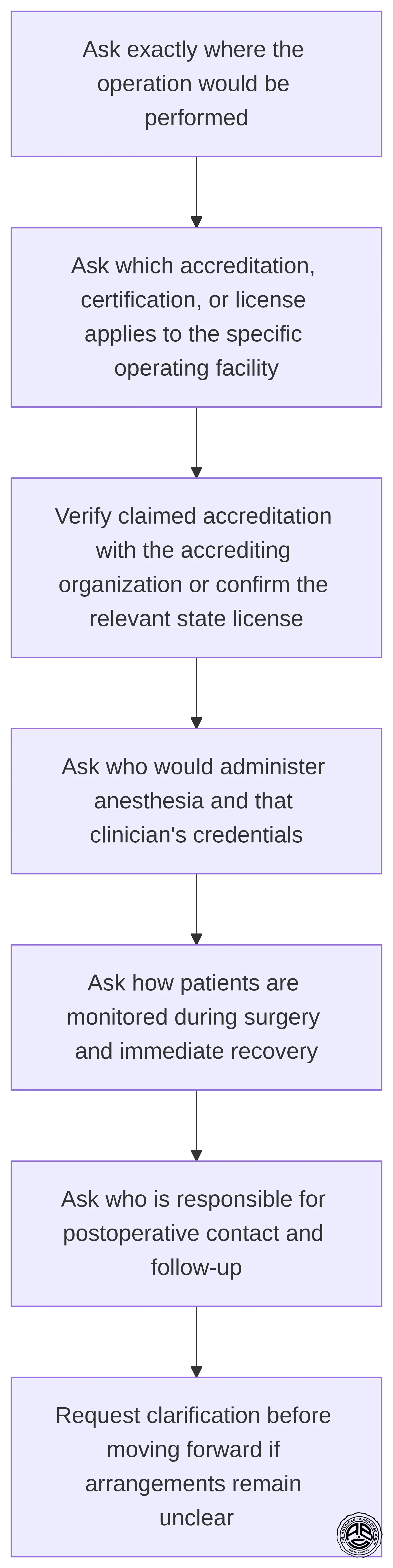
    For procedures beyond local anesthetic or mild oral sedation, ASPS facility criteria identify accreditation by AAAASF, AAAHC, or the Joint Commission; Medicare certification; or state licensure as qualifying pathways. Ask which pathway applies to the named facility, then verify a claimed accreditation with the accrediting organization or confirm the relevant state license with the appropriate authority.

    Create one facility entry with these fields:

    File field What to record
    Operating location The exact facility name provided for the procedure under discussion.
    Status claimed The accreditation, certification, or state license identified by the candidate.
    Verification Authority checked, date checked, and result found.
    Care-team details Who would administer anesthesia, how monitoring is described, and who handles immediate recovery and postoperative contact.
    Remaining question Any detail not yet identified or understood.

    Ask whether the surgeon has hospital privileges for the same procedure at a local accredited hospital; who would administer anesthesia and that clinician’s credentials; and how patients are monitored during surgery and immediate recovery. ASPS states that a qualifying facility should permit surgery by an ABMS-certified or board-eligible surgeon with privileges for the same procedures at a local accredited hospital, provide anesthesia through a board-certified or board-eligible anesthesiologist or a certified nurse anesthetist, and use advanced monitoring during surgery and immediate recovery.

    Keep two labels visible in this record: independently verified and described in consultation. The first is for the facility status you confirmed. The second is for care arrangements explained by the candidate. If the location, anesthesia clinician, monitoring, or recovery arrangement remains unclear, leave the entry open and request clarification before moving forward.

    A step-by-step flow for confirming the operating facility, its status, anesthesia credentials, monitoring, and postoperative follow-up arrangements.
    Verify the surgical setting and care arrangements before moving forward with a candidate.

    File 2: Capture What You Learn in Each Consultation

    File 2 is not a rating of bedside manner. It is a dated account of whether the consultation supplied information you could understand and use. ASPS notes that consultations are an opportunity to ask questions and that answers can help patients inform or refine their goals. Prepare written questions in advance and use the same core prompts with every candidate.

    Begin with your own goals and concerns, rather than a fixed procedure or another person’s result. ASPS notes that an approach that suited one person may not be suitable for another because bodies differ. Your notes should show whether the discussion stayed connected to your circumstances and whether you understood the explanation.

    After each consultation, complete this record:

    Consultation record What to capture
    Your stated priorities The goals and concerns you brought to the discussion.
    Candidate’s explanation The options, limits, and trade-offs as you understood them.
    Questions answered The question asked and a concise note of the answer.
    Questions still open Terms, documents, or decisions that need follow-up.
    Visual information Whether a photo gallery was available and what it could or could not help you understand.
    Decision boundary Whether you have enough clear information for a further discussion, or need clarification first.

    A photo gallery can help you visualize potential outcomes, but it is not a forecast of your individual result. Note what examples were shown, then ask what may differ in your own situation and what uncertainty remains. Do not let visual examples substitute for discussion of risks, device information, or long-term care.

    The useful comparison is not which consultation felt most memorable. It is whether each File 2 entry contains direct answers, understandable explanations, and clearly identified unresolved questions.

    File 2: Test Whether the Information Is Complete Enough to Consider

    Use a completeness check in File 2 before treating a consultation as sufficient for a decision. The check does not determine what is appropriate for you. It identifies whether the discussion and documents leave important questions unanswered.

    Ask the surgeon to explain the options relevant to your goals, why an option is being discussed, and the trade-offs you should understand. Ask how the surgeon approaches concerns if an outcome does not align with a patient’s goals, without assuming a particular revision, satisfaction, or outcome.

    For implant-based augmentation, FDA materials list risk categories that include breast pain; changes in nipple and breast sensation; additional surgeries; capsular contracture; rupture or deflation; BIA-ALCL; systemic symptoms; and effects on breastfeeding. FDA also lists wrinkling, asymmetry, scarring, pain, and incision-site infection among local complications. Record which questions you raised and what explanation you need to revisit with the surgeon.

    Before closing the entry, confirm whether you received or requested:

    • the patient labeling for the specific implant under consideration, including its complication information;
    • the actual product-specific Patient Decision Checklist for that implant;
    • an explanation of follow-up and whom to contact with concerns; and
    • an answer about how concerns are addressed if results do not align with a patient’s goals.

    FDA states that complete complication lists and rates for approved breast implants are available in patient labeling for the specific device. FDA also requires manufacturers to provide a product-specific Patient Decision Checklist with each device, containing information on known or reported risks. An online sample may be educational, but it is not the device-specific checklist you would discuss and sign with the surgeon.

    Mark the entry complete for reflection only when you can identify the documents still needed and restate the explanation in your own words. Otherwise, record the missing item and request clarification.

    File 2: Document the Long-Term Follow-Up Discussion

    Create a long-term record in File 2 rather than leaving follow-up as a general reassurance. FDA states that breast implants are not lifetime devices, that people considering them should assume they may need additional surgeries because complications can occur, and that implants need monitoring for as long as they remain in place. FDA identifies capsular contracture, reoperation, and implant removal among the most common local complications and adverse outcomes. These facts do not predict an individual experience; they explain why the follow-up discussion belongs in the evidence file.

    Use these prompts:

    • Immediate contact: Who handles postoperative questions, and how is contact arranged?
    • Monitoring discussion: What ongoing monitoring plan does the candidate describe while implants remain in place?
    • Change in condition: What instructions are given for contacting a surgeon or health care provider about abnormal changes?
    • Continuity record: What information should you retain about the implant, procedure, and follow-up plan?

    FDA advises contacting a surgeon or health care provider promptly for abnormal changes in the breasts or implants. Record the practical instructions described for that situation rather than assuming every practice handles it the same way.

    One published international framework recommends postoperative surveillance through suture removal and, ideally, for the life of an implanted device. Treat that as a framework for questions, not a universal rule or a statement about any particular practice. The purpose of this record is to distinguish a documented follow-up explanation from a promise that future surgery will never be needed.

    Compare Completed Matrices and Take Time to Reflect Before Deciding

    Set your completed matrices side by side only after you have separated verified facts from consultation observations. Look first for missing essentials: an unverified license or certification status, an unnamed operating facility, unclear accreditation or licensing, unanswered anesthesia questions, or an incomplete follow-up explanation. Those are not small details to average away with a good impression. Resolve them or remove the candidate from consideration.

    Then compare the consultation notes. Which candidate addressed your goals without making another person’s experience a template? Which explanation of options and risks did you understand well enough to summarize in your own words? Which discussion made room for questions about long-term monitoring and possible future surgery? The right next step may be a follow-up consultation, not an immediate yes or no.

    Give yourself time to reflect. A published international framework characterizes a 10-day, preferably 14-day, reflection period between operating-surgeon consultations as best practice for breast augmentation. The same framework describes at least seven days of reflection as a minimum for cosmetic patients and states that informed consent should arise from face-to-face consultation with the surgeon. These are not universal legal requirements; applicable requirements can differ by jurisdiction. They are a useful reminder that a decision involving an implant and potential long-term care should not be rushed.

    Use the reflection period to reread device-specific materials, compare your notes, and list any question you still cannot answer. If uncertainty remains, your action is to ask for clarification before deciding. A completed matrix should leave you with a reasoned basis for proceeding to a personalized discussion—not pressure to proceed with surgery.

    Use Your Evidence File to Prepare a Personalized Discussion

    Before a personalized discussion, review the two files together. File 1 should identify the current records you checked and any provider or facility detail that remains unverified. File 2 should show your goals, the explanations you received, the device-specific materials requested or reviewed, and the questions still open.

    A virtual conversation can help you discuss personal goals and request current provider, facility, anesthesia, and follow-up information. It does not replace independent verification or guarantee an outcome. Bring your dated evidence file and written questions so you can ask for the specific information needed to complete it.

    If an item is missing, leave it visible rather than filling it with an assumption. A complete file gives you a more organized basis for deciding whether a candidate merits further discussion; an incomplete file tells you exactly what to clarify next.


    Breast Augmentation Surgeon Selection FAQ

    How can I verify a breast augmentation surgeon’s credentials before booking a consultation?

    Check the surgeon’s current state license and current ABPS certification through the relevant official verification tools, then confirm that any status details are up to date. If something is unclear or flagged, ask for an explanation before moving forward.

    What should I ask about the facility where the surgery would happen?

    Ask for the exact operating location and verify whether it is accredited, licensed, or otherwise qualified under the applicable standards. It is also reasonable to ask who provides anesthesia and how patients are monitored during surgery and immediate recovery.

    What makes a consultation useful when comparing candidates?

    A useful visit should leave you with a clear understanding of your options, the trade-offs, and whether the surgeon listened to your goals and concerns. If you feel rushed or do not understand the explanation, that is a sign to ask more questions or keep comparing.

    What implant information should I review before deciding?

    Ask to see the actual product-specific Patient Decision Checklist and the patient labeling for the specific implant being discussed. Those documents help you review known or reported risks and prepare follow-up questions.

    What risks should be discussed for implant-based augmentation?

    The conversation should cover relevant complications in plain language, including local issues such as capsular contracture, rupture or deflation, asymmetry, scarring, pain, and infection, as well as other implant-related concerns. The surgeon should relate those risks to the option being considered for you.

    How should I think about follow-up and possible future surgery?

    Plan for long-term monitoring, since implants are not lifetime devices and additional surgery may be needed later. Ask how postoperative surveillance, routine follow-up, and contact for abnormal changes are handled in the practice.