
Build one review packet before the meeting
A productive tax-planning meeting starts with one organized tax-planning review packet, not a stream of disconnected files. Your goal is simple: give the credentialed tax professional a clear view of documented history, current estimates, missing records, and open questions.
Good records can help you monitor business progress, prepare financial statements, identify income sources, and support items reported on tax returns. That makes organization useful before the meeting, even when your books are still being finalized.
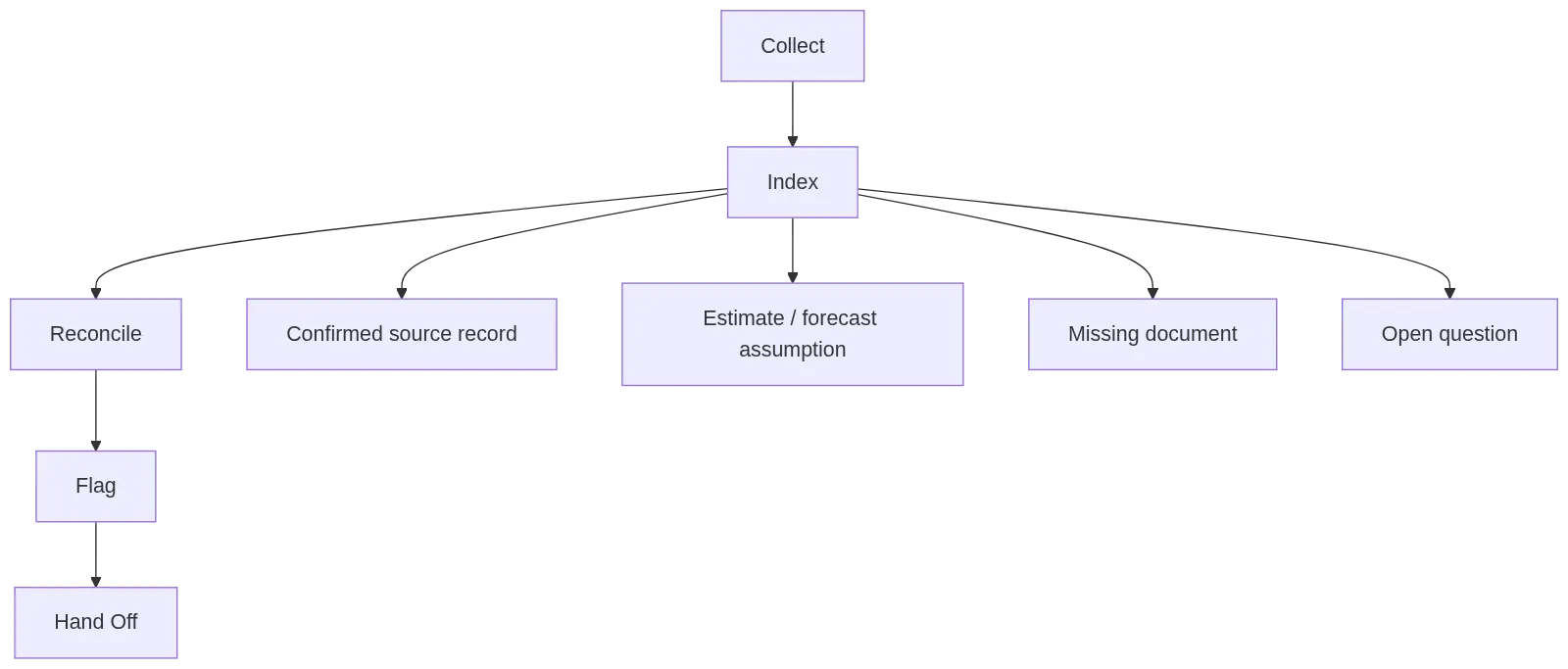
Use this workflow: Collect, Index, Reconcile, Flag, and Hand Off. It does not determine tax treatment, filing obligations, entity treatment, nexus, payment amounts, or outcomes. It creates a dependable starting point for professional review.
Start with the records you have. Label uncertainty rather than filling gaps with assumptions. A clearly marked missing document is more useful than an unsupported conclusion.
Create one index and status system for every packet item
Build one packet index before sorting folders. Give every item a row, even if the document is unavailable. A recordkeeping system may be suited to your business if it clearly shows income and expenses. Electronic records follow the same basic principles as hard-copy records. For tax books and records, an electronic storage system must be able to index, store, preserve, retrieve, and reproduce records in legible format.
Use these fields for every row:
| Item | Entity | Tax period | Source | Status | Follow-up |
|---|---|---|---|---|---|
| Profit and loss report | ABC LLC | 2026 year-to-date | Bookkeeping system | Confirmed source record | Reconcile to bank activity |
| Revenue forecast | ABC LLC | Next 12 months | Owner model | Estimate / forecast assumption | List sales assumptions |
| Payroll register | ABC LLC | Q2 2026 | Payroll provider | Missing document | Request export |
| Texas activity question | ABC LLC | 2026 | Owner notes | Open question | Ask professional to review |
Use a file-label pattern that matches the index: entity_period_record-type_status. For example: ABC-LLC_2026-YTD_bank-statements_confirmed.pdf or ABC-LLC_2027_forecast_estimate.xlsx.
Keep four statuses distinct:
- Confirmed source record: A document or system export that records completed activity, such as a bank statement, invoice, payroll report, paid bill, or filed return.
- Estimate / forecast assumption: A projection or input about future activity. A financial forecast predicts future performance from historical data, market trends, and economic conditions. It is not historical proof.
- Missing document: A record you expect should exist but cannot currently provide. State who may have it and what you will request.
- Open question: A fact, classification, timing issue, or rule question that needs professional review. Write the question plainly and attach the relevant documents.
Forecasts are inherently uncertain. If you bring scenarios, label each one, such as most likely, lower, or higher activity. Keep the assumptions beside the forecast rather than mixing them into source records.
Confirm the entity, tax period, and coverage frame first
Before gathering transactions, define what the packet covers. This prevents records for different businesses, periods, or owners from being blended together.
Create a one-page cover entry for each entity:
- Legal and working name used in the records.
- Entity covered by the packet.
- Tax period covered, such as calendar year, year-to-date, or a defined forecast period.
- Bookkeeping-file location and the person who maintains it.
- Business bank and card accounts included in the books.
- Known business changes during the period.
- Questions about entity treatment, period coverage, or records that belong elsewhere.
Your recordkeeping system should include a summary of business transactions, ordinarily in books such as journals and ledgers. IRS guidance states that business books must show gross income, deductions, and credits. For most small businesses, the business checking account is the main source for book entries.
The business you are in affects the records needed for federal tax purposes. If you operate more than one business, keep a separate packet and separate index for each one. If a document relates to both business and personal activity, label the distinction for review. Do not decide the treatment yourself when the facts are incomplete.
Action: complete the entity-and-period cover page first. Flag any uncertain ownership, entity, or coverage fact as an open question for the credentialed tax professional.
Collect bookkeeping, income, expense, and payment support
Next, collect the bookkeeping summaries and the source records behind material activity. Purchases, sales, payroll, and other business transactions generate supporting documents. These can include sales slips, paid bills, invoices, receipts, deposit slips, and canceled checks. They support entries in business books and on tax returns.
Organize documents by tax period and by income or expense type. The IRS offers organizing by year and type of income or expense as an example. Use folders that make the source easy to locate during the meeting.
Gather and index:
- Profit and loss, balance sheet, general ledger, and available account-detail reports from your bookkeeping system.
- Business bank statements, card statements, and payment-processor summaries.
- Income support, including invoices, deposit information, receipt books, sales reports, and applicable forms received.
- Purchase and expense support, including paid bills, invoices, receipts, statements, and payment confirmations.
- Records of payments made during the tax period, labeled by payee, date, amount, and source.
- Notes identifying transactions that are not yet reconciled or that have incomplete support.
For gross receipts, retain documents that show both amounts and sources. Purchase and expense support should identify the payee, amount, proof of payment, date, and a description showing the business purpose. More than one document may be needed to show the full transaction.
Reconcile means comparing a summary to its accessible source support and noting a difference. Do not force totals to match by changing a label or guessing at a category. Instead, create an index row describing the difference, the affected period, the available support, and the needed follow-up.
Action: bring the bookkeeping reports plus the source trail for significant or unresolved entries. Mark unexplained differences as open questions.
Add payroll records and business-asset documentation
Create separate modules for payroll records and business assets. Both areas often need documents from more than one system, so an index is especially useful.
Payroll records are documents created through employee compensation and related reporting. For each entity and tax period, gather available payroll registers, provider reports, payment confirmations, and notices. List the payroll provider and any period that is incomplete. IRS guidance says to keep employment tax records for at least four years. Ask the credentialed tax professional about any retention or reporting question tied to your facts.
Business assets are property you own and use in the business, such as machinery, furniture, equipment, or other documented property. For each asset, index the available acquisition document, date, cost information, payment support, and any sale or disposition record. Asset records are needed to compute annual depreciation and gain or loss when an asset is sold. Generally, property records should be kept until the limitations period expires for the year of disposal.
Do not infer an asset’s treatment from a bank description alone. If an invoice, purchase date, ownership detail, or disposition record is unavailable, use the missing-document status.
Action: provide available payroll and asset records by entity and tax period. Put missing details in the follow-up column rather than assigning treatment yourself.
Compare prior-year records with current payment evidence
Prior-year records establish the meeting’s documented starting point. Add a distinct module rather than burying older files inside the current-year folder.
Include:
- Filed prior-year returns available to the business.
- Prior-year financial statements and year-end bookkeeping reports, if available.
- Current-period payment confirmations and account statements.
- Notices, correspondence, or account records requiring discussion.
- A list of payments you believe relate to the business, with date, amount, source, and the reason you believe they matter.
Keep copies of filed tax returns because they can help prepare future returns and computations for an amended return. Generally, keep records that support an income, deduction, or credit item until the limitations period for that return expires.
A payment confirmation is evidence that a payment was made. It is not, by itself, a conclusion about how the payment should be applied. If the purpose, period, entity, or balance is uncertain, state that uncertainty directly.
Action: place prior-year records and current payment evidence in separate indexed folders. Give the professional a list of payment questions instead of a guessed reconciliation.
Keep forecasts separate from historical records and business changes
Historical source records describe completed activity. Forecast assumptions describe possible future activity. Keep them in separate folders and use different statuses throughout the packet.
For the forecast module, include:
- The forecast period.
- The preparer and date prepared.
- Historical reports used as inputs.
- Assumptions about sales, costs, staffing, financing, or other expected changes.
- Scenarios, if used, with each scenario clearly named.
- Questions the credentialed tax professional should review.
A projected balance sheet estimates end-of-period assets, liabilities, and equity using historical data and financial assumptions. That makes assumptions part of the forecast record, not confirmed facts.
Create a separate business-changes log. Record facts and attach available documents for events such as ownership changes, new locations, a new line of business, new accounts, acquisitions, asset sales, restructuring, or plans to end operations. Avoid conclusions about the tax effect. The useful meeting question is: “What records and rules should we review for this change?”
Action: label every projection as an estimate and every completed change as a documented fact. Route the possible tax effect of either item to professional review.
Document Texas activity without deciding applicability
If your entity is organized in Texas, operates there, or has activity connected to Texas, create a Texas module. This is a documentation exercise, not a conclusion about a filing obligation.
The Texas Comptroller describes Texas franchise tax as a privilege tax imposed on taxable entities formed or organized in Texas or doing business in Texas.
Collect and index:
- Entity formation and registration documents available to you.
- A factual summary of Texas locations, employees, property, customers, operations, and relevant dates.
- Available Texas franchise-tax reports, correspondence, account information, and payment evidence.
- Available Texas Franchise Tax Account Status results, labeled with the date viewed.
- Documents for a termination, conversion, merger, withdrawal, or other organizational change.
- Open questions about Texas activity, nexus, entity type, reports, account status, or organizational changes.
Texas Franchise Tax Account Status reflects an entity’s right to transact business in Texas and the Comptroller’s records at the time of the query. For listed entity types organized in Texas or having Texas nexus, the Comptroller states that Form 05-102 is filed annually; have a credentialed tax professional confirm whether it applies to your entity and circumstances.
For a Texas entity planning to terminate, convert, or merge, the Comptroller states that a final report and any amount due are required before obtaining a Certificate of Account Status. Confirm the entity’s circumstances with a credentialed tax professional.
Action: provide facts and available Texas records, then ask the professional to assess applicability. Do not treat Texas activity alone as proof of a filing result.
Finish with a clear professional-review handoff
Finish the packet with a one-page handoff summary. It should help the meeting begin with priorities rather than document hunting.
Use four headings:
- Ready: confirmed source records, organized by entity and tax period, with their source locations.
- Missing: documents requested or still being located, with the responsible person or system.
- Estimated: forecasts, assumptions, scenarios, and projected figures kept apart from historical records.
- Awaiting professional review: open questions about facts, entity treatment, payments, business changes, Texas activity, nexus, reports, or other tax-rule issues.
Bring the cover sheet, packet index, and labeled folders together. A packet can be useful before every item is found if its status is clear. The handoff is complete enough when the credentialed tax professional can see what is documented, what needs follow-up, and what requires a professional conclusion.
Tax-planning packet FAQ
What should be in a tax-planning review packet?
Include the entity, tax period, bookkeeping reports, payroll records, payment support, business assets, prior-year records, forecasts, business changes, and any Texas-related materials. Keep confirmed source records separate from estimates and open questions.
How should I label items in the packet?
Use one row for each item with item, entity, tax period, source, status, and follow-up. A file name that mirrors those fields makes the packet easier to review.
What counts as a confirmed source record versus an estimate?
A confirmed source record is completed activity supported by documents or system exports. An estimate is a forecast or assumption about future activity, so it should stay labeled as projected rather than factual.
Why do prior-year returns and older records matter?
They help the professional compare periods, prepare future returns, and work through amended-return questions if needed. Property records also stay important for depreciation and gain-or-loss questions.
What payroll records should I bring?
Bring available payroll registers, provider reports, payment confirmations, and any notices for the entity and tax period. If a period is incomplete, mark it as missing and note the follow-up needed.
How should I handle business assets in the packet?
List each asset with the acquisition record, date, cost support, payment evidence, and any sale or disposal record. Those documents help the professional review depreciation and disposition questions.
What Texas items are useful to include?
Include factual records for Texas activity, available franchise-tax reports, account-status results, payment evidence, and documents tied to formation, withdrawal, conversion, merger, or termination. Treat them as review items, not conclusions about filing responsibility.
Leave a Reply