
Tag: business recordkeeping checklist

  • Small-Business Tax-Planning Meeting Checklist: Build a Review-Ready Packet

    Small-Business Tax-Planning Meeting Checklist: Build a Review-Ready Packet

    Build one review packet before the meeting

    A productive tax-planning meeting starts with one organized tax-planning review packet, not a stream of disconnected files. Your goal is simple: give the credentialed tax professional a clear view of documented history, current estimates, missing records, and open questions.

    Good records can help you monitor business progress, prepare financial statements, identify income sources, and support items reported on tax returns. That makes organization useful before the meeting, even when your books are still being finalized.

    Use this workflow: Collect, Index, Reconcile, Flag, and Hand Off. It does not determine tax treatment, filing obligations, entity treatment, nexus, payment amounts, or outcomes. It creates a dependable starting point for professional review.

    Start with the records you have. Label uncertainty rather than filling gaps with assumptions. A clearly marked missing document is more useful than an unsupported conclusion.

    Create one index and status system for every packet item

    Build one packet index before sorting folders. Give every item a row, even if the document is unavailable. A recordkeeping system may be suited to your business if it clearly shows income and expenses. Electronic records follow the same basic principles as hard-copy records. For tax books and records, an electronic storage system must be able to index, store, preserve, retrieve, and reproduce records in legible format.

    Use these fields for every row:

    Item Entity Tax period Source Status Follow-up
    Profit and loss report ABC LLC 2026 year-to-date Bookkeeping system Confirmed source record Reconcile to bank activity
    Revenue forecast ABC LLC Next 12 months Owner model Estimate / forecast assumption List sales assumptions
    Payroll register ABC LLC Q2 2026 Payroll provider Missing document Request export
    Texas activity question ABC LLC 2026 Owner notes Open question Ask professional to review

    Use a file-label pattern that matches the index: entity_period_record-type_status. For example: ABC-LLC_2026-YTD_bank-statements_confirmed.pdf or ABC-LLC_2027_forecast_estimate.xlsx.

    Keep four statuses distinct:

    • Confirmed source record: A document or system export that records completed activity, such as a bank statement, invoice, payroll report, paid bill, or filed return.
    • Estimate / forecast assumption: A projection or input about future activity. A financial forecast predicts future performance from historical data, market trends, and economic conditions. It is not historical proof.
    • Missing document: A record you expect should exist but cannot currently provide. State who may have it and what you will request.
    • Open question: A fact, classification, timing issue, or rule question that needs professional review. Write the question plainly and attach the relevant documents.

    Forecasts are inherently uncertain. If you bring scenarios, label each one, such as most likely, lower, or higher activity. Keep the assumptions beside the forecast rather than mixing them into source records.
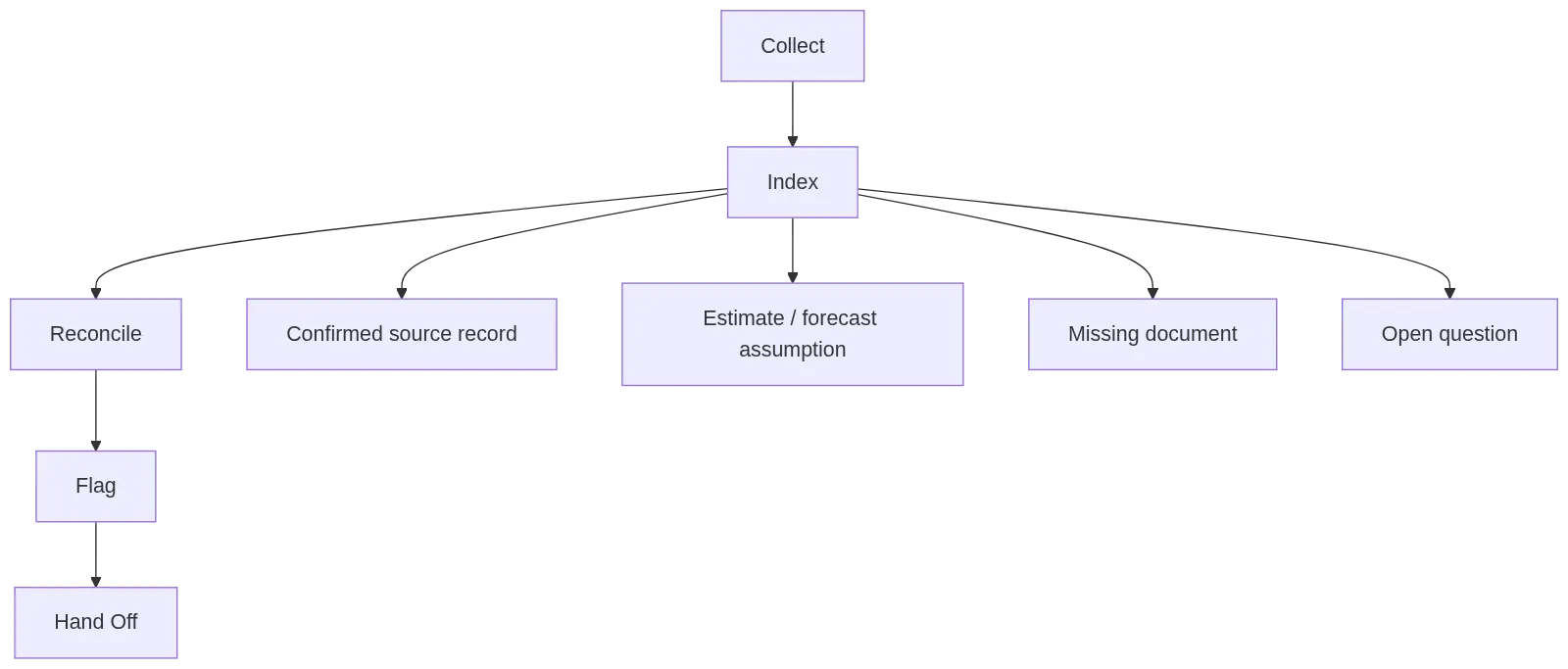
    A five-step packet workflow from collect to hand off, with four item statuses used in the index.
    Use one workflow to separate confirmed records, estimates, missing items, and open questions before review.

    Confirm the entity, tax period, and coverage frame first

    Before gathering transactions, define what the packet covers. This prevents records for different businesses, periods, or owners from being blended together.

    Create a one-page cover entry for each entity:

    • Legal and working name used in the records.
    • Entity covered by the packet.
    • Tax period covered, such as calendar year, year-to-date, or a defined forecast period.
    • Bookkeeping-file location and the person who maintains it.
    • Business bank and card accounts included in the books.
    • Known business changes during the period.
    • Questions about entity treatment, period coverage, or records that belong elsewhere.

    Your recordkeeping system should include a summary of business transactions, ordinarily in books such as journals and ledgers. IRS guidance states that business books must show gross income, deductions, and credits. For most small businesses, the business checking account is the main source for book entries.

    The business you are in affects the records needed for federal tax purposes. If you operate more than one business, keep a separate packet and separate index for each one. If a document relates to both business and personal activity, label the distinction for review. Do not decide the treatment yourself when the facts are incomplete.

    Action: complete the entity-and-period cover page first. Flag any uncertain ownership, entity, or coverage fact as an open question for the credentialed tax professional.

    Collect bookkeeping, income, expense, and payment support

    Next, collect the bookkeeping summaries and the source records behind material activity. Purchases, sales, payroll, and other business transactions generate supporting documents. These can include sales slips, paid bills, invoices, receipts, deposit slips, and canceled checks. They support entries in business books and on tax returns.

    Organize documents by tax period and by income or expense type. The IRS offers organizing by year and type of income or expense as an example. Use folders that make the source easy to locate during the meeting.

    Gather and index:

    • Profit and loss, balance sheet, general ledger, and available account-detail reports from your bookkeeping system.
    • Business bank statements, card statements, and payment-processor summaries.
    • Income support, including invoices, deposit information, receipt books, sales reports, and applicable forms received.
    • Purchase and expense support, including paid bills, invoices, receipts, statements, and payment confirmations.
    • Records of payments made during the tax period, labeled by payee, date, amount, and source.
    • Notes identifying transactions that are not yet reconciled or that have incomplete support.

    For gross receipts, retain documents that show both amounts and sources. Purchase and expense support should identify the payee, amount, proof of payment, date, and a description showing the business purpose. More than one document may be needed to show the full transaction.

    Reconcile means comparing a summary to its accessible source support and noting a difference. Do not force totals to match by changing a label or guessing at a category. Instead, create an index row describing the difference, the affected period, the available support, and the needed follow-up.

    Action: bring the bookkeeping reports plus the source trail for significant or unresolved entries. Mark unexplained differences as open questions.

    Add payroll records and business-asset documentation

    Create separate modules for payroll records and business assets. Both areas often need documents from more than one system, so an index is especially useful.

    Payroll records are documents created through employee compensation and related reporting. For each entity and tax period, gather available payroll registers, provider reports, payment confirmations, and notices. List the payroll provider and any period that is incomplete. IRS guidance says to keep employment tax records for at least four years. Ask the credentialed tax professional about any retention or reporting question tied to your facts.

    Business assets are property you own and use in the business, such as machinery, furniture, equipment, or other documented property. For each asset, index the available acquisition document, date, cost information, payment support, and any sale or disposition record. Asset records are needed to compute annual depreciation and gain or loss when an asset is sold. Generally, property records should be kept until the limitations period expires for the year of disposal.

    Do not infer an asset’s treatment from a bank description alone. If an invoice, purchase date, ownership detail, or disposition record is unavailable, use the missing-document status.

    Action: provide available payroll and asset records by entity and tax period. Put missing details in the follow-up column rather than assigning treatment yourself.

    Compare prior-year records with current payment evidence

    Prior-year records establish the meeting’s documented starting point. Add a distinct module rather than burying older files inside the current-year folder.

    Include:

    • Filed prior-year returns available to the business.
    • Prior-year financial statements and year-end bookkeeping reports, if available.
    • Current-period payment confirmations and account statements.
    • Notices, correspondence, or account records requiring discussion.
    • A list of payments you believe relate to the business, with date, amount, source, and the reason you believe they matter.

    Keep copies of filed tax returns because they can help prepare future returns and computations for an amended return. Generally, keep records that support an income, deduction, or credit item until the limitations period for that return expires.

    A payment confirmation is evidence that a payment was made. It is not, by itself, a conclusion about how the payment should be applied. If the purpose, period, entity, or balance is uncertain, state that uncertainty directly.

    Action: place prior-year records and current payment evidence in separate indexed folders. Give the professional a list of payment questions instead of a guessed reconciliation.

    Keep forecasts separate from historical records and business changes

    Historical source records describe completed activity. Forecast assumptions describe possible future activity. Keep them in separate folders and use different statuses throughout the packet.

    For the forecast module, include:

    • The forecast period.
    • The preparer and date prepared.
    • Historical reports used as inputs.
    • Assumptions about sales, costs, staffing, financing, or other expected changes.
    • Scenarios, if used, with each scenario clearly named.
    • Questions the credentialed tax professional should review.

    A projected balance sheet estimates end-of-period assets, liabilities, and equity using historical data and financial assumptions. That makes assumptions part of the forecast record, not confirmed facts.

    Create a separate business-changes log. Record facts and attach available documents for events such as ownership changes, new locations, a new line of business, new accounts, acquisitions, asset sales, restructuring, or plans to end operations. Avoid conclusions about the tax effect. The useful meeting question is: “What records and rules should we review for this change?”

    Action: label every projection as an estimate and every completed change as a documented fact. Route the possible tax effect of either item to professional review.

    Document Texas activity without deciding applicability

    If your entity is organized in Texas, operates there, or has activity connected to Texas, create a Texas module. This is a documentation exercise, not a conclusion about a filing obligation.

    The Texas Comptroller describes Texas franchise tax as a privilege tax imposed on taxable entities formed or organized in Texas or doing business in Texas.
    Collect and index:

    • Entity formation and registration documents available to you.
    • A factual summary of Texas locations, employees, property, customers, operations, and relevant dates.
    • Available Texas franchise-tax reports, correspondence, account information, and payment evidence.
    • Available Texas Franchise Tax Account Status results, labeled with the date viewed.
    • Documents for a termination, conversion, merger, withdrawal, or other organizational change.
    • Open questions about Texas activity, nexus, entity type, reports, account status, or organizational changes.

    Texas Franchise Tax Account Status reflects an entity’s right to transact business in Texas and the Comptroller’s records at the time of the query. For listed entity types organized in Texas or having Texas nexus, the Comptroller states that Form 05-102 is filed annually; have a credentialed tax professional confirm whether it applies to your entity and circumstances.

    For a Texas entity planning to terminate, convert, or merge, the Comptroller states that a final report and any amount due are required before obtaining a Certificate of Account Status. Confirm the entity’s circumstances with a credentialed tax professional.

    Action: provide facts and available Texas records, then ask the professional to assess applicability. Do not treat Texas activity alone as proof of a filing result.

    Finish with a clear professional-review handoff

    Finish the packet with a one-page handoff summary. It should help the meeting begin with priorities rather than document hunting.

    Use four headings:

    1. Ready: confirmed source records, organized by entity and tax period, with their source locations.
    2. Missing: documents requested or still being located, with the responsible person or system.
    3. Estimated: forecasts, assumptions, scenarios, and projected figures kept apart from historical records.
    4. Awaiting professional review: open questions about facts, entity treatment, payments, business changes, Texas activity, nexus, reports, or other tax-rule issues.

    Bring the cover sheet, packet index, and labeled folders together. A packet can be useful before every item is found if its status is clear. The handoff is complete enough when the credentialed tax professional can see what is documented, what needs follow-up, and what requires a professional conclusion.


    Tax-planning packet FAQ

    What should be in a tax-planning review packet?

    Include the entity, tax period, bookkeeping reports, payroll records, payment support, business assets, prior-year records, forecasts, business changes, and any Texas-related materials. Keep confirmed source records separate from estimates and open questions.

    How should I label items in the packet?

    Use one row for each item with item, entity, tax period, source, status, and follow-up. A file name that mirrors those fields makes the packet easier to review.

    What counts as a confirmed source record versus an estimate?

    A confirmed source record is completed activity supported by documents or system exports. An estimate is a forecast or assumption about future activity, so it should stay labeled as projected rather than factual.

    Why do prior-year returns and older records matter?

    They help the professional compare periods, prepare future returns, and work through amended-return questions if needed. Property records also stay important for depreciation and gain-or-loss questions.

    What payroll records should I bring?

    Bring available payroll registers, provider reports, payment confirmations, and any notices for the entity and tax period. If a period is incomplete, mark it as missing and note the follow-up needed.

    How should I handle business assets in the packet?

    List each asset with the acquisition record, date, cost support, payment evidence, and any sale or disposal record. Those documents help the professional review depreciation and disposition questions.

    What Texas items are useful to include?

    Include factual records for Texas activity, available franchise-tax reports, account-status results, payment evidence, and documents tied to formation, withdrawal, conversion, merger, or termination. Treat them as review items, not conclusions about filing responsibility.


  • Small Business Tax Deductions Checklist for a Status-Labeled Tax-Planning Packet

    Small Business Tax Deductions Checklist for a Status-Labeled Tax-Planning Packet

    Prepare a review packet before discussing potential deductions

    Use this small business tax deductions checklist to organize records and questions for a potential deduction review before meeting with a credentialed professional.

    For an Austin healthcare business, organize five folders: Bookkeeping, Payments, Payroll/Contractors, Assets, and Forecasts. Add a short change log and a review agenda. This approach gives your bookkeeper, CPA, EA, attorney, or other credentialed professional a clear starting point without treating a working note as proof or a possible expense as a deduction.

    The IRS says you may use a recordkeeping system suited to your business when it clearly shows income and expenses. The business you operate affects the records needed for federal tax purposes. Electronic records must meet the same basic recordkeeping principles as paper records.

    Use one label on every item in your packet:

    • Confirmed information: A dated source record supports the fact.
    • Assumption: A planning note or expectation that has not been supported by records.
    • Missing record: You know an item occurred, but the source document is not in the packet.
    • Needs verification: A record exists, but the applicable tax-year rule, timing, classification, or treatment needs current review.
    • Unresolved question: A fact-specific issue for credentialed professional review.

    This packet is preparation, not a tax result. Current federal and Texas rules, filing periods, business activity, entity facts, and record support still matter.

    Pair every checklist item with a dated source record

    Use a simple rule throughout the packet: a working note identifies an issue; a dated source record supports review. Purchases, sales, payroll, and other business transactions generate supporting documents. Examples include sales slips, paid bills, invoices, receipts, deposit slips, and canceled checks.

    For each potential expense-related item, create one line in your checklist with:

    1. The item or service.
    2. The affected period.
    3. The payee.
    4. The amount.
    5. Payment evidence.
    6. The date incurred.
    7. A short business-purpose description.
    8. The folder and file name for the source record.
    9. A status label.
    10. A question for review, if needed.

    For example, a note reading “new treatment-room equipment” is not enough by itself. Pair it with the invoice, payment record, acquisition date, and any available use or disposal information. Mark treatment as Needs verification rather than assigning a deduction category yourself.

    One document may not establish every relevant element. A receipt may show an amount, while a bank or card record shows payment; an invoice may provide the service description. Keep related documents together. Organize supporting documents by year and by income or expense type because they support entries in your books and tax return.

    For travel, gifts, or transportation being considered for deduction, create an Unresolved question for your tax professional about the substantiation that applies to your tax year and facts. Do not rely on a general expense list to settle those requirements.

    Gather current bookkeeping records and payment evidence

    Start with records that show how money moved through the business. Keep a transaction summary in business books, such as accounting journals and ledgers. IRS guidance states that business books must show gross income, deductions, and credits.

    Bookkeeping folder

    Gather current bookkeeping records for the review period:

    • General ledger or transaction-detail reports.
    • Profit-and-loss statement and balance sheet, if maintained.
    • Business bank-account activity and reconciliations.
    • Credit-card account activity used for business transactions.
    • Revenue summaries by service line, payer, or location when your records use those categories.
    • Notes identifying unusual, corrected, duplicated, or unreconciled entries.

    Label a report Confirmed information only when it is dated, identifies its period, and can be traced to underlying records. Mark an unreconciled balance, an uncategorized transaction, or a report prepared from incomplete data as Needs verification.

    Payments folder

    For gross receipts, keep records showing the amount and source. Depending on your practice, this may include invoices, deposit information, receipt records, payment-platform reports, cash-receipt summaries, or payer remittance records.

    For outgoing payments, gather invoices, paid bills, receipts, account statements, card statements, canceled checks, and electronic-payment confirmations. Keep each record with its period and transaction reference where possible.

    Use a short exception list rather than silently filling gaps. For example:

    Status Item Source record needed Review question
    Missing record Vendor payment in bookkeeping Invoice or receipt What service or item was received?
    Needs verification Payment split between personal and business activity Dated allocation support What facts should be reviewed?
    Assumption Planned recurring subscription Contract or invoice when available Did the service begin in this period?

    The goal is traceability. Do not convert an unclear payment into a claimed business expense merely because it appears in a business account.

    Separate payroll and contractor records from worker classification questions

    Keep payroll records and contractor payment records in the same folder only if they remain clearly separated. The packet can show what happened; it should not decide worker classification, compensation treatment, payment-reporting obligations, or filing consequences.

    Payroll records

    Gather payroll registers, payroll-provider reports, wage summaries, tax-payment confirmations, benefit records, and records of owner compensation where applicable. Note the covered pay periods and the source system. IRS guidance states that employment tax records must be retained at least four years after the tax is due or paid, whichever is later.

    Contractor records

    Gather contracts, invoices, payment confirmations, vendor details, and any payment summaries maintained by the business. Keep contractor records distinct from employee payroll records. If the same person’s role, pay arrangement, duties, or work location changed, place that change in the change log.

    Use these escalation prompts:

    • Worker classification: “What current facts and records should be reviewed before determining worker status?”
    • Payment reporting: “Which payments and payees require current review for reporting purposes?”
    • Owner compensation: “What changed in amount, timing, or method of payment?”
    • Missing support: “Which payroll or contractor records must be obtained before review?”

    Send the supporting facts and the question for credentialed professional review.

    Document asset activity from purchase through disposition

    Create an Assets folder for equipment, furniture, technology, and other business property. Asset records may be needed to compute depreciation and gain or loss on disposition. That does not mean a purchase has a particular tax treatment; treatment and timing need current review.

    For each asset, assemble the following as applicable:

    • Acquisition date and method.
    • Purchase invoice and purchase price.
    • Payment evidence.
    • Improvement records.
    • Description of business use.
    • Prior depreciation, Section 179, casualty-loss, or other deduction records, if any exist.
    • Sale, trade-in, retirement, or other disposition date.
    • Sale price and selling-expense records.

    A practical asset line might read: “Ultrasound unit; acquired March 2026; invoice and payment confirmation attached; placed-in-service date needs verification; no disposition.” This keeps confirmed facts separate from tax conclusions.

    Also flag planned purchases. A signed quote, budget, or vendor proposal can be useful planning context, but label it Assumption or Needs verification unless it documents a completed transaction. Ask your credentialed professional which current-year facts, dates, and records are needed to discuss treatment.

    Generally keep property records through the limitations period for the year of disposition. Retention can depend on the event and the return involved, so keep the asset file intact and obtain current advice before destroying records.

    Add prior-year returns and a dated cash-flow forecast

    Add copies of filed prior-year tax returns to the packet. The IRS advises keeping filed returns because they can help prepare future returns and make amended-return computations. Treat them as reference records, not as a template that automatically fits this year.

    Then prepare a dated cash-flow forecast. Keep it simple and identify the date prepared, period covered, preparer, source assumptions, and version. Include expected receipts, major operating costs, payroll changes, contractor payments, planned purchases, financing activity, and known changes in owner compensation where relevant.

    A prior-year federal return can be a starting record for an estimated-tax discussion. Current-year income and facts still require review. Do not calculate an estimated-tax amount in this checklist or assume that last year’s pattern continues.

    Use a forecast status block:

    • Confirmed information: Actual current-year results supported by current bookkeeping records.
    • Assumption: Expected collections, planned hiring, expected purchases, or projected expenses.
    • Missing record: A prior-year return, current financial report, or source document not yet obtained.
    • Needs verification: A forecast item that may affect estimated tax, entity-level reporting, or tax treatment.
    • Unresolved question: “What information is needed to discuss estimated tax for the remaining period?”

    Bring both the prior-year return and the dated forecast to review. The useful action is to document what changed, not to turn the forecast into a payment instruction.

    Log business changes that may affect the review

    Your folders show individual records. The change log shows what is different from the prior period and where review may be needed. It is especially useful when several people maintain records or when the business changed during the year.

    Use one row for each material change:

    Change area What changed Affected period Source record Status Question for review
    Income New payer, service, or collection pattern Month or quarter Dated revenue report Confirmed information Does this change require any current review?
    Expenses New recurring cost or unusual payment Month or quarter Invoice and payment evidence Needs verification What records establish the business purpose?
    Payroll Hiring, pay, benefit, or owner-compensation change Pay period Payroll register Confirmed information What facts require review?
    Contractors New vendor or changed arrangement Period Contract and payments Unresolved question Are classification or reporting issues present?
    Assets Purchase, improvement, sale, or trade-in Date Invoice, payment, sale record Needs verification What treatment and timing should be reviewed?
    Entity facts Ownership, legal structure, or operating change Effective date Governing or business record Unresolved question What federal or Texas consequences require review?
    Multistate activity New location, remote work, or out-of-state activity Start date Lease, payroll, contract, or sales record Needs verification Which jurisdictions should be reviewed?

    Do not use the log to resolve the issue. Its job is to connect a change to evidence, a period, a status, and a specific professional question.

    List Texas franchise tax and multistate questions separately

    Keep Texas franchise tax and multistate activity on a separate escalation page. These questions can depend on entity status, where the entity is formed or organized, business activity, revenue, locations, and current report-year rules.

    For 2024 report years and later, verify the current threshold and whether the entity must file a Texas information report even when no No Tax Due Report is required. The Texas Comptroller provides current report-year forms and instructions.

    Place these records on the escalation page:

    • Legal entity name and entity type.
    • Texas formation or registration details, if applicable.
    • Current and prior operating locations.
    • Locations of employees, contractors, and owners performing work.
    • Revenue and activity by state, if maintained.
    • Leases, contracts, registrations, or correspondence relevant to a new location or jurisdiction.
    • Prior Texas franchise-tax filings and current notices, if any.
    • The current report-year forms or instructions being reviewed.

    For multistate activity, write the facts first and the conclusion last. Example: “Therapist performed services from another state beginning in May; agreement and payment records attached; Texas and other-state implications need review.” The Texas Comptroller provides a Nexus Questionnaire for specified non-Texas entities, but whether it applies to your facts is an unresolved question for credentialed professional review.

    Do not infer nexus, taxable-entity status, report type, or filing obligation from a single record. Bring the entity facts and operating facts to review.

    Bring a clear agenda to credentialed professional review

    Before the meeting, place a one-page agenda at the front of the packet. Group it under four headings:

    1. Confirmed information: Records attached and periods covered.
    2. Assumptions to test: Forecast items, planned purchases, or expected changes.
    3. Missing records to obtain: The specific invoice, statement, return, payroll report, or asset document still needed.
    4. Unresolved questions: Worker classification, estimated tax, asset treatment, Texas franchise tax, multistate activity, payment reporting, and any entity-specific issue.

    For each question, state the affected period and point to the folder or change-log row. This lets the review focus on facts that matter rather than reconstructing the business from memory.

    Keep the packet after review as part of your records. Generally retain records supporting return items until the applicable period of limitations expires. Retention details can vary by event and return, so preserve the source records and confirm the appropriate retention approach for your circumstances.

    A well-labeled tax-planning packet does not determine whether an item is deductible or what you owe. It gives Austin Small Business Tax Advisors and your credentialed professional review team a clearer record trail: what is confirmed, what is assumed, what is missing, and what requires current judgment.

    Tax-planning packet FAQ

    What should be in a tax-planning packet for a small business review?

    Include current bookkeeping records, payment records, payroll records, asset activity, prior-year returns, and a dated cash-flow forecast. Label each item as confirmed information, assumption, missing record, needs verification, or unresolved question.

    How should I document expenses so they can be reviewed properly?

    Pair each expense with the payee, amount, proof of payment, date incurred, and a description of the business purpose. One document may not show every detail, so keep invoices, receipts, statements, and confirmations together.

    What records help with payroll and contractor questions?

    Keep payroll registers, wage summaries, tax payment confirmations, and related benefit records separate from contractor invoices, contracts, and payment records. If a role or arrangement changed, note the change and flag it for review.

    What should I collect for asset purchases or sales?

    Gather acquisition date, purchase price, payment evidence, improvement records, business-use details, and any sale or disposition information. Those records may be needed to review depreciation or gain or loss later.

    Can I rely on last year's return when planning this year's taxes?

    Use it as a reference, not as a final answer. A prior-year return can help frame an estimated-tax discussion, but current-year income, expenses, and other facts still need review.

    When should Texas franchise tax or multistate activity be flagged for review?

    Those facts can affect filing questions, so keep them separate as unresolved questions for credentialed professional review.

  • Small-Business Tax Planning Packet Checklist for Austin Owners

    Small-Business Tax Planning Packet Checklist for Austin Owners

    Build a review-ready packet before drawing tax conclusions

    A useful tax-planning meeting starts with an organized record packet, not a list of assumed deductions or tax-saving ideas. Your goal is to make the current facts visible: what the books show, what documents support them, what you are forecasting, what is absent, and what needs professional judgment.

    For an Austin small-business owner, that packet can bring together current bookkeeping, prior-year returns, payment records, payroll and owner-compensation materials, contractor information, asset activity, and dated forecasts. It is preparation for a conversation with a credentialed tax professional—not a way to decide tax treatment, eligibility, entity choices, deductions, credits, or filing outcomes on your own.

    The IRS says good records are needed to prepare returns and support reported income, expenses, and credits. A packet that preserves both the evidence and the uncertainty gives a professional a clearer starting point than a folder of unlabeled documents.

    Label every packet item by its evidence status

    Use one status on every report, document group, forecast, and question. The labels are simple, but they prevent an estimate from being mistaken for a record or an unanswered question from being treated as a conclusion.

    Status Use it when What belongs in the packet Reader action
    Confirmed record A document or reconciled report supports the item for a stated period. The source document, report location, period, and a short note. Keep the evidence with the related book entry or question.
    Owner assumption or forecast The item reflects an expectation, estimate, or management view rather than completed activity. The assumption, date prepared, period covered, and basis you used. Label it as an assumption; do not present it as a completed transaction.
    Missing information A needed document, amount, account detail, or period is unavailable. A description of what is absent and where you looked. Identify the person, system, or statement needed to fill the gap.
    Credentialed-professional review required The issue depends on current rules or tax treatment. The facts, records, period, and precise question. Bring it for current-period review rather than deciding applicability yourself.

    Apply the label at the smallest useful level. A monthly bank statement may be a confirmed record while several transactions within that month remain missing information. A forecast may be well documented but still remain an owner assumption. The point is not to make every item look complete; it is to let the reviewer see exactly what can be relied on and what needs follow-up.

    Checklist: current bookkeeping and transaction support

    Start with the period you want reviewed. Create one folder or clearly named digital location for each year and, within it, separate current-period materials from prior-year records. The IRS says a business may choose a recordkeeping system suited to its operations that clearly shows income and expenses, subject to limited exceptions. It also says a recordkeeping system should include a summary of business transactions, and that business books must show gross income, deductions, and credits.

    Gather these current-bookkeeping items:

    • Current profit-and-loss report, balance sheet, general ledger, or other transaction summary used by the business.
    • Business bank-account statements for the period, plus credit-card or payment-account statements used for business transactions.
    • Reconciliation reports or a note identifying which accounts and months are reconciled, unreconciled, or not yet entered.
    • Sales reports, invoices, receipt books, deposit records, payment-processor reports, and other support for money received.
    • Paid bills, vendor invoices, receipts, canceled checks, and proof of electronic payment for money spent.
    • A short explanation of any personal account, cash activity, loan activity, or payment platform that appears in the business records.
    • A list of bookkeeping changes during the period, such as a new system, new account, changed chart of accounts, or revised reporting process.

    Sales slips, paid bills, invoices, receipts, deposit slips, and canceled checks are among the supporting documents the IRS lists. Those documents support entries in the books and on a tax return. Organize them by year and by type of income or expense so a reviewer can move from a report line to underlying support without guessing.

    Electronic files are workable when they are orderly. The IRS says electronic systems are subject to the same basic recordkeeping principles and requirements as hard-copy records. Give files a consistent name that includes the period and document type, such as 2026-03 business checking statement or 2026 Q1 vendor invoices. Mark the folder or report confirmed record only if you can identify the period and supporting source. Otherwise, use the appropriate uncertainty label.

    Checklist: income, payments, purchases, and expense evidence

    Treat the books as a summary and the underlying records as the support behind that summary. This is especially important when a transaction is unusual, large for the business, split across accounts, or not clearly described.

    For income and gross receipts, gather:

    • Customer invoices, sales summaries, receipt records, and payment-processor reports.
    • Deposit information that connects receipts to a bank or other account.
    • A list of items that do not clearly match between sales records and deposits.
    • Notes identifying the source of each unusual receipt or nonroutine payment.

    IRS guidance says gross-receipt support should show the amount and source of business receipts. Do not infer a source from a bank description if you cannot confirm it; mark the entry missing information or credentialed-professional review required, depending on the question.

    For purchases and expenses, gather:

    • Vendor invoices, receipts, paid bills, account statements, canceled checks, card statements, and electronic-payment confirmations.
    • A transaction note where the document does not plainly show what was purchased or what service was received.
    • Any correspondence or agreement that helps explain an unusual payment.
    • A list of transactions for which payment evidence exists but the invoice, receipt, or business-purpose description is absent.

    For purchases, the IRS lists the payee, amount paid, proof of payment, date incurred, and a purchase description among the identifying information supporting records should show. For expenses, it similarly lists the payee, amount paid, proof of payment, date incurred, and a description showing business purpose. More than one document may be needed to substantiate all elements of a purchase or expense.

    A practical packet note can be brief: March vendor payment — confirmed payment record; invoice missing; business-purpose description needed. That phrasing documents what you know without converting an incomplete file into a tax conclusion. If a payment may involve a deduction, credit, owner transaction, related party, travel, gift, transportation, or other tax-sensitive treatment, place the item in the professional-review category.

    Checklist: prior returns, payroll, assets, contractors, and forecasts

    Complete the packet with records that provide context for the current period. Keep each category separate, identify the applicable period, and avoid deciding whether an item qualifies for a particular tax result.

    Prior-year returns and carry-forward context

    • Copies of filed business and owner returns that relate to the business.
    • Prior-year financial statements, workpapers you have, and notices or correspondence you want reviewed.
    • A list of changes since the prior year: ownership, operations, locations, financing, payment methods, payroll, or major purchases.

    The IRS advises keeping copies of filed returns because they can help with future returns and amended-return computations. Label prior filings as confirmed record; label any interpretation of what they mean for the current period as credentialed-professional review required.

    Payroll and owner-compensation materials

    • Payroll registers and payroll-provider reports.
    • Wage-payment dates and amounts, tax-deposit confirmations, filed payroll-return copies, and employee information maintained for payroll purposes.
    • Withholding certificates, benefit or reimbursement records, and support for any payroll-related item you want reviewed.
    • Owner-payment and owner-draw records, clearly separated from employee payroll records.

    The IRS lists payroll payment records, employee information, withholding certificates, deposit records, filed returns, and substantiation for certain benefits, reimbursements, and credits among employment-tax records. Questions about worker treatment, owner compensation, payroll treatment, benefits, reimbursements, or credits require credentialed-professional review.

    Contractor information

    • Agreements, invoices, payment history, and contact records for contractors.
    • A list of payments lacking an invoice, agreement, or clear description of services.
    • Any question about the proper treatment of a worker or payment.

    Keep the facts and the question together. Do not use the packet to reach a contractor, payroll, or reporting conclusion.

    Asset activity

    • Purchase documents, invoices, proof of payment, financing records, and descriptions for business property acquired during the period.
    • Records of property sold, disposed of, transferred, or no longer used in the business.
    • Existing asset schedules, if available, and notes on missing asset details.

    The IRS says businesses need asset records to verify asset information and to calculate annual depreciation and gain or loss when assets are sold. Whether a particular item receives a particular treatment is a professional-review question.

    Dated forecasts

    • A cash, revenue, staffing, purchase, financing, or expansion forecast relevant to the planning discussion.
    • The preparation date, covered period, major assumptions, and source of the underlying figures.

    Forecasts are useful planning inputs, but they are not transaction records. Label them owner assumption or forecast and identify changes that would materially alter the forecast.

    Checklist: catch up incomplete current-period bookkeeping without guessing

    Incomplete books do not prevent you from preparing for review. They do change the job: assemble the available evidence, make the gaps visible, and avoid filling those gaps with unsupported conclusions.

    Use this sequence for the catch-up period:

    1. Define the period. Write down the first and last month that need attention. List every account, payment platform, and record location used during that period.
    2. Assemble source documents. Pull statements, invoices, receipts, deposit records, card records, paid bills, payroll reports, and sales reports. Keep originals or accessible copies with the reconstruction file.
    3. Organize transactions by month. Group the documents and available entries by month before trying to categorize disputed items. The goal is an orderly chronology, not a final tax classification.
    4. Reconcile available accounts to statements. Identify which months and accounts match the available statements and which do not. For most small businesses, the IRS says the business checking account is the main source for entries in business books; it is often a useful starting point, not proof that it captures every business fact.
    5. Compare reports with filed returns. Put current or reconstructed reports beside relevant filed-return copies and note differences, missing periods, and unexplained balances. Do not change a conclusion simply to make documents appear consistent.
    6. Label each discrepancy. Use confirmed record where support is present, missing information where documents are absent, and credentialed-professional review required where the issue depends on treatment or current rules.
    7. Prepare a reconstruction file. Include the transaction list, source documents, reconciliation notes, assumptions, and unresolved questions in one location for review.

    IRS material states that partial records can serve as a basis for reconstruction using a sound and reasonable estimate when formal books and supporting documents are unavailable. It also says a knowledgeable preparer can guide reconstruction from partial records and may refuse preparation if the reconstructed records are not sufficiently accurate. That is the boundary: bring partial records and clear gap notes forward; do not manufacture support or force a conclusion from incomplete information.

    Log each unresolved question with its records, period, status, and next action

    A question log turns uncertainty into an agenda. Use one line per issue, even when several issues concern the same vendor, account, or forecast. Keep the wording factual and specific enough that a reviewer can see what materials relate to the question.

    Question Relevant period Supporting records Status Next action
    What is the appropriate treatment of this payment? Month, quarter, or year Invoice, payment proof, account entry, agreement Credentialed-professional review required Provide complete file for current-period review
    Why does this deposit not match the sales report? Stated month Deposit record, sales report, payment-processor detail Missing information Obtain missing processor report or customer record
    Is this forecast assumption still reasonable for planning? Forecast period Forecast version, assumptions, management notes Owner assumption or forecast Update assumption date and bring for discussion
    Is the ledger entry supported? Stated month Receipt, invoice, bank statement, reconciliation note Confirmed record or missing information Retain support or identify the missing document

    Add a short identifier to each question, such as Q-01, so the reviewer can refer to it without searching through attachments. A good entry names the issue without presuming the answer. For example, write Question about treatment of equipment purchase rather than depreciation deduction approved.

    Before the meeting, sort the log by period and then by status. Start the conversation with items requiring professional review and missing information that could materially affect the records. End every row with a direct next action: provide a document, update a forecast, reconcile a report, or obtain credentialed review.

    Mark current-rule and tax-treatment issues for credentialed review

    The packet should document facts; it should not decide whether current law applies to those facts. Use credentialed-professional review required for entity-specific, transaction-specific, payroll, contractor, credit, deduction, depreciation, multistate, Texas filing, or retention questions.

    Escalate when you need a current answer about:

    • Entity, ownership, or owner-payment treatment.
    • A worker, contractor, payroll, benefit, reimbursement, or compensation issue.
    • A credit, deduction, depreciation, asset disposition, financing, or unusual transaction.
    • Travel, gift, or transportation expenses. The IRS states that deductible travel, gift, and transportation expenses are subject to specific substantiation requirements; current requirements should be reviewed before reliance.
    • Texas or multistate filing, registration, tax, or reporting matters.
    • How long to retain a particular record. IRS guidance generally says to keep records supporting income, deductions, or credits until the applicable return’s limitations period expires, and property records generally through the limitations period for the year of disposition; confirm current requirements before relying on a retention decision.
    • Employment-tax retention. The IRS says to retain employment-tax records for at least four years after filing the fourth-quarter return for the year; confirm current requirements before reliance.

    Write the issue as a question, attach the relevant records, state the period, and stop there. A clearly labeled unresolved item is more useful than an unsupported answer.

    Use the completed packet to focus the next conversation

    Before handing off the packet, do one final pass: confirm the period on each folder, ensure each item has a status label, attach or locate the source records for confirmed items, and place every open issue in the question log. Your packet does not need to be flawless to be useful. It needs to show what is documented, what is assumed, what is missing, and what needs current professional judgment.

    Bring a partially completed packet forward when the remaining uncertainty is visible. That allows the next conversation to focus on records, assumptions, forecasts, and unresolved questions instead of reconstructing the basic file from scratch.


    Frequently asked questions about preparing a tax-planning packet

    What should be included in a small-business tax-planning packet?

    Include current bookkeeping reports, bank and card statements, source documents for income and expenses, prior-year returns, payroll records, asset records, and any dated forecasts you plan to discuss. Keep each item tied to its period and source so the reviewer can trace it quickly.

    How should I label items when I am not sure they are complete?

    Use one of four labels: confirmed record, owner assumption or forecast, missing information, or credentialed-professional review required. That makes it clear what is supported, what is estimated, what is absent, and what needs current tax judgment.

    What if my current bookkeeping is incomplete before the review?

    Gather the available source documents, organize them by month, reconcile what you can to statements, and list the gaps instead of guessing. Partial records can still help build a reasonable reconstruction, but unresolved items should stay labeled as missing or needing professional review.

    Which documents are most useful for income and expense support?

    Bank and payment records, invoices, receipts, paid bills, deposit slips, canceled checks, and account statements are all useful. For each transaction, keep the payee, amount, proof of payment, date, and a short business-purpose description when available.

    Do I need to keep prior-year returns in the packet?

    Yes. Copies of filed returns can help with future return preparation and amended-return computations, and they also give context for changes from one year to the next. Keep them with any notes about what changed since the prior period.

    When should a question be marked for professional review?

    Mark it that way when the answer depends on current tax treatment or a specific rule, such as payroll, contractor, entity, credit, deduction, depreciation, retention, or asset-disposition questions. Attach the related records and state the period, then let the reviewer make the call.

    How should I handle asset, payroll, and contractor records?

    Keep asset purchase and disposition documents, payroll registers and deposit confirmations, and contractor agreements or invoices in separate sections with clear periods. These records often affect different tax questions, so separating them helps the reviewer see which items are confirmed and which still need follow-up.