
Using a Change-Tracking Journal to Organize Before-and-After Expectations
Before-and-after expectations for augmentation can be organized with a dynamic, self-guided observation record. Instead of focusing on interpreting device information or labeling, use a "change-tracking journal" to document your own experiences, questions, and evolving priorities throughout the process. This journal is not a checklist or a worksheet to fill out in advance; it is a living record that adapts as you move from initial research through consultation, surgery, and recovery.
With a change-tracking journal, you:
- Describe your starting context: Write down what you notice about your body and what changes you are considering.
- Log observations at each stage: After each appointment or milestone, record what you see, feel, or learn—such as new questions, unexpected changes, or support needs.
- Note uncertainties and follow-up topics: Use the journal to highlight areas where outcomes are variable or where you want more explanation.
- Reflect on priorities and decisions: As your understanding grows, update your journal to capture shifting goals or new concerns.
This approach allows you to recognize patterns in your own experience, organize questions for your provider, and make the before-and-after process more transparent and personally relevant. It is intended to support your decision-making by focusing on your lived experience and evolving needs, rather than on interpreting technical device details.
What Augmentation Involves: Methods and Goals
Augmentation procedures may use implants or fat transfer. Using a worksheet, you can record your appearance goal, note which procedure options fit your anatomy and priorities, and identify what general information clarifies versus what needs clinical input. This record helps you prepare for a more focused discussion with your provider.
How Choices Shape the Outcome
Use your worksheet to record the choices that shape your outcome: implant type, size, placement, incision, and technique. For each, write what you know, what remains uncertain, and what you want clarified. Instead of treating these as a checklist, organize them as separate entries in your record. This method turns the planning conversation into a practical tool for comparing options and tracking what needs further discussion.
Visualizing Changes: Sizers and Reference Images
When visualizing changes, use your worksheet to record what reference images or sizer trials clarify for you and what remains uncertain. Note which examples are comparable to your anatomy, what questions they raise, and which features you want to discuss. This method turns visual preferences into practical questions for your provider.
Incision and Placement Choices Affect Scarring and Appearance
There are four main incision types for breast augmentation:
- Inframammary: Under the breast fold (most common)
- Periareolar: Around the lower edge of the areola (also common)
- Transaxillary: Through the armpit (less common, used with saline implants)
- Trans-umbilical (TUBA): Through the navel (rare, used with saline implants)
The choice of incision depends on your anatomy, implant type, and surgeon-patient preference. Placement method (above or below the muscle) also affects the final look and feel. Each approach has trade-offs in terms of scar visibility, healing, and the ability to achieve your desired result. Discussing these options with your surgeon helps clarify what to expect for your own body.
Implant Shape, Feel, and Longevity
Implants come in two main shapes: round and shaped (teardrop). Round implants can look as natural as anatomical (teardrop) implants, depending on your anatomy and the technique used. Shaped implants were developed to mimic the natural slope of the breast and are used in both reconstruction and cosmetic cases.
Modern silicone gel implants are designed to feel more natural and have a lower risk of visible rippling compared to older saline types. However, no implant is considered a lifetime device—most last more than a decade, but may eventually require replacement. Your surgeon will discuss the expected feel, appearance, and longevity of different implant options during your consultation.
Immediate Postoperative Changes
Record immediate postoperative changes in your worksheet as observations, not as fixed expectations. Note what you experience—grogginess, soreness, tightness, swelling—and compare these with your written instructions. Use the worksheet to track what needs clarification or follow-up, and to organize questions for your provider about support needs and early recovery.
Recovery and Cosmetic Changes: A Personalized Timeline
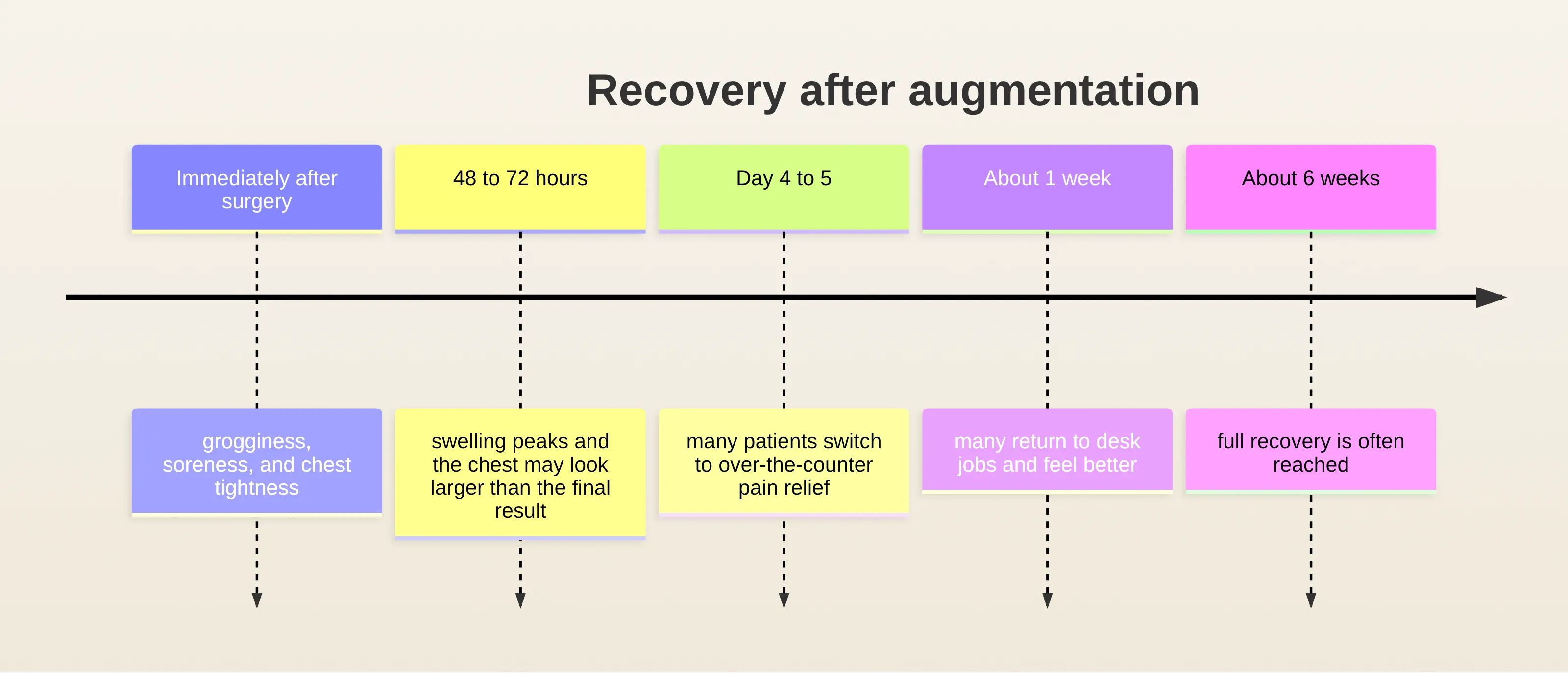
Early recovery after augmentation is influenced by the choices made before and during surgery, including implant type, placement, and your personal health context. Swelling, tightness, and changes in sensation are common, but the degree and duration can differ from person to person. Swelling may peak within the first few days, and your chest could appear larger or firmer than the final result. Pain management strategies and the timeline for returning to daily activities should be tailored to your needs and discussed with your surgeon. Some people return to light work within a week, while others may need more time. During this phase, implants often remain high and firm, and sensation changes may occur as tissues heal.
It is normal to experience fatigue, limited range of motion, and a need for extra rest during the first week or two. You may be advised to sleep on your back and avoid raising your arms above shoulder level. Most people are encouraged to walk and perform gentle movements to support circulation, but should avoid strenuous activity. Over-the-counter pain relievers are often sufficient after the initial days, but always follow your provider’s recommendations. Noticing gradual improvement in comfort and mobility is a positive sign, but any new or worsening symptoms—such as increasing redness, swelling, or pain—should be reported promptly. Early follow-up appointments are an opportunity to review your progress and clarify any questions about activity or wound care.
Activity Restrictions and Support Needs
The activity restrictions and support you need after augmentation are shaped by your surgical plan and individual recovery progress. Planning for time off work or school, arranging home support, and understanding which activities are safe to resume should be based on your provider’s instructions and your own healing response. While some people can return to light activities after a week, others may require a longer period of rest. Strenuous exercise, heavy lifting, and jarring movements should be avoided until your surgeon provides clearance, as the appropriate timeline can vary. Adapting your recovery plan to your specific situation helps support healing and reduces the risk of complications.
In addition to physical restrictions, consider the practical aspects of recovery: you may need help with childcare, meal preparation, and household tasks during the first days or weeks. Preparing your recovery space with items like extra pillows, ice packs, and loose clothing can make the process more comfortable. If you have a physically demanding job or responsibilities that cannot be postponed, discuss these with your provider to set realistic expectations for your return. Remember that even after you feel better, your tissues may still be healing, so gradual resumption of activities is important. Following your provider’s written instructions and attending scheduled follow-up appointments are key steps in ensuring a safe and smooth recovery.
Implant Settling and Cosmetic Evolution
The cosmetic evolution after augmentation is shaped by both the choices made during planning and your individual healing process. As swelling and bruising subside, implants may gradually settle into a lower, more natural position—a process sometimes called "drop and fluff." The timeline for these changes is not fixed: some people notice visible changes within weeks, while for others, settling and softening may continue for several months. Scars and sensation changes also evolve at different rates depending on your anatomy, surgical technique, and recovery. Tracking your own progress and discussing any concerns with your provider can help you understand what is typical for your situation and what may require further attention.
It is also common for the appearance of the breasts to change in subtle ways as the tissues adapt to the new implant. For example, the lower portion of the breast may gradually fill out, and the upper pole may become less prominent as swelling decreases. Some people notice that their breasts look or feel uneven during the early weeks, but this often improves as healing continues. The process of scar maturation can take several months to a year, with scars typically fading and flattening over time. Sensation changes—such as numbness or hypersensitivity—may resolve gradually, but some differences can persist. Keeping a photo record or written log of changes can help you notice gradual improvements and provide useful information for follow-up visits. If you experience any unexpected or concerning changes, such as persistent firmness, increasing asymmetry, or new lumps, bring these to your provider’s attention for assessment.
Recovery Timeline Variation
Instead of following a standard recovery calendar, use your worksheet to document how your own experience unfolds at each stage. Record when you notice changes in comfort, activity level, or appearance, and highlight any milestones or concerns that matter to you. This personalized record can help you prepare for follow-up visits and clarify which aspects of your recovery need more discussion with your provider.
Risks, Complications, and When to Contact Your Surgeon
All surgeries carry risks. After augmentation, some patients experience persistent sensitivity or unusual changes—especially if these occur on one side. These should be reported to your surgeon promptly. Infection is a known risk, with up to 4% of patients experiencing acute infection in the first month and up to 9% of procedures involving infection overall. Signs of early infection include swelling, redness, pain, discharge, fever, or a rapid heartbeat. Rarely, patients may report systemic symptoms (sometimes called "breast implant illness"), such as fatigue or joint pain, but there is currently no formal medical diagnosis for these symptoms and research findings are inconsistent. Very rarely, a type of cancer called squamous cell carcinoma can develop in the capsule around an implant, with symptoms like swelling, pain, or lumps that may appear years after surgery. If you notice any concerning changes, contact your surgical team without delay.
Individual Factors That Influence Results
Your outcome is shaped not only by surgical choices but also by individual factors. Age, health status, anatomy, education, and even personality traits can influence how you perceive risks, your recovery experience, and your satisfaction with results. For example, your chest width, breast tissue, and skin quality affect implant selection and final appearance. Emotional stability and openness to experience may shape your expectations and willingness to recommend the procedure. Discussing your personal context with your surgeon helps tailor the plan to your needs.
Questions to Ask Providers About Before-and-After Expectations
To make your worksheet more useful during a consultation, add questions such as:
- What changes should I expect immediately after surgery and over the following months?
- How will my anatomy influence the recommended approach and likely results?
- What are the main risks and how are complications handled?
- What is the expected recovery timeline for my situation?
- How will scars and sensation change over time?
- What support and follow-up care are provided?
- How long do implants typically last, and what signs should I watch for in the future?
Bringing your worksheet and these questions to your consultation can help you organize information and clarify what matters most for your decision.
Setting Realistic Expectations and Deciding on Consultation
Using a worksheet to track before-and-after changes, recovery needs, and influencing factors can help you organize your priorities and decide whether to move forward. Reflect on your goals, recovery process, and questions, then use your worksheet to guide your next steps. If you want to explore augmentation further, a consultation with a qualified provider is the next step.
Frequently Asked Questions About Augmentation Before and After
What changes are normal right after augmentation surgery?
Right after surgery, it is common to feel groggy, sore, and tight across the chest. Swelling can make the area look larger or firmer than the final result, and a surgical bra is often used for support and swelling control.
When do the final results usually become easier to see?
The look changes gradually as swelling goes down and the implants settle. Many people notice the breasts soften over weeks, while cosmetic settling can continue for several months before the result looks more natural.
What factors can change how augmentation looks on different people?
Several choices and body-specific factors matter, including implant type, size, shape, incision, placement, your chest width, breast tissue, and skin quality. Technique and the overall surgical plan also affect the result.
What should I ask about before-and-after expectations at a consultation?
Ask what changes are likely immediately after surgery and over time, how your anatomy affects the plan, what recovery usually involves, how scars and sensation may change, and what follow-up care and warning signs the practice wants you to know about.
Which recovery changes should prompt a call to the surgeon?
Contact the surgeon if you notice persistent or unusual sensitivity, especially on one side, or signs of infection such as swelling, redness, pain, discharge, fever, or a rapid heartbeat. Any new or concerning change deserves prompt review.
Can breast augmentation be done with something other than implants?
Yes. Augmentation can also be done with fat transfer in some cases. The right approach depends on the change you want, your anatomy, and the discussion you have with the surgeon about goals and trade-offs.