
Decide whether your child’s need is routine preventive care
A well-child visit is a routine visit focused on prevention, including early-childhood visits and annual visits through age 21. A well-child visit may include an examination, measurements, and other age-appropriate review.
A routine visit is not a diagnosis, individualized medical advice, or a promise that a practice can provide every requested service. A parent can ask the practice which appointment type matches the child’s stated need.
Start by naming the child’s purpose rather than relying only on an appointment label. A check-up, growth and development review, vaccination-information discussion, screening question, or general health assessment can be described directly. That description gives the practice context for its response; it does not decide whether the appointment is medically appropriate. If more than one topic applies, list each one rather than assuming the practice will infer it from a general label. This approach helps a parent notice when the request is focused on a concern that may need another route.
Before contacting the practice, consider which of the following topics match the child’s needs:
- A scheduled well-child check-up.
- A general health assessment.
- Review of growth, developmental milestones, learning, or social behavior.
- Discussion of nutrition or safety at home and school.
- Review of vaccination information without assuming a particular vaccine or schedule.
- Guidance about screening that may be appropriate for the child’s age and individual circumstances.
These recommendations are designed for children who have no manifestations of important health concerns and are growing and developing satisfactorily. Additional visits may be needed when concerns arise. A parent should describe the child’s actual reason for contact instead of choosing a general label without explanation.
If a child has a new, severe, rapidly worsening, or urgent concern, pause the usual booking process and use appropriate immediate medical care. A routine-care decision does not determine medical eligibility.
Identify what preventive care may include
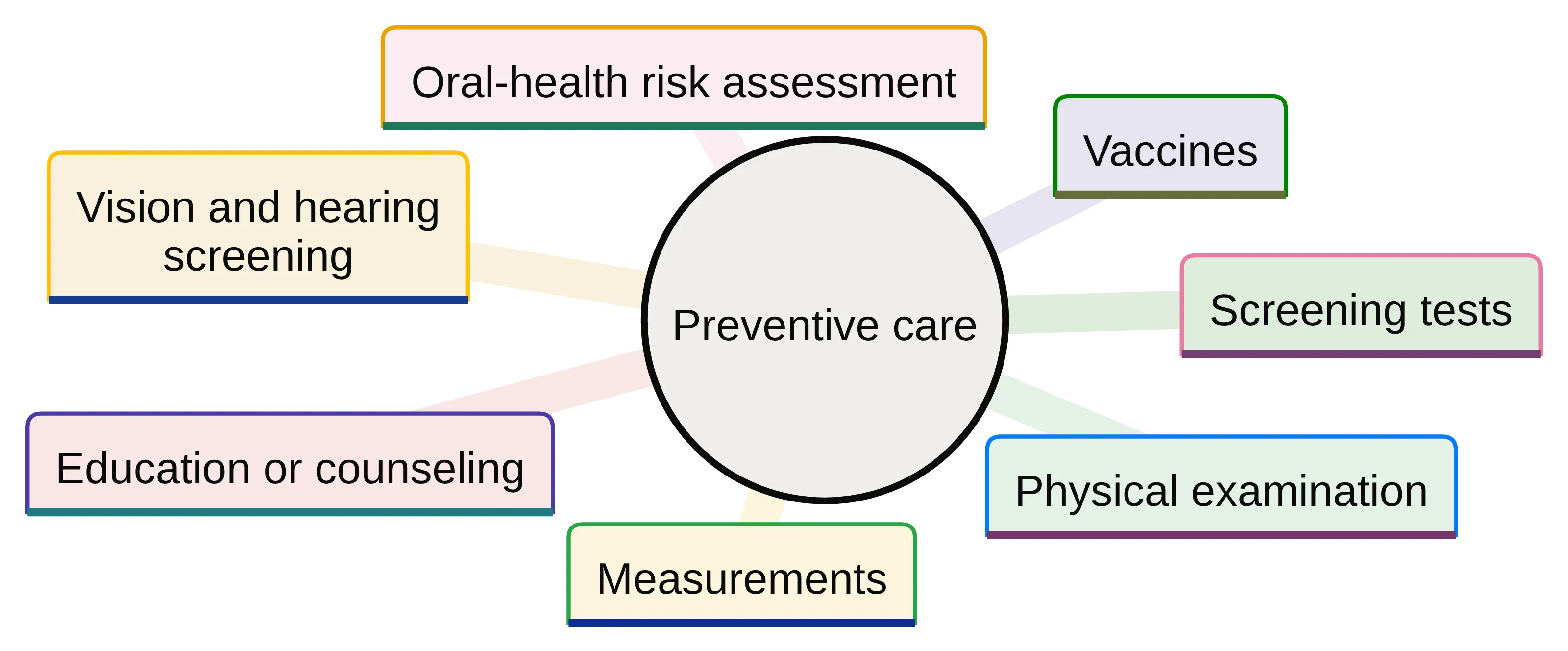
A child’s visit can combine several types of routine review. Routine visits may also include screening tests intended to find some diseases early, when earlier identification may make treatment easier.
Screening needs vary with age, sex, overall health, family health history, and risks for certain diseases. A screening discussion is not a conclusion about a child’s health, and a parent should not assume that every screening applies to every child.
These visits may include vaccines plus education or counseling about health decisions. A family may use a routine visit to ask about nutrition, safety, activity, sleep, learning, or other topics relevant to the child’s health. Ask the practice which requested components are included before treating an appointment description as confirmed.
Possible health-assessment components can be named more specifically when a parent contacts the practice. An examination and measurements, vision and hearing screening, and an oral-health risk assessment are examples of components associated with well-child visits. Their inclusion depends on the visit’s scope and the child’s circumstances, so treat them as questions to clarify rather than items promised by a general description. The same applies to screening tests, vaccines, and education or counseling: each may be relevant without being included in every appointment. Ask which items the practice handles directly and which require another current service.
A parent can think of a well-child appointment as a structured conversation with several possible components:
- General review: The clinician may discuss the child’s current health and questions.
- Developmental review: The family may discuss growth, milestones, social behaviors, learning, or everyday functioning.
- Screening discussion: The clinician may consider whether screening is appropriate for the child’s age, health, family history, and relevant risks.
- Vaccination discussion: The clinician may review vaccination information and identify topics for discussion.
- Family guidance: The visit may include education or counseling that helps a parent make informed health decisions.
The list describes possible visit components, not a guaranteed service package. Before contacting the practice, write down the components the family wants to discuss. During contact, ask whether the practice offers each requested component, whether a separate visit is required, and what information the practice needs.
Use a well-child visit to review growth and development
A well-child visit can help a parent and clinician track the child’s growth and development over time. Discussion may cover developmental milestones, social behaviors, learning, eating, sleep, behavior, and relationships with family members. A parent does not need to wait for a major concern before writing down an observation or question for a routine visit.
Nutrition and safety questions can also be raised during a well-child visit. Examples include questions about nutrition at home, safety at home or school, learning, sleep routines, or behavior. Preparing examples helps a family use appointment time clearly; preparation does not provide a medical conclusion about the child.
Before the visit, write down the most important questions or concerns and raise the highest-priority topics early in the appointment. A short list can help a parent explain what the family has noticed and what answer the family needs from the clinician.
A useful development note for one child can include:
- A milestone, learning, behavior, sleep, eating, or social question.
- The setting where the parent notices the question, such as home or school.
- The approximate time when the parent first noticed the change or concern.
- The parent’s main question for the clinician.
- Any nutrition or safety topic that needs discussion.
A parent should describe observations in ordinary language rather than trying to assign a diagnosis. The child’s clinician can decide what belongs in a routine review and what needs another type of assessment. Bring the three to five questions that matter most, and place the highest-priority question at the beginning of the visit.
The immediate use of the note is simple: keep the note with the child’s other appointment information, read the questions before contact, and lead with the question that matters most.
Consider your child’s age and individual circumstances
Age is one factor in deciding what a child’s preventive-care visit may cover, but age alone does not establish the right assessment. Screening needs can vary with age, sex, overall health, family health history, and risks for certain diseases. A parent should provide the child’s age and relevant history when asking a practice which visit type fits.
Parent education materials from the American Academy of Pediatrics are organized by age from infancy through adolescence. Age-based organization can help a parent prepare questions, but an educational handout does not confirm a practice’s scope, establish medical eligibility, or replace a clinician’s assessment.
Individual circumstances also matter. A child with an ongoing developmental, psychosocial, or chronic-disease need may require counseling or treatment separate from routine preventive care. Tell the practice about the child’s actual needs so the practice can explain whether the request belongs in a routine visit or another appointment type.
Use age and circumstances to shape questions, not to guess a schedule. Ask the practice:
- Which preventive-care assessment is appropriate for the child’s age?
- Which health history details should the parent provide before the appointment?
- Does the requested visit include developmental review, screening discussion, vaccination review, or several components?
- Does an ongoing developmental, psychosocial, or chronic-disease need require a separate counseling or treatment visit?
- Which parent education materials or preparation instructions apply to the child’s age?
Because recommendations can differ, a parent should ask about the child’s own record and circumstances rather than infer a vaccine schedule from age alone.
A parent can use the child’s age as a starting point for questions, then add the child’s history and current needs. The practice’s response should determine the next administrative question, while a clinician determines medical appropriateness.
To make that preparation practical, separate the note into three lines: what is already known from the child’s record, what the parent has observed, and what the parent needs the practice to clarify. The record line can identify available vaccination information and relevant history. The observation line can capture a question about growth, learning, sleep, behavior, nutrition, or safety. The clarification line can ask whether those topics belong in the requested assessment or another visit. This keeps age-based material in its proper role: it organizes questions, while the child’s information and the practice’s response guide the next contact step. If information is missing, mark it as unavailable and ask what the practice wants supplied. Do not fill gaps by inferring a vaccine schedule, screening need, or appointment type from age alone.
Recognize when routine preventive care may not be the right route
Well-child visits are generally intended for children who are doing well, while additional visits may be needed when concerns arise. A parent should tell the practice when a child needs more than a routine review, including a developmental, psychosocial, or chronic-disease discussion.
Some developmental, psychosocial, or chronic-disease needs may require a separate counseling or treatment visit. The distinction does not mean a well-child visit has no value for a child with an ongoing need. The distinction means the family should ask whether the concern can be addressed during the requested visit or needs a separate appointment type.
Use a direct description when contacting the practice: explain that the child needs a routine check-up, vaccination discussion, health assessment, or review of a specific concern. Ask whether the practice recommends a well-child visit, a separate counseling or treatment visit, or another current route. Administrative fit checks do not determine medical eligibility.
A well-child appointment may be a poor fit when the family is seeking care primarily for an active concern that needs focused counseling or treatment. A parent should not hide the concern behind a general appointment label to obtain a simpler booking path.
When a concern is not urgent but needs focused attention, describe the concern during the first contact and ask what appointment type the practice recommends. When a concern is urgent, severe, or worsening, do not rely on the usual booking route. Use appropriate immediate medical care instead.
The decision boundary is clear: use a well-child visit for a routine review, disclose active concerns during contact, and follow the practice’s direction when a separate visit may be needed.
Route urgent, severe, or worsening concerns to immediate care
A routine preventive-care appointment is not the route for a medical emergency.
For a medical emergency, the caller should be ready to provide the emergency location, the callback phone number, the nature of the emergency, and relevant details such as symptoms or injuries. The 911 call-taker’s questions help direct the response, so answer the questions as clearly as possible.
During a 911 call for a child’s medical emergency, follow the call-taker’s instructions and remain on the line until the call-taker says to hang up. A parent should not use a routine preventive-care form, ordinary practice message, or appointment request as a substitute for immediate emergency guidance.
A parent may not be able to determine the correct medical route from an article alone. When the situation appears urgent, severe, or worsening, choose appropriate immediate medical care. Reserve routine booking questions for a child whose immediate needs do not require emergency response.
Prepare a separate checklist for each child
Create one preparation note for every child who may need care. A separate note keeps each child’s request, history, medications, and questions distinct.
For each child, record:
- The child’s name and age.
- The reason for requesting care, such as a routine check-up, vaccination discussion, or health assessment.
- Relevant health history that the parent already knows.
- Current medications or other information the practice has requested.
- Vaccination information or records available to the family.
- Growth, developmental, learning, behavior, sleep, eating, nutrition, or safety questions.
- The parent’s most important questions for the clinician.
- Any concern that may require a separate counseling or treatment visit.
A parent can mark uncertain details for later confirmation instead of guessing. The checklist organizes information for contact with the practice; the checklist does not determine eligibility or provide a medical assessment.
To keep the notes usable, give each one a clear child identifier and use the same headings for that child’s information. Keep uncertain or unavailable items visibly marked rather than completing them from another child’s record. If a question applies to more than one child, state that explicitly and identify each child to whom it applies. If the children need different services, list those differences at the top of the relevant notes. Before submitting a request, read each note independently and remove details that belong to another child. This preparation supports clear communication with the practice, but it does not determine whether a visit is appropriate or what care a clinician may recommend.
When more than one child needs care, give the practice information for each child separately. State whether the children need the same or different appointment types, and ask whether the practice wants one request per child. Keep one question list and one vaccination-history note for each child.
Writing the most important questions before contact helps a parent raise priority topics early. Reviewing vaccination history can help identify vaccines to discuss during routine or acute-care visits. A parent should provide the records or details requested by the practice, while allowing the practice to explain the assessment type and current booking requirements.
The family can use the following short sequence for each child:
- Describe the child’s reason for care.
- Note relevant history and current medications.
- Gather vaccination information.
- List the most important questions.
- Ask which visit type and booking route fit the child.
- Record the practice’s instructions separately for each child.
The immediate use of the sequence is to prepare one complete contact record per child before a parent calls, writes, or submits a request.
Review vaccination information without assuming a schedule
A vaccination-history review can help identify vaccines to discuss at routine or acute-care visits. Healthcare providers are encouraged to review whether patients are up to date on vaccinations, even when a provider does not administer vaccines. A parent should therefore ask whether the practice reviews vaccination records, provides vaccinations, or directs families to another current service.
Bring the child’s available vaccination record and ask the clinician to explain which topics apply to the child.
Keep vaccination questions tied to the record for the child whose visit is being discussed. Note whether the family has a complete record, a partial record, or no record available, and tell the practice which situation applies. The practice can then explain what it needs for review and whether the next step is a routine discussion, an administration visit, or another current service. A record review can support a conversation without establishing that a vaccine is due or that the practice will administer it. Do not use a general list as a personal recommendation; use the child’s information to frame questions for the clinician.
Vaccine administration involves preparation and patient-care steps before a dose is given. Ask the practice what information or preparation is needed before a vaccination appointment, and ask whether vaccination review belongs in a routine preventive visit or a separate appointment.
A parent should avoid promising a particular vaccine appointment until the practice confirms the current scope, assessment type, and booking route. A parent should also avoid treating a general vaccine list as a personal recommendation. The child’s vaccination history, relevant health information, and clinician discussion provide the basis for the practice’s next instruction.
Before contact, place the available vaccination record beside the child’s checklist. During contact, ask whether the practice needs the complete record, a specific portion of the record, or another form of information. Follow the practice’s current instructions rather than relying on an assumed schedule.
Confirm whether Tely Health is the right practice before booking
Do not assume that Tely Health serves Austin. Tely Health lists its location in Port Orange, Florida, so an Austin family should confirm the current practice address and service area directly before traveling, submitting personal information, or treating a booking as confirmed.
The location check should come before the appointment decision. Ask whether the current practice location is in or near Austin, whether pediatric care is offered at the location relevant to the family, and whether the practice accepts routine preventive-care requests for children. Keep the answer in the family’s records so each parent or caregiver uses the same confirmed information.
A location match alone does not establish that the requested care fits the child. Confirm the practice’s current pediatric scope, the requested health assessment type, and the correct booking route in the same contact whenever possible.
Before making the request, separate the details that must be confirmed from questions that can wait. First confirm where the relevant service is offered and whether the practice accepts the type of child visit requested. Then ask which assessment description and booking route apply. If the location or scope answer is unclear, do not treat a general reply as confirmation; ask a focused follow-up or pause the request until the practice clarifies it. This sequence keeps travel and information submission after the location question is resolved.
Use ordinary service language when asking about scope. A parent can ask how the practice currently handles:
- Family medicine for children and adults.
- Pediatric care for routine check-ups, vaccinations, and health assessments.
- Preventive care when a child also has an ongoing health need.
- Chronic disease management when a child needs continuing support.
- Diabetes management or hypertension monitoring when a child’s care involves either service label.
The list is a set of clarification questions, not a statement that Tely Health provides every listed service. Ask whether the child’s request belongs in a preventive-care visit, a separate counseling or treatment visit, or another current route. Ask whether the practice performs the requested service, coordinates the service elsewhere, or requires a different appointment type. Obtain a clear answer before scheduling.
Contact the practice only after the fit checks are clear
After the location and scope checks are clear, contact Tely Health through the practice’s current communication channel. Keep the contact focused on the child’s request and ask for the details needed to make an informed booking decision.
A concise contact script can include:
I am seeking routine preventive care for a child. Please confirm your current location, pediatric scope, the appropriate assessment type, and the current booking route. The child’s reason for care is [brief description]. Please tell me what history, medication information, vaccination information, or questions you need before scheduling.
Replace the bracketed description with the child’s actual reason for contact. If more than one child needs care, provide a separate description and separate information for each child. Ask the practice to clarify whether one request can cover multiple children or whether each child needs a separate booking process.
Before a parent schedules, travels, or submits detailed personal information, confirm all four fit points:
- Location: The current address and service area match the family’s needs.
- Scope: The practice currently accepts the child’s requested pediatric preventive-care need.
- Assessment type: The practice has identified the appropriate routine check-up, vaccination discussion, health assessment, or separate visit.
- Booking route: The practice has confirmed the current way to request or arrange the appointment.
Ask about insurance acceptance, pricing, appointment availability, or required records only when the practice provides current information. Do not infer any administrative detail from a general service description. A confirmed address, contact response, or form submission does not determine medical eligibility. Follow the practice’s instructions and ask for clarification when any fit point remains uncertain.
For a family with multiple children, repeat the four checks for each child when the children have different needs, requested services, or appointment types. Keep the confirmed information tied to the correct child and visit request.
A simple confirmation record can make the decision easier to review. For each child, write the practice’s answer beside four labels: location, pediatric scope, assessment type, and booking route. Mark each label as confirmed, not confirmed, or needing follow-up; do not treat a partially answered message as a completed fit check. If the location is not suitable, stop before sharing more information or arranging travel. If the location fits but scope is unclear, ask about the child’s stated request. If scope fits but the assessment type is unclear, ask whether the practice recommends routine preventive care or a separate visit. If all four points are clear, follow the current booking instructions and retain the response with that child’s preparation note. These administrative steps organize the request; they do not replace a clinician’s judgment about care.
If the practice gives different answers through different channels, treat the discrepancy as unresolved and ask which current instruction controls before proceeding. Keep the date or context of the response in your notes without assuming it remains current later.
Take the confirmed next step for your child’s assessment
A per-child checklist helps a parent describe the child’s needs, history, medications, vaccination information, and questions clearly. Confirm the practice’s current location, pediatric scope, assessment type, and booking route before travel or information submission. Keep immediate medical concerns on an appropriate urgent-care or emergency pathway rather than a routine booking route.
Once the practice confirms the four fit points, keep the practice’s instructions with the correct child’s records and follow the agreed route for the visit.
What should I prepare for a child’s routine visit?
How can I prepare for my child's routine visit?
Before the visit, write down important questions and raise them early in the appointment.
What should I do if my child has urgent health concerns?
For urgent, severe, or worsening concerns, seek immediate medical care instead of a routine appointment. For a medical emergency, call 911 and be ready to give the location, callback number, nature of the emergency, and relevant symptoms or injuries.
How can I confirm if Tely Health serves my area?
Before booking, confirm directly with Tely Health whether they serve Austin, Texas, and whether they offer the pediatric services you need.
What should I ask the practice when contacting them for an appointment?
When contacting the practice, ask about their current location, pediatric scope, the appropriate assessment type for your child, and the booking route.
How do I know if my child's needs require a separate visit?
If your child has ongoing developmental, psychosocial, or chronic-disease needs, those needs may require a separate counseling or treatment visit.