
Start With a Two-Area Trade-Off
Before comparing procedures, write two short statements: what you want changed, and what uncertainty you can discuss. Keep those statements separate.
Statement one: your breast-area goal. Note whether you want to discuss fullness, cleavage, contour, or symmetry. Do not turn that preference into a predicted result. [cont10-retest-20260906]
Statement two: your trade-off question. Ask whether donor-area liposuction and possible fat resorption fit the conversation, or whether an implant device and its ongoing responsibilities also need review.
This sequence creates a clearer consultation starting point. First, describe the breast change. Next, identify the trade-off that matters most. Then ask whether fat transfer, implants, or both approaches should be discussed.
Fat transfer uses liposuction to remove fat from another area, then places it in the breasts. ASPS describes it as an option for women seeking a relatively small size increase and natural results. Another ASPS source describes fat grafting as providing moderate enlargement and shape improvement. Some transferred fat is resorbed after surgery.
Implants create a separate device discussion. FDA materials state that breast implants are not lifetime devices. They also require ongoing monitoring. If implants remain part of your questions, record those device responsibilities separately.
Bring your two statements to a consultation with a board-certified plastic surgeon. Ask which parts require personal assessment, what remains uncertain, and how each option would address the goal you described.
How Breast Fat Transfer Works
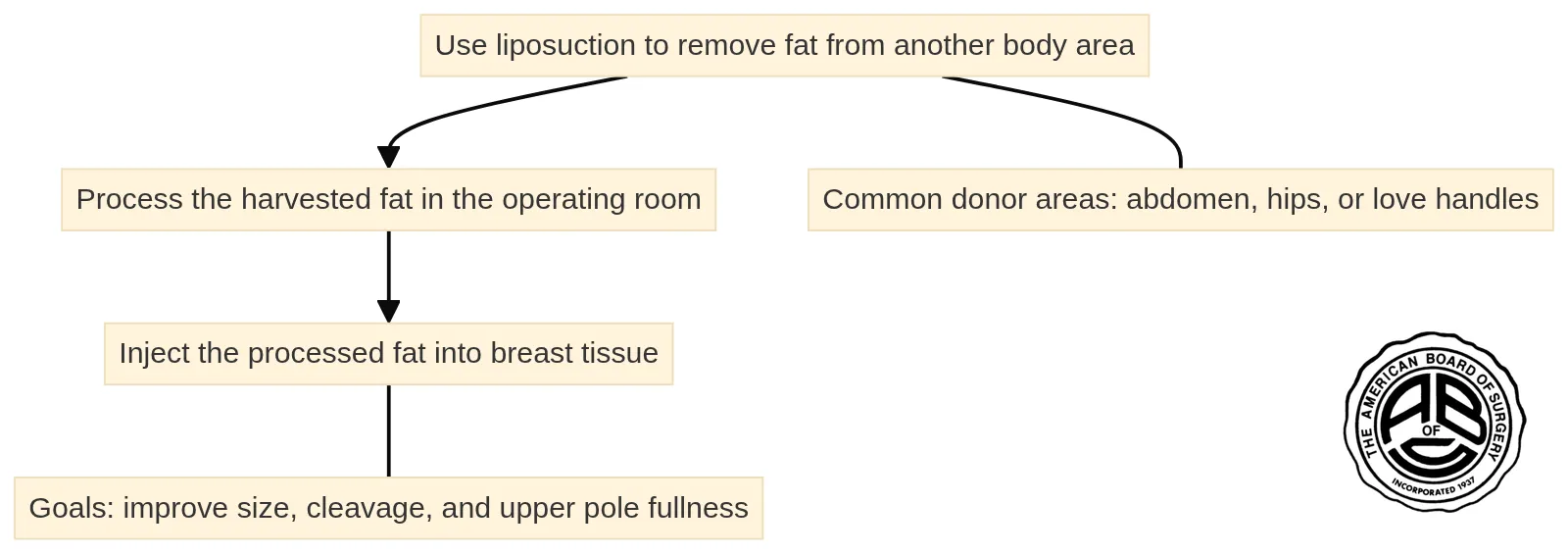
Fat transfer is a two-area procedure. It involves a donor area and the breasts.
First, a surgeon uses liposuction to remove fat from another part of your body. Common donor areas described by ASPS include the abdomen, hips, and love handles. The available donor area is therefore part of the consultation. It is not a separate detail.
Next, the harvested fat is processed in the operating room. In the described process, the surgeon places processed fat into small syringes. The fat is then injected into breast tissue.
This sequence matters when you compare options. Fat transfer does not only concern breast shape. It also includes liposuction in the selected donor area. Ask the surgeon to explain how both areas fit into the proposed plan.
Useful questions include:
- Which donor areas would you assess for me?
- Why are those areas appropriate for discussion?
- How would the fat be processed and placed?
- What breast-shape goals can the proposed placement address?
- How would you assess existing breast asymmetry?
- What should I understand about the donor-area portion of surgery?
A consultation should make the steps understandable in plain language. You should be able to repeat back the plan: where fat may come from, how it is handled, and what it is intended to add to the breast. If that description remains unclear, pause and ask for clarification before choosing an approach.
Match Your Goal to the Fat-Transfer Path
Use the comparison as a note-taking tool. It separates questions by where they belong.
| Question lane | Fat-transfer notes | Implant notes |
|---|---|---|
| What is involved? | Liposuction removes fat from another body area. Processed fat is injected into the breasts. | A breast implant device is used. |
| What change is described? | ASPS sources describe relatively small or moderate enlargement and shape improvement. | Review the specific device and its labeling. |
| What needs careful discussion? | Donor areas, breast shape, symmetry, and resorption uncertainty. | Risks, monitoring, and possible future surgery. |
| What belongs in your record? | The intended breast change and questions about both procedure areas. | The proposed device and its patient information. |
This format does not decide which approach fits you. It helps prevent one broad preference, such as “natural,” from hiding several different questions.
For the breast portion, describe the appearance you want to discuss. You might note fullness, cleavage, contour, or balance between breasts. For the donor-area portion, ask what role liposuction would play in the proposed plan. If implants remain under consideration, use a separate device note rather than blending those questions into the fat-transfer discussion.
Visual references can help explain a preference. Describe what you notice in them instead of treating them as a personal forecast. A clear description gives the surgeon a better starting point for discussing options and limitations.
Fat Retention Is an Important Uncertainty
Fat retention deserves a direct discussion. Some transferred fat is resorbed after surgery. That is a core limitation of fat grafting.
A 2016 systematic review included 22 articles involving 3,565 patients. Follow-up ranged from 12 to 136 months. The review reported mean retained volume of 62.4%, with wide variation across included studies. The reported range was 44.7% to 82.6%.
Those figures are not a forecast for you. They summarize older, study-level findings across different included studies. They do show why a consultation should not promise a precise final volume or a fixed degree of retained fat. The review also called for more research into factors affecting retention.
Ask direct questions instead:
- How do you explain resorption uncertainty to patients?
- What change is realistic to discuss for my goals?
- How would uncertainty affect the plan?
- Could more than one procedure become a discussion point?
- How would you assess whether my donor areas support the goal?
- What would you consider a reasonable expectation in my case?
You do not need a guaranteed number to make progress. You need a clear explanation of what remains uncertain. A useful consultation separates the intended change from what cannot be predicted in advance. That distinction helps you compare fat transfer with implants without assuming either option provides certainty.
Fat-Transfer Risks, Imaging, and Evidence Gaps to Discuss
Ask about risks and follow-up without expecting a one-size-fits-all answer. The available evidence here needs careful interpretation.
The 2016 systematic review reported a pooled complication rate of 17.2% in cosmetic breast fat-grafting studies. This is study-level evidence, not an individual risk prediction. The review identified indurations, persistent pain, and hematoma among the most frequently reported complications.
The same review reported mammographic micro-calcifications and macro-calcifications in included fat-grafting studies. It also called for further research on cancer occurrence and detection after cosmetic breast fat grafting.
These findings are reasons for a focused discussion. They are not a basis for predicting what will happen to you. Ask the surgeon how they address risk, what follow-up they recommend, and how you should communicate your surgical history to clinicians involved in future breast imaging.
Use this question set:
- What risks do you discuss for breast fat transfer?
- Which risks relate to the breasts, donor areas, or both?
- How are complications handled if they occur?
- What breast imaging or screening questions should I raise?
- What records should I keep for future care?
- What follow-up plan would you recommend after surgery?
A clinician should tailor those answers to your medical assessment. Do not rely on a review statistic, online images, or another person’s experience to replace that assessment. Clear uncertainty is part of informed decision-making.
If You Also Review Implants
If an implant option remains part of your visit, request the specific patient labeling and safety information. FDA materials advise reviewing these records for the implant under consideration.
Keep breast-imaging questions in that same implant note. If you have implants, follow your clinician’s imaging instructions and tell the mammography facility about them. For silicone gel-filled implants, clarify whether MRI or ultrasound monitoring is recommended.
FDA materials list BIA-ALCL among implant risks. Have the clinician explain relevant risks for the option under review. Keep this device review separate from your questions about donor areas, fat placement, and resorption.
When a Combined Fat-Transfer and Implant Approach Is Worth Discussing
A combined plan has separate parts to explain. Some surgeons use fat transfer with implants for additional breast shaping.
Use a three-part note if this option is raised. Label the parts implant, donor area, and fat placement. Under each label, record its intended purpose in the proposed plan.
The implant note should cover the specific device, its labeling, risks, monitoring, and possible future surgery. The donor-area note should cover the liposuction portion of surgery. The fat-placement note should cover the breast-shape goal and the uncertainty created by fat resorption.
This structure matters because one explanation should not stand in for all three parts. Ask the surgeon to state the purpose of each part in plain language. Record whether it is intended to address volume, shaping, symmetry, or another stated goal.
Questions for this format include:
- What purpose does the implant serve?
- What purpose does the fat placement serve?
- Which donor areas are part of the discussion?
- Which uncertainties apply to each part?
- How would follow-up address the implant and fat-transfer portions?
Leave any unanswered item open. A combined plan needs a clear explanation before it can be compared with either approach alone.
Build a Fat-Transfer Consultation Brief
Bring a short two-area consultation brief. It organizes the questions that fat transfer creates before any implant discussion begins.
Breast-area page. State the change you want to discuss. Note shape, cleavage, upper-breast fullness, and asymmetry if relevant. Add what you do not want. Then ask what the proposed fat placement is intended to address.
Donor-area page. List the areas you want explained. Ask how liposuction would fit into the proposed procedure. Write down questions about the donor-area portion of surgery and its follow-up.
Uncertainty line. Write that some transferred fat is resorbed after surgery. Ask how the surgeon explains that uncertainty in relation to your stated goals. Do not turn a study average into a personal prediction.
Optional implant page. Add this page only if an implant remains under review. Request the specific device labeling and safety information. Record questions about monitoring, complications, and possible future surgery separately from your fat-transfer notes.
Safety and setting line. Confirm whether the surgeon is certified by the American Board of Plastic Surgery. Review relevant training, hospital privileges, and facility accreditation or licensing.
Support and follow-up line. Clarify where and how the procedure would be performed. Discuss recovery support, complication handling, and follow-up.
This brief is not a scorecard or a candidacy test. It gives you a clear record of the questions tied to each part of the discussion. Bring it to a board-certified plastic surgeon and leave space for answers in the surgeon’s own words.
Turn Your Priorities Into a Clear Discussion
A productive consultation begins with a clear trade-off. Fat transfer involves donor-area liposuction, breast injection, and resorption uncertainty. Implants require a device-specific discussion, monitoring, and review of possible complications. A combined approach may also deserve discussion when both volume and shaping matter.
Bring your written priorities. Include breast shape, symmetry, donor areas, implant concerns, follow-up, imaging questions, and the recovery support you may need. Ask how the procedure would be performed, how complications are handled, and what results are reasonable for you.
Choose a board-certified plastic surgeon for the discussion. The goal is not to select an option from a checklist. It is to understand which questions need an individualized medical assessment before you move forward.
Frequently Asked Questions About Choosing a Surgeon and Facility
What does breast fat transfer involve?
It uses liposuction to remove fat from one area. The fat is then processed and injected into the breasts.
How is fat transfer different from implants?
Fat transfer uses your own tissue. Implants use a device and come with ongoing monitoring needs.
What should you expect from fat transfer results?
It may suit a smaller increase and shape improvement. Some transferred fat is resorbed after surgery.
What risks should you discuss before choosing fat transfer?
Ask about donor-area healing, breast changes, and complications. Also ask how follow-up and imaging are handled.
What should you ask about if implants are part of the discussion?
Ask for the specific implant labeling, risks, and monitoring plan. Implants are not lifetime devices.
Can fat transfer and implants be used together?
Yes, some surgeons discuss both together. The plan should clearly explain each part’s purpose and trade-offs.
Who should you choose for this consultation?
Choose a board-certified plastic surgeon. Ask open questions about goals, expectations, and reasonable results.