
Why a Breast Lift Requires Individual Planning
A breast lift is not a one-size-fits-all procedure. The same broad concern—such as breasts that sit lower than desired or have changed shape—can lead to very different planning conversations depending on a person’s goals, anatomy, health history, and practical needs after surgery.
That is why a single universal answer cannot meaningfully describe a breast lift plan. Before an approach can be discussed, a qualified surgical provider needs to understand what change the person is seeking, what the breast tissue and skin are like, whether there are relevant health considerations, and what recovery support is realistically available. A systematic review of nonimplant mastopexy procedures reached a related conclusion: no single procedure is ideal for every patient.
This article is general education, not a candidacy assessment or medical recommendation. Its purpose is to help you understand what a breast lift is designed to do, where its limits are, and which non-financial planning questions can make a consultation more useful.
What a Breast Lift Is Designed to Address
A breast lift, also called mastopexy, raises the breasts by removing excess skin and tightening surrounding tissue to reshape and support the breast contour. In plain language, the procedure is intended to address position and shape rather than simply add or remove breast volume.
People may begin exploring a lift after noticing that the breasts appear lower, have a flatter or more elongated shape, or no longer have the contour they want. Nipple and areola position, skin quality, asymmetry, and the relationship of the nipple to the breast crease can all be part of an examination. Those observations can help frame a conversation, but they do not determine whether surgery is appropriate for a particular person.
The central planning question is therefore not just “Do I want a lift?” It is “What am I trying to change, and what procedure approach is appropriate for my own circumstances?” A useful consultation translates a general concern into clear goals, then considers whether mastopexy is aligned with those goals.
When Size or Fullness Is a Different Goal
It is important to separate a desire for a lifted position from a desire for a different size or more fullness. A breast lift does not significantly change breast size or create upper-breast fullness. That distinction can prevent a consultation from starting with an expectation that a lift alone is not designed to meet.
If fullness is a goal, ask a qualified surgeon whether a lift alone or a lift combined with augmentation should be discussed for your circumstances. If reducing breast size is a goal, ask whether a lift combined with reduction should be discussed instead. These are not interchangeable choices, and they should not be selected from general descriptions online.
Bring a simple statement of priorities: what bothers you now, what you would like to preserve, and whether position, shape, fullness, or size matters most. If more than one goal is important, say so directly. The provider can then explain which goals may be compatible, which involve trade-offs, and which may call for a different discussion.
A clear boundary is useful here: wanting more upper-pole fullness or a smaller breast size does not by itself identify the right procedure. Discuss those goals during an individualized evaluation rather than assuming a lift will address all of them.
What an Individualized Breast Lift Plan Needs to Account For
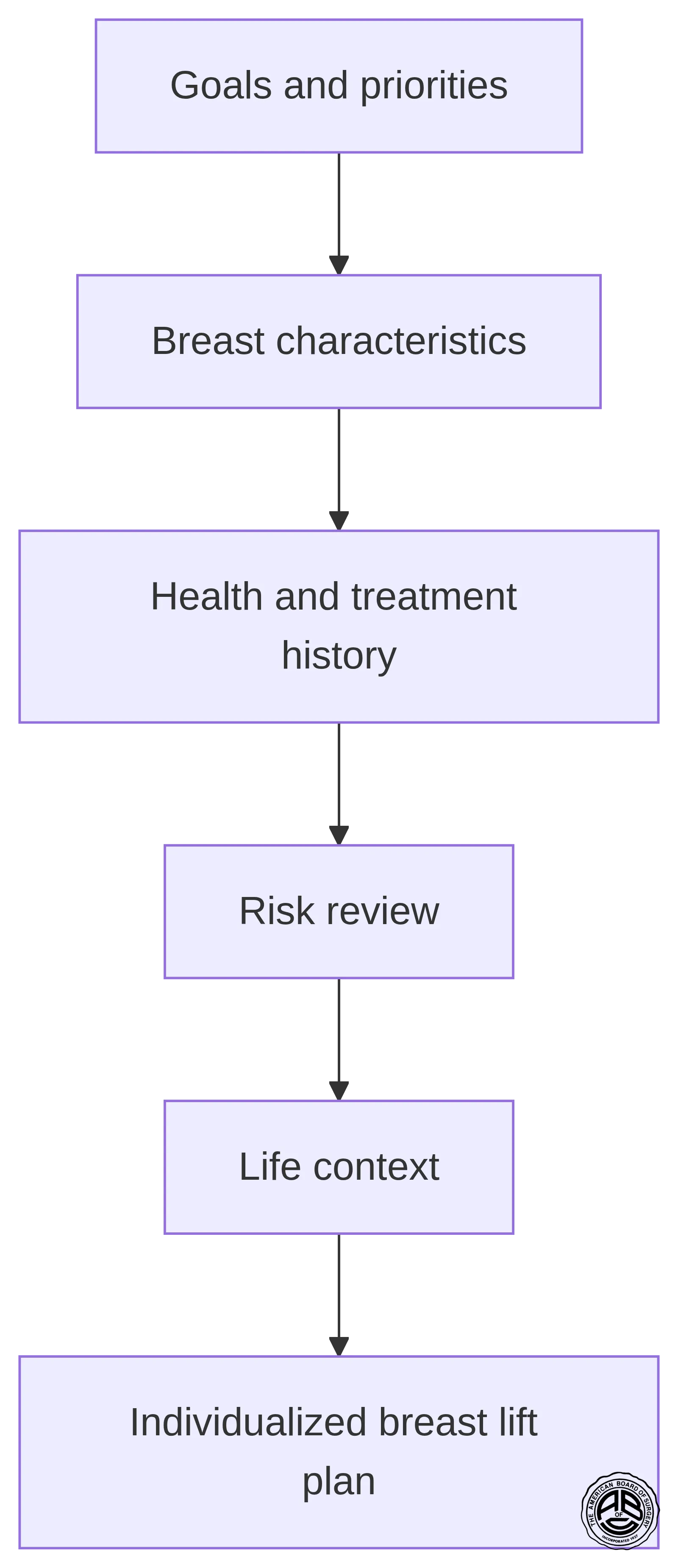
A productive consultation is a planning conversation, not merely a description of a procedure. Several categories of information help a surgical provider understand what needs to be assessed.
Goals and priorities. Explain what you hope will look different and what matters most to you. A discussion of goals helps distinguish concerns about position and shape from concerns about volume, symmetry, or future changes you may be considering.
Breast characteristics. Planning may include an examination of breast size and shape, skin quality, and nipple and areola placement. These features are relevant because a lift reshapes and supports the breast contour; they are not details that can be responsibly inferred from a generic description or a single image.
Health and treatment history. A consultation may cover medical conditions, allergies, medical treatments, current medications, vitamins and herbal supplements, alcohol, tobacco and drug use, and previous surgeries. Relevant family history and prior mammogram or biopsy information may also be discussed. Bring complete information rather than trying to decide in advance what is important.
Risk review. An individualized evaluation may assess general health, existing conditions, and surgical risk factors. This is a safety discussion, not an obstacle course. It gives the provider an opportunity to decide what information is needed before recommending any next step.
Life context. Recovery planning is practical as well as medical. Your home responsibilities, work demands, transportation, and availability of help are reasonable topics to raise. The goal is not to predict your personal course from an article; it is to make sure the recovery conversation reflects your actual circumstances.
Together, these categories explain why an individualized plan requires more than a procedure name. If you are considering a consultation, prepare a brief goals list, a current medication and supplement list, relevant breast-health records if available, and questions about your recovery logistics.
How Procedure Approach, Safety, and Expectations Shape Planning
After gathering the relevant background, a consultation may cover options, the rationale for a proposed approach, potential outcomes, risks and complications, and anesthesia. These topics belong together. The approach is not a cosmetic label to choose independently; it is part of a broader discussion about anatomy, goals, safety, and the practical care plan.
Technique names can sound decisive, but a name alone does not tell you whether an approach suits your circumstances. The systematic review of nonimplant mastopexy literature found that no single procedure is ideal for every patient. One review finding about comparative long-term stability among certain pedicle approaches does not establish a universally best technique for an individual. A provider should be able to explain why a particular approach is being discussed for you and what its limitations are.
Realistic expectations are equally important. A consultation can explore what changes may be reasonable to discuss, but it cannot turn a desired image into a guaranteed result. Ask the provider to distinguish between the intended purpose of the procedure and outcomes that cannot be promised.
Safety planning also includes anesthesia and the setting where the procedure would be performed. Rather than treating these as administrative details, use them to understand the full care pathway. Ask what will happen before surgery, on the day of the procedure, and during follow-up. If an explanation feels unclear, ask for it in plain language before making a decision.
Why Interest in a Lift Does Not Establish Candidacy
A person can have a concern that leads them to explore a breast lift without being an appropriate candidate for surgery at that time. The American Society of Plastic Surgeons lists several breast-shape and nipple-position characteristics that may lead someone to consider a lift, including sagging or lost shape, a flatter or elongated appearance, stretched skin, and differences between the breasts. Those characteristics alone do not establish candidacy.
ASPS also lists being physically healthy, maintaining a stable weight, and not smoking among characteristics of breast lift candidates. Individual assessment still matters. A surgeon may decide not to proceed based on surgical risk factors, underlying health conditions, or expectations for the procedure.
That boundary is not a judgment about whether a concern is valid. It reflects the difference between recognizing a concern and deciding whether surgery is appropriate, safe, and aligned with realistic goals.
Use this section as a prompt for honest preparation. Share relevant health information, be direct about tobacco use and other substances, and describe your expectations plainly. If your expectations include a specific appearance that cannot reasonably be discussed as an assured outcome, ask the provider to explain the limits of the procedure. Do not rely on general eligibility lists to determine your own candidacy.
Non-Price Questions to Bring to a Breast Lift Consultation
A written question list can keep a consultation focused on the information needed for an informed decision. The following questions are designed to clarify planning, safety, and the care setting.
About the proposed approach
- What technique are you recommending for me?
- Where and how would the procedure be performed?
- Which of my goals is this approach intended to address, and which goals may remain outside its scope?
- What outcomes are reasonable to discuss in my case?
About clinician and facility verification
- Are you certified by the American Board of Plastic Surgery?
- What plastic-surgery training have you completed?
- Do you have hospital privileges to perform this procedure? If so, where?
- If the procedure is planned in an office-based setting, what applicable accreditation, licensure, or certification does the facility have?
These questions are particularly useful for U.S. readers because they focus on information a prospective patient can independently ask a provider to explain. They are not a substitute for checking current credentials or understanding the provider’s answers.
About risks and care planning
- What risks and complications are associated with the procedure you are proposing?
- How are complications handled if they occur?
- What kind of recovery support might I need at home?
- Who should I contact with concerns after the procedure?
Bring the list with you, take notes, and ask for clarification when an answer is unfamiliar. A direct answer to each question is more useful than a broad reassurance. If you do not receive enough information to understand the proposed plan and its boundaries, pause rather than treating the consultation as a decision deadline.
Questions About Recovery, Follow-Up, and Future Considerations
Recovery deserves its own conversation because it affects planning at home and the ability to follow postoperative instructions. ASPS states that dressings or bandages are applied to breast-lift incisions after the procedure. Your own provider should explain the details of your postoperative plan rather than leaving you to infer them from general information.
Ask practical questions such as:
- What medication may be given or prescribed after surgery?
- Will I have dressings or bandages, and when would they be removed?
- Are stitches removed, and if so, when?
- What guidance will I receive about normal activity and exercise?
- When will I return for follow-up care?
- What help might I need during recovery?
Avoid treating another person’s experience as a timetable for yours. Recovery instructions and follow-up plans should come from the clinician responsible for your care.
Future considerations also belong in the conversation. Ask how breastfeeding could be affected. Ask how pregnancy or breastfeeding may relate to longer-term appearance, while recognizing that no article can predict your individual experience. If you are weighing future family plans, raise them early so they are part of the goals discussion rather than an afterthought.
Finally, ask what options exist if you are dissatisfied with the cosmetic outcome and what outcomes are reasonable in your situation. These questions do not presume a problem; they help establish a clear understanding of expectations, follow-up, and communication before a decision is made.
Turn General Information Into a Personal Plan
General information can help you separate the purpose of a breast lift from goals involving size or fullness, prepare your health history, and organize questions about technique, safety, recovery, and follow-up. It cannot determine whether you are a candidate or identify the appropriate approach for you.
The next useful step is an individualized discussion of your goals, health considerations, and questions with a qualified surgical provider. Bring your written priorities and consultation questions so the conversation can focus on the details that matter for your own planning.
Frequently Asked Questions About Breast Lift Planning
What does a breast lift address?
A breast lift, or mastopexy, raises the breasts by removing excess skin and tightening surrounding tissue to reshape the breast contour. It is mainly about position and shape, not adding fullness or significantly changing size.
What factors can change the plan for a breast lift?
Planning may depend on your goals, breast size and shape, skin quality, nipple and areola position, health history, medications and supplements, substance use, prior surgery, and any relevant breast imaging or biopsy information. Those details help a provider determine what should be discussed for your situation.
Is a breast lift always the right option for sagging breasts?
Not necessarily. Some people who are bothered by sagging or shape changes may be candidates for a lift, but candidacy depends on an individualized assessment of health, risk factors, and expectations. In some cases, a surgeon may recommend a different discussion or decide not to proceed.
What should I ask about the technique and safety of the procedure?
Ask which technique is recommended and why, where the procedure would be performed, what anesthesia is planned, what risks and complications apply, and how complications are handled. It is also reasonable to ask about the provider’s training, board certification, hospital privileges, and the facility’s accreditation or licensure.
What should I ask about recovery and follow-up?
Ask what medication may be used after surgery, whether dressings or bandages will be placed, when stitches are removed if applicable, when you can resume normal activity and exercise, and when follow-up care is scheduled. You should also ask what help you may need at home during recovery.
Can a breast lift change future breastfeeding or long-term appearance?
That is an important topic to discuss during consultation. Ask how breastfeeding could be affected and how pregnancy or breastfeeding may relate to longer-term appearance, while keeping in mind that individual results and future changes cannot be promised.