
Define the Terms Before Assigning Responsibilities
Breast augmentation is surgery intended to increase breast size. Although people often use “breast augmentation” and “breast implants” as if they mean the same thing, they describe different things: augmentation is the procedure, while implants are prosthetic devices that may be used during it.
That distinction matters before you decide whether to book a consultation. The first question is not simply, “Which implant should I get?” It is, “What change am I hoping to discuss, and which approach might fit that conversation?” Implant-based augmentation is one pathway, but it is not the only one. Fat transfer and a discussion of breast lift surgery may also be relevant depending on the change a person wants to explore.
General information can help you arrive prepared to discuss those pathways. It cannot determine whether surgery is appropriate for you, select an approach, predict a visual result, or replace a clinical assessment. Your anatomy, health history, breast tissue, goals, prior procedures, reproductive plans, and tolerance for future care all belong in an individualized conversation with a qualified clinician.
A useful starting point is to write a short description of your goal without naming a solution: for example, whether you want to discuss added volume, a change in shape, concerns about breast position, or more than one of these. That keeps the consultation centered on the change you want to understand rather than on a device or procedure chosen before the assessment.
Map the Responsibilities Attached to Each Discussion Pathway
Use these categories to identify terms that need explanation, not to select a procedure for yourself. A clinical consultation is where their different purposes, trade-offs, and responsibilities can be discussed in relation to your situation.
| Pathway to discuss | What it involves | Questions and boundaries to carry forward |
|---|---|---|
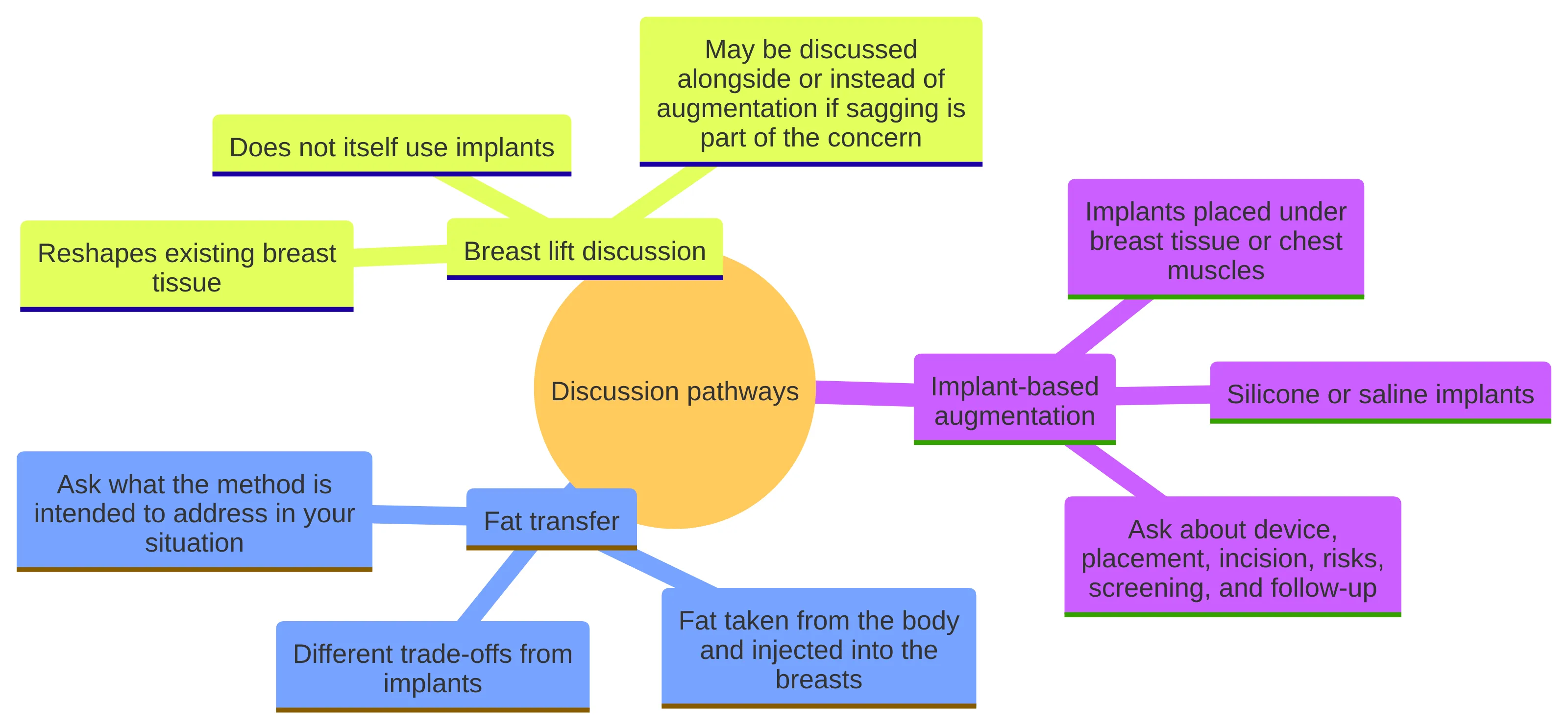
| Implant-based augmentation | In implant-based augmentation, implants are placed under breast tissue or chest muscles. Implant options are commonly described as silicone or saline. | Ask how the proposed device, placement, incision, risks, breast screening communication, and long-term follow-up relate to your goals. Implant-specific responsibilities should be part of the decision from the outset. |
| Fat transfer | Augmentation may also be performed with fat transfer, using fat taken from the body and injected into the breasts. | Ask what this method is intended to address in your individual situation and what trade-offs the clinician considers relevant. Do not assume it is interchangeable with implant-based augmentation simply because both are forms of augmentation. |
| Breast lift discussion | A breast lift is distinct from implant augmentation: it reshapes existing breast tissue and does not itself use implants. | If breast position or sagging is part of your concern, ask whether a lift should be discussed alongside or instead of augmentation. Implants do not prevent breast sagging. A clinician may discuss a lift in addition to augmentation after an individual assessment. |
The practical takeaway is that “more volume,” “more upper fullness,” and “a breast position concern” are not automatically the same problem. Rather than treating implants and fat transfer as competing answers, use the consultation to identify the responsibilities and unanswered questions each pathway introduces. A lift has a separate purpose from implant augmentation. Bringing those distinctions into the consultation helps prevent a narrow conversation in which the method is assumed before the goal is clear.
If you are unsure which pathway applies, that uncertainty is itself worth bringing forward. State what you notice, what you hope to change, and what you do not want to assume. The clinician’s role is to assess the relevant options; your role is to make sure the discussion addresses the questions that matter to you.
Build a Breast Augmentation Responsibility Profile
Use this as a responsibility-routing profile, not as a candidacy checklist or a way to compare yourself with another patient. Instead of ranking pathways or predicting an outcome, place each question in the lane that can answer it: general information, individualized clinical planning, or implant-specific device information. Then connect the unresolved questions to the pathway that creates them. The purpose is to prevent a general fact, a device document, or a personal clinical decision from being treated as interchangeable.
-
Name the question before naming the pathway. Write the change you want to discuss in ordinary language, such as volume, shape, position, or asymmetry. Then create three notes for it: what general information can clarify, what requires individualized clinical planning, and what device information would matter if implants enter the discussion.
-
Separate the pathways. Keep implant-based augmentation, fat transfer, and a lift discussion in separate entries. For implants, the profile must include device information and long-term care; for fat transfer, it must include the separate questions created by using fat taken from another body area; for a lift, it must preserve the distinction between position and implant-based volume.
-
Mark plan-dependent responsibilities. Record the incision, placement, and anesthesia questions only as items for clinical explanation. General descriptions can show what needs discussion but cannot establish a plan for you.
-
Attach device duties only where they belong. If implants are under consideration, add patient-labeling materials, implant-specific complications, breast-screening communication, and the possibility of future procedures. Breast implants are not lifetime devices, and future surgery may be needed for reasons including rupture or changes in the breasts or body.
-
Record life considerations separately. Keep breastfeeding questions and practical recovery-support questions distinct from device information. Breastfeeding after augmentation is possible for some people but can be challenging for others.
-
Test the routing, not just the list. Ask whether each entry is assigned to the right answer source: general explanation, clinician discussion, or approved device labeling. If travel or distance could affect care, place continuity and follow-up questions in the clinician-discussion lane rather than assuming an arrangement.
-
Set a discussion boundary. End with the responsibility you would need explained before deciding whether to continue exploring that pathway. An unresolved material responsibility is a reason to seek clarification, not a conclusion about suitability.
This profile does not tell you which option to choose. It helps you test whether you understand the terms, uncertainties, and responsibilities well enough to have a more informed clinical conversation. Signed documentation alone may not establish understanding; ask for clarification when you cannot explain a material point in your own words.
Reserve Surgical-Plan Choices for Individual Explanation
It is tempting to turn procedural details into preferences before meeting a clinician. In practice, they are planning questions. The cited clinical source lists incision locations at the breast crease, under the arm, and around the nipple. It also notes that anesthesia planning varies: local anesthesia may be used, while general anesthesia is often used.
Those facts are useful because they show that breast augmentation is not a single, standardized sequence of choices. They are not a basis for choosing an incision or anesthesia plan for yourself. The relevant decision depends on the procedure being discussed and on individual clinical planning.
Use the consultation to ask direct, bounded questions: Which incision locations are being considered in my case? What factors are shaping that discussion? What anesthesia approach is planned, and who will explain its role? What should I understand about the surgical plan before consenting? Ask for explanations in language you can repeat back. A clear answer should help you understand the proposed plan and its rationale, not merely give you a term to search online.
It is also reasonable to pause if a material choice remains unclear. Elective surgery allows room to seek clarification, review information, and decide whether you understand the proposed approach well enough to proceed.
Add Implant-Specific Safety Responsibilities to the Profile
For someone considering implant-based augmentation, safety is not a short disclosure at the end of the consultation. It is part of deciding whether the pathway fits your priorities. In the United States, the FDA lists breast pain, changes in nipple or breast sensation, additional surgery, capsular contracture, rupture or deflation, and possible breastfeeding impact among implant risks and complications.
Some terms deserve plain-language discussion. FDA defines capsular contracture as tightening of tissue around an implant that can cause firmness or hardening and, when severe, squeeze the implant. FDA defines rupture as a tear or hole in an implant’s outer shell. FDA states that severe capsular contracture may require reoperation and can recur after corrective surgery.
The FDA also identifies BIA-ALCL, a type of non-Hodgkin lymphoma, among breast-implant-associated risks. It lists reports of squamous cell carcinoma, lymphomas other than BIA-ALCL, and mesenchymal tumors including sarcoma among breast-implant concerns. These are consequential topics to review carefully in a device-specific conversation; they should not be minimized, generalized into a prediction about an individual, or treated as a reason to skip informed discussion.
Long-term planning also includes the possibility of later procedures.
FDA directs readers to approved implant patient labeling for complete complication lists and rates. Ask for the patient labeling for any implant under discussion and review it before making a final decision. In 2021, FDA strengthened breast-implant risk-communication requirements, including sales and distribution restrictions intended to support informed decisions.
A productive consultation question is not “Will I need another surgery?” because no one can promise a personal answer. Ask instead: “What future procedures might become relevant, what circumstances could lead to them, and what does the device labeling say about complications and rates?” That question keeps uncertainty visible without converting it into either reassurance or alarm.
Keep Variable Implant Lifespan and Consent Questions Visible
Do not treat an implant as a lifetime purchase with a fixed expiration date. Available clinical information gives different typical estimates—about 10 years in one source and about 10–15 years for possible replacement or revision in another—so implant lifespan should be treated as variable rather than fixed. The same source notes that rupture and changes in the breasts or body can lead to further surgery. The more useful planning stance is to understand that implant-based augmentation can involve long-term attention and that future decisions may be necessary.
Meaningful consent is more than signing a form. The cited informed-consent article describes inconsistency in cosmetic-surgery consent practices and cautions that signed documentation alone may not establish understanding. If you cannot explain the proposed procedure, alternatives, material risks, expected follow-up, and future-care responsibilities in your own words, ask for a slower explanation.
In one international respondent survey, 63.2% reported two face-to-face consultations with physical examination before cosmetic surgery, while 31.2% reported one. This describes respondents’ practices, not a universal requirement. Likewise, most respondents believed the performing surgeon should be responsible for consent and postoperative management, including in surgical-tourism cases; that is a survey finding rather than a universal legal or clinical standard.
For a reader, the practical lesson is straightforward: prioritize continuity, clarity, and enough time to consider what you have learned. If travel is part of your plan, ask specifically who handles postoperative management, how follow-up is arranged, and what information should travel with you. Do not rely on an online exchange alone to settle questions that require physical examination and individualized planning.
Turn the Responsibility Profile Into a Consultation Agenda
Before scheduling or after a consultation, use a short written routing agenda organized by answer source and pathway. You do not need to know the answers in advance. Its purpose is to show which points belong in general education, which require individualized explanation, which should be checked against implant labeling, and which pathway-specific responsibilities remain unresolved.
- What change do I want to discuss, and what responsibility might that discussion introduce without selecting a procedure in advance?
- Which pathway is being discussed—implant-based augmentation, fat transfer, or a lift—and what purpose does each term describe?
- If implants are under consideration, what device information and patient labeling should I review?
- Which responsibilities belong specifically to the implant, including capsular contracture, rupture or deflation, sensation changes, breast screening communication, and possible additional surgery?
- What questions about fat transfer or a lift should remain separate from implant responsibilities?
- Which incision, placement, and anesthesia choices require an individualized explanation?
- What recovery-support, follow-up, and continuity questions remain unanswered?
- What future revision or removal possibilities should I understand without treating them as a prediction?
- Which responsibility would I need explained before deciding whether to continue exploring this pathway?
A useful consultation should help you complete your responsibility profile by showing which pathway is being discussed, what responsibilities it creates, and which questions remain individualized. Take time to review device information when implants are discussed, keep alternatives distinct, and pause when you cannot explain a material part of the proposed plan to your satisfaction.
Frequently Asked Questions About Breast Augmentation Responsibilities
What is the difference between breast augmentation and breast implants?
Augmentation is the procedure intended to increase breast size, while implants are the prosthetic devices often used in that procedure. The terms are often used together, but they are not the same thing.
What options are usually discussed besides implant-based augmentation?
Fat transfer and a breast lift may also come up, depending on the change you want to discuss. Each pathway has different trade-offs, so it helps to clarify whether your main concern is volume, shape, position, or more than one of these.
What should I ask about implant safety if implants are part of the discussion?
Ask about the risks and complications that are most relevant to the specific device and plan being discussed, including capsular contracture, rupture or deflation, sensation changes, and the possibility of additional surgery. It is also reasonable to ask for the patient labeling and to review it before deciding.
Will implants stop breast sagging?
No. Implants do not prevent sagging. If breast position is part of your concern, a clinician may discuss whether a lift should be considered along with or instead of augmentation after an individual assessment.
What long-term issues should I bring up if I am considering surgery?
Plan to discuss breast screening, possible future procedures, and any breastfeeding concerns that matter to you. Breast implants may require additional mammographic views, and future surgery can become relevant if the implant or breast changes over time.