
Start With the Question You Want Surgery to Answer
Breast augmentation is elective surgery that uses implants or, less commonly, fat transfer to enhance breast size. For many people, the more useful starting point is not “Which implant should I choose?” but “What change am I hoping to see in my proportions, clothing fit, or breast volume?”
That distinction matters because implant selection is only one part of an individualized treatment plan. A thoughtful discussion connects your goals with your existing breast shape, tissue coverage, skin quality, symmetry, lifestyle, recovery needs, and willingness to manage an implant over time—what would you want surgery to answer for you?
Natural-looking results can be a planning goal, not a promise. Open discussion of your motivation, expectations, and concerns can help you and a surgeon decide whether surgery is appropriate, while realistic expectations matter because an outcome may not fully match every imagined goal—are you ready to describe both what you hope will change and what you want to preserve?
If you are also considering facial rejuvenation, body contouring, or med spa care, keep those topics separate from your breast augmentation goals—would separating these priorities make the discussion clearer?
If surgeon credentials or travel access matter to you, ask directly whether the clinician is a double board-certified plastic surgeon and confirm whether a virtual consultation or Destination Surgery applies to your circumstances—what details would you want verified before scheduling?
Decision One: Is Added Volume the Change You Want to Evaluate?
The first decision is whether added volume is the change you want to evaluate. Breast augmentation is designed to add volume, while a lift may be discussed when significant sagging is present because implants alone may not correct that concern—does added volume address the concern you see?
That distinction cannot be settled by a cup-size goal, a photograph, or general information. An individualized examination is needed to determine whether a lift belongs in the discussion—would you be open to a different approach if it better matched your anatomy?
Breast revision is a separate consideration for someone with existing implants. It may involve revising, replacing, or removing implants; some cases involve replacement alone, while others require work on soft tissue or breast structure—if you have implants, what change are you trying to evaluate now?
This first decision is not about choosing a procedure from a list. It is about naming the concern clearly enough to understand whether volume, breast position, or an existing implant result is central—can you state that concern without assuming the answer in advance?
What Your Starting Anatomy Can and Cannot Answer
A desired size is useful information, but it cannot determine a surgical plan by itself. During a consultation, you can discuss your goals and concerns, and recommendations may take your medical history and other factors into account—what would make a proposed size feel proportionate to you?
Bring attention to your starting point: breast width, existing volume, the amount of natural tissue coverage, skin quality, and baseline differences between the breasts. Natural tissue coverage is one consideration when discussing placement, while pre-existing asymmetry may remain after surgery even with careful planning—have you considered which differences you would accept as part of your own anatomy?
Body proportion and lifestyle also belong in the conversation. For an active patient, exercise and possible muscle interference can be discussion points when considering placement, so your work, training, childcare, and everyday movement are relevant planning details—what activities would you want to protect during recovery and afterward?
A useful consultation does not promise an identical result to an image or another person’s outcome. Instead, it asks whether your goals, expectations, and motivation align with what surgery can reasonably aim to achieve—can you describe your priorities in terms of balance and proportion rather than a single measurement?
Decision Two: Weigh Implant Features Only After Defining the Goal
Once the change being considered is clear, implant features can be considered in context. In the United States, breast implants are FDA-approved devices for augmentation and reconstruction—what information would help you understand the device decision?
Implants may be saline-filled or silicone-filled, and both have an outer silicone shell. Silicone implants contain cohesive gel, while saline implants are filled with sterile saltwater after placement and may feel firmer; neither option is universally better because anatomy, preferences, and goals matter—what trade-off matters most to you?
A proposed size, shape, or profile has meaning only in relation to the volume goal and the breast that will support it. Ask for an explanation of how breast width, tissue coverage, body proportion, and desired change informed the recommendation—would the reasoning make sense without relying on a generic ideal?
Placement, surface, and incision location also belong to the clinical discussion. For someone with little natural breast tissue, submuscular placement may be discussed as a way to help conceal implant edges, but no single feature determines the entire plan—does the proposed approach account for the limits as well as the intended change?
Decision Three: Consider the Long-Term Device Commitment
Recovery is not a single standard timetable. Timing varies by procedure, medical history, and other individual factors, so ask how recovery could affect work, childcare, exercise, sleep arrangements, transportation, and the activities that matter in your day-to-day life—who could support you while you recover?
Implants are not lifetime devices, and future surgery to replace one or both implants may be needed. Pregnancy, weight loss, and menopause may also influence the appearance of augmented breasts over time, which is why the decision is about more than the immediate surgical result—are you comfortable considering the longer arc of this choice?
For silicone implants, discuss the current FDA-recommended MRI or ultrasound screening schedule with a qualified clinician: five to six years after placement and every two to three years thereafter. Routine screening can assess implant integrity and identify rupture or silicone leakage, and rupture may be asymptomatic for some women—have you included future screening in your planning?
This is general educational information, not a personal monitoring plan. Ask the clinician who knows your health history and implant details how follow-up, routine breast health care, and implant screening should fit together—do you know which follow-up questions you would want answered before proceeding?
A practical way to assess the long-term commitment is to separate three responsibilities: keeping scheduled follow-up discussions, maintaining routine breast health care, and understanding when implant screening may be relevant. This does not mean every future change requires surgery, but it does mean the initial decision should leave room for future evaluation if your priorities, breast appearance, or implant condition changes—would you be prepared to revisit the plan if circumstances change over time?
Monitoring is different from waiting until you notice a problem. Because rupture may be asymptomatic for some women, follow-up discussions can help you understand how implant integrity may be evaluated even when you do not notice a change; for silicone implants, ask who will help you keep track of the current FDA-recommended imaging schedule—would you be able to keep that information accessible over time?
It can also help to regard a future implant discussion as an evaluation rather than a predetermined outcome. A later conversation may be relevant after a complication, a change in breast appearance, or a change in your own priorities, and the appropriate next step depends on the reason and an individualized assessment—does this longer perspective fit your expectations for an elective device decision?
Understand the Uncertainty That Remains With Any Plan
A plan can be carefully individualized and still involve uncertainty. Potential surgical and implant-related complications include anesthesia-related risks, bleeding, infection, fluid collections, hematoma, sensation changes, capsular contracture, leakage or rupture, implant malposition, persistent pain, poor scarring, and possible revision surgery—what uncertainties would be most important for you to understand?
BIA-ALCL is a type of T-cell lymphoma that can develop following breast implants. FDA materials state that it appears more often in patients with textured implants, making the surface of a proposed device an important topic for a current discussion—would you want to understand the safety information for the device being considered?
Breast implants and breast surgery may interfere with successful breastfeeding. Sensation changes may be temporary or permanent and may affect sexual response or nursing, while implants can interfere with mammography and breast exams; patients should tell their mammography technician about implants—how do these considerations relate to your present or future priorities?
Implant removal can also change breast appearance, including size or shape, dimpling, puckering, sagging, chest-wall concavity, or incision appearance. These possibilities do not predict an individual outcome, but they show why the device decision includes more than the initial operation—does knowing the range of future possibilities change how you view the decision?
Baseline asymmetry may remain after surgery, and implant displacement can contribute to asymmetry or other cosmetic concerns. A proposed plan cannot erase every variable, so realistic expectations should include what may remain outside a surgeon’s control—can you distinguish a planning goal from an assured appearance?
Use the Three Decisions to Decide Whether to Continue
Write down questions before your consultation. The answers may help you clarify or refine your goals, especially when you feel pulled between a desired look, practical recovery needs, and uncertainty about future surgery—what do you need to understand to make an unhurried decision?
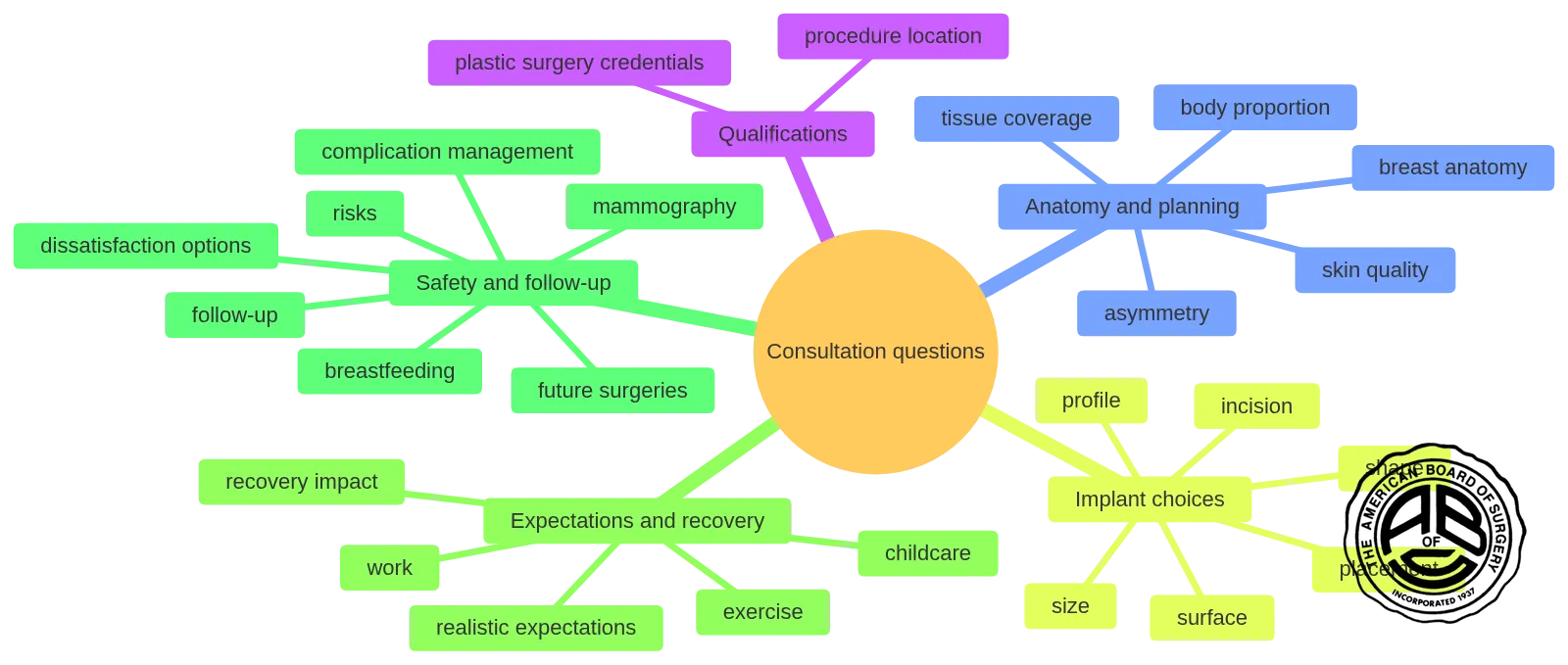
Use this list to connect the proposed plan to your priorities:
- What are your qualifications in plastic surgery, and where would the procedure be performed?
- What about my breast anatomy, tissue coverage, skin quality, asymmetry, and body proportion supports this recommendation?
- Why are you recommending this implant fill, size, shape, profile, surface, incision, and placement for me?
- What realistic expectations should I have, including differences that may remain after surgery?
- How might recovery affect work, childcare, exercise, and other usual responsibilities?
- What are the important risks in my situation, and how are complications handled?
- How could surgery affect breastfeeding, nipple or breast sensation, mammography, and routine breast care?
- What follow-up and silicone-implant screening discussions should I plan for?
- What future surgeries might become relevant, and what are my options if I am dissatisfied?
A surgeon should be able to explain the reasoning behind a recommendation in language you understand. If an answer does not connect the plan to your stated goals and practical circumstances, ask for clarification before deciding—can you repeat back the plan and why it was chosen?
Make the Next Decision With Context
General guidance can help you organize questions, but it cannot determine candidacy or select an implant, placement, lift, or breast revision for you. Those decisions require an individualized discussion of your goals, health history, anatomy, realistic expectations, recovery responsibilities, and comfort with long-term device considerations—are you ready to have that conversation with the full context in view?
If you are considering this procedure in Beverly Hills, bring your priorities, questions, and concerns to a consultation with Dr. Golshani. If a virtual consultation would be more practical, confirm directly whether it is available and appropriate for your situation—would a focused first discussion help you decide whether to move forward?
Frequently Asked Questions About Breast Augmentation Planning
What is breast augmentation intended to change?
It is surgery used to add breast volume, usually with implants and less often with fat transfer. The goal is typically a change in size and proportion, not a promise of a specific look.
How do implant size, shape, and placement get chosen?
Those choices are individualized to your breast width, tissue coverage, skin quality, asymmetry, body proportion, and lifestyle. Your surgeon should explain why a particular combination is being suggested for you.
What should I ask about recovery before deciding on surgery?
Ask how recovery may affect work, childcare, exercise, sleep, and daily support needs. Recovery timing varies by procedure and by patient, so it helps to plan around your real schedule instead of a generic timeline.
What long-term issues should I understand before getting implants?
Implants are not lifetime devices, and future surgery may be needed. You should also understand routine monitoring, possible implant rupture or leakage, changes in sensation, breastfeeding impact, and the chance that revision surgery could become relevant later.
What questions should I bring to a breast augmentation consultation?
Ask about qualifications, the proposed surgical plan, realistic expectations, risks, complication management, follow-up, and how the plan fits your anatomy and goals. Good answers should connect each recommendation to a clear reason.