Tag: breast augmentation recovery

  • Augmentation Before and After: What to Expect, How Results Change, and What Shapes the Outcome

    Augmentation Before and After: What to Expect, How Results Change, and What Shapes the Outcome

    Using a Change-Tracking Journal to Organize Before-and-After Expectations

    Before-and-after expectations for augmentation can be organized with a dynamic, self-guided observation record. Instead of focusing on interpreting device information or labeling, use a "change-tracking journal" to document your own experiences, questions, and evolving priorities throughout the process. This journal is not a checklist or a worksheet to fill out in advance; it is a living record that adapts as you move from initial research through consultation, surgery, and recovery.

    With a change-tracking journal, you:

    • Describe your starting context: Write down what you notice about your body and what changes you are considering.
    • Log observations at each stage: After each appointment or milestone, record what you see, feel, or learn—such as new questions, unexpected changes, or support needs.
    • Note uncertainties and follow-up topics: Use the journal to highlight areas where outcomes are variable or where you want more explanation.
    • Reflect on priorities and decisions: As your understanding grows, update your journal to capture shifting goals or new concerns.

    This approach allows you to recognize patterns in your own experience, organize questions for your provider, and make the before-and-after process more transparent and personally relevant. It is intended to support your decision-making by focusing on your lived experience and evolving needs, rather than on interpreting technical device details.

    What Augmentation Involves: Methods and Goals

    Augmentation procedures may use implants or fat transfer. Using a worksheet, you can record your appearance goal, note which procedure options fit your anatomy and priorities, and identify what general information clarifies versus what needs clinical input. This record helps you prepare for a more focused discussion with your provider.

    How Choices Shape the Outcome

    Use your worksheet to record the choices that shape your outcome: implant type, size, placement, incision, and technique. For each, write what you know, what remains uncertain, and what you want clarified. Instead of treating these as a checklist, organize them as separate entries in your record. This method turns the planning conversation into a practical tool for comparing options and tracking what needs further discussion.

    Visualizing Changes: Sizers and Reference Images

    When visualizing changes, use your worksheet to record what reference images or sizer trials clarify for you and what remains uncertain. Note which examples are comparable to your anatomy, what questions they raise, and which features you want to discuss. This method turns visual preferences into practical questions for your provider.

    Incision and Placement Choices Affect Scarring and Appearance

    There are four main incision types for breast augmentation:

    • Inframammary: Under the breast fold (most common)
    • Periareolar: Around the lower edge of the areola (also common)
    • Transaxillary: Through the armpit (less common, used with saline implants)
    • Trans-umbilical (TUBA): Through the navel (rare, used with saline implants)

    The choice of incision depends on your anatomy, implant type, and surgeon-patient preference. Placement method (above or below the muscle) also affects the final look and feel. Each approach has trade-offs in terms of scar visibility, healing, and the ability to achieve your desired result. Discussing these options with your surgeon helps clarify what to expect for your own body.

    Implant Shape, Feel, and Longevity

    Implants come in two main shapes: round and shaped (teardrop). Round implants can look as natural as anatomical (teardrop) implants, depending on your anatomy and the technique used. Shaped implants were developed to mimic the natural slope of the breast and are used in both reconstruction and cosmetic cases.

    Modern silicone gel implants are designed to feel more natural and have a lower risk of visible rippling compared to older saline types. However, no implant is considered a lifetime device—most last more than a decade, but may eventually require replacement. Your surgeon will discuss the expected feel, appearance, and longevity of different implant options during your consultation.

    Immediate Postoperative Changes

    Record immediate postoperative changes in your worksheet as observations, not as fixed expectations. Note what you experience—grogginess, soreness, tightness, swelling—and compare these with your written instructions. Use the worksheet to track what needs clarification or follow-up, and to organize questions for your provider about support needs and early recovery.

    Recovery and Cosmetic Changes: A Personalized Timeline

    Early recovery after augmentation is influenced by the choices made before and during surgery, including implant type, placement, and your personal health context. Swelling, tightness, and changes in sensation are common, but the degree and duration can differ from person to person. Swelling may peak within the first few days, and your chest could appear larger or firmer than the final result. Pain management strategies and the timeline for returning to daily activities should be tailored to your needs and discussed with your surgeon. Some people return to light work within a week, while others may need more time. During this phase, implants often remain high and firm, and sensation changes may occur as tissues heal.

    It is normal to experience fatigue, limited range of motion, and a need for extra rest during the first week or two. You may be advised to sleep on your back and avoid raising your arms above shoulder level. Most people are encouraged to walk and perform gentle movements to support circulation, but should avoid strenuous activity. Over-the-counter pain relievers are often sufficient after the initial days, but always follow your provider’s recommendations. Noticing gradual improvement in comfort and mobility is a positive sign, but any new or worsening symptoms—such as increasing redness, swelling, or pain—should be reported promptly. Early follow-up appointments are an opportunity to review your progress and clarify any questions about activity or wound care.
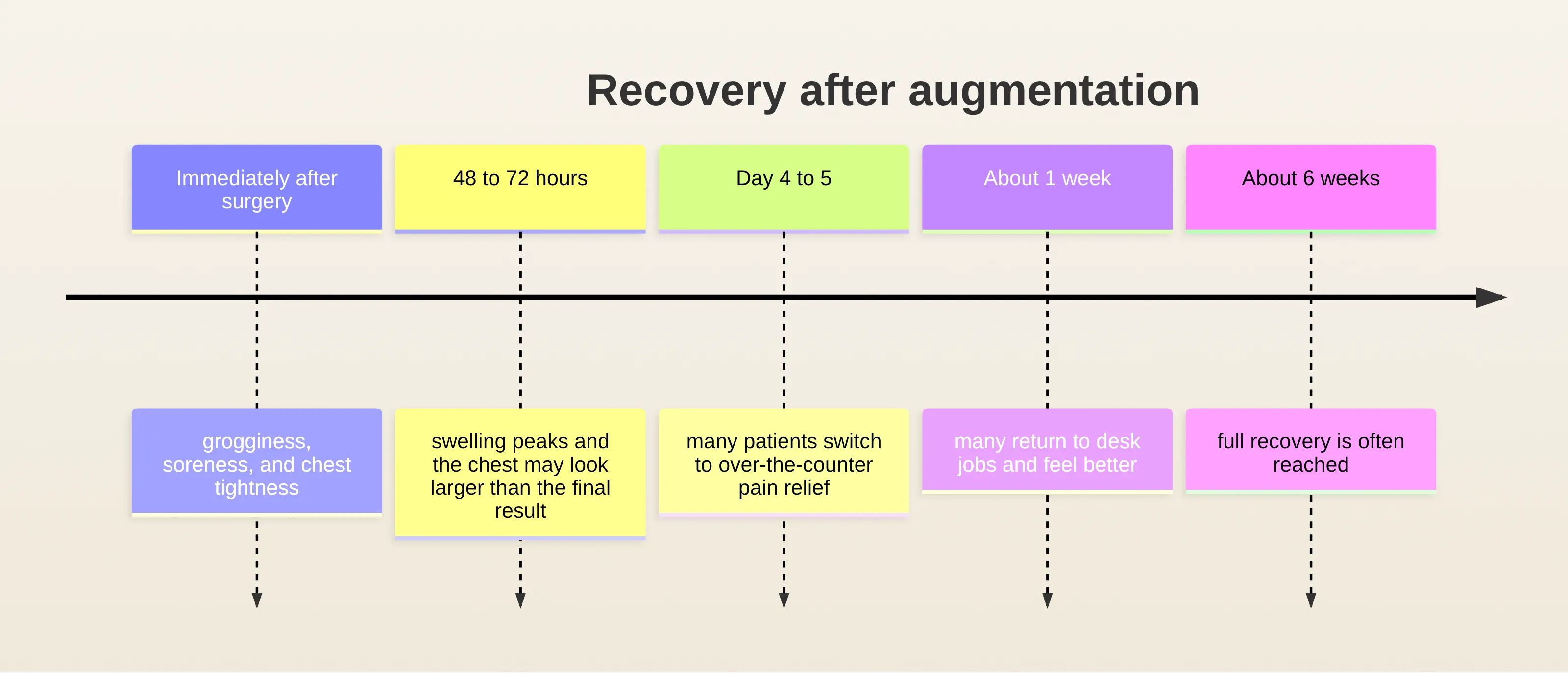
    A timeline showing the main recovery stages after augmentation, from immediate grogginess and swelling to about six weeks of recovery.
    Recovery after augmentation usually improves in stages over the first several weeks.

    Activity Restrictions and Support Needs

    The activity restrictions and support you need after augmentation are shaped by your surgical plan and individual recovery progress. Planning for time off work or school, arranging home support, and understanding which activities are safe to resume should be based on your provider’s instructions and your own healing response. While some people can return to light activities after a week, others may require a longer period of rest. Strenuous exercise, heavy lifting, and jarring movements should be avoided until your surgeon provides clearance, as the appropriate timeline can vary. Adapting your recovery plan to your specific situation helps support healing and reduces the risk of complications.

    In addition to physical restrictions, consider the practical aspects of recovery: you may need help with childcare, meal preparation, and household tasks during the first days or weeks. Preparing your recovery space with items like extra pillows, ice packs, and loose clothing can make the process more comfortable. If you have a physically demanding job or responsibilities that cannot be postponed, discuss these with your provider to set realistic expectations for your return. Remember that even after you feel better, your tissues may still be healing, so gradual resumption of activities is important. Following your provider’s written instructions and attending scheduled follow-up appointments are key steps in ensuring a safe and smooth recovery.

    Implant Settling and Cosmetic Evolution

    The cosmetic evolution after augmentation is shaped by both the choices made during planning and your individual healing process. As swelling and bruising subside, implants may gradually settle into a lower, more natural position—a process sometimes called "drop and fluff." The timeline for these changes is not fixed: some people notice visible changes within weeks, while for others, settling and softening may continue for several months. Scars and sensation changes also evolve at different rates depending on your anatomy, surgical technique, and recovery. Tracking your own progress and discussing any concerns with your provider can help you understand what is typical for your situation and what may require further attention.

    It is also common for the appearance of the breasts to change in subtle ways as the tissues adapt to the new implant. For example, the lower portion of the breast may gradually fill out, and the upper pole may become less prominent as swelling decreases. Some people notice that their breasts look or feel uneven during the early weeks, but this often improves as healing continues. The process of scar maturation can take several months to a year, with scars typically fading and flattening over time. Sensation changes—such as numbness or hypersensitivity—may resolve gradually, but some differences can persist. Keeping a photo record or written log of changes can help you notice gradual improvements and provide useful information for follow-up visits. If you experience any unexpected or concerning changes, such as persistent firmness, increasing asymmetry, or new lumps, bring these to your provider’s attention for assessment.

    Recovery Timeline Variation

    Instead of following a standard recovery calendar, use your worksheet to document how your own experience unfolds at each stage. Record when you notice changes in comfort, activity level, or appearance, and highlight any milestones or concerns that matter to you. This personalized record can help you prepare for follow-up visits and clarify which aspects of your recovery need more discussion with your provider.

    Risks, Complications, and When to Contact Your Surgeon

    All surgeries carry risks. After augmentation, some patients experience persistent sensitivity or unusual changes—especially if these occur on one side. These should be reported to your surgeon promptly. Infection is a known risk, with up to 4% of patients experiencing acute infection in the first month and up to 9% of procedures involving infection overall. Signs of early infection include swelling, redness, pain, discharge, fever, or a rapid heartbeat. Rarely, patients may report systemic symptoms (sometimes called "breast implant illness"), such as fatigue or joint pain, but there is currently no formal medical diagnosis for these symptoms and research findings are inconsistent. Very rarely, a type of cancer called squamous cell carcinoma can develop in the capsule around an implant, with symptoms like swelling, pain, or lumps that may appear years after surgery. If you notice any concerning changes, contact your surgical team without delay.

    Individual Factors That Influence Results

    Your outcome is shaped not only by surgical choices but also by individual factors. Age, health status, anatomy, education, and even personality traits can influence how you perceive risks, your recovery experience, and your satisfaction with results. For example, your chest width, breast tissue, and skin quality affect implant selection and final appearance. Emotional stability and openness to experience may shape your expectations and willingness to recommend the procedure. Discussing your personal context with your surgeon helps tailor the plan to your needs.

    Questions to Ask Providers About Before-and-After Expectations

    To make your worksheet more useful during a consultation, add questions such as:

    • What changes should I expect immediately after surgery and over the following months?
    • How will my anatomy influence the recommended approach and likely results?
    • What are the main risks and how are complications handled?
    • What is the expected recovery timeline for my situation?
    • How will scars and sensation change over time?
    • What support and follow-up care are provided?
    • How long do implants typically last, and what signs should I watch for in the future?

    Bringing your worksheet and these questions to your consultation can help you organize information and clarify what matters most for your decision.

    Setting Realistic Expectations and Deciding on Consultation

    Using a worksheet to track before-and-after changes, recovery needs, and influencing factors can help you organize your priorities and decide whether to move forward. Reflect on your goals, recovery process, and questions, then use your worksheet to guide your next steps. If you want to explore augmentation further, a consultation with a qualified provider is the next step.

    Frequently Asked Questions About Augmentation Before and After

    What changes are normal right after augmentation surgery?

    Right after surgery, it is common to feel groggy, sore, and tight across the chest. Swelling can make the area look larger or firmer than the final result, and a surgical bra is often used for support and swelling control.

    When do the final results usually become easier to see?

    The look changes gradually as swelling goes down and the implants settle. Many people notice the breasts soften over weeks, while cosmetic settling can continue for several months before the result looks more natural.

    What factors can change how augmentation looks on different people?

    Several choices and body-specific factors matter, including implant type, size, shape, incision, placement, your chest width, breast tissue, and skin quality. Technique and the overall surgical plan also affect the result.

    What should I ask about before-and-after expectations at a consultation?

    Ask what changes are likely immediately after surgery and over time, how your anatomy affects the plan, what recovery usually involves, how scars and sensation may change, and what follow-up care and warning signs the practice wants you to know about.

    Which recovery changes should prompt a call to the surgeon?

    Contact the surgeon if you notice persistent or unusual sensitivity, especially on one side, or signs of infection such as swelling, redness, pain, discharge, fever, or a rapid heartbeat. Any new or concerning change deserves prompt review.

    Can breast augmentation be done with something other than implants?

    Yes. Augmentation can also be done with fat transfer in some cases. The right approach depends on the change you want, your anatomy, and the discussion you have with the surgeon about goals and trade-offs.


  • Breast Augmentation: How to Review Implant Labeling Before a Consultation

    Breast Augmentation: How to Review Implant Labeling Before a Consultation

    Start With an Implant-Labeling Review Record

    Before a consultation, use the implant materials as a document-audit set rather than as a general procedure summary. Breast augmentation is intended to increase breast size, and implant-based augmentation involves placing implants under breast tissue or chest muscles. The audit question is narrower: can you identify what the materials say about the proposed device, what each document is for, and which terms still need clarification?

    Collect the benefit-and-risk labeling, boxed warning information, patient decision checklist, manufacturer patient labeling, and device card for the implant under discussion. Mark each document’s title, device details, warnings, risks, and unresolved terms. The FDA states that breast implants are not lifetime devices, so the record should also show where the materials address monitoring and the possibility of additional procedures.

    Do not use the documents to select an implant, placement, incision, or surgical plan on your own. Use them to make the later discussion more precise and to distinguish information that is device-specific from decisions that require an individualized clinical assessment.

    Record What Labeling Cannot Choose for You

    A labeling record should include a clearly marked section called “questions the materials cannot answer.” Device information can describe an implant, but it cannot establish whether a particular surgical plan fits an individual.

    Implant insertion and positioning are individualized based on factors such as implant type, the degree of enlargement desired, body type, and the surgeon’s recommendations. Potential incision locations include the areolar edge, the fold under the breast, and the armpit. These are discussion topics, not options to select from a general article. The American Society of Plastic Surgeons notes that a belly-button approach is associated with a higher complication rate.

    Write your own questions beside, rather than inside, the device materials:

    • What change am I hoping to discuss?
    • Which implant characteristics, placement, and incision are being considered, and why?
    • What features of my anatomy need professional assessment?
    • What would the proposed approach not change?

    Also separate volume from breast position. Implants do not prevent breast sagging, so a lift may be discussed when sagging is a concern. Whether augmentation alone addresses a particular concern cannot be settled by a label, photograph, or another person’s experience.

    Use Your Goals to Read Benefits and Limits Carefully

    Before reading a proposed implant’s materials, add a short statement of what you want to discuss. Breast augmentation is intended to increase breast size, but that general purpose does not establish that every appearance concern will be addressed.

    Use a second note headed “limits that matter to me.” For example, breast implants do not stop breast sagging, and changes in the breasts and body over time can affect appearance. If position is an important concern, record it as a topic for individualized assessment rather than assuming added volume will resolve it.

    Future breastfeeding priorities also belong in this note. Breast augmentation can affect nerves and ducts involved in lactation. Cleveland Clinic notes that implant placement and incision location can matter for future milk production. This does not predict an individual experience; it identifies a priority that should be raised before a plan is selected.

    This part of the record helps distinguish a hoped-for change from questions that need clinical explanation. It is a way to read benefit information carefully, not a way to forecast a personal result.

    Build the Record From Required Implant Materials

    Audit Each Document Against the Others

    Start with the benefit-and-risk labeling and boxed warning. Record the proposed device’s identifying details and copy the main benefits, warnings, risks, and limitations into separate notes. Do not combine a general implant statement with a device-specific statement unless the materials support that connection.

    Next, review the patient decision checklist. Under FDA requirements, the checklist is reviewed with the prospective patient and signed by the patient and implanting physician. Mark each topic that is clear and each term that needs explanation. The checklist is an informed-discussion document, not a personal risk calculation.

    Then compare the manufacturer’s patient labeling and educational materials with the earlier notes. Look for information that adds detail, narrows a statement, or identifies a device-specific qualification. If a term appears inconsistent or unclear, preserve both references in the record and bring the discrepancy to the surgeon rather than resolving it yourself.

    Finally, record what the device card identifies, including the implant’s serial or lot number and style and size. Keep the card with the reviewed labeling so the device information remains accessible later. The FDA advises reading the manufacturer’s materials and discussing questions with the surgeon before deciding.

    A completed audit should answer three limited questions: which documents were reviewed, which statements appear to describe the proposed device, and which points require clarification. It should not become a substitute for examination or an individualized surgical plan.

    Add Device Risks to the Record Without Self-Calculating

    FDA approval reflects testing for reasonable assurance of safety and effectiveness; it does not eliminate implant risks. Your individual likelihood of a complication cannot be determined from an article, but the known categories should be part of the decision before surgery.

    The FDA identifies capsular contracture, reoperation, and implant removal among the most common local complications and adverse outcomes. It also identifies rupture or deflation, wrinkling, asymmetry, scarring, pain, and infection at the incision site. For silicone gel-filled implants, rupture can be silent, meaning it may occur without symptoms.

    Some risks may require further evaluation or treatment. The FDA describes breast implant-associated anaplastic large cell lymphoma, or BIA-ALCL, as a risk associated with implants that can occur in the breast or surrounding scar capsule; it is not breast cancer. The FDA also says that cases of squamous cell carcinoma and various lymphomas in the capsule around implants may be rare.

    These facts do not tell you what will happen in your case. They do establish why informed consent should be more than a general statement that surgery has risks. Ask for an explanation of the risks associated with the proposed implant, what symptoms or changes should prompt contact, and what further evaluation or treatment could be considered if a complication occurs.

    A reasonable decision does not require pretending that risks are absent. It requires understanding which risks are known, which questions remain individualized, and whether you are prepared to accept the possibility of additional care.

    One way to keep this discussion useful is to separate three kinds of questions. First, ask which complications and warnings are identified in the labeling for the specific device under consideration. Second, ask what changes or symptoms the treating team would want you to report and what evaluation may follow. Third, ask which aspects of your health history, anatomy, and proposed plan still need individualized assessment. This separation matters because a general risk list can identify subjects for discussion, but it cannot predict whether a complication will occur for you or determine how a clinician would manage it.

    If an explanation leaves you unsure whether a point is a known device risk, a monitoring issue, or an individualized concern, write it down for clarification before making a decision. Understanding the category of a question can make manufacturer materials and the patient decision checklist more useful without turning them into a personal risk calculation.

    Record the Follow-Up Responsibilities Attached to a Device

    The device card and follow-up information should form the long-term section of the review record. The FDA states that breast implants require monitoring for as long as they remain in place, and that the likelihood of complications and adverse outcomes rises the longer implants are in place.

    For silicone gel-filled implants, a clinician may recommend periodic MRI or ultrasound screening for rupture and other complications. Record the questions you need answered about the proposed device: what monitoring may be considered, when it may be considered, who will explain the plan, and how the plan will be documented.

    The device card contains information specific to an implant, including its serial or lot number and style and size. Keep it with the labeling and postoperative information so the information remains accessible later. The FDA advises promptly contacting a surgeon or health care provider about abnormal changes in the breasts or implants.

    A completed record does not supply a universal follow-up schedule. It helps you recognize that device information remains relevant after surgery and gives you a focused list for a clinician-led follow-up discussion.

    Keep Recovery Questions Separate From Device Information

    Keep recovery logistics in a separate section of the record rather than treating them as device-labeling details. Preparation may include testing, medication review or adjustments, smoking cessation, and avoiding certain substances as directed by the surgical team. Do not make medication or substance changes from a general checklist alone.

    After surgery, support may include gauze dressings and an elastic bandage or support bra. Instructions vary, including directions about support garments and incision care. The treating plastic surgeon’s specific postoperative instructions are the directions to follow.

    Use this page to capture practical questions for a consultation:

    • Which preparation steps would need to be discussed in light of my medical history and current medications?
    • What garment use, incision care, support, and activity questions should I ask about?
    • What follow-up arrangements would be relevant to the proposed plan?
    • Whom should I contact if I have a recovery question?

    This is not a recovery schedule or a promise about healing. It is a way to determine whether you understand the practical responsibilities that would accompany an individualized surgical plan.

    Use the Completed Record to Decide Whether to Seek Discussion

    Use the Audit to Prepare a Focused Discussion

    Bring the reviewed documents and a short discrepancy list to a consultation. Ask which labeling applies to the implant being discussed, how the patient decision checklist will be reviewed, what the boxed warning means in this context, and what information the device card will contain.

    Also mark questions that the documents cannot answer, including how your goals and anatomy affect the proposed plan, what placement or incision options may be considered, how recovery instructions would be individualized, and what monitoring or future procedures may need discussion. The American Society of Plastic Surgeons identifies asking whether a surgeon is certified by the American Board of Plastic Surgery as an important consultation question.

    The purpose of this audit is not to produce a recommendation. It is to make the source documents easier to compare and the unresolved questions easier to explain. If you want an individualized discussion of the audited materials and your goals, move from general education to a personalized assessment.


    Breast Augmentation Consultation FAQ

    How is the implant plan chosen?

    The choice depends on factors like the amount of enlargement desired, body type, implant characteristics, and the surgeon’s recommendations. A consultation is where placement and incision options are discussed in relation to your goals.

    What should I know if I want to breastfeed in the future?

    Mention that early in the discussion. Augmentation can affect the nerves and ducts involved in lactation, and implant placement and incision location may matter, so this priority should be reviewed before a plan is selected.

    What are the main risks to discuss before deciding?

    Some silicone implant ruptures can happen without symptoms, so risks should be reviewed carefully.

    Do breast implants need long-term follow-up?

    Yes. Discuss the follow-up plan for the device being considered with the surgeon.

    What should I expect during recovery planning?

    Preparation may include testing, medication review or adjustments, smoking cessation, and avoiding certain substances if directed by the surgical team. After surgery, you may be instructed to use a support garment and follow specific incision-care directions.

    What questions are useful to bring to a consultation?

    Ask which implant is being proposed, what labeling materials you should read, what the device card will show, how the decision checklist will be reviewed, whether the plan addresses sagging or breastfeeding goals, and what follow-up or monitoring may be needed.


  • Breast Augmentation Recovery Timeline: A Planning-First Guide to Healing and Support

    Breast Augmentation Recovery Timeline: A Planning-First Guide to Healing and Support

    Recovery Is a Guide, Not a Guaranteed Schedule

    A breast augmentation recovery timeline can serve as a planning tool, not a promise about exactly how you will feel on a particular day. Recovery varies between people, and general timelines cannot predict an individual course. Implant details, implant placement, tissue tightness, lifestyle, and personal goals can all shape recovery planning.

    A practical way to use the timeline is to make three decisions before surgery: arrange help for the first days at home, protect healing by following your operating surgeon’s instructions, and know which changes require a call versus emergency evaluation. This guide describes commonly reported stages, but your surgeon’s written directions take priority over every general milestone here.

    Think of recovery in two tracks. Early functional recovery is about rest, basic comfort, and gradually resuming light daily tasks when your surgeon permits it. Longer healing continues after daily life starts to feel easier. That distinction can help you plan realistically without treating an early improvement—or a slower day—as a verdict on your healing.

    Plan Before Surgery for Supported Rest at Home

    The first days are easier to manage when practical support is arranged before surgery. Decide in advance who can assist with meals, household tasks, children or pets, and other responsibilities that could require lifting, reaching, or sustained activity.

    Set up the items you expect to need regularly where you can reach them without stretching or repeatedly getting up. Loose, comfortable clothing and a simple resting area can make the first days less demanding. Complete routine household tasks ahead of time where possible, and make sure your support person knows how to reach the surgical team if you are unable to do so comfortably.

    Work and school planning should reflect what your day actually requires. Physically demanding work may require more time away than desk-based work. Rather than choosing a return date solely from a generic timeline, discuss your actual duties with the operating surgeon and ask what restrictions apply to your role.

    Before-surgery preparation checklist

    • Confirm your ride home and the person who will stay or check in during the early recovery period.
    • Arrange help with routine responsibilities that could involve lifting, reaching, driving, cooking, or caregiving.
    • Place frequently used necessities within easy reach in your recovery area.
    • Tell work or school that your timing may need flexibility, especially if your duties are physical.
    • Save the surgical team’s contact information and understand how to reach them after hours.
    • Bring your questions about restrictions, follow-up, and symptoms to report to your preoperative visit.

    This preparation does not replace individualized postoperative directions. It gives you the space to follow them without having to solve logistics while you are recovering.

    Make the Operating Surgeon’s Instructions Your Recovery Roadmap

    Your operating surgeon’s protocol is the recovery plan to follow. Before you leave after surgery, expect individualized postoperative instructions and follow-up planning from the surgical team. Those directions may address medications, garment use, incision care, bathing, activity, lifting, arm movement, and the timing of follow-up visits.

    A support bra, elastic bandage, or other support garment may be part of postoperative care. The type of garment and how long to wear it are not details to copy from another patient or an online checklist. Follow your surgeon’s directions about garment type, fit, and wear.

    The same principle applies to incisions. Some surgeons may give instructions involving cleansing and ointment; others may direct patients to leave tape or a bandage in place. Do not substitute a general article for the specific instructions you received. If a written direction is unclear, contact the surgical team for clarification rather than guessing.

    Follow-up timing is also surgeon-specific. One postoperative practice schedules a physician visit approximately five to seven days after surgery, but your own appointment schedule may differ. Keep every scheduled follow-up, and use it to review healing, restrictions, comfort, and questions about returning to normal routines.

    A helpful question for every instruction is: What should I do, what should I avoid, and what change means I should call? Write down the answers. This makes your surgeon’s advice easier to follow when you are tired or uncomfortable.

    The First 48 Hours and Early Days: Common Experiences and Rest

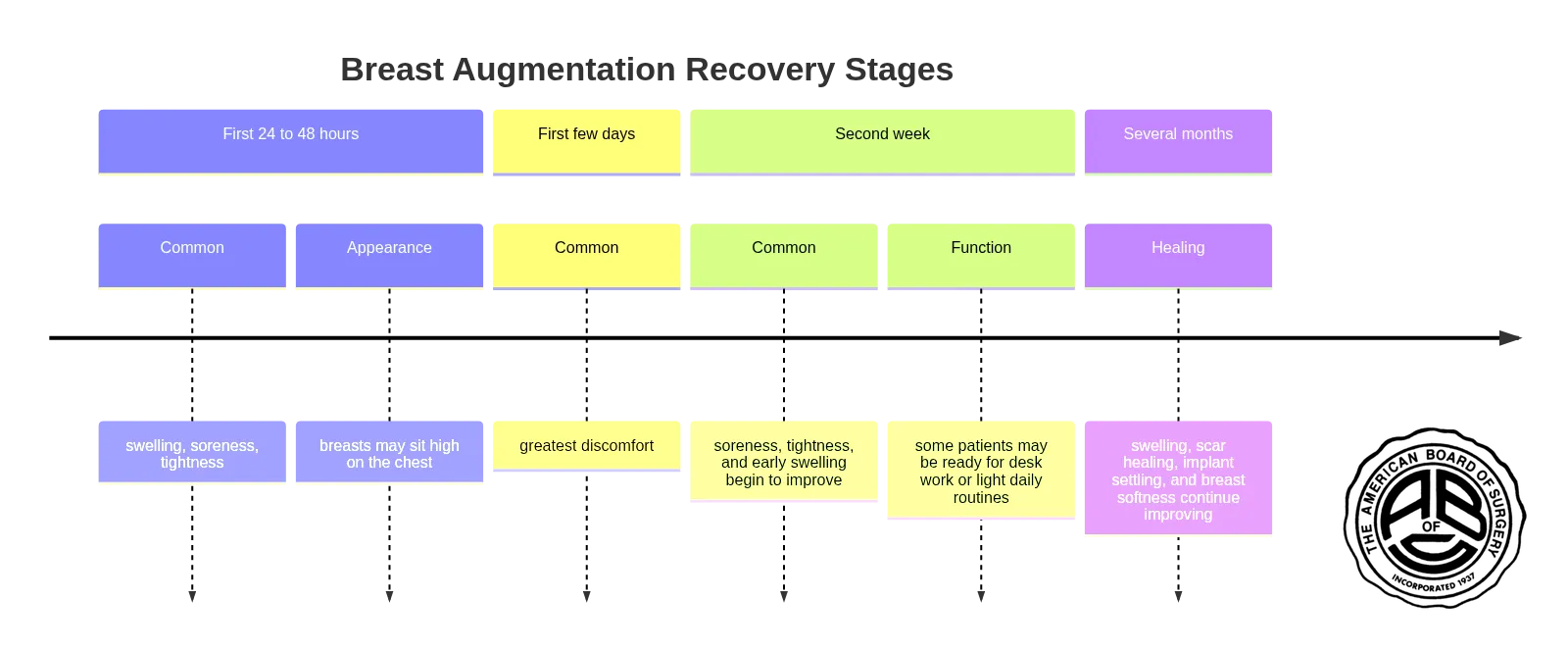
    During the first 24 to 48 hours, swelling, soreness, and tightness are commonly reported. The first few days are also commonly the period of greatest discomfort. These experiences can make rest, a calm environment, and early support especially important.

    Breasts can initially appear high on the chest and may change position as healing progresses. That early appearance is one reason not to judge the longer healing process from the first days alone. Your surgeon can tell you what is expected for your procedure and when they want to hear about a change.

    Use this period to focus on the basics: rest, follow the prescribed plan, attend to incision and garment instructions exactly as given, and accept help with tasks that could strain your chest or arms. Do not use how another person felt after surgery as a standard for what you should be able to do.

    Comfort should generally move in the direction of improvement, but recovery is not necessarily linear from hour to hour. If you are unsure whether a symptom fits your instructions, contact the surgical team. A question asked early is more useful than trying to self-interpret a change.

    A recovery timeline showing common breast augmentation stages from the first 24 to 48 hours through several months.
    A general breast augmentation recovery timeline can help patients plan for early rest, gradual functional improvement, and longer healing.

    When Light Daily Routines May Start to Feel More Manageable

    For some patients, the second week starts to feel easier as soreness, tightness, and early swelling begin to improve. That can be an encouraging shift, but the breasts and implant pockets are still healing. Feeling more independent is not the same as being cleared for every routine, workout, or work duty.

    Some people may be ready for desk work or light daily routines around the second week, subject to their surgeon’s guidance. A job with physical duties, a longer commute, frequent lifting, or repeated overhead reaching may call for a different plan. Ask the surgeon to translate restrictions into the activities you actually perform rather than relying on a broad “back to normal” label.

    Use gradual progress as a reason to reassess, not to accelerate. At follow-up, ask whether you may increase walking, driving, work tasks, household responsibilities, or other activities that matter to your routine. If you have not received clearance, keep the activity on hold.

    Some people also report temporary emotional changes, such as moodiness or anxiety, during recovery. If your emotional state feels difficult to manage or concerns you, bring it to the attention of your surgical team or an appropriate healthcare professional. Recovery planning includes support for how you feel, not only what you can physically do.

    Protect Healing Before Advancing Lifting, Reaching, or Exercise

    Activity restrictions are not a test of willpower. They are part of protecting healing while your body recovers. Overhead reaching may remain limited during the second week, and exercise, heavy lifting, chest workouts, and high-impact movement should wait until the operating surgeon clears them.

    Avoid using a generic lifting number as your personal rule. One source describes an approximately 8-pound limit as a common postoperative restriction for several weeks, but individual lifting restrictions are surgeon-specific. Your procedure and recovery plan determine what applies to you.

    When deciding whether to do an activity, use this simple sequence:

    1. Identify the demand. Does it involve lifting, pushing, pulling, repetitive arm use, overhead reaching, chest strain, impact, or a risk of being bumped?
    2. Compare it with your written instructions. If the instructions do not clearly cover it, do not assume it is allowed.
    3. Ask before advancing. Contact the surgical team for guidance and wait for clearance.

    This approach applies to gym sessions, carrying groceries, lifting children, moving luggage, cleaning, yoga positions, and sports. A temporary boundary is easier to manage when it is planned for ahead of time. Build help into your schedule rather than trying to work around a restriction.

    Longer-Term Healing Continues After Daily Life Feels Easier

    Early functional recovery and longer-term healing are different phases. Even after you begin resuming selected daily routines, swelling, scar healing, implant settling, and breast softness may continue to change for several months. Chest tightness and temporary tingling or electrical sensations in the breast or nipple can also occur in the weeks after surgery.

    The practical takeaway is to keep following your plan after the most restrictive early period has passed. Continue attending follow-ups, use garments as directed, and obtain clearance before adding activities. Do not treat a changing appearance, sensation, or level of comfort as proof that you should independently change your care routine.

    Longer healing is also why it helps to bring focused questions to follow-up appointments: What changes are expected at this stage? Which activities remain restricted? What should prompt a call? What is the next milestone for reassessing activity? Your surgeon can answer those questions in the context of your own procedure and examination.

    Changes to Promptly Report to the Surgical Team

    Recovery should generally move toward improvement. Promptly contact the surgical team about new, worsening, or returning symptoms, particularly after you had begun to feel better. The team is the right first contact for a concern that is not clearly an emergency but does not fit your written recovery plan.

    Report severe or increasing pain, feverishness, spreading redness, breast warmth, a red rash, or concerning wound drainage promptly. Also contact the team for changes in nipple color or appearance, increasing asymmetry, or markedly increased pain, bruising, swelling, or bloody drainage.

    When you call, give a clear timeline: when the change started, whether it is getting worse, whether one side differs from the other, and what instructions or medications you have already followed. Do not attempt to diagnose the cause yourself. Your role is to notice and report the change; the surgical team’s role is to advise you on the next step.

    If you are uncertain whether a symptom is important, use the safer boundary: contact the surgical team. General guidance cannot determine what is normal for your individual recovery.

    Symptoms That Need Emergency Evaluation

    Some symptoms require emergency evaluation rather than waiting for a routine callback. A breast that is rapidly or progressively enlarging after surgery requires immediate contact with the surgeon or emergency evaluation.

    Seek emergency care for sudden breathing difficulty, unexplained shortness of breath, chest pain, coughing up blood, fainting, or severe lightheadedness. These can signal a serious postoperative complication.

    Seek urgent medical assessment for possible clot symptoms, including swelling, pain, tenderness, warmth, or discoloration in one leg. Sudden shortness of breath or chest pain requires emergency care.

    If you have severe breathing or chest symptoms, fainting, or another immediate emergency, seek emergency help first. Notify the surgical team as soon as it is safe to do so.

    Use This Roadmap to Prepare for a Safer Conversation

    A useful timeline helps you prepare; it does not replace your individualized care plan. Before surgery, make a list of the practical questions that affect your home, work, and support system: Who will help me in the first days? What can I lift or reach for? When should I ask about returning to work or exercise? How should I use my garment and care for my incisions? Who do I contact after hours, and which symptoms require emergency care?

    Bring that list to your consultation and keep the postoperative instructions somewhere accessible at home. Recovery varies, and surgeon-specific directions and follow-up planning are important for your own situation.


    Frequently Asked Questions About Breast Augmentation Recovery

    What should I have ready at home before breast augmentation surgery?

    Plan for a ride home, early at-home support, and a recovery area with the things you use most often within easy reach. It also helps to arrange time away from work or school, especially if your duties involve lifting or other physical tasks.

    How strict are activity restrictions during recovery?

    They are usually important, especially early on. Lifting, overhead reaching, exercise, chest workouts, and high-impact activity should wait until the operating surgeon clears them, and the exact limits should come from your own postoperative instructions.

    What is commonly felt in the first few days after surgery?

    Swelling, soreness, tightness, and the greatest discomfort are commonly reported early on. Breasts can also sit high on the chest at first and then change position as healing progresses.

    When might light daily routines start to feel manageable again?

    For some people, the second week feels easier as soreness, tightness, and early swelling begin to improve. Even then, healing is still underway, so return to work, driving, and household tasks should follow your surgeon’s guidance.

    How long can healing keep changing after the early recovery period?

    Longer healing can continue for several months. Swelling, scar healing, implant settling, and breast softness may keep evolving even after basic daily routines start to feel more comfortable.

    Which changes should prompt a call to the surgical team?

    Contact the team promptly for new or worsening pain, feverishness, spreading redness, breast warmth, a red rash, concerning drainage, increasing asymmetry, changes in nipple color or appearance, or marked swelling or bruising that is getting worse.

    Which symptoms need emergency care instead of a routine call?

    Seek emergency evaluation for rapid breast enlargement, sudden shortness of breath, chest pain, coughing up blood, fainting, severe lightheadedness, or possible clot symptoms such as one-sided leg swelling, pain, warmth, or discoloration.