
Use local search results to build candidates—not make the final choice
A search for “breast augmentation near me” can identify practices in a workable travel area, but it cannot tell you which provider is right to contact. Search placement, polished galleries, and promotional language are starting points for discovery—not proof of qualifications, communication quality, surgical-setting details, or follow-up arrangements.
Breast augmentation may involve implants or fat transfer, and the appropriate discussion is individualized. That makes the provider-selection task more important than finding a single highly visible result. Build a small list, verify facts that can be checked independently, and use the same questions with every practice you consult.
The goal is not to declare one surgeon “best” from a screen. It is to narrow your choices to providers who can give clear, specific, and verifiable answers about their background, recommendations, surgical setting, risks, and continuity of care. A nearby office may be convenient, but proximity should be one consideration alongside the quality of the information you receive.
Build a shortlist through discovery, verification, comparison, and booking
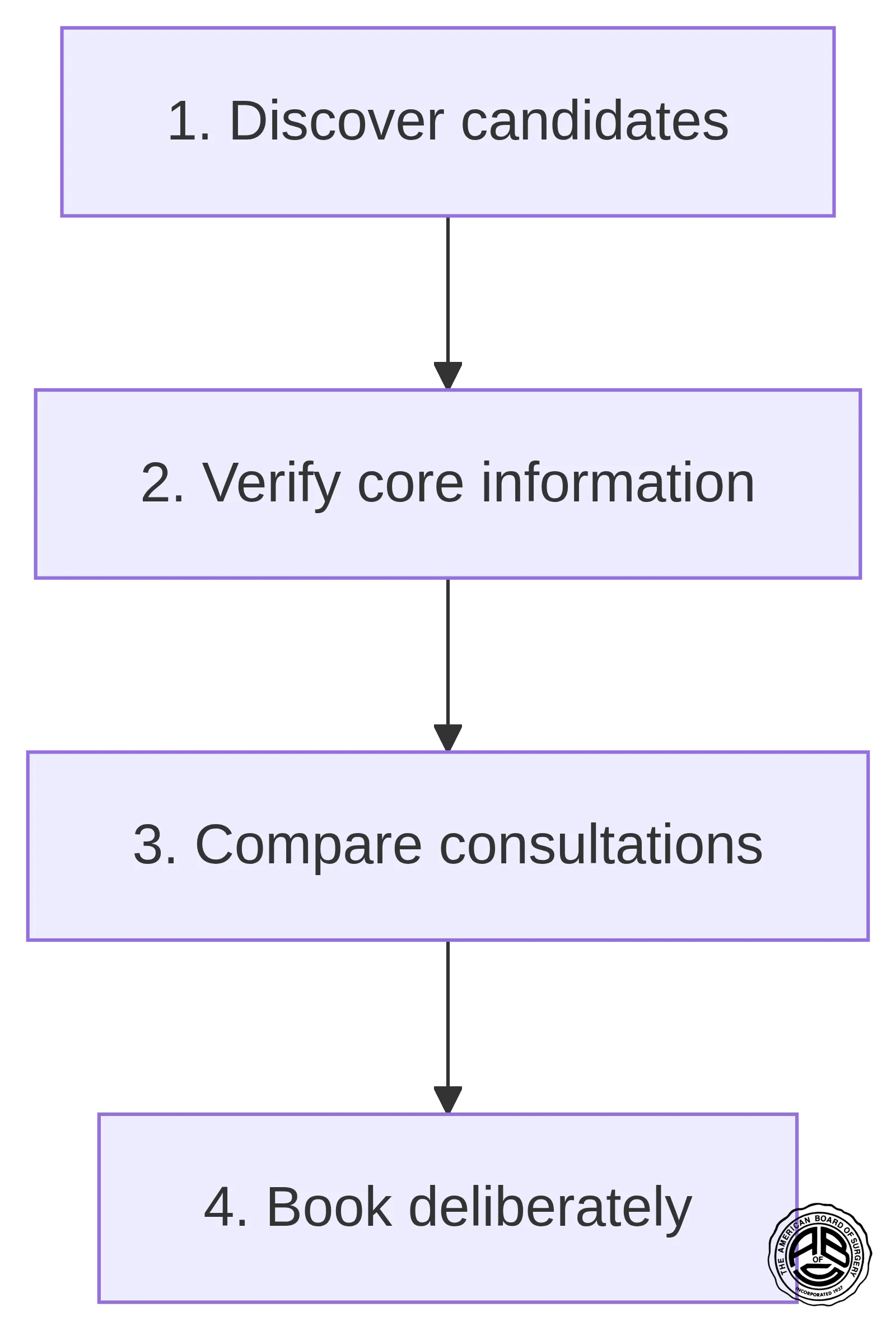
Use a four-step process that separates decisions a search page often blurs together.
-
Discover candidates. Search locally, ask for referrals if you wish, and note several practices whose services appear relevant. At this stage, collect names and contact details; do not treat marketing claims as verified facts.
-
Verify core information. Confirm surgeon credentials through an independent source, then ask each office about the planned surgical setting, hospital privileges, and how follow-up is handled. Record what is confirmed, what is stated by the practice, and what remains unanswered.
-
Compare consultations. Bring the same written goals and question list to each consultation. Compare the clarity of explanations, the discussion of alternatives and uncertainty, and the specificity of plans for recovery, complications, and revision decisions.
-
Book deliberately. Contact the practice or practices that provide complete, consistent answers without pressure. If a key answer is unclear, preserve that question for a follow-up conversation or seek another consultation.
A simple worksheet helps keep the comparison fair. Patient-facing decision tools are designed to organize options, benefits, risks, and personal priorities in an accessible way. However, the available review found that direct decision-aid evidence in plastic surgery was concentrated in breast reconstruction, not aesthetic surgery. Treat this scorecard as a practical way to organize your own notes, not as a validated tool that can determine the right choice for you.
| Comparison area | What to record | Decision boundary |
|---|---|---|
| Credentials | Independent certification result, training answers, hospital privileges | Verify rather than relying on a profile or advertisement. |
| Relevant experience | How the surgeon describes breast-augmentation experience and recommendation rationale | Look for direct, individualized explanations. |
| Surgical setting | Where surgery would occur and the facility status when office-based | Ask for information you can confirm directly. |
| Communication | Whether goals, alternatives, limits, and risks were discussed clearly | Pause if answers are dismissive, rushed, or inconsistent. |
| Follow-up and revision planning | Postoperative contact, appointments, complication response, and dissatisfaction discussion | Do not leave these topics unresolved. |
| Long-term questions | How future implant-monitoring questions would be addressed | Ask which current guidance the practice follows. |
Verify surgeon credentials before relying on practice claims
For U.S. candidates, use the American Board of Plastic Surgery public search to verify whether a surgeon is certified by ABPS. Record the result and the date you checked it rather than relying on a practice biography, directory badge, or search snippet.
ABPS describes its certification as voluntary. According to ABPS, its certified surgeons have completed appropriate training and passed comprehensive written and oral examinations. That is meaningful information, but it is one part of a broader evaluation—not a substitute for a consultation, discussion of relevant experience, or verification of provider-specific arrangements.
Certification status also deserves a current check. ABPS says certificates issued since 1995 are valid for 10 years and require continuing-certification requirements for renewal. ABPS also states that active, unrestricted licensure is required for certification. When its results show a “See FSMB” alert, ABPS directs users to Federation of State Medical Boards information.
Add two separate lines to your worksheet:
- ABPS result: verified, date checked, and any follow-up indicated by the result.
- State license and disciplinary review: verify directly through the appropriate official state resources for the state where the surgeon practices.
Do not collapse these into a single yes-or-no label. A credential check establishes a specific fact; it does not answer whether the surgeon’s communication, recommendations, surgical setting, or follow-up plan fit your needs. If an office cannot identify the surgeon who would perform the procedure or answers about credentials are unclear, seek further verification before booking.
Compare breast-augmentation experience and the reasoning behind recommendations
A useful consultation does more than list options. It connects your stated goals to a recommendation and explains the reasoning in language you can understand. The American Society of Plastic Surgeons includes questions about ABPS certification, plastic-surgery training, years of training, and hospital privileges in its breast-augmentation consultation guidance.
Ask each prospective surgeon:
- Are you certified by the American Board of Plastic Surgery?
- What plastic-surgery training did you complete?
- What hospital privileges do you have for this procedure, and at which hospitals?
- How do you approach breast-augmentation consultations for goals like mine?
- What implant or procedural characteristics do you recommend for me, and why?
- How do shape, size, surface texturing, incision site, and placement site enter that recommendation?
You are not asking for a promise or trying to establish candidacy from a checklist. You are testing whether the discussion is specific, responsive, and grounded in your individual priorities. A clinician may recommend against a requested approach, suggest more discussion, or identify uncertainty; those can be signs of a substantive consultation when they are explained respectfully.
Use your notes to distinguish an explanation from a slogan. “This is the right option for everyone” is not a personalized rationale. A more useful answer describes the relevant choices, the trade-offs being considered, what the surgeon can and cannot predict, and what information would be needed before a plan is made. If recommendations change between conversations, ask what new information accounts for the change. If the answer remains vague, keep the candidate in the verification stage or obtain another opinion.
Confirm the surgical setting, postoperative access, and follow-up plan
The setting and the plan after surgery deserve the same attention as the initial consultation. Ask where and how surgery would be performed. If surgery is planned in an office-based facility, ask whether it is accredited by a nationally or state-recognized agency, state-licensed, or Medicare-certified, as applicable. Record the exact answer and verify facility status directly with the relevant organization or regulator before proceeding.
Ask the practice to explain who will be involved in the surgical setting and how you can verify provider-specific details. This includes any anesthesia arrangements that apply to your planned care. Do not assume that a facility description on a website answers every operational question.
Then focus on continuity after surgery. ASPS recovery guidance states that patients are given specific postoperative instructions and a follow-up appointment before leaving after breast augmentation. Ask how this practice arranges those instructions and appointments, who handles routine postoperative questions, and how you would contact the team if a concern arises. Recovery instructions can vary by surgeon, so the operating surgeon’s directions are the ones to follow.
A practical note template is:
- Planned setting: location and type of facility discussed.
- Facility status: exact accreditation, licensure, or certification information provided; verification still needed or completed.
- Postoperative instructions: when and how they are supplied.
- Follow-up: expected appointment arrangement and primary contact.
- Questions or concerns: how the practice says it handles them outside a routine visit.
- Future continuity: how the practice will address later questions about implants or monitoring.
Long-term guidance can change, so avoid treating a generic online timeline as a complete plan. Ask the practice how future follow-up and monitoring questions will be handled. If the office cannot explain its follow-up process clearly, do not treat that as a minor administrative detail; resolve it before moving forward.
Ask questions that test whether the consultation supports an informed decision
Bring questions in writing and leave space for answers. A meaningful consent discussion should cover material risks, alternatives—including no surgery—realistic limits, uncertainty, and provider-specific factors without pressure. The point is not to memorize technical terms; it is to understand what is being proposed, why it is being proposed, and what remains uncertain.
Goals and options
- Based on my goals, what options are being considered and why?
- What implant or procedural characteristics do you recommend, and what trade-offs are relevant to that recommendation?
- What alternatives, including choosing not to have surgery, should I understand?
- Can I review before-and-after photos for this procedure and discuss what is reasonable for me?
Risks, limits, and future decisions
- What are the material risks and complications associated with this procedure?
- Does the discussion address scars, asymmetry, contour changes, nerve symptoms, dissatisfaction, revision, and recovery limitations?
- How are complications handled by this practice?
- How many additional implant-related operations might be relevant over a lifetime?
- What are the options if I am dissatisfied with the cosmetic outcome?
- What would implant removal without replacement mean for my appearance over time?
Recovery and support
- What recovery needs should I plan to discuss, including the help I may need?
- What postoperative instructions will I receive, and when?
- When will follow-up appointments be arranged?
- How should I contact the practice with a postoperative concern?
Personal circumstances and longer-term questions
- How might pregnancy or breastfeeding be part of the discussion for me?
- What current guidance does the practice follow for future implant-monitoring questions?
- Which parts of the plan depend on information that is still uncertain or requires further evaluation?
Write down the answer in the provider’s own terms, then note whether you understood it. If you leave unable to explain the recommendation, alternatives, risks, or follow-up plan back to yourself, ask for clarification before making a decision. No consultation can promise permanent results, symmetry, invisible scars, a complication-free recovery, or no future revision.
Treat pressure, guarantees, and unverifiable claims as reasons to pause
The way a practice communicates is information you can compare. Clear communication does not require certainty where certainty is impossible. It requires direct answers about limits, alternatives, risks, and what the practice would do if the course is not straightforward.
Pause and seek further verification or another consultation when you encounter any of these patterns:
- Credentials, hospital privileges, facility status, or the identity of the operating surgeon are difficult to confirm.
- A recommendation is presented without a clear explanation of why it fits the goals you described.
- Questions about complications, recovery limitations, dissatisfaction, or revision are brushed aside.
- You are discouraged from asking about alternatives, including no surgery.
- Answers change without an explanation, or the practice will not put key details in a form you can review.
- You feel rushed to decide before you understand the plan.
- Marketing language substitutes for provider-specific information.
- The discussion suggests guaranteed satisfaction, permanent results, perfect symmetry, invisible scars, or freedom from complications or future revision.
Images also need context. Treat simulation or AI images as illustrative rather than as a promise of a surgically achievable result. Ask whether an image is an example, a simulation, or an expected outcome, and ask what limits the clinician sees in applying it to your situation.
A respectful practice may tell you that more time, more information, or another opinion is appropriate. That is different from pressure. The decision boundary is simple: if you cannot obtain clear and consistent answers about the procedure, setting, and follow-up, do not let convenience or urgency make the decision for you. Continue verification or consult another qualified provider.
Ask how the practice will handle long-term implant monitoring questions
Keep long-term monitoring on your scorecard, but do not treat it as a fixed, one-size-fits-all instruction. A review of breast plastic surgery monitoring notes that recommendations have differed among organizations and that guidance can change. The review describes differing positions on routine imaging for people without symptoms.
The practical question for a consultation is therefore: What monitoring plan do you recommend, which current guidance do you follow, and how will future questions be addressed? Ask who will discuss changes in guidance with you, whether the practice expects periodic follow-up, and how to reconnect if you have a later concern.
This conversation should sit beside, not replace, discussion of your ordinary health care and any screening recommendations that apply to you. Your provider can explain how the proposed plan relates to your circumstances and what future contact pathway the practice offers. If the answer is only a broad assurance without an explanation of the practice’s approach, ask for clarification or document it as unresolved before deciding.
Move forward with the candidates who provide clear, verifiable answers
Set your completed notes side by side before you contact a practice again. Give the most weight to independently verified credentials, a clear explanation of the recommendation, a surgical-setting discussion you can verify, and a specific plan for postoperative access and follow-up. Preserve unanswered questions rather than filling gaps with assumptions.
A useful next step may be a follow-up call or a second consultation focused only on unresolved points. Choose the candidates that communicate directly, acknowledge uncertainty, discuss alternatives without pressure, and help you understand what would happen before and after surgery. A structured comparison cannot make the decision for you, but it can make the basis for your next conversation clearer.
Frequently asked questions about choosing a nearby breast augmentation provider
How can I compare nearby breast augmentation providers in a fair way?
Use the same checklist for every office: verify the surgeon’s credentials, ask who would perform the procedure, compare how clearly each practice explains options and risks, and confirm the surgical setting and follow-up plan. That keeps the choice based on verifiable details rather than search placement or marketing.
What should I verify about a surgeon before booking a consultation?
Check whether the surgeon is certified by the American Board of Plastic Surgery, confirm current licensure through the appropriate state resources, and ask about plastic-surgery training and hospital privileges. If any of those details are unclear, treat that as a reason to ask more questions before scheduling.
What questions should I ask about the procedure itself?
Ask what implant or procedural characteristics are being recommended, why they fit your goals, and what alternatives—including no surgery—should be considered. It also helps to ask about the material risks, expected recovery needs, and what options exist if you are dissatisfied with the outcome later.
How do I confirm that the surgical setting is appropriate?
Ask where the surgery will be performed and whether the facility is accredited, state-licensed, or Medicare-certified when it is office-based. You should also confirm how anesthesia is handled and whether the practice can point you to information you can verify directly.
What should a good postoperative plan include?
It should cover written recovery instructions, a follow-up appointment, and a clear way to reach the practice if a concern comes up after surgery. Since recovery instructions can vary by surgeon, make sure you understand whose directions you will be expected to follow.
When should I keep looking for another provider?
If answers are vague, inconsistent, rushed, or pressure-filled, it is reasonable to pause and seek another consultation. The same applies if a practice suggests guaranteed results, avoids discussing complications or revision, or will not give clear information about credentials, setting, or follow-up.