Use Before-and-After Photos as Discussion Examples, Not Personal Forecasts
Before-and-after photos can be useful as discussion examples, not as forecasts of your own result. They can show that breast augmentation can create visible changes in volume, proportion, and the way the breasts relate to the chest. They can also help you notice the kinds of appearances you are drawn to, the changes you would rather avoid, and the questions you need answered before a consultation.
A photo pair is still a record of one person’s starting point, procedure, healing, and photography session. The American Society of Plastic Surgeons notes that gallery images may represent typical results, but not everyone who has plastic surgery achieves the same result. The FDA similarly says that a surgeon should be able to provide other patients’ before-and-after pictures to help a prospective patient discuss expectations and potential outcomes. Those are valuable uses of images; neither makes another person’s after photo a promise about yours.
Start with a simple rule: an image is an example, not an estimate. This protects you from turning a visual preference into an expectation that may not fit your anatomy, health history, goals, or surgical circumstances. It also leaves room for a clinician to explain what may be reasonable in your particular situation.
Use photos to do three jobs:
- Observe: What can you actually see in the pair?
- Compare cautiously: Are the before and after images presented under conditions that make the visual comparison meaningful?
- Prepare: What preferences, concerns, and unanswered questions should you bring to a consultation?
That approach is more useful than trying to identify a single “ideal” result. A result that appeals to one viewer may not match another person’s goals, starting anatomy, lifestyle, or comfort with the tradeoffs involved. Photos can help you develop better language for a consultation, but they cannot determine candidacy, select an implant, determine a surgical plan, or show every aspect of recovery and long-term responsibility.
Record What the Images Show Without Ranking the Result
The first part of a photo-review worksheet is an observation column. Its purpose is to slow down the jump from “I like this” to “I want this exact outcome.” Write down visible details in neutral language before deciding what they mean to you.
Breast augmentation may involve implants or fat transfer. A gallery may not always make the procedure details clear, so avoid assuming that every visible difference came from the same approach. Instead, record only what the images appear to show.
For each pair, note observations such as:
- the apparent change in breast volume;
- the relationship of the breasts to the chest and upper torso in the available views;
- the apparent fullness in areas visible in the images;
- whether the breasts appear more or less similar to one another in the photographs;
- the visibility of incision lines, if they are shown;
- the patient’s posture, clothing, and image crop; and
- details that cannot be determined from the images, such as the procedure used, timing, or whether a lift or another procedure was involved.
Use descriptive wording rather than value judgments. For example, write “the after image appears to show more upper-breast fullness from this angle” rather than “this is a better shape.” Write “the incision area is not visible in this crop” rather than assuming there is no scar. The goal is not to grade another person’s body or result. It is to identify what you are seeing and what remains unknown.
Then create a separate preference column. This is where you can write statements such as: “I prefer a change that looks modest in fitted clothing,” “I am concerned about a very noticeable change,” or “I want to understand how a result like this might look from more than one angle.” Separating observation from preference matters. The first is a note about a photograph; the second is a topic for a personal discussion.
Finally, add a question column. If a photo leads you to wonder about scar placement, recovery timing, procedure approach, or whether the result is representative of the patient’s longer-term appearance, write the question down. A useful worksheet does not fill in missing information. It makes the missing information visible.
Check Whether the Before-and-After Pair Is Fair to Compare
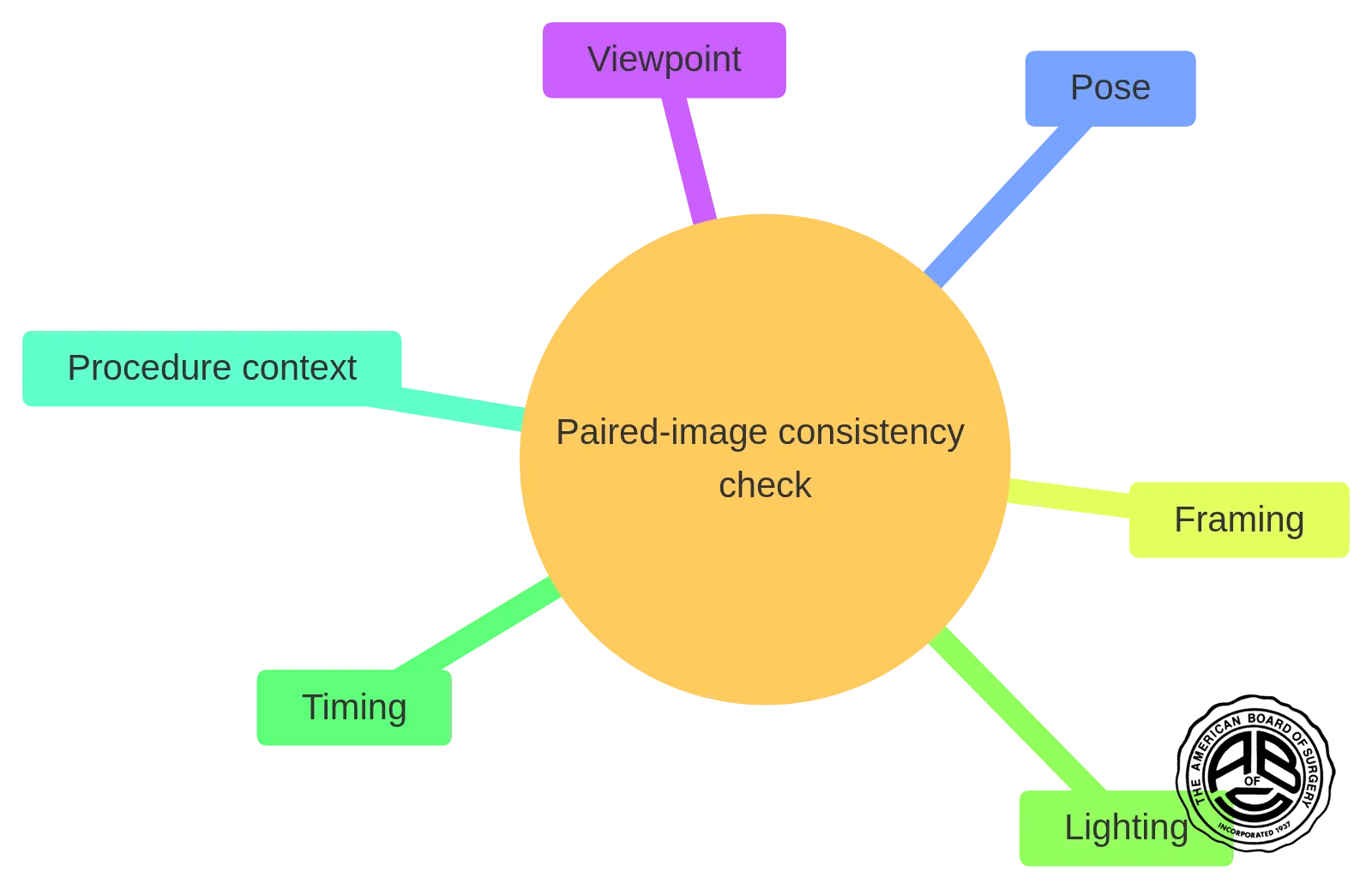
Before drawing conclusions from a pair, look at the conditions of the images. This is a reader-facing consistency check, not a professional photography standard and not a way to decide whether an image is authentic. It simply helps you recognize when visual differences may be harder to interpret.
Review these six items:
- Viewpoint: Are the photographs taken from a similar front, side, or angled view?
- Pose: Does the person appear to be standing in a similar position, with similar arm placement and shoulder position?
- Framing: Is a similar amount of the chest and torso shown in both images?
- Lighting: Does lighting create noticeably different shadow, contour, or skin-tone effects?
- Timing: Is the timing after surgery stated? If so, is it early in healing or later?
- Procedure context: Is there any disclosed information about the procedure, such as implants or fat transfer, or whether another breast procedure was involved?
A pair does not have to look identical in every photographic detail to be worth discussing. But if viewpoint, pose, crop, or lighting differ substantially, treat conclusions about contour, symmetry, size, or scar visibility as limited. The appropriate response is not to accuse anyone of manipulation or to decide that a result is inferior. It is to ask for clarification, additional views, or more context before treating the comparison as meaningful.
Timing deserves special attention. ASPS notes that enlargement is immediate after breast augmentation, while final appearance may take weeks as swelling subsides and skin stretches. Incision lines may take several months, and sometimes a couple of years, to fade. An early after image and a later after image can therefore answer different questions. An early image may illustrate immediate postoperative change, while a later image may offer more context about how the appearance evolved. Neither one establishes your personal timeline.
Add a short conclusion to each worksheet entry: comparable enough to discuss, partly comparable, or unclear—ask for context. This prevents a polished photo pair from carrying more weight than the information behind it. When timing or image conditions are unclear, keep the visual lesson narrow: “I would like to ask about this feature,” not “this is what will happen to me.”
Identify Why Another Patient’s Images May Not Transfer to You
Once you have recorded what a photo shows and whether the pair is reasonably comparable, ask a different question: how transferable is this example to me? Usually, the answer is limited. Another patient’s image may help you express a preference, but it cannot settle what outcome is reasonable for you.
A cited plastic surgeon notes that surgical results are affected by unique anatomy, healing, and surgical variables. Those factors help explain why two people who want a similar-looking change may not have the same visible result. Starting anatomy can differ, including the existing breast shape, breast-tissue characteristics, skin, chest structure, and baseline asymmetry. Goals may differ as well: one person may seek a subtle change, while another may prioritize a different degree or distribution of volume. Procedure approach and the details of the surgical plan also matter, and healing introduces another source of variation.
This means that an image can be personally relevant without being personally predictive. You might write, “I am interested in the overall proportion shown here,” while also writing, “I do not know whether my starting anatomy or recommended approach would make this appearance reasonable for me.” That is an informed distinction.
The same boundary applies to computer-generated imaging. It may help a discussion about what breasts could look like after surgery, but it cannot predict or guarantee an actual surgical outcome. Treat an image simulation as a communication aid, not a commitment. Ask what assumptions it reflects, what it cannot show, and how it relates to the clinician’s assessment of your circumstances.
ASPS also emphasizes realistic expectations because an outcome may not match a person’s goals. Realistic does not mean settling for vague answers. It means asking for clear explanations of what the clinician believes may be achievable, what limitations may apply, and where uncertainty remains.
A practical transferability note can include four prompts:
- What aspect of this example do I want to discuss?
- What visible feature worries me or feels important to understand?
- What about this patient’s starting point, goals, procedure, or healing may differ from mine?
- What would I need to know before treating this image as relevant to my own decision?
Bring those prompts to consultation rather than trying to resolve them from a gallery alone. A qualified clinician can listen to your goals and concerns and may make recommendations based on medical history and other factors.
Turn Photo Notes Into Focused Consultation Questions
Your worksheet becomes most valuable when it leads to a focused consultation discussion. ASPS advises thinking through and writing down questions ahead of time. Rather than arriving with a demand to reproduce a single photo, arrive with notes about your preferences, concerns, and the image conditions you want explained.
You can organize questions into four groups.
1. Expectations and relevance
- Which changes in these examples may be reasonable to discuss in light of my circumstances?
- What features of my starting anatomy affect the range of appearances we should discuss?
- Which details in these photos are not useful for predicting my result?
- Can you explain the benefits, limitations, and uncertainty associated with the plan you are discussing?
2. Proposed approach
FDA consultation questions can cover the recommended implant shape, size, surface texture, incision site, and placement, as well as why those recommendations are being made. If implants are part of the discussion, ask how the clinician connects the recommendation to your goals and circumstances. If you have brought an image, use it as a visual reference for a conversation, not as a specification for surgery.
3. Recovery and daily life
Recovery timing varies by procedure, medical history, and other factors. Ask how recovery may affect your work, caregiving, exercise, and other usual activities. Ask what the displayed timing of a gallery image means, if it is provided, and what changes may occur as healing progresses. A photo can show an appearance at one moment; it cannot show the full experience of recovery.
4. Safety and decision-making
Ask about the risks and complications associated with breast implants if implants are being considered. Ask what follow-up may be needed, what longer-term considerations matter, and what options exist if your expectations and the outcome do not align. These questions belong beside aesthetic preferences, not after them.
Keep the worksheet short enough to use. For each image or group of images, bring one observation, one comparability concern, one preference, and one question. For example: “These images appear to show a change I find proportionate; the side views are not comparable; I prefer a natural-looking change in clothing; what may be reasonable for my starting anatomy, and what recommendation would you make?”
A consultation should help refine your goals, not simply confirm them. If an explanation is unclear, ask for it in plain language and write down the answer. The point is to make a decision with a fuller understanding of what is proposed, what is uncertain, and what responsibilities may continue after surgery.
Keep Benefits, Limitations, Risks, and Long-Term Responsibilities in View
A gallery is designed to show visible results. It cannot fully show the decision-making, recovery demands, device information, monitoring, or possible complications that belong in an informed discussion. Keep that broader context beside every photo you save.
For breast implants in the United States, FDA materials describe a boxed warning, a patient decision checklist, device-material information, and a patient device card. These materials are not decorative paperwork. They are part of understanding the risks, benefits, and device-specific information before deciding.
The FDA says breast implants are not lifetime devices and that additional surgery may be needed over time. It also says implants need monitoring for as long as a person has them. FDA materials identify capsular contracture, reoperation, and implant removal among the most common local complications and adverse outcomes. They also list risks and complications that include pain or changes in nipple or breast sensation, rupture or deflation, BIA-ALCL, systemic symptoms, and potential effects on breastfeeding.
A before-and-after photo cannot tell you whether a patient had complications, what follow-up was needed, how the result may change over time, or how the person weighed benefits and tradeoffs. It also cannot answer which risks apply to you or how they should be considered in your circumstances. Those are clinical questions for a qualified clinician.
If silicone gel-filled implants are being considered, a health care provider may recommend regular MRI or ultrasound screening for rupture and other complications. Ask how ongoing monitoring would fit into your longer-term plan. Ask what you should understand about the device’s labeling and what follow-up the clinician recommends.
Use a separate “beyond the photo” section in your notes:
- benefits I hope to discuss;
- limitations I need explained;
- recovery questions;
- risks and complications to review;
- follow-up and monitoring questions; and
- longer-term questions, including how breasts may look over time, after pregnancy or breastfeeding, or after implant removal without replacement.
This does not mean a photo gallery is unhelpful. It means the gallery should occupy its proper place: one input in a larger decision. A clear consultation should connect your visual goals with realistic expectations, procedure options, recovery, risks, and the ongoing responsibilities associated with the option under consideration.
Use Your Notes to Support a More Useful Consultation Discussion
Bring your completed notes with you: the details you observed, whether the images seemed comparable, the preferences you identified, and the questions that remain. This gives you a practical starting point for discussing what may be reasonable in your circumstances rather than trying to make a gallery image carry the entire decision.
It is also appropriate to ask about the clinician’s certification and training, hospital privileges, and the surgical facility’s accreditation or licensing status. Ask to review before-and-after photos and discuss which results may be reasonable for you. Include questions about longer-term appearance, pregnancy and breastfeeding, removal without replacement, and the options available if you are dissatisfied with the outcome.
A photo review can end with clearer questions rather than a personal prediction. Use the images to describe your priorities, then discuss benefits, limitations, risks, recovery, and expectations with a qualified clinician.
Frequently Asked Questions About Breast Augmentation Photo Review
What can I reasonably learn from breast augmentation before-and-after photos?
They can show the kinds of visible changes a procedure may create, such as volume, proportion, and overall contour. They are best used to identify patterns you like or want to avoid, not to forecast your own result.
Why can’t one person’s after photo predict my result?
Results vary because each person starts with different anatomy, goals, healing, and surgical variables. A photo may be informative, but it cannot account for those differences or guarantee a matching outcome.
How should I compare before-and-after photos more fairly?
Check whether the viewpoint, pose, framing, lighting, timing, and disclosed procedure context are similar. If those conditions differ a lot or are unclear, treat the comparison as limited and ask for more context.
How long can the visible result keep changing after surgery?
The appearance may continue to change as swelling subsides and the skin stretches. Incision lines can also take a long time to fade, so an early after photo may not reflect a later look.
What should I ask in a consultation after reviewing photos?
Bring questions about what results may be reasonable for you, how the proposed approach fits your anatomy and goals, what recovery may involve, and what risks or longer-term responsibilities you should understand.
Can computer-generated imaging be used the same way as real before-and-after photos?
It can help you talk about possible appearance, but it cannot predict or guarantee an actual outcome. Use it as a discussion aid, not as a promise of what will happen.