
Separate the Balderas Family Medicine search from unrelated clinic information
If you are searching for Balderas Family Medicine in Austin, begin by confirming that the name, physician, location, pediatric scope, and contact route all refer to the same practice. Do not treat a page, form, or phone number using the Tely Health name as proof that you have reached Balderas Family Medicine. The two names should remain separate unless the practice itself confirms a connection.
The practical decision is simple: contact the practice when the material details line up, or continue looking when a key detail remains unclear. A directory listing can help you identify a possible practice, but it does not replace a direct check of the information you would rely on before arranging care for your child.
Use this order:
- Identity: Confirm the practice name and the clinician or organization associated with it.
- Austin location: Confirm the exact office where your child would be seen.
- Pediatric fit: Ask whether the practice currently handles the type of preventive visit, health assessment, vaccination question, or developmental screening your child needs.
- Contact route: Reconfirm the phone number, booking process, and any information the practice wants before scheduling.
This approach keeps a search for an Austin family medicine practice focused on your child’s actual needs. It also prevents a convenient-looking consultation route from being mistaken for confirmation that the intended practice has been found. You do not need to decide from a name alone. You need enough current information to know whom you are contacting, where the visit would occur, and what to ask for.
Public profiles connect Dagoberto Balderas with family medicine and primary care in Austin, Texas. A WellMed directory also identifies Balderas Family Medicine and links the organization with Dagoberto Balderas, DO. Those descriptions provide useful identity leads, while the practice’s present details still need to be confirmed through its current communication channel. Use the name and city as starting points, not as a substitute for that confirmation.
Start with the decision: is this current Austin listing a fit for your child?
Before you call, decide what a suitable listing must establish. For a child’s routine-care request, a useful listing should point to the intended Austin practice and give you a way to ask whether the practice’s present services match your child’s needs. The AAP describes age-based pediatric guidance that can include screenings, assessments, physical examinations, procedures, and anticipatory guidance. Its well-child-care guidance also discusses prevention, growth and development, and parent questions about behavior, sleep, eating, and other areas of daily life. That framework can help you form precise questions, but it does not confirm what any particular practice offers today.
Treat the listing as a fit when you can answer these questions with reasonable confidence:
- Am I looking at Balderas Family Medicine rather than a different clinic or an unrelated business name?
- Is the practice location in Austin the one that serves the area where I plan to take my child?
- Does the practice currently provide or coordinate the pediatric care I am seeking?
- Have I identified the right type of request, such as a routine check-up, health assessment, vaccination discussion, or developmental screening question?
- Do I have a current route for contacting the practice and asking about scheduling?
If all five answers are clear, contact the practice and describe the visit you need. If one of the first four remains unclear, keep checking before making a routine booking. If the contact route itself is uncertain, do not assume that a number or form belongs to the intended practice simply because it appears beside a familiar name.
A good fit is therefore not just a matching keyword. It is a matching identity, location, care request, and communication path. The more specific your request is, the easier it is for the practice to tell you whether the appointment type is appropriate or whether another service is needed.
Turn the check into a short written record before you contact anyone. This keeps facts from separate listings from blending together and gives you a clear point at which to pause.
Record these fields:
- Search name: Write the exact name that brought you to the listing, including any spelling or organization wording.
- Practice name confirmed: Leave this blank until a current practice communication channel confirms the name used for appointments.
- Clinician connection: Note the clinician’s full name and whether the practice confirms the association.
- Austin office: Record the complete address for the visit you are considering, not only the city.
- Requested care: Describe the child’s need in plain language, such as a routine check-up, health assessment, vaccination question, or developmental concern.
- Pediatric-care answer: Write whether the practice handles the request, routes it elsewhere, or needs more information.
- Contact route: Record the number, portal, form, or other route the practice confirms for that request.
- Next action: Note whether you should schedule, send records, call another office, or continue looking.
Use “confirmed,” “unclear,” or “not applicable” beside each field. Do not fill an unanswered field with information copied from a different directory. If the practice confirms a detail that differs from a listing, keep the confirmed version and note where you received it.
A concise opening can help: “I am trying to reach Balderas Family Medicine in Austin about a [child’s age]-year-old who needs [visit purpose]. Can you confirm that this is the right practice and tell me which office and appointment type apply?” Then ask only the questions that affect the next step. If the person who answers cannot confirm the practice, office, or requested service, do not treat the call as complete verification.
Finish the record immediately after the interaction. If the identity, location, care fit, or route still has an unanswered material field, continue checking instead of booking through assumption.
Write down the four facts you still need to confirm: the exact practice name, the Austin office, the child’s requested service, and the current contact route. Use those facts to guide the rest of your search.
Use Austin directories to identify the practice, then reconfirm its details
Several public directory descriptions can help connect the name you searched with a person and an Austin practice. A Zocdoc profile identifies Dr. Dagoberto Balderas as a primary care doctor serving Austin, Texas and describes him as working with an independent practice there. An MDVIP profile describes Dagoberto Balderas, DO, as a family-medicine physician in Austin and reports more than 15 years of local practice experience. A WellMed directory identifies Balderas Family Medicine and links it with Dagoberto Balderas, DO.
These descriptions are useful for cross-checking names. They are not enough, by themselves, to establish every detail you need for a child’s appointment. Profiles can use different organization labels, may describe a clinician rather than the full practice, and can require confirmation before you rely on their contact or location information.
Compare the listings for the details that should match:
- The practice or organization name.
- The clinician’s full name and credentials as displayed.
- Austin, Texas, as the relevant city.
- A contact route that appears to connect with the same practice.
- Any office information that can be reconfirmed before travel.
Do not combine the strongest-sounding parts of separate listings into one assumed profile. For example, one page’s description of the clinician does not automatically establish that another page’s phone number, office, organization, or booking route remains current. Keep each detail tied to the page or communication channel where it appears, then ask the practice to confirm the combined information.
The same method applies if a search result uses a shortened name, a network directory label, or a physician profile instead of the practice name. Ask whether the listing is for the practice you intend to contact and whether the person and office shown are still associated with it. This is especially important when you are arranging preventive care for a child and need to know where records, questions, and follow-up should be directed.
Use the directories to create a short identity note, then ask the practice to confirm the exact organization name, clinician, Austin location, and contact route before you schedule. If the details cannot be reconciled, continue searching rather than choosing one listing by appearance alone.
Confirm which practice name and organization currently apply
The practice name deserves its own check because public pages describe it in more than one way. An About Us page says the organization changed its name to Balderas Family Medicine in 2020. A WellMed directory uses the name Balderas Family Medicine and links it with Dagoberto Balderas, DO. The directory label and the name-change statement point toward the same practice name, but they do not tell you every current organizational or administrative detail.
When you contact the practice, ask which name you should use for the appointment and for any forms, records, billing questions, or follow-up communication. You can also ask whether the clinician, practice, and directory listing are still connected. Keep the question neutral: you are confirming that the name shown in your search is the name used by the practice today.
Do not assume that a historical name, a network directory, and a clinician profile represent identical booking systems. A practice may be described by its organization name in one place and by a clinician’s name in another. That difference does not prove that the listing is wrong, but it does create a reason to ask before relying on it.
If the practice confirms the name and connection, record the exact wording you were given. If the answer points to another organization or a different office, update your search before sharing your child’s details. If no one can confirm the relationship, treat the identity as unresolved and continue looking for a current practice contact.
Ask, “What practice name should I use when requesting my child’s appointment, and is it associated with Dr. Dagoberto Balderas?” Proceed only when the answer matches the practice you intended to find.
Check the current Austin office before planning a visit
Location is a separate decision from identity. A WellMed listing displays 1-512-643-4400 as a number to call to schedule. A Zocdoc profile says Dr. Balderas has two office locations in Austin. Because these details come from directories and can change, confirm the office you would actually use before arranging transportation or arriving with your child.
Ask the practice to confirm:
- The complete street address for the relevant appointment.
- Whether more than one Austin office is available for the type of visit you are requesting.
- Which office the phone number or booking route reaches.
- Whether the office location has changed since the directory listing was published or updated.
- What arrival instructions apply to a child’s routine visit.
The phrase “Austin office” is not specific enough if more than one location is associated with the clinician. A location that appears in a profile may not be the location for every appointment type. Likewise, a scheduling number may connect to a central line, a network directory, or a practice route that needs confirmation.
Keep a written record of the address and the person or department that confirmed it. If the practice gives you a different address from the one shown in a directory, use the practice’s confirmed information for your next step and do not rely on the older listing. If the practice cannot confirm which office serves your request, pause the booking and seek a clearer current route.
Call the displayed scheduling number only as a lead, and ask which Austin office applies to your child’s requested visit. Confirm the full address before planning travel; if the office remains unclear, continue searching.
Ask whether the practice currently covers your child’s preventive-care needs
Once the identity and office look consistent, clarify the care scope. Do not assume that the phrase family medicine answers every pediatric question. Ask directly whether the practice currently handles the specific request you have, such as pediatric care, a routine check-up, health assessments, preventive care, vaccinations, or developmental screening.
The AAP describes its Bright Futures guidance as covering age-based pediatric screenings, assessments, physical examinations, procedures, and anticipatory guidance. Its well-child-care guidance says routine visits can address prevention, growth and development, and parent concerns involving behavior, sleep, and eating. The AAP also describes a periodicity schedule that covers recommended screenings and assessments from infancy through adolescence. These materials can help you name the service you want to discuss, but they do not establish that Balderas Family Medicine provides each item.
Use specific questions rather than asking only, “Do you see children?” For example:
- Does the practice schedule routine well-child visits for my child’s age?
- Can the clinician complete the health assessment I need?
- Does the practice provide the vaccination service my child needs, or will it direct us elsewhere?
- Does the practice conduct developmental surveillance or developmental screening when appropriate?
- If my child needs diabetes monitoring or hypertension management, is that part of the practice’s current scope, or should I contact another clinician?
The last questions may not apply to your child, and asking them does not imply that your child needs that care. They simply show why a general label is not enough for every family. A practice may answer differently depending on age, visit purpose, clinician availability, or the assessment requested. Ask for the present scope and the next appropriate route rather than assuming that a general service label confirms a particular appointment.
Describe your child’s age and the exact preventive-care request, then ask the practice to confirm whether it handles that request today. If the answer is unclear or the practice directs you elsewhere, follow that direction or continue looking for a suitable pediatric route.
Identify the right visit or assessment before you call
A clearer description of the requested visit helps you avoid booking the wrong kind of appointment. Start by separating a routine preventive visit from a focused assessment. A routine visit may involve general health supervision, growth and development questions, preventive guidance, or several concerns together. A focused request may involve developmental surveillance, a developmental screening question, a vaccination discussion, or follow-up for a specific health matter.
AAP materials describe the Bright Futures schedule as age based and emphasize continuity of care in comprehensive health supervision. The AAP also says well-child visits can cover prevention, growth and development, and parent concerns such as behavior, sleep, and eating. That means you can prepare a short description rather than relying on the broad phrase “check-up.”
Developmental surveillance and developmental screening are related but not identical terms. AAP guidance recommends developmental surveillance during every health-supervision visit, with special attention at ages 4 to 5. The same guidance says general developmental screening tests should be conducted at 9, 18, and 30 months, and autism-spectrum-disorder screening at 18 and 24 months. It also says screening may be appropriate when a clinician, parent, or early-childhood professional raises a concern outside the routinely listed ages. These age points come from the cited guidance and should be checked against the current AAP schedule when you make plans.
For a call, describe the request in one sentence:
- “I am looking for a routine well-child visit for my [age]-year-old.”
- “I want to ask about a developmental concern and whether a screening appointment is appropriate.”
- “I need to discuss vaccination records and what preventive visit my child needs next.”
- “I need a health assessment for a school, activity, or other stated purpose.”
Do not use a screening label as a conclusion about your child. A screening question is a request to ask the clinician what evaluation is appropriate; it is not a diagnosis or a determination of eligibility. Similarly, a routine visit does not guarantee that every requested assessment will occur during one appointment. Ask how the practice classifies the visit and whether it wants additional information before confirming it.
If your child has an ongoing concern, include when you first noticed it and whether another clinician or early-childhood professional has raised it. Keep the description factual and brief. The practice can then tell you whether to request routine scheduling, a focused assessment, another type of appointment, or a different care route.
Before contacting the practice, write your child’s age, the purpose of the visit, and any developmental or preventive-care question in plain language. Ask the practice to classify the appointment rather than choosing a screening or assessment label on your own.
Prepare your child’s details and three to five priority questions
Preparation can make a routine inquiry more focused. AAP guidance suggests bringing three to five priority questions or concerns to discuss at the start of a routine child visit. You can use the same limit when preparing to contact a practice: choose the questions that affect whether the appointment is suitable, then keep secondary questions for later.
Have these details available if the practice requests them:
- Your child’s age or date of birth.
- The reason for the visit in one sentence.
- Whether the request is routine preventive care, a health assessment, vaccination-related, developmental, or follow-up care.
- Relevant dates, such as the last routine visit or when a concern first arose.
- The names of clinicians or services already involved, if that helps explain the request.
- Vaccination or health records that the practice asks you to provide.
- Your preferred contact details and any scheduling limits.
Then select three to five questions. A practical set might include:
- Is this practice the correct Austin location for my child’s requested visit?
- Does the practice currently provide the service I described?
- What records or forms should I have ready?
- Does the requested assessment occur during a routine visit or require a separate appointment?
- What is the confirmed next step after this inquiry?
You may also ask whether the practice accepts your insurance or what payment information applies, but do not assume acceptance, pricing, or coverage from a directory listing. Ask for the practice’s present answer before you make a financial decision.
Keep your notes factual. You do not need to prepare a long account of every past concern for an initial scheduling question. A concise description helps the practice route your request, while the clinician can decide what information is relevant during care. If the practice asks for records, send only through the communication method it identifies.
Write down three to five priority questions and keep your child’s basic visit details nearby. Use the first contact to establish fit and preparation requirements; save less urgent questions for the appointment or the practice’s requested follow-up.
Verify the contact and booking route when you are ready to act
A contact route should be confirmed in the same way as the practice name and office. The WellMed listing displays 1-512-643-4400 as a scheduling number. Because the listing’s contact details can change, treat that number as a lead that requires confirmation rather than as a permanent guarantee.
When the call connects, state the practice name you are trying to reach and ask whether the person or department handles appointments for the Austin location. Then give your child’s age and the type of visit you want to discuss. Ask whether the practice wants you to use a different phone number, portal, form, or office for that request. Do not submit personal details through a route that you cannot connect to the intended practice.
If the number does not connect, reaches a different organization, or produces an answer that conflicts with the listing, pause before booking. Search for a more recent practice communication channel and compare it with the name, clinician, and Austin location you have already checked. If a practice page provides a different route, ask that route to confirm the relationship rather than assuming that one listing supersedes every other detail.
A successful connection also does not guarantee an appointment. It gives you an opportunity to ask whether the practice is the right place for your request and what must happen next. Availability, visit type, records, insurance, pricing, and credentials require direct confirmation when they matter to your decision.
Use the displayed number only to begin the check. Confirm the organization, Austin office, requested visit, and next booking step with the practice before treating the route as ready for action.
Contact the practice only after the material details align
At this point, choose between two practical paths: contact the practice or continue searching. Use the same criteria for both options rather than letting one convenient detail decide for you.
| Check | Contact the practice | Continue searching |
|---|---|---|
| Identity | The practice name, clinician, and organization connection have been confirmed. | The name changes across listings, or no current contact can confirm the connection. |
| Austin location | The practice confirms the exact office for your child’s requested visit. | The office, address, or applicable Austin location remains unclear. |
| Pediatric scope | The practice confirms that it handles or appropriately routes the preventive-care request you described. | The practice cannot confirm pediatric care, the requested assessment, vaccination question, or developmental request. |
| Visit fit | You can explain whether you need a routine check-up, health assessment, preventive visit, or focused question. | You are not sure what appointment type to request, or the practice cannot identify the right one. |
| Contact route | A current practice representative confirms the route and tells you what to do next. | The number, form, or listing cannot be tied to the intended practice. |
Choose contact the practice when the identity, location, pediatric scope, visit type, and route are all sufficiently clear. During the call, repeat the visit purpose and ask for the next action. That may be a scheduling step, a records request, a different office, or a recommendation to use another care route. Follow the answer that applies to the practice you reached.
Choose continue searching when any material detail remains unresolved. A missing address, uncertain organization name, unclear pediatric scope, or disconnected route is enough to pause. Continuing the search is not a judgment about the practice; it is a way to avoid arranging care through an unconfirmed listing. Record what you know, identify the unanswered question, and look for a current practice communication channel or another Austin option that can answer it.
Make the call only after the first path in the table fits your situation. If the second path describes your situation, keep searching until a current practice contact can answer the unresolved question.
Know when routine scheduling is not the right next step
This guide cannot determine what your child’s symptoms mean or decide which level of care is appropriate. When immediate medical attention may be needed, use the appropriate emergency or urgent-care route rather than waiting for a routine family-medicine appointment.
MedlinePlus recommends determining the location and quickest route to the nearest emergency department before an emergency occurs and keeping emergency phone numbers accessible. Make that plan in advance for your household, including knowing which local number or emergency service to use. If an urgent situation is happening now, follow current local emergency instructions and seek immediate medical care.
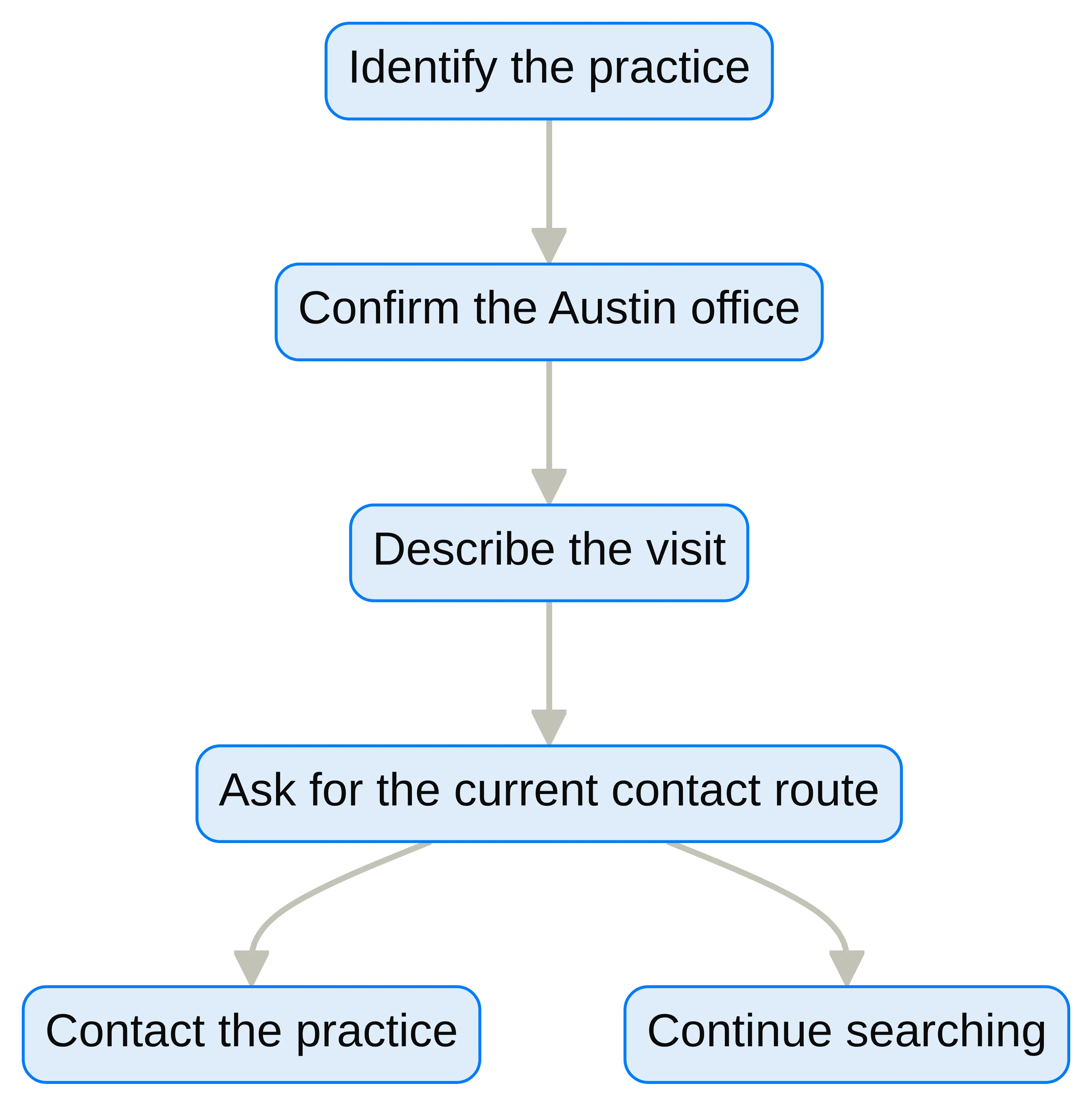
For a non-urgent request, return to the verification steps: identify the practice, confirm the Austin office, describe the visit, and ask for the current contact route. Do not use a routine scheduling form to seek an immediate response.
For urgent, severe, or worsening concerns, seek appropriate immediate medical care. Use routine practice contact only for a concern that can safely wait for ordinary scheduling.
Make the next step based on what you can verify today
The decision does not depend on finding the most detailed profile. It depends on confirming the details that affect your child’s care: the practice identity, the Austin office, the current pediatric scope, the type of visit, and the route for contact. AAP guidance can help you describe preventive visits, health assessments, developmental questions, and priority concerns. The practice must still confirm what it handles, where the appointment occurs, and how you should proceed.
Questions Austin parents may still have before contacting a practice
What should I verify before contacting the practice for my child's care?
Confirm the practice name, clinician association, Austin location, pediatric care scope, and current contact route before reaching out.
How can I check if the practice provides the pediatric services my child needs?
Ask directly whether the practice handles routine check-ups, health assessments, vaccinations, or developmental screenings for your child’s age.
What information should I prepare before calling Balderas Family Medicine?
Have your child’s age, the reason for the visit, and three to five priority questions ready to discuss during the call.
How can I confirm the current office location for the practice?
Contact the practice directly to confirm the complete street address and whether it has multiple locations in Austin.
How can I verify that I have the correct contact information for the practice?
Verify the phone number and booking route with the practice before using them to schedule an appointment.
What should I do if I cannot confirm the practice's details?
If any key detail remains unclear, continue searching for accurate information rather than proceeding with a booking.