
Start with a deadline-to-action map, not a single list of tax dates
For 2026 cash planning, the useful question is not “What is the tax deadline?” It is “Which action is due for this entity, and what cash or records must be ready?” A return filing, a tax payment, an estimated-tax installment, a payroll deposit, and an extension request are separate actions.
Start by making one calendar line for each date that may apply to you. Label it with the period, entity, source, and status. For example: “2026 Q2 | Clinic LLC | payroll register and bank confirmation | open for review.” This keeps a hiring forecast from being confused with completed payroll, and a future equipment purchase from being confused with historical records.
The IRS notes that some taxpayers need more than one calendar. Employers may need the Employer’s Tax Calendar, and excise-tax payers may need an additional calendar. If the business uses a fiscal tax year rather than a calendar year, confirm adjusted dates instead of relying on the calendar-year dates below.
What each deadline means for filing, payment, estimated tax, payroll, and extensions
Use these distinctions when building your calendar:
- Filing a return means submitting the required tax form and related schedules. A filing date can apply even when no new payment is planned.
- Paying tax means sending an amount due. For an individual federal return, the April 15 deadline is both a filing and payment date.
- Estimated tax is the IRS method for paying tax on income not subject to withholding, including self-employment income. It is a forward-looking payment process, not a completed annual return.
- Payroll deposits are deposits of employment taxes under the employer’s applicable deposit schedule. They are not the same as filing a quarterly Form 941.
- An extension request asks for more time to file. It does not automatically create more time to pay.
That final distinction matters for cash planning. The IRS states that an individual extension provides additional time to file, not additional time to pay. Amounts owed remain due by April 15, 2026. The IRS lists three ways to request an individual automatic extension by the return due date: make an extension-designated payment, e-file Form 4868, or file paper Form 4868. For a fiscal-year individual, the IRS says the request must use paper Form 4868.
For estimates, begin with prior-year return information, then separate it from your forecasts and assumptions. The IRS says prior-year income, deductions, credits, and the prior-year federal return can be a starting point for a current-year estimate. Update later-quarter estimates when revenue, hiring, compensation, or purchasing assumptions change. Form 1040-ES permits payment of 2026 estimated tax in full by April 15 or in four equal amounts under its schedule. Bring the assumptions and the historical records to a credentialed tax professional for review.
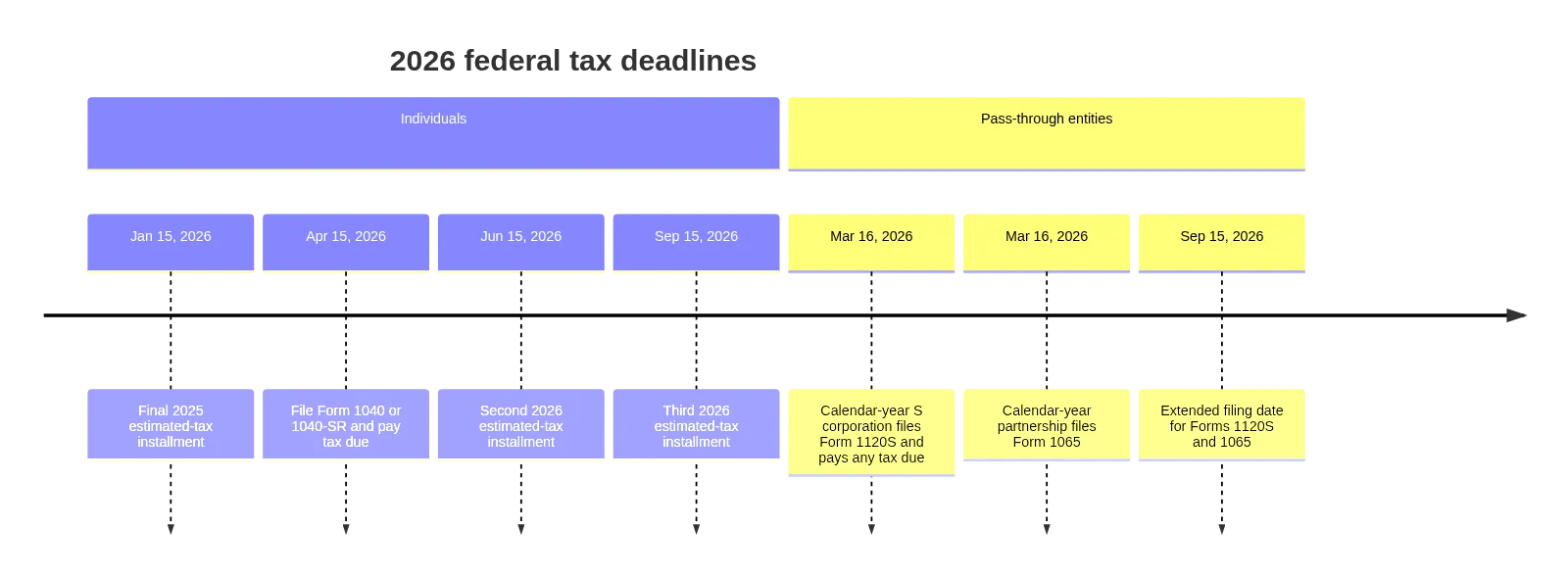
2026 federal dates for individuals, calendar-year S corporations, and partnerships
These dates are a calendar-year reference. They do not determine whether you must file a particular form, how your entity is classified, or what you owe.
| Date | Commonly affected | Required action to calendar | Packet status |
|---|---|---|---|
| January 15, 2026 | Individuals making estimates | Final 2025 individual estimated-tax installment using Form 1040-ES. | Match payment confirmation to the 2025 estimate record. |
| March 16, 2026 | Calendar-year S corporations | File Form 1120S, pay any tax due, and furnish Schedule K-1 or K-3 to shareholders. The IRS calendar lists Form 7004 and an estimated-tax deposit for an automatic six-month extension. | Confirm return owner, shareholder delivery records, and extension status. |
| March 16, 2026 | Calendar-year partnerships | File Form 1065 and furnish Schedule K-1 or K-3 to partners. The IRS calendar lists Form 7004 for an automatic six-month Form 1065 extension. | Confirm partner information and extension status. |
| April 15, 2026 | Individuals | File Form 1040 or 1040-SR and pay tax due. An individual extension request must be made by this due date. | Separate completed 2025 records from 2026 forecasts. |
| June 15, 2026 | Individuals making estimates | Second 2026 estimated-tax installment using Form 1040-ES. | Update cash forecast and supporting assumptions. |
| September 15, 2026 | Individuals making estimates | Third 2026 estimated-tax installment using Form 1040-ES. | Reconcile year-to-date results against forecast. |
| September 15, 2026 | Calendar-year S corporations and partnerships with timely six-month extensions | Listed extended filing date for Forms 1120S and 1065. | Confirm the extension was timely and assemble final records. |
A calendar-year S corporation or partnership should not treat the March and September entries as interchangeable. March is the original filing point described in the IRS calendar. September is the listed extended filing date only when a timely six-month extension was requested.
If your business is planning a new hire, owner-compensation change, or major purchase, place a review meeting before the next estimated-tax date. Attach a forecast showing the expected timing and amount, then label it Forecast rather than documented activity.
Employer deadlines: separate payroll deposits from quarterly employment-tax returns
If the business pays employees, keep payroll deposits and employment-tax returns on separate calendar lines. Employers generally report wages, tips, and other compensation using Form 941. Certain small employers may use Form 944 if the IRS approves that filing arrangement.
Selected 2026 employer dates
- January 15: For employers on the monthly deposit rule, the IRS lists this as the deposit date for December 2025 payroll taxes.
- February 10: Forms 940, 941, 943, 944, and/or 945 are due on this date only if all required payments were timely deposited.
- February 17: For the monthly deposit rule, this is the listed deposit date for January payroll taxes.
- April 30: Listed Form 941 deadline for the first quarter.
- July 31: Listed Form 941 deadline for the second quarter.
- July 31: Deposit FUTA tax owed through June if it exceeds $500.
The IRS employment-tax calendar also lists quarterly due dates of April 30, July 31, October 31, and January 31 for the prior calendar year’s fourth quarter. Deposit timing can differ from those return dates. For FUTA, timing depends on quarterly liability and prior undeposited amounts; confirm whether the $500 threshold is met.
Create a payroll record group for each period. Include payroll registers, bank statements, payroll-provider reports, withholding deposit confirmations, and filed-return copies. Mark each item Documented, Needs source, or Open question. Keep contractor payment confirmations in a separate payroll and contractor records folder. Contractor classification is the question of whether a worker should be treated as a contractor or employee; flag that question for a credentialed tax professional rather than deciding it from payment records alone.
If payroll is new or changing, calendar the applicable deposit schedule only after confirming it. Do not use a quarterly return date as a substitute for a payroll deposit date.
Texas franchise-tax dates and reporting questions for 2026
Texas franchise tax is a privilege tax for taxable entities formed or organized in Texas or doing business in Texas. Whether a particular business is a taxable entity, has Texas nexus, or has a specific reporting obligation requires entity-specific confirmation.
The annual Texas franchise-tax report is due May 15, or the next business day if May 15 falls on a weekend or holiday. For 2026 reports, Texas states that the No Tax Due Report is not available. The stated no-tax-due threshold is $2.65 million in annualized total revenue. An entity at or below that threshold is not required to file a No Tax Due Report, but it generally remains required to file a Public Information Report (PIR) or Ownership Information Report (OIR) unless an exception applies.
The Texas E-Z Computation option may be available when annualized total revenue is $20 million or less. Eligibility and the remaining reporting requirements should be confirmed before you choose a report.
A Texas franchise-tax extension is tentatively granted upon a valid, timely online extension payment or request on the Comptroller’s form. The request or payment must be received or postmarked by the original report due date. If an online extension payment is made, the Comptroller says not to also submit paper Form 05-164.
Use a separate Texas franchise tax branch in your calendar:
- Label the item “2026 Texas franchise tax | [entity name] | Comptroller filing records | open for review.”
- Attach annualized revenue support, prior-year documents, PIR or OIR information, and any extension confirmation.
- Flag a termination, conversion, or merger. Texas requires a final report and payment in the year a Texas entity plans that transaction.
- If an out-of-state entity is ending Texas nexus, flag the cessation date. Texas lists a final report and payment due within 60 days after sufficient nexus ends.
Texas franchise tax is a separate business branch from federal income-tax filing. Calendar both where applicable, but do not assume one filing resolves the other.
Link each applicable date to a review-ready Tax Planning Packet
A Tax Planning Packet is an organized set of calendar items, records, assumptions, and questions prepared for discussion with a credentialed tax professional. Its purpose is to make the period, entity, source, and status visible before a deadline or planning meeting.
Use this four-step workflow.
- Create the date record. For each applicable deadline, record the date, action type, entity, responsible person, and status. Use status labels such as Documented, Forecast, Needs source, and Open question.
- Attach historical records. Keep bookkeeping records and source documents together by period. Useful examples include bank statements, reconciliations, invoices, receipts, payroll registers, contractor payment confirmations, financing documents, filed returns, and payment confirmations.
- Create a separate forecast page. List expected revenue, proposed hiring dates, compensation changes, equipment purchases, financing cash needs, and estimated-payment assumptions. Do not mix these forecasts and assumptions into historical records.
- Prepare the review agenda. For every unresolved item, name the follow-up owner and the decision needed. Example: “Q3 2026 | PLLC | proposed equipment financing | Forecast | owner to provide term sheet; ask about timing.”
A business asset activity file should cover purchases, sales, trade-ins, financing, or disposal of business property. An asset disposition means selling, trading, or otherwise disposing of an asset. Attach the invoice, receipt, financing document, and any sale or trade-in records. Flag the intended transaction date and treatment questions for professional review.
This structure supports a clearer estimate update. Prior-year records provide a starting point; current-year historical records show what has happened; forecasts show what may happen next. Each category has a different status and should remain separate.
Open questions to bring to a credentialed tax professional
Bring a short agenda with your Tax Planning Packet. These questions help connect deadlines to planned business changes:
- Does the business use a calendar tax year or a fiscal tax year? If it is fiscal-year, which dates change?
- Which federal returns and estimated-tax dates apply to each entity and owner?
- Is an individual extension needed, and what payment amount should be reviewed by April 15? If the individual is fiscal-year, confirm use of paper Form 4868.
- What payroll deposit schedule applies to the business? Are payroll registers and deposit confirmations complete for each period?
- Are any workers paid as contractors, and is contractor classification a question requiring review?
- Does planned hiring or a compensation change alter the cash forecast before the next estimate or payroll date?
- Does business asset activity include a purchase, financing arrangement, sale, trade-in, or other disposition? Which source documents are still needed?
- Which prior-year documents support the current estimate, and what assumptions changed since that return?
- Is the entity potentially subject to Texas franchise tax? What PIR or OIR requirement, threshold, exception, or extension step should be confirmed?
- Is the business terminating, converting, merging, or ending Texas nexus? If so, what final-report timing applies?
For fiscal-year estimated-tax taxpayers, the IRS says a payment date that falls on a weekend or legal holiday moves to the next business day. Confirm the relevant period and date calculation rather than copying calendar-year dates into a fiscal-year calendar.
End the meeting agenda with a named owner for every open question. A question without an owner is easy to carry past the next deadline.
Use the calendar as a cash-planning and review tool
A useful 2026 tax calendar shows more than dates. It shows the action, entity, cash need, supporting records, current status, and person responsible for follow-up.
Calendar the applicable filing, payment, estimated-tax, payroll, and Texas franchise-tax actions separately. For each one, attach the related source documents and identify whether the figure is historical, documented, forecast, or unresolved. Keep cash reserved for a payment distinct from work still needed to file a return. If an extension is under consideration, treat the filing timeline and payment timeline as separate review items.
Before a hiring decision, purchase, financing change, or owner-compensation change, update the forecast page and compare it with current bookkeeping records. Then bring the packet and its open questions to a credentialed tax professional for entity-specific review.
Frequently asked questions about 2026 tax deadlines
Does an extension give more time to pay federal income tax?
No. An individual extension gives more time to file, not more time to pay. If tax is owed, the payment is still due by the original deadline, so keep the payment and filing timelines separate.
Who usually needs to make estimated tax payments in 2026?
Estimated tax is used for income not subject to withholding, including self-employment income. If your income, deductions, or credits change during the year, use prior-year records as a starting point and update later estimates for review.
How should payroll deposit dates be tracked alongside quarterly payroll returns?
Track them as separate items. Payroll deposits follow the employer’s deposit schedule, while Form 941 and similar returns have their own filing dates. Keep payroll registers, deposit confirmations, and filed returns together by period.
When might a Texas business need to review franchise tax reporting?
If the business is formed in Texas or doing business in Texas, franchise tax may be relevant. The annual report is due May 15, and the entity’s reporting, PIR or OIR, and extension steps should be confirmed for the business type.
What should be included in a Tax Planning Packet before a review meeting?
Include historical bookkeeping records, source documents, prior-year documents, payroll and contractor records, business asset activity, and a separate page for forecasts and assumptions. Label each item by period, entity, source, and status, and list open questions with a follow-up owner.