
What “latest treatment” means for chronic kidney disease
One disease-specific example is guidance for ADPKD from KDIGO. It covers therapies intended to delay progression, CKD management, kidney failure, and kidney replacement therapy. The relevant topic depends on the diagnosis and clinical context, so discuss how it applies with a healthcare provider.
These areas serve different treatment goals. An approach discussed for one cause, stage, or level of kidney function may not fit another situation, and other health conditions can also affect the discussion.
For people with CKD and their caregivers, the practical goal is not to choose a treatment independently. It is to identify the topics that deserve a focused discussion with a healthcare provider.
When a provider mentions a newer development, ask where it fits in relation to established care, whether it applies to the specific diagnosis, and what monitoring or safety information accompanies it. Treatment approvals, guideline recommendations, and safety information can change, so the status of an approach should be confirmed at the time of the clinical discussion.
Use the map below to prepare questions. Do not start, stop, or change CKD treatment based only on a general description.
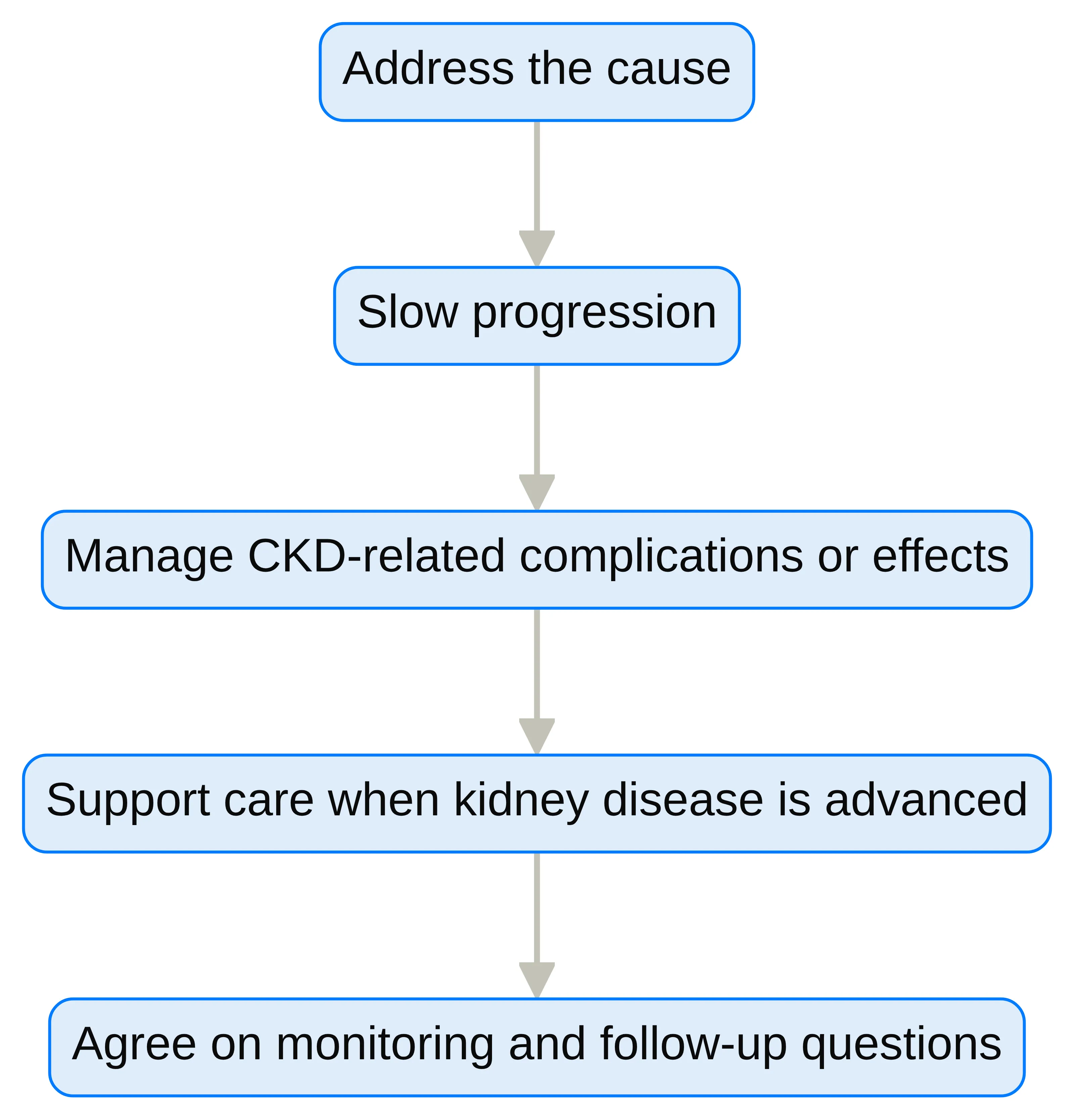
Four purposes organize the CKD treatment conversation
1. Address the cause. CKD can arise from different underlying conditions. The first treatment question may therefore be, “What is causing or contributing to the kidney disease?” The answer helps determine which treatment topics are relevant and which are not. Ask the healthcare provider what cause has been identified, what remains uncertain, and whether the next step is intended to clarify the cause or address it.
2. Slow progression. Some CKD discussions focus on delaying further loss of kidney function. This is a treatment purpose rather than the name of one universal therapy. The appropriate conversation depends on the cause of CKD, its stage, the person’s kidney-function level, and other health conditions. Ask, “Is slowing progression a goal in my situation, and how will we judge whether the plan remains appropriate?” Do not assume that an approach used for one kidney disease applies to every form of CKD.
3. Manage CKD-related complications or effects. A plan may also focus on a problem associated with CKD rather than on the underlying cause itself. Ask what issue the proposed treatment is intended to address, what is being monitored, and what would lead the provider to adjust the plan. Keep this purpose separate from a progression discussion so that a treatment’s intended role is clear.
4. Support care when kidney disease is advanced. Advanced CKD creates a different planning conversation. The questions may concern how care will be monitored, what future decisions could become relevant, and how the person’s preferences should be included. Ask which topics should be discussed now and which decisions are not yet relevant. This category does not establish that a particular person needs advanced kidney care or determine eligibility for any option.
These purposes provide a simple appointment structure: begin with the cause, identify the immediate goal, discuss how the plan fits the person’s kidney function and other conditions, and agree on monitoring and follow-up questions. Bring the purpose that best matches the current concern to the healthcare provider rather than trying to rank treatments from a general list.
How CKD cause, stage, kidney function, and other health conditions inform treatment discussions
CKD has multiple possible causes, including inherited, autoimmune, glomerular, infectious, obstructive, malignant, and stone-related conditions. Examples include polycystic kidney disease, lupus nephritis, glomerulonephritis, IgA nephropathy, severe infections, kidney cancer, kidney stones, long-lasting urinary tract infections, and hydronephrosis.
That range matters when someone asks for the latest treatment. A treatment discussion should start by identifying whether the CKD is linked to an inherited condition, an autoimmune process, a glomerular disease, an infection, an obstruction, a stone-related problem, or another cause. The relevant treatment questions can differ across those categories.
If the cause is known, ask how it changes the treatment plan. If the cause is uncertain, ask what information the provider is using, what still needs clarification, and whether the uncertainty changes the next step. A caregiver can help by keeping a record of the diagnosis wording, prior evaluations, and questions that arise between visits.
The direct action is to ask, “What is the likely cause of CKD, and which part of my plan addresses that cause?” Treat the answer as specific to the person’s clinical assessment; do not use a list of possible causes to self-diagnose or select a treatment.
Progression-slowing treatments depend on clinical context
A progression-slowing discussion should connect the proposed approach to the person’s diagnosis and current clinical picture. Important context includes the cause of CKD, the stage, the level and pattern of kidney function, other health conditions, and the medicines already being used. These factors help a provider decide which treatment purposes are relevant and what follow-up is needed.
Ask the provider to explain the purpose in plain language: Is the approach intended to slow progression, address another problem, or serve more than one role? Also ask what information supports using it in this particular situation and what would make the plan change. This keeps a promising development from being treated as a universal answer.
For autosomal dominant polycystic kidney disease (ADPKD), the KDIGO guideline addresses therapies intended to delay kidney disease progression as well as CKD management, kidney failure, and kidney replacement therapy. That scope makes it relevant to discussions about ADPKD, but it does not turn an ADPKD recommendation into a general recommendation for every type of CKD.
If a provider raises a progression-slowing option, ask which diagnosis and clinical findings make it relevant, how the response will be monitored, and what safety issues need attention. Do not apply an approach discussed for ADPKD, or for another person, to your own CKD without a provider’s assessment.
Disease-specific guidelines help frame newer developments
Disease-specific guidance can organize more than a list of treatments. The KDIGO guideline for ADPKD covers evaluation, prognosis, kidney manifestations, CKD management and progression, kidney failure, kidney replacement therapy, and therapies intended to delay progression. It was developed with patients, healthcare professionals, and researchers and based on a formal systematic literature review.
For a reader, the important distinction is between an established approach that is being considered for the relevant diagnosis and a newer or investigational approach whose status and fit need closer review. A guideline may help frame a disease-specific conversation, while the individual plan still depends on the person’s cause, stage, kidney-function level, other conditions, and treatment history.
When a new development is mentioned, separate four questions:
- Is it intended for the person’s specific kidney disease or only being studied in a different condition?
- Is it an established treatment, a newer approved option, or an investigational approach?
- What monitoring and safety information accompany it?
- What alternatives or supportive parts of care remain relevant regardless of the development?
Ask the provider, “Does disease-specific guidance apply to my diagnosis, and what part of it is relevant to my current stage and kidney function?” If the answer is uncertain, ask what needs to be confirmed before making a treatment decision. Do not treat the existence of a guideline or a research development as a personal recommendation.
Complication management and advanced kidney care are separate treatment goals
The latest treatment conversation should not focus only on slowing progression. Another part of care may address a complication or other effect associated with CKD. To understand that part of the plan, ask:
- What problem is this treatment meant to address?
- What finding, symptom, or monitoring result led to the discussion?
- What benefit is the provider seeking?
- What side effects or changes should be reported?
- When will the plan be reviewed?
These questions help distinguish treatment of a current problem from treatment intended to change the longer-term course of kidney disease.
Advanced kidney care has its own purpose: preparing for decisions that may become relevant as kidney disease becomes more advanced. The appropriate timing and content of that discussion depend on the person’s assessment. A provider can explain which planning topics belong in the current visit, which options require further evaluation, and how the person’s preferences should be considered.
In ADPKD, the KDIGO guideline specifically includes kidney failure and kidney replacement therapy within its scope. That statement describes the subjects addressed by the disease-specific guideline; it does not determine whether any individual with ADPKD needs a particular therapy or when such planning should occur.
Ask, “Which treatment goal are we addressing now, and what future care topics should we understand?” Keep the provider’s explanation tied to the current clinical situation. Do not interpret a discussion of advanced kidney care as a diagnosis, prognosis, or eligibility decision.
Medication safety and monitoring should accompany every CKD treatment discussion
People with CKD should recognize that medicines can cause side effects or other safety concerns, and some can harm the kidneys.
Because many medicines are cleared by the kidneys, they may build up as CKD becomes more advanced. The relevance of that concern depends on the medicine and the person’s kidney-function level, so a general treatment article cannot determine an appropriate medicine or dose.
A useful medication review should cover:
- the purpose of each medicine being considered;
- whether kidney function affects how it is handled;
- what monitoring the provider expects;
- which side effects or other changes should be reported;
- whether another clinician, pharmacist, or caregiver needs the same information; and
- what to do if a dose is missed, a new medicine is suggested, or a medicine is difficult to tolerate.
Bring an up-to-date list of medicines to the appointment and include the questions you want answered about safety. Ask the healthcare provider or pharmacist to explain any change before acting on it.
The direct safety step is to discuss medicines, monitoring, side effects, and proposed changes with a healthcare professional who can review the person’s CKD and full clinical context. Do not start, stop, substitute, or change a treatment based on a general description of what may be current.
Questions to bring about cause, stage, treatment fit, and monitoring
Questions about the diagnosis and cause
- What is the likely cause of my CKD?
- Is the cause inherited, autoimmune, glomerular, infectious, obstructive, stone-related, or another type of condition?
- What information supports that explanation?
- Does the cause make any treatment purpose more relevant than another?
- What remains uncertain, and what should I ask about at the next visit?
Questions about stage and treatment fit
- What stage of CKD and level of kidney function are being used in this discussion?
- Is the proposed approach intended to address the cause, slow progression, manage a complication, or support advanced kidney care?
- How do my other health conditions affect the options being considered?
- Is this approach established for my diagnosis, newer, or investigational?
- What would make this approach unsuitable or cause the plan to change?
These questions help keep the conversation specific to the person rather than to a headline about the latest development.
Questions about guidelines and newer developments
- Is there disease-specific guidance that applies to my diagnosis?
- If ADPKD is part of my diagnosis, which parts of the KDIGO guidance are relevant to my situation?
- What does the guidance say about the treatment purpose being discussed?
- Is the development available as an established treatment, or is it still investigational?
- What current approval, guideline, or safety information should we confirm before considering it?
- What questions should I bring to a kidney specialist if the treatment decision is complex?
Questions about medicines and monitoring
- Could my kidney-function level affect how this medicine is handled?
- Could the medicine build up as CKD becomes more advanced?
- What side effects or other safety concerns should I discuss promptly?
- What monitoring is needed, and when will the plan be reviewed?
- Which medicines or proposed changes should be reviewed with a healthcare professional before I act?
- What should I do if I have difficulty taking the medicine as directed or if another provider suggests a change?
Choose the questions that match the current concern and write down the answers, follow-up timing, and any instructions that need to be shared with a caregiver. If several treatment purposes are being discussed, ask the provider to identify the main goal first. That simple clarification can make it easier to understand what a proposed treatment is meant to do and what it does not decide.
Use the treatment map to plan your next clinical discussion
The latest CKD treatment discussion is most useful when it is organized around purpose rather than novelty alone. Start with the cause, then ask whether the immediate goal is to slow progression, manage a CKD-related problem, or plan for advanced kidney care. From there, review how stage, kidney-function level, other health conditions, medication safety, monitoring, and disease-specific guidance affect the conversation.
Bring the questions that fit your situation to a healthcare provider, and keep the final decision tied to an individualized clinical assessment. General information can help you prepare; it cannot select treatment, determine eligibility, change a dose, or provide a prognosis.
A focused health assessment can provide a structured opportunity to review family health concerns and care planning with a healthcare professional.
Practical questions about newer CKD treatments
How can I prepare for a discussion about the latest treatments for chronic kidney disease with my healthcare provider?
Prepare by identifying your CKD cause, understanding your current stage and kidney function, and bringing specific questions about treatment options, monitoring, and safety concerns.
What should I ask my healthcare provider about the cause of my chronic kidney disease?
You should ask what is likely causing your CKD, whether it is inherited, autoimmune, or related to another condition, and what information supports that diagnosis.
What safety considerations should I keep in mind regarding medications for chronic kidney disease?
People with CKD should recognize that medicines can cause side effects or other safety concerns, and some can harm the kidneys. Because many medicines are cleared by the kidneys, they may build up as CKD becomes more advanced. Discuss these concerns with your healthcare provider.
What questions should I bring to my healthcare appointment regarding chronic kidney disease treatment?
Consider asking about the specific treatment goals, how your other health conditions affect treatment options, and what monitoring will be needed for any prescribed medications.