Category: Uncategorized

  • Small-Business Tax Planning Review Checklist: Prepare Records, Assumptions, and Professional Questions

    Use a review-preparation checklist—not generic tax-saving tips

    Small-business tax planning is useful when it begins with organized facts, not a list of generic ways to reduce taxes. Before a planning review, build a packet that shows what has already happened, what you expect may happen, and what is still unknown. That gives you and a credentialed tax professional a clearer basis for discussing timing, records, cash flow, and questions that could affect a filing or payment decision.

    This checklist is an organizational framework for U.S. small-business owners, including owners in Austin, Texas. It does not determine a deduction, credit, entity treatment, worker classification, estimated-tax obligation, filing position, payment amount, deadline, eligibility, or tax outcome. Texas and Austin requirements should be confirmed from current authoritative state or local sources and reviewed with an appropriate professional.

    Use four rules throughout the process:

    • Gather source records first. Original invoices, bank records, payroll reports, returns, and other source documents remain the underlying record.
    • Label each input by status. Mark it Confirmed, Assumed/Planned, or Unresolved rather than allowing a forecast or guess to look like a completed fact.
    • Keep working copies distinct. A worksheet may summarize, annotate, or model information, but it should not be presented as though it changed an original document.
    • Escalate judgment calls. Separate practical current-period tasks from questions that need credentialed tax-professional judgment.

    A well-prepared review does not promise savings or a refund. Its value is transparency: you can see which facts are supported, which assumptions could change a scenario, and which decisions remain open.

    Checklist: gather current business records and transaction support

    Current records are the foundation of a useful planning conversation. The IRS says good records can help a business monitor progress, prepare financial statements, identify income sources, track expenses and property basis, prepare returns, and support items reported on returns. The IRS also describes substantiation as the taxpayer’s burden of proof: records need to support entries, deductions, and statements made on the return.

    There is no single required bookkeeping format for most businesses. The IRS says you may use a system suited to the business if it clearly shows income and expenses, although some situations have special requirements. Your system should include a summary of transactions—ordinarily in books such as journals or ledgers—that shows gross income, deductions, and credits. Electronic systems follow the same basic recordkeeping principles as paper records.

    Start with this collection checklist:

    • Year-to-date bookkeeping: profit-and-loss report, balance sheet if maintained, general ledger, and any reconciliation status or exception list.
    • Business transaction support: sales records, invoices, receipts, paid bills, deposit slips, canceled checks, credit-card records, and proof of electronic payments.
    • Income support: documents that identify both the amount and source of receipts, such as invoices, deposit information, receipt records, and applicable information returns received.
    • Expense and purchase support: records showing the payee, amount, date, proof of payment, and business description. One document may not establish every needed detail; retain related support together when necessary.
    • Bank and payment-account records: current business-account statements and merchant-processor summaries, with unexplained entries identified rather than silently categorized.
    • Property and major transaction records: purchase documents, financing papers, sale or disposal records, and supporting documentation for assets or other significant transactions.
    • Record index: a simple folder list by year and income or expense category so another reviewer can locate support efficiently.

    Organize documents in an orderly, safe system—such as by year and transaction type—and retain them as long as needed to prove reported income or deductions. Do not treat an accounting report as a replacement for underlying support when the report contains an unclear, incomplete, or unusual item. The report is a useful summary; the source documents explain what it summarizes.

    Checklist: assemble the current planning-review packet

    Once the records are accessible, assemble a planning packet around the current period. The goal is not to recreate a completed return from memory. It is to make the present business picture reviewable and to identify what still needs support.

    Include the following:

    1. Current bookkeeping and transaction support. Provide year-to-date books along with source support for material income, purchases, expenses, and unusual entries. For gross receipts, the IRS advises retaining records that show amounts and sources. For purchases, supporting documents should identify the payee, amount, proof of payment, date, and a description of the purchase.

    2. Prior-year federal and relevant business returns. Use these as a comparison period: they can help frame recurring activity, prior reporting patterns, and questions to investigate. They are not a substitute for missing current-period records. If the current ledger is incomplete, label that gap as Unresolved rather than relying on last year to fill it.

    3. Estimated-payment records. Gather dates, amounts, confirmations, notices, and any working notes used when payments were considered. Do not assume a prior payment pattern establishes what is required this year.

    4. Payroll and owner-compensation materials. Include them if applicable, even if payroll is administered by a third party. Owner payments, draws, compensation records, and related questions should be clearly labeled according to what is documented and what requires review.

    5. Major asset purchases or planned purchases. Separate completed purchases from future plans. Include dates and source documents for completed activity; for planned activity, include a dated description, expected timing, and any available vendor or financing documentation.

    6. A dated cash-flow forecast. This is a planning input, not a tax conclusion. State the period covered, the date it was prepared, major assumptions, expected receipts, expected outflows, and known timing constraints.

    7. A one-page open-items list. Note missing records, unreconciled accounts, unclear transactions, anticipated changes, and questions for professional review.

    This packet is intentionally status-aware. A planned purchase is not a completed purchase. A forecast is not a bank statement. A prior-year return is not current-period proof. Keeping those distinctions visible prevents a working scenario from being mistaken for a confirmed fact.

    Checklist: add payroll records when your business has workers

    If your business has employees or uses workers whose status needs review, add a dedicated payroll section. Payroll affects more than cash paid to people: the SBA notes that distinguishing employees from independent contractors can affect withholding and legal compliance. Do not resolve an uncertain classification through a generic checklist; flag it for an appropriate credentialed professional.

    For employees, gather available records such as:

    • employer identification information and payroll-provider reports;
    • wage-payment amounts and payment dates;
    • employee names, addresses, identifying information, occupations, and employment dates, where applicable;
    • completed withholding certificates, including Forms W-4 where applicable;
    • tax-deposit dates, amounts, confirmations, and acknowledgment numbers;
    • copies of filed payroll returns and filing confirmations;
    • records relating to fringe benefits and expense reimbursements; and
    • documentation supporting any payroll-related credits claimed or under consideration for professional review.

    The IRS says employment-tax records should be retained for at least four years after filing the fourth-quarter return for the year and be available for IRS review. That is a federal retention context, not a statement that every item in your file has the same retention period or that no other requirements apply.

    Also create an Unresolved payroll questions page. Possible entries include: “Is this worker’s classification supported by the current facts?” “Are all required payroll records available?” “Do state or local registrations, tax IDs, filings, or deadlines apply?” The provided materials do not establish a specific Texas or Austin obligation, deadline, threshold, or holiday rule. Those questions require current authoritative sources and professional review.

    Checklist: label every input as Confirmed, Assumed/Planned, or Unresolved

    A status ledger keeps the planning packet honest. Use it beside the underlying documents, not in place of them. For each material item, record the item, its status, source, date, assumption if any, and next step.

    1. Confirmed

    Use Confirmed only when you have current support that matches the statement being made. Examples include a reconciled bookkeeping entry supported by an invoice and payment record, a filed-return copy, a payment confirmation, or a documented completed purchase.

    Record: source document, document date, period covered, and any limitation. “Confirmed through July 31 based on reconciled account statements” is more useful than simply “confirmed.”

    2. Assumed/Planned

    Use Assumed/Planned for future-facing information or scenario inputs: a dated cash-flow forecast, a possible purchase, an expected contract, or an owner’s stated expectation. An assumption is not a defect; it is a condition that needs to be visible.

    Record: assumption date, source of the estimate, expected timing, and what would change the scenario. For example: “Planned equipment purchase; timing and final cost not confirmed; obtain signed vendor agreement or final invoice.” Do not relabel this item as Confirmed until supporting facts exist.

    3. Unresolved

    Use Unresolved when a record is missing, information conflicts, a transaction is unclear, or a tax conclusion requires professional judgment. Examples include unknown payment status, incomplete payroll information, unclear worker classification, uncertain entity treatment, or an unverified Texas or Austin requirement.

    Record: what is unknown, why it matters, the next needed record or decision, and the responsible reviewer. This converts vague concern into an actionable review agenda.

    Preserve originals and identify working copies

    Keep original documents as source records. If you create a spreadsheet, annotated PDF, forecast, or summary schedule, label it clearly—for example, “Working copy,” “Scenario worksheet,” or “Prepared from records dated [date].” The working copy can help a reviewer understand your thinking, but it must not be presented as though it altered the original document. Put assumptions beside each scenario so a changed fact can be traced to the conclusion it may affect.

    Checklist: separate questions for a credentialed tax professional

    Your packet should make it easy to distinguish an administrative follow-up from a professional tax judgment. Bring the following topics as written questions rather than trying to settle them from generalized advice:

    • Whether estimated tax is required in your circumstances, how an amount should be determined, and how changes in income or withholding affect the analysis.
    • Whether worker classification is supported by the facts.
    • Entity treatment, owner-compensation treatment, deductions, credits, basis, and filing positions.
    • Whether a completed or planned transaction changes a federal, Texas, or local obligation.
    • Which filing or payment deadlines apply to the entity, tax year, employer status, and business activity.
    • Whether missing records are sufficient to support a return position or whether additional documentation is needed.

    For a Texas deadline review, record the applicable entity, tax year, employer status, and business activity first. That is preparation, not a conclusion that a particular Texas filing obligation or deadline applies.

    When choosing help, credentials and experience matter. The IRS says professionals with a PTIN may prepare federal returns, but skills, education, and expertise differ. It also states that enrolled agents, CPAs, and attorneys have unlimited representation rights before the IRS, including audits, collection matters, and appeals. The IRS describes enrolled agents as IRS-licensed professionals who pass a three-part examination covering federal tax planning, individual and business return preparation, and representation; it notes that some CPAs specialize in tax preparation and planning.

    Ask a prospective professional about the specific work you need: planning, business-return preparation, payroll issues, representation, Texas matters, or another defined question. A credential alone does not answer whether the professional’s experience fits your facts.

    Checklist: treat estimated-tax timing as a dated review item

    Estimated-tax timing belongs in the review packet because timing and payment history can matter independently of the final annual return. The IRS states that estimated-tax purposes use four payment periods, each with a specific due date, and that insufficient timely payment may result in a penalty even if a refund is due when the annual return is filed.

    For calendar-year taxpayers, the IRS page retrieved August 12, 2026 lists these payment dates: April 15 for the January 1–March 31 period, June 15 for April 1–May 31, September 15 for June 1–August 31, and January 15 of the following year for September 1–December 31. If a due date falls on a Saturday, Sunday, or legal holiday, the IRS says payment is timely on the next day that is not a Saturday, Sunday, or legal holiday.

    Treat these dates as federal context to verify, not as a personalized payment instruction. Before acting, confirm the applicable tax year’s dates and your circumstances. Fiscal-year taxpayers have special rules, and separate rules may apply to taxpayers with farming or fishing income. Your packet should identify, as Unresolved where necessary:

    • whether estimated-tax rules apply to you;
    • the taxpayer and entity involved;
    • the tax year and accounting period;
    • payments already made and the evidence supporting them;
    • changes in income, withholding, ownership, or business activity; and
    • the current authoritative deadline information to be used.

    Do not calculate or submit a payment merely because a checklist contains dates. Use the checklist to ensure that a credentialed professional receives the current records and questions needed to review the issue.

    Tax-planning review FAQ

    What records should I bring to a small-business tax-planning review?

    Bring current bookkeeping, source documents for income and expenses, bank and payment-account statements, prior-year returns for comparison, estimated-payment records, payroll records if you have workers, owner-compensation records, major purchase documents, and a dated cash-flow forecast.

    Should I use last year’s return as my main planning document?

    No. A prior-year return is useful as a comparison period, but it does not replace current-period records. If current information is missing, label that item as unresolved instead of relying on last year to fill the gap.

    How should I label items in my planning packet?

    Label each item as Confirmed, Assumed/Planned, or Unresolved. Use Confirmed only when you have current support, use Assumed/Planned for future-facing estimates or proposed actions, and use Unresolved when a record is missing or a tax judgment still needs review.

    What questions should I save for a credentialed tax professional?

    Bring questions about estimated-tax requirements and amounts, worker classification, entity treatment, owner compensation, deductions, credits, basis, filing positions, deadlines, and whether missing records are enough to support a return position.

    Do I need special records if I have employees or payroll?

    Yes. Keep payroll records that support wages, employee information, withholding forms, tax deposits, filed payroll returns, and related benefits or reimbursements. For federal retention purposes, the IRS advises keeping these records for at least four years after filing the fourth-quarter return for the year.

    How do estimated-tax due dates fit into planning?

    Estimated-tax timing is a separate review item. The IRS uses four payment periods, and missing enough payment by a due date may create a penalty even if you later receive a refund. Confirm the applicable dates and whether special rules apply before acting.

    How do I tell whether a tax professional is the right fit for my issue?

    A PTIN means a professional may prepare federal returns, but credentials and experience differ. For questions that may require representation, enrolled agents, CPAs, and attorneys have unlimited IRS representation rights, so ask about the specific work you need before deciding.

    Can I use a spreadsheet or working copy instead of the original documents?

    You can use a spreadsheet or other working copy to summarize or organize information, but it should be clearly labeled as a working copy. Keep the original documents as the source record and do not present a working copy as though it changed the original.

    Bring a status-labeled packet to your planning review

    You are ready for a planning review when you can provide current bookkeeping and transaction support, prior-year returns for comparison, payment and payroll materials where applicable, owner-compensation records, completed or planned major purchases, and a dated cash-flow forecast. Bring original source documents when available, and label every summary, forecast, or annotated file as a working copy.

    Most importantly, bring a short status ledger: what is Confirmed, what is Assumed/Planned, what is Unresolved, and what record or professional decision is needed next. That structure helps keep a review focused on real facts and visible assumptions rather than unsupported tax-saving claims. It does not promise savings, a refund, eligibility, or a particular tax result.


  • How to Decide Which Manual Workflows to Automate—and Where Human Control Should Remain

    Business process automation coordinates repeatable work across people, systems, approvals, and data

    The useful question is rarely whether to automate an entire process or leave it entirely manual. It is which segments of the process can be automated, what those segments are permitted to do, and where a person must continue to make a decision or authorize an outcome.

    Business process automation is the coordinated use of software, integrations, and rule-based logic to move repeatable work across people, systems, approvals, and data. In practical terms, it replaces defined manual workflow steps and handoffs with an operating path that can be observed and managed. That is broader than automating a single click: a workflow may begin with a request, validate information in one system, seek approval from an owner, update another system, and route exceptions for review.

    For an operations leader, the goal is not maximum automation. It is a defensible boundary: automate work that is sufficiently defined, preserve human authority where judgment or authorization is material, and make exceptions visible rather than hiding them in a nominally automated flow. Start with one workflow and make that boundary explicit before considering broader rollout.

    Choose among workflow automation, RPA, and AI-assisted steps by segment

    These approaches are related, but they solve different problems. Treating them as competing labels can obscure a better design: use each where it fits within the same workflow.

    • Workflow automation connects a known event to a predefined action. For example, a complete request can be routed to a named queue, or an approved record can trigger a defined update.
    • Robotic process automation (RPA) uses bots or scripts to mimic human actions at the user-interface level. It can be useful where a needed system interaction is available only through its interface, but it is still an implementation choice—not a substitute for understanding the business rule and ownership behind the action.
    • Deterministic automation is the right mental model where identical inputs must lead to identical outputs by the same execution path. Its behavior is specified before execution. This is a strong fit for defined comparisons, routing rules, required-field checks, and other work with stable rules.
    • AI-assisted workflow steps use AI capabilities such as machine learning, natural-language processing, or predictive analytics to enhance or orchestrate work. AI-driven steps may interpret context, detect patterns, predict likely outcomes, or choose a next step, unlike explicit workflow instructions that connect an event to a predefined action.

    The distinction matters because interpretation is not the same as authorization. An AI-assisted step may help classify an unstructured explanation or produce a structured routing suggestion. That does not mean it should receive broad system access, change a material record without validation, or approve an outcome. Where a process needs the same result every time, design for deterministic behavior. Where bounded interpretation is genuinely needed, constrain the input, output, permissions, and escalation path.

    Screen candidates for repeatability, clear decision paths, and safe testability

    A visible or frustrating workflow deserves attention, but it is not automatically a good automation candidate. Visibility and frustration may be useful signals, but they are insufficient on their own. A better first screen asks whether the work can be described, measured, and tested without creating uncontrolled consequences.

    Choose one candidate segment and assess it against these questions:

    1. Is the work repeatable? Look for a recurring trigger and a recognizable sequence, not a one-off resolution process.
    2. Are inputs and outputs clear? Identify what must be present before work starts and what record, route, decision, or status constitutes completion.
    3. Are decision paths known? Defined rules and known branches are more suitable for automation than work that depends on unstated expertise.
    4. Can the segment be measured? You need a way to observe volume, routes, exceptions, completion states, or rework—not necessarily to promise a business outcome, but to understand the process and test it.
    5. Can it be tested safely? A candidate should support controlled testing before it is scaled. If an incorrect action would be difficult to detect or reverse, the design needs stronger boundaries or should retain human handling.

    High volume can make a workflow worth investigating, but volume does not repair ambiguous rules. Likewise, a high exception rate is not automatically an automation opportunity: it may indicate that inputs are incomplete, policy is unclear, or upstream work needs improvement. Use the screen to select a segment that is understandable enough to scope, rather than selecting the loudest operational pain point.

    Map triggers, handoffs, decisions, exceptions, and ownership before automating

    Process mapping turns an appealing automation idea into something that can be evaluated. At minimum, a map represents the initial trigger, steps, decisions, inputs, outputs, roles, and final outcome. It also gives the team a place to find bottlenecks, redundant work, stalled handoffs, approval points, and sources of errors or rework.

    Do not map only the happy path. For each segment, record:

    • the trigger that permits work to begin;
    • required inputs and their source systems;
    • the rule or decision being applied;
    • the permitted action or output;
    • the accountable owner;
    • approval and handoff points;
    • exception conditions, escalation destination, and stop conditions; and
    • the final state that closes the segment.

    Clearpath describes its Boundary Map as one way to perform this scoping exercise one workflow segment at a time. It records a segment’s trigger, required inputs, deterministic rules, judgment point, permitted action, exception or escalation path, and accountable owner. Use it as an initial scoping aid, not as an industry-standard method or a complete production-control specification.

    That distinction is important. A clean map can reveal that a supposedly manual workflow already contains several different kinds of work: a defined check, an ambiguous interpretation, a manager approval, and a system update. Those should not automatically share one automation approach or one permission set.

    Assign each segment to deterministic automation, bounded agent assistance, or human decision

    Once a segment is mapped, give it a primary disposition. The key architectural question is whether that portion needs repeatable identical results or whether it benefits from interpretation—and whether the resulting action is safe to permit without a person.

    Clearpath describes three dispositions in its framework:

    1. Deterministic automation. Use this when inputs, rules, and the permitted action are fully defined. The system can apply stated logic and follow a known path. This is appropriate for work such as checking defined fields, applying a fixed threshold, or routing a record according to an established rule.
    2. Bounded agent assistance. Use this when unstructured input needs interpretation, but permissions and output remain fixed. For example, an assisted step might return a value from a fixed taxonomy or draft a routing recommendation in a defined schema. The boundary is essential: interpretation should not silently become open-ended authority.
    3. Human decision. Retain this disposition when material judgment or authorization must remain with a person. This includes situations where the rule is incomplete, competing considerations must be weighed, or the action carries authority the organization has not delegated.

    A segment can move between dispositions over time, but do not assume that a human decision should become automated merely because it occurs frequently. Repetition may justify documenting the decision criteria; it does not prove that the criteria are complete or that authority can be delegated. Conversely, a workflow can combine all three dispositions: deterministic validation, bounded assistance to interpret an exception, and human authorization before a consequential action.

    Specify permissions, validation, approvals, logging, and escalation around every segment

    A disposition says what kind of work a segment performs. A control envelope says how that segment is allowed to operate. Without the envelope, “automate this” is an incomplete instruction.

    For each segment, document the following:

    • Permissions: Which systems can it access, and can it read, write, submit, or execute?
    • Input and output contracts: What information is required, what format must it have, and what output is allowed?
    • Validation: What checks must occur before an output is accepted or an action is taken?
    • Approvals: Which actions require a named human checkpoint, and what evidence is needed for approval?
    • Logging: What should be retained so an owner can reconstruct the inputs, route, actions, and exceptions?
    • Uncertainty handling: What happens when an interpretation is missing, conflicting, or outside the permitted taxonomy?
    • Reversibility and execution: Can the action be held, corrected, or returned to a known state? What must happen before execution?
    • Escalation and ownership: Who receives a stopped or exceptional case, and who is accountable for resolving it?

    Clearpath says its control envelope records these elements around a chosen disposition. It is a useful prompt for initial scoping, but it is not evidence that any particular set of controls is sufficient for a specific production, security, legal, or regulatory context.

    For AI-assisted segments, a broader risk-management lens is also appropriate. NIST characterizes its AI Risk Management Framework as voluntary guidance intended to help organizations incorporate trustworthiness considerations across AI-system design, development, use, and evaluation. NIST released a Generative AI Profile in July 2024 to address risks specific to generative AI. These resources do not replace organization-specific decisions, but they reinforce the need to treat AI-assisted steps as governed system components rather than as informal helpers.

    See the boundary method applied to a hypothetical invoice-exception workflow

    The following is a hypothetical Clearpath illustration, not a universal invoice-control design or evidence that these controls are sufficient in another organization.

    Validation segment — deterministic automation. The segment begins when an invoice and purchase order are available. It reads those records and a fixed tolerance, applies exact comparison rules, records the result, and routes a mismatch to exception review. The logic is suitable for deterministic treatment because the inputs, comparison rule, and permitted route are defined.

    Exception segment — bounded assistance or controlled handling. After a mismatch with a written reason, the segment receives read-only access to the reason and comparison result. It uses a fixed route taxonomy and output schema, logs activity, validates its output, has no payment permission, and escalates unmatched values to the accounts-payable exception owner. This illustrates a central boundary principle: a segment may help interpret or classify an exception while being unable to make a payment decision.

    Payment segment — human authorization followed by deterministic controls. Payment starts only after the exception route is resolved and an approved payment instruction is available. Authorization remains with the finance approver. Deterministic finance controls execute after that approval, while rejected or incomplete instructions are placed on hold.

    The value of the example is the separation of powers, not the specific workflow. Define what the validation rule can do, what the interpretation step may access and return, and what a person must authorize. Apply that same pattern to your own process only after mapping its real systems, policies, exceptions, and owners.

    Record dependencies and unresolved contracts before testing and scaling

    A scoped segment still requires testing before it is scaled. Before testing, record every dependent system and data source, along with any unresolved integration contract. An automation can have clear internal logic and still fail operationally if a required field is unavailable, a system state is unclear, an interface changes, or the receiving team does not own the exception path.

    Use a staged test plan that follows the map:

    1. Test the defined path with representative inputs.
    2. Test missing, conflicting, and malformed inputs.
    3. Test each known exception route and confirm the named owner receives it.
    4. Test approval boundaries: verify that the segment cannot execute an action before required authorization.
    5. Test what the team can observe afterward, including the record of routes, actions, and holds.
    6. Resolve or explicitly retain open dependencies before expanding scope.

    Safe testability is a useful characteristic when screening a candidate. It does not establish a universal test standard, so adapt the plan to the workflow’s consequences and internal requirements.

    Clearpath states that its product can enforce owner-configured approval checkpoints and retain a run record of workflow steps and tool actions. Those are product-specific statements, not a guarantee of implementation readiness or a substitute for validating the complete control design.

    Frequently asked questions about selecting and controlling workflow automation

    How do I know if a workflow is a good automation candidate?

    Use the screen as a first-pass scoping test, not as a determination that the workflow is ready for production. Keep unresolved inputs, dependencies, ownership questions, and integration contracts visible for further assessment.

    What is the difference between workflow automation, RPA, and AI-assisted automation?

    These approaches can coexist within one workflow. Choose among them by segment: the relevant question is what behavior, access, and decision boundary that segment requires, rather than which label describes the entire workflow.

    When should a step stay with a human instead of being automated?

    Ask whether the segment’s permitted action is fully defined and whether the organization has delegated the relevant authority. If either boundary remains unresolved, retain the human decision point while the segment is scoped.

    What should be included in the process map before automation starts?

    Map the exception path as deliberately as the normal path. A segment is not fully scoped until the team knows where it stops, who receives an escalation, and what final state closes the work.

    What controls should be defined around an automated workflow?

    Treat the control envelope as a scoping prompt rather than proof that the resulting controls are sufficient for a particular production, security, legal, or regulatory context. Adapt the review to the workflow and its consequences.

    Should I automate the whole workflow at once or start smaller?

    Do not treat a successful test of one segment as evidence that the rest of the workflow is ready to scale. Reassess each additional segment’s boundaries, dependencies, owners, and unresolved controls before expanding scope.

    Map one workflow segment and make unresolved controls visible


  • Employment Law Consultation Checklist: How to Prepare for an Initial Meeting in Austin, Texas

    What this consultation checklist can—and cannot—help you do

    An employment law consultation is more useful when you can give a clear, organized account of what happened, what records are available, and what decision you need to make next. This checklist is designed to help Austin workplace decision-makers prepare that account.

    It is not a way to decide whether you have a legal claim, whether an employer acted unlawfully, or what result may follow. Workplace disputes turn on details, applicable law, available evidence, employer practices, and procedural considerations. A well-prepared packet helps a lawyer identify missing facts and better frame questions; it does not prove a claim.

    Before an engagement, information provided by the firm is general only and does not establish an attorney-client relationship. Intake alone also does not establish a claim, representation, or a likely outcome.

    The practical goal is modest but important: arrive ready to discuss facts rather than reconstruct them under pressure. Keep your account accurate, distinguish what you know from what you infer, and flag anything time-sensitive for prompt, jurisdiction-specific review.

    Start with a six-part consultation packet

    Create one folder—paper or digital—with six labeled parts. Do not try to write a legal brief. Build a factual working packet that another person can review efficiently.

    1. Dated timeline: the sequence of relevant workplace events.
    2. People involved: names, roles, and each person’s connection to an event.
    3. Available original materials: communications, records, policies, and other items you may lawfully access.
    4. Records versus recollection: what a document or message shows versus what you remember.
    5. Immediate decisions or timing concerns: anything pending at work or any concern that may require prompt advice.
    6. Consultation questions: the process, missing information, and what decision to make after the meeting.

    According to the firm’s intake practice, the packet is used to identify missing facts and possible next questions. Its purpose is organization, not a legal diagnosis. If one category is thin or unavailable, say so. A visible gap is more useful than an assumption presented as fact.

    Use consistent file names and a simple index. For example, label a document with its date, general subject, and related timeline entry. Keep a short list of questions that arise while organizing the packet; those questions may be more useful than additional narrative.

    Checklist item 1: Create a dated timeline of what happened

    Start with the event that made you consider a consultation, then work backward and forward. Use the most accurate date you can identify. If you do not know an exact date, label it as an estimate—for example, “approximately mid-May” or “the week after the performance review.” Do not silently convert an estimate into certainty.

    For each entry, use a consistent format:

    • Date and time: exact, approximate, or unknown.
    • What occurred: a short factual description.
    • Who was involved: names, job titles or roles, and any witnesses.
    • How it occurred: meeting, call, email, text, scheduling system, written notice, or other setting.
    • Related material: the filename, email subject line, screenshot, policy, or note that corresponds to the event.
    • What happened next: a report, response, schedule change, discipline, request, or other follow-up.

    A timeline might say: “June 4: Supervisor told me in a meeting that my schedule would change. Present: supervisor and me. Follow-up email sent June 5.” It should not say: “Supervisor illegally retaliated against me,” unless you are clearly recording that as your concern or interpretation rather than as an established fact.

    Include relevant earlier context: hire date, role changes, performance feedback, leave requests, accommodations requested, complaints or reports, policy acknowledgments, and major changes in duties, pay, schedule, discipline, or employment status. Include internal reporting as its own timeline entry: whom you contacted, what you reported, how you reported it, whether you received a response, and what you know happened afterward.

    Austin Workplace Counsel asks prospective clients to prepare a dated event timeline and identify the people involved. In the firm’s intake process, date order helps distinguish the sequence of events from later interpretation. That distinction matters. Your memory and your reaction are relevant to explain, but labeling them accurately allows the consultation to focus on what can be confirmed, clarified, or investigated further.

    Do not omit events because they seem unfavorable or embarrassing. Note uncertainty plainly, including conflicting dates or incomplete recollections. A lawyer can help determine which facts matter; a selective timeline makes that review harder.

    Checklist item 2: Organize available original records and messages

    Gather materials that are already lawfully available to you and appear connected to the timeline. Useful categories can include offer letters, job descriptions, handbooks or policies, performance reviews, written warnings, schedules, pay records, benefits communications, leave-related correspondence, meeting invitations, emails, texts, letters, and notes made at the time of an event. A record does not need to resolve the dispute to be worth organizing.

    Original materials can preserve wording and surrounding context available for review. Avoid editing, cropping, relabeling, or combining materials in a way that obscures what they originally showed. If you make notes about an item, put those notes in a separate document.

    Create a simple index: item name, date, source, related timeline entry, and one-line description. Texas Workforce Commission employment-law guidance notes that email is widely used by employees and businesses and that sexual, racial, and other harassment can occur by email. That is a reason to preserve relevant communications carefully, not a conclusion about what any particular message establishes.

    Separate direct records from recollection. Direct records include the actual email, notice, calendar invitation, photograph, or contemporaneous note. Recollection is your account of a conversation or event for which no record is presently available. Both may be useful to discuss, but they should not be treated as identical. TexasLawHelp explains that evidence can include documents, spoken words, and physical things, and that courts require specific steps concerning evidence and its accuracy. This consultation checklist is not instruction on admissibility or litigation evidence rules.

    Be especially careful with employer-controlled systems and information. Preserve only materials you are lawfully allowed to access, and do not alter originals. Employer-controlled systems and communications may be subject to workplace policies.

    Checklist item 3: Write a factual summary of the concern, reporting, and immediate goal

    Write a one-page summary after you finish the timeline. Lead with the practical issue, not a legal label. A useful structure is:

    • What workplace action or conduct concerns you?
    • Who was involved?
    • When did it occur?
    • What did you do or report afterward?
    • What response, if any, did you receive?
    • What immediate decision, information, or next step do you want to discuss?

    Use precise language. “I was denied a promotion on July 10 after reporting concerns to HR on June 20” is more useful than “I was treated unfairly.” You can explain why you believe events are connected, but distinguish that belief from the underlying events and records.

    For general Texas context, the Texas Workforce Commission states that employment discrimination generally exists where an applicant or employee is treated less favorably merely because of a protected characteristic—including treatment because of race, color, religion, sex, age over 40, national origin, or disability. It lists hiring, firing, promotions, harassment, training, wages, and benefits among work situations to which discrimination applies. Those statements do not determine whether a particular workplace situation meets a legal standard.

    The Commission also says that, to process a discrimination complaint, it requires the identities of the parties, a description of the specific employment action or conduct, and a causal connection to a protected characteristic. That is a useful model for organizing factual information when discrimination is a concern. It is not a direction to file a complaint or a statement that every concern belongs in that process.

    State your goal separately from your theory. You may want to understand a workplace notice, respond to an investigation, preserve options, assess whether consultation is appropriate, or decide what to say next. Naming that goal helps keep the meeting practical without requiring you to characterize the law in advance.

    Checklist item 4: Flag any immediate workplace decision or timing concern

    Put a short “urgent items” note at the front of the packet. List any pending workplace decision or timing concern, such as a meeting, response request, performance plan, leave-related issue, separation document, schedule change, investigation interview, or other event that may require a decision. Include the date you learned of it and the date by which you believe action is requested, if known.

    Do not assume that a workplace deadline is legally controlling, or that no other timing issue exists because an employer has not given you a date. Employment-law timing and filing requirements can depend on the facts, jurisdiction, and type of concern. Seek jurisdiction-specific advice before any stated deadline or workplace action passes.

    In its consultation process, identifying it helps prioritize what must be discussed first. Bring the document or message that created the concern, along with your timeline entry, rather than relying only on a description.

    If you have already responded, record what you sent and when. If you have not responded, do not treat this checklist as permission to ignore a workplace instruction or make a rushed legal conclusion. Put the question at the top of the consultation list and explain the practical constraints.

    Checklist item 5: Bring questions about process, next steps, and potential representation

    A consultation is not only a chance to tell your story. It is also a chance to understand what information is missing and what decision you should make next. Prepare your questions in advance and leave room to write down the answers.

    Consider asking:

    • Based on the facts discussed, what should I clarify or document next?
    • What is the next decision I need to make after this consultation?
    • Are there materials I should locate, preserve, or describe more clearly?
    • What questions should I ask before responding to a workplace request or attending a meeting?
    • How would communication work if future work were proposed?
    • Who would handle any future work?
    • What scope of work, if any, might be proposed?
    • How would fees be discussed?
    • What should I understand about the difference between a consultation, an engagement, and representation?

    Austin Workplace Counsel asks prospective clients to prepare questions about the next decision after the consultation, future work responsibility, communication, documents still needed, proposed scope, and fees. It helps you evaluate whether you have enough information to make an informed next decision.

    Also ask what the consultation will and will not cover, what additional facts would change the discussion, and whether any issue should be raised promptly. Do not assume that a general answer resolves your individual situation. Note the answer, the assumptions behind it, and any follow-up information requested.

    Frequently asked questions about preparing for an employment law consultation

    How detailed should my timeline be?

    Keep it factual and chronological. Include dates or best estimates, what happened, who was involved, how it happened, and what happened next. If you are unsure about a date, say so rather than guessing.

    What documents are most useful to organize before the meeting?

    Focus on materials that connect to the timeline, such as emails, texts, offer letters, handbooks, performance reviews, schedules, pay records, written warnings, and notes made at the time.

    Should I separate facts from what I think the facts mean?

    Yes. Separate direct records from your recollection and keep your interpretation distinct from what a document or message actually shows. That makes it easier to spot gaps and discuss the facts clearly.

    What if I think there is a deadline or urgent workplace decision?

    Flag it at the front of your packet and bring the document or message that created the concern. Do not assume a workplace deadline is legally controlling, and seek prompt jurisdiction-specific advice when timing may matter.

    If my concern involves discrimination, what information should I be ready to explain?

    Be ready to identify the parties involved, the specific workplace action or conduct, and the protected characteristic you believe is connected to it. Also explain any internal report you made and the response you received, if any.

    Organize the packet before you take the next step


  • Blocked Drain Repair in Austin: Choose the Right Next Step From What You Can Observe

    Blocked Drain Repair in Austin: Choose the Right Next Step From What You Can Observe

    Start with what you can observe, not a presumed blockage cause

    A blocked or slow drain is frustrating, but a useful first question is not “Where is the clog?” You usually cannot establish the exact location or cause from a sink, tub, toilet, or floor drain alone. The better question is: what is the plumbing doing right now?

    For an Austin homeowner, a few observable conditions provide a practical decision path: Is wastewater entering the home? Is the problem limited to one fixture or showing up at several? Does water eventually drain, remain pooled, or appear somewhere else? Has the problem returned after an earlier clearing? When did it begin, and is it getting worse?

    A slow drain is one that empties more slowly than usual but does eventually empty. That can be an early sign of buildup, but it does not tell you exactly what is inside the pipe or whether the issue is near the fixture or farther along the drainage system. Likewise, a request screen or phone conversation cannot diagnose a particular home or decide that a repair is needed. Those determinations require assessment.

    Use this guide to choose a proportionate next step. Indoor wastewater and cross-fixture backup call for urgency. A stable issue confined to one fixture, with no wastewater entering the home, is the situation in which you can document the facts and seek service. Between those paths are warning signs—recurrence, worsening flow, odors, gurgling, and several affected fixtures—that make professional assessment more important without proving a particular diagnosis.

    Treat indoor wastewater and cross-fixture backups as urgent conditions

    If wastewater is entering the home, stop using the affected plumbing and treat the condition as urgent. The same applies when several fixtures are backing up together, or when using an appliance causes water to back up into another fixture. Do not keep testing fixtures to see whether the problem clears; additional water use can add to the backup.

    Austin Water describes a sanitary sewer overflow as a wastewater overflow that poses significant environmental, health, and safety risks. It notes that when a blockage prevents wastewater from flowing through a pipe, wastewater can back up and overflow through a manhole, cleanout, or drain and may reach a home or business. That is why indoor wastewater is not simply a more inconvenient version of a slow sink.

    Cross-fixture behavior is also meaningful. For example, water appearing in one fixture when another fixture or appliance is used is a serious blockage warning sign. It does not identify the exact pipe, cause, or repair that will be required. It does tell you that the problem is no longer behaving like a simple, isolated one-fixture blockage.

    Keep the response focused and factual: stop using the affected plumbing, avoid attempts that introduce more water, and seek urgent help. Mr. Rooter Plumbing of Austin states that customers reporting indoor wastewater or several fixtures backing up together can request urgent help. This is not a cleanup or municipal-reporting protocol; current local reporting and public-health instructions should come from the appropriate Austin authority when needed.

    For a stable blockage, avoid actions that can escalate the situation

    A stable blockage, for this decision guide, means there is no wastewater entering the home and the issue is not presenting as a multi-fixture backup. A single sink, tub, or shower that drains poorly may fit this path, but keep watching for a change in conditions.

    A practical action is restraint. Do not mix drain-cleaning products, and Poison Control says liquid drain cleaners may contain potentially poisonous compounds and that many contain highly concentrated corrosive chemicals. The concern is not only whether a product seems to work; report any prior use and wait for situation-specific directions.

    If someone has already used a chemical drain cleaner, do not try additional clearing measures. Report the exact product used when you request help and wait for situation-specific directions. Mr. Rooter Plumbing of Austin specifically asks for that information before further clearing is attempted.

    For a single blocked fixture with no indoor wastewater, Mr. Rooter Plumbing of Austin states that clogged-drain service can be requested. That is a service-routing condition, not a remote diagnosis or a promise about the cause, method, price, or result. If the drain begins to affect other fixtures, wastewater appears, or the behavior worsens, move out of the stable path and seek help appropriate to the new condition.

    Record four observations before requesting blocked-drain service

    A concise observation record makes a service request more useful than a guess about the blockage. Before contacting a provider, note these four items:

    1. Is wastewater entering the home? Describe what you can see without trying to diagnose it. This is the first routing question because it separates a stable blockage from an urgent condition.
    2. Is one fixture affected, or several? Name the affected fixtures. A kitchen sink only is different information from a sink, shower, and toilet all behaving abnormally.
    3. Has the issue returned after earlier clearing? Note whether the fixture seemed to recover and then clogged or slowed again. Recurrence matters even when today’s symptoms look modest.
    4. Has any chemical drain cleaner been used? If yes, provide the exact product name if available. Do not add more product while waiting for directions.

    Add two brief context notes that help describe the situation: what the drainage behavior is now, and when you first noticed it. For example: “The upstairs tub drains slowly but eventually empties; it started two days ago and has become slower.” This is still an observation, not a conclusion about the pipe.

    According to Mr. Rooter Plumbing of Austin, the four core observations—wastewater entry, number of affected fixtures, recurrence, and chemical cleaner use—determine how a request is routed. They are useful because they communicate severity and scope without requiring you to identify the source of the obstruction. If the condition changes while you are documenting it, update the request rather than relying on the original description.

    Describe drainage behavior and onset as context, not a diagnosis

    Drain behavior provides context, especially when it is described plainly. A slow drain may have water that pools around the opening and then gradually disappears. Other observable signs can include progressively slower drainage, gurgling or bubbling, an unpleasant or musty odor, and a problem limited to one fixture.

    Write down what happens rather than translating it into a cause. Useful descriptions include:

    • “Water drains, but much more slowly than normal.”
    • “Water pools in the basin before receding.”
    • “The drain gurgles as the water goes down.”
    • “There is a persistent unpleasant odor.”
    • “The issue began suddenly this morning” or “it has worsened over the last week.”

    Gurgling or bubbling can signal trapped air associated with a blockage, but it does not identify the blockage’s location. Persistent odors after cleaning can mean a deeper blockage needs attention, but odor alone does not establish what is causing it. These distinctions matter because homeowners are often tempted to treat a familiar symptom as proof of a familiar fix.

    Onset is worth recording because it supplies a timeline. Note whether the issue was sudden or gradual, whether it followed ordinary use or appeared after an earlier clearing, and whether the behavior is stable or worsening. Avoid forcing water through the fixture just to collect more detail. The goal is a clear handoff: what fixture is involved, what the water does, when it began, and whether the condition has changed.

    Recognize when the problem falls outside the simple one-fixture path

    The simple one-fixture path is deliberately narrow: one affected fixture, no wastewater entering the home, and no signs that the issue is spreading or returning. Once the facts fall outside that description, it is sensible to seek professional assessment rather than treating the condition as a routine isolated clog.

    A recurring clog in the same location can point to a problem beyond surface buildup. Several fixtures draining slowly at the same time may mean professional intervention is needed. A drain that becomes progressively slower, repeatedly returns after clearing, or fails to regain stable flow deserves the same caution. None of these observations proves an exact line problem, identifies a blockage location, or guarantees that repair will be necessary. They do show that the situation may be broader or less stable than a one-time slow drain.

    Mr. Rooter Plumbing of Austin treats multi-fixture blockages, recurring blockages, and cases in which initial clearing does not restore stable flow as outside its simple one-fixture path. That framing is useful for decision-making: do not wait for a complete backup to take recurrence or multi-fixture behavior seriously.

    When you make the request, distinguish between “one fixture is slow” and “several fixtures are slow or backing up.” Mention any earlier clearing and whether the problem returned. This gives the provider the information needed to route the request appropriately while preserving the important uncertainty: only an assessment can determine what is actually happening in a particular home.

    Understand what a service request and visit can establish

    A service request begins the assessment process; it does not settle the diagnosis in advance. Mr. Rooter Plumbing of Austin says its technician reviews the observations you report, inspects the accessible drain path, and explains the initial clearing step before starting it. That structure gives you an opportunity to make sure the reported conditions are accurate and to understand the proposed initial step.

    The company also says that a camera inspection, a different cleaning method, or pipe repair is explained and quoted separately before additional work. In practical terms, do not assume that a camera will be needed, that repair is already the answer, or that one fixed price applies to every blocked drain.

    According to the company, the initial clearing price is materially affected by the fixture and accessible drain location, the number of fixtures or line sections involved, whether the problem is recurring, and the access or method required for the initial clearing. Those are variables, not a price quote. A request process likewise does not diagnose the blockage or choose repair over the phone.

    Finally, a response window is confirmed for the specific address and request rather than promised as a universal arrival time. For the homeowner, the useful expectation is clarity: provide the observations, ask questions about the initial step, and understand that any additional inspection, method, or repair should be discussed separately before it proceeds.

    Blocked drain repair FAQ

    Does a slow drain always mean the pipe is fully blocked?

    No. A slow drain may still empty eventually and can be an early sign of buildup, but it does not prove the exact cause or location of the problem. If the issue worsens or spreads to other fixtures, it may need professional assessment.

    Choose the request path that matches the observed condition

    Choose the next step from the condition you can observe—not from a guess about what is blocked.

    Seek urgent help when indoor wastewater appears or multiple fixtures back up together; water backs up into another fixture when an appliance is used. Stop using the affected plumbing rather than continuing to test it.

    Request routine clogged-drain service when the issue is a stable blockage with no wastewater entering the home. Before making the request, record: wastewater entry, whether one or several fixtures are affected, whether the problem has recurred after earlier clearing, and whether chemical drain cleaner was used. Add the drainage behavior and when it began.

    For future prevention, Austin Water identifies fats, oils, grease, wipes—including some labeled flushable—and feminine hygiene products among common obstruction-related causes of sanitary sewer overflows. Its resident guidance includes keeping food scraps and oily residue out of drains and flushing only pee, poop, and toilet paper. These habits can reduce what enters the drainage system, though they cannot explain or resolve a particular current blockage.

    For a stable blockage without wastewater entering the home, record the four observations and use the service request below.


  • Rhinoplasty Consultation Checklist: How to Prepare, Ask Questions, and Decide What Comes Next

    Rhinoplasty Consultation Checklist: How to Prepare, Ask Questions, and Decide What Comes Next

    Use the consultation to clarify a decision—not secure a promised result

    A first rhinoplasty consultation can feel high-stakes, especially when you are nervous or unsure how to describe what you want. Approach it as a structured decision conversation—not a sales conversation or a promise of a particular result.

    A consultation may cover goals for appearance and breathing, your concerns and health history, an examination, available reshaping options, likely outcomes, and possible risks or complications. Recommendations may depend on medical history and other individual factors. An evidence-based AAO-HNS Foundation guideline provides a framework focused on nasal form and function.

    The visit cannot replace individualized evaluation. It cannot establish candidacy from a photo, guarantee an outcome, or turn a desired image into a medically appropriate plan. A productive goal is to leave understanding what can be assessed now, what remains uncertain, which questions need answers, and whether you want to take another step.

    You do not need to arrive with a final decision. You need enough organized information to participate in the discussion and determine whether the next step fits your priorities. The checklist below is designed to help you prepare for that conversation in Beverly Hills without treating general education as personal medical advice.

    Checklist: Prepare your Consultation Decision Record before the visit

    The following Consultation Decision Record reflects this Beverly Hills practice’s workflow. It is not a universal clinical standard or a candidacy tool. Its purpose is to help you arrive prepared and make the discussion less overwhelming.

    Before the appointment, write brief notes for these five fields:

    1. The specific visible change you want to discuss. Use plain language, such as “I want to discuss the appearance of a bump from the side,” rather than “I want a perfect nose.”
    2. Breathing symptoms, separately. Describe what you notice and keep it distinct from appearance goals. Both may matter, but they are not the same question.
    3. Relevant history and current medicines. Be ready to discuss medical conditions, allergies, previous treatments and surgeries, medicines, vitamins or herbal supplements, and alcohol, tobacco, or drug use as relevant.
    4. What you want the examination to clarify. Note questions about proportions, visible features, breathing concerns, or limits that cannot be judged from your own mirror or photographs.
    5. Unresolved questions or records still needed. Leave room for items that cannot responsibly be answered in advance.

    Bring the record as a prompt, not a script you must defend. If you have prior nasal surgery or relevant records, ask whether anything should be brought or obtained. More information can make the discussion more specific without guaranteeing that a procedure or result will be recommended.

    A simple preparation page can include three columns: what I know, what I want to ask, and what still needs confirmation. That structure helps separate an established part of your history from an expectation, assumption, or question. It also gives you something concrete to review after the appointment rather than relying on memory from an emotional conversation.

    Checklist: State a specific goal and the preferences that matter to you

    Specificity helps, but you do not need technical vocabulary. State what you notice, when you notice it, and what matters about it. You can also say what you do not want—for example, an appearance that feels unlike you. This gives the clinician something concrete to evaluate while preserving room for individualized discussion.

    Keep appearance and breathing in separate notes. A consultation may address both, but one should not be assumed from the other. If you have breathing symptoms, explain them clearly rather than expecting them to be inferred from an aesthetic concern. Note whether the concern is persistent, situational, or connected to a prior event, but do not assume its cause; that requires clinical evaluation.

    Personal preferences belong in the conversation. If preserving ethnic characteristics matters to you, say so directly. A systematic review on rhinoplasty in diverse populations emphasizes attention to patient expectations and culturally attuned approaches intended to preserve ethnic characteristics. That does not determine what treatment, if any, is appropriate; it identifies a preference that should be part of the discussion.

    Useful prompts include:

    • What visible change am I hoping to discuss?
    • What would feel too dramatic or otherwise unlike me?
    • Are there breathing concerns I need to describe separately?
    • Which preferences or identity-related features matter to me?
    • What would I need to understand before making an unpressured decision?

    Bring reference images only as communication aids if you choose to use them. An image may help explain a preference, but it does not establish that the same change is feasible or appropriate for your anatomy. Ask how your stated goal relates to the examination, possible limitations, and trade-offs.

    A clinician may refine your goal based on history, examination, and other factors. That is part of testing whether the goal can be discussed responsibly, not a reason to feel that you described it incorrectly.

    Checklist: Understand what evaluation and photographs may add to the discussion

    A consultation may include review of general health, existing conditions, and relevant risk factors. It may also include facial examination and measurement, photographs, and discussion of available options. These steps add information to the discussion about your anatomy, goals, and available options.

    In this practice’s workflow, standardized photographs are used to discuss proportions and limits, not to promise an exact result. A photograph can make a conversation more concrete, but it cannot erase uncertainty or guarantee that a planned change will look identical in real life.

    Ask what the examination is intended to clarify and what limits the clinician sees. Ask which observations are established from the examination and which remain uncertain. You do not need to agree to anything simply because photographs were taken or options were discussed.

    The useful outcome may be a better understanding of what requires further evaluation, what trade-offs would be involved, and which expectations need adjustment. If you are shown a visual comparison or photograph, ask what it is meant to illustrate and what it cannot show. This keeps a communication tool from becoming an implied promise.

    You can also ask whether a breathing concern is being evaluated separately from external appearance. The distinction matters because a visible feature, a symptom, an examination finding, and a proposed plan are different kinds of information.

    Checklist: Bring questions about options, trade-offs, risks, recovery discussion, and follow-up

    Write your questions down before the visit. The answers may clarify or refine your goals, and a written list makes it easier to remember what matters when you are anxious. An ASPS consultation article advises asking whether the surgeon is certified by the American Board of Plastic Surgery before requesting a consultation.

    Consider asking:

    • How do my appearance goals and breathing concerns affect this discussion?
    • What options are being considered, and what trade-offs or limitations should I understand?
    • What can be discussed now, and what needs more information?
    • What outcomes are considered likely in my situation, and what remains uncertain?
    • Which risks and potential complications are most relevant for me?
    • How would recovery and follow-up be discussed if I considered further planning?
    • How are dissatisfaction and possible revision addressed during consent?
    • Are records, evaluations, or questions needed before a plan can be discussed further?

    Recovery questions should be treated as topics for individualized discussion, not as a timeline to apply to yourself. Ask what the clinician would want you to understand about the recovery process, restrictions or follow-up, and what circumstances would change that discussion. The available information here does not establish a personal recovery schedule.

    Avoid treating the list as a search for reassurance alone. “We need more information” or “That change cannot be responsibly promised” can be useful answers. Before leaving, summarize what was clarified, what remains unresolved, and what the next step would involve. If an answer is unfamiliar, ask for it in plain language and write down any terms you want to review later.

    Checklist: Treat risk and uncertainty as individualized consent topics, not personal predictions

    Rhinoplasty has a range of possible complications, which is why informed consent deserves time and careful questions. One literature review of studies published from 2000 through 2017 identified 36 reported complication types across 117 included articles. It reported varying study-level rates for outcomes including skin problems, numbness, hospital revisit, revision, and dissatisfaction.

    Those figures are context, not a forecast for you. The studies differed in populations and outcomes, and literature-level rates do not predict an individual patient’s risk, result, or need for further treatment. Your relevant risks require individualized clinical evaluation and discussion.

    Ask directly how dissatisfaction and the possibility of revision would be addressed in consent. Ask what uncertainty means in your circumstances, which trade-offs matter most, and which questions remain unanswered. A responsible discussion should neither minimize risk nor use generalized statistics to imply a personal prediction.

    This checklist is educational and does not replace medical advice. If a risk is mentioned, ask how it relates to your history and proposed plan and how follow-up would be discussed. You can ask for clarification about the difference between a possible complication, a known limitation, and an event that would require additional evaluation.

    Do not use a published percentage to decide that your own risk is low or high. The review’s dates, included studies, definitions, and populations limit what can be inferred about any one patient. The practical value of the evidence is to remind you to ask about complications, dissatisfaction, and revision—not to calculate your personal odds.

    Checklist: Recognize when another evaluation, record, or more information may be needed

    More information is not a failure of the consultation. In this practice’s workflow, a breathing concern, prior nasal surgery, missing record, or unresolved examination question may lead to another evaluation or a request for additional information.

    Discussion of a surgical plan may continue when the goal is specific enough to evaluate and the relevant history, examination findings, and questions available at the visit have been addressed. This describes a workflow; it does not establish candidacy or indicate that a particular approach is preferable.

    If the conversation pauses, ask what information is missing, why it matters, and what decision it could help clarify. Do not interpret a request for more information as a prediction of outcome. It means the available information may not yet be enough for the question being considered.

    Before leaving, write down whether the next step is another evaluation, a request for records, a clarification of symptoms, or simply more time. Ask who is expected to provide the information and what question it is meant to answer. If you are unsure whether a detail is relevant, disclose it and let the clinician determine its significance rather than editing your history to fit an expected answer.

    Checklist: Keep proceeding, waiting, and declining open as valid decisions

    A consultation is successful when it supports an informed decision, not only when it leads to treatment. In this practice’s workflow, deciding not to proceed remains an option if an expected change cannot be responsibly promised or the trade-offs are not acceptable. Waiting is also an option if your goal is still changing or you want more time to decide.

    Give yourself permission to leave without a final answer. Consider whether you feel heard, whether your questions were answered clearly, whether uncertainty was acknowledged, and whether the proposed next step fits your priorities. You are allowed to ask for time to review what you learned.

    After the visit, update your decision record: note what was clarified, what remains unknown, what information is needed, and whether proceeding, waiting, or declining currently fits your values. No checklist can determine the right choice for you; it can only make the choice more informed and less pressured.

    Be cautious of treating urgency as evidence. A decision can be revisited when your goal is unsettled, the trade-offs do not fit your priorities, or you need time to understand the discussion. A pause is not necessarily a rejection of the possibility of rhinoplasty; it is a way to keep the decision aligned with your understanding and preferences.

    Rhinoplasty consultation FAQ

    How should I talk about my goals if I’m nervous or not sure what I want?

    Use plain language and be specific about the visible change you want to discuss, what concerns you most, and what would feel too dramatic or unlike you. If breathing matters to you, describe that separately. You do not need to have the perfect wording before the visit.

    What questions should I ask about risks and limitations?

    Ask which risks and potential complications are most relevant in your situation, what limitations or trade-offs the clinician sees, and how dissatisfaction or possible revision would be addressed in consent. General complication data can provide context, but it does not predict your individual risk.

    How do I request a private rhinoplasty consultation in Beverly Hills?

    If you are ready to discuss your goals and questions in a private setting, request a private rhinoplasty consultation and use the visit to review what can be evaluated, what remains uncertain, and what you want to do next.

    Prepare for an individualized discussion


  • Advantages of Business Process Automation: A Decision Framework for Operations Leaders

    By Clearpath Workflow

    Advantages of business process automation in operations workflows

    • Business process automation can standardize defined workflows and create structured process data that supports traceability and visibility, but those outcomes depend on workflow design and governance.
    • Start with high-volume, repetitive, time-sensitive work that has clear rules and defined inputs and outputs; judgment-heavy or exception-heavy work is a weaker immediate candidate.
    • Evaluate automation software beyond a feature demonstration by examining integrations, reporting, security and compliance, scalability, governance, cost, and ability to adapt.
    • Map and improve the process before automating it, then use measurable goals, a controlled pilot, training, phased deployment, and monitoring.
    • Automation initiatives still face integration, documentation, scaling, and workforce-change trade-offs; software alone does not resolve them.

    Business process automation (BPA) uses software to fully or partially automate complex, repetitive processes across departments. For operations leaders evaluating workflow automation software, BPA can improve traceability, visibility, consistency, system and API integration, accountability, monitoring, and audit readiness when processes have clear rules, structured data, and appropriate governance. Without clear design and governance, however, automation can scale existing weaknesses instead of fixing them.

    BPA, RPA, and BPM: where each one fits

    Category Scope Role in an operations automation decision
    Business process automation (BPA) Automates complex, repetitive processes that can span multiple departments, using software that may connect data systems and APIs. Use BPA when evaluating an end-to-end workflow rather than one isolated task.
    Robotic process automation (RPA) A narrower form of automation for routine, rules-based tasks that mimic human interactions with software. Consider RPA for predictable task-level work; it is a weaker fit when the process depends heavily on judgment or frequent exceptions.
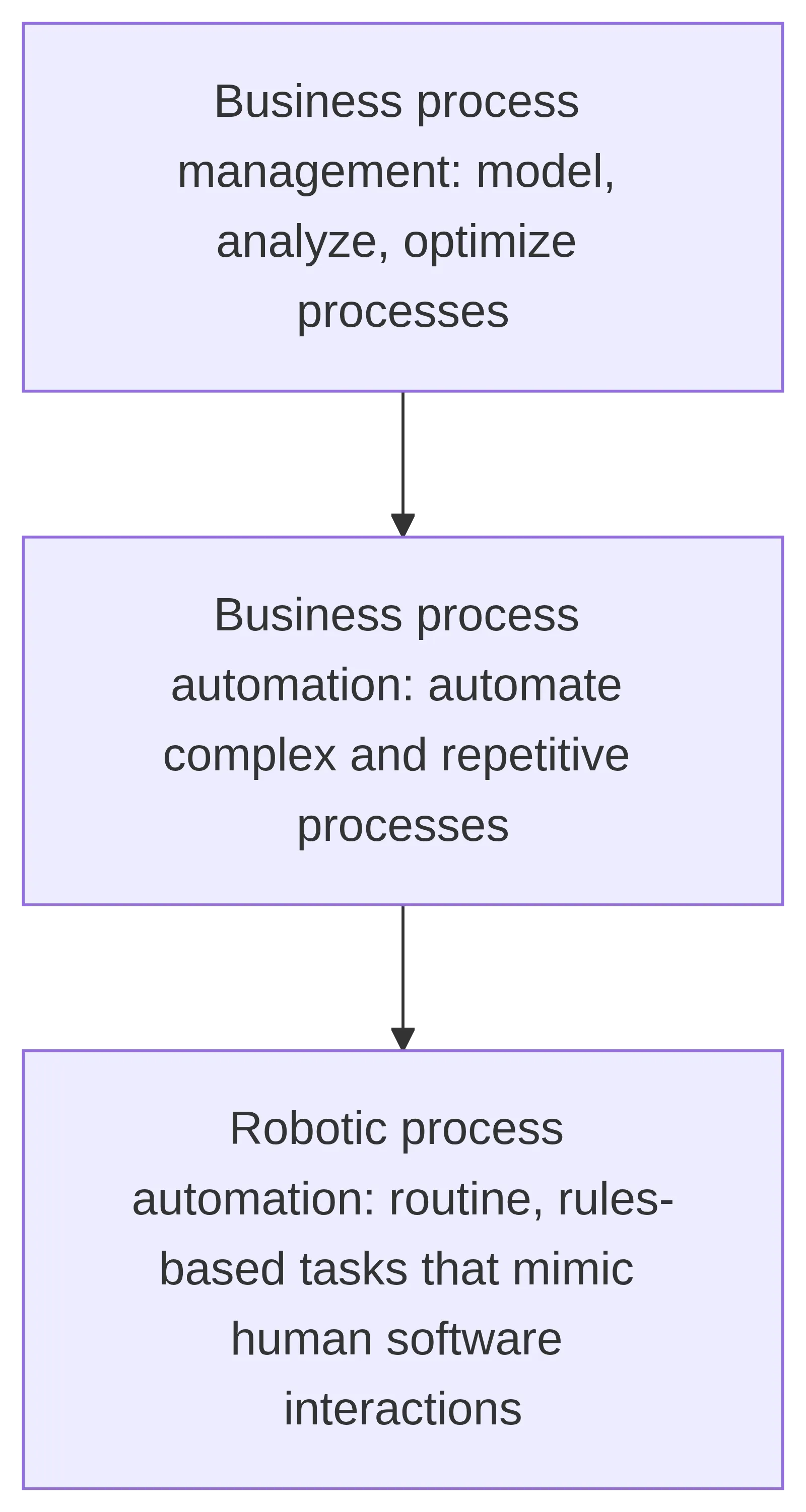
    Business process management (BPM) The broader discipline of modeling, analyzing, and optimizing business processes. Treat BPM as the process-management context for automation, not as a synonym for a single automation tool.

    The practical boundary is scope: BPA addresses connected business processes, RPA addresses specific repetitive software tasks, and BPM provides the discipline for understanding and improving those processes. Treating RPA as a standalone initiative can produce local efficiencies without broader enterprise value, so an operations leader comparing workflow automation software should first define the process and its place in the wider operating model.

    Diagram showing BPM as the broader discipline, BPA as cross-process automation, and RPA as automation of routine rules-based tasks within the BPA umbrella.
    How BPA, RPA, and BPM relate

    Automation-ready processes: what to look for

    A strong first workflow candidate is high-volume, repetitive, time-sensitive, and governed by clear rules with defined inputs and outputs. Screen it for a predictable path, sufficient recurrence, measurable results, and limited exceptions; processes requiring substantial human judgment are weaker immediate candidates because automation rules may not cover their real decisions.

    For an operations leader comparing workflow automation options, document one candidate’s steps, inputs, outputs, volume, timing requirements, rules, exceptions, and success measures. This turns software evaluation into a fit test: prioritize a workflow whose requirements the tools can represent clearly rather than choosing a platform before defining the work.

    Before automating, map the current workflow, including exceptions, and fix its design: automating a flawed process can amplify weaknesses, and poor process selection is a leading cause of RPA project failure.

    Software evaluation criteria beyond the demo

    A production-ready workflow automation option should be judged by how well it fits your operating environment—not by an isolated feature demonstration. Use the same criteria for every option:

    Criterion Decision it informs
    Workflow automation and process modeling Whether the software can represent and execute the processes you need to automate.
    Integration depth Whether it can connect with the systems and data your workflows already depend on.
    Analytics and monitoring Whether operations teams can monitor execution and use reporting to evaluate performance.
    Security and compliance Whether its controls fit your organization’s governance and compliance requirements.
    Scalability Whether it can support greater workflow volume or broader use as requirements expand.
    Governance and deterministic control Whether rules, approvals, and execution behavior can be controlled consistently in production.
    Data sovereignty Whether data-handling arrangements fit your location and organizational requirements.
    Cost Whether the commercial model fits the option’s expected use and operating constraints.
    Adaptability Whether the software leaves room to change workflows as processes and requirements evolve.

    For an operations leader comparing workflow automation options, turn each row into a test: document a representative workflow, identify its required integrations and controls, then verify monitoring, data handling, scalability, cost, and change requirements against that same scenario. This applies the evaluation criteria to a representative workflow rather than relying on an isolated demonstration. Clearpath Workflow provides software guidance for operations teams evaluating workflow automation; the supplied information does not establish particular product capabilities or guaranteed implementation results.

    Phased implementation and its limits

    Map the full workflow, including steps, handoffs, inputs, outputs, rules, exceptions, and systems. Set measurable goals for cycle time, errors, and completion; test automation in a controlled scope, validate results, train affected users, deploy in phases, and refine the live workflow when evidence reveals failures or new exceptions.

    Automation may face incomplete documentation, integration barriers, training needs, cultural resistance, and scaling challenges. Improve and clarify the process first: high-volume, repetitive, time-sensitive workflows with clear rules and defined inputs and outputs are better initial candidates, while processes requiring substantial judgment or frequent exceptions may not be. A prudent sequence is to document the workflow, set measurable goals, run a controlled pilot, train affected users, deploy in phases, and monitor results for refinement.

  • Affordable Family Vacations for 2026: A Practical Planning Framework

    By Austin Family Trip Planning

    Affordable family vacations 2026: evaluate the trip, not a “cheapest” label

    • Test flexible travel dates before ruling out a destination: 72% of surveyed Americans said they would flex dates to seek cheaper fares.
    • Consider lodging with a kitchen and set a paid-attraction limit; these were reported money-saving strategies in a 2025 survey of U.S. parents and grandparents.
    • Use editorial destination lists as starting points, not price guarantees, because trip costs and availability vary by dates, party size, and booking choices.
    • For Austin-area road trips, longer drive estimates can change the practical fit: supplied estimates range from 2.5 hours to 6 hours for named options.
    • Set your party size, children’s ages, trip length, date flexibility, starting point, and budget ceiling before comparing options.

    For a first-time family visitor, Austin Family Trip Planning recommends comparing 2026 vacation costs by travel dates, lodging setup, paid attractions, drive time, and your family’s constraints. Affordability was the biggest travel obstacle for 73% of parents in a 2025 survey; 50% chose lodging with a kitchen, and 46% limited paid attractions to save money. In a separate 2026 survey, 72% were willing to change travel dates for cheaper fares, while 66% said the best parts of a vacation are free. Use these findings to frame comparisons—not to claim that a particular Austin trip or destination will be cheapest. The supplied destination ranking is an editorial starting point, and the available evidence does not provide comparable total-trip costs for your dates and party size.

    Flowchart showing a family setting trip assumptions, testing flexible dates, kitchen lodging and paid-attraction limits, then comparing destination and drive-time trade-offs.
    Affordable family vacation decision framework

    Budget levers to test before choosing a destination

    Test these three levers before choosing an Austin trip plan:

    • Dates: If your schedule allows, compare several date ranges. That is a stated preference, not proof that a particular Austin date will cost less.
    • Lodging: Compare a room with kitchen access against lodging without it. The survey does not show the savings amount or Austin prices.
    • Paid attractions: Set a maximum number or budget for paid attractions, then build the rest of the plan around it. Forty-six percent of 2025 survey respondents reported limiting paid attractions to save money, while 66% of respondents in the 2026 survey agreed that the best parts of a vacation can be free. These findings describe reported approaches and attitudes, not guaranteed savings or a complete Austin itinerary.

    The 2025 survey was not a direct measurement of Austin trip costs and included a sample with higher-income and more-educated respondents than some earlier editions. Use the three levers as comparison criteria against your dates, lodging needs, and attraction priorities—not as evidence that any option is automatically affordable.

    A bounded 2026 destination shortlist and what it does not prove

    A supplied 2026 editorial ranking lists Washington, D.C., Myrtle Beach, South Padre Island, and Denver among its affordable family-vacation recommendations, based on traveler feedback, editor analysis, sights, value, and accessibility. It identifies them as destinations to investigate—not proof of current prices, availability, or suitability for a family’s dates and needs—so use it as a starting point, not a conclusion about which trip will cost less.

    Source: 25 Best Affordable Family Vacations for 2026.

    Austin drive-time trade-offs for family road trips

    An Austin Moms article lists these road-trip ideas and labels their approximate drive times from Austin:

    Destination Published estimate
    Glen Rose About two and a half hours
    Frio River 3 hours
    South Padre Island 5.5 hours
    Broken Bow, Oklahoma 6 hours

    These estimates come from a 2023 local editorial article rather than live routing data. The source presents the destinations and labeled times as published estimates.

    First-trip assumptions to set before you compare options

    Before comparing an Austin stay with a road trip or another destination, write down the assumptions that determine whether an option fits:

    1. Children’s ages and party size.
    2. Trip length: decide how many days you have. A local road-trip guide lists Glen Rose at about 2.5 hours, Frio River at 3 hours, South Padre Island at 5.5 hours, and Broken Bow at 6 hours from Austin; actual times vary with route, traffic, stops, and starting point.
    3. Dates and flexibility: record fixed dates and possible alternatives.
    4. Starting point and transport: specify where you will travel from and whether you will drive or fly.
    5. Budget ceiling and trade-offs: decide what you can spend and whether kitchen lodging, fewer paid attractions, or free activities fit your priorities. In the 2025 U.S. Family Travel Survey, 73% of respondents identified affordability as their biggest obstacle; 50% reported booking lodging with a kitchen and 46% limiting paid attractions. The survey included 1,596 U.S. parents and grandparents and was conducted in summer 2025, so it is not a direct measure of Austin trip costs.

    With those inputs ready, the next step is to learn about family trip planning rather than assume a guaranteed price, availability, weather outcome, or best trip.

  • Choosing an Austin Employment Law Attorney: What to Prepare and Ask

    By Austin Workplace Counsel

    Austin employment law attorney: prepare for the consultation first

    • Texas employment for an indefinite term may generally be ended by either party at any time, with or without cause or notice, subject to exceptions.
    • Texas recognizes a narrow exception when an employee is terminated for refusing to perform an illegal act.
    • Texas wage-payment rules summarized by the supplied source require exempt employees to be paid at least monthly and non-exempt employees at least twice monthly; under that summary, final pay is due within six calendar days after discharge and on the next regularly scheduled payday after a voluntary departure.
    • Texas does not itself address overtime-payment requirements; employers must comply with the FLSA and accompanying federal regulations to determine federal overtime entitlement.
    • The Texas Commission on Human Rights Act prohibits specified workplace discrimination and retaliation for protected activity under that Act, subject to applicable coverage and procedural requirements.

    Before meeting an Austin employment law attorney, organize three things: what happened, which records show it, and what decisions you need to make next. For a workplace decision-maker seeking general, jurisdiction-aware information, this preparation is more useful than assuming the facts already establish a legal claim.

    • Sort the concern: Identify whether the issue involves termination, pay, workplace treatment, retaliation, or another employment dispute. Texas generally follows at-will employment, but the supplied Texas-law summary identifies narrow exceptions, including termination for refusing to perform an illegal act. ()
    • Build a timeline and records file: List key dates and preserve relevant performance reviews, supervisor communications, protected-activity documentation, wage and time records, pay stubs, handbooks, offer letters, and written employment agreements. ()
    • Prepare focused questions: Ask whether the facts may support a legal claim, what deadlines apply, which evidence matters, what process to expect, what risks exist, and what to do—or avoid doing—now. ()

    This framework is preparation, not a fact-specific assessment. A consultation is the appropriate setting to discuss how Texas wage timing, federal overtime coverage, discrimination protections, retaliation rules, or an exception to at-will employment may apply to particular facts.

    Flowchart showing a workplace concern moving through issue sorting, timeline and record organization, and consultation questions.
    Employment law consultation preparation flow

    Texas workplace issue areas to sort before you consult

    Start the consultation by identifying the issue area and the specific facts you need assessed.

    Concern Supported Texas-law context Bring or ask about
    Termination and a possible exception Indefinite-term employment is generally at will: either party may end it with or without cause or notice. Texas recognizes narrow exceptions, including termination for refusing to perform an illegal act. Whether the employment was indefinite-term, what happened immediately before termination, and whether you were asked to perform an illegal act.
    Final pay Under the supplied Texas-law summary, a discharged employee’s final pay is due within six calendar days; someone who voluntarily leaves is due on the next regularly scheduled payday. The separation date, whether the departure was a discharge or resignation, pay records, and any disputed wages.
    Overtime Texas law does not itself set overtime-payment requirements; federal law and regulations determine entitlement under the Fair Labor Standards Act, subject to coverage and exemptions. Hours worked, pay rate, job duties, payroll records, and the facts relevant to federal coverage or an exemption.
    Discrimination or retaliation The Texas Commission on Human Rights Act addresses discrimination based on characteristics including race, color, disability, religion, sex, pregnancy or a related medical condition, national origin, age, and genetic information, and prohibits retaliation for protected activity under that Act. The protected activity or characteristic involved, key dates, comparable events, communications, and the action you believe was discriminatory or retaliatory.

    Use these categories to organize a consultation, not to resolve a claim. The relevant exceptions, coverage, exemptions, procedures, and application depend on the particular facts and law.

    Records and timeline to organize

    Before the consultation, use this checklist to identify records to discuss with counsel—not to require every item:

    • Performance reviews
    • Emails or other supervisor communications
    • Documentation of protected activity
    • Wage and time records
    • Pay stubs
    • Employee handbook
    • Offer letter
    • Written employment agreement

    Mark what you have and what is missing; which records matter and how they may be obtained or used depends on the particular matter.

    Create a dated timeline pairing important events with supporting records, such as emails, reviews, pay records, or protected-activity documentation. Bring it to the consultation, identify gaps, and avoid deciding in advance which facts establish a legal claim. Discuss deadlines, evidence, process, risks, and immediate steps to take or avoid.

    Questions to ask and what the consultation cannot decide

    Austin Workplace Counsel’s general information, contact forms, text messages, calls, and voicemails do not create an attorney-client relationship.

  • How Austin Small-Business Owners Can Prepare for a Tax Planning Conversation

    By Austin Small Business Tax Advisors

    Austin tax advisors: checklist for a tax-planning conversation

    • Use a tax-planning meeting to discuss decisions before the tax year closes; tax preparation focuses on organizing records, completing forms, and filing a return.
    • Bring records for income, cost of goods sold, expenses, fixed assets, and loans so the discussion starts from the business’s financial facts.
    • Ask which taxpayer and entity are affected, which deduction limits or elections may apply, whether Form 3115 is relevant, and who owns each filing step.
    • Treat tax guidance as fact- and law-dependent, not as a guarantee of savings, returns, or a particular tax outcome.

    A small-business tax-planning meeting may review profit and loss, expenses, estimated-tax payments, income, cost of goods sold, fixed assets, and loans for the current tax year. Unlike tax preparation, which organizes records, completes required forms, and files a return, tax planning addresses decisions before year-end. This appointment structure describes one provider’s service model, not a universal requirement.

    For a dated, assumption-aware conversation, prepare these items:

    1. Assemble records for income, cost of goods sold, expenses, fixed assets, and loans relevant to the current tax year.
    2. Ask about the taxpayer and entity involved.
    3. Ask which deduction limits, current-law rules, and elections may apply; request the assumptions and effective dates behind the answer.
    4. Ask who can claim depreciation, whether deductions can be used, and whether a Form 3115 issue may be relevant.
    5. Ask who owns each filing step.

    This checklist helps a small-business owner focus the discussion on the business’s records and current-law questions; it does not replace individualized tax advice.

    Austin Small Business Tax Advisors focuses on simplifying small-business finances and supporting business goals; this does not establish any specific process, result, or local-tax conclusion.

    Tax planning and tax preparation have different timing

    Tax planning and tax preparation serve different needs: planning is a year-round process for evaluating decisions before the tax year closes, while preparation organizes financial records, completes required government forms, and files the return. Small-business owners may use either or both, depending on their circumstances; tax planning does not guarantee savings, returns, or a particular tax result.

    Bring records that show the business financial picture

    The records needed depend on the business and filing situation; begin with a current-year review of income, cost of goods sold, expenses, fixed assets, and loans, treating it as a starting point rather than a complete list.

    Ask how the advice applies to your facts and filing

    Before engaging an Austin tax advisor, ask:

    • Who is covered? Clarify whether the advice applies to you personally, the business entity, or both.
    • Which deductions are limited, and which current-law elections matter? Ask what factual and legal assumptions drive the answer; later law changes can affect earlier advice.
    • Who owns each filing step? Confirm who is responsible for each filing step.

    You should leave knowing how the advice applies and who must act. Tax planning cannot guarantee savings, returns, or a particular tax result.

    For a complex tax issue, ask which authority supports the recommendation, how the rule applies to your facts, which assumptions could change it, and what date or current-law assumption underlies the advice. Primary authority includes statutes, regulations, and case law; secondary material explains or interprets it. Because tax advice depends on your facts and the law in effect when provided, ask what changes would trigger a review. This advice does not predict a tax result or guarantee savings.

    Treat tax guidance as fact-dependent, not a promised result

    AICPA Statements on Standards for Tax Services apply to AICPA members; statutes, regulations, and case law are primary authority, secondary sources interpret it, and individual circumstances determine how it applies.

    For complex tax questions, primary authority consists of statutes, regulations, and case law, while secondary sources interpret that source law.

  • Austin Plumbing for a Blocked Drain: What to Verify Before Hiring Help

    By Mr. Rooter Plumbing of Austin

    Austin plumbing: blocked-drain hiring checklist

    • Treat a blocked-drain job as a scope-and-requirements decision: distinguish simple stoppage clearing from broader plumbing repair.
    • For Austin homeowners, ask which current permit, licensing, and City-registration requirements apply to the specific blocked-drain repair.
    • Mr. Rooter Plumbing of Austin aims to understand and appreciate customers’ needs in every situation; use the checklist below to clarify the work and requirements before choosing a service.
    • The supplied 2017 Austin ordinance text and current City guidance should be checked against the present requirements before work begins.

    Before choosing a drain repair service for a blocked drain, ask these questions in order:

    1. Is the immediate work limited to clearing a stoppage? The City of Austin’s current work-exemption page says that clearing a stoppage, including removing and reinstalling a water closet, is exempt from a building permit when the work does not require replacing or rearranging valves, pipes, or fixtures. Exempt work must still comply with applicable Building Codes, City Codes, and other applicable ordinances.
    2. If clearing the stoppage does not resolve the problem, what repair work would be considered next? Ask the provider to separate stoppage clearing from any repair to the plumbing system so you understand the proposed scope before hiring. The current City guidance indicates that replacement or rearrangement of valves, pipes, or fixtures can change whether the stoppage-clearing exemption applies.
    3. Which Austin and Texas requirements apply to this specific job? The supplied 2017 Austin ordinance text states that a person contracting to install or repair a plumbing system for which a permit is required must be licensed by the State of Texas, and that a licensed plumber must register with the City before performing work regulated by the Plumbing Code. Because that ordinance text is dated 2017, use the City’s current work-exemption guidance and confirm the current permit, licensing, and registration requirements for the particular scope before work begins.
    4. Is the work being considered under a homeowner permit? The supplied ordinance text states that an unlicensed individual may perform certain plumbing work on the individual’s own residence and property under a homestead permit, subject to stated limitations and application requirements. Because the text is dated 2017, confirm current eligibility and permit requirements with the City for the particular project.

    This sequence keeps the first question focused on whether the job is limited to blocked-drain stoppage clearing or may involve broader plumbing-system repair. The supplied evidence supports separating those scopes and checking the applicable current City requirements before work begins.

    Stoppage clearing and permit limits

    Austin’s current work-exemption guidance covers clearing a stoppage, including removing and reinstalling a water closet, when no valves, pipes, or fixtures are replaced or rearranged. Because the supplied ordinance text dates from 2017, verify current requirements with the City for each project.

    Repair work: licensing and registration checks

    The 2017 Austin ordinance requires contractors installing or repairing permit-required plumbing systems to hold a Texas state license; use it only as historical reference, not to determine licensing for a specific job.

    The supplied 2017 ordinance says licensed plumbers must register with the City before performing Plumbing Code-regulated work. For blocked-drain jobs beyond simple stoppage clearing, review current exemptions and requirements and ask the provider which permit pathway applies; the ordinance does not establish the project’s current status.

    Homeowner work and current-rule check

    The supplied 2017 Austin ordinance says a homeowner may perform certain plumbing work in the owner’s residence and on the owner’s property under a homestead permit, subject to its limitations and an in-person application. Treat it as historical guidance, not confirmation that you currently qualify for a permit for this blocked-drain repair.

    The Uniform Plumbing Code (UPC) is an ANSI-designated model standard for protecting public health and safety. Austin exempts stoppage clearing, including removing and reinstalling a water closet, from a building permit only when no valves, pipes, or fixtures are replaced or rearranged. The work must still comply with applicable codes and ordinances. Austin adopted UPC changes effective September 1, 2021. Because the supplied materials do not establish whether later amendments apply, check the City’s current requirements for the specific repair.
