
Recovery Is a Guide, Not a Guaranteed Schedule
A breast augmentation recovery timeline can serve as a planning tool, not a promise about exactly how you will feel on a particular day. Recovery varies between people, and general timelines cannot predict an individual course. Implant details, implant placement, tissue tightness, lifestyle, and personal goals can all shape recovery planning.
A practical way to use the timeline is to make three decisions before surgery: arrange help for the first days at home, protect healing by following your operating surgeon’s instructions, and know which changes require a call versus emergency evaluation. This guide describes commonly reported stages, but your surgeon’s written directions take priority over every general milestone here.
Think of recovery in two tracks. Early functional recovery is about rest, basic comfort, and gradually resuming light daily tasks when your surgeon permits it. Longer healing continues after daily life starts to feel easier. That distinction can help you plan realistically without treating an early improvement—or a slower day—as a verdict on your healing.
Plan Before Surgery for Supported Rest at Home
The first days are easier to manage when practical support is arranged before surgery. Decide in advance who can assist with meals, household tasks, children or pets, and other responsibilities that could require lifting, reaching, or sustained activity.
Set up the items you expect to need regularly where you can reach them without stretching or repeatedly getting up. Loose, comfortable clothing and a simple resting area can make the first days less demanding. Complete routine household tasks ahead of time where possible, and make sure your support person knows how to reach the surgical team if you are unable to do so comfortably.
Work and school planning should reflect what your day actually requires. Physically demanding work may require more time away than desk-based work. Rather than choosing a return date solely from a generic timeline, discuss your actual duties with the operating surgeon and ask what restrictions apply to your role.
Before-surgery preparation checklist
- Confirm your ride home and the person who will stay or check in during the early recovery period.
- Arrange help with routine responsibilities that could involve lifting, reaching, driving, cooking, or caregiving.
- Place frequently used necessities within easy reach in your recovery area.
- Tell work or school that your timing may need flexibility, especially if your duties are physical.
- Save the surgical team’s contact information and understand how to reach them after hours.
- Bring your questions about restrictions, follow-up, and symptoms to report to your preoperative visit.
This preparation does not replace individualized postoperative directions. It gives you the space to follow them without having to solve logistics while you are recovering.
Make the Operating Surgeon’s Instructions Your Recovery Roadmap
Your operating surgeon’s protocol is the recovery plan to follow. Before you leave after surgery, expect individualized postoperative instructions and follow-up planning from the surgical team. Those directions may address medications, garment use, incision care, bathing, activity, lifting, arm movement, and the timing of follow-up visits.
A support bra, elastic bandage, or other support garment may be part of postoperative care. The type of garment and how long to wear it are not details to copy from another patient or an online checklist. Follow your surgeon’s directions about garment type, fit, and wear.
The same principle applies to incisions. Some surgeons may give instructions involving cleansing and ointment; others may direct patients to leave tape or a bandage in place. Do not substitute a general article for the specific instructions you received. If a written direction is unclear, contact the surgical team for clarification rather than guessing.
Follow-up timing is also surgeon-specific. One postoperative practice schedules a physician visit approximately five to seven days after surgery, but your own appointment schedule may differ. Keep every scheduled follow-up, and use it to review healing, restrictions, comfort, and questions about returning to normal routines.
A helpful question for every instruction is: What should I do, what should I avoid, and what change means I should call? Write down the answers. This makes your surgeon’s advice easier to follow when you are tired or uncomfortable.
The First 48 Hours and Early Days: Common Experiences and Rest
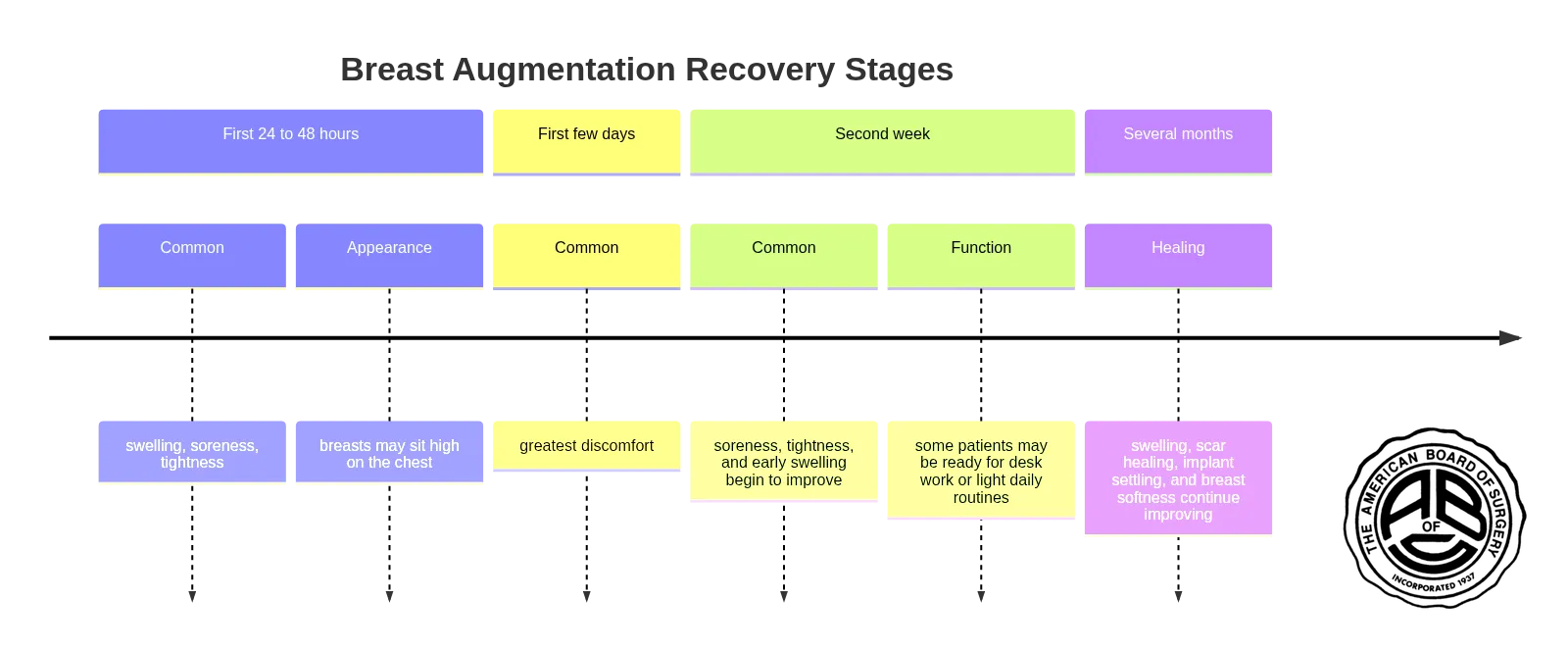
During the first 24 to 48 hours, swelling, soreness, and tightness are commonly reported. The first few days are also commonly the period of greatest discomfort. These experiences can make rest, a calm environment, and early support especially important.
Breasts can initially appear high on the chest and may change position as healing progresses. That early appearance is one reason not to judge the longer healing process from the first days alone. Your surgeon can tell you what is expected for your procedure and when they want to hear about a change.
Use this period to focus on the basics: rest, follow the prescribed plan, attend to incision and garment instructions exactly as given, and accept help with tasks that could strain your chest or arms. Do not use how another person felt after surgery as a standard for what you should be able to do.
Comfort should generally move in the direction of improvement, but recovery is not necessarily linear from hour to hour. If you are unsure whether a symptom fits your instructions, contact the surgical team. A question asked early is more useful than trying to self-interpret a change.
When Light Daily Routines May Start to Feel More Manageable
For some patients, the second week starts to feel easier as soreness, tightness, and early swelling begin to improve. That can be an encouraging shift, but the breasts and implant pockets are still healing. Feeling more independent is not the same as being cleared for every routine, workout, or work duty.
Some people may be ready for desk work or light daily routines around the second week, subject to their surgeon’s guidance. A job with physical duties, a longer commute, frequent lifting, or repeated overhead reaching may call for a different plan. Ask the surgeon to translate restrictions into the activities you actually perform rather than relying on a broad “back to normal” label.
Use gradual progress as a reason to reassess, not to accelerate. At follow-up, ask whether you may increase walking, driving, work tasks, household responsibilities, or other activities that matter to your routine. If you have not received clearance, keep the activity on hold.
Some people also report temporary emotional changes, such as moodiness or anxiety, during recovery. If your emotional state feels difficult to manage or concerns you, bring it to the attention of your surgical team or an appropriate healthcare professional. Recovery planning includes support for how you feel, not only what you can physically do.
Protect Healing Before Advancing Lifting, Reaching, or Exercise
Activity restrictions are not a test of willpower. They are part of protecting healing while your body recovers. Overhead reaching may remain limited during the second week, and exercise, heavy lifting, chest workouts, and high-impact movement should wait until the operating surgeon clears them.
Avoid using a generic lifting number as your personal rule. One source describes an approximately 8-pound limit as a common postoperative restriction for several weeks, but individual lifting restrictions are surgeon-specific. Your procedure and recovery plan determine what applies to you.
When deciding whether to do an activity, use this simple sequence:
- Identify the demand. Does it involve lifting, pushing, pulling, repetitive arm use, overhead reaching, chest strain, impact, or a risk of being bumped?
- Compare it with your written instructions. If the instructions do not clearly cover it, do not assume it is allowed.
- Ask before advancing. Contact the surgical team for guidance and wait for clearance.
This approach applies to gym sessions, carrying groceries, lifting children, moving luggage, cleaning, yoga positions, and sports. A temporary boundary is easier to manage when it is planned for ahead of time. Build help into your schedule rather than trying to work around a restriction.
Longer-Term Healing Continues After Daily Life Feels Easier
Early functional recovery and longer-term healing are different phases. Even after you begin resuming selected daily routines, swelling, scar healing, implant settling, and breast softness may continue to change for several months. Chest tightness and temporary tingling or electrical sensations in the breast or nipple can also occur in the weeks after surgery.
The practical takeaway is to keep following your plan after the most restrictive early period has passed. Continue attending follow-ups, use garments as directed, and obtain clearance before adding activities. Do not treat a changing appearance, sensation, or level of comfort as proof that you should independently change your care routine.
Longer healing is also why it helps to bring focused questions to follow-up appointments: What changes are expected at this stage? Which activities remain restricted? What should prompt a call? What is the next milestone for reassessing activity? Your surgeon can answer those questions in the context of your own procedure and examination.
Changes to Promptly Report to the Surgical Team
Recovery should generally move toward improvement. Promptly contact the surgical team about new, worsening, or returning symptoms, particularly after you had begun to feel better. The team is the right first contact for a concern that is not clearly an emergency but does not fit your written recovery plan.
Report severe or increasing pain, feverishness, spreading redness, breast warmth, a red rash, or concerning wound drainage promptly. Also contact the team for changes in nipple color or appearance, increasing asymmetry, or markedly increased pain, bruising, swelling, or bloody drainage.
When you call, give a clear timeline: when the change started, whether it is getting worse, whether one side differs from the other, and what instructions or medications you have already followed. Do not attempt to diagnose the cause yourself. Your role is to notice and report the change; the surgical team’s role is to advise you on the next step.
If you are uncertain whether a symptom is important, use the safer boundary: contact the surgical team. General guidance cannot determine what is normal for your individual recovery.
Symptoms That Need Emergency Evaluation
Some symptoms require emergency evaluation rather than waiting for a routine callback. A breast that is rapidly or progressively enlarging after surgery requires immediate contact with the surgeon or emergency evaluation.
Seek emergency care for sudden breathing difficulty, unexplained shortness of breath, chest pain, coughing up blood, fainting, or severe lightheadedness. These can signal a serious postoperative complication.
Seek urgent medical assessment for possible clot symptoms, including swelling, pain, tenderness, warmth, or discoloration in one leg. Sudden shortness of breath or chest pain requires emergency care.
If you have severe breathing or chest symptoms, fainting, or another immediate emergency, seek emergency help first. Notify the surgical team as soon as it is safe to do so.
Use This Roadmap to Prepare for a Safer Conversation
A useful timeline helps you prepare; it does not replace your individualized care plan. Before surgery, make a list of the practical questions that affect your home, work, and support system: Who will help me in the first days? What can I lift or reach for? When should I ask about returning to work or exercise? How should I use my garment and care for my incisions? Who do I contact after hours, and which symptoms require emergency care?
Bring that list to your consultation and keep the postoperative instructions somewhere accessible at home. Recovery varies, and surgeon-specific directions and follow-up planning are important for your own situation.
Frequently Asked Questions About Breast Augmentation Recovery
What should I have ready at home before breast augmentation surgery?
Plan for a ride home, early at-home support, and a recovery area with the things you use most often within easy reach. It also helps to arrange time away from work or school, especially if your duties involve lifting or other physical tasks.
How strict are activity restrictions during recovery?
They are usually important, especially early on. Lifting, overhead reaching, exercise, chest workouts, and high-impact activity should wait until the operating surgeon clears them, and the exact limits should come from your own postoperative instructions.
What is commonly felt in the first few days after surgery?
Swelling, soreness, tightness, and the greatest discomfort are commonly reported early on. Breasts can also sit high on the chest at first and then change position as healing progresses.
When might light daily routines start to feel manageable again?
For some people, the second week feels easier as soreness, tightness, and early swelling begin to improve. Even then, healing is still underway, so return to work, driving, and household tasks should follow your surgeon’s guidance.
How long can healing keep changing after the early recovery period?
Longer healing can continue for several months. Swelling, scar healing, implant settling, and breast softness may keep evolving even after basic daily routines start to feel more comfortable.
Which changes should prompt a call to the surgical team?
Contact the team promptly for new or worsening pain, feverishness, spreading redness, breast warmth, a red rash, concerning drainage, increasing asymmetry, changes in nipple color or appearance, or marked swelling or bruising that is getting worse.
Which symptoms need emergency care instead of a routine call?
Seek emergency evaluation for rapid breast enlargement, sudden shortness of breath, chest pain, coughing up blood, fainting, severe lightheadedness, or possible clot symptoms such as one-sided leg swelling, pain, warmth, or discoloration.