Begin with the question the evaluation must answer
Choosing dental implants in Plymouth starts with a focused evaluation question: what replacement approach matches the number and location of missing teeth, and what information could change that answer? A dental implant is a small post placed in the jawbone to support a replacement crown, bridge, or denture. A careful evaluation comes before any implant recommendation because stability depends on healing bone and healthy surrounding tissues.
One missing tooth, several missing teeth, and a full arch lead to different restoration discussions. Fixed or removable design, daily maintenance, treatment scope, and cost are questions to take into the evaluation, not reasons to assume implants fit. A practical path is to place national-use context beside those clinical and planning questions, then record the answers that should shape a Plymouth consultation.
Implant-supported dentures are one multi-tooth option. They offer improved stability for chewing, eating, and speaking; their fixed or removable design affects how they attach and how they are maintained. That design does not make the appliance automatically suitable for you; bone condition, surrounding tissues, health history, treatment scope, and your willingness to use a removable appliance still matter.
Use two connected records rather than a universal recommendation. The first describes the missing-tooth pattern and daily priorities. The second captures what the evaluation shows about bone, surrounding tissues, imaging, medical history, treatment stages, and cost.
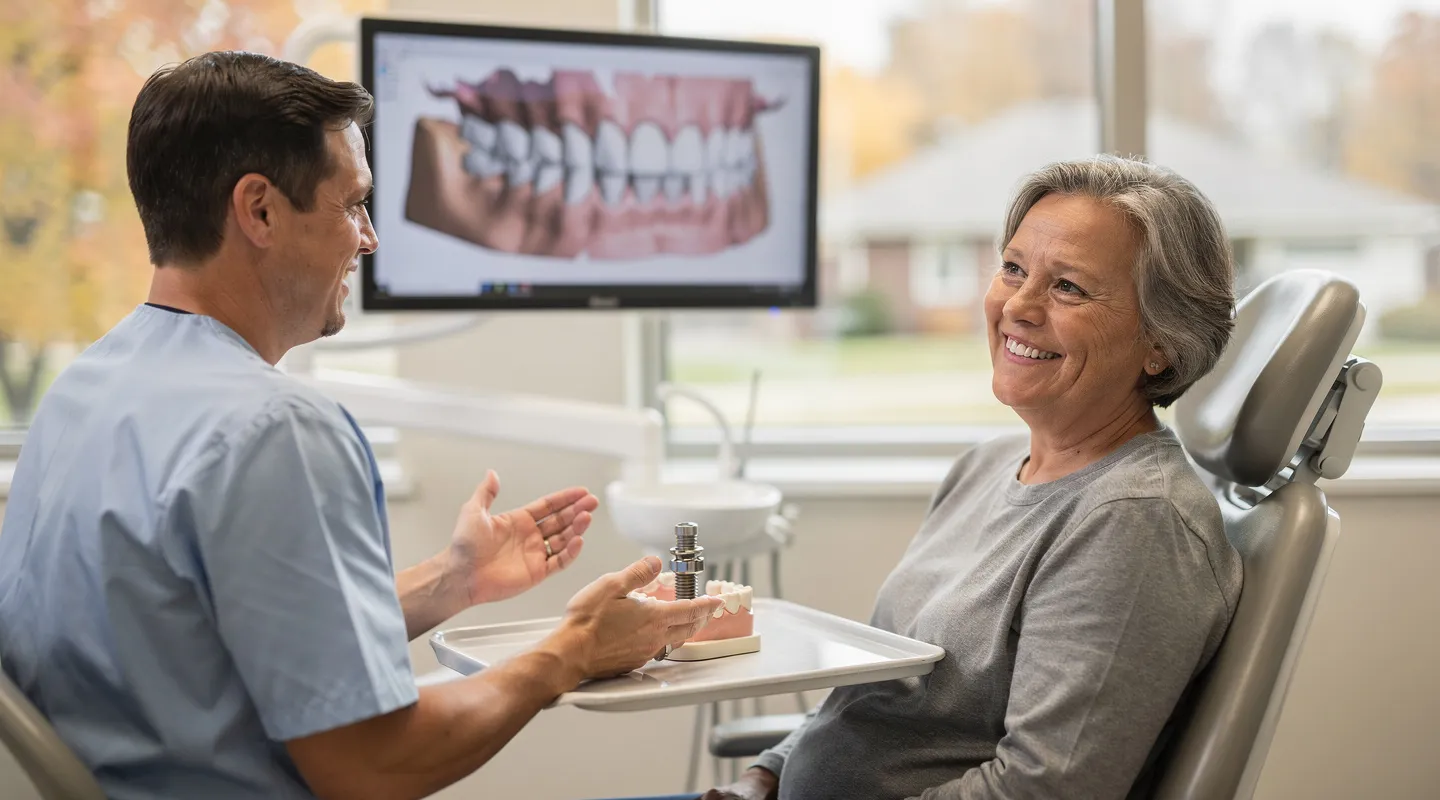
At a Plymouth consultation, bring the description of your tooth loss and record the proposed restoration, the reasons for it, the full sequence, recovery considerations, and alternatives. If the answers remain unclear, a second opinion can add another professional assessment before you commit to treatment.
The goal is not to treat national use or a practice’s organization as proof that implants fit. It is to connect your circumstances to an explained evaluation and a complete estimate.
Classify the missing-tooth pattern
Classify the missing-tooth pattern before discussing the restoration. A single implant can carry a crown for one missing tooth. For multiple missing teeth, two or three implants may support a bridge spanning the space. For a full arch replacement, several implants - often 4, 6, or 8 - may support a replacement arch. These figures are examples, not a treatment rule for Plymouth, Minnesota.
Fixed and removable implant-supported appliances create different daily responsibilities. A fixed implant-supported denture is secured by the dental team and cannot be removed by you at home; it comes out for professional maintenance. A removable implant-supported overdenture may attach to a bar or ball-and-socket and can be removed by you.
Ask these questions before comparing designs:
- Will I remove the appliance at home, or will the dental team remove it for maintenance?
- Which teeth or arch will the proposed restoration replace?
- How will the restoration attach to the implants?
- What cleaning and professional maintenance will it require?
- What alternatives remain if the evaluation identifies a limitation?
The word denture does not identify one single design. Ask for the attachment method and daily care instructions in plain language.
Interpret national implant-use data in context
Use these trade-offs to identify what the evaluation must clarify. For one missing tooth, a single-tooth implant and a dental bridge are common options, but they work differently and have different advantages and disadvantages.
| Option | Tooth preparation | Cost and replacement point | Jawbone consideration |
|---|---|---|---|
| Dental implant | The implant stands alone rather than relying on adjacent teeth. | Implants cost more upfront than traditional dentures and bridges. | Dental implants replace the tooth root and help maintain bone. |
| Traditional bridge | Traditional bridges require filing down two healthy adjacent teeth. | Traditional bridges cost less initially but typically need replacement every 5 to 15 years. | Traditional bridges do not stop jawbone loss from missing teeth. |
| Conventional denture | The option involves a removable appliance; ask how that affects your daily routine. | Conventional dentures cost less initially but typically need replacement every 5 to 15 years. | Conventional dentures do not stop jawbone loss from missing teeth. |
The 5-to-15-year replacement range applies to traditional dentures and bridges; it is not a promise about every restoration.
The choice among implants, bridges, and dentures depends on bone density, the health of adjacent teeth, your budget horizon, and your willingness to wear a removable appliance. Use those factors to frame a conversation rather than to make your own diagnosis.
Choose comparison questions that match your priorities:
- If neighboring teeth are healthy, ask whether preparing them for a bridge is necessary and what alternatives exist.
- If you are focused on the initial bill, ask how the total compares with the expected replacement needs of each option.
- If jawbone changes concern you, ask what the proposed option does and does not address.
- If you do not want a removable appliance, ask which fixed designs are possible and what maintenance they require.
- If several teeth are missing, ask whether one restoration supported by implants could address the gap instead of separate replacements.
No single trade-off decides the treatment. Your consultation should connect the option to your tooth-loss pattern and stated priorities.
The seven-survey U.S. data set covering 1999 through 2016 estimated dental implant prevalence among adults missing any teeth; the data set is useful background for how treatment use has changed, not a local treatment recommendation. Provider structure is another separate comparison point. Park Dental says its network includes 50+ practices and 150+ dentists and may use local specialist relationships when care cannot be provided in-house. A network’s size does not establish which restoration fits you, so ask who will evaluate, place, restore, and maintain the proposed treatment.
Put Plymouth searches in national context
Plymouth searches need a clear distinction between national usage data and a local prevalence rate. Among U.S. adults missing any teeth, analyzed survey data showed dental implant prevalence increased from 0.7% in 1999-2000 to 5.7% in 2015-2016. The figures describe the U.S. population included in those survey periods, not adults in Plymouth, Minnesota.
The same analysis reported that the largest absolute increase in implant prevalence was 12.9% among individuals ages 65 to 74. That finding identifies the age group with the largest increase in the analyzed data; it does not mean that every adult in that age group receives implants or that age alone determines candidacy.
National implant use increased in the analyzed data, but national growth does not answer your local treatment questions. The source also explains that little is known about implant prevalence across the U.S. population and that projections depend on assumptions about how trends continue.
For your Plymouth search, use the data as context and use a consultation to answer practical questions:
- Which replacement options address your pattern of missing teeth?
- What examination and imaging will shape the recommendation?
- What treatment stages, healing periods, and maintenance apply to your plan?
- What will the complete estimate include?
- Who will handle each stage of care?
The national figures can explain why you may encounter implants in discussions about tooth replacement. They cannot tell you whether an implant-supported crown, bridge, or denture fits your mouth.

Prepare the clinical questions that determine fit
Treat the evaluation as a test of whether the proposed site and restoration can support the plan. Implant stability depends on healing bone and healthy surrounding tissues, so bone, surrounding tissues, medical history, imaging, and the proposed restoration all belong in the discussion. Ask whether a CBCT scan will be part of your workup and whether you can see and understand what it shows.
Bone-density concerns or other limiting factors may affect candidacy and may require changes to the plan or consideration of alternatives. The explanation should connect the imaging and health history to the proposed implant site, identify whether infection, tissue health, or available bone changes the sequence, and state what alternatives remain if an implant is not recommended.
A clear explanation is more useful than a simple yes-or-no answer about candidacy.
Your medical and treatment history belongs in the evaluation. A review of literature published from 1993 through 2013 reported that tobacco addiction and head-and-neck radiotherapy were correlated with higher loss of dental implants. The same review reported that cardiac systemic diseases, diabetic endocrine pathologies, or controlled metabolic disorders did not seem to be total or partial contraindications to implant placement in the reviewed literature.
The review also reported an increased risk of bone necrosis after oral surgery for people receiving bisphosphonate therapy for osteoporosis, especially when the drugs were administered intravenously. Tell the dental team about prescriptions, infusion treatments, tobacco use, prior radiotherapy, diabetes, heart conditions, and other relevant medical history. The cited review is older, so use these points to prepare questions about your history rather than to decide what treatment you can receive. Medical history should be treated as information for individualized planning, not as a self-screening verdict. The reviewed evidence includes both conditions that did not seem to be total or partial contraindications and factors correlated with higher implant loss or bone-necrosis risk, so a provider should explain which finding applies, what it changes, and whether another option or additional consultation is needed. A provider’s explanation lets you distinguish a question to investigate from a reason to rule out treatment.
An evaluation should leave you with a reasoned explanation of the proposed option and its limits. Ask what would need to change before treatment, whether an alternative could address the same missing-tooth problem, and how the provider will respond if the planned approach changes. Write down the answers while the details are fresh, especially if you are comparing practices in Plymouth. The provider should distinguish findings that are known from questions that require further evaluation. That distinction helps explain why further imaging or an additional consultation may be proposed.
Separate treatment stages from expected timelines
Implant treatment often involves multiple phases, so the evaluation record should identify what each phase involves, how long it takes, and what recovery looks like. A common planning sequence may include evaluation and imaging, treatment of a tooth or infection if needed, implant placement, healing, and attachment of the final crown or other restoration. The exact sequence depends on the site and proposed restoration.
Implants are often placed several months after extraction. Immediate placement may be possible but may involve a little more risk and is not the best treatment when infection or other bone problems are present. Ask whether extraction, site preservation, implant placement, and restoration will occur in separate stages or whether any stages can be combined for your situation. Comparing implant plans by milestone rather than only by total treatment time helps reveal whether two plans include the same stages.
Typical implant treatment can span 3-9 months from the first surgery to the final crown, depending on your healing and whether bone grafting is needed. The range is a planning reference, not a promised finish date. Ask which events start and end the proposed timeline, what could lengthen it, and what temporary replacement you would use during healing.
Ask how the provider defines success, what follow-up care is expected, and what happens if healing or implant integration does not proceed as planned.
Bone preparation can add stages to treatment. An enlarged sinus can preclude implant placement in upper back areas because implants need to be surrounded by solid bone. A sinus lift or graft can restore the sinus cavity and replace lost bone. The new bone graft typically takes nine to 12 months to heal before implants can be placed into it. If an implant site lacks sufficient bone, bone may be borrowed from another area of the mouth and grafted into the deficient area.
When infection has caused bone loss around a tooth that needs removal, bone grafting can sometimes be performed at the same time as removal. Ask whether the plan includes grafting, sinus procedures, or another site-development step, and ask how each additional stage affects healing, appointments, and the complete estimate.
Read the estimate as a treatment plan
Dental implant cost is a treatment-plan question rather than a single implant-price question. Ask for an itemized breakdown that identifies bone grafting, the implant fixture, the abutment, and the final crown or restoration. Costs may also be affected by the number and location of implants, the type of implant, geographic location, insurance coverage, restoration type, surgical complexity, anesthesia type, and other factors.
A single dental implant is generally much less expensive than multiple implants or an implant-supported bridge. Implants in difficult-to-reach areas of the mouth might require sinus surgery and add to your costs. These points explain why two people asking about dental implants may receive different estimates. Titanium is the most common and cost-effective material for implants, but material choice is only one part of a complete estimate. The number of implants, restoration design, surgical complexity, and any grafting or sinus procedure can change the total. Where a patient lives may also affect implant costs because dental professionals may charge more in cities with higher costs of living. Ask the practice to identify which estimate items may change after imaging and which costs depend on additional procedures.
Insurance and payment terms should be separated from the clinical estimate. One cost overview says dental insurance usually covers major procedures such as implants, while other types of coverage, including Medicare, may leave you paying out of pocket. Review the terms of your own plan and ask which parts of the proposed treatment are included, excluded, or subject to separate limits.
Request a detailed cost breakdown and clarify dental insurance coverage and financing options before scheduling surgery dates. Ask whether the estimate includes examinations, imaging, extraction, grafting, the implant fixture, the abutment, the crown or denture, temporary teeth, follow-up visits, and maintenance. Do not compare two totals until you know whether they include the same stages.
A lower initial estimate does not describe the entire financial decision. Implants cost more upfront than traditional dentures and bridges, while those alternatives cost less initially but typically need replacement every 5 to 15 years. Ask how the provider expects each option to be maintained and what future replacement or repair costs should be considered.
Treat clinical expectations and financial planning as separate parts of the conversation.
Keep a Plymouth evaluation record
Care coordination should be stated specifically. Kingston Bay Dentistry says it provides coordinated care from the initial consultation through final crown placement under one roof, but that statement describes Kingston Bay Dentistry and does not establish how every Plymouth practice organizes treatment. Ask each provider whether evaluation, surgery, restoration, and follow-up occur through the same practice or involve outside clinicians.
Also ask how treatment planning uses imaging. Computer software can evaluate a dental CT scan in three dimensions for bone quality, bone quantity, and bone location to help plan implant placement. Ask who reviews the images with you and how the findings affect the proposed restoration.
Maintenance belongs in the provider comparison before treatment begins. Implants can accumulate plaque and tartar just as teeth can. After restoration, a professional cleaning schedule is necessary, with the interval determined by individual needs. Ask who provides those visits, what daily cleaning involves, and how the practice will monitor the implant and restoration.
A directory listing may not show every dentist or current participation status, so verify a particular dentist’s network participation with the dentist or Delta Dental. Record the answer with the date you received it, especially if insurance affects your estimate. Compare the clinical plan, care coordination, maintenance expectations, and financial terms together rather than choosing from a directory name alone.
Your comparison record can be a one-page table with the provider name, proposed option, treatment stages, surgical and restorative roles, estimated duration, itemized cost, insurance information, failure policy, and maintenance plan. Add a space for unanswered questions and a note about whether a second opinion is recommended. A clear record makes it easier to compare a Plymouth consultation with another consultation without relying on promotional language or incomplete totals. If a provider leaves a material question unanswered, mark that gap instead of treating the lowest quoted total as the best option. Missing information may depend on an examination or imaging, so ask which additional finding would resolve the uncertainty. A written gap list gives you focused questions for a second consultation and keeps uncertainty visible while you compare Plymouth providers. Comparing the same categories across records also makes it easier to tell whether a price difference reflects a different restoration or simply omitted services.

Treat warning signs as a prompt for professional review
Warning signs should move the matter from routine planning to prompt professional assessment. Dental implant complications can include implant failure, peri-implantitis, nerve and sinus issues, infection, and bone loss. Warning signs around an implant include gum swelling, recurring tenderness, frequent bleeding when brushing or flossing, a loose implant or restoration, pain or pressure when chewing, visible metal or implant threads, gum recession, or an uneven gumline.
Contact a qualified dental professional promptly if you notice one of these signs rather than waiting for a routine visit. A loose implant or restoration, repeated bleeding, swelling, or chewing pain needs an assessment of the implant and surrounding tissues. Do not try to diagnose the cause from the symptom alone. If symptoms include severe pain, uncontrolled bleeding, or another concern that may be urgent, contact a qualified dental professional or responsible emergency authority promptly rather than waiting for a routine appointment. Do not rely on a symptom list to decide that an urgent concern is harmless. Do not attempt to manage a suspected infection, a loose implant, or uncontrolled bleeding without qualified guidance.
Complications or delayed healing can occur after bone grafting, ridge augmentation, or sinus augmentation. If you have a concern after one of these procedures, contact the qualified dental professional responsible for your care promptly and describe when the symptom began, where it occurs, and whether it is worsening.
If you are unsure how urgent a symptom is, seek professional guidance rather than delaying contact. Keep your written treatment information available so you can describe the procedure and restoration involved.

Arrange an informed Plymouth implant evaluation
A useful next step is to arrange an initial evaluation with a qualified Plymouth dental professional and bring your written comparison questions. Ask for the proposed replacement options, imaging explanation, treatment stages, healing expectations, itemized estimate, roles of the surgical and restorative providers, maintenance plan, and response if the implant fails. Use the answers to decide whether to continue, compare another practice, or seek a second opinion.
A qualified dental professional must decide whether a particular implant or implant-supported denture is suitable for your mouth, health history, and treatment goals. Your role is to describe your priorities, share your medical and dental history, understand the alternatives, and choose whether the explanation is clear enough to support your next decision. Bring your dental records to the consultation.
Leave a Reply